
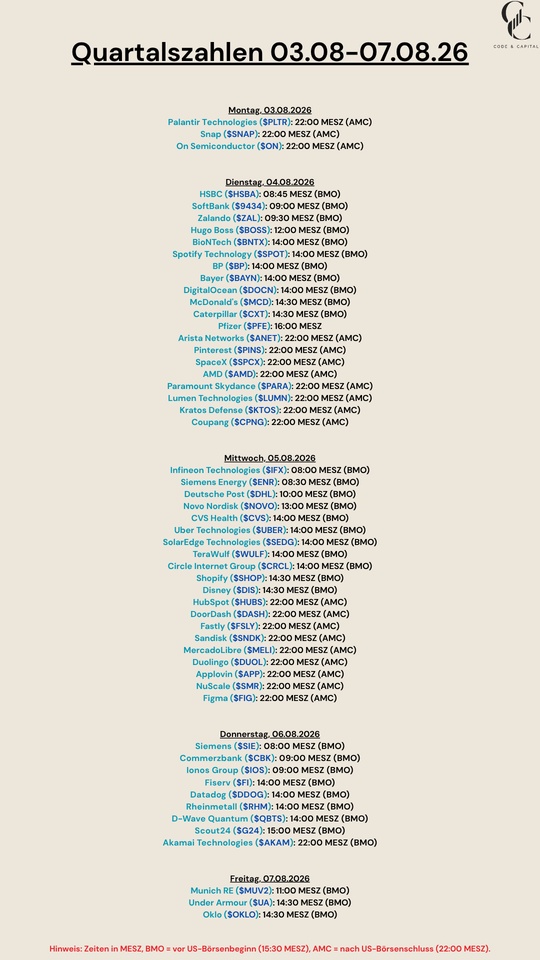
$PLTR (+5,43%)
$SNAP (+1,83%)
$HSBA (-1,02%)
$9434 (+1,06%)
$ZAL (+2,82%)
$BOSS (+1,16%)
$BNTX (+1,92%)
$SPOT (-2,23%)
$BP. (-0,44%)
$BAYN (-1,86%)
$DOCN (+2,85%)
$MCD (+0,3%)
$CAT (-1,03%)
$PFE (-0,16%)
$ANET (+3,31%)
$PINS (+0,77%)
$SPCX (+0,82%)
$AMD (+1,87%)
$PARA (-3,44%)
$LUMN (-3,86%)
$KTOS (-2,28%)
$CPNG (+0,95%)
$IFX (+0,38%)
$ENR (-0,6%)
$DHL (-1,98%)
$NOVO B (-0,84%)
$CVS (-0,88%)
$UBER (+0,29%)
$SEDG (-2,42%)
$WULF (+2,98%)
$CRCL (-0,78%)
$SHOP (+1,32%)
$DIS (-0,43%)
$HUBS (+0,97%)
$DASH (+0,85%)
$FSLY (+3,13%)
$SNDK (+6,06%)
$MELI (+0,09%)
$DUOL
$APP (+0,69%)
$SMR
$FIG (+0,52%)
$SIE (-0,92%)
$CBK (-2%)
$IOS (+2,45%)
$FI (+0,3%)
$DDOG (+6,6%)
$RHM (-3,05%)
$QBTS (+0,02%)
$G24 (-0,69%)
$AKAM (+0,44%)
$MUV2 (-0,57%)
$UA (-0,19%)
$OKLO

OKLO Inc.
Ação
Ação
Ticker: OKLO
OKLO
Price
Discussão sobre OKLO
Postos
432Mês·
Quarterly Results August 3–7, 2026
1313

2Mês·
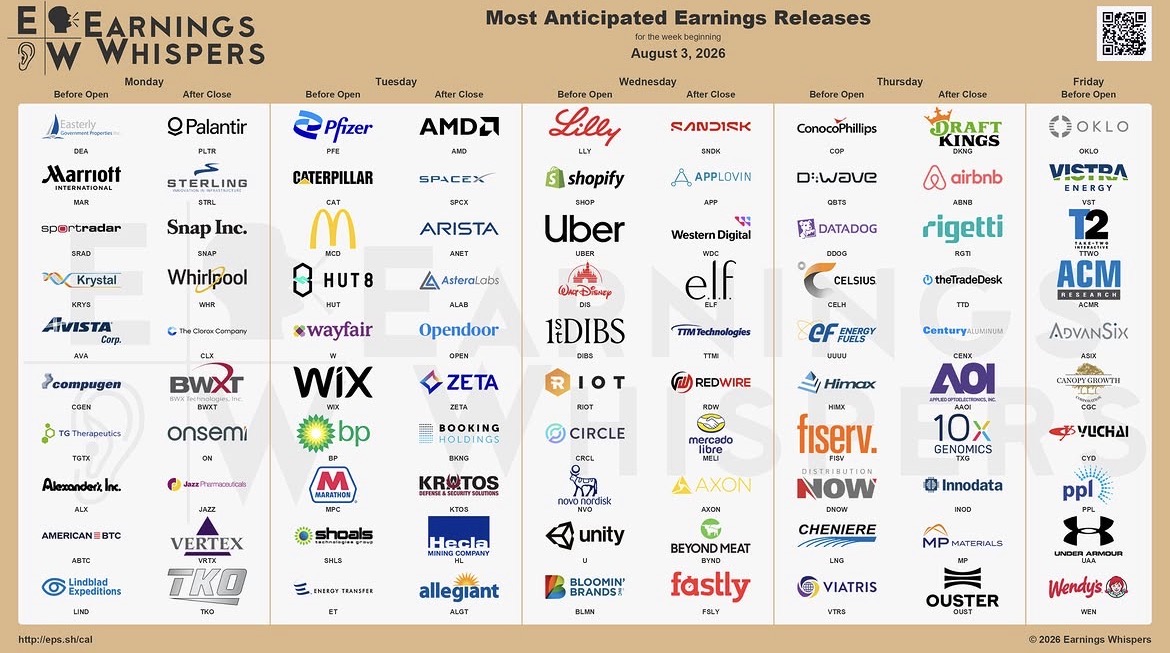
Let's move on to the next round!
$MAR (+0,94%)
$KRYS (+1,24%)
$PLTR (+5,43%)
$STRL (+0,07%)
$SNAP (+1,83%)
$WHR (-5,04%)
$CLX (-2,41%)
$BWXT (-0,43%)
$ON (-0,24%)
$VRTX (+1,27%)
$PFIZER
$CAT (-1,03%)
$MCD (+0,3%)
$HUT (+0,82%)
$WIX (-0,44%)
$W (+5,54%)
$BP. (-0,44%)
$SHLS
$AMD (+1,87%)
$SPCX (+0,82%)
$ANET (+3,31%)
$ALAB (+0,39%)
$OPEN (-2,99%)
$ZETA (+2,47%)
$BKNG (-0,59%)
$KTOS (-2,28%)
$HL (-0,84%)
$LLY (-0,55%)
$SHOP (+1,32%)
$UBER (+0,29%)
$DIS (-0,43%)
$RIOT (+1,6%)
$CIRC
$NOVO B (-0,84%)
$U (-0,25%)
$SNDK (+6,06%)
$APP (+0,69%)
$WDC (+5,22%)
$ELF (+0,77%)
$MELI (+0,09%)
$AXON (-1,85%)
$TTMI (+3,11%)
$RDW (+0%)
$QBTS (+0,02%)
$DDOG (+6,6%)
$CLA (+0%)
$FI (+0,3%)
$LNG (-0,64%)
$UUUU (-1,88%)
$HIMX (+1,92%)
$ABNB (+1,1%)
$RGTI (-0,6%)
$TTD (-0,78%)
$AAOI (+2,1%)
$TXG (+0,56%)
$INOD (+2,02%)
$OUST
$MP (-2,23%)
$OKLO
$VST (-1,53%)
$TTWO (+0,19%)
$ACMR (+5,56%)
$WEED (-1,09%)
$UAA (+0,3%)
2626
13 Comentários
Get_Rich_or_Die_Tryin@Get_Rich_or_Die_Tryin
2Mês
•
1010
•Ver todas as 9 restantes respostas
4Mês·
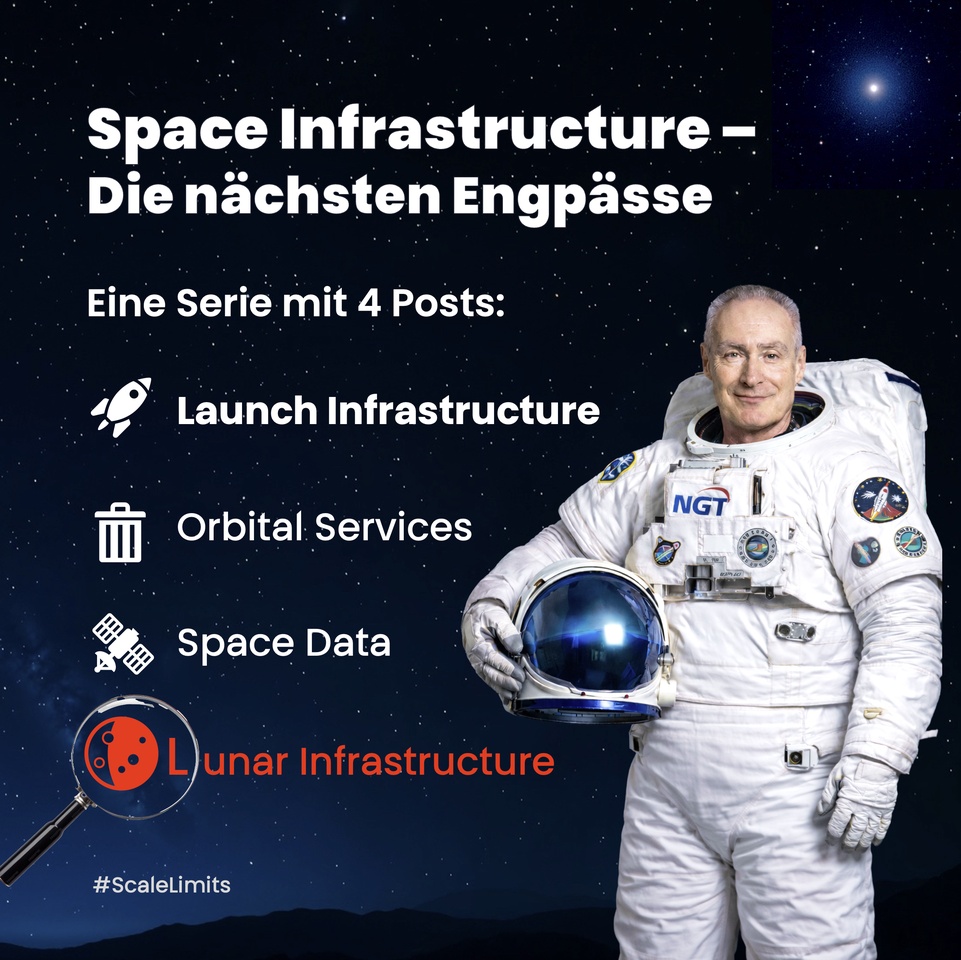
Bottleneck Space Infrastructure: 4. lunar infrastructure 🌖
The first three levels of this series dealt with access to orbit, the operation of orbital infrastructure and the resulting data and communication systems. Lunar Infrastructure goes one step further.
There is still hardly any economic activity there. This is precisely why I find this area exciting. Many of the necessary building blocks are known, but the infrastructure is almost completely lacking.
Should a permanent economic presence develop beyond the Earth's orbit in the coming decades, new bottlenecks will arise practically from scratch. These include, among others:
- Energy supply - Electricity will become a basic requirement for any activity on the moon and space stations
- Nuclear systems - compact Compact reactors for permanent energy supply in extreme environments
- Communication networks - Data links between Earth, Moon and orbital infrastructure
- Navigation and positioning - GPS does not exist on the moon
- Resource extraction - Using water, oxygen and raw materials directly on site
- Robotics and autonomous systems - Maintenance and operation without permanent human presence
- Transportation and logistics systems - Supply of lunar and orbital sites
- In-Situ Manufacturing - Production directly outside the earth (advantage: no gravity)
- New space stations - Research, industrial and logistics platforms in orbit
- Computing power and data processing - Local processing of large amounts of data in space
I find it particularly interesting that many of these future bottlenecks are already recognizable today. Some of the actual business models do not even exist yet. The infrastructure problems, on the other hand, are already becoming apparent. Investment in this area has so far been limited.
$LUNR (-0,35%) (Intuitive Machines) is working on central building blocks for a future lunar infrastructure. $FLY (+0,07%) (Firefly Aerospace) is increasingly expanding its activities in the direction of lunar services. $RDW (+0%) (Redwire) is developing technologies for space stations and industrial applications in orbit. $VOYG (+0%) (Voyager Technologies) is working on commercial space station projects (Starlab) as a possible successor to today's government infrastructure. $OHB (+6,38%) (OHB) builds satellite and space systems that could also become relevant for more distant missions in the long term.
Companies outside the traditional space sector could also play a role in the future. If nuclear energy supplies on the moon or space stations become a reality, suppliers of compact reactor systems, e.g. $OKLO (Oklo) will come more into focus. The same applies to robotics, communication and automation technologies.
Many of these ideas still seem a long way off today. However, this applies to almost any infrastructure before it is actually built. Perhaps the next major infrastructure zone will not be built on Earth, but a few hundred thousand kilometers away.
1818
1 Comentar
Sehr passend, kam gerade auf X rein: „We're building a Moon Base! @NASAMoonBase will serve as a habitat where astronauts live and work during long-term science missions.
Join us at 2pm ET on Tuesday, May 26, for a live news event where we’ll share updates on our lunar exploration plans: go.nasa.gov/4uinkLi“.
Join us at 2pm ET on Tuesday, May 26, for a live news event where we’ll share updates on our lunar exploration plans: go.nasa.gov/4uinkLi“.
•
22
•5Mês·
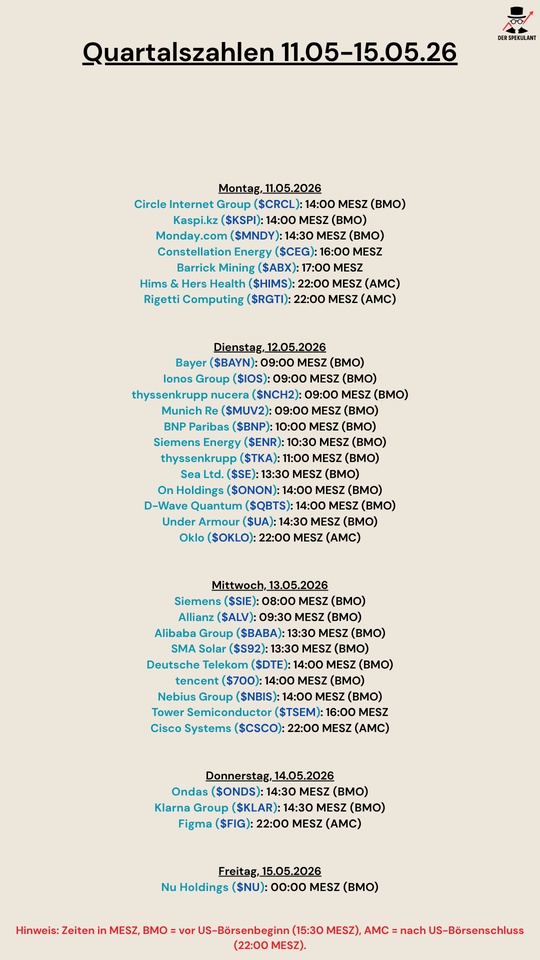
Quarterly figures 11.05-15.05.26
$CRCL (-0,78%)
$KSPI (-1,09%)
$MNDY (+3,17%)
$CEG (-2,95%)
$ABX (-0,55%)
$HIMS (+0,2%)
$RGTI (-0,6%)
$BAYN (-1,86%)
$NCH2 (-1,41%)
$IOS (+2,45%)
$MUV2 (-0,57%)
$BNP (-2,41%)
$ENR (-0,6%)
$TKA (-1,92%)
$SE (-5,52%)
$ONON (+1,79%)
$QBTS (+0,02%)
$UA (-0,19%)
$OKLO
$SIE (-0,92%)
$ALV (-1,36%)
$BABA (+0,05%)
$S92 (-2,84%)
$DTE (-1,16%)
$700 (-0,78%)
$NBIS (-0,31%)
$CSCO (-0,12%)
$ONDS (+0,83%)
$KLAR (+0,26%)
$FIG (+0,52%)
$NU (-0,54%)


8Mês·
Infrastructure and waste disposal: The profiteers of the nuclear boom
Dear Community,
Where the hunger for energy is being met by nuclear power and the new generation of Small Modular Reactors (SMRs), a massive growth market for downstream services is inevitably emerging.
This applies above all to nuclear waste disposal, the professional dismantling of old plants and the recycling of fuels and water.
Since there is currently no pure "nuclear waste ETF" (at least that I am aware of), we investors must focus on specialized individual stocks that are global leaders in the disposal of uranium and contaminated components (including water).
1. the operational heavyweights for dismantling and disposal
- Veolia ($VIE (-1,94%)
): Although Veolia is primarily perceived as a global environmental services provider, it also operates a nuclear power plant with Veolia Nuclear Solutions a highly specialized division. As the global market leader in robot-assisted cleaning and the dismantling of highly radioactive sites (such as Fukushima), they are indispensable. They offer technologies for the vitrification of waste ("vitrification", the transformation of liquid or solid nuclear waste into a solid glass body) and for water treatment in contaminated areas. Veolia thus bridges the gap to the traditional water business and covers two key areas in its portfolio at the same time.
- Fortum ($FORTUM (-2,41%)
): The Finnish energy group is a hidden champion of nuclear aftercare. In addition to operating power plants, Fortum offers specialized services for the purification of radioactive liquids (NUKEM technology) and final disposal. They are a key player in European waste management standards.
- Jacobs Solutions ($J (-1,59%)
): The US engineering services giant manages major government nuclear sites such as Sellafield (UK) and Hanford (USA). Its focus is on program management for the long-term storage of fuel elements. The SMR connection is particularly exciting: Jacobs is already advising numerous developers on planning the entire life cycle, including disposal.
- Perma-Fix Environmental Services ($PESI (-3,1%)
): Perma-Fix is regarded as one of the few genuine "pure plays". The company operates its own facilities for the treatment of nuclear and mixed waste. Its core competence lies in massively reducing the volume of nuclear waste before it is transferred to a final repository.
2 The fuel cycle: Cameco and Westinghouse
Cameco ($CCO (-0,48%)
) is primarily known as a uranium producer, but together with Brookfield Asset Management holds a majority stake in Westinghouse Electric Corporation (electrical engineering). The company thus covers the entire cycle:
- Operations: Cameco produces uranium concentrate (yellowcake), while Westinghouse supplies the reactor technology and maintenance.
- Disposal expertise: Through Westinghouse, Cameco covers the lucrative "back end". This includes the decontamination of process water as well as the conditioning and volume reduction of of radioactive waste.
- Dismantling service: As a technological market leader, the team offers solutions for the dismantling (D&D) of old plants, using specialized filter systems to clean contaminated liquids.
- Market model: Sales are stable through long-term supply contracts. The service division makes the company less dependent on fluctuations in the uranium price, as maintenance and waste treatment are permanent tasks required by law.
Energy Fuels ($UUUU (-1,88%)
): This company occupies a strategic niche. In its White Mesa Mill they recover uranium from residual materials and waste from other industries. This positions Energy Fuels as a pioneer in "uranium recycling", which reduces dependence on primary extraction and makes waste streams economically viable.
3. specialty materials and water technology
In the nuclear industry, water is not only a coolant, but often also a transport medium for contaminants. This is where the technology leaders come into play:
- Xylem Inc. ($XYL (-0,31%)
): As a pure water technology company, Xylem supplies the heavy-duty pumping and filtration systems that are essential for the cooling circuits of modern reactors and subsequent wastewater treatment.
- Danaher Corporation ($DHR (-1,45%)
): Via the divested environmental division Veralto Danaher offers high-precision analytical instruments for monitoring water quality - a critical component for detecting leaks and contamination in real time.
- Umicore ($UMI (-5,12%)
): The materials technology group is pursuing a "closed-loop" model. In the long term, its expertise in recovering metals from complex industrial waste could play a role in the recycling of power plant components.
The new generation of reactors: SMR specialists in detail
When it comes to direct energy supply for the AI sector, two companies are in the spotlight:
- NuScale Power ($SMR
): The conservative pioneer relies on proven light water reactor technology (VOYGR™). As NuScale traditionally relies on water, the need for water technology (pumps, filters from suppliers such as Xylem) is extremely high. This makes NuScale an ideal partner for traditional infrastructure investors.
- Oklo Inc.$OKLO
): The radical innovator (supported by Sam Altman) develops "fast reactors". The key feature: these can be fueled with recycled nuclear waste (HALEU). Oklo transforms a disposal problem directly into an energy source and thus addresses the waste problem at its root.
Strategic conclusion
If you want to bridge the gap between water cooling and waste disposal, you will find in Veolia the most stable connection.
Jacobs Solutions and Perma-Fix are the most direct options for physical dismantling.
Energy Fuels offers an exciting bet on the recycling of uranium residues, while Xylem and Danaher provide the indispensable technological basis for water management in a nuclear renaissance.
However, the decisive strategic winner of the current nuclear renaissance could be the team of Cameco & Westinghouse ($CCO) (-0,48%) could be:
By merging uranium mining and reactor technology, they have created a vertically integrated business model. They not only profit from the sale of the fuel, but also control the entire downstream value chain via Westinghouse - from the purification of the process water to the final storage preparation.
As a result, Cameco has risen from a pure mining player to an indispensable infrastructure partner for the energy and AI economy.
In addition, the 80 billion dollar agreement with the US government agreed at the end of 2025 is likely to have cemented Cameco's long-term market leadership in the West (https://de.marketscreener.com/boerse-nachrichten/westinghouse-electric-cameco-und-brookfield-starten-80-milliarden-dollar-offensive-fuer-atomkraft-in-ce7d5ddcd88cf127).
Risk analysis
The nuclear renaissance is more real today than it was ten years ago, but as investors we need to look at two sides of the coin:
Opportunities through regulatory certainty: Waste disposal and dismantling are not "optional services", but permanent tasks prescribed by law. Financing is often already secured by existing provisions of the groups, which makes the service providers (Veolia, Jacobs, Perma-Fix) crisis-resistant.
Risks: Political risks remain. A change of government can delay approval processes for final storage facilities. In addition, the sector is highly emotional; ESG ratings often (still?!) determine how much capital actually flows into the shares.
Could water and waste management technology end up being the safer investment than the actual SMR builders, because it makes money from every technological outcome? How do you see the risk/reward ratio?
Best regards and thank you very much for the positive response and all the feedback on my previous and very first post ✌🏼
Anderlé
1919
10 Comentários
Thank you for the interesting article. In my opinion, you are addressing exactly the right thoughts. Uranium is currently an extremely exciting topic. Let's see when the downstream industries will benefit accordingly.
Personally, I am currently still playing the hype cycle around the manufacturers, as I expect a greater return here in the short term. In the long term, however, the music is at least as strong here.
Personally, I am currently still playing the hype cycle around the manufacturers, as I expect a greater return here in the short term. In the long term, however, the music is at least as strong here.
•
33
•
8Mês·
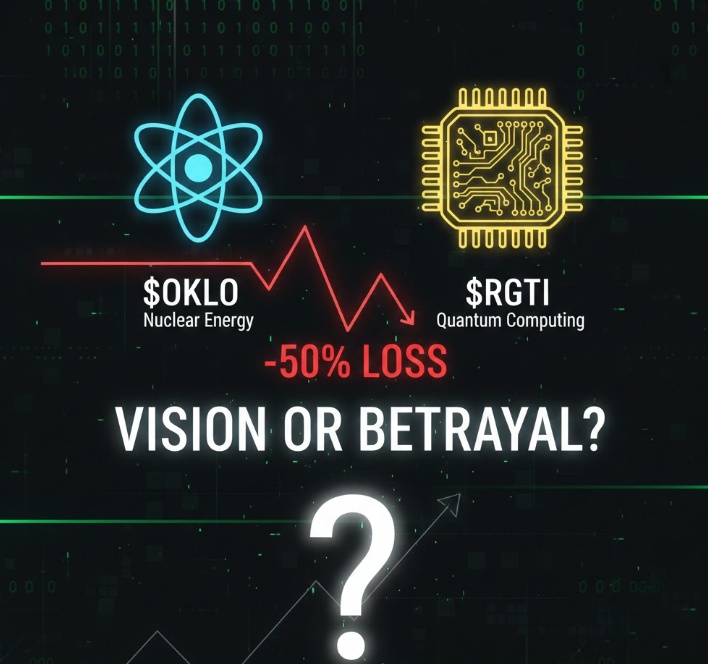
📉 $OKLO (Oklo Inc) & $RGTI (Rigetti Computing Inc): My Full Analysis After a -50% Drop – Why I’m Not Selling, But Doubling Down on My Convi
Hello community, on October 15th, I invested in $OKLO and $RGTI (-0,6%) , two bets on the energy of the future and quantum computing. Today, I see a -50% loss on that bet. I know what you’re thinking: "Pure madness." Perhaps in the short term, it is. But let me explain why, instead of running away, I am deepening my analysis and why I am staying in this investment.
📉 THE PERFECT STORM: What has happened since my entry?
CORRECTION OF EUPHORIC VALUATIONS
- In October, $OKLO was above $190, valued as if it were already producing energy, while it is still in the "pre-revenue" stage.
- The market did its job: deflating the speculative bubble and bringing prices back to more realistic levels.
INSIDER SELLING (On OKLO)
- The CEO and CFO sold shares in late 2025.
- The market interpreted this as a lack of short-term confidence.
- In reality, these are often scheduled sales for tax reasons or personal liquidity. Technical Note: These were executed under pre-planned Rule 10b5-1 plans adopted months in advance, which mitigates the negative connotation.
DISAPPOINTING RESULTS AND DELAYS (On RGTI)
- November report: revenues -18%, operating losses increasing.
- Postponement of the 108-qubit "Cepheus-1" system to Q1 2026. However, Rigetti has just confirmed reaching 99% fidelity on two-qubit gates, a crucial step for commercial launch.
- The market punished the lack of immediate progress.
ADVERSE MACRO CONTEXT
- Strong global volatility and "risk-off" sentiment.
- Flight from growth and speculative stocks toward safer assets.
- Innovative sectors like quantum and advanced nuclear were the first to be liquidated.
STRUCTURAL CHALLENGES
- High burn rate: both are burning cash for R&D.
- Fear of dilution: dread of new share issuances.
- Lack of short-term catalysts: no revolutionary news to support prices.
💡 WHY, DESPITE EVERYTHING, AM I MORE CONVINCED THAN BEFORE?
TIME HORIZON: 2028-2030, NOT 2025
- I didn't buy to make a profit by Christmas 2025. My horizon is 5-10 years, when:
- The first "Aurora" reactors from Oklo will be operational (2027/2028).
- Quantum advantage will become commercially relevant.
SOLID STRATEGIC FUNDAMENTALS
- For $OKLO: Strategic partnerships with the U.S. Department of Energy (in January 2026, a new OTA agreement was signed for the radioisotope pilot plant). A clear business model: compact and sustainable micro-reactors. A concrete solution to the energy problem of AI data centers. A team with extensive experience in the nuclear sector.
- For $RGTI (-0,6%):
$8.4 million order from India for a 108-qubit system (proof of real market demand). Proprietary hardware and high-level expertise. A pipeline of academic and corporate clients. One of the purest listed players in quantum computing.
THE MARKET DISCOUNTS THE FUTURE, I BET ON IT
- Current valuations reflect fear and uncertainty.
- Clean energy and quantum computing sectors will grow exponentially in the coming decades.
- When the fear fades, prices will reflect the true potential.
THE "CRASH" IS AN OPPORTUNITY
- Using DCA (Dollar Cost Averaging), I am lowering my average entry cost.
- Historically, the greatest opportunities are created during times of peak fear.
- I am monitoring technical progress, not just prices.
🎯 MY STRATEGY NOW
- CONSTANT MONITORING of technological progress.
- DCA ON DIPS to reduce the average price.
- FOCUS ON THE LONG TERM, ignoring short-term noise.
- CONTINUOUS RESEARCH on sector developments.
🤔 THE KEY QUESTION The market is testing us: do you believe in the technology or just follow the price? I have made my choice: I believe in the energy revolution of Oklo and the computational revolution of Rigetti. The -50% is part of the journey, not the final destination.
I prefer to be a year early than a day late on revolutions of this magnitude. Those who bought today’s great tech leaders during their early years faced similar drawdowns. Patience is the hardest asset to accumulate, but it is the one that, in the end, generates the greatest return.
How are you managing this test of nerves? Do you believe in the project or have you let the price scare you away? 👇
⚠️ CRUCIAL DISCLAIMER This is not financial advice. Investing in high-potential, high-risk stocks requires: Deep independent research; High volatility tolerance; Long time horizons (5-10 years); The ability to withstand significant losses.
44

9Mês·
Uranium ETFs
Hello my dears,
I have now also realized that there is a lot of potential for the future in uranium energy and that there are some opportunities in the field of SMR mini-reactors. Since I want to invest more broadly in the field of uranium and do not want to and cannot deal with countless shares and areas of uranium, you are in demand.
Do you see more potential in the pure uranium mining or producer sector or would you diversify?
I have picked out several ETFs that I can trade on TR (please no hate for the platform😅).
My goal will be to invest 10k in the sector over the year, which is about 7% of my portfolio as of today.
I would also have the funds to invest in one go, but I sleep better if I spread it out over the next few months, or do you see so much potential in 2026 that you would invest it directly yourself?
Here is the selection of ETFs:
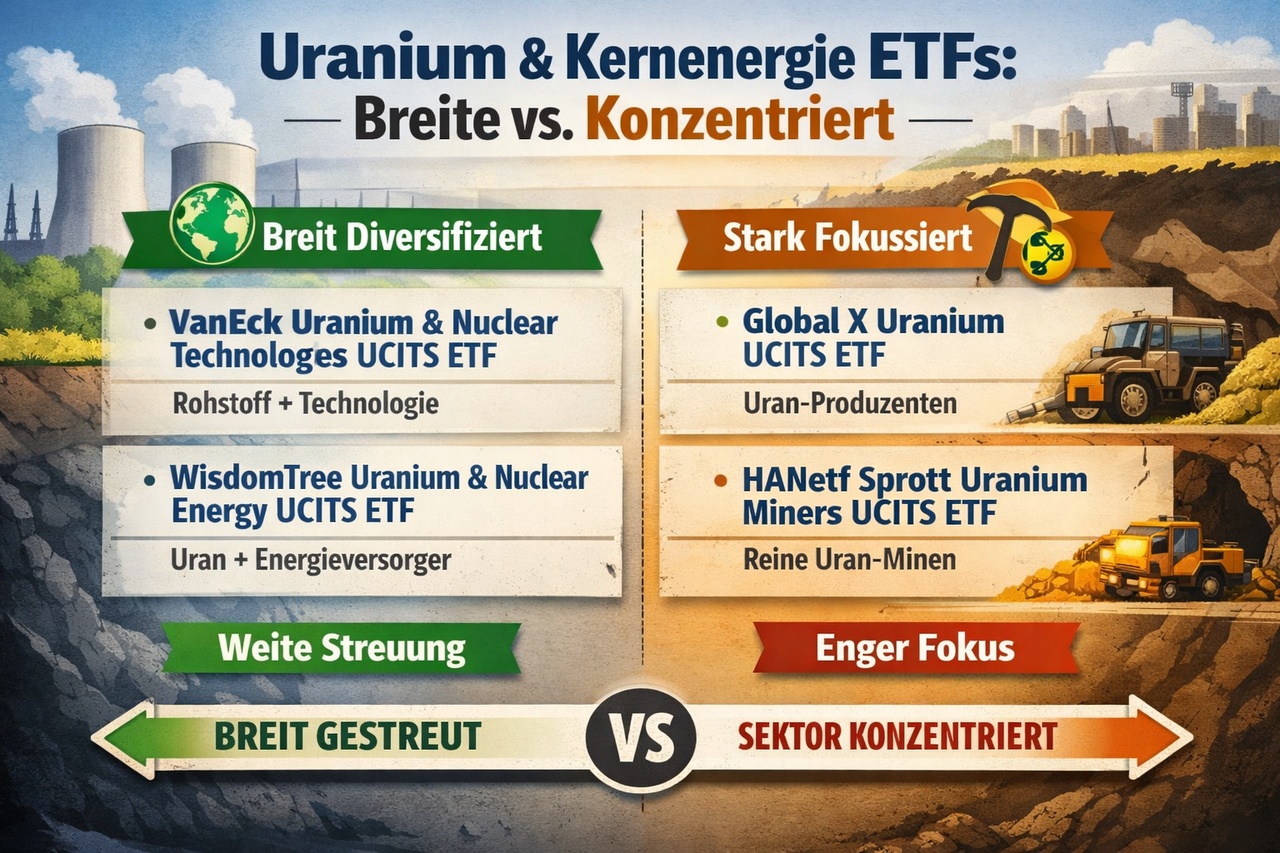
1. VanEck Uranium and Nuclear Technologies UCITS ETF
➡️ Broad thematically in the uranium/nuclear energy sector
👉 Mix of uranium producers, nuclear technology and energy/component companies → More diversification across sub-sectors
2nd Global X Uranium UCITS ETF
➡️ Commodity/producer-centric
👉 Strong focus on uranium mining, exploration and supporting components → More concentrated on commodity/producer sector
3rd HANetf Sprott Uranium Miners UCITS ETF
➡️ Very specialized in uranium miners
👉 Sector segment with a focus on mining and exploration companies → High concentration risk in one sector
4 WisdomTree Uranium and Nuclear Energy UCITS ETF
➡️ Broad across the nuclear energy ecosystem
👉 Includes mining, utilities, suppliers and technology → Broad diversification across different industries in the nuclear sector
$OKLO$CCO (-0,48%)
$UUUU (-1,88%)
$3842
$UEC (+0,21%)
$NXE (+1,28%)
$BWXT (-0,43%)
$CEG
$LEU (-5,53%)


9Mês·
🚀 Good morning, Community!
📊 Today’s session is looking extremely dynamic. While European markets consolidate the gains from their 2026 debut, the US Premarket is sending significant rotation signals. Here is what I’m monitoring in my portfolio:
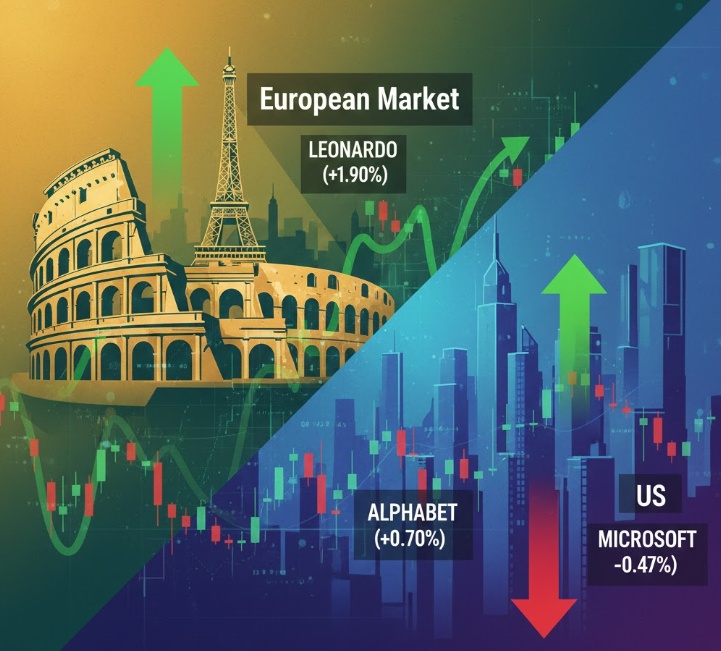
🇮🇹 Europe (Market Open): Defense and Banking in Focus
The portfolio is benefiting from the push in Piazza Affari, which is among the most resilient indices today.
- $LDO (-1,97%)
🚀: This is the top performer. The surge comes from news of a new international contract and a general climate of confidence in the European Defense sector, which is seeing upward target price revisions for 2026. - $CE (-2,45%)
🟢: Excellent holding for Italian financials. The sector is benefiting from expectations of "higher for longer" interest rates compared to late 2025 forecasts, which favors net interest margins.
🇺🇸 US Premarket: The Clash of the Tech Giants
Wall Street is preparing for a mixed opening with clear technical movements:
- $GOOGL (+1,24%)
🟢: Google’s golden moment continues in the premarket. Cantor Fitzgerald just upgraded the rating to "Overweight" with a price target of $370, citing dominance in Generative AI and the success of Gemini. The market is rewarding its market cap flip over Apple. - $NVDA (+1,37%)
🟢: Remains in the green despite general caution. Investors are looking toward new announcements from CES 2026 and the sustained demand for H200 chips. - $MSFT (+1,21%)
🔴: Slight pressure in pre-opening. This is mainly technical profit-taking after the stock hit all-time highs yesterday. No change in fundamentals—just a physiological consolidation.
🔬 Semiconductors & Growth
- $TSM (+1,49%)
🟢: The Taiwanese giant reflects the optimism of Goldman Sachs, which raised its price target, forecasting a record-breaking 2026 thanks to 2nm production. - $RGTI (-0,6%)
🔴& $OKLO
🔴: More speculative stocks are suffering in the premarket due to a rotation toward safer "Large Caps" (like Google). Volatility remains high here, typical for stocks linked to Quantum Computing and Advanced Nuclear. These were two year-end bets, and I believe they could still deliver satisfaction in the short term.
🎯 Session Outlook
The strategy remains focused on quality. While Europe pushes into Defense and Banking, in the US, I am monitoring Alphabet’s volume to see if the rally has the legs to continue past the opening bell.
How are you positioned? Are you riding the Leonardo rally or waiting for the "dips" on US Tech? 👇
Would you like me to analyze the specific technical levels for any of these stocks or summarize the latest news on the CES 2026 announcements?
77
2 Comentários
As of now I’m pretty much convinced the European market is going to outperform the US market this year, considering the geopolitical circumstances and the USD/EUR valuation. Because of that I’m mostly invested in Europe atm.
•
11
•10Mês·
📈 Market Analysis: Why Growth is Bouncing Back Today!
The pre-market session is showing strong resilience. It's not just a "green day," but a clear reaction to specific fundamental catalysts. Here is why the key players are moving:
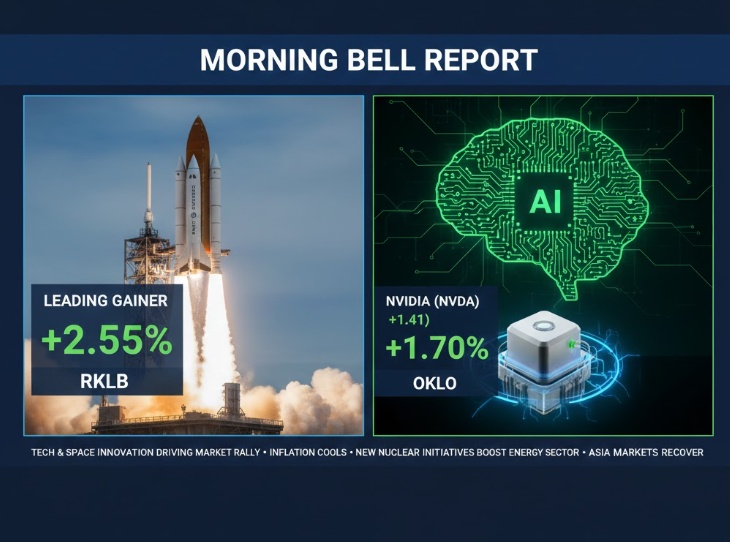
🚀 Aerospace - $RKLB (+1,26%) (+2.55%): Rocket Lab's outperformance is driven by its increasing "launch cadence" and the de-risking of its Neutron program. As the space economy shifts from speculative to industrial, RKLB is capturing a massive share of the small-to-medium satellite market.
💻 Semiconductors - $NVDA (+1,37%) (+1.41%): The bounce is fueled by softer-than-expected inflation data, which provides a "green light" for high-multiple tech stocks. With AI demand still outstripping supply, the fundamental case for Nvidia remains bulletproof heading into 2026.
⚛️ Energy - $OKLO (+1.70%) & $NNE : We are witnessing a "Nuclear Renaissance." The market is pricing in the massive power requirements of next-gen data centers. OKLO is benefiting from the positive spillover of recent regulatory breakthroughs in the SMR (Small Modular Reactor) space.
🌏 China Tech - $BABA (+0,05%) (+1.48%): Sentiment on Chinese equities is improving as macro data points to a stabilizing export machine. Alibaba remains the primary vehicle for investors looking to play the recovery of the Eastern consumer.
The "Red" Side: What's Cooling Down? 🧊
Banking & Finance: We see slight pressure on $UCG (-1,76%) (-0.50%) and $AXP (+1,02%) (-0.27%). This isn't a crash, but profit-taking. After a strong run for financial stocks, investors are rotating capital out of Value to fund the new leg of the Tech rally.
Big Tech Lagging: While $MSFT (+1,21%) and $GOOGL (+1,24%) are slightly positive, they are underperforming the broader tech market. The focus has shifted from software platforms to hardware providers and infrastructure.
Conclusion: I am staying long on Energy Infrastructure and Specialized Tech. The convergence of AI power needs and Space logistics is the strongest narrative for the upcoming year.
What’s your top conviction for the final sessions of 2025? Let’s talk in the comments! 👇
44

10Mês·
Portfolio ATH
This week marks an important milestone for my portfolio.
it just reached a new all-time high in total value, pushing my year-to-date performance to almost 70%.
This result didn’t come from luck or chasing hype. It came from sticking to the formula I’ve shared many times:
Fundamentals + Algorithm AI + Patience.
Throughout the year, I rotated between defensive names when volatility spiked and shifted back into high-quality tech and oversold growth stocks when the signals aligned. Step by step, the strategy paid off.
What makes this new ATH more meaningful is the context:
Many major indices struggled for long stretches this year. Market sentiment swung wildly with geopolitics, tariffs and rate expectations
Most investors expected a slower rebound, especially after the deep corrections earlier in the year. Even so, staying disciplined and waiting for the right moments to enter positions created the compounding effect I was aiming for.
This year has been a reminder of something simple:
You don’t need to predict the market. You just need a method — and the discipline to follow it..
😎 𝗗𝗶𝘀𝗰𝗹𝗮𝗶𝗺𝗲𝗿: This is my personal opinion and is for informational purposes only. You should not interpret this information as financial or investment advice
$TSLA (+4,44%)
$NVDA (+1,37%)
$AVGO (+1,53%)
$NOVO B (-0,84%)
$AMZN (+5,14%)
$OKLO
44
Títulos em alta
Principais criadores desta semana
Dados financeiros e EOD da FactSet