
📉💥 The Trade Desk cratered 22% after Q2 revenue of $715M missed the $751M estimate and adjusted EPS of $0.34 fell short of the $0.40 consensus.

Trade Desk
Ação
Ação
Ticker: TTD
TTD
Price
Discussão sobre TTD
Postos
111
2Mês·
𝐓𝐡𝐞 𝐓𝐫𝐚𝐝𝐞 𝐃𝐞𝐬𝐤: 𝐆𝐫𝐨𝐰𝐭𝐡 𝐒𝐥𝐨𝐰𝐬 𝐒𝐡𝐚𝐫𝐩𝐥𝐲 𝐚𝐬 𝐐𝟑 𝐎𝐮𝐭𝐥𝐨𝐨𝐤 𝐏𝐨𝐢𝐧𝐭𝐬 𝐭𝐨 𝐑𝐞𝐯𝐞𝐧𝐮𝐞 𝐃𝐞𝐜𝐥𝐢𝐧𝐞
⠀
📊 𝐑𝐞𝐬𝐮𝐥𝐭𝐬
• Revenue: $715M, +3% YoY
• GAAP EPS: $0.14 vs. $0.18 YoY
• Adj. EPS: $0.34 vs. $0.41 YoY
• Adj. EBITDA: $241M vs. $271M YoY
• Adj. EBITDA Margin: 34% vs. 39% YoY
• Net Income: $64M vs. $90M YoY
⠀
🎯 𝐆𝐮𝐢𝐝𝐚𝐧𝐜𝐞
• Q3 Revenue: At least $650M
• Q3 Adj. EBITDA: Approximately $160M
⠀
📌 𝐊𝐞𝐲 𝐓𝐚𝐤𝐞𝐚𝐰𝐚𝐲𝐬
• Revenue growth slowed sharply to 3% YoY from 19% in Q2 2025, while profitability also declined with Adj. EBITDA down 11% YoY
• Customer retention remained above 95%, continuing a streak of more than a decade
• Netflix joined The Trade Desk’s Sellers and Publishers 500+, while new integrations expanded its commerce ecosystem across travel, hospitality and mobility
• Dentsu selected TTD as the first DSP partner for its New Stream Media retail-data offering, while Databricks and Adobe announced new integrations
• TTD repurchased approximately $78M of stock during Q2, with $269M remaining under its authorization
⠀
💬 𝐌𝐚𝐧𝐚𝐠𝐞𝐦𝐞𝐧𝐭 𝐂𝐨𝐦𝐦𝐞𝐧𝐭𝐚𝐫𝐲
“This quarter did not meet the standard we set for ourselves, but it has reinforced our belief that we are focused on the right opportunities for the future. We have a clear understanding of the factors that impacted our performance, and we are taking decisive action to strengthen our execution.” — CEO Jeff Green
88
8 Comentários
Jeong@Jeong
1Mês
•
22
•

2Mês·
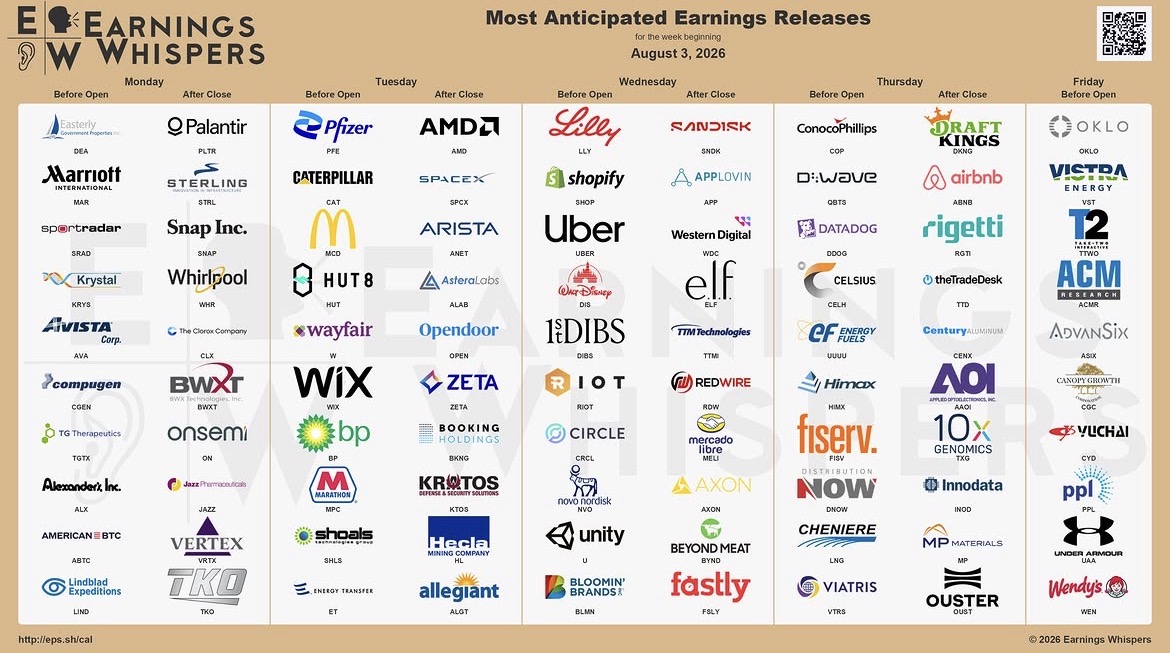
Let's move on to the next round!
$MAR (+2,85%)
$KRYS (-0,78%)
$PLTR (+0,05%)
$STRL (-1,58%)
$SNAP (+5,32%)
$WHR (+1,13%)
$CLX (+1,21%)
$BWXT (+1,15%)
$ON (+0,97%)
$VRTX (+0,88%)
$PFIZER
$CAT (-1,76%)
$MCD (+1,34%)
$HUT (+2,84%)
$WIX (+8,23%)
$W (+6,85%)
$BP. (-1,44%)
$SHLS
$AMD (-1,12%)
$SPCX (-2,4%)
$ANET (-4,48%)
$ALAB (+2,24%)
$OPEN (+15,64%)
$ZETA (+4,34%)
$BKNG (+3,2%)
$KTOS (+3,3%)
$HL (+2,52%)
$LLY (+3%)
$SHOP (+2,25%)
$UBER (+2,27%)
$DIS (+1,13%)
$RIOT (+2,51%)
$CIRC
$NOVO B (+3,05%)
$U (+4,09%)
$SNDK (+0%)
$APP (+5,92%)
$WDC (-1,44%)
$ELF (+7,31%)
$MELI (+0,56%)
$AXON (+1,58%)
$TTMI (-1,63%)
$RDW (+3,92%)
$QBTS (+6,2%)
$DDOG (-1,25%)
$CLA (+0%)
$FI (+2,5%)
$LNG (-1,06%)
$UUUU (+3,75%)
$HIMX (+0,93%)
$ABNB (+3,67%)
$RGTI (+8,17%)
$TTD (+7,08%)
$AAOI (-2,85%)
$TXG (-1,38%)
$INOD (+7,19%)
$OUST
$MP (+4,12%)
$OKLO
$VST (+2,07%)
$TTWO (+3,16%)
$ACMR (-5,48%)
$WEED (+3,99%)
$UAA (+1,86%)
2626
13 Comentários
And all this while on vacation🫣😂😭
•
1010
•5Mês·
EARNINGS ANALYSIS: Trade Desk slumps after EPS miss & weak guidance
- Q1 mixed: Adj. EPS $0.28 vs. $0.32 Est. ; Sales $689m vs. ~$679m Est. , +12% YoY
- Negative: Q2 sales guidance of at least $750m is clearly below consensus of ~$772m.
- Q2 growth implies only approx. +8% YoY → strongest warning signal for investors
- Adj. EBITDA Q1 at $206m, slightly below prior year; margin falls to 30% from 34%
- KeyBanc and Oppenheimer downgrade; pressure from macro, middle-east turmoil, agency tensions and stronger competition
- Evercore remains Outperform, lowers PT to $27; BofA remains Underperform, lowers PT to $18
- Current: $20.80, -11.5% pre-market
55
7 Comentários
Doesn't collapse at all?
Edit: 🏳️
Edit: 🏳️
•
22
•
7Mês·
Increase due to massive insider buying and OpenAI rumors
$TTD (+7,08%) starts today with two pieces of massively bullish news. CEO Green Terry has just spent 148,101,266 dollars on the purchase of 6 million shares - an average of 24.68 dollars per share!
First insider purchase in about 4 years!
There are also rumors that OpenAI wants to run advertising on $TTD (+7,08%) wants to run advertising.
I wonder if there is a correlation between rumor and insider purchase?
Very interesting in any case.




7Mês·
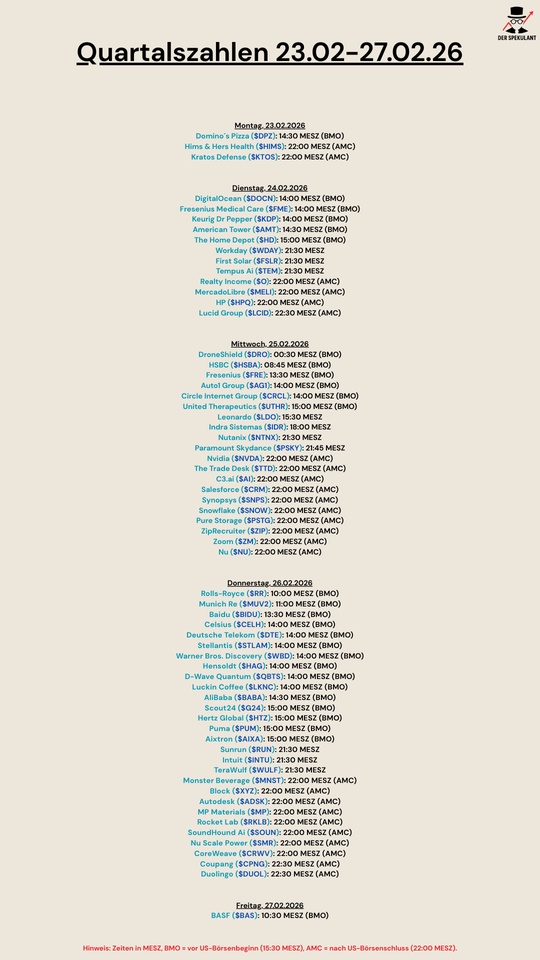
Quartalszahlen 23.02-27.02.2026
$DPZ (+2,66%)
$HIMS (+4,71%)
$KTOS (+3,3%)
$DOCN (-0,11%)
$FME (+2,66%)
$KDP (+2,51%)
$AMT (+0,34%)
$HD (+3,93%)
$WDAY (+1,76%)
$FSLR (-0,31%)
$TEM (+4,32%)
$O (+0,44%)
$MELI (+0,56%)
$HPQ (+1,18%)
$LCID (+5,42%)
$DRO (+4%)
$HSBA (-0,54%)
$FRE (+0,59%)
$AG1 (+4,89%)
$CRCL (+7,74%)
$UTHR (-0,3%)
$LDO (+2,89%)
$IDR (+0,71%)
$NTNX (-0,38%)
$PARA (+2,37%)
$NVDA (-1,52%)
$TTD (+7,08%)
$AI (+3,43%)
$CRM (+3,94%)
$SNPS (-2,85%)
$SNOW (+0,33%)
$PSTG (-5,66%)
$ZIP (+9,09%)
$ZM (+3,22%)
$NU (-1,42%)
$RR. (+1,91%)
$MUV2 (+2,31%)
$BIDU (-0,75%)
$CELH
$DTE (+1,09%)
$STLAM (+1,53%)
$WBD
$HAG (+3,43%)
$QBTS (+6,2%)
$LKNCY (+0%)
$BABA (+0,45%)
$G24 (+7,29%)
$HTZ (-0,61%)
$PUM (+3,49%)
$AIXA (-3,05%)
$RUN (+4,05%)
$INTU (+6,13%)
$WULF (+10,96%)
$MNST (+1,65%)
$SQ (+4,51%)
$ADSK (+5,94%)
$MP (+4,12%)
$RKLB (+2,28%)
$SOUN (+7,29%)
$SMR
$CRWV (+4,86%)
$CPNG (+2,09%)
$DUOL
2222
4 Comentários7Mês·
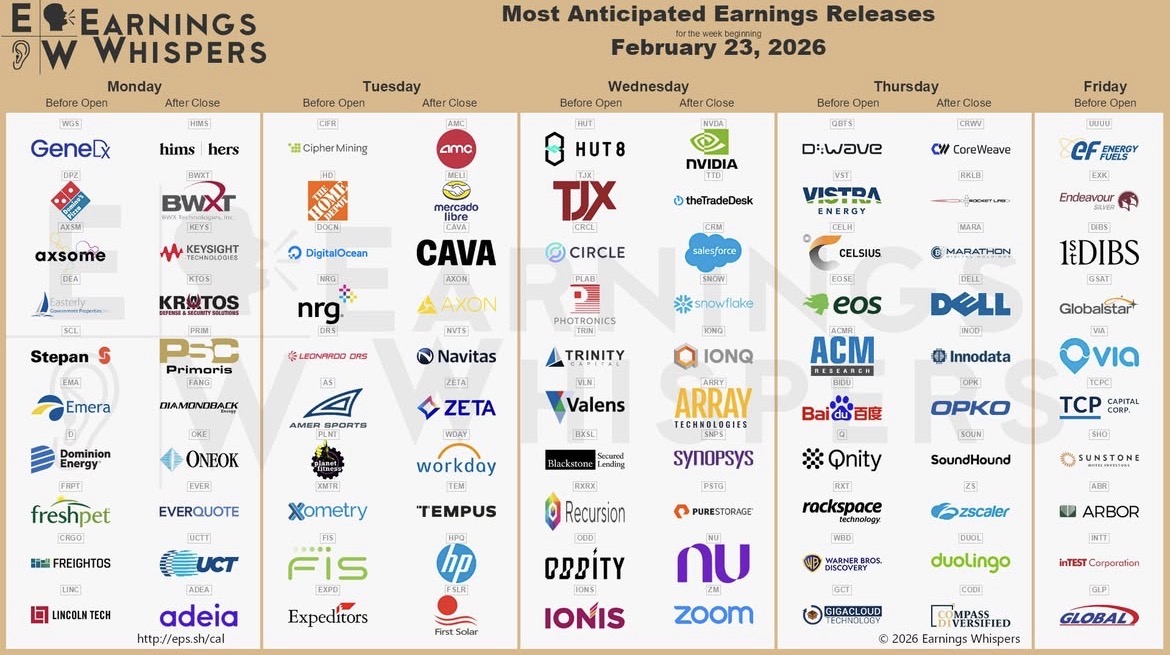
What to expect next week
$DPZ (+2,66%)
$D (-0,5%)
$AXSM (-0,83%)
$HIMS (+4,71%)
$FRPT (-1,23%)
$BWXT (+1,15%)
$KEYS (-4,45%)
$KTOS (+3,3%)
$CIFR (+2,71%)
$HD (+3,93%)
$DOCN (-0,11%)
$XMTR (+4,02%)
$MELI (+0,56%)
$CAVA
$ZETA (+4,34%)
$WDAY (+1,76%)
$TEM (+4,32%)
$FSLR (-0,31%)
$HUT (+2,84%)
$TJX (+0,78%)
$CIRC
$RXRX
$NVDA (-1,52%)
$TTD (+7,08%)
$CRM (+3,94%)
$SNOW (+0,33%)
$IONQ (+8,55%)
$SNPS (-2,85%)
$NU (-1,42%)
$ZM (+3,22%)
$QBTS (+6,2%)
$VST (+2,07%)
$CELH
$ACMR (-5,48%)
$9888 (-0,73%)
$Q (-1,37%)
$CRWV (+4,86%)
$DELL (-6,89%)
$INOD (+7,19%)
$SOUN (+7,29%)
$ZS (-0,05%)
$DUOL
$RKLB (+2,28%)
$AXON (+1,58%)
$LDO (+2,89%)
$FANG (-2,37%)
$ALV (+1,68%)
2525
8 Comentários
Next week will be wild! NVIDIA, Allianz, Vistra Energy and Rocket Lab! 🚀
•
66
•
8Mês·
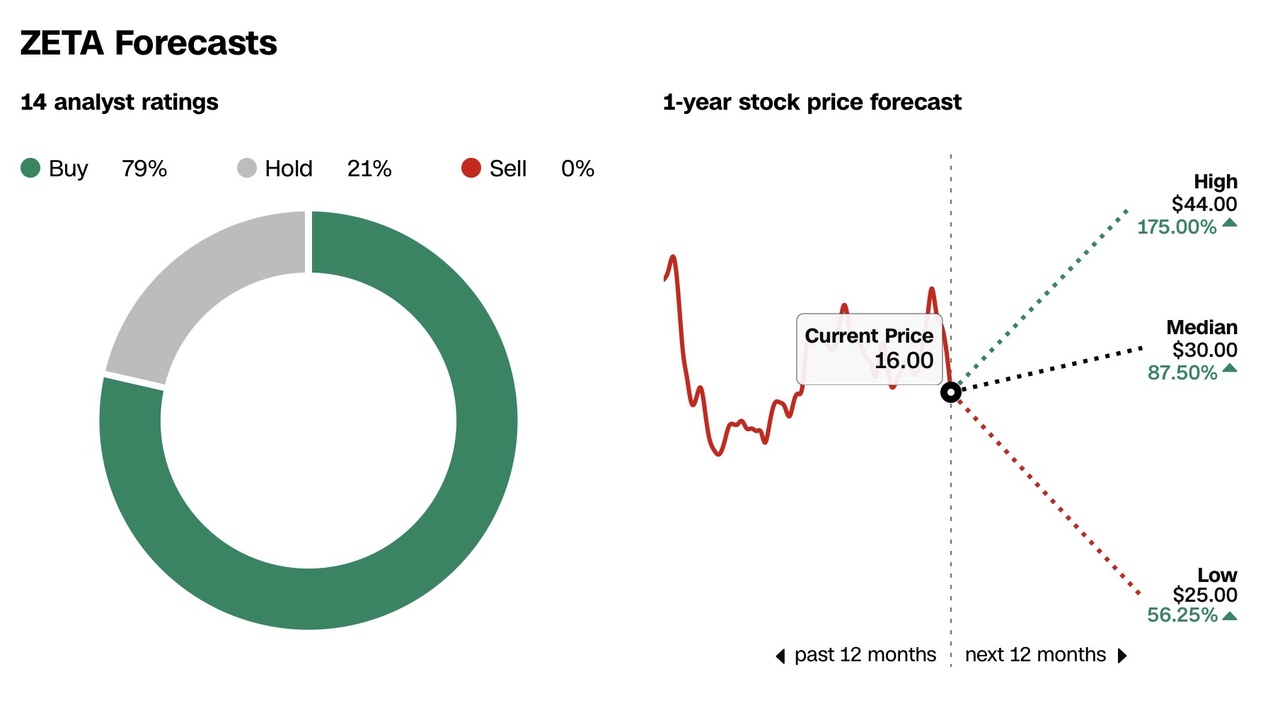
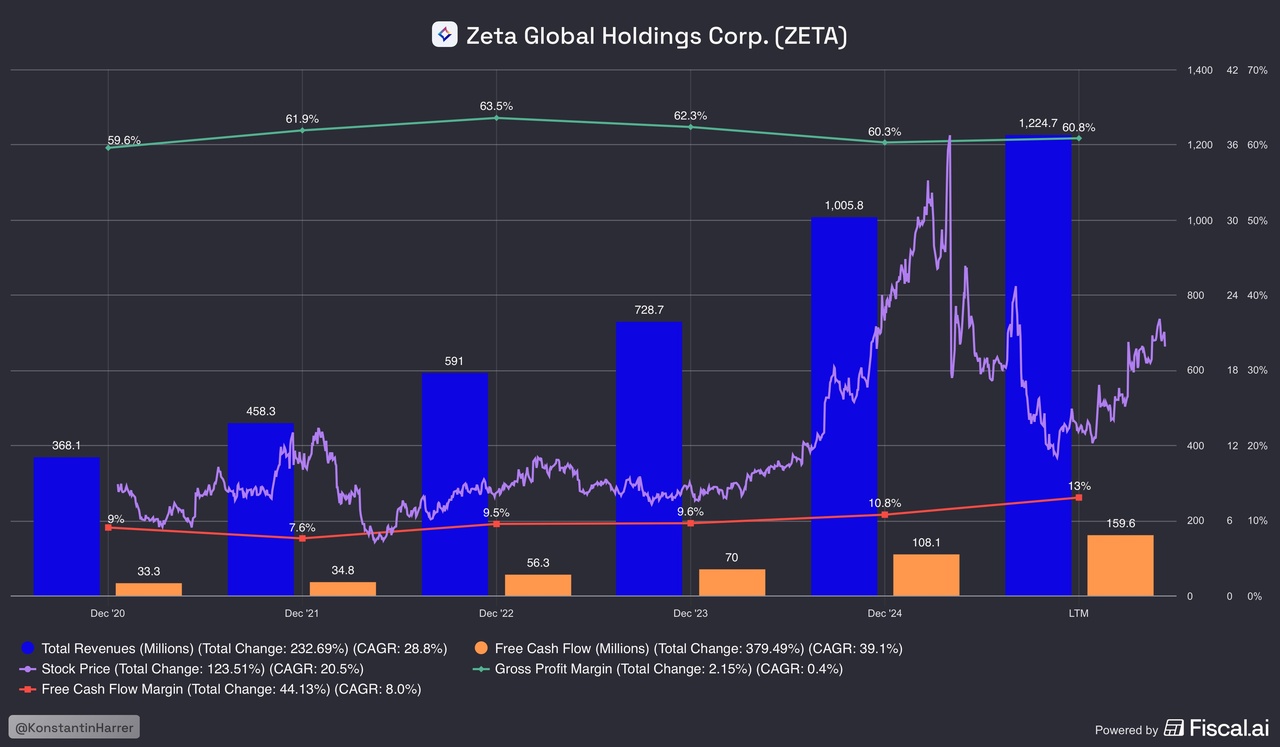
Jan 23 / Zeta — High Conviction, High Upside, and My Most Exciting Bet for the Future
The next stock on my 2026 list, and arguably the most exciting one, is Zeta. This is my biggest satellite position. Yes, it’s volatile. No, it’s not a mature compounder with decades of customer lock-in yet. But it absolutely has the potential to become one over the next few years.
I started building my position toward the end of last year in the $17–18 range, and it now represents roughly 5% of my portfolio. This is not a trade. This is a long-term bet on a company that sits right at the intersection of AI, data, and enterprise marketing.
At its core, Zeta Global is a customer intelligence and marketing platform for large brands. Think Nike, Disney, Ford, or major banks. These companies have millions of customers, but their data is fragmented everywhere. Emails live in one system, website clicks in another, store purchases somewhere else entirely. Zeta’s platform, called Athena, pulls all of that data together, cleans it up, and uses AI to predict what a customer is likely to do next. It’s essentially a decision engine. Instead of blasting generic ads, Zeta helps brands reach the exact right person at the exact right time.
What has investors excited recently is the shift to agentic AI. Athena is no longer just showing dashboards and charts. Thanks to Zeta’s partnership with OpenAI, marketers can literally talk to the software. You can ask Athena to identify a specific customer cohort, design a campaign, build the content, and execute it automatically. This turns software from a passive tool into something closer to an autonomous employee. That is a massive step change.
Zeta is also very different from competitors like AppLovin. AppLovin dominates mobile apps and performance marketing, especially gaming. Zeta operates across the open internet, email, web, and connected TV, focusing on high-value purchases like cars, financial products, and long-term brand relationships. That difference matters.
The real moat, though, is data. Zeta owns a deterministic identity graph of roughly 2.5 billion real people. This is first-party, consented data. As cookies disappear and privacy restrictions tighten, much of ad-tech is flying blind. Zeta is not. Brands come to Zeta because it still knows who the customer actually is. That advantage cannot be replicated overnight.
Execution matters, and this is where Zeta really separates itself. CEO David Steinberg has been delivering quarter after quarter, with Zeta beating and raising guidance for 16 consecutive quarters. That alone puts the company in rare territory.
But let this quote from Steinberg actually sink in:
“Eight out of 512 tech companies grew at a 20%+ CAGR for four years. The other seven trade at over 50x P/EBITDA.”
Zeta trades at roughly 16.6x P/EBITDA.
At the same time, revenue is projected to grow north of 30% annually, free cash flow yield exceeds 8% on FY27 estimates, and the company owns one of the largest first-party data clouds in the world. Steinberg has said it clearly: Zeta can make the same or better decisions for its clients in milliseconds, and that directly translates into superior ROI.
This stock is volatile. I genuinely do not care. I do not look at daily price movements. I am buying into what I believe is one of the most underappreciated AI beneficiaries in the market today.
This is a five-year story. The payoff comes later.



8Mês·
Trade Desk: 70% price loss and record profit?
For a long time, Trade Desk was considered an almost untouchable growth stock. But competition, KI and Amazon have shaken the narrative.
Now is the time to strike?
A few months ago, I wrote an analysis of The Trade Desk (Trade Desk: Ein Börsenmärchen mit ungewissem Ausgang). At first glance, the share was a perfect fit. A long-term outperformer that had undergone a considerable correction.
At that time, the share price had already plummeted from USD 141 to USD 59. The conclusion was nevertheless sobering: "All in all, the risk/reward ratio is surprisingly modest despite the enormous price losses."
Since then, the share price has slumped further from USD 59 to USD 36.55, causing the valuation to fall considerably once again - especially as the business has developed better than expected.
Has the time finally come to get in?
Advertising technology is a billion-dollar market
Trade Desk is one of the world's leading advertising technology and marketing groups. This is a gigantic market.
Some of the largest companies in the world earn most of their money from advertising, including Google, Facebook and, increasingly, Amazon.
Trade Desk has set itself the task of increasing the effectiveness of marketing measures and operates the world's largest demand-side platform. In simple terms, advertising space is purchased via this platform.
Instead of booking blindly, advertisers can define target groups, run tests and regulate budgets dynamically. The platform provides transparency, reporting and - increasingly - AI-supported decision-making mechanisms. The Trade Desk itself describes Kokai and its AI modules as the heart of this automation.
The Trade Desk complements the DSP with data management and a marketplace. Customers can integrate their own data, purchase third-party data and build models to meet their own target group as precisely as possible or find new target groups.
The platform can be connected to planning tools, purchasing workflows and reporting systems. The result is a comprehensive offering for data-driven marketing: planning, activation, measurement and automation.
Trade Desk against Goliath
This approach has proven to be a success story. Since the IPO in 2016, turnover, profit and cash flow have multiplied and the share price has risen more than tenfold.
Recently, however, the share price has taken a massive hit. There is a fear on the stock market that Meta, Google and Amazon will grab more and more of the cake.
Amazon in particular is expanding aggressively in this segment.
On the other hand, offline channels still account for a surprisingly high proportion of advertising budgets. However, the trend is clear. The market for Trade Desk and its competitors is therefore continuing to grow.
Furthermore, the bears argue that AI reduces switching costs and Trade Desk could lose customers as a result - but they seem to forget that the reverse is also true.
The biggest threat seems to come from Amazon. Google and Meta are relying on their own ecosystems in the advertising business and are largely sticking to their prices.
The two companies seem to be convinced that there is no way around them anyway, and realistically they are probably right.
Why Amazon has become the biggest threat
The biggest threat comes from Amazon, which primarily uses two Hebel uses. Amazon's core business provides in-house purchasing and retail data that no one else can offer.
This makes Amazon the better alternative for many advertisers and puts pressure on Trade Desk.
At the same time, Amazon is aggressively expanding its own demand-side platform, particularly in the streaming sector, where the company is already strongly positioned thanks to Prime Video and Twitch.
Amazon is thus directly attacking Trade Desk's core business and experience shows that competing with Amazon rarely ends well.
It can therefore be described as a drumbeat within the industry that Amazon has signed an exclusive deal with Netflix has concluded an exclusive deal with
Amazon's frontal attack
Amazon has also massively expanded its market share through far-reaching exclusive contracts in the sports and technology sector. One key example is the exclusive broadcasting of NBA and WNBA games from the 2025/26 season.
In addition, there were partnerships with Roku, Spotify, Pinterest and Nascar.
But there are also cases in which Amazon has emerged like a spectre in an industry, shares in the sector went into a tailspin and in the end it turned out that coexistence was possible after all.
Take the logistics sector, for example. FedEx It still exists today, as does Deutsche Post.
Or when Amazon took over Whole Foods, the share price of Sprouts Farmers Marketwent into a decline lasting several years, even though the business continued to perform well.
At some point, the good business figures could no longer be ignored and the share went through the roof.
When fear obscures the figures
Perhaps a similar development will occur at Trade Desk. Because as scary as the news on the Amazon front sounds, Trade Desk's business figures continue to look good.
Since the last analysis, the company has presented quarterly figures three times and has consistently delivered. In the first quarter, sales increased by 25 %, in Q2 by 19 % and in the third quarter by 18 %.
Growth momentum is somewhat lower than in previous years, but still high.
Profitability has also improved, which indicates that price pressure is being contained. Operating cash flow increased by 26% to USD 681.1 million in the first nine months.
The Executive Board responded to the fall in the share price with substantial share buy-backs. Over the course of the year, almost USD 1 billion was invested in buybacks, reducing the number of shares outstanding from 502.6 million to 493.0 million.
Free cash flow is currently expected to have increased by 23% to USD 1.56 per share in financial year 2025.
The Trade Desk therefore arrives at a P/FCF of 23.4.
If FCF increases by 20% to USD 1.90 per share in the 2026 financial year as expected, the P/FCF would fall to 19.2.
Before the share price collapse last year, the share never traded for a P/FCF of less than 40
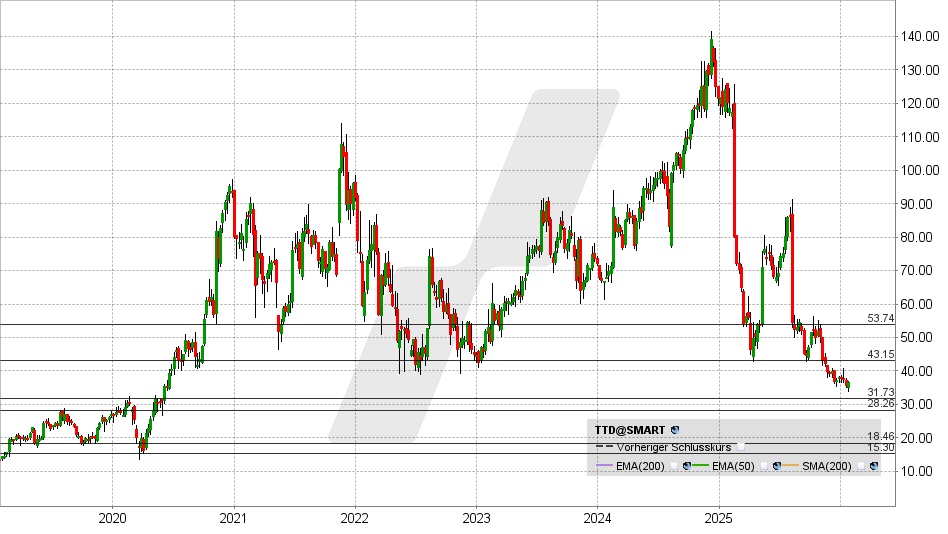
The Trade Desk share: Chart from 26.01.2026, price: USD 36.28 - symbol: TTD | Source: TWS
If it manages to rise above USD 40, this could trigger a recovery towards USD 43. The chart picture would brighten considerably above this level. In this scenario, a rise to USD 50 or 54 would also be possible.
If, on the other hand, the share falls below the low for the year to date, further price losses to the support zone at USD 28 - 32 must be expected.
Source


8Mês·
Trade Desk: Share price slide after surprising CFO resignation
The share of The Trade Desk $TTD (+7,08%) are under heavy pressure today. The main trigger is the surprising resignation of CFO Alex Kayyal with immediate effect - after only five months in office. As this is already the second change of CFO in less than six months, investors are reacting nervously to the apparent instability in management.
Additional headwinds are coming from analysts (Citizens JMP), who have downgraded the share due to growing competition. The fact that TTD confirmed its sales forecast for the fourth quarter at the same time could not offset the uncertainty on the market caused by the abrupt change in personnel.
88
2 Comentários
I think. TTD continues to be profitable and is growing, albeit only moderately.
•
22
•Títulos em alta
Principais criadores desta semana
Dados tempo real da LSX · Dados financeiros e EOD da FactSet