We're curious: Which of you wanted an allocation, and did you receive one? If so, what percentage of your subscription was allocated, and through which broker?
To everyone who subscribed: Good luck when trading begins!

Pinned by moderator
We're curious: Which of you wanted an allocation, and did you receive one? If so, what percentage of your subscription was allocated, and through which broker?
To everyone who subscribed: Good luck when trading begins!
Welcome to Ultimate Homer Hardcore Holding.
There are portfolios that consist of three ETFs, a little bit of a money market account, and the hope that your retirement savings will be enough someday.
And then there’s this portfolio.
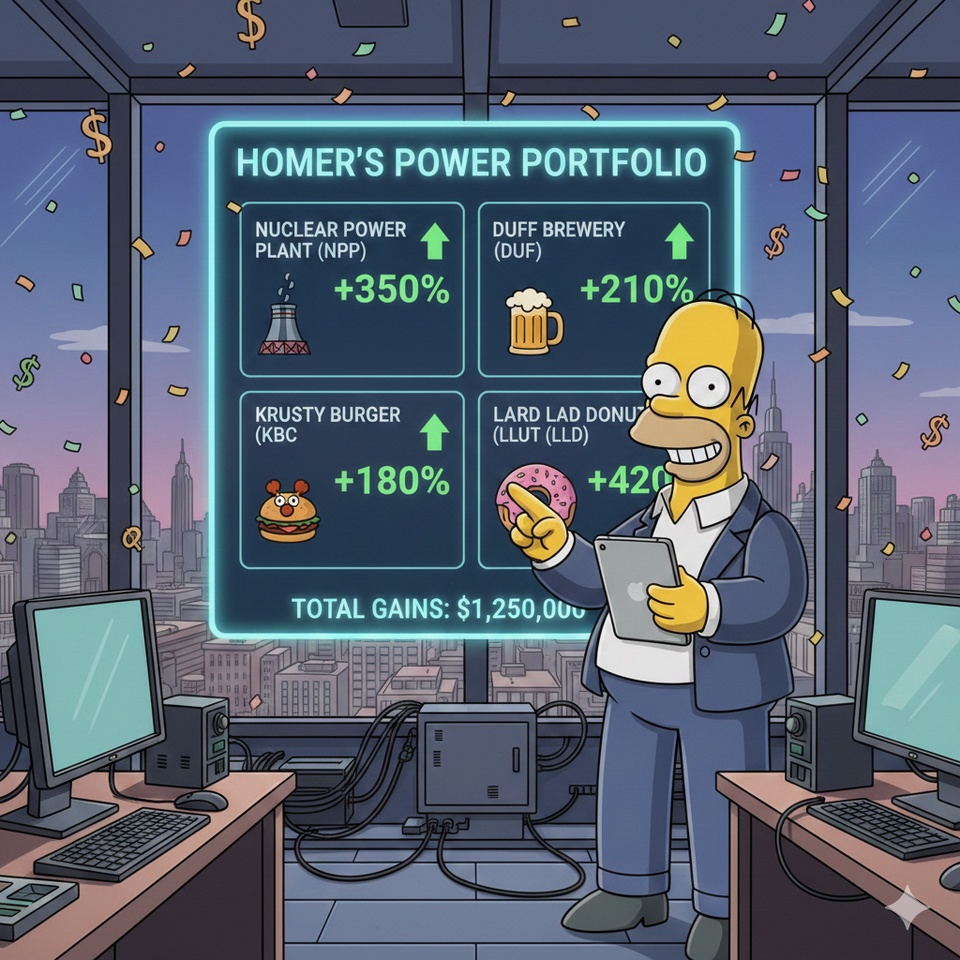
Ultimate Homer Hardcore Holding is a collection of 65 companies that’s about as diversified as if Homer Simpson had spent an evening on Wall Street—but for once, instead of just ordering donuts, he actually put together a remarkable investment strategy.
Here, Apple, Microsoft, and Alphabet meet semiconductor manufacturers, infrastructure companies, insurers, industrial giants, energy providers, and financial services firms.
The result is a mix of technology, artificial intelligence, digitalization, industrial value creation, consumer goods, healthcare, and infrastructure.
Or to put it another way: If the world decides tomorrow to become even more digital, electric, automated, and complex, this holding company wants to be in a position to bill for as much of that as possible.
The basic idea: Don’t just bet on a single trend, but own as many companies as possible that can benefit from long-term economic developments.
That said, the holding company is by no means risk-free. Its strong focus on technology, semiconductors, AI, and U.S. companies in particular also entails concentration and valuation risks.
The Magnificent 65
The Heavyweights—the Foundation of the Holding Company
1. Apple – €40,116
The iPhone company has long been much more than just a smartphone manufacturer. With the iPhone, Mac, iPad, Apple Watch, and services, Apple has a massive ecosystem with a loyal customer base. The business model: get people into the ecosystem once and, if possible, never let them leave. Homer would probably even give up his Duff for his iPhone.
2. Microsoft – €27,908
Windows, Office, Azure, and AI: Microsoft holds key positions across the digital economy. Its cloud business and AI integration, in particular, offer long-term growth opportunities. In short: When the world works on computers, Microsoft wants a piece of the action. Homer, of course, uses Excel to track his donut expenses.
3. Alphabet A – €27,609
Google’s parent company makes most of its money from advertising, search, YouTube, and the cloud. It also invests in artificial intelligence and autonomous mobility. Alphabet owns one of the most valuable digital distribution channels in the world. Homer asks Google how to get rich and gets 10 million ads for trading courses.
4. Amphenol A – €20,065
Amphenol manufactures connectors, cables, and electronic interconnect systems. These are found in cars, airplanes, communication systems, and data centers, among other places. It’s a company that ensures the digital world is connected in the first place. Without Amphenol, even Homer’s remote control might be out of a job.
5. KLA Corp – €17,099
KLA develops inspection and measurement systems for semiconductor production. Modern chips must be manufactured with extreme precision—and that’s exactly where KLA comes in. The more complex the chip technology, the more important quality control and process monitoring become. Homer also checks for quality: a donut must have at least three centimeters of frosting.
6. Berkshire Hathaway B – €16,543
Warren Buffett’s investment holding company owns stakes in and operates businesses in insurance, energy, manufacturing, transportation, and consumer goods. Berkshire stands for long-term thinking, capital discipline, and business diversity. It’s the calm counterpoint to the hectic stock market frenzy. Homer has heard that you should invest for the long term, so he’s been holding onto his shares for 20 minutes.
7. Comfort Systems USA – €16,360
The company designs and installs heating, ventilation, and air conditioning systems for commercial and industrial buildings. Large data centers, in particular, require enormous cooling capacities. Comfort Systems thus benefits indirectly from the expansion of digital infrastructure. After all, even artificial intelligence needs a functioning air conditioning system—and so does Homer, by the way.
8. AMETEK – €15,718
AMETEK develops electronic measuring instruments and industrial technologies. Its products are used, for example, in aviation, energy, medical technology, and industry. A specialist in precision and technical reliability. By the way, Homer measures his productivity with a stopwatch that’s been on pause since 1998.
9. Constellation Energy – €15,042
Constellation Energy is a major U.S. energy provider focused on low-carbon power generation, particularly nuclear energy. The rising demand for electricity driven by data centers, electrification, and industry could benefit the company. Homer also uses a lot of energy—especially for his TV.
10. Coca-Cola – €14,105
One of the world’s best-known beverage companies. Coca-Cola boasts global brands, tremendous distribution power, and a wide range of beverages. A classic consumer goods company with a global presence. Homer would say: A stock for the ages. Best served chilled.
Technology, Chips, and Digital Infrastructure
11. Arista Networks – €14,008
Arista develops high-performance networking technology for data centers and cloud providers. AI systems, in particular, require fast connections between thousands of processors. Arista provides a key part of this infrastructure. Homer has a network, too: it connects the couch, the fridge, and the TV.
12. Applied Materials – €13,791
Applied Materials manufactures equipment and technologies for the production of semiconductors and displays. Without such equipment, modern chips would be nearly impossible to produce. The company benefits from long-term investments in increasingly powerful semiconductors. Homer generally likes machines, as long as they don’t take his food away.
13. Vistra Corp – €13,278
Vistra is a U.S. energy company involved in power generation and distribution. Among other things, the company owns conventional and nuclear generation capacity. Rising energy demand makes the sector attractive. Homer takes electricity for granted—until the bill arrives.
14. Broadcom – €13,242
Broadcom develops semiconductors and infrastructure software. Network chips, custom AI accelerators, and data center technology are particularly important growth areas. This makes Broadcom a major supplier to the AI industry. Homer wants to know if Broadcom also makes chips for toasters.
15. Waste Management – €12,999
Waste Management is one of the leading U.S. providers of trash collection, recycling, and waste management. It’s a business that’s needed even in economically challenging times. After all, humanity reliably produces trash. Homer considers this one of his core areas of expertise.
16. Lam Research – €12,670
Lam Research supplies equipment for semiconductor production, particularly for etching and deposition processes. These technologies are crucial for ever-smaller and more complex chip structures. Another bet on the growing importance of semiconductors. Homer doesn’t understand how the chips work, but he likes the packaging.
17. Nasdaq – €12,611
Nasdaq operates stock exchanges and offers financial market technology, data, and analytics products. The company earns revenue from the capital market’s infrastructure. Whether investors are buying or selling, Nasdaq often provides the technical platform. Homer thinks that’s brilliant—finally, someone is making money when others get nervous.
18. ASML Holding – €12,256
ASML is the key Dutch supplier to the global chip industry. The company’s EUV lithography systems enable the production of state-of-the-art semiconductors. An exceptional technological market position. Homer calls it a money-printing machine, even though ASML actually builds machines for chip production.
19. Linde – €11,815
Linde produces and distributes industrial gases such as oxygen, nitrogen, hydrogen, and specialty gases. The products are used in the medical, chemical, metal processing, and semiconductor industries, among others. An unassuming but important infrastructure component of the economy. Homer is particularly interested in oxygen—without it, even watching TV would be difficult.
20. Salesforce – €11,806
Salesforce is a leading provider of cloud software for customer management and business processes. Companies use it to manage customers, sales, marketing, and service. AI features are designed to further enhance the platform. Homer would use Salesforce to create a database of his favorite donut shops.
21. Arthur J. Gallagher & Co – €11,792
An international insurance broker and risk consultant. Gallagher helps companies and organizations analyze risks and find suitable insurance solutions. A business model that thrives on the need for coverage and professional risk management. Homer would take out insurance here against exploding grills.
22. Allianz – €11,700
The German insurance giant is one of the world’s leading insurance and asset management groups. Allianz generates revenue through insurance, retirement planning, and investment management. It represents an important European holding in a portfolio that is otherwise heavily weighted toward the U.S. Homer is relieved: At least his financial ruin is now insured.
23. United Rentals – €11,393
United Rentals is a major rental company for construction machinery, aerial work platforms, and industrial equipment. Businesses can flexibly rent expensive machinery instead of owning it themselves. The company benefits from construction projects, infrastructure investments, and industrial activity. Homer would probably rent an excavator to expand his garage.
24. JPMorgan Chase – €11,182
One of the world’s largest banks. JPMorgan is active in retail banking, investment banking, corporate banking, and wealth management. The bank generates revenue from lending, financial transactions, and capital market activities. Homer only goes to the bank when his account once again needs a serious talk.
Consumer Goods, Services, and the Real Economy
25. McDonald’s – €9,901
A global restaurant chain with enormous brand recognition and a heavily franchise-oriented business model. McDonald’s benefits from standardized processes and a global presence. Homer views the stock as a strategic investment in his personal food supply.
26. Cintas – €9,835
Cintas provides companies with workwear, uniforms, laundry and hygiene services, as well as fire safety solutions. Many customers require these services on a regular basis. A recurring service business with a B2B focus. While Homer owns work clothes, getting them cleaned is another story.
27. Republic Services – €9,614
A major U.S. provider of waste management, recycling, and environmental services. Similar to Waste Management, Republic Services benefits from a basic need that is always present. The holding company thus has two specialists in a field Homer knows particularly well: producing trash.
28. Tetra Tech – €9,441
Tetra Tech is a consulting and engineering firm specializing in water, the environment, infrastructure, and resource management. It supports public and private clients on complex technical projects. Homer would hire the company to finally plan Springfield properly.
29. Amazon.com – €9,430
Amazon combines e-commerce, logistics, cloud computing, and digital services. AWS, in particular, is a significant part of the company and the digital infrastructure. So Amazon makes money not only from packages but also from the cloud that other companies use. Homer loves Amazon: The fridge is empty, but the credit card works.
30. Deere & Co – €9,215
Deere is known for tractors, agricultural machinery, and smart farming technology. Modern agriculture is becoming increasingly automated and digitized. Precision farming and autonomous machines are opening up new possibilities. Homer thinks tractors are great vehicles—especially when he doesn’t have to drive them himself.
31. Intercontinental Exchange – €8,859
ICE operates stock exchanges and financial market infrastructure, including the New York Stock Exchange. It also provides data and technology services. The company earns revenue from the infrastructure that enables global trading in financial products. Homer wants to know if you can trade donuts there, too.
32. Caterpillar – €8,778
Caterpillar manufactures construction machinery, mining equipment, engines, and power generation systems. The machinery is used in infrastructure projects and in the extraction of raw materials. It’s a company that literally works on the construction site of the global economy. Homer would buy a Cat excavator—and probably ruin his yard with it.
33. Westinghouse Air Brake Technologies – €8,710
Wabtec develops braking systems, components, and digital solutions for rail vehicles. Rail transportation requires safety, reliability, and modern technology. The company benefits from investments in rail transportation and its modernization. Homer prefers to drive a car, but his stock, of course, rides the train.
34. S&P Global – €8,480
S&P Global provides financial information, ratings, indices, and market data. The S&P 500 is arguably one of the world’s best-known stock indices. The company earns revenue from the information and ratings that investors and companies need. Homer would like a credit rating: Category “Donut Junkie.”
35. Visa – €8,370
Visa operates one of the world’s largest payment networks. The company facilitates electronic payments between merchants, banks, and customers. It generates revenue from the payment infrastructure without having to issue traditional loans itself. Homer pays for everything with Visa—even things he can’t really afford.
36. NVIDIA – €8,329
NVIDIA is one of the leading providers of graphics processors and AI accelerators. Its technology is used in data centers, artificial intelligence, gaming, and simulations. It’s a key player in the AI boom. Homer wonders if AI can also file his tax return. The answer is probably: better not.
37. Roper Technologies – €8,214
Roper owns and develops specialized software and technology companies. Many products serve narrowly defined industries and critical business processes. The business model relies on specialized solutions and recurring revenue. Homer loves software when it tells him when his next lunch break starts.
38. MSCI Inc – €7,670
MSCI is known for stock indices, risk analysis, and investment data. Many funds and institutional investors use MSCI indices as a benchmark. The company earns revenue by providing financial data and analytical tools. Homer would launch his own index: the Donut Performance Index.
39. Teledyne Technologies – €7,615
Teledyne develops highly specialized sensors, measuring instruments, cameras, and electronic systems. Its products are used in aviation, industry, science, and defense, among other fields. A specialist in technical niches with demanding customers. Homer thinks sensors are unnecessary—until his car beeps.
40. Quanta Services – €7,144
Quanta builds and maintains power grids, energy infrastructure, and telecommunications networks. Electrification and the expansion of the power grid could create long-term demand. In other words, the company builds the lines that keep a modern economy running. Homer is thrilled—as long as the power doesn’t cut off the TV.
41. Oracle – €6,925
Oracle offers database software, enterprise applications, and cloud infrastructure. Many large companies use Oracle for business-critical IT systems. The company is trying to expand its cloud presence and capitalize on rising demand for computing power. Homer prefers to store his donut orders in a database rather than in his memory.
42. HCA Healthcare – €6,343
HCA Healthcare operates hospitals and medical facilities in the U.S. and the U.K. The company is thus directly involved in the healthcare sector. Demand for medical care remains steady, though there are cost, staffing, and regulatory risks. Homer is a regular customer—though more by necessity than by choice.
43. American Express – €6,337
American Express combines a payment network, credit cards, and financial services. The company has a particularly strong brand in the premium customer segment. It benefits from card payments and its customers’ spending. Homer would love to have a Platinum Card. His credit score, however, has other ideas.
44. Automatic Data Processing – €6,131
ADP offers payroll, personnel management, and HR software for businesses. Payroll and personnel administration are essential business processes. This creates an interesting, recurring service model. Homer knows: Paycheck is important. Especially the part that’s left after all the deductions.
45. BlackRock – €5,521
BlackRock is one of the world’s largest asset managers. The company offers funds, ETFs, and institutional investment solutions. With its iShares brand, BlackRock also has a massive presence in the ETF business. Homer owns BlackRock; BlackRock owns what feels like half the financial world—a nice division of labor.
46. Sterling Infrastructure – €5,513
Sterling Infrastructure is active in the construction and development of infrastructure projects. Among other things, the company works on transportation, e-infrastructure, and construction projects. This means it plays a role in the physical foundation of economic growth. Homer could finally have his garage professionally expanded.
47. Union Pacific – €5,504
Union Pacific operates one of North America’s major freight rail networks. Raw materials, industrial products, and consumer goods are transported over long distances. It’s a vital backbone of American logistics. Homer may prefer to drive himself, but for the economy, a freight train is sometimes the better solution.
48. EMCOR Group – €4,802
EMCOR provides technical building services and electrical, mechanical, and industrial systems. The company installs and maintains complex technical systems in buildings and industrial projects. Data centers and infrastructure also play a role here. Homer would call EMCOR if his air conditioner started smoking again.
49. Jabil – €4,708
Jabil is a global manufacturing services provider. The company produces and develops components and assemblies for numerous industries, including electronics, healthcare, and manufacturing. It thus bridges the gap between the technological concept and the finished product. Homer would love to have Jabil build his own donut machine.
50. Vertiv Holdings A – €4,576
Vertiv provides power, cooling, and infrastructure technology for data centers and critical IT systems. AI data centers require enormous amounts of energy and cooling. Vertiv is therefore a major indirect beneficiary of the expansion of AI. Homer also needs cooling—for his donuts and, occasionally, for his head.
51. Honeywell Aerospace – €4,511
Honeywell Aerospace specializes in avionics, aircraft engineering, engine components, and other systems for the aviation industry. The industry requires reliable and highly specialized technology. A position focused on technological advancements in air travel. Homer loves to fly—especially when the food is free.
52. Hitachi – €4,502
The Japanese industrial conglomerate operates in numerous sectors, including energy, rail technology, IT, and industrial systems. Hitachi combines traditional industry with digitalization and infrastructure. A diversified technology and industrial conglomerate. Homer isn’t particularly familiar with Hitachi, but the logo looks professional.
53. Solstice Advanced Materials – €4,490
Solstice develops specialty materials and chemical solutions for applications in industry, electronics, energy, and other markets. Such materials are often invisible but crucial components of modern products. An investment in specialty materials and technological applications. Homer hopes that Solstice will also develop indestructible donut packaging.
54. Parker-Hannifin – €4,335
Parker-Hannifin produces motion and control technologies, including hydraulics, pneumatics, filtration, and sealing systems. Its products are found in machinery, aircraft, and industrial equipment. A major supplier to global industry. Homer would say: As long as it moves, that’s what matters. And if it doesn’t, there’s Parker.
55. NextEra Energy – €4,170
NextEra Energy is a major U.S. energy company active in power generation and renewable energy. Wind and solar energy are among its key business areas. The energy transition and growing demand for electricity present opportunities, but also entail investment and interest rate risks. Homer likes renewable energy—especially when it powers the refrigerator.
56. Hubbell – €3,966
Hubbell manufactures electrical components and infrastructure products, such as those for power grids, buildings, and industry. The modernization of the energy supply could create demand in the long term. A classic infrastructure supplier. Homer has no idea how an electrical outlet works. But he knows it has to work.
57. TransDigm Group – €3,270
TransDigm manufactures specialized components for the aviation industry. These include technical systems and replacement parts used in commercial and military aircraft. The company focuses on demanding niche markets. Homer may not own an airline, but at least he now owns a small piece of aircraft technology.
58. Martin Marietta Materials – €2,811
Martin Marietta produces construction materials such as crushed stone, sand, gravel, and concrete products. These materials are essential for roads, buildings, and infrastructure. It’s a business closely tied to construction activity and public investment. Homer finds crushed stone boring—until he needs a foundation for his pool.
59. Kioxia Holdings – €2,640
Kioxia is a Japanese specialist in NAND flash memory. The technology is found in SSDs, smartphones, data centers, and numerous electronic devices. The rising demand for data storage is a key driver. Homer also has a memory: unfortunately, he just regularly forgets where he put it.
60. NXP Semiconductors – €2,412
NXP develops semiconductors for automotive, industrial, communications, and security applications. Automotive chips and systems for connected devices are particularly important areas. Another position betting on the growing use of electronics in the real world. Homer wants a smart car—so it can drive him to work on its own in the future.
61. Munich Re – €2,338
Munich Re is one of the world’s leading reinsurers. It insures insurance companies against major risks such as natural disasters and other large-scale losses. It’s a complex but important business model in the global financial sector. Homer thinks reinsurance is overkill—until his house is hit by a meteorite.
62. Tokyo Electron – €2,132
Tokyo Electron develops production equipment for semiconductors and displays. The company is a key supplier to the global chip industry. It thus complements ASML, Lam Research, KLA, and Applied Materials in the portfolio. Homer recognizes a pattern: Many companies sell machines that manufacture other machines for computer chips.
63. Fujikura – €1,726
Fujikura produces cables, fiber-optic technology, and connectivity solutions. Fiber optics and data transmission infrastructure are particularly important areas of application. The company stands to benefit from growing demand for communication networks and data centers. Homer likes cables—as long as he doesn’t trip over them.
64. Ebara Co – €1,558
Ebara is a Japanese industrial conglomerate that manufactures, among other things, pumps, compressors, and equipment for the semiconductor industry. Its products are used in water management, energy, and industry. A small but interesting industrial holding. Homer wants a pump for his pool—and Ebara might be the right place to look.
65. Cummins – €1,242
Cummins is a long-established manufacturer of engines, power generation systems, and propulsion technologies. The company is also increasingly developing alternative propulsion solutions. Commercial vehicles, industry, and energy supply are particularly important markets. Homer loves engines—especially when they power the refrigerator.
What makes the Ultimate Homer Hardcore Holding special?
The holding company has several notable areas of focus.
1. The AI and Semiconductor Portfolio
Apple, Microsoft, Alphabet, NVIDIA, Broadcom, ASML, KLA, Lam Research, Applied Materials, Amphenol, Arista, Vertiv, Tokyo Electron, and others.
This represents a comprehensive stake across the entire digital value chain—from chip production to the cloud
2. Energy and Electrification
Constellation Energy, Vistra, NextEra Energy, Quanta Services, Hubbell, and Linde.
The world needs electricity, power grids, and energy infrastructure. These companies cover different aspects of this development.
3. The Real Economy
Caterpillar, Deere, United Rentals, EMCOR, Sterling Infrastructure, Martin Marietta, Parker-Hannifin, and Union Pacific.
Machinery, building materials, transportation, and infrastructure. Here, work isn’t just done digitally—it’s actually being built.
4. Finance and Insurance
Berkshire Hathaway, Allianz, JPMorgan, BlackRock, Visa, American Express, MSCI, S&P Global, Nasdaq, ICE, Gallagher, and Munich Re.
The holding company thus also stands to profit from payment transactions, asset management, capital markets, and risk management.
5. Consumer Goods and Daily Necessities
Coca-Cola, McDonald’s, Amazon, Cintas, Waste Management, Republic Services, and others.
Companies whose products and services are needed in everyday life. Even when the stock market is in a slump, people still eat, shop, and produce waste.
The Official Conclusion
The Ultimate Homer Hardcore Holding is no ordinary stock portfolio.
It is a collection of 65 companies operating in many critical sectors of the global economy.
It owns companies that manufacture chips, supply electricity, transmit data, construct buildings, equip airplanes, sell food, process payments, and even dispose of our trash.
It focuses on technology, but not exclusively. It invests in future trends, yet does not overlook traditional industry and everyday consumption.
With a portfolio value of approximately 627,153 euros and a reported performance to date of 59.30%, the holding company has already demonstrated remarkable growth.
Ultimate Homer Hardcore Holding – In Homer We Trust.


Today is my last day at work! Tomorrow marks the start of a new chapter in my life. And apparently, Rockstar Games timed its release perfectly to coincide with that. 😎
Joking aside: My investment portfolio is supposed to support me going forward.
Some of you are familiar with my posts about the “lifeline.” In light of geopolitical tensions, rising national debt, and the end of my career, I’ve now focused my portfolio even more on safety. Over the past few weeks, I’ve sold off some individual holdings and further simplified my portfolio.
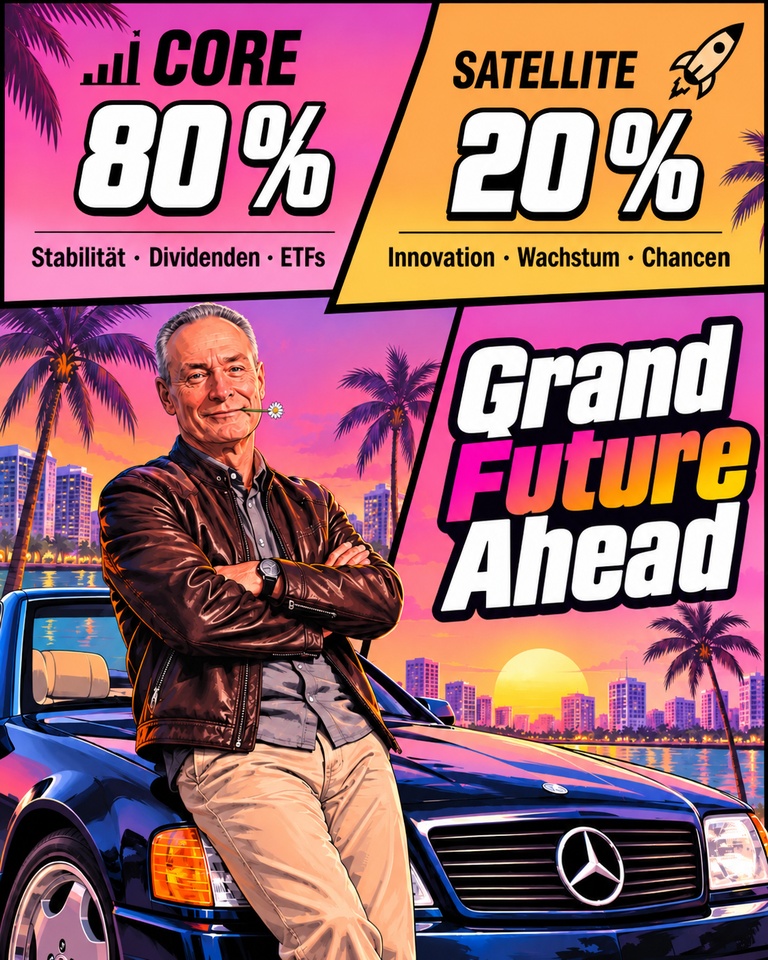
The result: 80% Core, 20% Satellite.
🛡️ CORE – 80% | Stability, Dividends, ETFs
The foundation consists of broadly diversified ETFs with different focuses. My key components and their shares of the total portfolio (slightly rounded up or down):
Dividends are reinvested. The Core portfolio is intended to grow steadily through savings plans and occasional profit-taking from the Satellite portfolio.
🚀 SATELLITE – 20% | Innovation, Growth, Opportunities
My belief in future technologies remains unwavering. Where rising demand meets limited capacity, opportunities arise for companies with specialized capabilities: semiconductor manufacturing, AI infrastructure, energy, power grids, photonics, automation, and aerospace. That is precisely what my NGT strategy and my ScaleLimits wikifolios are all about.
There, I focus on fewer, but particularly promising, companies. Many of these stocks have recently lost significant value. In my view, we are currently witnessing, above all, a revaluation of future expectations, while the fundamental growth drivers remain largely intact . That’s why I think it’s quite possible that the current period of weakness will be followed by another phase of significant price gains.
‼️ I’m not reducing my conviction. I’m just reducing their share of my portfolio. ‼️
🎯 Less complexity. More freedom.
I want to combine growth and security in a way that frees me from constantly having to manage my personal portfolio. Because my most important resource now is time, and in the future, I want to devote that time to the things that bring me joy.
And the Mercedes R129 in the picture? I’ll buy that when—hopefully—the NGT stock goes up again. 😉
New chapter in life. New level. A Grand Future Ahead. 🌴
I have a question for the dividend pros here. If you were to pick 5—or at most 10—top dividend stocks—that is, stocks with high dividend yields that also deliver steady long-term price appreciation—which ones would they be? Preferably with a net yield, excluding one-time special dividends. And very importantly, without having to deal with foreign customs or tax authorities to reclaim taxes.
And it shouldn’t be an ETF like the $TDIV (-1,82%) .

I think a lot of people just don't want to look at it and would rather keep scrolling because they don't want to hear about what happened over 20 years ago. Maybe it's also because they believe you can't compare that time to today.
But that's not the point.
A brief look back at stock market history for you
Over 20 years ago, the world was different. Education was different, technology was different, the mindset was different, the financial world was different, industry was different, and so on.
History is history, but we can still learn from it. It’s not just investors who do this—entrepreneurs and entire nations do as well. We look to the past to better position ourselves for the future and, as much as possible, avoid repeating the same mistakes.
But there’s never 100% certainty.
In ancient Rome, 2,000 years ago, no one would have imagined that 1,400 years later, people would in some cases be walking through muddy streets again—even though the Romans had long since built paved roads and sewer systems.🏛️
And 500 years later? Rockets from $SPCX (-3,85%) landing back on Earth on their own.
So what happened after the dot-com bubble burst?
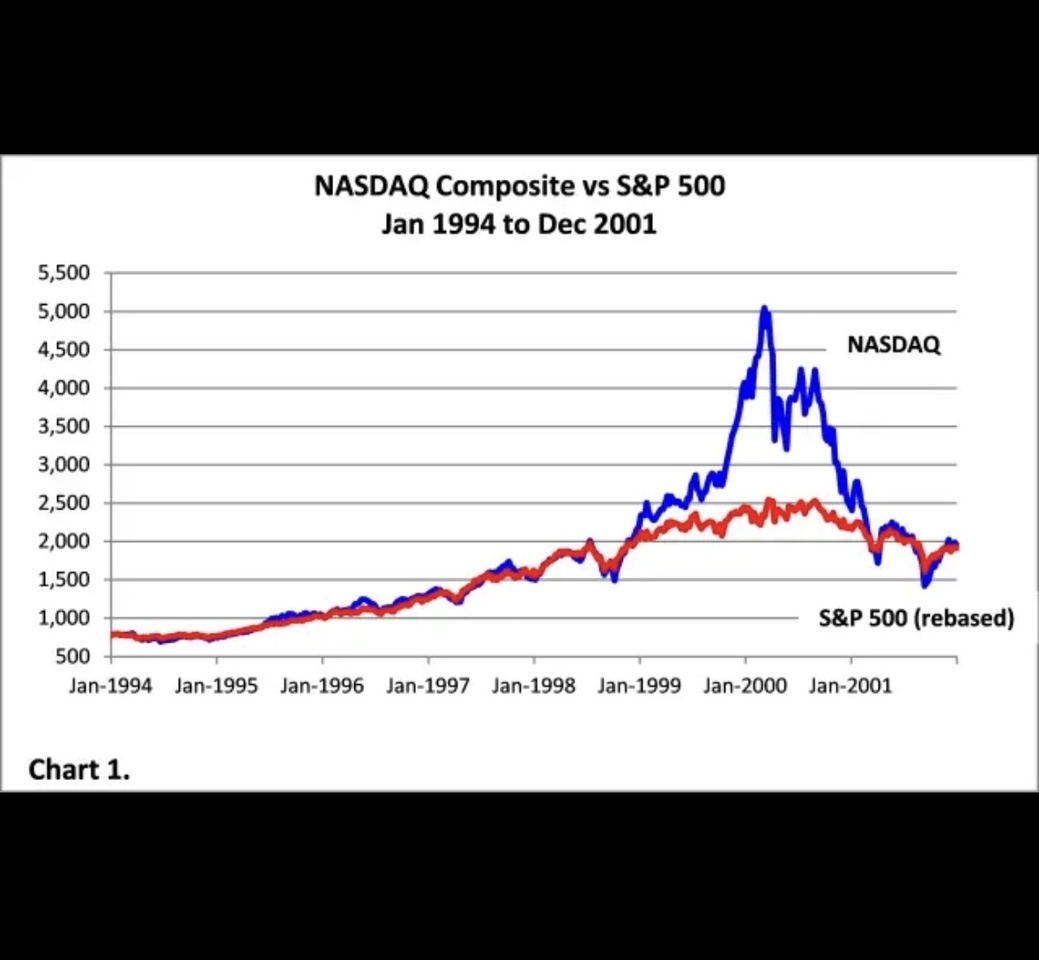
After the dot-com bubble peaked in March 2000, the Nasdaq went into a downward spiral for nearly two and a half years.
To recap briefly:
By October 2002, the Nasdaq Index had lost about 78% of its value.
Microsoft was one of the world’s largest technology companies at the time. The company dominated the PC market with Windows and Office. Nevertheless, its stock lost a massive amount of value. Antitrust proceedings also weighed on the company.
The company continued to make money, kept evolving, and built out new business areas in the years that followed. Later, the cloud business—particularly Azure became a key growth driver.
Amazon was still primarily an online retailer at the time. During the crash, the company temporarily lost over 90% of its market value. Many investors doubted whether Amazon would even survive in the long term. But Amazon survived.
The company improved its cost structure, posted an annual profit for the first time in 2003, and over the next few decades grew into one of the world’s largest corporations. In 2006, AWS—which would later become the cloud business.
Apple had gone through some difficult years. Steve Jobs had returned in 1997, and the iMac was released in 1998. But the big breakthrough didn’t come until after the crash. The iPod followed in 2001, and the iPhone in 2007.
Nvidia didn’t go public until 1999. At the time, Nvidia was known primarily for graphics chips. Nvidia, too, was hit hard by the crash. While many other companies disappeared, Nvidia continued to develop its technology. Over the decades, the former graphics card manufacturer evolved into one of the world’s leading semiconductor companies. After the crash, it took Nvidia 6 years—
At that time Google, now Alphabet $GOOGL (-2,91%) wasn’t even publicly traded during the crash. The company was founded in 1998 and didn’t go public until 2004—right in the middle of the recovery phase. With Google’s search engine and advertising business, GOOGL became one of the largest technology companies.
Cisco
$CSCO (-2,84%) manufactured routers and network switches during the dot-com bubble that were crucial for the expansion the Internet. The company was thus among the biggest beneficiaries of the Internet boom at that time.
Similar to today’s suppliers? Perhaps not.
Cisco was at times the most valuable company during the dot-com bubble. When the bubble burst, the stock lost about 89% of its value.
It wasn’t until about 25 years later (last year) that the stock reached its all-time high from back then again!
The interesting thing is that the Internet didn’t disappear just because the dot-com bubble burst. On the contrary. The Internet became increasingly important—and even more so. It’s just that expectations for many companies back then were far too high.
And what about the other industries?
While many tech stocks plummeted, there were also companies that weathered this period relatively well.
Coca-Cola
$KO (-1,66%) is a good example of how even outstanding companies are no guarantee of rising stock prices. The stock had already experienced a massive surge even before the dot-com crash. Over the preceding decades, Coca-Cola had delivered exceptional returns to its shareholders. In 1998, the stock reached its peak at that time. The P/E ratio was at times over 50. Coca-Cola then lost about half of its market value.
Not because suddenly no one wanted to drink Coca-Cola anymore, but because… you know. A P/E ratio of 50 is already a good clue.
What happened to the big banks?
While the tech sector was under pressure, many banks initially performed significantly better. JPMorgan
$JPM (-1,29%), Bank of America
$BAC (-1,14%) and Wells Fargo
$WFC (-0,78%) were among the big names in the American financial sector.
Traditional banking continued as usual. People needed loans, companies needed financing, and the banks continued to earn money from interest and fees.
However, not all banks followed the same trajectory.
Investment banks, in particular, were also affected by the collapse of the financial markets. In the years that followed, the banking sector increasingly benefited from the economic recovery, lending, and the booming real estate market.
By 2006 and 2007, respectively, many bank stocks had posted strong gains.
And then it came… 2008, the financial crisis.
But that’s not the topic here
And traditional industries?
Things kept moving forward outside the tech sector as well. Companies like Caterpillar
$CAT (-3,93%), 3M
$MMM (-1,36%) and General Electric
$GE (-2,85%) were already big names back then.
In particular, Caterpillar benefited in the years following the crash from rising demand for construction equipment, raw materials, and infrastructure. China’s economic boom and industrialization played a key role in this.
General Electric , on the other hand, was an example of how size alone offers no protection. The conglomerate was one of the world’s most valuable companies in 2000, but it also struggled with a high valuation and, later, with problems in its financial division.
$GE (-2,85%) It reached its all-time high again in 2007.
The global economy continued to grow, new investments were made, and other sectors came more into focus.
How did the stock markets perform?
After hitting a low in October 2002, a new uptrend began. The S&P 500 and the Dow
Jones rebounded in the following years and reached new highs again in 2007.
The Nasdaq, on the other hand, took significantly longer. The Nasdaq reached its March 2000 high as late as 2015 .
This means that investors who were at the peak had to wait about 15 years for a full nominal price recovery.
How expensive was the Nasdaq-100 back then?@Simpson
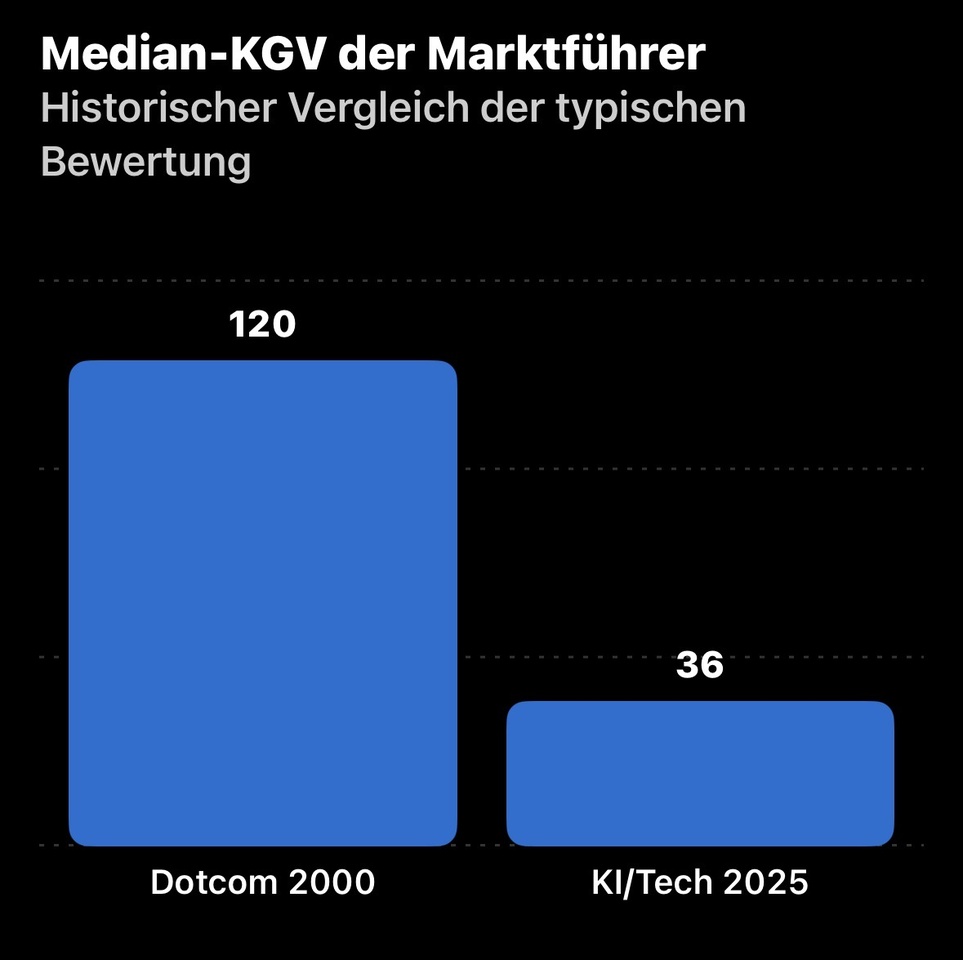
The Nasdaq itself has published an interesting historical comparison on this topic. At the end of 1999, the estimated P/E ratio of the Nasdaq-100 was already at approximately 104! At its peak in early 2000, the P/E ratio may even have been between 150 and 200 .
I know I said this isn’t about comparisons, but here’s a quick one:
For comparison: In November 2025 , the P/E ratio hovered around the low 30s. It is important to note, however, that the 150 to 200 figure is a historical estimate by Nasdaq and not an exact observed peak.
The valuations of tech companies at that time were therefore, in some cases, significantly more extreme than the valuations we have seen in recent years.
It’s also interesting to look at the inflation-adjusted Shiller P/E ratio.
The so-called CAPE takes into account the average, inflation-adjusted earnings of the past ten years.
While the standard P/E ratio primarily considers current earnings, the Shiller P/E ratioattempts to somewhat smooth out short-term earnings fluctuations.
And this is where it gets interesting.
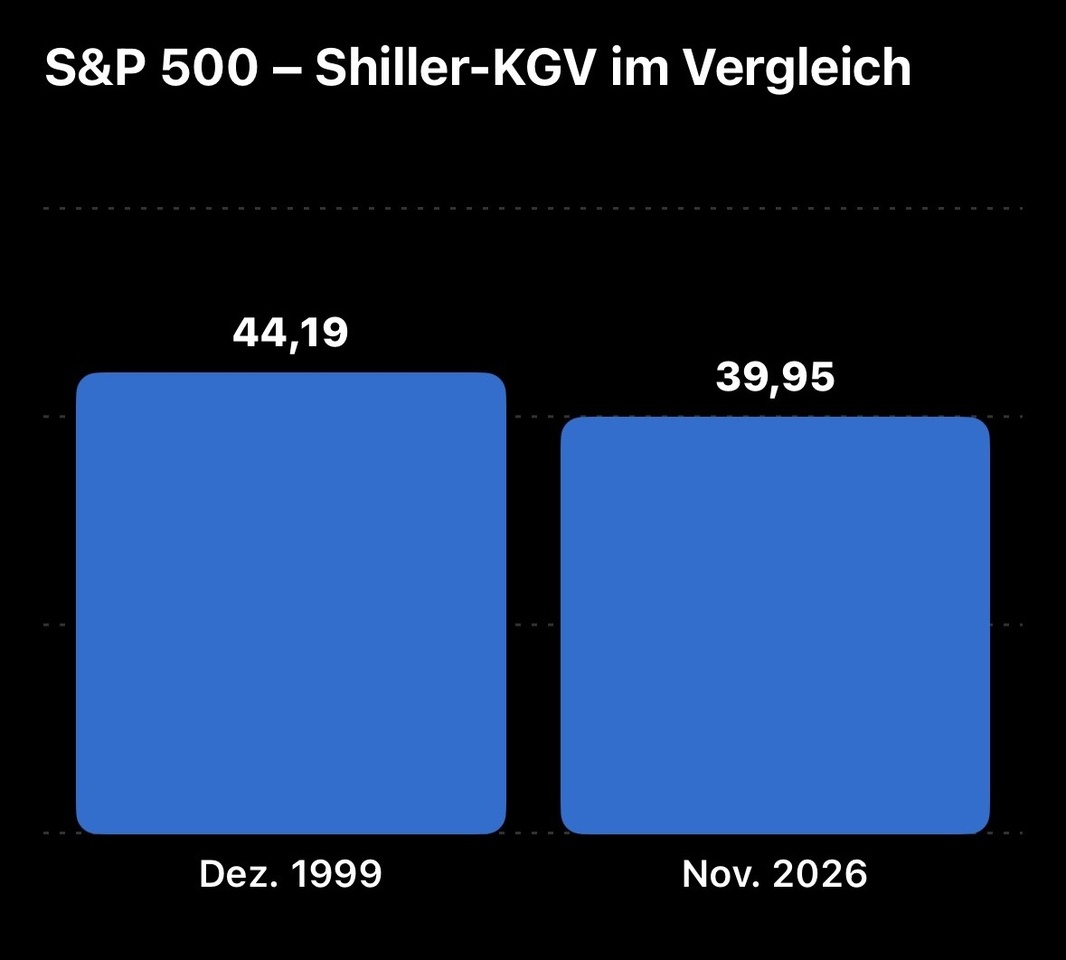
In November 2026 , the Shiller P/E ratio for the overall U.S. market stands at approximately 40. The all-time high during the dot-com era was about 44.2.
This means the overall U.S. market’s Shiller P/E ratio is only about 10% below the record set back then.
This does not automatically mean that a crash is imminent. But it does show that, from a historical perspective, the U.S. stock market is very highly valued.
Another interesting point:
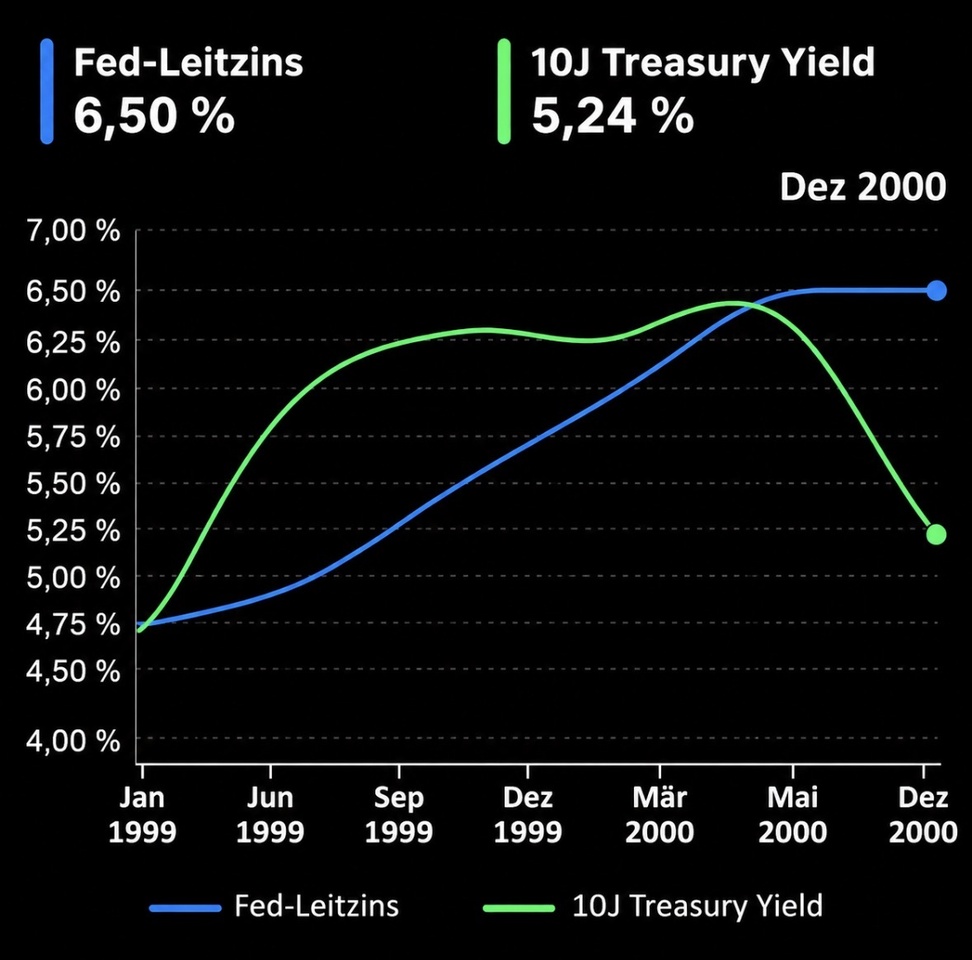
U.S. key interest rates were raised between June 1999 and May 2000 a total of six times.
The Federal Reserve began lowering interest rates on January 3, 2001.
And that’s exactly why I think it’s important to remain open to all information—even if we might not want to hear about the past.
What can we learn from this?
Everyone learns for themselves, but I think you should really dig into the material, especially if young investors are just after the big money.
If a headline with the word “dot-com” already gives you goosebumps and you’d rather keep scrolling, then maybe you should ask yourself how well you handle risk in the stock market . Perhaps a broadly diversified ETF would actually be the better choice for some.
That said, even ETFs offer no guarantee against price losses. If the entire market crashes, the corresponding ETFs will naturally lose value as well.
The stock market isn’t just made up of rising prices. Not every major innovation is automatically a good investment. And not every stock market crash means the end of a major innovation.
Sooner or later, we’ll experience another one anyway. And then at least we’ll all be in it together.
Thanks for reading :)
A Brief History of the Stock Market:
First off:
This is a look back at what happened during the dot-com bubble. No comparison
In 1969, with the ARPANET . Initially, it was intended primarily for researchers and universities. It wasn’t until much later…
in the early 1990s, the World Wide Web became accessible to more and more people. And that marked the beginning of a truly new era.
Companies slowly began to realize what the Internet could make possible.
Selling products, reaching customers, advertising... all online.
The U.S. economy was doing quite well in the 1990s; unemployment was falling, and optimism reigned on the stock market. Things really took off in the mid-1990s.
Suddenly, everyone wanted to be part of the be part of the . Start-ups went public, some without ever having turned a profit. Many of these companies invested huge sums in advertising, employees, and growth. The only problem was: Revenue often couldn’t keep up with costs, and debt piled up.
Good examples: Pets.com, Webvan, eToys.com— wiped out of the stock market.
Nevertheless, valuations continued to rise. Hopes for the future was, in some cases, worth more than the actual business!
Warren Buffett and Charles Munger steered clear of ".com" in the name
A Few Big Players in 1999–2000
Today’s Big Players: 1999–2000
And then came the crash...
In March 2000 , sentiment took a turn for the worse. The Federal Reserve had raised interest rates, many stocks were overvalued, and investors began to question whether the promised profits were even realistic and whether companies could cover their investment debt .
After the crash, it became difficult for many young companies to raise new capital. Without capital, they could not continue. Bankruptcies and massive stock price declines followed.
The Internet hadn’t failed… but expectations for many Internet stocks were too high.
The Nasdaq lost in March 2000 until it hit its low in October 2002 approximately 78 percent! Read that again...
The S&P 500 lost -49% and the Dow Jones fell by -38%. You can probably guess why... the tech weighting in each index
Not all stocks fell by the same amount. Walmart
$WMT (-0,79%) (-37%) continued to sell groceries and everyday items, Coca-Cola $KO (-1,66%) (-55%) continued to sell beverages. Businesses like these were less dependent on whether the internet would change the world. Nevertheless, every company was affected. JPMorgan Chase
$JPM (-1,29%) (-72%), on the other hand, was more heavily dependent on the overall economy and the financial markets. Banks, too, came under pressure.
Who fared better? 2000–2002
Winners of the crisis?
So you can see: Outside of the tech sector, you weren’t automatically safe. What mattered was how each company made its money and how highly its stock had been valued previously.
What else happened, by the way
In 2001, the U.S. slipped into a recession. On top of that, the terrorist attacks of September 11, 2001, further shook confidence. So the stock market wasn’t just dealing with the bursting dot-com bubble .
How long did the recovery take?
The Nasdaq didn’t reach its 2000 high again until 2015—15 years later.
The S&P 500 managed to do so as early as 2007, before the next financial crisis struck. — Excluding dividends
What were Warren Buffett and Charles Munger doing at that time?
In his 1999 letter to shareholders, Buffett explained, in essence:
“We believe that technology companies will change society. But we don’t know which companies will have a sustainably superior competitive advantage.”
So... he and Munger simply didn’t want to gamble on hope.
What did Buffett and Munger buy instead?
In late 1999—that is, before the crash—he and Charlie Munger bought:
Coca-Cola: $11.6 billion
American Express $AXP (-1,46%)
: $8.4 billion
Gillette (P&G says hello): $3.95 billion
Wells Fargo $WFC (-0,78%)
: $2.39 billion
Berkshire has been criticized for being out of touch because it largely ignored the tech boom.
Image generated with AI :)