Iris Energy
Price
Discussão sobre IREN
Postos
314800€ IREN topped up 🚀
I added another €800 today $IREN (+1,77%) more today. The sell-off was more of an opportunity for me than a reason to panic. I now hold 44 shares. The target is still 50 shares.
The drop today had little to do with the actual situation of the company. It looks very much like a large seller was forced to reduce positions. The volume was more than twice as high as normal, and yet the price held above $40 in the end. So someone with a lot of capital sucked up everything that was thrown on the market.
To me, the whole thing looks more like a technical effect that has now run its course. When it calms down, things should settle down again. I expect that we will see the upper 40s again relatively quickly, and when the big partnerships become official, we could see another spike.
In any case, I'm sticking with it and will probably add more shares in the next few days to fill up my 50 shares
Community project & crypto gnaw at returns
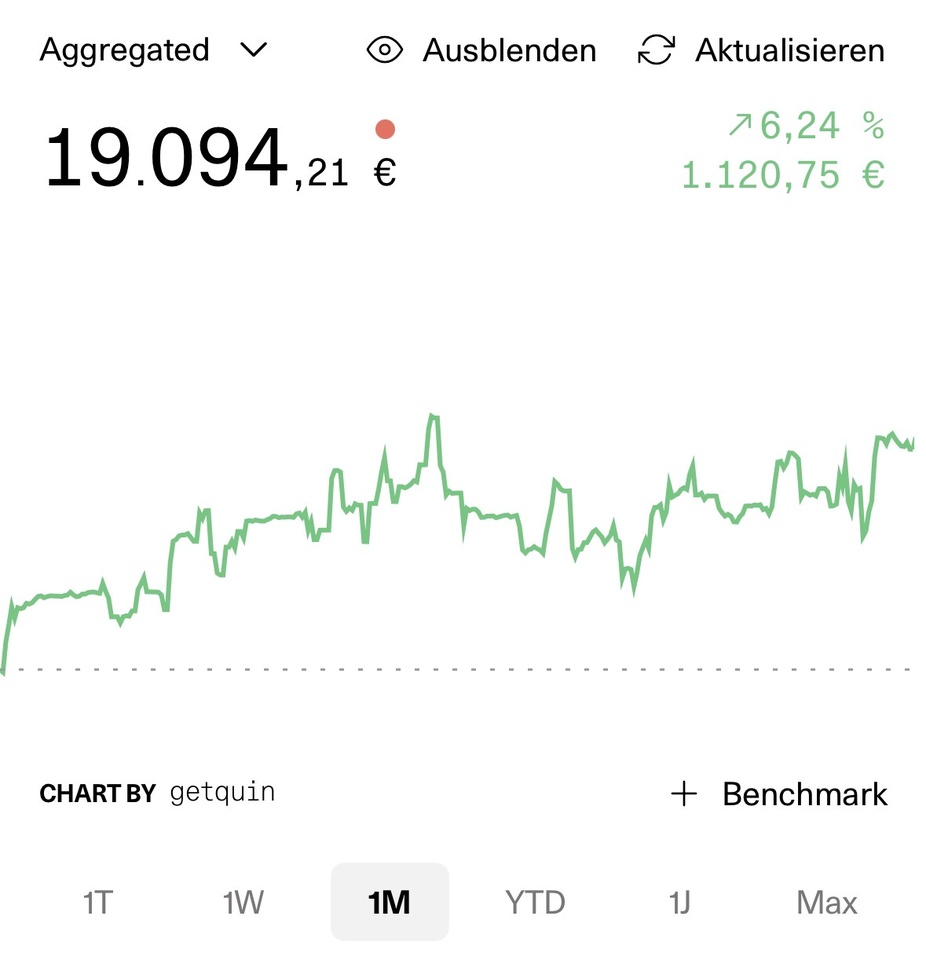
I also have to show a red November.
Both the community project "Tenbagger of the future", consisting of $IREN (+1,77%)
$HIMS (+0,93%)
$PNG (+0,58%)
$SOFI (+1,07%) and $RKLB (+0,55%) as well as the two crypto assets $BTC (+0,81%) and $ETH (+2,06%) have not exactly led to a positive return - quite the opposite. Thanks to $GOLD however, the month was not quite so red. Fortunately.
Let's see how December turns out 😁
You have to expect that!
He @Aktienfox was faster, of course, because he has a few hours' head start 😎😂.
Nevertheless, here is also what Investing $IREN (+1,77%) writes.
Investing.com - The share of IREN Limited (NASDAQ:IREN) fell 7% in after-hours trading on Monday after the company announced its intention to issue $2 billion of convertible senior notes in a private placement to qualified institutional buyers.
The planned offering consists of US$1 billion of convertible senior notes due 2032 and an additional US$1 billion due 2033. IREN also intends to grant initial subscribers options to purchase up to US$150 million of additional notes of each series within 13 days of the offering.
The bonds are senior unsecured notes with semi-annual interest payments. Bondholders have the right to convert the bonds under certain circumstances, with IREN having the option to settle the conversion in cash, common stock or a combination of both.
At the same time, IREN announced a registered direct placement of common shares to fund the repurchase of a portion of its outstanding convertible bonds due 2029 and 2030. The Company expects the proceeds from this equity offering to be approximately equal to the cash required for these repurchases.
IREN intends to use the net proceeds from both offerings to fund capped call transactions, to repurchase existing convertible bonds and for general corporate purposes. The capped call transactions are intended to reduce the potential dilution of the ordinary shares upon conversion of the new bonds.
Irish: IVES AI list + 2 billion convertible note
$IREN (+1,77%) was added to the Dans IVES AI 30 list as the winner of the NeoCloud.
Now we come to the exciting part:
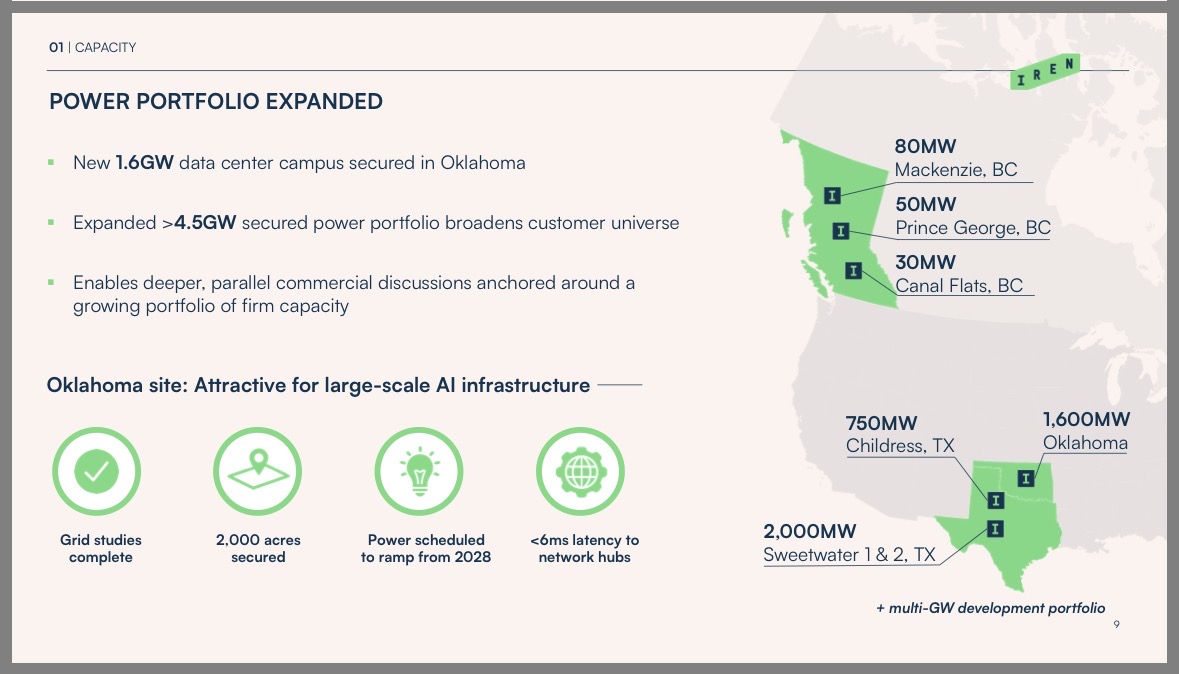
Irish needs capital to equip Childress with GPUs and prepare everything for the deal for Microsoft and for this they need money.
What has Iren done now?
First of all, they bought back the former Convertible Note completely. Why? Because it is debt, and Iren does not want these convertible notes to be converted into equity in the long term, so they would rather buy them back earlier than have holders exchange their convertibles at a price of e.g. $100 for shares at a price of $20.
But, they don't want to lose cash/ and need cash for the deal so there is a new convertible (2 billion USD) with a maturity until 2032/33, this gives more room to maneuver.
And shows that management expects strong growth in the near future otherwise this shift would not make sense.
I could also imagine a Google deal, which was ruled out for a long time by $GOOGL (-0,36%) Due to a lack of capacity and the $MSFT (-0,57%) I could imagine a change.
Rocket Lab Analysis Part II
Hello everyone,
If you haven't read the first part yet, you should read this one first, because I'm going to refer to it directly and continue where I left off. $RKLB (+0,55%)
Part I: https://getqu.in/7y934F/
includes the points
1. foundation and history
2.the Electron success story
3.Neutron, a completely new dimension
this part is now about
4.Space Systems (Service), the true core
5.quarterly figures Q3 2025
6.personal assessment
4.Space Systems, the true core of Rocket Lab
I had previously perceived Rocket Lab as a rocket launch company, but when I looked at the balance sheets I realized something else:
Just under 70% (that's the $114.2 million in black) of last year's revenue came from a division that wasn't really on my radar. Rocket Lab itself calls this division Space Systems. According to my research, this includes everything that has to do with the manufacture and maintenance of satellites, spacecraft and components such as solar panels for space.
For example Photon:
Photon is a "satellite bus" from Rocket Lab: in other words, a ready-made spacecraft platform with power supply, propulsion, communication and attitude control - based on the kick-stage of the Electron rocket.
This enables Rocket Lab to offer complete missions: Launch, transportation into orbit or even to the moon or interplanetary space, as well as operation and control of the payload - so customers do not have to build their own satellite hardware.
Space Systems also covers the area of data collected from space. This can be used, for example, to make statements about climate, weather, forest conditions, disaster forecasts, etc.
This means that Rocket Lab has a much broader base than I had initially assumed.
The advantage of this division is that you can achieve higher margins than in the launch sector and also generate recurring income.
Rocket Lab itself states that it wants to become an end-to-end provider.
In other words, the aim is to cover the entire value chain of satellites, space systems and constellations and thus generate stable, recurring revenue with a higher margin.
This segment also means that the company is not so dependent on individual large orders and rocket launches.
Another advantage is that you then have a better chance of winning larger government contracts, for example from NASA, because you can implement entire projects in one company.
Considering the growth of this segment, it makes perfect sense to me why the management at Rocket Lab has decided to place a clear focus on this area. Recently, Rocket Lab has acquired several companies to expand this area. I would be digressing too far if I were to include that.
In the course of the article, I will also calculate why this segment could possibly become even more lucrative than rocket launches (under point 6).
5th quarterly figures Q3 2025
The latest quarterly figures caused the share price to jump in the short term, even if the trend did not last long.
Nevertheless, I think it is worth taking a look at the figures.
Rocket Lab has clearly exceeded expectations for sales.
On a quarterly basis, turnover rose by 48 % compared to the previous year.
Just for comparison: SpaceX is forecast to grow 9-10% in 2025. (SpaceX had revenues of $14.2bn in 2024 and is expected to generate around $15.5bn in 2025)...
Rocket Lab was also surprised by the strong order backlog of around USD 1.1 billion, which is usually converted into sales within the next few quarters. The order backlog has grown by 10% compared to the previous year and shows a certain financial stability of the company!
This means that Rocket Lab will probably continue to present strong sales figures in the coming quarters.
Another point that struck me positively is the expansion of the gross margin to 37%, an increase of 10.3% compared to Q3 2024 (26.7% gross margin).
For me, these figures are a confirmation of the company's continued growth and long-term goals.
What disappointed some investors - and what I mentioned earlier:
The launch of the Neutron rocket has been postponed until the middle of next year. While progress has been made in the development and completion of Neutron, the company wants to minimize the risk of failure.
Of course, this represents a certain risk: If the management keeps postponing Neutron, the hoped-for growth spurt from Neutron could be postponed indefinitely.
If you have read this far, please write the word "Read" in the comments so that I can see if anyone here is interested! Thank you very much...
On the whole, however, I found the quarterly figures quite convincing, and I think the targets for the fourth quarter - to grow by another 15% or so compared with this quarter - are realistic and decent.
Another thing that should not go unmentioned is that Rocket Lab is not yet profitable. If Neutron were not in development, the company would already be making a profit, but the development of Neutron is still consuming a lot of capital and therefore Rocket Lab is not yet profitable at the bottom line.
Analysts see 2026 or 2027 as one of the years in which Rocket Lab is likely to be in the black for the first time. I think that this will also give the share another good boost!
6 My personal assessment
As you have probably read between the lines:
I am very optimistic about Rocket Lab! I see an exciting company here that is gaining market share - and has a real future project in the pipeline with Neutron. The development of the service segment and the solid growth have convinced me!
Here is a small calculation for the entire space industry:
Depending on the sources, I was able to find various figures on the internet for the size of the space industry as a whole.
In 2024, the space industry is expected to have a turnover of around 466 billion US dollars.
By 2030, the market is expected to grow to 700-1000 billion, i.e. 1 trillion US dollars.
I couldn't find a clear figure for the share of space services (i.e. everything except rocket launches). But it is estimated that around 80% of turnover in the space industry is accounted for by the service sector, at Rocket Lab the Space Systems sector, and not by rocket launches.
As mentioned above, the entire space industry is expected to roughly double in terms of capital over the next five years. I see a great opportunity to participate as an investor with Rocket Lab!
Let's assume that the calculation from the first part of my analysis is correct and that Rocket Lab will generate around $1.05 billion in revenue from launches in 2030 and that its share of total revenue will remain the same.
In that case
1.05 billion would account for 25-30% of sales, which would result in sales of $3.5-4.2 billion in 2030!
The best case scenario would of course be that Neutron launches successfully in the middle of next year and Rocket Lab can then quickly start commercial launches.
In addition, the Space Systems segment should be rolled out further and sales should be in line with expectations.
Then I am very optimistic that we will be talking about a market capitalization of 100-200 billion US dollars in 5-10 years.
Rocket Lab accounts for around 15-20% of my portfolio.
I currently see the market capitalization of around $20 billion as justified, but not significantly undervalued. Not a bargain, but a bet on the future✅ 📈.
I think it's important to mention that there are also risks - such as a Neutron failure, which could certainly weigh heavily on the stock. It's also important to keep an eye on costs so that the company is in the black as soon as possible. These are actually the two most important things I will be looking out for in the coming quarters.
I would also like to emphasize once again that it depends very much on your investment horizon whether you want to add the share to your portfolio! I have an investment horizon of probably over 40 years, and I'm actually pretty sure that a total loss through Rocket Lab won't destroy my social and family environment! The volatility and the risk are really high - but so is the chance of a tenbagger!
At this point, I would also like to recommend a read for anyone interested in Rocket Lab: Take a look at the article by @Shiya on the subject!
With this in mind, I wish you a lovely evening and a peaceful 1st Advent!
Please give me feedback so that I know what I can improve next time! As I said, this is my first analysis and your feedback is really important to me! In the next time following, the analyzes to $SOFI (+1,07%)
$IREN (+1,77%)
$PNG (+0,58%) and $HIMS (+0,93%) .
The positive response to the first post has really motivated me! Thank you very much!
Best regards, your small investor ✌️😁
@Tenbagger2024
@HoldTheMike
@Multibagger
@Hotte1909
@Semos25
@value_crafter_1628
@Shiya
@Aktienfox
@TheWorst
@TomTurboInvest
@TradingHase
@ImmoHai
@Seven0815
@Iwamoto
@SAUgut777
@EpsEra
@BamBamInvest
Sources:
https://www.eoportal.org/other-space-activities/rocket-lab
https://www.boerse-express.com/news/articles/rocket-lab-usa-aktie-insider-werfen-hin-845172
https://www.youtube.com/watch?v=fydHg0Z0TUw

+ 6
What next after the rally? D-Wave, Nebius, CoreWeave, Iren, Plug Power, Oklo, Bloom Energy, MicroStrategy, Metaplanet, Circle
$QBTS (+4,55%)
$NBIS (+0,6%)
$CRWV (+1,53%)
$IREN (+1,77%)
$PLUG (+0,68%)
$OKLO
$BE (+0,58%)
$MSTR (+3,27%)
$3350 (+1,42%)
$CRCL (+2,86%)
@Tenbagger2024
@BamBamInvest
@Multibagger
@Iwamoto
@All-in-or-nothing
Dear community, many of you are invested in precisely these stocks or are watching them very closely. This also applies to all the hype surrounding drone stocks, such as $ONDS (+6,7%) etc.
The questions that keep coming up here, and which concern me just as much, are the same everywhere:
"Is it still worth getting in? Is the rally over? Where are the sensible zones? How do you actually deal with such high-beta stocks?"
Because these discussions keep popping up - and because it's really hard to keep a clear head here - I would like to give you some real trade education I would like to recommend this video. I simply have nothing to add.
I can recommend the 10XTrading channel 100%. The daily content has fundamentally changed my view of the stock market - and not in the sense of becoming a great trader, I'm more of a "buy and hold" type, but in the sense of understanding it better:
- How do such high-risk stocks behave?
- Which structures are repeated again and again?
- How can you categorize rallies without chasing them?
- And how do you remain capable of acting despite volatility?
Particularly with speculative stocks such as those mentioned above, it is not the pure "trade" that makes the difference, but the understanding of when a chart shows structure, when a bubble bursts and when opportunities are actually asymmetrical.
Perhaps it will help some of you as much as it has helped me.
Detailed Rocket Lab analysis part 1
Rocket Lab
Hello everyone,
As part of my "portfolio concentration strategy", I've done a proper clear-out and taken a closer look at the companies I've kept. So $RKLB (+0,55%)
$IREN (+1,77%)
$SOFI (+1,07%)
$PNG (+0,58%)
$HIMS (+0,93%) .
The analysis actually took me quite some time, but I hope that I have developed the necessary conviction to buy in a crash (-50% and more) instead of panicking. If any of you also find the company exciting, perhaps my analysis will also help you. If it's too long for you, just let me know. And if you're not interested at all, then please let me know, because then I don't have to go to the trouble of formulating it all again. Feel free to repost this post so that it doesn't get lost sooo quickly...
As I said, the first company I looked at in detail was Rocket Lab $RKLB (+0,55%) .
I have subdivided the analysis into the following sub-areas:
1. foundation and history (short)
2. success story of Electron
3. neutron, a new dimension
In the second part:
4.the importance of service and the true core of Rocket Lab
5. quarterly figures Q3 25
6.my personal opinion + risks
1.foundation and history
Rocket Lab was founded in New Zealand in 2006. Company founder Peter Beck wanted to launch small satellites into space at low cost. Previously, satellites and small payloads always had to be carried as "co-flyers" on large rockets. This meant that they always had to "fly along", so to speak. What was missing was the flexibility of having a small rocket itself to get into space cheaply AND flexibly. Over time, Rocket Lab moved its headquarters to the United States because that's where most of their customers, as well as NASA, are located. However, as far as I understand it, they still have some of their development and launch sites in New Zealand.
But let's start from the beginning...
In the early years, the company worked on suborbital rockets and engines, but had the ambitious goal of developing an orbital-capable rocket over time. In 2009, the first rocket was tested, Ätea-1, which only flew to an altitude of around 100 km and was relatively small (payload of a few kilograms). The payload was very low and the planned successor Ätea-2 was not realized, but the focus was on the next size of rocket. Rocket Lab subsequently began to build the Launch Complex 1 rocket launch site in New Zealand. Electron, a rocket that was still under development, was to be launched from there. This was already something historic, as it was the world's first private rocket launch site for orbital rockets. And now Electron comes into play.
2nd Electron
Peter Beck recognized early on that there was a gap in the space sector. Large rockets such as Ariane-5 or Falcon-9 were expensive, but there was really no way to launch small satellites and payloads into orbit. Universities, research institutions and private space companies were looking for a cheap solution for small satellites without having to wait a long time for a ride.
The idea behind Electron
- small rocket, designed for payloads of 100-300kg
- Mass production to carry out as many launches as possible per year
- Low launch costs to appeal to customers with lower budgets
These goals were new and until then there was no company that wanted to achieve something like this.
Here is a brief overview of what Rocket Lab did to achieve these goals.
-3D printed engines (cheaper, faster production)
-Carbon instead of aluminum or steel (lighter)
-Electrically powered propellant pumps (simpler, cheaper)
As the technical details are not so important to me as an investor, I have not delved into the smallest detail.
After 11 years of development, the first tests followed:
May 2017: first Electron test flight - reaching space, important milestone.
January 2018: second test flight - successful launch into orbit, paving the way for commercialization.
November 2018: first commercial launch - start of regular missions for customers.
And Electron is a real success!
Here is the number of launches per year since 2018:
2018 - 3 launches
2019 - 6 launches
2020 - 7 launches
2021 - 6 starts (Corona)
2022 - 9 starts
2023 - 10 starts
2024 - 16 starts
2025 - 18 launches until November
With the exception of the coronavirus year 2021, more Electron launches were carried out in each year than in the previous year.
To date, almost 70 Electron rocket launches have been carried out, making Electron THE most important rocket in its segment. Although the cost per kilogram of payload is relatively high, customers are obviously willing to pay this price for the flexibility.
Just to compare the costs:
A rocket launch with the Electron costs around USD 7.5 million, while SpaceX's Falcon 9 costs around USD 65 million per launch.
Of course, it has to be said that the comparison doesn't quite fit, because the Falcon 9 rocket has a MUCH higher payload than the Electron. But it is still interesting for small research institutes or small companies that may not have 60/70 million dollars for a rocket. In addition, the launch is also correspondingly more flexible because you can carry out more launches per year and at shorter notice.
Market share with Electron
I couldn't find a direct market share online, but theoretically it should be possible to calculate this:
According to Wikipedia, 259 orbital rocket launches were carried out in 2024 and thus Rocket Lab had a global market share of approx. 6.18% of orbital rocket launches with 16 launches of Electron.
In 2025 (as of 26.11), 281 launches were carried out, giving Rocket Lab a global market share of approx. 6.41% (+0.22% YoY). So you can see that
the global rocket launch market continues to grow year over year and
Rocket Lab is not only defending its market share but is even gaining market share.
At first glance, these figures do not seem bad, but if you put them in relation to the dominant company SpaceX, you can understand why Rocket Lab is not satisfied with Electron.
SpaceX carried out a total of 134 orbital rocket launches in 2024, giving it a market share of over 50%. Over 90% of the rocket launches came from the Falcon 9 rocket, which I mentioned earlier. This is in a completely different segment to Rocket Lab's Electron. This is precisely why Rocket Lab decided a few years ago to develop a completely new rocket:
3rd Neutron
Neutron catapults Rocket Lab into a completely new league. With a payload of 13,000 kg and a length of approx. 43 m, Neutron is an attack on the most successful rocket at present, namely Falcon-9.
As with Electron, Rocket Lab is again relying on 3D printing to make the parts light and flexible. One part of the rocket, the first stage, is to be reusable in order to reduce costs for Rocket Lab.
Originally, the launch of Neutron was supposed to take place this year, but has been postponed to mid-2026. On the one hand, I see this as a risk if the launch is delayed even further. On the other hand, a failed launch this year would not really be any better than a successful launch next year. The company emphasizes that it wants to avoid a false start and therefore wants to improve a few things before attempting a launch.
If Neutron then successfully launches, it will be really exciting!
Even if the price per kg payload of $3,800 - $4,000 is still higher than that of the Falcon-9 at $2,900 - $3,100, there would probably be enough customers who would use Neutron.
Now it's getting a bit hypothetical:
Financially, Neutron would pretty much increase Rocket Lab's revenue significantly. The target per launch is around $50 million (Rocket Lab revenue 2024 -> $436.2 million). If you now imagine that Rocket Lab can also continuously increase the launch frequency with Neutron and that we will have around 15 launches with Neutron in 2030 (I think this is quite realistic and conservative) and Electron is also successfully rolled out further (around 40 launches in 2030 would be quite possible), I have made the following simple calculation:
15 (Neutron) x 50 million $
+
40 (Electron) x 7.5 million $
=
1,050 million (1.05 billion)$ turnover with rocket launches only
Rocket launches currently account for around 26.3% of sales.
So in my optimistic-realistic scenario, one can expect total sales of around $4 billion.
I think it is rather unlikely that Rocket Lab's valuation is still at $20bn, but more on that later.
In my opinion, that alone would justify the valuation, but the company would not be a bargain at the moment. After all, Neutron hasn't even launched yet and 18 launches this year times $7.5 million would result in sales (not profits) of less than $150 million.
But this is where something comes into play that I didn't even consider when investing - the other 73.7% of sales...
This part of the analysis (Services division, Q3 25 figures and my personal
assessment) will come tomorrow evening, if I can manage it... (it's already online : https://getqu.in/TQJcW6/ )
Please give me feedback, because this is my first analysis and be honest. Please also give me criticism on what I can improve. I think this is my first "serious" post on getquin 😅.
LG Small investor ✌️
PS @Shiya You already did a much deeper and nicer analysis some time ago!!! But I thought I'd take another look at the company personally!
Sources:
https://www.finanzen.net/bilanz_guv/rocket_lab#:~:text=Rocket%20Lab%3A%20GuV%20%28in%20Mio,USD
@Multibagger
@Tenbagger2024
@Aktienfox
@BamBamInvest
@HoldTheMike
@Semos25
@Hotte1909
@Iwamoto
@TomTurboInvest
@Wiktor_06
@TradingHase

Títulos em alta
Principais criadores desta semana