A little more Europe can't hurt 😬
That's why I decided to $TSTL (+0,88%) , but $NOVO B (+1,09%) I kicked it out of my portfolio a few months ago 🤔

Postos
960A little more Europe can't hurt 😬
That's why I decided to $TSTL (+0,88%) , but $NOVO B (+1,09%) I kicked it out of my portfolio a few months ago 🤔
Out
$NOVO B (+1,09%) -35% off the fry stand
In (additional purchases, no new purchases)
$MCD (-0,54%) 15x
$NFLX (-1,81%) 100x
I’m also planning a small savings plan project. I’ll share that later :)


Hey neighbors!
I've had this stock on my watchlist for a long time now.
Do you think it's worth looking into right now, or is it a falling knife?
Any opinion would be helpful!
Thanks!

Hi everyone,
I often read posts here where people ask for feedback, but the story behind them is missing. That’s why today I’d like to share my own portfolio—and my story—in a completely transparent way.
A little about me:
I’m 31 years old and have been active on GQ for quite some time. My current net worth of just under 1.28 million euros is the result of my own hard work. Even as a child, I would occasionally try out potentially profitable business ideas on the side to earn some money—and six years ago, I took the plunge into self-employment.
I now have two companies in different industries. It became clear to me quite early on that I needed a high, recurring active income if I wanted to build up a certain level of wealth, so I left my full-time job fairly early on.
For the next 12 months, I’m planning on a monthly income of approximately 30,000 euros. In addition, I naturally have recurring income, which can fluctuate up or down over the long term.
My goal is to continue growing this wealth prudently so that I can eventually live entirely off the dividends. Currently, for tax reasons, I hold portions of two stocks ($MSFT (+2,41%) and $NOVO B (+1,09%) ) are held as individual positions in my holding account, and the rest is held in my personal account.
My Strategy and the Core of the Portfolio
I follow a classic core-satellite approach. The core—which I intend to use later as a kind of pension substitute—consists of two ETFs: the $HMWO (+0,68%) and the $QQQ. (+0,6%) I’m aware that these two holdings overlap; I continue to contribute to both monthly via a savings plan.
The individual stocks and my problem children
When it comes to individual stocks, I look for a combination of long-term trends and reliable cash flow. On the one hand, I deliberately overweight tech stocks and future classics such as $MSFT (+2,41%) , $GOOGL (+0,84%) , $NVDA (-0,56%) , $META (-0,3%) , $AMZN (+3,14%) and $AAPL (-1,19%) , because I am firmly convinced that these industries will continue to perform well in the coming years.
For my dividend strategy and the necessary cash flow, I’ve invested in quality stocks such as $ALV (+0,35%) , $MUV2, $NOVO B (+1,09%) and $UNH (+2,98%) in my portfolio. This is complemented by classic dividend-paying stocks such as $BATS (+0,06%) , $SIE (+2,7%) , $ARCC (-0,19%) and $O (+0,29%).
But let’s be honest: values like $MPW (-1,41%)
$PYPL (+1,19%) , $BAYN (+1,57%) or gambling $LILM aren’t performing at all as once hoped.
In the crypto sector, $BTC (+0,2%) as the largest holding, along with a small amount of $SOL (-0,47%) and $XRP (-0,69%) the whole thing—in the future, I’ll consolidate everything into the position $BTC (+0,2%) and add a little $4GLD (+1,62%) to it.
What’s Next
At the end of this month, I’m expecting a large incoming payment of around 50,000 euros. I’d like to split the amount and invest it both in the $HMWO (+0,68%) as well as specifically into my dividend stocks to further strengthen the foundation.
The goal is to reach a portfolio value of 1.5 million by the end of the year.
Feel free to share your thoughts—I look forward to the discussion :-)

It's pushed my disastrous entry price down a bit.
I think we've seen the lows and all the negative news is already priced in.
For me, it's now a fairly valued value play with turnaround potential.📈

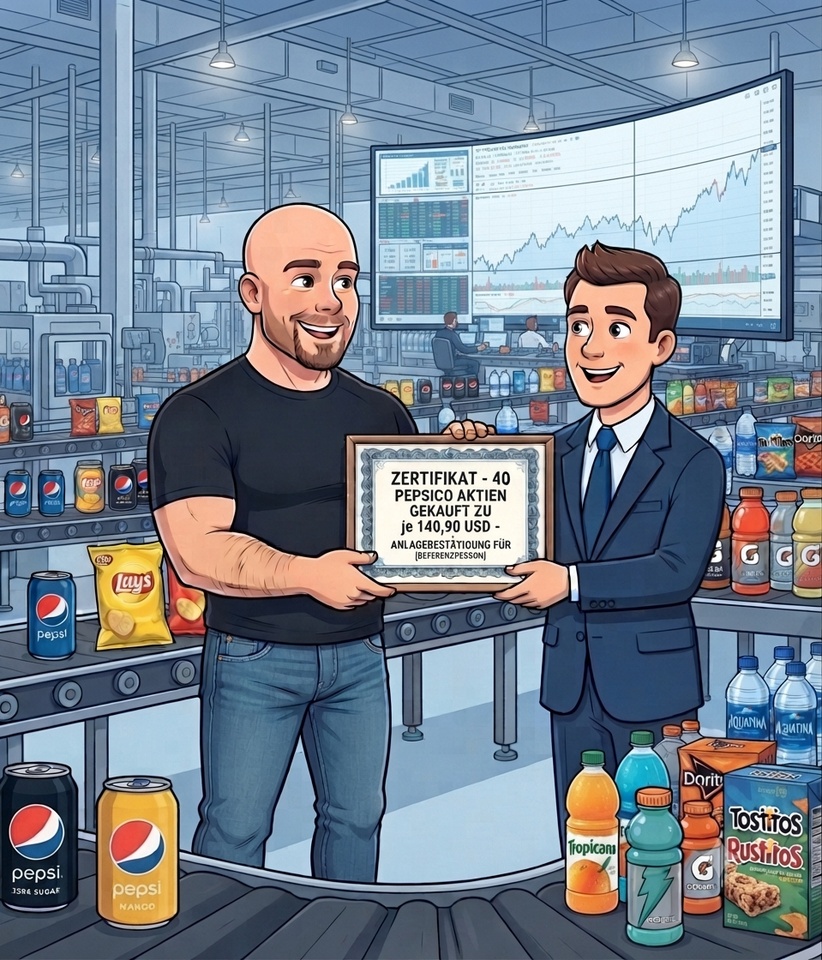
Today, $PEP (-1,69%) a significant portion has found its way into my portfolio.
Unlike $KO (+0,52%) , Pepsi doesn’t just produce beverage syrup and sell it—it also bottles it and handles the logistics. On top of that, several snack brands are part of its product portfolio.
However: Recently, the business has also struggled precisely because of $NOVO B (+1,09%) and $LLY (+0,92%) weight-loss drugs. That’s just how everything is interconnected in the markets. One person’s gain is another’s loss.
Nevertheless, I believe the time is right to buy into this “dividend king.”
Medications designed to curb cravings for sweets are not a panacea; they’re very expensive and cannot be taken long-term—they require people to actively change their diets as well. To be honest, I foresee many yo-yo effects here and consumers who will eventually return to their old habits. Not everyone will be that disciplined. And the rest?
This is where Pepsi is also stepping in—it plans to develop and launch new, healthier products to win back customers. Last but not least, the company aims to increase efficiency and reduce costs.
*AI-generated image*
Hey there, dear community✌️
Today I’m back with another company spotlight! This company has been on my watchlist for a while now, and I was actually supposed to feature it a few months ago, but due to a lack of time, I kept putting it off.
Today, it’s all about the pharmaceutical sector—more specifically, a potential replacement for my $NOVO B (+1,09%) position.
Let’s go🚀
It’s Ligand Pharma $LGND (+2,28%)
🧬 Ligand Pharmaceuticals $LGND (+2,28%) : The License to Make Money in the Biotech World
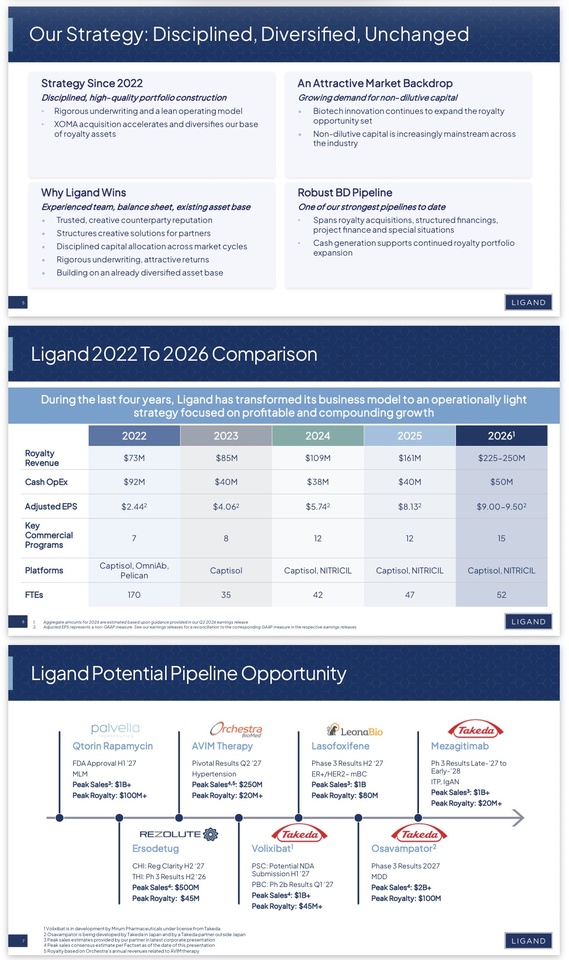
Ligand $LGND (+2,28%) is not a traditional pharmaceutical company that pours billions into its own risky clinical trials. It’s the industry’s “royalty machine.” While other biotech firms put all their eggs in one basket, Ligand operates purely as a royalty aggregator, holding the rights to technologies and contracts that make hundreds of drugs possible in the first place.
1. The Business Model: The “Toll Booth” of Drug Discovery 🛣️
Ligand $LGND (+2,28%) acts as a financier and license aggregator for the entire pharmaceutical industry.
The Mechanism: Ligand $LGND (+2,28%) offers platforms such as Captisol (a technology that makes drugs soluble and thus stable) as well as targeted capital funding for biotech companies. In return, Ligand receives milestone payments and—even more importantly—ongoing revenue shares (royalties).
The ingenious part: Ligand $LGND (+2,28%) does not bear the costs of clinical trials, regulatory approval, or marketing. The partners handle that. Ligand $LGND (+2,28%) simply collects a percentage of gross revenue once the drug is on the market.
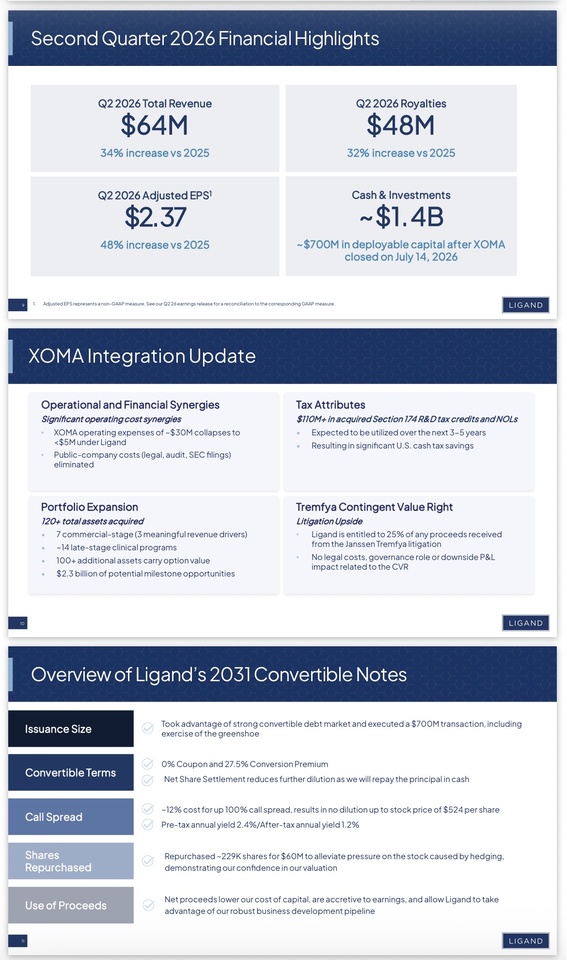
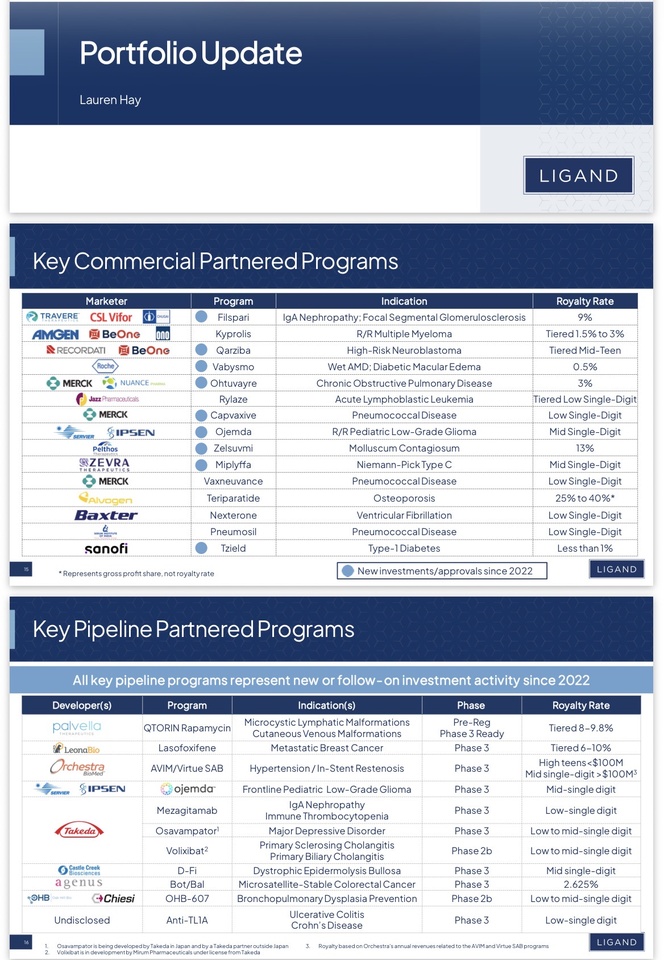
Growth driver: “Royalty Aggregation Pipeline”: Through targeted M&A transactions (such as the acquisition of APEIRON or the takeover of the XOMA royalty portfolio), Ligand $LGND (+2,28%) access to over 100 ongoing partner projects. Instead of betting on a single drug, the company benefits from broad exposure across the entire sector.
2. Key Figures 📊
Market capitalization: approx. $5.8–6.0 billion (an established, highly profitable mid-cap).
Gross margin: Nearly 100% in the pure royalty segment (total gross margin ~88.5%, including Captisol material sales). Since there are virtually no direct manufacturing costs, the majority of licensing revenue flows directly into profit.
Diversification & Growth Drivers: Revenue comes from established blockbusters such as Kyprolis (Amgen $AMGN (+3,17%) ) as well as new growth stars such as Filspari (Travere) and Ohtuvayre (Verona Pharma / Merck ecosystem).
Balance Sheet Strength: Massive net cash cushion. With over $1.3 billion in cash and cash equivalents and investments, Ligand $LGND (+2,28%) uses this capital strategically for share buybacks or to acquire new royalty rights from smaller biotech companies.
Lean Management & Profitability: An extremely lean workforce structure with an ROIC of >24% and FCF margins exceeding 40%, as partners handle the operational work (clinical trials/sales).
3. Why is this stock exciting? 🚀
🚀1. Risk Asymmetry: If a partner’s drug fails in Phase 3, the impact on Ligand $LGND (+2,28%) only minimally, as they have over 100 other irons in the fire. In the event of success, they benefit directly from global sales.
🚀2. Beneficiary of Interest Rate Cuts: Biotech companies need capital. In an environment of falling interest rates, partners’ pipelines flourish, while cash-strapped developers are more willing to assign future royalty rights to Ligand in exchange for an upfront payment.
🚀3. Captisol Moat: Captisol technology is an industry standard. Without this excipient, many life-saving drugs could not be absorbed by the body at all—this creates high switching costs for partners.
🚀4. Operating Leverage: Since the lean holding company’s fixed costs remain virtually constant, every new approval of a partner drug leads to a disproportionately large increase in profits (operating leverage).
Additional Insider Facts (The “Deep Dive” Bonus) 💡
The Portfolio Principle: Ligand $LGND (+2,28%) operates similarly to a royalty-based pharmaceutical ETF or a specialized, publicly traded licensing fund.
Strategic Focus (Pure Play): Following the spin-off of OmniAb (2022), Ligand $LGND (+2,28%) has consistently transformed itself into a pure-play royalty aggregator. This makes the balance sheet more transparent and focused.
Approval Pipeline: Numerous FDA decisions and Phase 3 data from the partner network are expected over the next 12 to 24 months—each positive approval acts like a “free lottery ticket” for shareholders.
5. Risks ⚠️
❗️Patent Expiration: When patents for key technologies or older flagship drugs expire, new royalty rights must fill the gap.
❗️Concentration risk in the top segment: A significant portion of current revenue depends on just a few major drugs. Setbacks with these anchor drugs are felt by Ligand $LGND (+2,28%) in its top line.
❗️M&A misallocation: Ligand $LGND (+2,28%) is growing rapidly through acquisitions (such as the XOMA portfolio). If too much capital is paid for overvalued royalty rights, the overall return (ROIC) suffers.
My personal conclusion & Reaper Bonus🧐
In my search for a suitable, high-quality alternative to Novo Nordisk $NOVO B (+1,09%) , Ligand Pharmaceuticals has currently emerged as my absolute top candidate. Novo Nordisk $NOVO B (+1,09%) remains, without a doubt, an exceptional quality company in my view. I’m still holding the position for the next few quarters; after that, I’ll decide what to do with it. Ligand, $LGND (+2,28%) , on the other hand, offers the perfect counterpart here: a lean, high-margin, asset-light model, a well-stocked cash cushion, and a broad range of growth drivers that scale completely independently of the performance of any single blockbuster.
💀Jack’s Verdict:
Ligand is like the landlord of a casino. Ligand doesn’t care whether the player at the table wins or loses—they get their rent. While the biotech bros burn through their money in companies hoping for a miracle, Ligand sits back on a $1.3 billion cash mountain and lets Pfizer, Amgen, and Merck do the heavy lifting. It might not be the sexy story for the headlines, but it’s the story that reliably pays the bills in the end. If you hate the volatility of individual biotech stocks but love the sector’s margins, this is the place for you."
Rating: 🟡 WAIT AND SEE / TAKE ADVANTAGE OF DIPs
BUY-ON-DIP RANGE: $230–$240
Score: 9.0/10
@Get_Rich_or_Die_Tryin
@Tenbagger2024
@Raketentoni
@Stocktective
@Multibagger
@Dividendenopi
@SAUgut777
@PikaPika0105
@NichtRelevant and, of course, everyone else!
+ 3

Principais criadores desta semana