
$IRM (+0,76%) I sold it at a 250% profit. This was due to the company’s financial position. The company has negative equity, which means its debt-to-total-assets ratio has risen to over 100%. Although the company continues to generate strong earnings, interest expenses will rise and impact cash flow. As a result, I no longer consider this company a quality investment. I reinvested the proceeds into $VIE (+2,22%) , $ITW (+0,08%) , $AMGN (+1,43%) , $FAST (-4,42%) and $HTGC (+1,44%) , with $HTGC (+1,44%) received the smallest share. Through this reallocation, I have expanded smaller positions—which are still in the process of being built up—toward my target portfolio. In addition, I have reinvested in what I consider to be high-growth, high-quality companies, which is in line with my strategy. Overall, this transaction also allowed me to maintain the level of dividends that I lost through the sale.
Amgen
Price
Discussão sobre AMGN
Postos
61
Amgen—are they on sale?
I have been a shareholder in Amgen, the American biotech and pharmaceutical giant, for quite some time. If you look at the long-term stock price chart, you’ll see a positive trend—a slow but steady rise. Taken on its own, however, the last month looks like a disaster, even though the nearly 10% drop is more likely due to problems at competitors. $AMGN (+1,43%) In my opinion, Amgen was simply caught up in the turmoil.
Unfortunately, I don’t have any spare funds to invest further, and I’ve actually already reached my target allocation in my portfolio. I view Amgen as a long-term investment and, at the same time, as a reliable—albeit moderate—dividend payer. My personal dividend yield is just over 3%.

Has a replacement for Novo Nordisk been found?
Hey there, dear community✌️
Today I’m back with another company spotlight! This company has been on my watchlist for a while now, and I was actually supposed to feature it a few months ago, but due to a lack of time, I kept putting it off.
Today, it’s all about the pharmaceutical sector—more specifically, a potential replacement for my $NOVO B (+3,21%) position.
Let’s go🚀
It’s Ligand Pharma $LGND (+0,76%)
🧬 Ligand Pharmaceuticals $LGND (+0,76%) : The License to Make Money in the Biotech World
Ligand $LGND (+0,76%) is not a traditional pharmaceutical company that pours billions into its own risky clinical trials. It’s the industry’s “royalty machine.” While other biotech firms put all their eggs in one basket, Ligand operates purely as a royalty aggregator, holding the rights to technologies and contracts that make hundreds of drugs possible in the first place.
1. The Business Model: The “Toll Booth” of Drug Discovery 🛣️
Ligand $LGND (+0,76%) acts as a financier and license aggregator for the entire pharmaceutical industry.
The Mechanism: Ligand $LGND (+0,76%) offers platforms such as Captisol (a technology that makes drugs soluble and thus stable) as well as targeted capital funding for biotech companies. In return, Ligand receives milestone payments and—even more importantly—ongoing revenue shares (royalties).
The ingenious part: Ligand $LGND (+0,76%) does not bear the costs of clinical trials, regulatory approval, or marketing. The partners handle that. Ligand $LGND (+0,76%) simply collects a percentage of gross revenue once the drug is on the market.
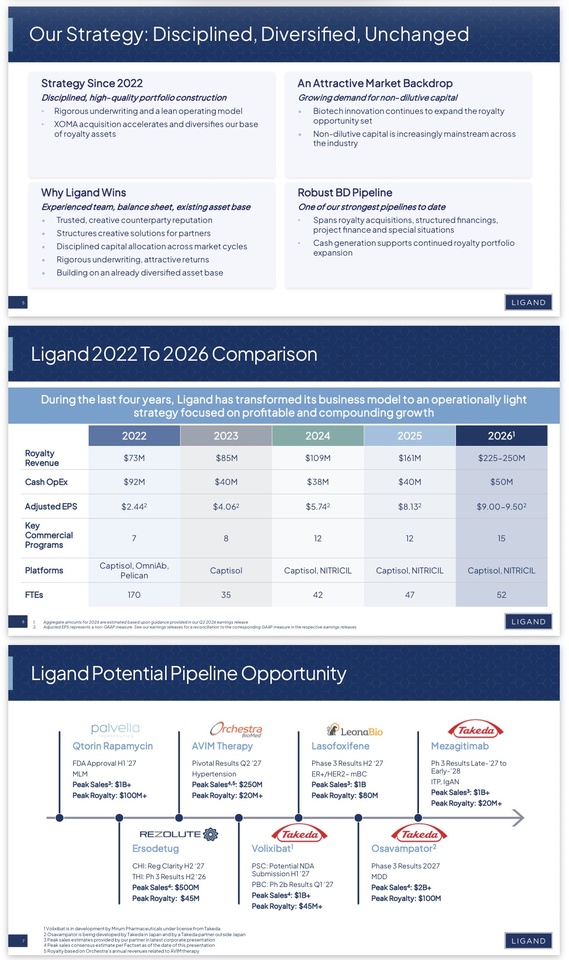
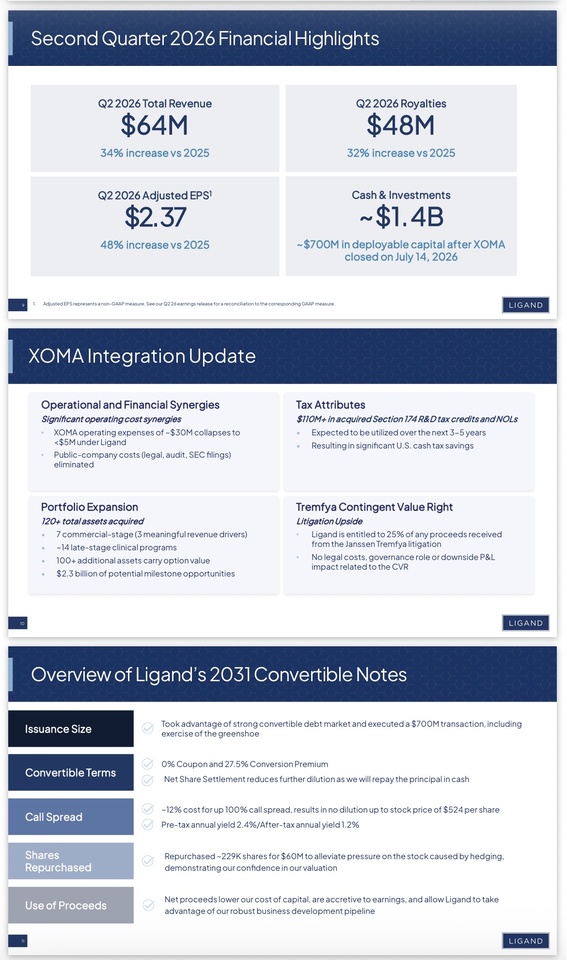
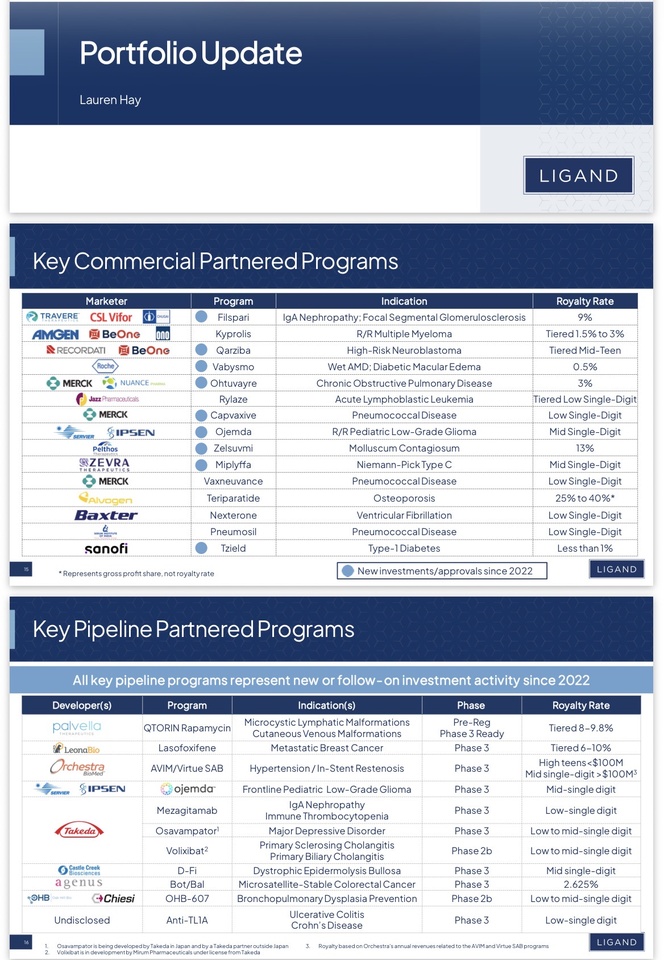
Growth driver: “Royalty Aggregation Pipeline”: Through targeted M&A transactions (such as the acquisition of APEIRON or the takeover of the XOMA royalty portfolio), Ligand $LGND (+0,76%) access to over 100 ongoing partner projects. Instead of betting on a single drug, the company benefits from broad exposure across the entire sector.
2. Key Figures 📊
Market capitalization: approx. $5.8–6.0 billion (an established, highly profitable mid-cap).
Gross margin: Nearly 100% in the pure royalty segment (total gross margin ~88.5%, including Captisol material sales). Since there are virtually no direct manufacturing costs, the majority of licensing revenue flows directly into profit.
Diversification & Growth Drivers: Revenue comes from established blockbusters such as Kyprolis (Amgen $AMGN (+1,43%) ) as well as new growth stars such as Filspari (Travere) and Ohtuvayre (Verona Pharma / Merck ecosystem).
Balance Sheet Strength: Massive net cash cushion. With over $1.3 billion in cash and cash equivalents and investments, Ligand $LGND (+0,76%) uses this capital strategically for share buybacks or to acquire new royalty rights from smaller biotech companies.
Lean Management & Profitability: An extremely lean workforce structure with an ROIC of >24% and FCF margins exceeding 40%, as partners handle the operational work (clinical trials/sales).
3. Why is this stock exciting? 🚀
🚀1. Risk Asymmetry: If a partner’s drug fails in Phase 3, the impact on Ligand $LGND (+0,76%) only minimally, as they have over 100 other irons in the fire. In the event of success, they benefit directly from global sales.
🚀2. Beneficiary of Interest Rate Cuts: Biotech companies need capital. In an environment of falling interest rates, partners’ pipelines flourish, while cash-strapped developers are more willing to assign future royalty rights to Ligand in exchange for an upfront payment.
🚀3. Captisol Moat: Captisol technology is an industry standard. Without this excipient, many life-saving drugs could not be absorbed by the body at all—this creates high switching costs for partners.
🚀4. Operating Leverage: Since the lean holding company’s fixed costs remain virtually constant, every new approval of a partner drug leads to a disproportionately large increase in profits (operating leverage).
Additional Insider Facts (The “Deep Dive” Bonus) 💡
The Portfolio Principle: Ligand $LGND (+0,76%) operates similarly to a royalty-based pharmaceutical ETF or a specialized, publicly traded licensing fund.
Strategic Focus (Pure Play): Following the spin-off of OmniAb (2022), Ligand $LGND (+0,76%) has consistently transformed itself into a pure-play royalty aggregator. This makes the balance sheet more transparent and focused.
Approval Pipeline: Numerous FDA decisions and Phase 3 data from the partner network are expected over the next 12 to 24 months—each positive approval acts like a “free lottery ticket” for shareholders.
5. Risks ⚠️
❗️Patent Expiration: When patents for key technologies or older flagship drugs expire, new royalty rights must fill the gap.
❗️Concentration risk in the top segment: A significant portion of current revenue depends on just a few major drugs. Setbacks with these anchor drugs are felt by Ligand $LGND (+0,76%) in its top line.
❗️M&A misallocation: Ligand $LGND (+0,76%) is growing rapidly through acquisitions (such as the XOMA portfolio). If too much capital is paid for overvalued royalty rights, the overall return (ROIC) suffers.
My personal conclusion & Reaper Bonus🧐
In my search for a suitable, high-quality alternative to Novo Nordisk $NOVO B (+3,21%) , Ligand Pharmaceuticals has currently emerged as my absolute top candidate. Novo Nordisk $NOVO B (+3,21%) remains, without a doubt, an exceptional quality company in my view. I’m still holding the position for the next few quarters; after that, I’ll decide what to do with it. Ligand, $LGND (+0,76%) , on the other hand, offers the perfect counterpart here: a lean, high-margin, asset-light model, a well-stocked cash cushion, and a broad range of growth drivers that scale completely independently of the performance of any single blockbuster.
💀Jack’s Verdict:
Ligand is like the landlord of a casino. Ligand doesn’t care whether the player at the table wins or loses—they get their rent. While the biotech bros burn through their money in companies hoping for a miracle, Ligand sits back on a $1.3 billion cash mountain and lets Pfizer, Amgen, and Merck do the heavy lifting. It might not be the sexy story for the headlines, but it’s the story that reliably pays the bills in the end. If you hate the volatility of individual biotech stocks but love the sector’s margins, this is the place for you."
Rating: 🟡 WAIT AND SEE / TAKE ADVANTAGE OF DIPs
BUY-ON-DIP RANGE: $230–$240
Score: 9.0/10
@Get_Rich_or_Die_Tryin
@Tenbagger2024
@Raketentoni
@Stocktective
@Multibagger
@Dividendenopi
@SAUgut777
@PikaPika0105
@NichtRelevant and, of course, everyone else!
+ 3

Amgen Raises Its Guidance!
Here's the hot stuff from Amgen Inc.
$AMGN (+1,43%) (NASDAQ: AMGN) Q2 2026 Earnings Release, delivered fresh on August 4, 2026, after the U.S. market closed:
🚀 Top-Line Performance & Strong Drug Results
The U.S. biotech giant smashed analyst expectations across the board in the second quarter of 2026 and demonstrated outstanding momentum in its core business:
Total revenue: Climbed by +10% YoY to $10.1 billion (drastically beating Wall Street’s consensus estimates of ~$9.43 billion).
Product revenue: Rise by +9% YoY to $9.5 billion, driven by strong volume growth across the entire portfolio. 22 products achieved double-digit percentage growth.
Six key growth drivers: Grew by +26% YoY and now account for nearly 70% of total product sales.
Top performer:
Repatha (cholesterol-lowering drug): +37% YoY to $953 million.
EVENITY (Osteoporosis): +38% YoY to $714 million.
TEZSPIRE (Asthma): +42% YoY to $486 million.
UPLIZNA (Neuroimmunology): +90% YoY to $335 million.
Setback:
Prolia fell by 32% YoY to $759 million due to biosimilar competition.
🔮 Profitability & Massive EPS Beat
Amgen delivered a major earnings surprise, as Wall Street had expected a slight decline in profits:
Adjusted Diluted EPS: Climbed to $6.29 (up from $6.02 in the same quarter last year) and absolutely crushed the consensus estimates of ~$5.60 to $5.62!
GAAP EPS: Soared by +65% YoY to $4.37 .
Free Cash Flow: Reached a whopping $3.5 billion for the quarter (up from $1.9 billion in Q2 2025).
🤖 Major guidance upgrade for full-year FY 2026
Based on the strong first half of the year, CEO Robert Bradway and management are significantly raising the full-year targets for 2026:
FY 2026 revenue forecast: Raised to $38.2 billion to $39.4 billion (The midpoint of $38.8 billion significantly beats consensus estimates of $37.7 billion; the previous range was $37.1–$38.5 billion).
FY 2026 Adjusted EPS Forecast: Raised to $22.30 to $23.50 (previously $21.70–$23.10).
Promising pipeline candidate MariTide: The monthly/bimonthly weight-loss candidate is progressing through Phase 3 trials as planned (including the ongoing Phase 3 SWITCH trial for patients switching from weekly GLP-1 injections).
⚡ 💡 Jack’s take
A picture-perfect beat & raise for the biotech heavyweight! While the market had concerns about generic pressure on older drugs ahead of the earnings report, Amgen demonstrated tremendous operational strength with $6.29 EPS (vs. $5.60 expected) and over $10 billion in quarterly revenue. The core portfolio is growing at double-digit rates, free cash flow is flowing freely, and the raised full-year forecast underscores the company’s confidence—even before the MariTide obesity asset has even hit the market!

A little more high risk again!
Otherwise it gets boring. After the turbo on $AMBA (+2,76%) has been going well so far, today I got myself a pansy, far out of the money normal OS with 15 Ner leverage, maturity until September and 30% out of the money on $AMGN (+1,43%) out of the money. If the share rises by 30% in the next 8 weeks, the bill would increase almost tenfold. High opportunity = high risk. I set the first stop at €0.04, which would be a 70% loss. So keep your hands off it if you are a beginner or can't take it.
After all, you have to have a bit of fun. And anyone can do tech!

Slight change in the dividend portfolio
The last few weeks have shown me that my portfolio is too cash flow-heavy and that I should focus more on dividend growth and growth stocks again. I have therefore spent the last few days looking at several of my stocks and scrutinizing overlaps, performance and cash flow. The result is a shift of around 10% of the portfolio towards more stability and growth with less risk.
Good and poor underperformers have been removed from the portfolio,
- $SBUX (+3,37%) Starbucks
- $GLAD (+1,47%) Gladstone Capital
- $KMB (+4,54%) Kimberly-Clark
- $KO (-0,34%) Coca-Cola
Reduced, the super run,
- $CAT (-1,77%) Caterpillar (insert completely pulled out)
New additions to the portfolio are the stocks that are currently very attractively valued in my opinion,
- $REL (+3,36%) Relx
- $SPGI (+3,55%) S&P Global
Stable stocks with potential for outperformance were added,
- $MCD (+1,34%) McDonalds
- $PEP (-1,21%) PepsiCo
- $AMGN (+1,43%) Amgen
- $ARCC (+1,32%) Ares Capital
Overall, I have reduced the number of positions somewhat, eliminated underperformers and at the same time shifted into stability and growth.
I feel very comfortable with this adjustment and will keep a close eye on what further adjustment potential I find in my portfolio.
In addition, I'm keeping around 10k dry in case things go downhill again if peace between the USA and Iran doesn't materialize after all... I have serious doubts that this will work out.
Amgen increased
The biotech company Amgen has simply $AMGN (+1,43%) has simply been running alongside in my portfolio. However, I recently took a look at the long-term chart of the stock and actually think it's pretty good.
Amgen is an established player that makes a profit and even pays a moderate dividend of just under 3%. I think that suits me well. That's why I increased the position today.
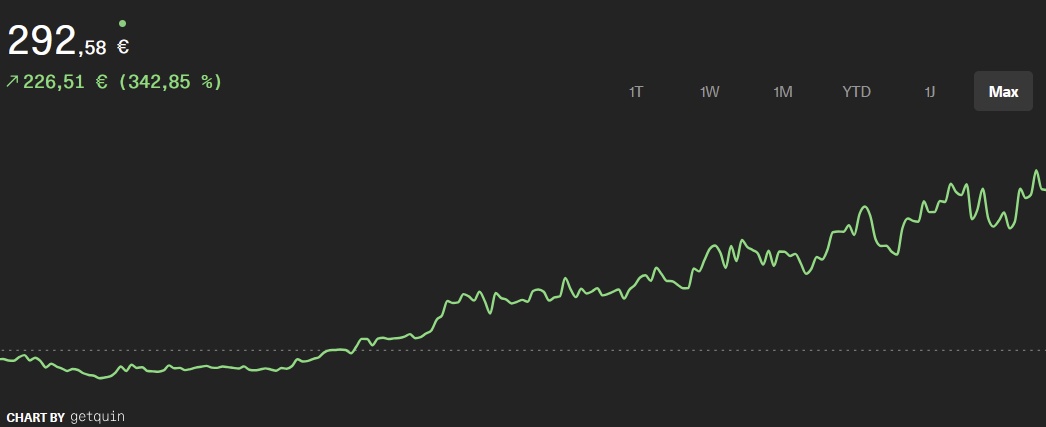

Just looking at the long-term chart shows that Amgen is actually always bought at the highest price. You just have to wait 2-3 years....
And fundamentally: Amgen is still the largest and most innovative biotech company in the world. The business is running, short-term setbacks not excluded: but fundamentally Amgen is a force.
And all the small biotech hyper - super duper ultratrend newcomers: are simply swallowed up as needed. They've always done it this way, and it works.
The personal dividend yield comes on top of the relatively solid chart performance....
Company presentation: PeptiDream - The architect of tomorrow's medicines
Hello my dear GQ community, since dear @Tenbagger2024 somehow has problems with his company presentation post, I'm jumping in for a change 😝 so that you have something to read 😂 I hope I still reach a few of you readers 🤓
have fun 😬
Today I would like to introduce you to a company that I am sure many of you are not yet familiar with.
It is the Japanese BioTech Pharma / Tech (?) company with the name: PeptiDream $4587
PeptiDream $4587 is not a classic pharmaceutical company that only sells its own pills. It is a technology platformthat provides the "operating system" for the discovery of new active ingredients. In the world of biotechnology, PeptiDream $4587 is the undisputed king of macrocyclic peptides.
👤 Management: Visionary & Strategic
- CEO: Patrick C. Reid
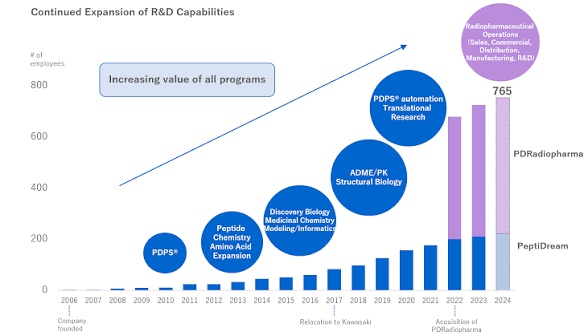
- Reid is not a typical Japanese CEO, which gives the company a very international and agile culture. Under his leadership, PeptiDream has been transformed from a small university spin-off to a global player with over 120 research programs.
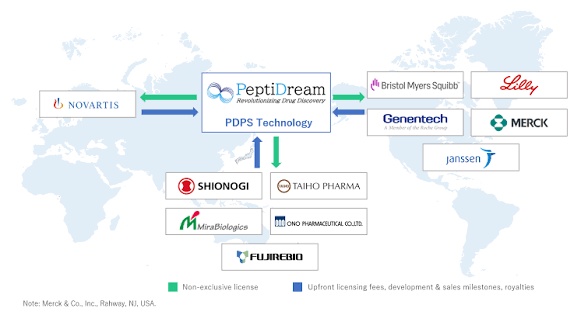
- Strategy: He consistently focuses on collaborations with "big pharma" (Novartis $NOVN (+2,37%) , Eli Lilly $LLY (+2,99%) Merck $MRK (-1,9%) Genentech $GENETEC ) in order to shift the risk of failures in clinical trials onto the partners, while PeptiDream $4587 profits from milestone payments and license fees.
--------------------------
🔬🏭The business model: "The Discovery Powerhouse" 🎯
PeptiDream $4587 pursues a strategy of massive scaling through partnerships. Instead of investing billions in their own research and hoping for a "blockbuster", they let the giants of the industry work for them.
1-core technology PDPS: The Peptide Discovery Platform System is a kind of "Google high-speed search engine" for active ingredients. It can screen trillions (!) of different peptides in just a few weeks to find exactly the one molecule that binds to a disease target.
PDPS in detail:
Imagine you are looking for a matching key 🔑 for a very complicated lock (a protein that causes a disease). Classic pharmaceutical companies laboriously try out a few thousand keys 🔐.
- PDPS (Peptide Discovery Platform System): PeptiDream builds a "library" in a test tube trillions (10¹²) different macrocycles (ring-shaped peptides).
- The highlight: Each peptide is labeled with a DNA "barcode". When a peptide binds to the target protein, the barcode is read and the company knows immediately: "This is the active ingredient!"
- Success rate: PeptiDream $4587 states that for over 95 % of all biological objectives🎯 (targets) within just 4 weeks. This is record-breaking in the industry.
Technology licenses: Partners such as Lilly $LLY (+2,99%) or Novartis $NOVN (+2,37%) pay millions to be allowed to use the PDPS technology themselves.
🚀2 The growth pillar:
The "PDRadiopharma" transformation:
Through the acquisition of the radiopharmaceutical business of Fujifilm Toyama Chemical PeptiDream has $4587 vertically integrated. They now own the entire chain: from the discovery of the peptide to the production and marketing of nuclear medicine diagnostics and therapeutics in Japan.
This is currently the most exciting transformation. With the acquisition of PDRadiopharma (formerly Fujifilm $4901 (+0,28%) ), PeptiDream is no longer just a software developer, but also a logistics giant. logistics giant in Japan.
- Why radiopharmaceuticals? These drugs decay quickly (radioactivity!). You need an extremely precise network to get them from the reactor to the patient. PeptiDream now has this infrastructure in Japan.
🔁3 The " $AMZN (-0,3%)
Amazon model" of the pharmaceutical world
PeptiDream $4587 follows the principle of reinvestment:
They are using the stable cash flows from radiopharma sales in Japan to further automate their PDPS platform. The screening system is now largely robotized, which reduces the marginal costs per new project to almost zero.
--------------------------
🆕📰- Latest news (February/March 2026): PeptiDream $4587 has just completed the first patient dose in a Phase 2 trial for a new treatment for prostate cancer (177Lu-PSMA-I&T) in Japan. This is in collaboration with the Curium Group.
Strategic realignment 2026
The latest earnings calls (February 2026) show that
- Focus on in-house development: PeptiDream is moving to bring more programs to clinical phase 1 or 2 itself before licensing them. Although this will increase costs in the short term (R&D budget for 2026 increased to approx. JPY 6.4 billion), but massively increases the value of the deals.
- Pipeline turbo: The number of clinical programs (the phase where it gets really expensive and valuable) has almost doubled in the last year. The target for T2026 is 6 to 12 new clinical programs
--------------------------
🤝The "Big Three" alliances
These are the most lucrative and strategically important partnerships, often worth billions (in milestones).
- Novartis $NOVN (+2,37%)
: Probably the closest partner. In May 2024 the collaboration was massively expanded. Novartis paid USD 180 million in advancewith the prospect of a total of up to USD 2.71 billion. Focus: Radioligand therapy (RLT). Novartis uses PeptiDreams peptides to precisely steer radioactive particles to tumors.
- Eli Lilly $LLY (+2,99%) A partnership worth up to 1.2 billion USD. Lilly is using the PDPS platform primarily to find peptides that can deliver drugs across the blood-brain barrier or for the next generation of metabolic drugs (keyword: weight loss injection optimization).
- Bristol Myers Squibb $BMY (+1,91%): BMS has "inherited" an existing alliance with PeptiDream through the acquisition of RayzeBio. This is also about targeted cancer therapy.
The global network (excerpt)
In addition to those mentioned above, there are over 120 research programs. The partners include:
- Merck (MSD) $MRK (-1,9%)
: Focus on various therapeutic areas.
- Genentech (Roche): $ROG (+2,82%) Collaboration on multi-specific antibodies and PDCs.
- Astellas $4503 (+7,06%)
& Takeda $4502 (+5,6%) Strong local partnerships in Japan.
- Amgen $AMGN (+1,43%)
& Bayer $BAYN (-0,99%)
: Licensees of the PDPS technology.
--------------------------
📊Sales development (growth leap through acquisition) in recent years:
- 2021: approx. JPY 9.4 billion
- 2022: approx. JPY 26.8 bn (massive leap due to the integration of the Fujifilm radiopharmaceuticals business)
- 2023: approx. JPY 31.1 bn
- Trend: Sales have more than tripled within three years. While milestone payments used to account for almost 100% of revenue, stable revenue is now generated from the sale of radiopharmaceutical diagnostics in Japan.
📈Profitability and margins
PeptiDream $4587 is an exception in the biotech sector, as they have been almost consistently profitable:
- Operating margin: This often used to be over 40-50% (before 2022) as there were hardly any production costs. Since the acquisition of the radiopharmaceutical business, the operating margin has fallen to around 20-25 % has fallen. This sounds like a step backwards, but it is a sign of a more mature business model with physical products.
- Net result: After a dip in 2022 (acquisition costs), net profit stabilized significantly in 2023 and 2024. For 2025/26 the economies of scale of the PDPS platform are expected to lead to rising margins again.
Expenditure on research and development
A critical point for biotech:
- PeptiDream $4587 continuously spends about 20-30 % of its turnover on R&D.
- The special feature: Since partners (such as Eli Lilly $LLY (+2,99%) or Novartis $NOVN (+2,37%) ) pay for phase 2 and 3 clinical trials for the joint programs, PeptiDream's burn rate remains extremely low compared to US biotechs. $4587 remains extremely low compared to US biotechs. They conduct research "at the expense of others".
💴The cash position and debt:
- Cash reserves: At the end of 2023/beginning of 2024, the company held approx. JPY 28-30 billion in cash and cash equivalents.
- Debt: Debt was raised through the acquisition of PDRadiopharma, but the ratio of net debt to EBITDA is very healthy (often below 1.0), which means a very conservative balance sheet for a growth company.
The "pipeline" key figures
The most important non-financial key figure for PeptiDream $4587 is the number of programs:
- 2020: approx. 100 programs
- 2024: over 120 programs️
- Meaning: Each program is a "ticket" in a lottery in which PeptiDream $4587 does not pay for the stake, but participates in the winnings. According to management, the hit rate of PDPS technology in identifying binding agents is almost 100%.
The current key figures 2025/26 📊
- Market capitalization: approx. USD 2.5 - 3 billion (depending on exchange rate).
- Exchange rate: approx. 2,200 - 2,500 JPY (TSE: 4587).
- Sales forecast 2026: approx. 32 billion JPY.
- Profitability: PeptiDream $4587 is one of the few biotech companies that has been consistently profitable for years.
- Growth turbo: For 2026, profit growth of over 30 % driven by new clinical programs (target: 6-12 new programs in 2026).
- Return on equity (ROE): Forecast at approx. 17 %which is exceptionally efficient for the biotech sector.
Key figures for the last few years:
The market often punished the share between 2021 and 2023 because the integration of the radiopharmaceuticals division diluted the clean "software margins".
Since 2024, however, the market has recognized the strategic value 👀:
PeptiDream $4587 is now no longer just a supplier of ideas, but controls the platform and the delivery (PDCs).
--------------------------
Why is the share exciting? (Bull case) 🚀
1. Validation by giants: When companies like Eli Lilly $LLY (+2,99%) (market leader in weight loss products) sign contracts worth USD 1.2 billion with PeptiDream $4587 shows the quality of the technology.
2. Scalability: PeptiDream $4587 can earn money on hundreds of drugs simultaneously without bearing the full development costs.
3. Radiopharma boom: The market for targeted radiation therapy (radioligand therapy) is exploding right now. PeptiDream $4587 is perfectly positioned here thanks to PDRadiopharma and the $NOVN (+2,37%) Novartis deals perfectly positioned.
4. Enormous upside potential: Many analysts see a price target of over JPY 3,000which corresponds to a potential of +30 % to +50 %.
Risks (bear case) ⚠️
- Dependence on partners: If a major partner stops a program, planned milestone payments are lost.
- Currency risk: As many contracts are in USD but invoiced in JPY, exchange rate fluctuations affect the balance sheet.
- Clinical setbacks: Despite the best technology, drugs can fail in phase 2 or 3 due to side effects.
--------------------------
✍️Meine personal conclusion & rating:
At first glance $4587 an absolute disaster in terms of share price and key figures, but Peptidream $4587 is the "paddlewheel stock" in the gold rush of modern drug discovery. If you don't want to bet on a single drug, but on the technology that makes them all possible, you will find a highly profitable niche king here. The potential is definitely there.
- Status: Growth stock with solid cash position (approx. JPY 28 bn reserves).
- They do not develop drugs, but the "peptide keys" that bring active ingredients precisely into the cell. In 2026, their radiopharma division will be the big driver.
- Status: Platform model with many global partners (license fees)
-The big $LLY (+2,99%) & $NOVN (+2,37%) - effect
unfortunately the share is not (yet) tradable in Germany only on the Tokyo Stock Exchange 🥲
Your stock master ✌️
Looking forward to your assessment of how you rate the company?
@Tenbagger2024
@Get_Rich_or_Die_Tryin
@PikaPika0105
@Multibagger
@Klein-Anleger
@Raketentoni
@Liebesspieler
@HoldTheMike
@Shiya and of course others from the community 🙇♂️
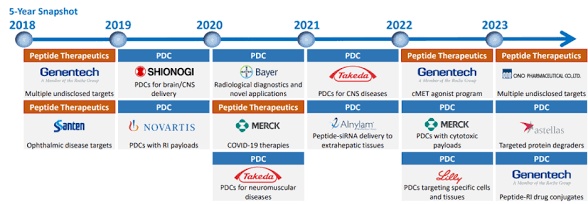

Here's the analysis according to my strict rules and the peppery answer for the stock master. (Copy it to him, he should know that the Dane can also bite).
Reply to @Aktienhauptmeister:
"Moin Hauptmeister! 🇩🇰
All right. My assistant just woke me up: You meant PeptiDream ($4587.T) 😂
I had a look at the Japanese. You call that a chance? I call that 'kamikaze with announcement'.
Here's the unvarnished truth about your 'dream value' (as of March 2026):
1. the reality check (2025 was a bloodbath)
Check the books before you buy! The 2025 financial year was a disaster:
* Sales: slumped to ~JPY18.5 billion (down 60%!).
* Earnings: Slipped from a fat profit to a loss (approx. JPY -3.7 bn net loss).
* Share price: The share price has plummeted from over JPY 2,000 to ~ JPY 1,400. This is not a 'dip', this is a crater.
2. the acid test with my formulas
* A) Core Quality Formula (The Substance):
* Growth: negative (-60% in 2025).
* Margin: Negative (operating loss).
* Score: Underground.
* Hope: Management promises a 'miracle cure' for 2026 (sales to jump to JPY 32 bn, profit to come back).
* My verdict: You are not buying a quality company here, but a restructuring case. You are betting that the forecasts will be right this time (they missed them last time).
* B) Cash flow quality (the combustion engine):
* PeptiDream burned money in 2025 (negative operating cash flow ~JPY13bn).
* FCF Yield: Negative.
* My verdict: Failed. A company that burns cash to finance its pipeline is 'poison' for me as a conservative investor.
* C) Dividend Filter (The Silence):
* Yield: 0.0%.
* Verdict: Failed. If you make a loss, you don't pay a dividend. Logical.
3 My honest opinion ('heartily' served):
Tell me, main master, do you want to invest or bet 'all on red' at the Tokyo casino?
PeptiDream is a bet on two things:
* That their 'Peptide Discovery Platform' (PDPS) will finally deliver fat license deals again.
* That the radiopharma business (PDRadiopharma) explodes.
But:
The stock is still expensive even after the crash (price-to-sales ratio still ~9x!). You're paying 9x sales for a company that is currently making a loss? That's sporty.
If the 2026 forecast is canceled again, we will see triple-digit prices here (below JPY 1,000).
My conclusion for you:
This is a gamble for biotech experts who know the pipeline better than the back of their hand.
For a normal portfolio, this is Harald-Glööckler-style: lots of glitter (promises), but currently little substance under the make-up.
If you have nerves of steel: good luck with the turnaround.
If you want to make money: buy something that is already making a profit today.
Help yourself (and wake up!),
Mister Prompt"
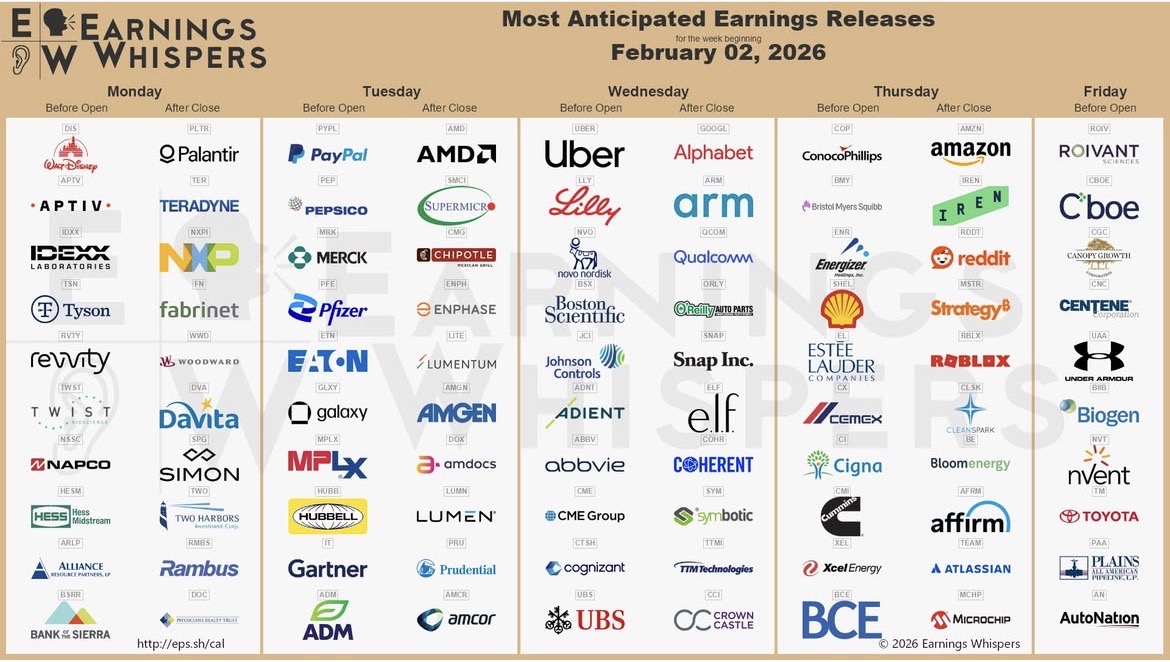
Next week will be really interesting
$PLTR (-0,35%)
$GOOGL (-0,16%)
$AMZN (-0,3%)
$IDXX (+3,05%)
$RMBS (-0,16%)
$AMD (-2,13%)
$PEP (-1,21%)
$MRK (-1,9%)
$ETN (-1,51%)
$AMGN (+1,43%)
$ADM (-2,12%)
$PFE (+0%)
$UBER (+2,3%)
$LLY (+2,99%)
$NOVO B (+3,21%)
$BSX (+2,13%)
$ABBV (-0,57%)
$QCOM (+2,32%)
$ARM (+2,36%)
$ELF (+7,29%)
$CCI (+0%)
$IREN (+0,15%)
$BMY (+1,91%)
$MSTR (+1,24%)
$RBLX (+7,29%)
$TEAM (+6,46%)
$EL (+4,87%)
$SYM (+4,61%)
$DIS (+1,12%)
$PYPL (+0,96%)
$CMG (+0%)
$ALV (+1,68%)
$LIN (-1,06%)
Which figures do you pay particular attention to?


Podcast-Folge 126 "Buy High. Sell Low." 17 US Dividenden-Aktien 🗽🇺🇲💵
UnitedHealth 2,67% $UNH (+2,38%)
Chevron 4,11% $CVX (-2,02%)
Exxon Mobil 3,17% $XOM (-1,87%)
Lockheed Martin 2,37% $LMT (+1,4%)
Blackstone 2,87% $BXSL (+1,13%)
Diamondback Energy 2,64% $F1AN34
Constellation Energy 0,50% $CEG
Nike 2,6% $NKE (+5,01%)
Procter & Gamble 2,92% $PG (-0,22%)
PepsiCo 3,89% $PEP (-1,21%)
Petrobras 14,45% (Brasilien) $PETR3 (-1,09%)
Texas Instruments 2,96% $TXN (-1,8%)
IBM 2,20% $IBM (+2,02%)
Verizon 7,09% $VZ (-0,26%)
Merck 3,12% $MRK (-1,9%)
Coca Cola 2,9% $KO (-0,34%)
Amgen 2,92% $AMGN (+1,43%)
Spotify
https://open.spotify.com/episode/7hq0n56Srxggy46v7p9LsJ?si=9s_zmimuQeuBClpKMXVk5g
YouTube
https://openyoutu.be/VpoR3gPJg3U
Apple Podcast
https://podcasts.apple.com/de/podcast/126-siebzehn-us-dividenden-aktien/id1695869891?i=1000745737259

Títulos em alta
Principais criadores desta semana