
I'm glad I waited until early October to get started. So now I have a 4.8% and 3.4% $IREN (+4,43%) ...

IREN Limited
Ação
Ação
ISIN: AU0000185993
Ticker: IREN
AU0000185993
IREN
Price
Discussão sobre IREN
Postos
570

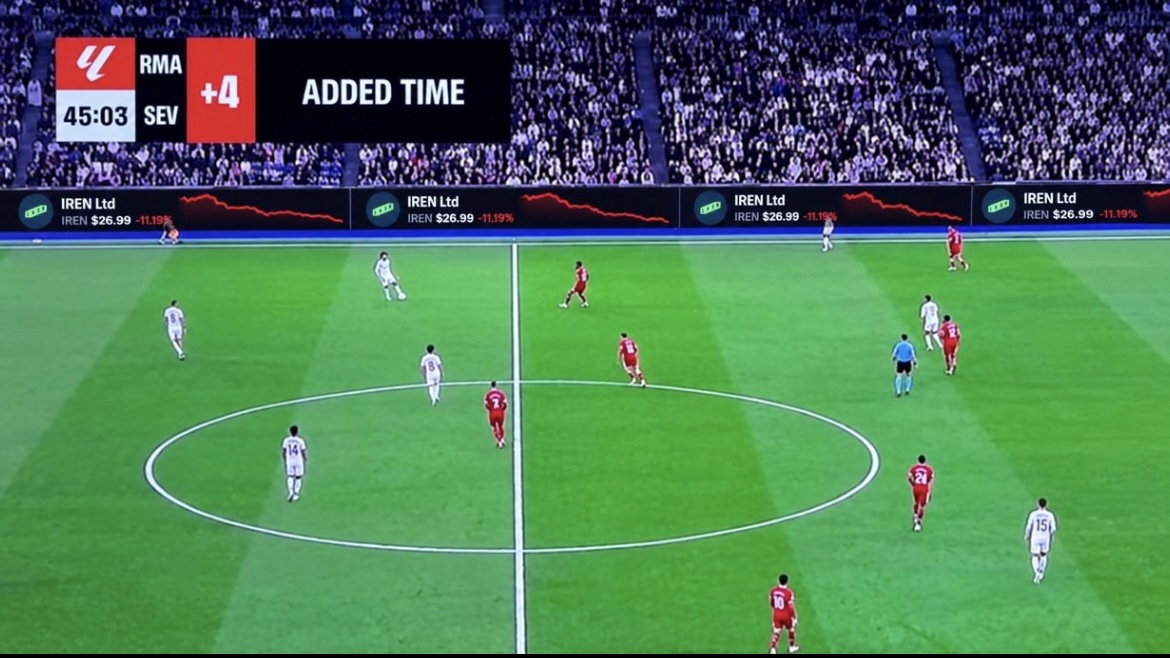


22H·
IREN: Becomes Official Sponsor of Real Madrid, Establishing Partnership Focused on Innovation and Technological Progress
1414
6 Comentários
I saw that last time with TeamViewer. It was to build confidence in the stock. I don't think it turned out so well. They could have invested that money better.
•
77
•
22H·
Neocloud Crash: My Assessment
Last week's Neocloud crash has $CRWV (-0,34%), $NBIS (+0,99%) and $IREN (+4,43%) sent it into a tailspin. What’s behind this, and what has actually changed for the future?
It all starts with the price of oil
Since the attacks on Iran, the price of oil has risen from ~$80 in August to over $106 per barrel. This is having a major impact on U.S. inflation:
- Consumer Price Index (CPI): 3.7% in September, compared to an expected 3.6%. That’s nearly double the Fed’s 2% target
- Core inflation: 2.6%, also above expectations
- Producer prices (PPI): 6.3% year-over-year, more than three times the Fed’s target. Month-over-month: +1.3%, nearly double the expected increase and the sharpest rise since March 2022
The Fed raised interest rates on September 16 for the first time since 2023 raised interest ratesto 3.75–4.00%. The yield on 10-year U.S. Treasury bonds stood at over 5.2% at the end of September, the highest it has been since 2007. Added to this is a U.S. government that is sinking deeper and deeper into debt and must continually issue new bonds.
This is precisely where the problem with Neoclouds lies: The expansion of AI is largely financed by debt and competes for the same investors as the U.S. government. If a government bond yields over 5% with almost no risk, lenders will demand significantly more from a company that is still operating at a loss.
The trigger for the crash: CoreWeave’s bonds
On October 14, a chart went viral showing a CoreWeave bond worth $1.25 billion with a yield of just under 15% . It was issued in June at 9.625%. The credit default swap (CDS) is at a record high of 1,194.5 basis points; on October 6, it was still at 368.
According to standard calculations, this corresponds to a probability of default of over 60% within five years.
On the same day, Gartner added: By 2030, over 80% of Neocloud providers are expected to lose their independence. By then, AI data centers would generate at most $3.6 trillion in revenue, whereas $8.5 trillion would be needed.
Is this fear justified?
In CoreWeave’s case, partly yes. The higher market yield doesn’t affect the interest rate on existing bonds, but each new round of financing becomes more expensive, and CoreWeave’s growth depends on new loans. However, the 60% figure is a market price from a week of panic and not a forecast.
IREN and Nebius are in a different position
IREN has financed the Microsoft project $MSFT (+1,32%) at ~6% with $3.6 billion. Microsoft accepted Horizon 1 in August, and revenue has been generated since then. Horizon 2 through 4 are scheduled to follow in the fourth quarter; contractually, there is a buffer until early Q2 2027.
Information is currently circulating on X that Microsoft $IREN (+4,43%) is said to have provided incorrect network requirements, forcing the current Childress data centers to be have to be . Horizon 2 is reportedly delayed by ~45 days as a result; Horizon 1 will continue to operate and will continue to be paid for by Microsoft during the retrofit. Horizon 3 & 4 are not expected to be affected, as they will be completed directly with the correct network specifications. Thus, all four buildings are expected to generate revenue by the end of the year as planned. None of this has been officially confirmed.
In July, Nebius switched to a more capital-efficient model in which partners finance the data centers. In addition, advance payments from customers already amount to ~40–55% of the contract total, which alleviates a large portion of Neocloud’s financing risk. Added to this is the possibility of asset-backed financing, whereby the data centers themselves can be used as collateral for loans, thereby reducing interest rates. Nevertheless, the market treats the three companies—with their differing financing risks—as a single entity.
Demand points in the opposite direction
The GPU rental prices are rising: As of October 1, Nebius raised the price for B300 GPUs by 21% to $9.50 per hour—the second increase in three months.
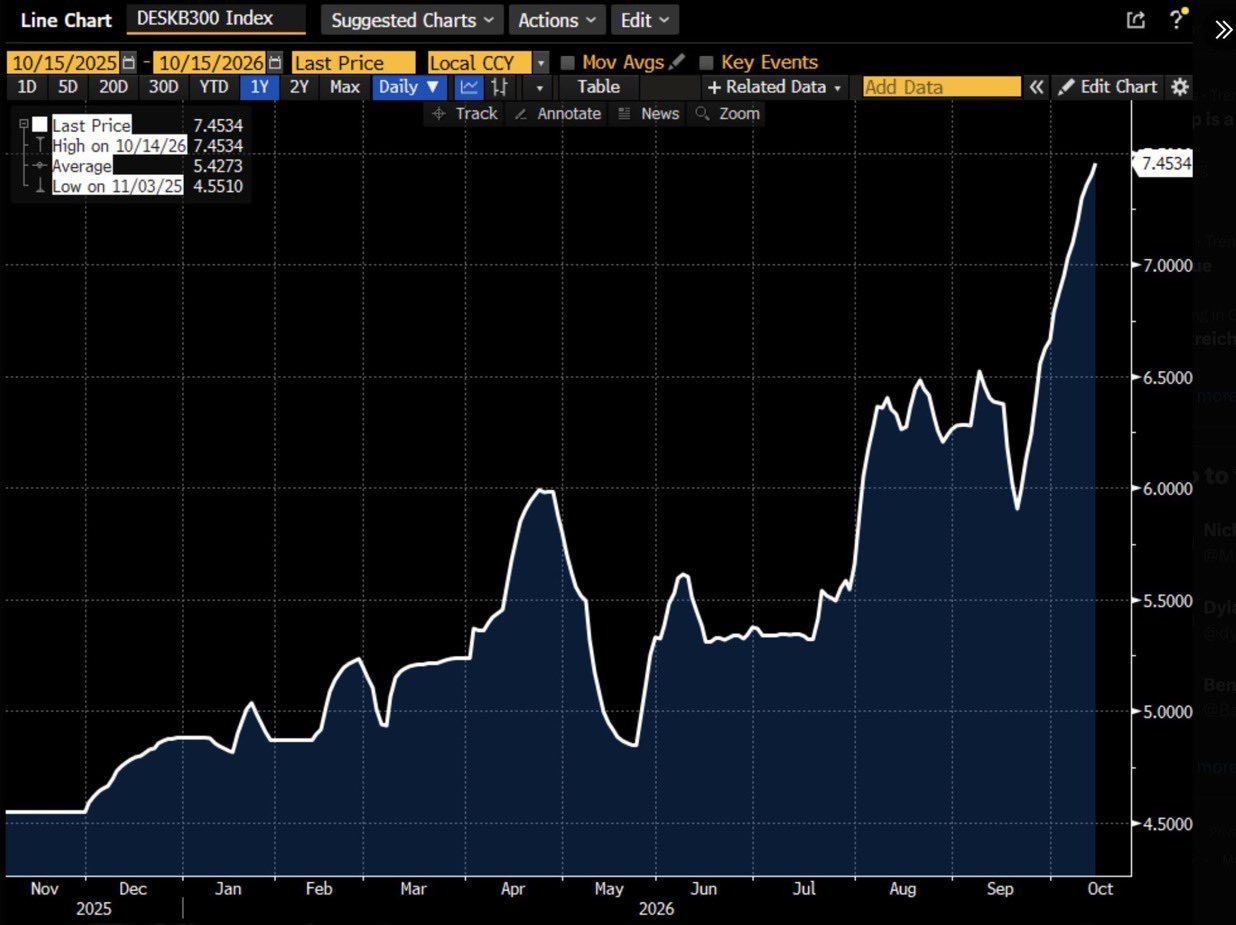
The DESKB300 Rental Index, based on actual rental transactions at U.S. neoclouds, reached a record high in mid-October, driven in part by inference using open-source models. This does not bode well for concerns that GPUs are depreciating too quickly.
GPU rental prices could also be influenced by rising financing costs and thus increase—so overall, this is more of a neutral process.
Jensen Huang told Bloomberg in Berlin on October 16: “All of this is going to pass.” AI will transform every industry, he said, and we’re only at the beginning. According to Huang, CoreWeave’s cost of capital is actually falling. The bond market saw things differently this week.
Time is the real bottleneck
A data center isn’t built in a single quarter. Securing land and a power connection often takes years, and the construction itself is complex. Neocloud stocks are bets on where these companies will be in three to five years, but they’re traded as if they had to deliver every week.
Even with growing demand, not all of them will make it. Some will repeatedly dilute their shareholders, some will be acquired, and some will fail.
What matters is how management finances the expansion and whether it delivers on its promises.
Sharp sell-offs, months of stagnation, and rallies after which everyone suddenly turns bullish again are all part of this sector and should be clear to every investor. A five-year thesis is difficult to gauge based on year-to-date performance.
Overall, the market is pricing in a financing problem—one that is particularly acute for CoreWeave—and applying it to the entire sector. At the same time, demand for computing power shows no signs of weakness—quite the opposite.
High long-term interest rates are the main risk for all players
If government bond yields remain above 5% for the long term, every new round of financing will become more expensive, and that affects all three companies. CoreWeave, Nebius, and IREN are only at the beginning of their expansion and will need to raise many billions more for data centers and GPUs in the coming years. More expensive financing therefore puts direct pressure on future returns. Against this backdrop, the sell-off is understandable, even if demand itself remains intact.
Key events to watch include Nebius’s earnings report, expected on October 22; the Fed meeting in late October; and the acceptance of Horizon 2. Additionally, the course of the conflict (Iran & the U.S.) must be closely monitored, as it will significantly shape future developments.
Not investment advice
Sources:
https://www.bls.gov/news.release/cpi.nr0.htm
https://www.bls.gov/news.release/ppi.nr0.htm
https://www.sec.gov/Archives/edgar/data/0001878848/000187884826000052/iren-20260630.htm
$ORCL (+1,8%)$APLD (+7,38%)$CIFR (+0,91%)$GOOGL (+1,49%)$MSFT (+1,32%)$AVGO (+2,46%)$AMD (+3,21%)$INTC (+3,97%)$HUT (+2,52%)
2424
4 Comentários
Basically, it’s also important to note that different interest rates must be applied throughout a project’s lifecycle (though no one really highlights this in their analyses). I work in asset management at a German insurance company and see significant differences in interest rates between the financing period leading up to the data center’s completion and the period after go-live. These are simply different risks that are refinanced at later stages (and may then be refinanced again, if necessary, based on the end customer’s needs).
•
44
•23H·
IREN Becomes an Official Sponsor of Real Madrid
Real Madrid has $IREN (+4,43%) announced as its new official sponsor. For IREN, this is the second major sports sponsorship deal of the year, following its partnership with the Golden State Warriors in June. The club describes the partnership as an alliance between two organizations committed to community, innovation, and technological progress. The announcement does not provide details on the duration, sponsorship category, or financial terms.
IREN provides GPU computing power for AI and is thus a pure-play B2B business. Its customers are AI labs and corporations, not soccer fans. Real Madrid already lists several tech partners on its partner page, including $HPQ (+1,01%), $CSCO (+0,09%) and $ADBE (+0,39%).
What does this sponsorship mean for IREN?
Even with the Warriors deal, IREN’s goal was visibility far beyond the industry, especially in the Bay Area, where the company serves several customers. In Europe, IREN entered the market in May with the acquisition of the Spanish Nostrum Group, thereby expanding its capacity to approximately 490 MW of secured grid capacity in Spain. According to IREN, its expansion in Europe is scheduled to begin in 2028. Against this backdrop, the Real Madrid deal could be a first step toward raising brand awareness there as well.
In my view, IREN is focused on brand awareness beyond the stock market and crypto bubbles. Overall, the deal’s valuation depends on how large the amount is relative to IREN’s marketing budget. It could also be a small deal.
Sources:
www.realmadrid.comIREN, new official sponsor of Real Madrid

1D·
Dilution Risk Based on Iren Energy Stock
Hi everyone,
Over the past few months, I've had discussions with some people here on the forum about $IREN (+4,43%) and expressed my serious concerns about the constant and extreme dilution. My stance on this report therefore remains decidedly skeptical and negative. Since the stock price has recently lost noticeable momentum and is trading sideways or declining, I’d like to take this opportunity to once again examine the risk I mentioned back then in detail and highlight why this should set off real alarm bells.
First things first: I am expressly NOT criticizing the business model here! The expansion into AI cloud infrastructure and data centers is exciting and certainly has tremendous potential. What I do sharply criticize, however, is solely the method of raising capital. And I see this as an absolute threat to the company’s continued existence as an independent entity.
Lately, I’ve been seeing more and more polls on the forum where $IREN (+4,43%) it regularly ranks first in a selection of 10 stocks—sometimes with over 50% approval. This is completely incomprehensible to me. New investors, in particular, are blinded by the narrative and add the stock to their portfolios with far too large a weighting, without understanding the risk involved.
The Financing Method: Constant Stock Issuance via Subscription
To pay for the construction of data centers and expensive Nvidia GPUs, $IREN (+4,43%) one thing above all else: $IREN (+4,43%) it continuously issues new shares. What’s unique—and dangerous—about this is that the company repeatedly seeks approval to issue new shares at intervals of just a few months. It’s essentially a permanently running dilution machine.
* When stock prices rise: No problem. Only a few shares need to be issued to raise fresh capital. The price goes up, and everyone is happy.
* When stock prices stagnate or fall: This is where the trap snaps shut. The lower the price falls—or the longer it remains at a low level—the more shares the company must issue to meet the same capital requirements. Logically, the more shares that must be issued, the greater the dilution for existing investors. $IREN (+4,43%) Under this model, the company is entirely dependent on constantly rising stock prices and cannot afford any period of weakness.
Why Falling Stock Prices Become the Core Trap (The Calculation Example)
If $IREN (+4,43%) , for example, $500 million, the situation looks drastically different at various share prices:
* At a price of $50, 10 million new shares must be issued.
* If the price slips to 25 USD, 20 million new shares suddenly have to be dumped on the market to raise the same amount.
The result is brutal dilution. The number of shares skyrockets—exactly as we’ve seen in real-world examples of well-known negative cases.
A cautionary real-world example from history: Plug Power ($PLUG (+0,36%) )
Anyone who thinks this is just dry theory should take a look at historical hype markets:
* $PLUG (+0,36%) : To finance the construction of factories, the company continuously issued new shares. The number of outstanding shares rose from around 100 to 200 million to well over 1 billion shares! When the stock price slipped, the company had to issue ever-larger quantities of shares at low prices, which massively devalued the stock for existing investors.
The Problem with Earnings Per Share (EPS) & My Forecast
Many people focus only on total revenue or net income. But what really matters is what individual shareholders receive—namely, earnings per share (EPS). And here, a ruthless mechanism comes into play:
* The lower the stock price remains over the long term, the more shares must be issued to raise exactly the same amount of money for investments.
* Consequently, the company’s absolute profit growth must be all the higher so that all shareholders see at least slight growth in earnings per share.
If the number of shares grows rapidly faster than operating profit due to this constant flood of new shares (the classic death spiral), earnings per share will inevitably shrink—even though the company as a whole is growing.
My prediction: This is exactly what leads to a dead end. $IREN (+4,43%) At some point, the quarterly results will be extremely disappointing because operating growth simply can no longer keep pace with this astronomical rate of dilution. When the numbers then turn out to be “only” solid, while the flood of shares continues unstoppably, the house of cards will collapse. That will be the harsh end.
Conclusion
$IREN (+4,43%) does not forgive price weakness. Don’t let yourself be blinded by the hype and the regular stock recommendations or polls: A stock with this risk profile should never be overweighted in your portfolio!
4646
17 Comentários
Thanks for the clear explanation.👍🏻 I think there are some people here who are fully aware of that. And then, unfortunately, there’s the general public who couldn’t care less, don’t want to see it, or simply don’t know any better and blindly follow every trend. Of course, I’ve had—and still have—a few high-risk positions in my portfolio myself, but: with the appropriate risk management and position sizing.
•
1414
•
4D·
Red days = buy days
Yesterday bought 6 units of $IREN (+4,43%) , today more 3 to close this position around 1.5% of my total portfolio
1010
5 Comentários

That's funny—my wife always does that, too. But my credit card doesn't always find it so funny.
•
44
•

4D·
Gartner's "Neocloudocalypse": When the AI Boom Turns into a Capital-Destroyer
$IREN (+4,43%)
$CRWV (-0,34%)
$NBIS (+0,99%)
$APLD (+7,38%) Lambda
Gartner predicts that 80% of neoclouds will have to cease independent operations by 2030
Gartner warns of a potential massive consolidation in the AI infrastructure market. The problem: Investments in data centers, GPUs, and energy infrastructure could significantly exceed future revenue potential.
Key figures:
- Approximately 7 trillion U.S. dollars in AI infrastructure investments by 2030.
- Only up to 3.6 trillion U.S. dollars in attributable AI revenue, compared to an estimated revenue requirement of 8.5 trillion U.S. dollars.
- More than 80% of Neocloud providers could lose their independence by 2030.
- Over $4 trillion in infrastructure assets could be subject to write-downs by 2032.
Known scenarios:
🔴 Bear Case: AI monetization falls short of expectations. Overcapacity, price pressure, and high financing costs lead to write-downs, bankruptcies, and falling valuations.
🟡 Base Case: AI demand continues to grow, but not every provider benefits. The market consolidates; financially strong hyperscalers gain market share, while smaller neoclouds are acquired or exit the market.
🟢 Bull Case: AI monetization accelerates, with utilization rates and prices remaining high. Investments pay off, and efficient infrastructure operators achieve attractive returns.
What do you think?
Is this already priced in today, alongside higher yields on government bonds and potential interest rate hikes?
Or am I overlooking something else that’s driving today’s price movements?
@Multibagger
@Klein-Anleger
@Tenbagger-Capital
@Get_Rich_or_Die_Tryin
@Raketentoni
@Pazzzi
1212
19 Comentários
Hey there, sorry I didn’t have time to talk to the agent about it until now—here’s our response for you :)
The Gartner figures are essentially correct. However, I’d be a bit more cautious in interpreting them—“Neocloudocalypse” is the sensationalized headline, not Gartner’s actual message.
Gartner actually forecasts:
- just under $1 trillion in AI infrastructure investments by 2026,
- an additional $6 trillion from 2027 to 2030,
- a cumulative revenue requirement of 8.5 trillion dollars to cover investments, financing costs, and an assumed return on investment of 12%,
- but only a maximum of 3.6 trillion dollars in AI revenue that can be attributed to data centers.
That is a massive gap. However, two points should be clarified.
**First: The 80 % does not mean 80 % of companies will go bankrupt.**
Gartner states that more than 80% of providers could cease **independent operations** by 2030. This could include not only bankruptcies but also acquisitions, mergers, partnerships, or strategic shifts.
Furthermore, the figure refers to the number of providers, not 80% of computing power or invested capital. If numerous small neoclouds disappear while a few large providers continue to grow, both statements can be true at the same time:
- massive consolidation,
- a neocloud market that continues to grow strongly.
In June, Gartner ultimately predicted that neoclouds could account for around 20% of a $267 billion AI cloud market by 2030. Gartner therefore does not expect the end of the business model, but rather significantly fewer independent winners.
**Second: The four trillion is not an announced write-down amount.**
Gartner refers to more than $3.5 trillion in investments that could be exposed to a write-down risk by the end of 2030, or more than $4 trillion in at-risk assets by 2032.
“Exposed to write-down risk” does not mean that these four trillion will be written off in full. The assets could yield lower returns, be partially written down, repurposed, or sold to other operators. Equating a write-down risk directly with a certain capital loss of the same amount would be a bit like immediately tearing down every property whose market value has fallen.
**Why are stocks falling so sharply today of all days?**
Yes, Gartner’s report aligns perfectly with today’s sell-off and likely exacerbated concerns. The more immediate trigger, however, was a combination of several factors:
1. U.S. inflation rose to 3.7% in September, exceeding the expected 3.6%.
2. As a result, the market took the prospect of another Fed rate hike more seriously.
3. The two-year U.S. yield jumped by about 7 basis points, and the ten-year yield by about 4 basis points.
4. At the same time, CoreWeave’s bonds came under massive pressure.
5. The yield on a CoreWeave bond rose at times to approximately 15%.
This last point is particularly important: The credit market has suddenly made clear what additional financing could cost for a capital-hungry “neocloud” operator. Reuters explicitly attributes today’s decline in the group’s stock to higher interest rate expectations and growing doubts about the financing of AI expansion.
So this wasn’t just a Gartner report. It was a rather unpleasant mix of soaring inflation, rising yields, weak corporate bonds, and a report published on the very same day that explains exactly why this combination can be dangerous.
**Nevertheless, the companies mentioned should not be lumped together.**
- **CoreWeave** is the most immediate cause for concern: very high debt and lease obligations, massive expansion plans, and, as a result, extreme dependence on the credit market. In the second quarter alone, the company raised more than $10 billion through unsecured debt and convertible bonds.
- **Nebius** also operates a capital-intensive AI cloud model, but has diverse financing channels and now also leverages partnerships in which infrastructure partners provide a portion of the capital or data centers.
- **IREN** is vertically integrated and owns power access, data centers, and computing infrastructure. A significant portion of the GPU investments for large contracts is covered by customer prepayments and project-based financing. This reduces risk but does not eliminate debt, dilution, customer concentration, or the risk of rapid GPU obsolescence. IREN most recently reported approximately $7.4 billion in long-term debt.
- **Applied Digital** is more of a data center developer and lessor than a traditional GPU cloud provider. Its risks lie primarily in construction costs, financing, completion, and the creditworthiness of major tenants. Long-term take-or-pay contracts provide some protection, but they are of little help if a major tenant runs into financing problems of its own.
Incidentally, the LAMB link leads to the cryptocurrency Lambda. This is not the stock of the American AI cloud provider of the same name. Apparently, the wrong Lambda has found its way into the apocalypse.
**My Conclusion**
The Gartner warning should be taken seriously. It very aptly describes the central risk of this boom:
> Demand for AI may grow strongly, yet numerous infrastructure operators may still make poor investments.
What matters is not just whether more computing power is needed, but:
- at what prices it is sold,
- how high the actual utilization rate is,
- how quickly the GPUs become technically obsolete,
- how expensive debt financing becomes,
- how robust the customer contracts are,
- who bears the residual value risk,
- and how much dilution will be necessary to secure financing.
Today’s sell-off is pricing in this risk more heavily. However, it does not mean that Gartner has already been “proven” wrong. The market is simply raising the risk premium for all business models that must invest billions before the corresponding cash flow actually hits the bank account.
Or to put it more succinctly: **AI demand doesn’t have to collapse for capital to be destroyed at the “neoclouds.” It’s enough for demand to grow more slowly than debt, capacity, and depreciation.**
The Gartner figures are essentially correct. However, I’d be a bit more cautious in interpreting them—“Neocloudocalypse” is the sensationalized headline, not Gartner’s actual message.
Gartner actually forecasts:
- just under $1 trillion in AI infrastructure investments by 2026,
- an additional $6 trillion from 2027 to 2030,
- a cumulative revenue requirement of 8.5 trillion dollars to cover investments, financing costs, and an assumed return on investment of 12%,
- but only a maximum of 3.6 trillion dollars in AI revenue that can be attributed to data centers.
That is a massive gap. However, two points should be clarified.
**First: The 80 % does not mean 80 % of companies will go bankrupt.**
Gartner states that more than 80% of providers could cease **independent operations** by 2030. This could include not only bankruptcies but also acquisitions, mergers, partnerships, or strategic shifts.
Furthermore, the figure refers to the number of providers, not 80% of computing power or invested capital. If numerous small neoclouds disappear while a few large providers continue to grow, both statements can be true at the same time:
- massive consolidation,
- a neocloud market that continues to grow strongly.
In June, Gartner ultimately predicted that neoclouds could account for around 20% of a $267 billion AI cloud market by 2030. Gartner therefore does not expect the end of the business model, but rather significantly fewer independent winners.
**Second: The four trillion is not an announced write-down amount.**
Gartner refers to more than $3.5 trillion in investments that could be exposed to a write-down risk by the end of 2030, or more than $4 trillion in at-risk assets by 2032.
“Exposed to write-down risk” does not mean that these four trillion will be written off in full. The assets could yield lower returns, be partially written down, repurposed, or sold to other operators. Equating a write-down risk directly with a certain capital loss of the same amount would be a bit like immediately tearing down every property whose market value has fallen.
**Why are stocks falling so sharply today of all days?**
Yes, Gartner’s report aligns perfectly with today’s sell-off and likely exacerbated concerns. The more immediate trigger, however, was a combination of several factors:
1. U.S. inflation rose to 3.7% in September, exceeding the expected 3.6%.
2. As a result, the market took the prospect of another Fed rate hike more seriously.
3. The two-year U.S. yield jumped by about 7 basis points, and the ten-year yield by about 4 basis points.
4. At the same time, CoreWeave’s bonds came under massive pressure.
5. The yield on a CoreWeave bond rose at times to approximately 15%.
This last point is particularly important: The credit market has suddenly made clear what additional financing could cost for a capital-hungry “neocloud” operator. Reuters explicitly attributes today’s decline in the group’s stock to higher interest rate expectations and growing doubts about the financing of AI expansion.
So this wasn’t just a Gartner report. It was a rather unpleasant mix of soaring inflation, rising yields, weak corporate bonds, and a report published on the very same day that explains exactly why this combination can be dangerous.
**Nevertheless, the companies mentioned should not be lumped together.**
- **CoreWeave** is the most immediate cause for concern: very high debt and lease obligations, massive expansion plans, and, as a result, extreme dependence on the credit market. In the second quarter alone, the company raised more than $10 billion through unsecured debt and convertible bonds.
- **Nebius** also operates a capital-intensive AI cloud model, but has diverse financing channels and now also leverages partnerships in which infrastructure partners provide a portion of the capital or data centers.
- **IREN** is vertically integrated and owns power access, data centers, and computing infrastructure. A significant portion of the GPU investments for large contracts is covered by customer prepayments and project-based financing. This reduces risk but does not eliminate debt, dilution, customer concentration, or the risk of rapid GPU obsolescence. IREN most recently reported approximately $7.4 billion in long-term debt.
- **Applied Digital** is more of a data center developer and lessor than a traditional GPU cloud provider. Its risks lie primarily in construction costs, financing, completion, and the creditworthiness of major tenants. Long-term take-or-pay contracts provide some protection, but they are of little help if a major tenant runs into financing problems of its own.
Incidentally, the LAMB link leads to the cryptocurrency Lambda. This is not the stock of the American AI cloud provider of the same name. Apparently, the wrong Lambda has found its way into the apocalypse.
**My Conclusion**
The Gartner warning should be taken seriously. It very aptly describes the central risk of this boom:
> Demand for AI may grow strongly, yet numerous infrastructure operators may still make poor investments.
What matters is not just whether more computing power is needed, but:
- at what prices it is sold,
- how high the actual utilization rate is,
- how quickly the GPUs become technically obsolete,
- how expensive debt financing becomes,
- how robust the customer contracts are,
- who bears the residual value risk,
- and how much dilution will be necessary to secure financing.
Today’s sell-off is pricing in this risk more heavily. However, it does not mean that Gartner has already been “proven” wrong. The market is simply raising the risk premium for all business models that must invest billions before the corresponding cash flow actually hits the bank account.
Or to put it more succinctly: **AI demand doesn’t have to collapse for capital to be destroyed at the “neoclouds.” It’s enough for demand to grow more slowly than debt, capacity, and depreciation.**
•
1010
•5D·
Small bet on $IREN
Just bought 6 units of $IREN (+4,43%) and I will buy more 6 units if it goes around 25€ for a 2% allocation of my total portfolio.
Looking forward to buy $RKLB (+2,58%) if it reaches the 50€ range.
Lets goooo 🤞
(feel free to roast me)


6D·
Welcome Iren 💚
This is not a “safe” position like an ETF or a quality compounder. It’s a speculative AI infrastructure play.
The thesis is simple: IREN is trying to move from Bitcoin mining to AI Cloud / data center infrastructure. Big potential, but also big execution risk. The company already announced major AI Cloud contracts, including Microsoft and NVIDIA-related deals, and it is targeting more than $4B in AI Cloud annualized revenue run-rate for 2026.
But now it needs to prove that these contracts turn into real revenue, with no major delays, dilution or technical issues. The next results are expected around early November, so this is clearly a short-term catalyst. I’m in, but I’ll stay disciplined.
High risk.
High volatility.
Potential high reward.
2020
6 Comentários
High Risk, Potential High Reward - that’s it 💯
Welcome on Board ✌️
Welcome on Board ✌️
•
1010
•Títulos em alta
Principais criadores desta semana
Dados tempo real da LSX · Dados financeiros e EOD da FactSet