
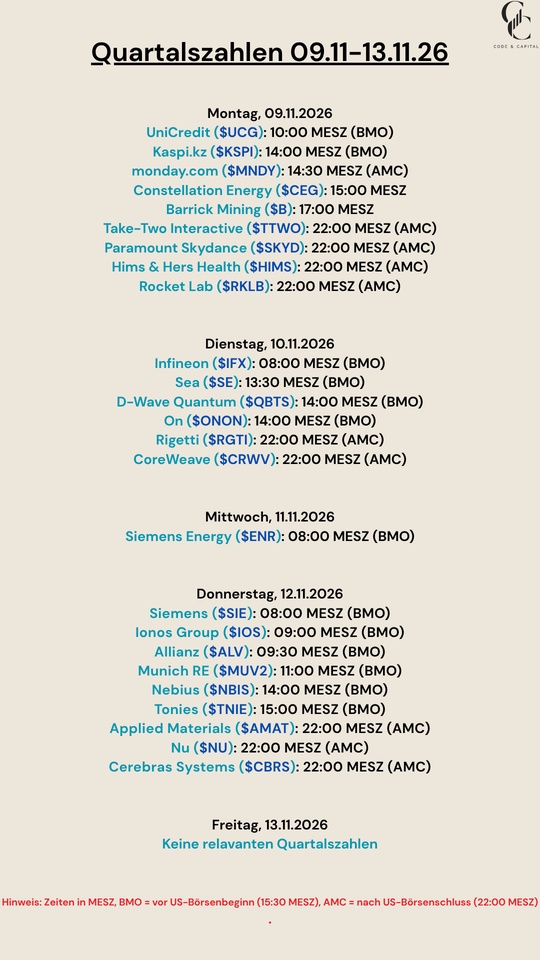
$UCG (+1,02%)
$KSPI (+0,86%)
$MNDY (-5,67%)
$CEG (+6,09%)
$ABX (+1,82%)
$TTWO (+1,26%)
$PARA (-0,14%)
$HIMS (+9,93%)
$RKLB (+17,37%)
$IFX (+1,56%)
$SE (+0,45%)
$QBTS (+21,07%)
$ONON (+0,75%)
$RGTI (+20,21%)
$CRWV (+6,9%)
$ENR (+3,27%)
$SIE (-2,83%)
$iOS$ALV (-2,56%)
$MUV2 (-3,69%)
$NBIS (+7,72%)
$TNIE (-2,08%)
$AMAT (+5,41%)
$NU (+3,65%)
$CBRS

CoreWeave, Inc. Class A
Ação
Ação
Ticker: CRWV
CRWV
Price
Discussão sobre CRWV
Postos
791D·
Quarterly Results Nov. 9–13, 26
1818

1D·
The Perpetual Motion Machine of Data Centers: Why the Data Center Hype Is Once Again Pushing the Limits of the Laws of Money
Every technological megatrend needs that one magical moment when all healthy skepticism is collectively set aside. Today we’re witnessing this spectacle unfold with artificial intelligence: Expectations are astronomical, future revenues have long since been mentally booked away in our minds, and data centers are springing up like mushrooms after a gentle spring rain. Everyone is in complete agreement: This technology will liberate humanity and rake in trillions. But amid all the euphoria, it’s easy to forget one tiny, ruthless truism: Visions take a hell of a long time—but bills and loans have a rock-solid due date.
The Principle of Infinite Growth
To satisfy the insatiable hunger for computing power, the infrastructure pioneer reaches deep into the bag of tricks of modern financial wizardry. He floods the market with billions in convertible bonds and high-yield debt, while simultaneously signing 10- or 15-year lease agreements as if there were no tomorrow.
The reassuring narrative sounds like pure gold at every investor conference:
Whoever builds the data centers today will collect the tolls for the entire digital universe tomorrow.
And if someone does timidly point out the gigantic mountains of debt, the manager waves it off: “Don’t worry, tech heavyweights have secured capacity for years anyway. It’s all absolutely rock-solid!”
The Deadly Trap of Convertible Bonds
Convertible bonds are particularly appealing during such hype phases because, thanks to low interest rates, they seem wonderfully cheap. The clever promise to creditors: “You’ll get almost no interest, but in return, you’ll soon convert your bonds into soaring stocks when our share price goes through the roof.”
It’s just too bad that this is the classic balance-sheet time bomb. If the stock price misses the magic target at maturity, the conversion right vanishes into thin air. And in exactly that fraction of a second, reality strikes with the force of a sledgehammer: The company is contractually obligated to repay the entire amount to investors in real, hard cash.
If the coffers are completely empty at that point—because the revolutionary AI application hasn’t yet brought in billions—it means: batten down the hatches; the bankruptcy trustees take over.
On top of that comes the second, wonderfully creative lever: The financial circular economy. Hardware giants grant data center operators lucrative vendor credit or invest capital directly in them (vendor financing) so that the operators can use that very borrowed money to repurchase expensive servers and chips in record time. This artificially drives chip manufacturers’ revenues through the roof, but at its core, it’s based on pure speculation.
When harsh reality sets in
What actually happens when the hype fizzles out? It’s simple: The laws of money are damn humorless.
- No leniency: Creditors and bondholders want to see real money on the due date—very few bakers will accept promises of a bright future or PowerPoint slides as payment for their bread rolls.
- Pricing collapse: When overcapacity suddenly looms in the market because customers are staying away, rents and prices for computing power plummet.
- Merciless major clients: Even the richest tech giants show zero loyalty as soon as cheap vacant space becomes available. They mercilessly exploit the crisis to renegotiate existing contracts downward.
- Those lovely fixed costs: Meanwhile, interest payments, cash repayments due, and long-term data center leases merrily continue, regardless of whether the servers are humming or standing idle.
The Resolution: A Brief History Lesson
Exactly this brilliant mechanism—endless revenue fantasies, tangled hardware deals, billions in convertible bonds, and outrageously expensive, long-term leases—has, of course, existed before in economic history. We’re talking about the period from 1998 to 2001. And back then, too, it was a data center operator.
I’m not settling scores with today’s NeoClouds here. This is the almost tragicomic story of the company Exodus Communications in the late 1990s and how it built its highly hyped data centers back then, until reality caught up with it.
Exodus was the absolute megastar on the stock market back then. It operated the server infrastructure for the Internet pioneers of the time: Yahoo!, eBay, and Cisco. Tech giants like Intel and Microsoft , as strategic partners, provided the hardware and the funding. Exodus issued convertible bonds on a massive scale and was valued at over $32 billion. Everyone swore back then: The Internet is unstoppable; the debt will pay for itself.
What Nvidia, Broadcom, and AMD are today—key financiers and, at the same time, the largest hardware suppliers for modern cloud operators—was back then Intel, Cisco, and Microsoft, using exactly the same method: They injected capital into the market, extended loans, and, in return, equipped the infrastructure to boost their own sales through targeted vendor financing.
But then came the spring of 2000. Suddenly, it dawned on the market that monetizing the Internet would take much longer than had been simply imagined in the billion-dollar business plans and PowerPoint fantasies. The dot-com bubble burst with a massive bang, and stock prices plummeted.
This abruptly shut the door on the stock consolidation of the convertible bonds—and creditors demanded their hard cash back. Customers went bankrupt, major clients drove down prices, and the coffers were empty. In September 2001 —a mere three years after the triumphant IPO—Exodus was bankrupt and filed for bankruptcy. The shareholders’ money had simply vanished.
What We Can Learn From This
The parallels to today’s NeoClouds are striking. The technology may sound fancy today, but the fundamental mathematical laws of interest, fixed costs, and the harsh reality of failed convertible bonds haven’t changed one bit since 1998.
“History doesn’t repeat itself, but it does rhyme.” (M. Twain)
$IREN (+17,11%)
$CRWV (+6,9%)
$NBIS (+7,72%)
$HUT (+15,25%)
$CIFR (+18,11%)
3434
18 Comentários
Thomas@Thomas_1963
1D
•
55
•3D·
The End of the AI Loophole: Why Neo-Clouds Are Facing a Margin Crash
The geopolitical screws in the global AI race are being tightened drastically. Anyone who thought that U.S. export bans on cutting-edge hardware—such as NVIDIA’s AI processors—could be circumvented through clever cloud leasing in third countries is now in for a rude awakening.
Published on November 4, 2026 , the collapsed 7-billion-dollar deal between Oracle and Tencent is just the beginning of a chain reaction that will particularly impact the business model of the so-called neo-clouds .
Timeline of the Escalation: November 2026
- November 3, 2026 (Nvidia directive): As reported in the media, Nvidia has instructed its cloud and data center partners worldwide to lease no more than 49% of their total capacity to Chinese customers. At least 51% of computing power must be allocated to non-Chinese customers. This directive, communicated verbally through sales and regional teams, closes the loophole that previously allowed Chinese tech companies to lease AI computing power abroad.
- November 4, 2026 (Intervention by U.S. authorities): Under pressure from the U.S. government, Oracle’s 5-year, $7 billion contract with Tencent fell through. Tencent had sought access to approximately 100,000 high-end AI chips via Oracle data centers in Southeast Asia. Following security concerns raised by Washington and the subsequent directive from Beijing to switch to domestic chips, Oracle terminated the negotiations.
Why Neo-Clouds Are the Primary Victims
Compared to the established Big Tech hyperscalers (AWS, Microsoft Azure, Google Cloud), this development hits specialized Neo-Clouds (such as $CRWV (+6,9%) , $NBIS (+7,72%) or $IREN (+17,11%)) in a vulnerable spot:
Massive losses in existing revenue: In recent years, neo-clouds have often relied to a considerable extent on the extremely liquid demand from Chinese customers to fund their aggressive capacity expansions and debt financing. If this customer segment were to abruptly disappear due to regulatory pressure and NVIDIA’s 49% cap, a massive portion of revenue would vanish overnight.
The Mandatory Implementation (The 51% Threshold): The providers have no choice. They must strictly comply with the requirements, as Nvidia mandates audited know-your-customer (KYC) verifications. Anyone failing to meet the quota for new business risks being cut off from allocations of future GPU generations.
The consequence: Desperate customer acquisition and falling leasing prices
To close the looming revenue gaps and reach the quota of at least 51% non-Chinese customers required by Nvidia, the neo-clouds must now frantically acquire international customers.
This market dynamic is predictably leading to the following developments:
- A race to the bottom in pricing: As dozens of providers simultaneously attempt to sell freed-up GPU capacity at breakneck speed to American, European, or Southeast Asian companies, a dramatic surplus of available computing power is created.
- Drastically falling leasing prices: To quickly poach major clients from the West, neo-clouds must slash their prices. Rental fees per GPU-hour will come under significant pressure in the future and drop drastically.
- Market consolidation: Providers with high debt burdens who have financed their hardware at high costs will suffer greatly from falling leasing prices and lost revenue.
The Outlook
The AI market is finally splitting into two isolated ecosystems. While Chinese corporations are being forced to switch to domestic alternatives, neo-clouds in the West must rapidly restructure their business models. The sudden loss of high-spending customers demands swift compensation—and those who lose the price war for Western customers risk falling by the wayside during this consolidation phase.
$NVDA (+3,8%)
$ORCL (+2,21%)
$CRWV (+6,9%)
$NBIS (+7,72%)
$IREN (+17,11%)


1Semana·
The funding channel for Neoclouds has been closed
What happens to an industry where demand is skyrocketing but which suddenly can’t get any more money?
This question has been on everyone’s mind since yesterday. Elon Musk wrote on X that the credit markets had AI data center operators. Just a few days earlier, the Nebius CEO himself had admitted that key sources of capital had temporarily dried up.
1. The Statements
- Elon Musk: In recent weeks, the credit markets have cut off all companies without significant revenue outside of AI data centers had almost completely cut off access to funding. $SPCX (+10,35%) I’ve taken on $40 billion in debt for GPUs, but only thanks to investment-grade (= high creditworthiness according to rating agencies) and revenue from Starlink and rocket launches. He predicts a mass extinction and consolidation . He rules out the possibility of SpaceX acquiring any Neoclouds.
- Chamath Palihapitiya: Neoclouds are disorganized and poorly capitalized. By 2027, there will be a lot of partially unused computing capacity, and that year will weed out many bad investments.
- Arkady Volozh, CEO of $NBIS (+7,72%): Asset-backed financing and debt markets have temporarily dried up. Nebius is working with customer prepayments and other instruments that should be sufficient to build at least the one gigawatt planned for this year.
- Gartner: As early as mid-October, the research firm predicted that by 2030, over 80% of neoclouds would no longer be independent.
Context: Musk is a direct competitor to traditional Neoclouds, as he rents out GPU capacity himself—SpaceX could benefit from negative headlines.
2. Why a lack of capital affects the valuation:
Neoclouds build and buy first, but the money doesn’t come back for years.
This results in a simple chain:
1. Growth requires capital.
2. Capital becomes expensive or is no longer provided at all: CoreWeave bonds $CRWV (+6,9%) maturing in 2031 yielded at times nearly 16%. At this price, projects are barely profitable, so this funding channel is largely closed.
3. Valuations factor in high growth: The market has priced in years of capacity expansion.
4. This growth cannot be delivered without capital: What isn’t financed won’t be built. Lower growth → lower stock prices. On top of that, companies are raising capital by issuing new shares at low prices, which dilutes the holdings of existing shareholders dilutes and creates further downward pressure.
5. Valuations are coming under pressure: Growth expectations are falling, while at the same time the interest rate used to discount future earnings is rising.
4. How are different types of financing affected?
Closed channels:
- Unsecured high-yield bonds
- GPU loans without high-credit-quality customers
- Asset-backed financing for Neoclouds
Open, but tighter and more expensive:
- Secured loans with investment-grade borrowers: Nebius received on October 22 $3.5 billion from $C (+1,03%), though with a term of only one year
- Stock sales that dilute shares more significantly when prices are low
Outstanding:
- Customer prepayments
- Bonds for hyperscalers and corporations with other sources of revenue
5. Why isn’t a booming business getting funding?
Investors aren’t short on money. $GOOGL (+2,52%), $AMZN (+1,98%), $META (+3,1%) and $ORCL (+2,21%) have invested over $228 billion in bonds.
The reason lies in the lender’s logic:
- No share in the boom: If GPU rental rates double, the shareholder benefits. The lender receives only the interest, but bears the loss in the event of a crisis.
- Uncertain collateral: Financiers estimate that a GPU’s value after three years will be 10 to 60 percent of the original price. This is a huge range when billions are invested in GPUs.
- Macro: Due to the Fed’s interest rate hike in September and an oil price above $100 caused by the war in Iran, new issuances in the high-yield market plummeted in October.
Has this ever happened before?
- Data Centers in 2001: Exodus Communications, then one of the largest data center operators, went bankrupt, and its facilities were sold off cheaply. Equinix $EQIX (+4,15%) barely survived, $DLR (+1,08%) and was later formed from acquired real estate. Data centers became a huge business—but only for the next owners.
- Fiber Optics 2000–2002: The demand for the Internet was real, but funding dried up. Global Crossing and WorldCom went bankrupt.
- Shale Gas 2015/16: The high-yield energy market dried up; many producers went bankrupt, and the most cost-effective ones took over the rest.
- Crypto Miners 2022: Core Scientific filed for bankruptcy and is now an AI rental provider itself.
The pattern is always the same: When the capital market closes for a capital-intensive industry, the balance sheet, not demand. In these examples, macro-driven freezes lasted weeks to months, while freezes affecting an entire industry lasted about one to three years.
6. Which Neoclouds are affected
The key factor is the business model:
- Landlords with tenants of high creditworthiness:
$CIFR (+18,11%) with Amazon as the direct tenant, $WULF (+12,04%) backed by Google. In the case of $HUT (+15,25%), $CLSK (+9,42%) and $RIOT (+15,7%) investment-grade credit protection is still pending. Banks are primarily reviewing the tenant in these cases, which is why financing continues. They benefit very little from the rise in GPU prices because their rents are locked in for 10–20 years. - Landlords with a large CoreWeave stake: Galaxy $GLXY (+5,46%) and Core Scientific, and to some extent also $APLD (+11,02%), where a hyperscaler now accounts for the majority of tenants. Their risk hinges on the industry’s weak link.
- GPU clouds: $IREN (+17,11%) , $NBIS (+7,72%) , $CRWV (+6,9%) , $USCTF (+12,34%) and $BTDR (+14,32%) . This is exactly the channel Musk is referring to. Nebius relies on contracts with $MSFT (+1,13%) and Meta, while IREN relies on Microsoft; on top of that, there are substantial upfront payments: At Nebius, they cover about 50–60%, and at IREN, about 45% of the respective investments. CoreWeave, on the other hand, contributes about $50 billion in debt and lease obligations.
- Without a signed AI contract:
$MARA (+8,8%) and $KEEL (+12,9%). They need customers and financing in the midst of the lockdown.
7. Conclusion
Overall, Musk’s statement is exaggerated, but essentially correct: For companies that only sell GPU rentals and don’t have customers with high credit ratings, the credit market is currently closed.
However, there’s a contradiction in this situation: What isn’t financed won’t be built, and that further reduces supply further, while Musk himself speaks of exploding demand .
Companies that can finance their capacity are likely to benefit from this.
Customers who urgently need computing power will become more aware of this problem, which could potentially increase prepayments for contracts. In addition, customers could use their own creditworthiness as collateral for their AI computing power providers or become lenders themselves.
In my view, therefore, one question above all else will determine the future of the industry:
Who can secure financing to sustain these growth rates?
The quarterly results in November will provide answers; particular attention should be paid to the financing structure and prepayments.
Sources:
https://x.com/elonmusk/status/2114434646914068862
https://x.com/chamath/status/2114389987563381004
https://www.youtube.com/watch?v=ElxZFG9lfmQ
https://www.sec.gov/Archives/edgar/data/0001513845/000110465926117978/tm2628078d1_ex99-1.htm
https://www.cnbc.com/2026/10/14/coreweave-stock-bond-yields-ai-debt.html
https://www.advisorperspectives.com/articles/2026/10/21/surging-yields-biggest-debt-sale-delay
3Semana·
Neocloud Crash: My Assessment
Last week's Neocloud crash has $CRWV (+6,9%), $NBIS (+7,72%) and $IREN (+17,11%) sent it into a tailspin. What’s behind this, and what has actually changed for the future?
It all starts with the price of oil
Since the attacks on Iran, the price of oil has risen from ~$80 in August to over $106 per barrel. This is having a major impact on U.S. inflation:
- Consumer Price Index (CPI): 3.7% in September, compared to an expected 3.6%. That’s nearly double the Fed’s 2% target
- Core inflation: 2.6%, also above expectations
- Producer prices (PPI): 6.3% year-over-year, more than three times the Fed’s target. Month-over-month: +1.3%, nearly double the expected increase and the sharpest rise since March 2022
The Fed raised interest rates on September 16 for the first time since 2023 raised interest ratesto 3.75–4.00%. The yield on 10-year U.S. Treasury bonds stood at over 5.2% at the end of September, the highest it has been since 2007. Added to this is a U.S. government that is sinking deeper and deeper into debt and must continually issue new bonds.
This is precisely where the problem with Neoclouds lies: The expansion of AI is largely financed by debt and competes for the same investors as the U.S. government. If a government bond yields over 5% with almost no risk, lenders will demand significantly more from a company that is still operating at a loss.
The trigger for the crash: CoreWeave’s bonds
On October 14, a chart went viral showing a CoreWeave bond worth $1.25 billion with a yield of just under 15% . It was issued in June at 9.625%. The credit default swap (CDS) is at a record high of 1,194.5 basis points; on October 6, it was still at 368.
According to standard calculations, this corresponds to a probability of default of over 60% within five years.
On the same day, Gartner added: By 2030, over 80% of Neocloud providers are expected to lose their independence. By then, AI data centers would generate at most $3.6 trillion in revenue, whereas $8.5 trillion would be needed.
Is this fear justified?
In CoreWeave’s case, partly yes. The higher market yield doesn’t affect the interest rate on existing bonds, but each new round of financing becomes more expensive, and CoreWeave’s growth depends on new loans. However, the 60% figure is a market price from a week of panic and not a forecast.
IREN and Nebius are in a different position
IREN has financed the Microsoft project $MSFT (+1,13%) at ~6% with $3.6 billion. Microsoft accepted Horizon 1 in August, and revenue has been generated since then. Horizon 2 through 4 are scheduled to follow in the fourth quarter; contractually, there is a buffer until early Q2 2027.
Information is currently circulating on X that Microsoft $IREN (+17,11%) is said to have provided incorrect network requirements, forcing the current Childress data centers to be have to be . Horizon 2 is reportedly delayed by ~45 days as a result; Horizon 1 will continue to operate and will continue to be paid for by Microsoft during the retrofit. Horizon 3 & 4 are not expected to be affected, as they will be completed directly with the correct network specifications. Thus, all four buildings are expected to generate revenue by the end of the year as planned. None of this has been officially confirmed.
In July, Nebius switched to a more capital-efficient model in which partners finance the data centers. In addition, advance payments from customers already amount to ~40–55% of the contract total, which alleviates a large portion of Neocloud’s financing risk. Added to this is the possibility of asset-backed financing, whereby the data centers themselves can be used as collateral for loans, thereby reducing interest rates. Nevertheless, the market treats the three companies—with their differing financing risks—as a single entity.
Demand points in the opposite direction
The GPU rental prices are rising: As of October 1, Nebius raised the price for B300 GPUs by 21% to $9.50 per hour—the second increase in three months.
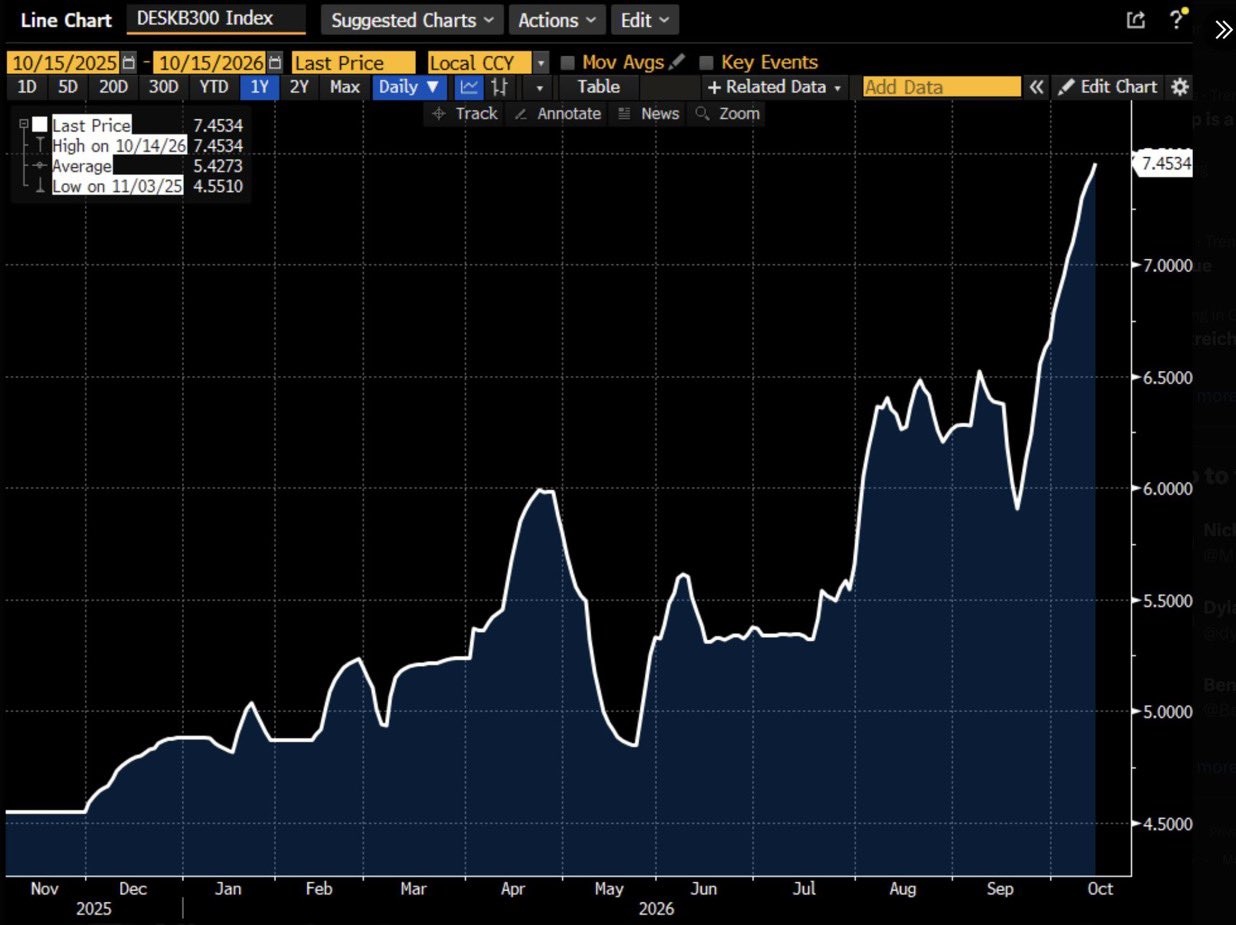
The DESKB300 Rental Index, based on actual rental transactions at U.S. neoclouds, reached a record high in mid-October, driven in part by inference using open-source models. This does not bode well for concerns that GPUs are depreciating too quickly.
GPU rental prices could also be influenced by rising financing costs and thus increase—so overall, this is more of a neutral process.
Jensen Huang told Bloomberg in Berlin on October 16: “All of this is going to pass.” AI will transform every industry, he said, and we’re only at the beginning. According to Huang, CoreWeave’s cost of capital is actually falling. The bond market saw things differently this week.
Time is the real bottleneck
A data center isn’t built in a single quarter. Securing land and a power connection often takes years, and the construction itself is complex. Neocloud stocks are bets on where these companies will be in three to five years, but they’re traded as if they had to deliver every week.
Even with growing demand, not all of them will make it. Some will repeatedly dilute their shareholders, some will be acquired, and some will fail.
What matters is how management finances the expansion and whether it delivers on its promises.
Sharp sell-offs, months of stagnation, and rallies after which everyone suddenly turns bullish again are all part of this sector and should be clear to every investor. A five-year thesis is difficult to gauge based on year-to-date performance.
Overall, the market is pricing in a financing problem—one that is particularly acute for CoreWeave—and applying it to the entire sector. At the same time, demand for computing power shows no signs of weakness—quite the opposite.
High long-term interest rates are the main risk for all players
If government bond yields remain above 5% for the long term, every new round of financing will become more expensive, and that affects all three companies. CoreWeave, Nebius, and IREN are only at the beginning of their expansion and will need to raise many billions more for data centers and GPUs in the coming years. More expensive financing therefore puts direct pressure on future returns. Against this backdrop, the sell-off is understandable, even if demand itself remains intact.
Key events to watch include Nebius’s earnings report, expected on October 22; the Fed meeting in late October; and the acceptance of Horizon 2. Additionally, the course of the conflict (Iran & the U.S.) must be closely monitored, as it will significantly shape future developments.
Not investment advice
Sources:
https://www.bls.gov/news.release/cpi.nr0.htm
https://www.bls.gov/news.release/ppi.nr0.htm
https://www.sec.gov/Archives/edgar/data/0001878848/000187884826000052/iren-20260630.htm
$ORCL (+2,21%)$APLD (+11,02%)$CIFR (+18,11%)$GOOGL (+2,52%)$MSFT (+1,13%)$AVGO (+1,41%)$AMD (+9,62%)$INTC (+9,91%)$HUT (+15,25%)
2727
12 Comentários
1Semana
What are you doing? Have you locked in a price at $IREN? Selling? Buying more?
•
44
•1Semana·
Musk: SpaceX Secures $40 Billion in Debt Financing — for GPUs
By Emily Bary
DOW JONES--According to Elon Musk, SpaceX has secured $40 billion in debt financing amid widespread skepticism toward artificial intelligence (AI). This will enable SpaceX to acquire graphics processing units (GPUs)—a type of AI chip—Musk announced on X, a platform he also owns. SpaceX is rapidly expanding its Neocloud business, through which the company leases access to chips to businesses that need AI computing power.
Musk explained that SpaceX’s investment-grade rating and the company’s diversified business model—which includes revenue from rocket launches and Starlink satellite technology—made the transaction possible. In a separate post, Musk noted that the debt consists “primarily of callable debt for GPU purchases to be delivered in the first and second quarters” and that the agreement would not be a “material factor” in the current quarter. SpaceX did not immediately respond to a request for comment on the debt financing.
In recent weeks, investors had become increasingly nervous about debt financing in the AI sector—particularly in connection with Neocloud companies like Coreweave, which rely on debt to fuel their growth. The pressure on Coreweave’s bonds has caused unease across the tech landscape, partly due to the close interconnections among large corporations. Coreweave did not immediately respond to a request from MarketWatch for comment on Musk’s remarks.
“Over the past few weeks, the credit markets have almost completely cut off access to funding for nearly every company that cannot demonstrate significant revenue independent of AI data centers,” Musk wrote in his X post on Sunday. He also predicted that “more than 200 Neocloud providers will experience a Guppy-level mass extinction and a wave of consolidation.” “Some will make it through, but not many,” he added.
Musk further hinted that his company would not be part of any future industry consolidation. He wrote: “SpaceX isn’t buying any Neoclouds. Completely pointless.”
Contact: redaktion.de@dowjones.com
DJG/DJN/hab/mgo
(END) Dow Jones Newswires
October 26, 2026 04:15 ET (08:15 GMT)
(c) 2026 Dow Jones & Company, Inc.
$SPCX (+10,35%)
$CRWV (+6,9%)
$IREN (+17,11%)
$HUT (+15,25%)
$NVDA (+3,8%)
66

2Semana·
Bavarian Permabull....
$CRWV (+6,9%) Of course, I could be completely off the mark, and this is just my humble opinion. But, phew. Anyone who still wants to jump in here is trying to catch a falling knife. This company isn’t an investment—it’s on the verge of a meltdown. A deadly mountain of debt: Over $51 billion in debt and lease obligations are crushing the company. Quarterly interest payments are eating up the entire operating cash flow. Bond yields at 16% and CDS spreads above 1,040 basis points show that default has long been priced in. $CRWV (+6,9%) It also acts as an artificial revenue booster for NVIDIA. They borrow billions to buy NVIDIA’s chips, while NVIDIA itself is on board as an investor. A true circular economy. If $CRWV (+6,9%) goes bankrupt due to the interest rate crisis, it will tear a massive hole in NVIDIA’s balance sheet and drag the entire AI bubble down with it.
66
5 Comentários
2Semana
That's a piece of cake for NVIDIA—they're at the top even without Coreweave. Otherwise, you're right.
•
55
•
2Semana·
Podcast Episode 169: "Buy High. Sell Low." Subscribe to the podcast so AI stocks can take off again.
00:00:00 Market Overview
00:26:30 AI Bubble
00:32:50 Coreweave
00:42:00 Anthropic IPO
00:57:00 CXMT
01:09:20 Nebius
Spotify
https://open.spotify.com/episode/0EwgdOqDPqirDafcXJgAkR?si=gqfU783WSrCkqXm3QKCj0A
YouTube
https://openyoutu.be/6y0twSPBHE4
Apple Podcasts
open.spotify.com#169 Nebius, Anthropic-Börsengang, Coreweave, CXMT, KI-Blase
55
2Semana·
Elon Musk: The shortage of AI computing power will persist for a long time to come
$SPCX (+10,35%) Earnings Call Statements on the AI Sector:
– Elon Musk: Every hyperscaler and dozens of smaller companies are asking SpaceX for computing power. If we were to say yes to all of them, we could rent out the capacity multiple times over.
– Bret Johnsen (CFO): At current prices, new data centers pay for themselves in less than a year.
– SpaceX deliberately leases on a short-term basis at market rates rather than through long-term contracts. Even older H100 chips from $NVDA (+3,8%) generate more rental revenue today than they did at the start.
– SpaceX’s capacity:
1.7 GW at the end of Q3
2.5–3 GW by year-end
~13 GW by the end of 2027
– The real bottlenecks are power and cooling, not chips.
– CapEx: $19.6 billion in Q3; SpaceX expects $35–40 billion for Q4.
$IREN (+17,11%)$NBIS (+7,72%)$MSFT (+1,13%)$GOOGL (+2,52%)$ORCL (+2,21%)$CRWV (+6,9%)
1818
1 Comentar
So why is there so much turmoil? Is it just because of rising interest rates and the resulting high cost of borrowing?
•
33
•3Semana·
Neocloud Crash: My Assessment
Last week's Neocloud crash has $CRWV (+6,9%), $NBIS (+7,72%) and $IREN (+17,11%) sent it into a tailspin. What’s behind this, and what has actually changed for the future?
It all starts with the price of oil
Since the attacks on Iran, the price of oil has risen from ~$80 in August to over $106 per barrel. This is having a major impact on U.S. inflation:
- Consumer Price Index (CPI): 3.7% in September, compared to an expected 3.6%. That’s nearly double the Fed’s 2% target
- Core inflation: 2.6%, also above expectations
- Producer prices (PPI): 6.3% year-over-year, more than three times the Fed’s target. Month-over-month: +1.3%, nearly double the expected increase and the sharpest rise since March 2022
The Fed raised interest rates on September 16 for the first time since 2023 raised interest ratesto 3.75–4.00%. The yield on 10-year U.S. Treasury bonds stood at over 5.2% at the end of September, the highest it has been since 2007. Added to this is a U.S. government that is sinking deeper and deeper into debt and must continually issue new bonds.
This is precisely where the problem with Neoclouds lies: The expansion of AI is largely financed by debt and competes for the same investors as the U.S. government. If a government bond yields over 5% with almost no risk, lenders will demand significantly more from a company that is still operating at a loss.
The trigger for the crash: CoreWeave’s bonds
On October 14, a chart went viral showing a CoreWeave bond worth $1.25 billion with a yield of just under 15% . It was issued in June at 9.625%. The credit default swap (CDS) is at a record high of 1,194.5 basis points; on October 6, it was still at 368.
According to standard calculations, this corresponds to a probability of default of over 60% within five years.
On the same day, Gartner added: By 2030, over 80% of Neocloud providers are expected to lose their independence. By then, AI data centers would generate at most $3.6 trillion in revenue, whereas $8.5 trillion would be needed.
Is this fear justified?
In CoreWeave’s case, partly yes. The higher market yield doesn’t affect the interest rate on existing bonds, but each new round of financing becomes more expensive, and CoreWeave’s growth depends on new loans. However, the 60% figure is a market price from a week of panic and not a forecast.
IREN and Nebius are in a different position
IREN has financed the Microsoft project $MSFT (+1,13%) at ~6% with $3.6 billion. Microsoft accepted Horizon 1 in August, and revenue has been generated since then. Horizon 2 through 4 are scheduled to follow in the fourth quarter; contractually, there is a buffer until early Q2 2027.
Information is currently circulating on X that Microsoft $IREN (+17,11%) is said to have provided incorrect network requirements, forcing the current Childress data centers to be have to be . Horizon 2 is reportedly delayed by ~45 days as a result; Horizon 1 will continue to operate and will continue to be paid for by Microsoft during the retrofit. Horizon 3 & 4 are not expected to be affected, as they will be completed directly with the correct network specifications. Thus, all four buildings are expected to generate revenue by the end of the year as planned. None of this has been officially confirmed.
In July, Nebius switched to a more capital-efficient model in which partners finance the data centers. In addition, advance payments from customers already amount to ~40–55% of the contract total, which alleviates a large portion of Neocloud’s financing risk. Added to this is the possibility of asset-backed financing, whereby the data centers themselves can be used as collateral for loans, thereby reducing interest rates. Nevertheless, the market treats the three companies—with their differing financing risks—as a single entity.
Demand points in the opposite direction
The GPU rental prices are rising: As of October 1, Nebius raised the price for B300 GPUs by 21% to $9.50 per hour—the second increase in three months.
The DESKB300 Rental Index, based on actual rental transactions at U.S. neoclouds, reached a record high in mid-October, driven in part by inference using open-source models. This does not bode well for concerns that GPUs are depreciating too quickly.
GPU rental prices could also be influenced by rising financing costs and thus increase—so overall, this is more of a neutral process.
Jensen Huang told Bloomberg in Berlin on October 16: “All of this is going to pass.” AI will transform every industry, he said, and we’re only at the beginning. According to Huang, CoreWeave’s cost of capital is actually falling. The bond market saw things differently this week.
Time is the real bottleneck
A data center isn’t built in a single quarter. Securing land and a power connection often takes years, and the construction itself is complex. Neocloud stocks are bets on where these companies will be in three to five years, but they’re traded as if they had to deliver every week.
Even with growing demand, not all of them will make it. Some will repeatedly dilute their shareholders, some will be acquired, and some will fail.
What matters is how management finances the expansion and whether it delivers on its promises.
Sharp sell-offs, months of stagnation, and rallies after which everyone suddenly turns bullish again are all part of this sector and should be clear to every investor. A five-year thesis is difficult to gauge based on year-to-date performance.
Overall, the market is pricing in a financing problem—one that is particularly acute for CoreWeave—and applying it to the entire sector. At the same time, demand for computing power shows no signs of weakness—quite the opposite.
High long-term interest rates are the main risk for all players
If government bond yields remain above 5% for the long term, every new round of financing will become more expensive, and that affects all three companies. CoreWeave, Nebius, and IREN are only at the beginning of their expansion and will need to raise many billions more for data centers and GPUs in the coming years. More expensive financing therefore puts direct pressure on future returns. Against this backdrop, the sell-off is understandable, even if demand itself remains intact.
Key events to watch include Nebius’s earnings report, expected on October 22; the Fed meeting in late October; and the acceptance of Horizon 2. Additionally, the course of the conflict (Iran & the U.S.) must be closely monitored, as it will significantly shape future developments.
Not investment advice
Sources:
https://www.bls.gov/news.release/cpi.nr0.htm
https://www.bls.gov/news.release/ppi.nr0.htm
https://www.sec.gov/Archives/edgar/data/0001878848/000187884826000052/iren-20260630.htm
$ORCL (+2,21%)$APLD (+11,02%)$CIFR (+18,11%)$GOOGL (+2,52%)$MSFT (+1,13%)$AVGO (+1,41%)$AMD (+9,62%)$INTC (+9,91%)$HUT (+15,25%)
2828
4 Comentários
3Semana
Basically, it’s also important to note that different interest rates must be applied throughout a project’s lifecycle (though no one really highlights this in their analyses). I work in asset management at a German insurance company and see significant differences in interest rates between the financing period leading up to the data center’s completion and the period after go-live. These are simply different risks that are refinanced at later stages (and may then be refinanced again, if necessary, based on the end customer’s needs).
•
44
•
3Semana·
Gartner's "Neocloudocalypse": When the AI Boom Turns into a Capital-Destroyer
$IREN (+17,11%)
$CRWV (+6,9%)
$NBIS (+7,72%)
$APLD (+11,02%) Lambda
Gartner predicts that 80% of neoclouds will have to cease independent operations by 2030
Gartner warns of a potential massive consolidation in the AI infrastructure market. The problem: Investments in data centers, GPUs, and energy infrastructure could significantly exceed future revenue potential.
Key figures:
- Approximately 7 trillion U.S. dollars in AI infrastructure investments by 2030.
- Only up to 3.6 trillion U.S. dollars in attributable AI revenue, compared to an estimated revenue requirement of 8.5 trillion U.S. dollars.
- More than 80% of Neocloud providers could lose their independence by 2030.
- Over $4 trillion in infrastructure assets could be subject to write-downs by 2032.
Known scenarios:
🔴 Bear Case: AI monetization falls short of expectations. Overcapacity, price pressure, and high financing costs lead to write-downs, bankruptcies, and falling valuations.
🟡 Base Case: AI demand continues to grow, but not every provider benefits. The market consolidates; financially strong hyperscalers gain market share, while smaller neoclouds are acquired or exit the market.
🟢 Bull Case: AI monetization accelerates, with utilization rates and prices remaining high. Investments pay off, and efficient infrastructure operators achieve attractive returns.
What do you think?
Is this already priced in today, alongside higher yields on government bonds and potential interest rate hikes?
Or am I overlooking something else that’s driving today’s price movements?
@Multibagger
@Klein-Anleger
@Tenbagger-Capital
@Get_Rich_or_Die_Tryin
@Raketentoni
@Pazzzi
1313
20 Comentários
3Semana
Hey there, sorry I didn’t have time to talk to the agent about it until now—here’s our response for you :)
The Gartner figures are essentially correct. However, I’d be a bit more cautious in interpreting them—“Neocloudocalypse” is the sensationalized headline, not Gartner’s actual message.
Gartner actually forecasts:
- just under $1 trillion in AI infrastructure investments by 2026,
- an additional $6 trillion from 2027 to 2030,
- a cumulative revenue requirement of 8.5 trillion dollars to cover investments, financing costs, and an assumed return on investment of 12%,
- but only a maximum of 3.6 trillion dollars in AI revenue that can be attributed to data centers.
That is a massive gap. However, two points should be clarified.
**First: The 80 % does not mean 80 % of companies will go bankrupt.**
Gartner states that more than 80% of providers could cease **independent operations** by 2030. This could include not only bankruptcies but also acquisitions, mergers, partnerships, or strategic shifts.
Furthermore, the figure refers to the number of providers, not 80% of computing power or invested capital. If numerous small neoclouds disappear while a few large providers continue to grow, both statements can be true at the same time:
- massive consolidation,
- a neocloud market that continues to grow strongly.
In June, Gartner ultimately predicted that neoclouds could account for around 20% of a $267 billion AI cloud market by 2030. Gartner therefore does not expect the end of the business model, but rather significantly fewer independent winners.
**Second: The four trillion is not an announced write-down amount.**
Gartner refers to more than $3.5 trillion in investments that could be exposed to a write-down risk by the end of 2030, or more than $4 trillion in at-risk assets by 2032.
“Exposed to write-down risk” does not mean that these four trillion will be written off in full. The assets could yield lower returns, be partially written down, repurposed, or sold to other operators. Equating a write-down risk directly with a certain capital loss of the same amount would be a bit like immediately tearing down every property whose market value has fallen.
**Why are stocks falling so sharply today of all days?**
Yes, Gartner’s report aligns perfectly with today’s sell-off and likely exacerbated concerns. The more immediate trigger, however, was a combination of several factors:
1. U.S. inflation rose to 3.7% in September, exceeding the expected 3.6%.
2. As a result, the market took the prospect of another Fed rate hike more seriously.
3. The two-year U.S. yield jumped by about 7 basis points, and the ten-year yield by about 4 basis points.
4. At the same time, CoreWeave’s bonds came under massive pressure.
5. The yield on a CoreWeave bond rose at times to approximately 15%.
This last point is particularly important: The credit market has suddenly made clear what additional financing could cost for a capital-hungry “neocloud” operator. Reuters explicitly attributes today’s decline in the group’s stock to higher interest rate expectations and growing doubts about the financing of AI expansion.
So this wasn’t just a Gartner report. It was a rather unpleasant mix of soaring inflation, rising yields, weak corporate bonds, and a report published on the very same day that explains exactly why this combination can be dangerous.
**Nevertheless, the companies mentioned should not be lumped together.**
- **CoreWeave** is the most immediate cause for concern: very high debt and lease obligations, massive expansion plans, and, as a result, extreme dependence on the credit market. In the second quarter alone, the company raised more than $10 billion through unsecured debt and convertible bonds.
- **Nebius** also operates a capital-intensive AI cloud model, but has diverse financing channels and now also leverages partnerships in which infrastructure partners provide a portion of the capital or data centers.
- **IREN** is vertically integrated and owns power access, data centers, and computing infrastructure. A significant portion of the GPU investments for large contracts is covered by customer prepayments and project-based financing. This reduces risk but does not eliminate debt, dilution, customer concentration, or the risk of rapid GPU obsolescence. IREN most recently reported approximately $7.4 billion in long-term debt.
- **Applied Digital** is more of a data center developer and lessor than a traditional GPU cloud provider. Its risks lie primarily in construction costs, financing, completion, and the creditworthiness of major tenants. Long-term take-or-pay contracts provide some protection, but they are of little help if a major tenant runs into financing problems of its own.
Incidentally, the LAMB link leads to the cryptocurrency Lambda. This is not the stock of the American AI cloud provider of the same name. Apparently, the wrong Lambda has found its way into the apocalypse.
**My Conclusion**
The Gartner warning should be taken seriously. It very aptly describes the central risk of this boom:
> Demand for AI may grow strongly, yet numerous infrastructure operators may still make poor investments.
What matters is not just whether more computing power is needed, but:
- at what prices it is sold,
- how high the actual utilization rate is,
- how quickly the GPUs become technically obsolete,
- how expensive debt financing becomes,
- how robust the customer contracts are,
- who bears the residual value risk,
- and how much dilution will be necessary to secure financing.
Today’s sell-off is pricing in this risk more heavily. However, it does not mean that Gartner has already been “proven” wrong. The market is simply raising the risk premium for all business models that must invest billions before the corresponding cash flow actually hits the bank account.
Or to put it more succinctly: **AI demand doesn’t have to collapse for capital to be destroyed at the “neoclouds.” It’s enough for demand to grow more slowly than debt, capacity, and depreciation.**
The Gartner figures are essentially correct. However, I’d be a bit more cautious in interpreting them—“Neocloudocalypse” is the sensationalized headline, not Gartner’s actual message.
Gartner actually forecasts:
- just under $1 trillion in AI infrastructure investments by 2026,
- an additional $6 trillion from 2027 to 2030,
- a cumulative revenue requirement of 8.5 trillion dollars to cover investments, financing costs, and an assumed return on investment of 12%,
- but only a maximum of 3.6 trillion dollars in AI revenue that can be attributed to data centers.
That is a massive gap. However, two points should be clarified.
**First: The 80 % does not mean 80 % of companies will go bankrupt.**
Gartner states that more than 80% of providers could cease **independent operations** by 2030. This could include not only bankruptcies but also acquisitions, mergers, partnerships, or strategic shifts.
Furthermore, the figure refers to the number of providers, not 80% of computing power or invested capital. If numerous small neoclouds disappear while a few large providers continue to grow, both statements can be true at the same time:
- massive consolidation,
- a neocloud market that continues to grow strongly.
In June, Gartner ultimately predicted that neoclouds could account for around 20% of a $267 billion AI cloud market by 2030. Gartner therefore does not expect the end of the business model, but rather significantly fewer independent winners.
**Second: The four trillion is not an announced write-down amount.**
Gartner refers to more than $3.5 trillion in investments that could be exposed to a write-down risk by the end of 2030, or more than $4 trillion in at-risk assets by 2032.
“Exposed to write-down risk” does not mean that these four trillion will be written off in full. The assets could yield lower returns, be partially written down, repurposed, or sold to other operators. Equating a write-down risk directly with a certain capital loss of the same amount would be a bit like immediately tearing down every property whose market value has fallen.
**Why are stocks falling so sharply today of all days?**
Yes, Gartner’s report aligns perfectly with today’s sell-off and likely exacerbated concerns. The more immediate trigger, however, was a combination of several factors:
1. U.S. inflation rose to 3.7% in September, exceeding the expected 3.6%.
2. As a result, the market took the prospect of another Fed rate hike more seriously.
3. The two-year U.S. yield jumped by about 7 basis points, and the ten-year yield by about 4 basis points.
4. At the same time, CoreWeave’s bonds came under massive pressure.
5. The yield on a CoreWeave bond rose at times to approximately 15%.
This last point is particularly important: The credit market has suddenly made clear what additional financing could cost for a capital-hungry “neocloud” operator. Reuters explicitly attributes today’s decline in the group’s stock to higher interest rate expectations and growing doubts about the financing of AI expansion.
So this wasn’t just a Gartner report. It was a rather unpleasant mix of soaring inflation, rising yields, weak corporate bonds, and a report published on the very same day that explains exactly why this combination can be dangerous.
**Nevertheless, the companies mentioned should not be lumped together.**
- **CoreWeave** is the most immediate cause for concern: very high debt and lease obligations, massive expansion plans, and, as a result, extreme dependence on the credit market. In the second quarter alone, the company raised more than $10 billion through unsecured debt and convertible bonds.
- **Nebius** also operates a capital-intensive AI cloud model, but has diverse financing channels and now also leverages partnerships in which infrastructure partners provide a portion of the capital or data centers.
- **IREN** is vertically integrated and owns power access, data centers, and computing infrastructure. A significant portion of the GPU investments for large contracts is covered by customer prepayments and project-based financing. This reduces risk but does not eliminate debt, dilution, customer concentration, or the risk of rapid GPU obsolescence. IREN most recently reported approximately $7.4 billion in long-term debt.
- **Applied Digital** is more of a data center developer and lessor than a traditional GPU cloud provider. Its risks lie primarily in construction costs, financing, completion, and the creditworthiness of major tenants. Long-term take-or-pay contracts provide some protection, but they are of little help if a major tenant runs into financing problems of its own.
Incidentally, the LAMB link leads to the cryptocurrency Lambda. This is not the stock of the American AI cloud provider of the same name. Apparently, the wrong Lambda has found its way into the apocalypse.
**My Conclusion**
The Gartner warning should be taken seriously. It very aptly describes the central risk of this boom:
> Demand for AI may grow strongly, yet numerous infrastructure operators may still make poor investments.
What matters is not just whether more computing power is needed, but:
- at what prices it is sold,
- how high the actual utilization rate is,
- how quickly the GPUs become technically obsolete,
- how expensive debt financing becomes,
- how robust the customer contracts are,
- who bears the residual value risk,
- and how much dilution will be necessary to secure financing.
Today’s sell-off is pricing in this risk more heavily. However, it does not mean that Gartner has already been “proven” wrong. The market is simply raising the risk premium for all business models that must invest billions before the corresponding cash flow actually hits the bank account.
Or to put it more succinctly: **AI demand doesn’t have to collapse for capital to be destroyed at the “neoclouds.” It’s enough for demand to grow more slowly than debt, capacity, and depreciation.**
•
1212
•Títulos em alta
Principais criadores desta semana
Dados tempo real da LSX · Dados financeiros e EOD da FactSet