
Taiwan Semiconductor Manufacturing ADR
Price
Discussão sobre TSM
Postos
248
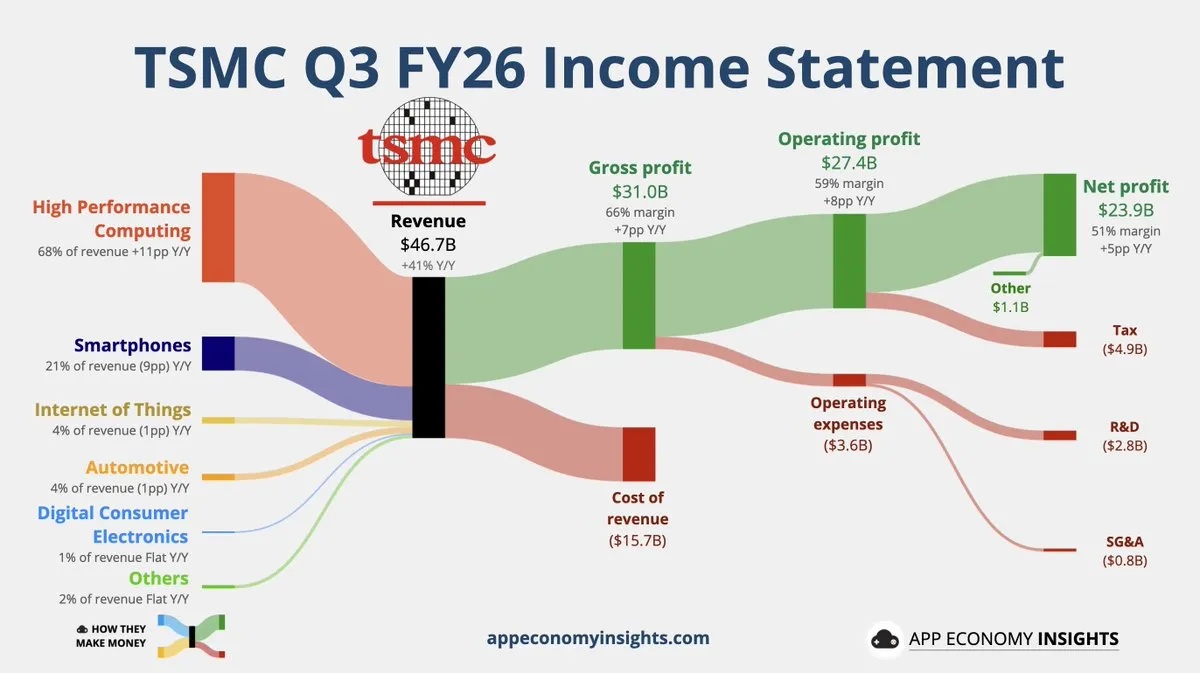
𝐓𝐒𝐌𝐂: 𝐐𝟑 𝐄𝐚𝐫𝐧𝐢𝐧𝐠𝐬 𝐁𝐞𝐚𝐭 𝐄𝐬𝐭𝐢𝐦𝐚𝐭𝐞𝐬 𝐚𝐬 𝐑𝐞𝐯𝐞𝐧𝐮𝐞 𝐒𝐮𝐫𝐠𝐞𝐬 𝟒𝟏% 𝐚𝐧𝐝 𝐀𝐝𝐯𝐚𝐧𝐜𝐞𝐝 𝐂𝐡𝐢𝐩𝐬 𝐃𝐨𝐦
⠀
📊 𝐑𝐞𝐬𝐮𝐥𝐭𝐬
• EPS per ADR: $4.60 (Est. $4.48) ✅
• Revenue: $46.72B (Est. $44.93B) ✅, +41.2% YoY.
• Gross Margin: 66.4% (Est. 66.3%) 🟰
• Operating Margin: 58.7% (Est. 57.7%) ✅
• Net Income: NT$763.06B (Est. NT$737.9B) ✅
• Net Profit Margin: 51.1%.
• Free Cash Flow: NT$476.56B.
• CapEx: $13.84B ($40.64B YTD).
⠀
📌 𝐊𝐞𝐲 𝐓𝐚𝐤𝐞𝐚𝐰𝐚𝐲𝐬
• Q3 revenue beat consensus by ~4.0%, while EPS exceeded estimates by ~2.7%.
• High Performance Computing accounted for 68% of revenue, growing 22% QoQ, while smartphones contributed 21%, up 10% QoQ.
• Advanced nodes (7nm and below) represented 79% of wafer revenue, including 3nm at 33%, 5nm at 28% and newly ramping 2nm at 8%.
• Gross margin declined 130 bps QoQ to 66.4%, primarily reflecting dilution from the initial ramp-up of N2 technology.
• Operating margin exceeded consensus by 100 bps, while net income topped estimates by ~3.4%.
• Automotive platform revenue grew 23% QoQ, while North America accounted for 79% of total revenue.
• Wafer shipments increased 9.6% YoY to 4.48M units, with inventory days declining by five to 82.
• Non-operating gains fell to NT$34.59B from NT$95.83B in Q2, which included gains related to VIS shares.

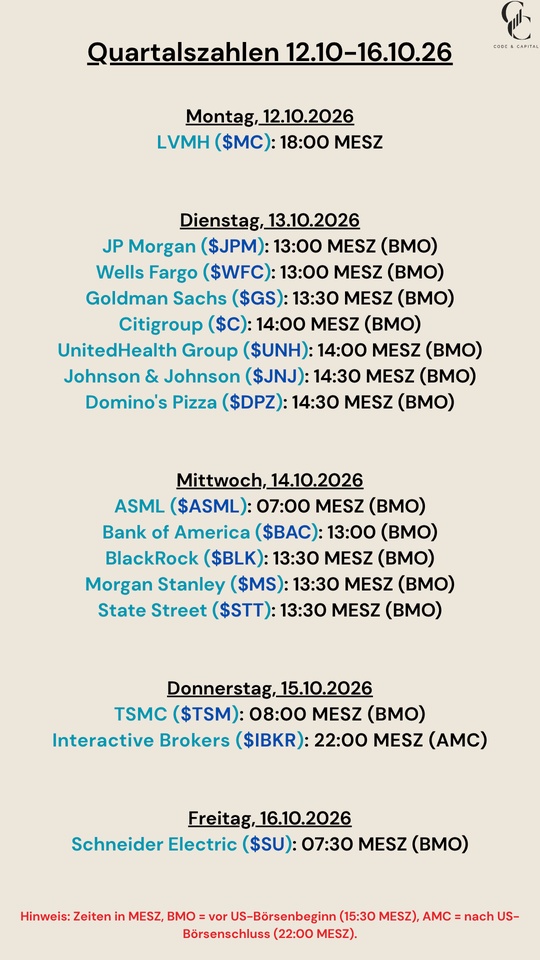

Final portfolio, at least up to 100-120k for now
Dear Community,
I’d like to present my portfolio once again.
The core of my portfolio is the $VWRL (-0,25%) which I contribute to monthly.
I also hold a few dividend-paying stocks such as $ALV (+1,68%)
$MCD (+1,19%)
$BMY (+1,66%) and $TTE (-1,28%) these stocks are my “dividend stocks”—to be honest, I don’t expect much in the way of returns from them, but they might still surprise me. As for $BMY (+1,66%) I’m not quite sure yet whether I should hold onto this stock or focus more on growth in the healthcare sector— $SYK (+4,34%) For example, looks interesting right now—it might even be my new employer in the future 😜.
Then I also have a bit of growth with dividends, though that’s not my main focus $TSM (-2,59%)
$AVGO (-1,2%)
$SU (-1,67%) and $8001 (+0,48%) Itochu is sort of a middle ground.
Last but not least, of course, $BTC (-0,26%) to cover crypto.
Once I’ve adjusted the positions under $MCD (+1,19%) the top holdings—with a target of about 5,000€ per stock for now and BTC at 3,000€—I plan to add new holdings in the form of $VST (+1,45%)
$XYL (+0,67%) and maybe again $RKLB (+0,66%) , though other holdings are of course possible until then.
Thanks for your support, opinions, suggestions for improvement, etc.
Best regards and have a great start to the weekend,
Florian


Taking a profit
I decided to close my position on Sandisk.
My exposure to semicon is already too large and I decided it was a good exit. I believe in the company but it's too volatile for me and I think in the next 1 year it will become cheaper.
Memory price was ALWAYS cyclical but logic doesn't follow the same pattern. I will keep growing my $TSM (-2,59%) position (largest in my portfolio) .


Supercycle on limited | Semiconductor 2026
$SOXX (-1,37%) semiconductor mix uptrend in midterm this season and market trend still get more point to high position from 52 weeks low on 254 and high on 655.
Stock market on high demand and performance :
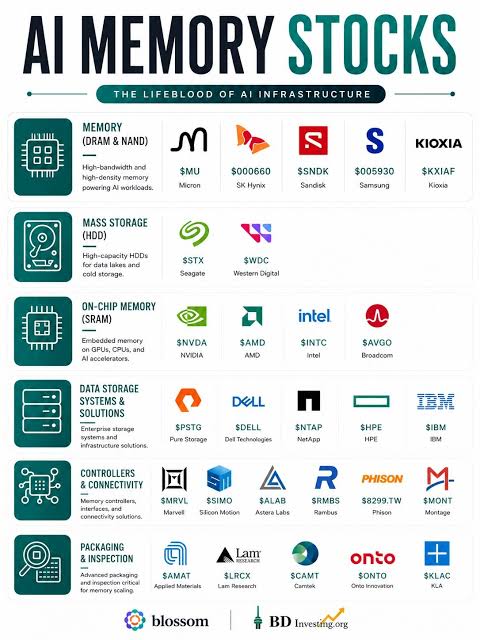
• $SNDK (-1,61%) , $SKHY (-1,14%) , $AVGO (-1,2%) , $STX (-4,72%) , $WDC (-2,94%) (tier 1)
• $INTC (-2,98%) , $AMD (-2,13%) , $NVDA (-2,34%) , $TSM (-2,59%) , $CBRS (tier 2)
ETF and Option on High trends and Fast speed :
• $MU (+1,5%) , $LITE (-2,65%) , $ASML (-0,26%) , $MRVL (-2,04%) , $NBIS (+0,44%) , $SIMO (-2,99%)
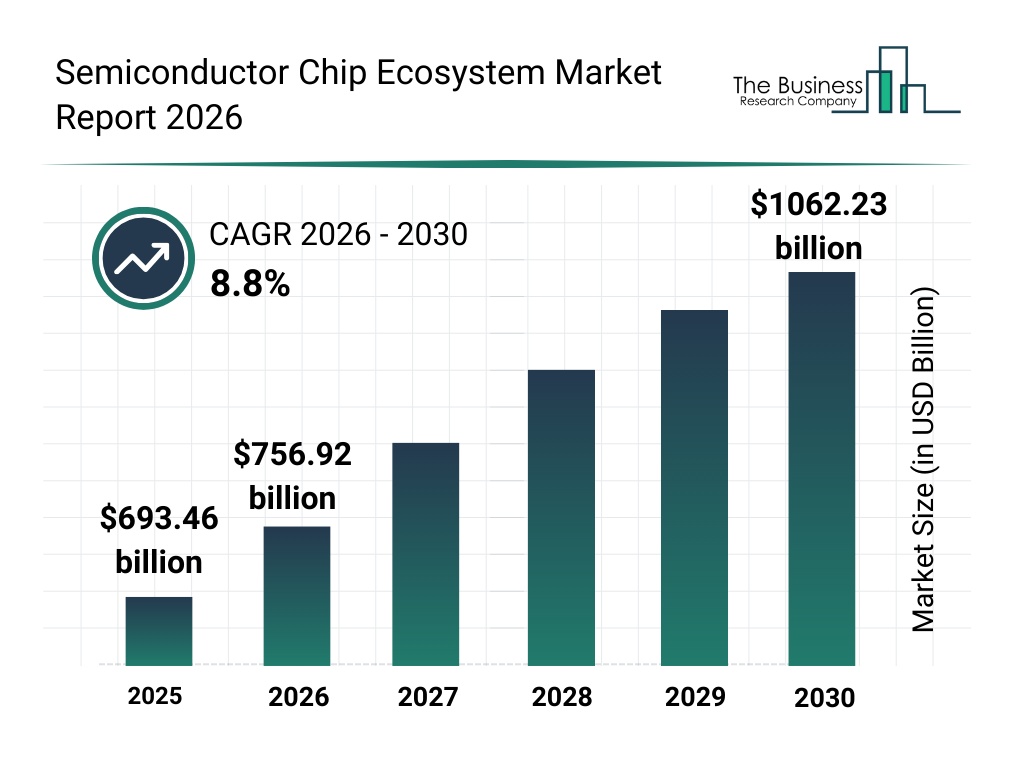
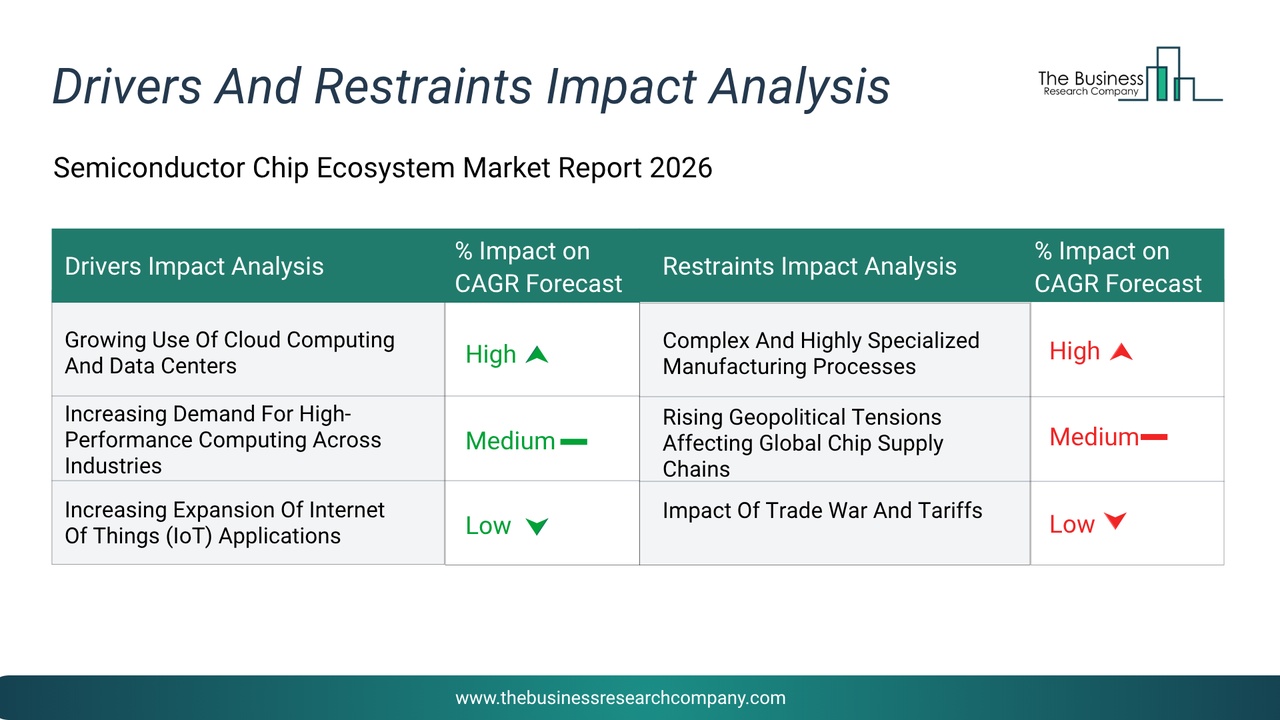
Semiconductor Chip Ecosystem Market still on top list get performance every years and continues keep on high demand for supercycle in Ai supercomputer. Its on thats semiconductor in CAGR get 8.8% to 2030 still possible makes uptrend every years, however in wave cycle on traditional event from average monthly return, semiconductor get works to drive with cycle time frame.
Portfolio Update + Investment Decision
Dear Community,
I felt like sharing my now-finalized strategy again and asking for your opinion on an investment decision.
Like most people, my strategy consists of an ETF plus satellite funds.
Basically, my strategy is focused on building up dividends.
Why?
My goal is to be able to cover my fixed expenses in retirement solely with dividends.
Of course, given my young age, I could also focus on growth and rebalance my portfolio later, but I’d still like to take the “boring” route, since my main interest lies in real estate.
I contribute $VWRL (-0,25%) about €1,200 per month
My individual holdings are topped up with various bonuses from my main job. Goal: to have invested approximately €5,000 in each position.
To still have growth in my portfolio beyond dividend growth, I’d like to add about two more stocks to my current holdings—and that’s where you come in.
Which stocks would you choose?
I’ve been $TSM (-2,59%) because this would allow me to invest more in the Asian region.
As for the second stock, I’m not sure what to choose yet—what would you pick? I was thinking of something American with at least a small dividend that’s growing steadily,
$MSFT (+0,19%) For example, or maybe something completely different.
I’m curious to hear your opinions and look forward to your stock suggestions.😊
Best, Flo
📊 My Portfolio Update: July 2026
July was a month of contrasts. The Nasdaq slipped into its second correction of 2026, triggered by a sharp sell-off in semiconductor stocks—memory chip manufacturers and chip equipment suppliers saw losses, in some cases in the double digits, and even strong quarterly results were no longer enough to prop up share prices. The DAX, on the other hand, hit new record highs during the same period, driven by software stocks and a rebound at Rheinmetall. At the same time, a significant amount of capital rotated out of AI and chip stocks and into Chinese tech and electric vehicle stocks, which staged a strong comeback after months of decline.
My portfolio benefited from this rotation and is back in the black:
📊 Monthly performance: +1.02%
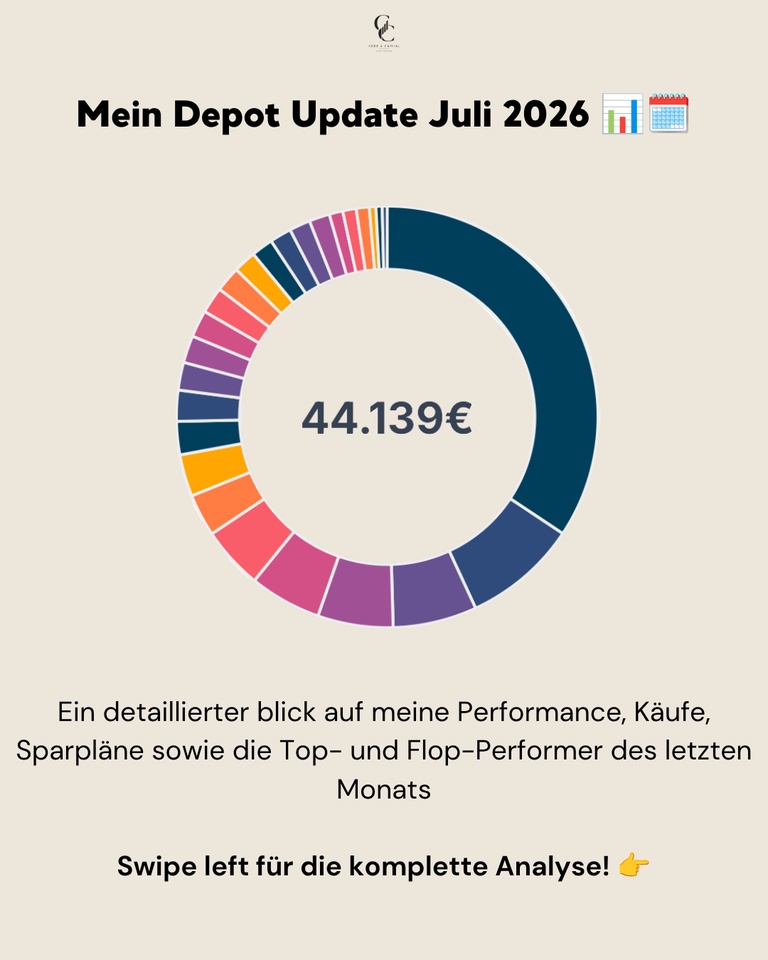
📊 Portfolio value: ~€44,139
📊 Peak performance (Jan. 6, 2022): +43%
📊 YTD performance: ~+14.09%
Performance & Comparison 🚀
July demonstrated how differently the indices could perform depending on their composition. While the Nasdaq suffered from the chip sell-off, the DAX benefited from its lower concentration of semiconductor stocks and the Rheinmetall recovery. My portfolio tracked the DAX more closely than the Nasdaq and ended the month in positive territory.
Performance Comparison (July 1–July 31, 2026, end of day):
My portfolio: +1.02%
DAX: +2.57%
S&P 500: -1.25%
FTSE All-World: -1.47%
NASDAQ 100: -6.97%
Purchases, Sales & Allocation 💶
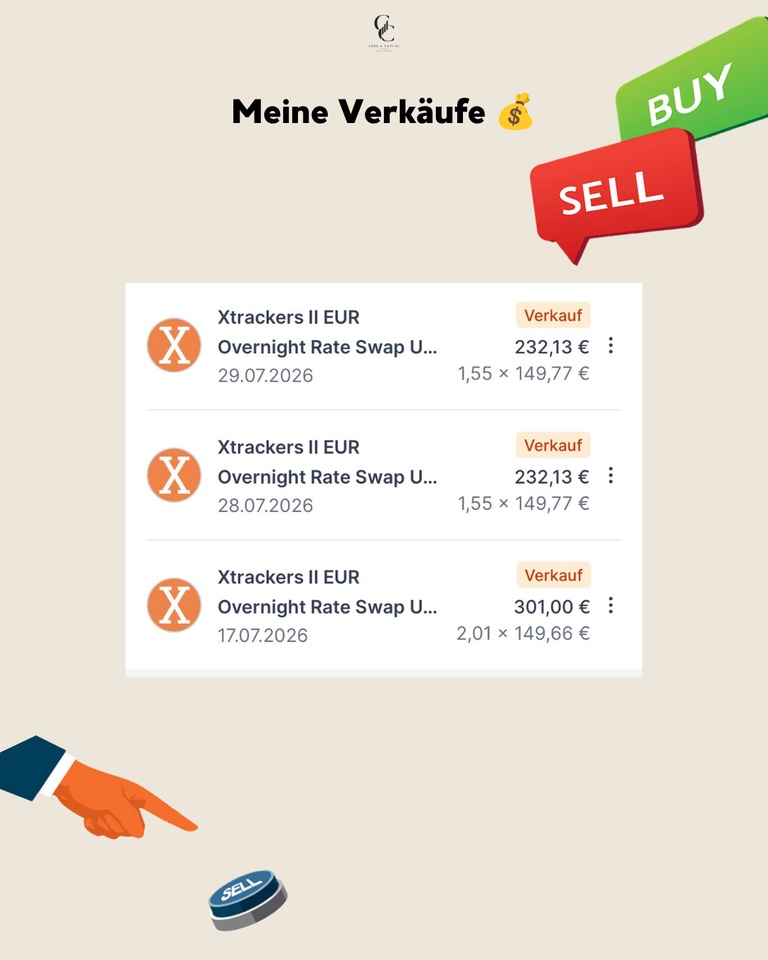
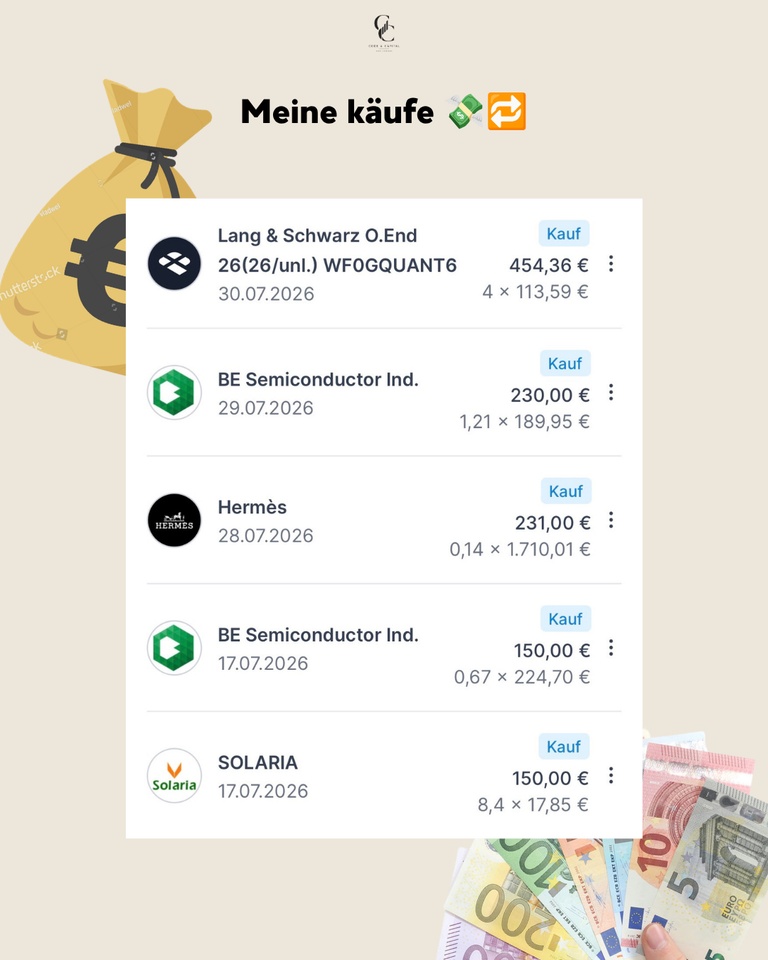
In July, I reduced my cash position. The Xtrackers II EUR Overnight Rate Swap ETF, which I had been using to park liquidity, was sold in three tranches: €301.00 on July 17, and €232.13 each on July 28 and July 29—totaling approximately €765. The freed-up funds were immediately allocated to three positions: BE Semiconductor Ind. $BESI (-4,05%) I increased my position in two steps: €150.00 on July 17 and €230.00 on July 29. For Solaria $SLR (+0,55%) , I added another €150.00 on July 17, and for Hermès $RMS (+3,78%) on July 28. In doing so, I deliberately reallocated cash into stocks rather than injecting new capital.
Additionally, on July 30, I invested €454.36 in my own Wikifolio certificate $DE000LS9V052 (-0,77%) —a private position separate from the rest of my portfolio.
Top Movers in July 🟢
The month clearly belonged to stocks that benefited from the rotation out of U.S. tech.
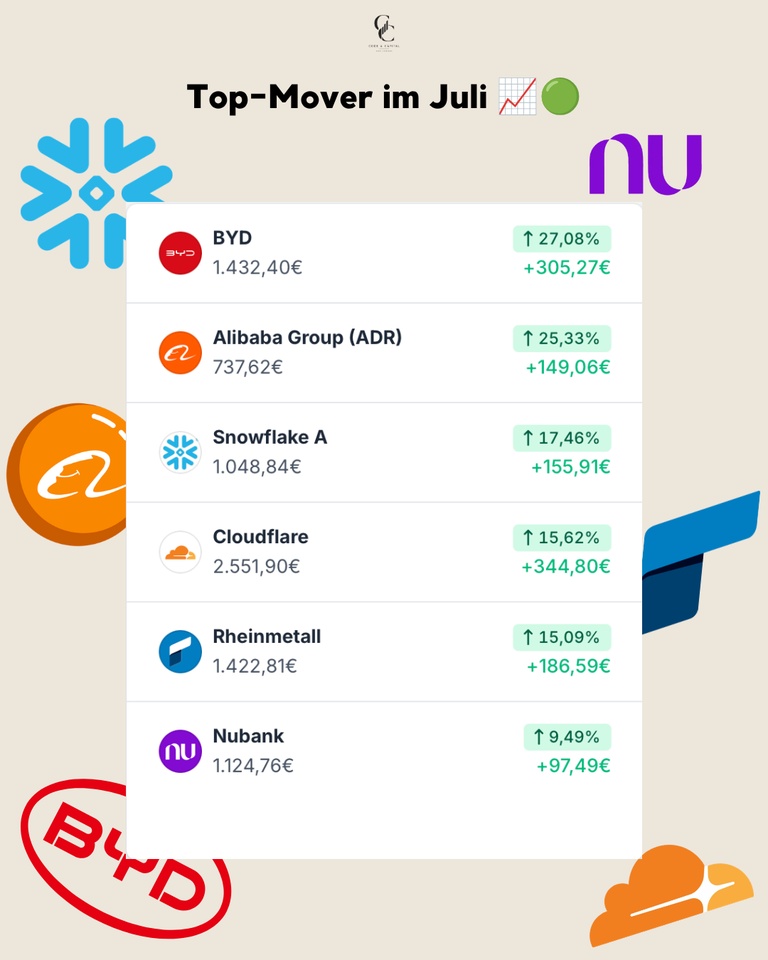
BYD posted the strongest gain at +27.08% (+€305.27). The stock received a double boost: capital flowed from AI and chip stocks into Chinese electric vehicle stocks, and BYD also reported $1211 (+0,9%) reported a nearly 22% jump in sales for July and more than a doubling of overseas deliveries. Alibaba $BABA (-0,45%) followed suit with a gain of +25.33% (+€149.06)—part of the same China-led rally that also swept up Tencent and Xiaomi. Snowflake $SNOW (-0,17%) rose by +17.46% (+€155.91) and Cloudflare $NET (-2,79%) by +15.62% (+344.80 €), the largest euro gain in the portfolio—both software stocks fared significantly better than hardware and chips in the rotation. Rheinmetall $RHM (+5,78%) rebounded by +15.09% (+€186.59) from its 52-week low following the frigate shock in June, supported by full order books and rising defense budgets in Europe. Nubank $NU (-1,27%) rounded out the list with a gain of +9.49% (+€97.49)—here, too, the rotation away from U.S. tech toward other regions played a role.
July’s Big Losers 🔴
On the other hand, the list consisted almost exclusively of stocks that were directly or indirectly hit by the chip sell-off.
Tempus AI $TEM (+4,32%) suffered the biggest loss at -25.08% (-€55.74)—AI-related stocks came under particular pressure during the broad sell-off. IREN $IREN (+0,15%) fell by -20.39% (-€179.15) and has remained weak since the price slump in early summer, still weighed down by the combination of Bitcoin weakness and skepticism regarding its transition to an AI cloud provider. BE Semiconductor Ind. $BESI (-4,05%) fell by -18.77% (-€169.56), directly impacted by the global sell-off among chip equipment manufacturers. TSMC $TSM (-2,59%) lost -15.04% (-€80.55)—despite a strong quarter, the stock was swept up in the general semiconductor correction. Hermès $RMS (+3,78%) dropped -10.27% (-24.26 €), with luxury goods following the downward trend of weaker growth stocks. Solaria $SLR (+0,55%) rounded out the list with a -9.50% (-€46.19) decline—solar and renewable energy stocks remain under pressure.
Conclusion 💡
July showed just how quickly capital flows can shift. While the chip sector underwent one of the sharpest corrections of the year, Chinese tech and electric vehicle stocks found their bottom. For my portfolio, this was a good example of why broad diversification across sectors and regions makes all the difference.
❓ Question for the Community
That was my month in numbers—how did the July chip sell-off affect you? Did you rotate into Chinese stocks, or are you holding onto your U.S. tech positions?
👇 Let us know in the comments!
➡️ Follow @codeandcapital26 for transparent portfolio updates!
🗞️ Newsletter: codeandcapitalquant.beehiiv.com
📈 Wikifolio: https://www.wikifolio.com/de/de/w/wf0gquant6
+ 2


+++ What weak signals are currently visible? 🔭 +++
Numerous companies in my DIBS investment universe have suffered significant losses in recent days. This affects not only individual stocks but also large segments of the AI infrastructure.
Following an exceptionally strong price performance, high valuations are now being scrutinized more critically. The market is taking a much closer look at margins, order intake, and the actual implementation of investment plans. At the same time, additional factors such as increasing competition or short-term disappointments are weighing on individual companies.
This is not an unusual development. Similar phases have also occurred in previous technology cycles. Sharp price increases are often followed by a phase in which the market once again distinguishes more clearly between vision and operational execution.
That is precisely why, in such market phases, I make a conscious effort to take a step back and not overinterpret every price movement.
That’s why, in such situations, I make a conscious effort to look not only at stock prices but also at the underlying signals. In doing so, I currently see both reasons for caution and indications that make me optimistic in the long term.
🔴 Selected “weak signals” that I view critically:
- Harmonic Drive Systems
$6324 (-6,48%) shows that high demand alone isn’t enough. The discussion surrounding margins and valuation has made the market significantly more sensitive. - SKF is intensifying competition in the robotics components sector through its acquisition of a Chinese precision robotics company. This could increase pressure on margins in the long term.
- Many companies continue to be valued at high multiples despite the correction. This leaves little room for operational disappointments.
🟢 Selected “Weak Signals” that make me optimistic:
- Micron $MU (+1,5%), TSMC
$TSM (-2,59%) and ASML
$ASML (-0,26%) have recently presented quarterly results and outlooks that continue to point to robust demand for AI infrastructure. - Micron
$MU (+1,5%) and Qualcomm
$QCOM (+2,32%) have signed a long-term supply agreement (LTA) for automotive AI. Such contracts provide planning certainty and suggest that key customers are planning their infrastructure beyond just the next few quarters. - The hyperscalers continue to invest billions in expanding their data centers. The focus is increasingly shifting from announcements to the actual implementation of these projects.
None of these signals on its own proves a trend reversal. But taken together, they help me continuously reassess my investment theses.
For my DIBS strategy, this does not currently imply an automatic decision to buy or sell. What matters to me is not whether a stock falls 30 or 40 percent in the short term, but whether the underlying bottleneck thesis has changed.
That’s why I scrutinize my investment universe particularly closely during such market phases. Not every investment thesis will ultimately pan out. At the same time, however, I currently see no convincing evidence that the fundamental technological bottlenecks in the AI infrastructure sector have already been resolved.
I will therefore continue to closely monitor developments, remaining equally open to both positive and negative signals. For now, I am not making any adjustments to my portfolio.
P.S. The photo of the observer fits the post. I took it years ago in Bonn. The figure can be found tucked away on the banks of the Rhine.


As soon as a hyperscaler or an AI company reports weaker results, the market could take a significant downturn.
Títulos em alta
Principais criadores desta semana