
Sandisk +16%. Micron +13%. Lumentum +14%. Coherent +12%. One CoreWeave report reignited the AI chip rally in a single session.
$SNDK (-1,76%)
$MU (+0,01%)
$LITE (-0,5%)
$COHR (-0,12%)
#AI
#Semiconductors
Postos
34Sandisk +16%. Micron +13%. Lumentum +14%. Coherent +12%. One CoreWeave report reignited the AI chip rally in a single session.
$SNDK (-1,76%)
$MU (+0,01%)
$LITE (-0,5%)
$COHR (-0,12%)
#AI
#Semiconductors
⠀
📊 𝐑𝐞𝐬𝐮𝐥𝐭𝐬
• Non-GAAP EPS: $4.57 (Est. $4.22) ✅, vs. $1.10 YoY.
• Revenue: $1.263B (Est. $1.25B) ✅, +136.5% YoY.
• GAAP EPS: $3.54 (vs. $0.05 YoY).
• Non-GAAP Gross Margin: 53.2%, +1,380 bps YoY.
• Non-GAAP Operating Margin: 42.3%, +2,360 bps YoY.
• GAAP Net Income: $360.3M.
• Non-GAAP Net Income: $461.1M.
• Cash & Short-Term Investments: $2.0B.
⠀
🎯 𝐆𝐮𝐢𝐝𝐚𝐧𝐜𝐞
• Q2 FY2027 Revenue: $1.575B–$1.625B, midpoint $1.60B (Est. $1.48B) ✅.
• Q2 FY2027 Non-GAAP EPS: $5.90–$6.20, midpoint $6.05 (Est. $5.08) ✅.
• Q2 FY2027 Non-GAAP Operating Margin: 45.0%–46.0%.
⠀
📌 𝐊𝐞𝐲 𝐓𝐚𝐤𝐞𝐚𝐰𝐚𝐲𝐬
• Q1 adjusted EPS beat consensus by ~8.3%, while revenue exceeded estimates by ~1.0%.
• Q2 revenue guidance midpoint stands ~8.1% above consensus, with EPS ~19.1% higher.
• Secured its second major NPO/CPO design win, backed by purchase commitments exceeding $5B.
• Optical Circuit Switching demand visibility expanded significantly, positioning OCS as a potential multi-billion-dollar annual revenue stream.
• Components revenue surged 99% YoY to $754.2M, driven by strong pump laser demand.
• Systems revenue increased 229% YoY to $508.4M, up 42% sequentially.
• Q1 revenue grew 25.5% QoQ, with Q2 guidance implying another ~26.7% sequential increase.
• Non-GAAP operating margin expanded from 18.7% to 42.3% YoY, reflecting significant operating leverage.
• Cloud modules continued to show strong demand and improving gross margins.
• Cash and short-term investments declined $758.8M sequentially to $2.0B.
⠀
💬 𝐌𝐚𝐧𝐚𝐠𝐞𝐦𝐞𝐧𝐭 𝐂𝐨𝐦𝐦𝐞𝐧𝐭𝐚𝐫𝐲
“During the quarter, we secured our second major NPO/CPO win, backed by purchase commitments exceeding $5 billion.”
⠀
• Deal: Lumentum shareholders receive 4.5 Marvell shares per share, implying ~$1,132 per share and a 23.9% premium.
• Ownership: Marvell shareholders will own ~67% of the combined company, Lumentum shareholders ~33%.
• AI Infrastructure: Combines Marvell's custom silicon and networking with Lumentum's optical transceivers, lasers and optical switching.
• Financial Impact: Targets a $550B addressable market, over $1B in annual cost synergies and EPS accretion in the first year after closing.
• Closing: Expected in H1 2028, subject to shareholder and regulatory approvals.
⠀
🔎 Strategic Significance: The merger would create a vertically integrated AI connectivity leader spanning electrical and optical technologies as data centers increasingly transition toward high-bandwidth optical interconnects.
🥹 Month 10 since launch has been less than stellar. 🥹
So far this year, things actually only went downhill from mid-June through the end of July, and we were able to continue our upward trend through August and September. But due to a very weak October, we’re once again far from the 30k mark. We’ve now fallen so far that we’re scraping the maximum drawdown from the backtest.
According to the algorithm, I was using Lumentum ($LITE (-0,5%) ), Kioxia ($285A (-1,12%) ), Micron ($MU (+0,01%) ), Hewlett Packard Enterprise ($HPE (-0,33%)), Marvell Tech ($MRVL (-0,93%)), SanDisk ($SNDK (-1,76%)) and Dell ($DELL (-1,12%) ).
The initial investment was approximately 30,000 euros. Upon the sale of Recruit Holdings ($6098 (+3,4%)) and when I bought Marvell Tech ($MRVL (-0,93%)), I kept about 200 euros.
Overall, October resulted in a loss of almost exactly -22% for the satellite portfolio.
-6,600 euros.
Who was in the portfolio and how it performed:
Kioxia’s decline, in particular, really hurt. After at one point more than doubling in value, the position is now in the red.
YTD, the momentum performance now stands at just +61% TTWROR.
The changes for October have already been made, with the exception of the pending sale of SanDisk. The rotation is massive and shows that the first major AI wave has crashed against the outlook, despite strong numbers.
Exits:
Additions:
This means the portfolio is now diversified across multiple sectors for the first time. Hoping quietly for a small year-end rally...
Another 44x to reach a million 🥹

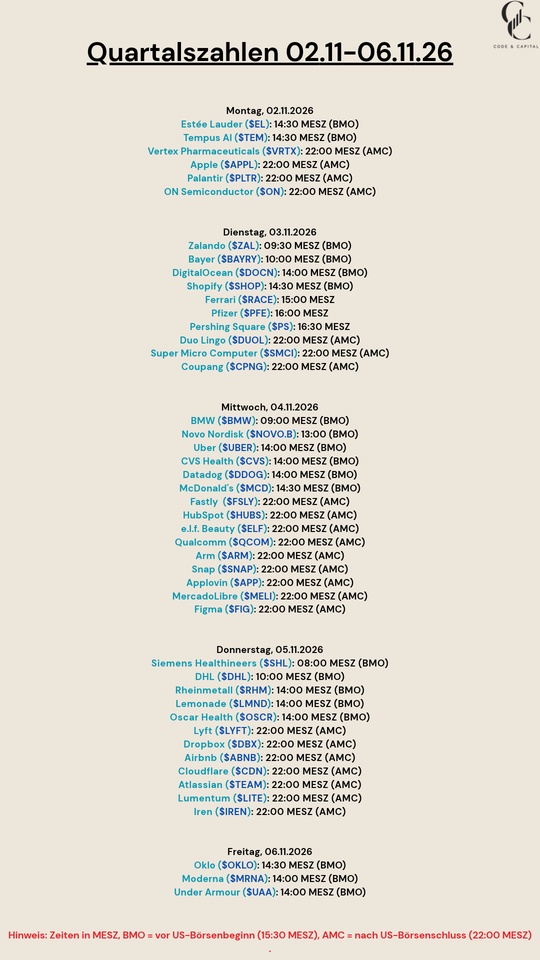
$EL (+0,59%)
$TEM (+0,68%)
$VRTX (+0,74%)
$AAPL (+0,42%)
$PLTR (+0,48%)
$ON (+0,24%)
$ZAL (+1,31%)
$BAYN (+0,39%)
$DOCN (+0,24%)
$SHOP (+0,79%)
$RACE (+0,16%)
$PFE (+0,06%)
$PS (+0,44%)
$DUOL
$SMCI (-0,16%)
$CPNG (+0,6%)
$BMW (+1,16%)
$NOVO B (+0,82%)
$UBER (-0,18%)
$CVS (+0,75%)
$DDOG (+2,05%)
$MCD (-0,1%)
$FSLY (+2,71%)
$HUBS (+0,76%)
$ELF (+0,37%)
$QCOM (-0,71%)
$ARM (-0,55%)
$SNAP (+0,16%)
$APP (+0,01%)
$MELI (+0,59%)
$FIG (+1,23%)
$SHL (+0,62%)
$DHL (+0,65%)
$RHM (-1,83%)
$LMND (+1,02%)
$OSCR (+1,94%)
$LYFT (+0,17%)
$DBX (-0,22%)
$ABNB (-0,91%)
$NET (+1,69%)
$TEAM (+2,79%)
$LITE (-0,5%)
$IREN (-1,4%)
$OKLO (+0,91%)
$MRNA (-0,64%)
$UAA (+0,51%)
The photon is the fundamental building block of our universe. See how it is used for generation, modulation, amplification, steering, and detection in the data center, communications, and industrial markets.
Hello, everyone,
Amazon, Alphabet, Microsoft, and Meta are maintaining their high capital expenditures. This continues to play into the hands of infrastructure stocks.
Marvell’s interest in Lumentum shows just how strong the interest in photonics companies is.
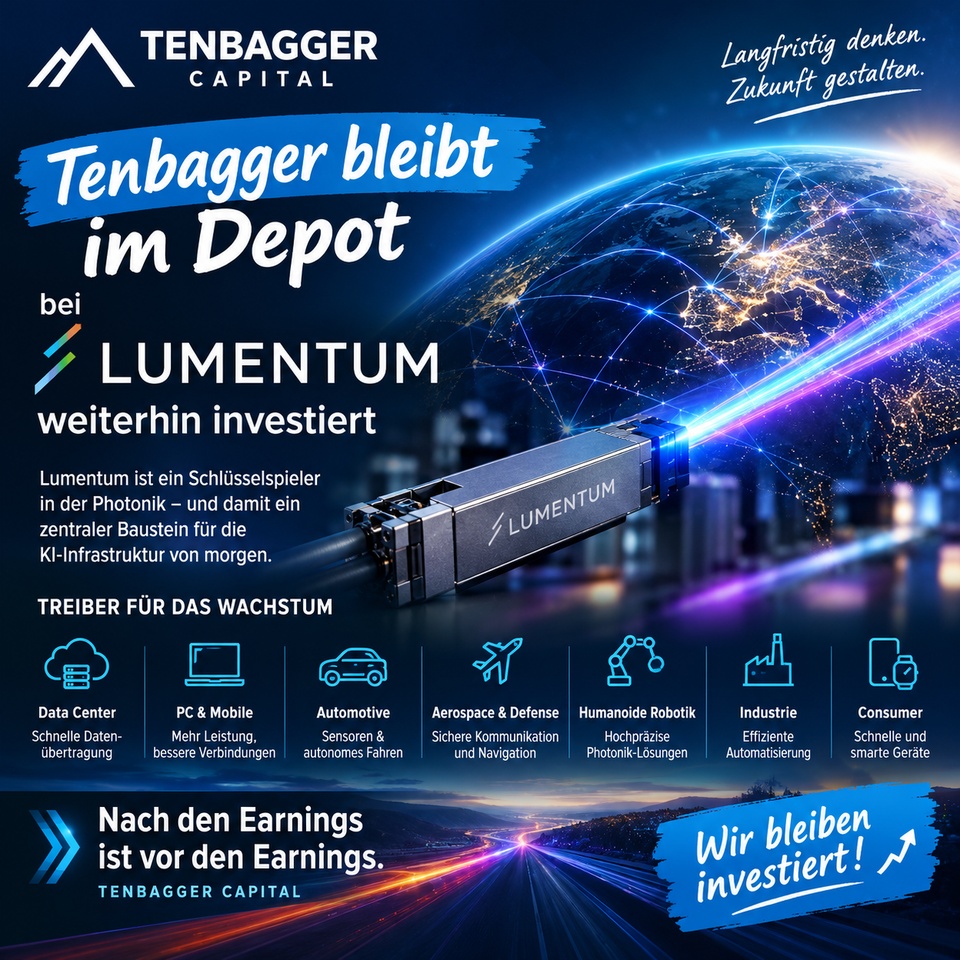
I’m going to hold onto Lumentum for now and wait out the next few trading days.
I had already classified Lumentum under the motto “Tenbagger stays in the portfolio.” I won’t abandon this long-term perspective because of short-term takeover rumors.
Should Marvell actually make a very attractive offer, I would reassess the situation.
My main thought: In my 2036 portfolio, I don’t just want to hold takeout speculations—I want companies that will benefit from the wave of investment in AI infrastructure.
And Lumentum could very well be one of them.
But the company I’m introducing to you today could also fit that description.
It’s a company that’s no stranger to many of you, either.
Despite my investment in Lumentum, I don’t rule out buying into Coherent. This would give me a second foothold in the sector in case Lumentum is acquired.
What do you think of my plan?
Before the earnings report on November 4 or after it.
Coherent could benefit from a Lumentum acquisition.
A deal for Marvell to acquire Lumentum would be positive for Coherent, as both companies operate in the same industry. Both manufacture lasers, optical transceivers, and network components that enable data to be transmitted at extremely high speeds using light signals instead of electrical ones.
The main difference between the two is that Coherent has a broader, vertically integrated portfolio, while Lumentum focuses more on specialized optical components, high-power lasers, and optical switching systems. In fact, Lumentum attempted to acquire Coherent some time ago.
Depending on the premium Marvell pays, there is a good chance that investors will use it to value Coherent. In fact, data shows that Coherent is already a more affordable alternative to Lumentum. It has a price-to-earnings ratio of 25, compared to 40 for Lumentum.
Coherent also benefits from Lumentum in other ways. In a recent statement, Lumentum explained that its products are sold out through 2029. Such a move means that many companies will turn to Coherent for these optical solutions.
Coherent’s Business Is Thriving
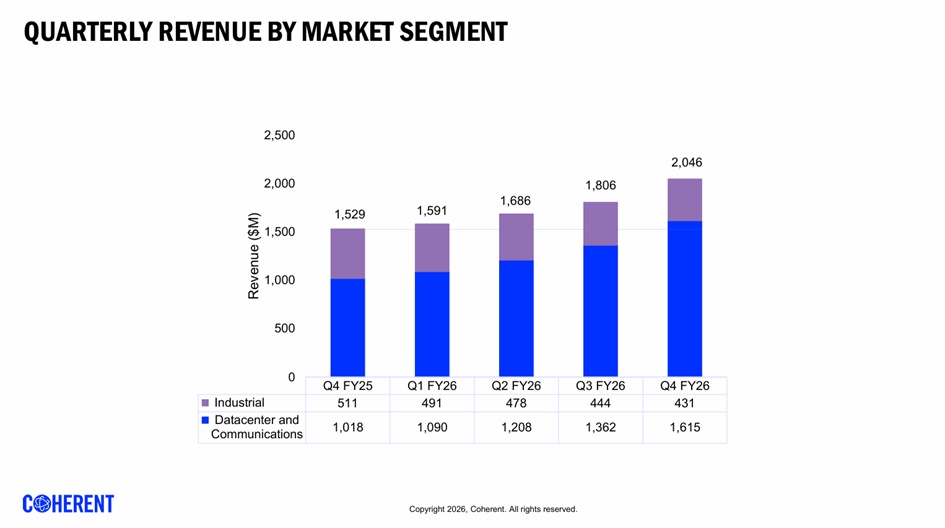
The latest results showed that Coherent’s revenue rose 34% to $2.05 billion in the fourth quarter, with the gross margin increasing to 38.5%. Net income rose to over $241 million.
The company expects revenue growth to continue accelerating this year. First-quarter revenue is projected to rise 45% to $2.3 billion, while earnings per share are expected to be $1.97. For the year, Coherent’s revenue is expected to rise to $10.6 billion, followed by $14.9 billion in the next fiscal year.
The renowned research firm Bernstein has initiated coverage of Coherent stock with an “Outperform” rating and has set an ambitious price target of $350. Outlook: As an indispensable supplier of photonic solutions and optical networks, the company is benefiting significantly from the structural expansion of modern AI infrastructure. Volume Drivers: A massive profit jump of +74% and revenue and earnings figures that significantly exceeded analyst estimates are currently attracting large institutional capital.
Coherent Unveils New PhotonLink Optics Platform for AI Expansion at ECOC 2026!
The photonics company Coherent is showcasing a broad portfolio of optical technology for AI data centers at the ECOC 2026 trade show and is introducing PhotonLink, a new integrated optics platform. The focus is on increased bandwidth, lower power consumption, and meeting growing cooling requirements. New PhotonLink Platform Coherent is presenting numerous new optical technologies and live demonstrations at the European Conference on Optical Communication (ECOC) 2026 in Málaga, Spain.
To me, Coherent is one of the most compelling suppliers of AI infrastructure, precisely because the company does not rely on a single product. Simply put, Coherent provides the optical technology that enables data centers to transmit massive amounts of data via light—and it is precisely this data traffic that is exploding with every new AI cluster. What particularly impresses me is the vertical integration: Coherent covers the entire supply chain, from raw materials to individual components to complete systems.
Management reports a record-high order backlog with visibility extending into the 2028 calendar year. Central to this is the partnership with NVIDIA concluded in March 2026: a $2 billion equity investment as well as a multi-year supply contract for co-packaged optics components through the end of the decade. As a result, cash reserves rose to $3 billion, and the debt-to-EBITDA ratio fell to 0.5 times.
In July, the company was honored on TIME’s “America’s Best Companies 2026” list. Furthermore, Coherent is the top holding in the new Roundhill Photonics & Optics ETF (LYTE). This ETF offers exposure to a concentrated portfolio of global companies in the photonics and optics sectors. LYTE is an actively managed ETF.
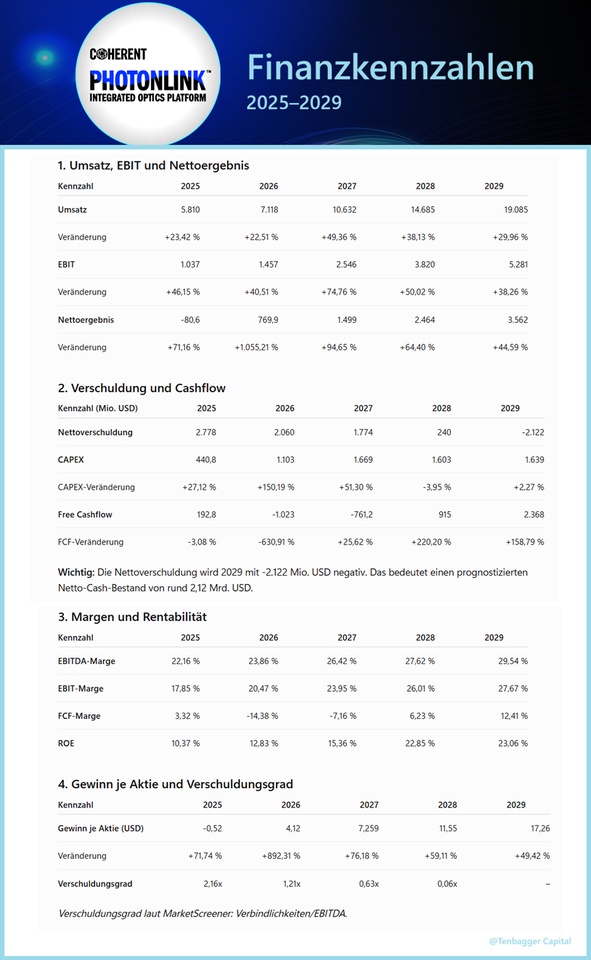
Coherent Corp. is one of the world’s leading manufacturers and marketers of photonic products, lasers, and engineered materials. The revenue breakdown by business segment is as follows:
- Manufacture of optical transmitters and modules (58.9%): transceivers, modules, components, optical devices, and semiconductors for data centers and communications applications;
- Manufacture of lasers and optical systems (24.7%);
- Manufacture of engineering materials and optoelectronic components (16.4%): laser optics, thermoelectric components, ceramic composites, VCSELs, EELs, pump lasers, and high-power lasers for material processing and integrated circuits.
Net revenue is distributed geographically as follows: North America (61.4%), Europe (12%), China (11.7%), Japan (6.7%), and other markets (8.2%).
Number of employees: 51,478
Company: Coherent Corp.
ISIN: US19247G1076
Source: Exclusively MarketScreener – Finanzdaten Coherent
Fiscal year: through June of each year
As of: October 31, 2026
All financial figures in millions of USD, except for earnings per share (USD), percentages, and debt-to-equity ratio. Thousands separated according to German notation.
Date of publication: August 12, 2026
5. My Assessment – Coherent as a Candidate for the 2036 Portfolio
The forecasts indicate a highly interesting trajectory.
Revenue Growth
⭐⭐⭐⭐⭐
EBIT Growth
⭐⭐⭐⭐⭐
Earnings Growth
⭐⭐⭐⭐⭐
Margin Performance
⭐⭐⭐⭐⭐
Cash Flow
⭐⭐⭐⭐
Balance Sheet Performance
⭐⭐⭐⭐⭐
Three particularly interesting points
1. The second growth phase
From 2025 to 2029, revenue is expected to rise from $5.81 billion to $19.09 billion. That represents more than a threefold increase.
2. Enormous operating leverage
EBIT is expected to rise from $1.04 billion to $5.28 billion. At the same time, the EBIT margin will improve from 17.85% to 27.67%.
This is a remarkable combination of growth and rising profitability.
3. Cash flow is the decisive test
In 2026 and 2027, high capital expenditures will significantly weigh on free cash flow. In 2028, it is expected to return to a clearly positive level and reach $2.37 billion as early as 2029.
My Conclusion
In my view, Coherent is a highly interesting beneficiary of the AI investment wave.
Particularly exciting is the combination of:
However: The forecasts through 2029 are ambitious. The key factor will be whether Coherent can actually convert this strong growth into sustainable free cash flow.
For the 2036 portfolio, I would therefore definitely continue to monitor Coherent as an interesting AI infrastructure stock.
Note: All figures are taken from the MarketScreener link provided. Figures from 2026 onward are forecasts or estimates, not guaranteed results.
My Assessment for the 2036 Portfolio
Three stocks stand out in particular:
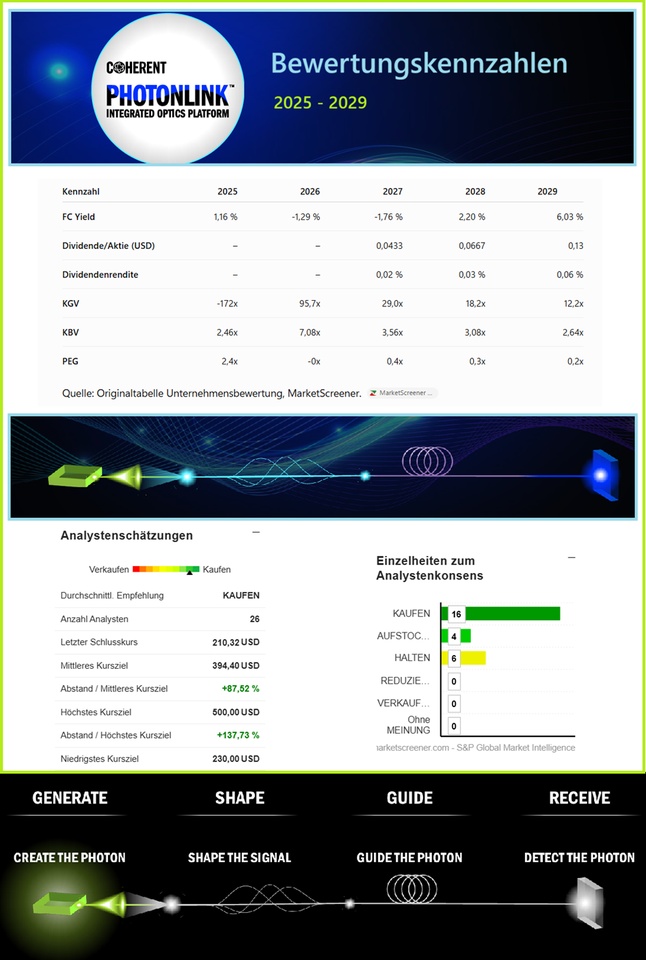
P/E ratio for 2029: 12.2 – significantly lower than the 2026 figure of 95.7.
FC Yield 2029: 6.03% – a substantial improvement over the negative figures in 2026 and 2027.
PEG 2029: 0.2 – very attractive based on the projected earnings growth.
My conclusion: The valuation looks extremely promising for 2028/2029. Coherent could be a major beneficiary of AI investments in optical data transmission and photonics.
Important: The low valuation multiples are forecasts and assume that Coherent will achieve its ambitious earnings targets.
Note: The dividend is stated in USD per share. All other figures are key metrics or multiples and do not require conversion to euros.
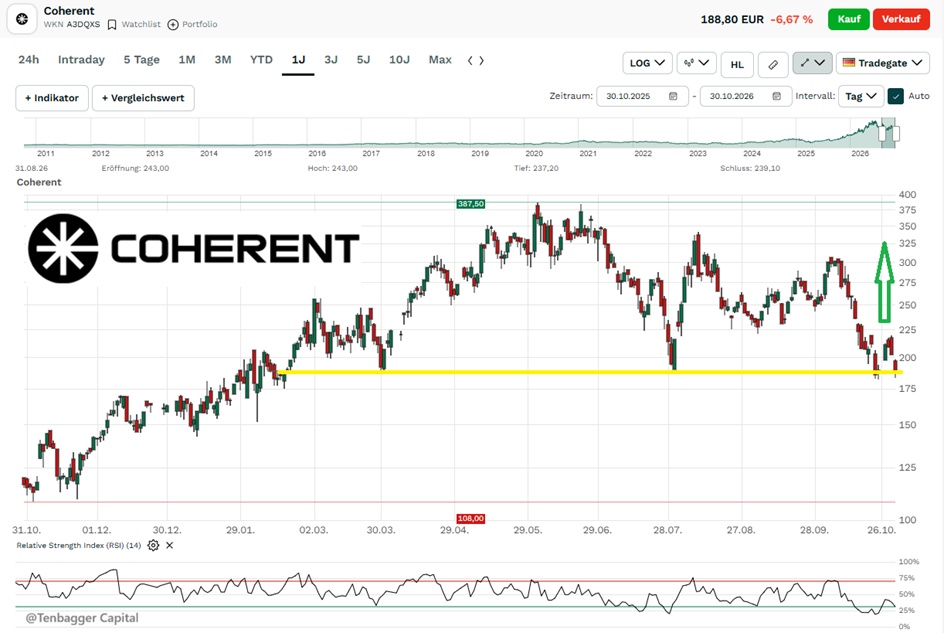
However, there is a risk that technical indicators suggest Coherent shares are on the verge of forming a death cross pattern. This pattern is characterized by the 50-day and 200-day crossover of the exponential moving averages (EMA). If it occurs, it could lead to further declines, potentially down to the psychological level of $200.
The death cross is possible because the AI sector faces significant challenges, as investors fear the bubble will burst. If that happens, the stock could fall further toward the psychological level of $200.
That said, I personally don’t see a bubble.
My friends, the earnings report is coming on November 4. What’s your take—wait, or get in before then?
190.05 EUR -10.85 EUR -5.40%
October 30, 2026
212.60 USD +2.33 USD +1.11%
+ 1
I'm keeping my investment in Lumentum in Portfolio 2036.
Marvell Technology is in advanced talks to acquire Lumentum Holdings, a provider of optical components for data centers. An announcement could come as early as next week, though no final agreement has been reached yet.
The acquisition would strengthen Marvell’s AI infrastructure business. Lumentum’s optical technologies are critical for data transfer in large AI data centers.
The stock reacted significantly on the market:
Neither the purchase price nor the financing details have been disclosed yet. Neither company has officially confirmed the talks so far.
Investor Perspective: The market is initially reacting positively to the news for Lumentum, as investors are speculating on a takeover premium. For Marvell, however, short-term concerns about the purchase price, financing, and integration risks are prevailing. Strategically, though, the deal would align well with the AI and data center boom.
Of particular interest to you as a growth investor: Marvell would thereby strengthen its position across the entire AI infrastructure, while Lumentum remains one of the key beneficiaries of the rising demand for optical connections in AI data centers.

Dear Community,
In the previous parts of our infrastructure journey, we worked our way from the outside in: First, we saw how data centers disconnect from the public power grid through self-sufficient microgrids (Grid Bypassing). Then we looked one level higher and analyzed how smart semiconductors, superconductors, and protective components safely manage the enormous amounts of energy within the server rack (Power Electronics).
But once the power is flowing steadily and the GPUs are running at full speed, we encounter the next technological challenge: Data transmission.
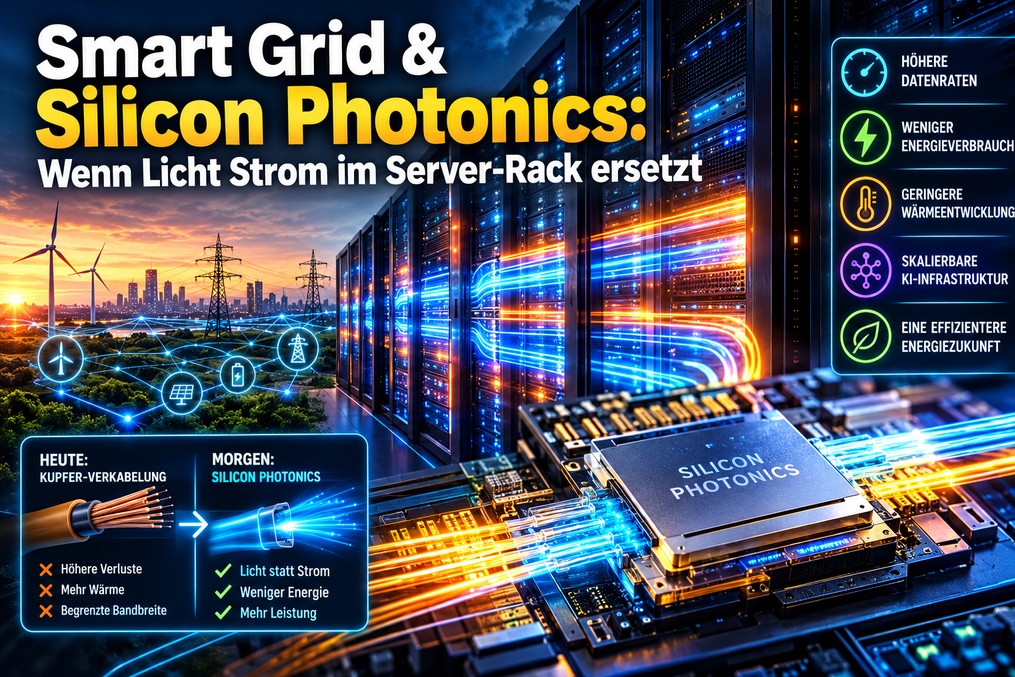
A modern AI cluster does not consist of individual servers, but rather of tens of thousands of GPUs that must exchange gigantic amounts of data with one another in real time during every training step. So far, this has been done via traditional copper cables and electrical circuit board connections. However, with today’s data rates of 800 Gbps—and future rates of 1.6 terabits per second and beyond—electrical connections are increasingly reaching technical and energy-related limits, especially over more demanding transmission paths:
The industry’s response is based on optical interconnect technology, in which three key concepts are intertwined: Silicon Photonics (the integration of photonic functions on silicon-based chips), high-speed optical transceivers (modules for converting electrical signals to optical signals and vice versa), and, increasingly in the future, co-packaged optics (CPO), in which optical engines are placed as close as possible to the switch or accelerator chip.
In this process, electrical data signals are converted into light pulses and transmitted via optical fibers. Especially at high data rates and over suitable transmission distances, this can offer significant advantages over electrical connections in terms of bandwidth, signal quality, and energy efficiency.
After power generation and power electronics, we now ask ourselves: Which companies are building the optical highways for the AI era?
These companies differ significantly: Some supply key optical components, while others integrate complete network platforms or develop the semiconductors that make reliable high-speed communication possible in the first place. The companies I’m introducing to you today are at the heart of this technological turning point:
1. Fabrinet ($FN (-0,68%))
The indispensable precision manufacturer for the optical AI boom
2. Coherent Corp. ($COHR (-0,12%))
The vertically integrated laser and optics giant of the AI era
3. Lumentum Holdings ($LITE (-0,5%))
The specialty laser supplier for hyperscalers’ AI infrastructure
4. Celestica Inc. ($CLS (+1,08%))
From Contract Manufacturer to Architect of Optical AI Networks
5. POET Technologies ($POET (+0,05%))
The disruptive wild card for optical chip-to-chip interfaces
6. Astera Labs Inc. ($ALAB (-0,72%))
The high-speed specialist in signal integrity and AI fabric
My Personal Favorites:
If I had to pick two stocks from this list that offer an exciting combination of different roles in a portfolio, they would be Fabrinet ($FN (-0,68%)) and Astera Labs ($ALAB (-0,72%)):
Now we’d like to hear your thoughts:
Light vs. Copper: Do you think the shift to silicon photonics and CPO in AI racks will happen faster than the market expects—or will optimized copper connections for short distances continue to dominate for even longer?
Which camp are you in? When it comes to such technological shifts, do you prefer a solid, already highly profitable contract manufacturer like Fabrinet , or do you prefer to bet directly on highly dynamic connectivity pioneers like Astera Labs?
Best regards ✌🏼
Anderlé

Following PepsiCo $PEP (-0,78%) versus McDonald’s $MCD (-0,1%) and Nu $NU (+3,03%) versus SoFi $SOFI (+0,61%) , today we’re taking a look at two companies without whose technology a lot of data in data centers would be stuck in a traffic jam for quite a while.
Today we have our first requested comparison of @Tenbagger-Capital
Lumentum $LITE (-0,5%) and Applied Optoelectronics $AAOI (-0,97%) both supply optical components for faster connections. Both are benefiting from the expansion of AI.
Nevertheless, they differ significantly in how much of that is already trickling down to shareholders today.
If you have a request for a comparison, feel free to write it in the comments—just one condition: both companies should be from the same sector and, ideally, be competitors :)
Quick note: As of October 16, 2026. Common price basis (U.S. close on October 15): Lumentum $869.54, AAOI $83.73. General comparison independent of any personal portfolio strategy. All scenarios are based on my own assumptions; these are not guaranteed price targets.
How the Companies Came to Be
Lumentum was formed in 2015 through a spin-off from JDS Uniphase. Over the years, other specialists joined the company, including Oclaro, NeoPhotonics, and Cloud Light. Today, its product portfolio includes laser chips, optical components, modules, and optical switches. This gives the company multiple opportunities to profit from the expansion of data communications.
AAOI was founded in Houston as early as 1997 and has been listed on the Nasdaq since 2013. The company produces optical transmitter and receiver modules and manufactures its own lasers. It also supplies cable network operators through its CATV business. In the last quarter, approximately 42 percent of revenue came from this segment. AAOI is therefore more than just an AI play, even though the market is currently paying particular attention to high-speed data center modules.
What I Like Better About Lumentum
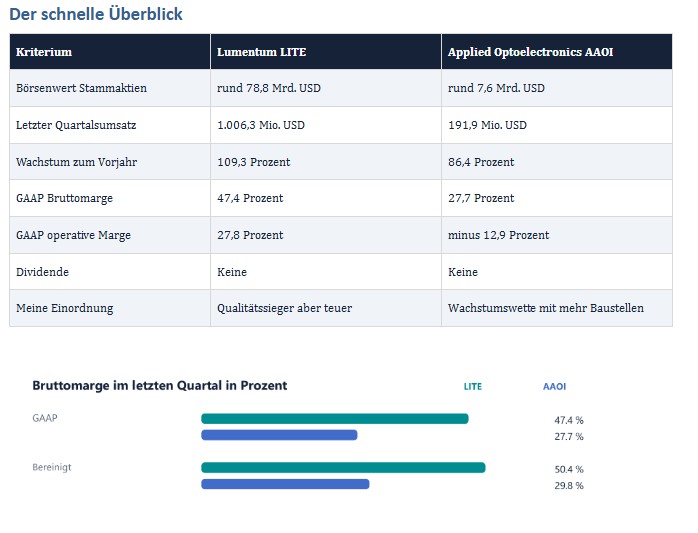
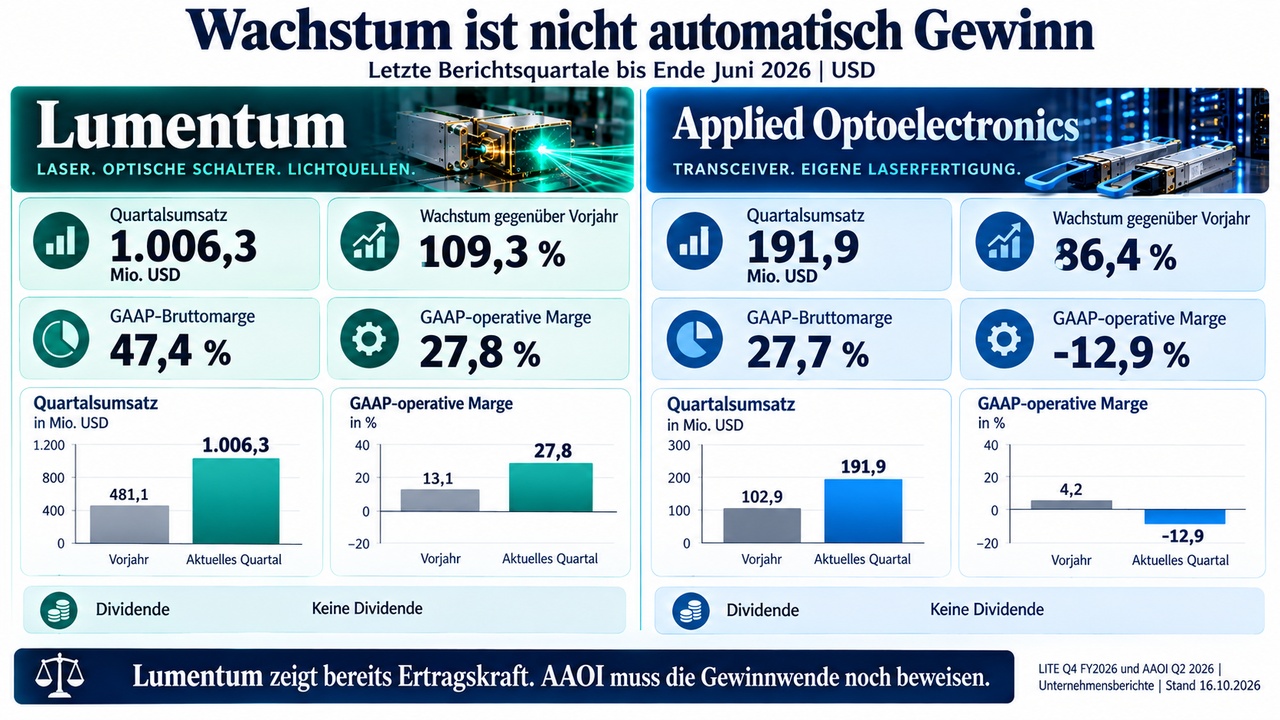
Lumentum has already demonstrated that high demand translates into strong operating profits. With quarterly revenue exceeding $1 billion, the GAAP operating margin stood at 27.8 percent. AAOI is also growing strongly but is still posting operating losses.
For me, that’s the most important difference: With Lumentum, I don’t have to pin my hopes as much on a turnaround in profitability that has yet to materialize.
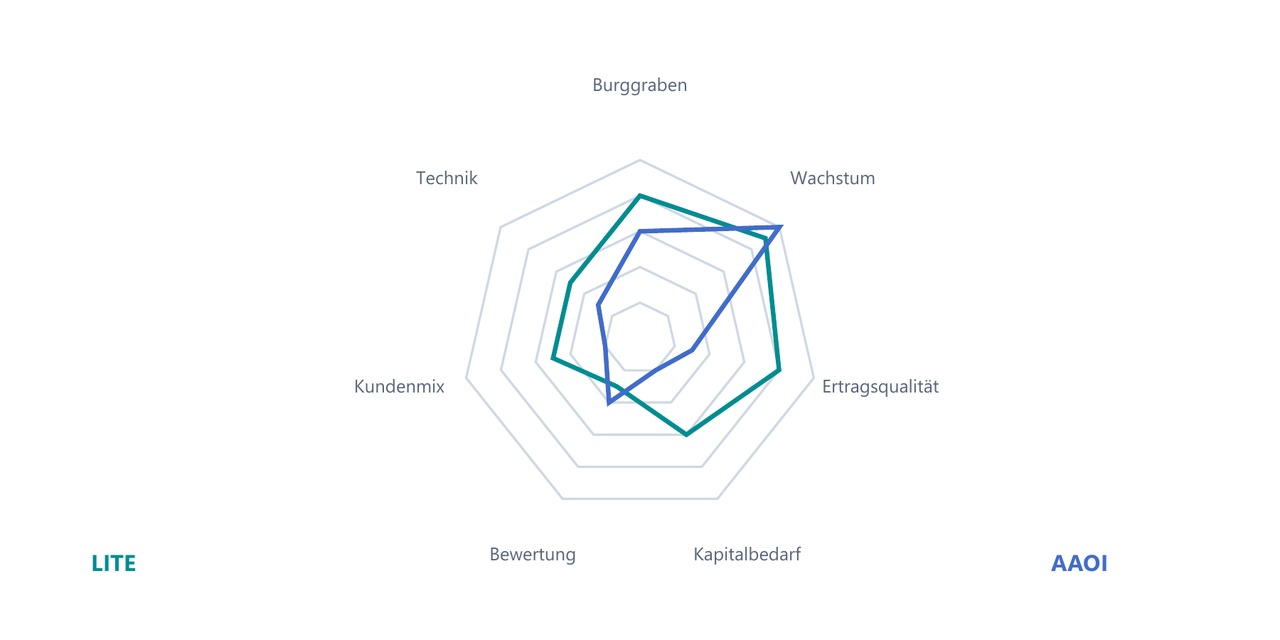
Added to this is the broader technical portfolio. If the design of a data center changes, Lumentum can remain involved through specialized lasers, external light sources, or optical switches, for example.
AAOI also has an advantage with its own laser production. However, its financial success currently depends more heavily on ramping up new transceiver capacity quickly and with reasonable margins.
Lumentum’s massive reported annual loss warrants an explanation.
It was primarily caused by a non-cash charge resulting from the conversion of convertible bonds. This was not a billion-dollar outflow from day-to-day operations.
The transaction is nonetheless relevant to shareholders because it alters the capital structure and dilutes equity. Simply dismissing it as a “one-time item—no big deal” would be too convenient for me.
What’s particularly exciting about AAOI
is that AAOI is starting from a significantly smaller base.
If the expansion for 800G and 1.6T modules succeeds, the company can grow at a higher rate than its larger competitor. In-house lasers can further improve costs and delivery capabilities.
In a best-case scenario, this would provide significant revenue and margin leverage. That’s where AAOI could very well come out on top in this head-to-head competition.
I wouldn’t, therefore, label AAOI as a bad company.
The question is how much of the future capacity will be used profitably and how many additional shares will be issued by then. After all, capacity listed on a presentation slide doesn’t pay the bills.
Especially with an expansion like this, one must distinguish between revenue growth and earnings per share growth.
Where Lumentum still doesn’t convince me
The company is good, but the market has known that for a long time. A market capitalization of nearly $79 billion contrasts with about $300 million in free cash flow from the last fiscal year.
Of course, this cash flow is expected to grow significantly. Nevertheless, the gap shows just how much of the future is already being priced in today. Even a good company can disappoint on the stock market if it delivers only “very good” results rather than “sensational” ones.
Added to this are new factories, bottlenecks, and a growing share of large customers.
The largest disclosed end customer most recently accounted for 26.6 percent of annual revenue, compared to 15.4 percent in the previous year. Long-term capacity utilization forecasts are positive. However, they are no substitute for addressing the question of how binding orders actually are and what prices will ultimately be achieved.
What makes me significantly more cautious about AAOI
The expansion is initially a cash drain. In the first half of the year, operating cash outflow totaled around $74 million.
Together with plant and equipment, advance payments for equipment, and land purchases—according to this broad definition of investment—approximately $707 million was spent. Part of this is intended to generate revenue later on. For now, however, it represents a real financing need.
The capital increase completed on October 5 raised a net total of approximately $588 million and improves the company’s financial flexibility. At the same time, about 5.7 million new shares were issued.
Both of the following are true: The financing situation has improved, and the existing shareholders’ stake has decreased. Whether another capital raise will be necessary depends primarily on the actual expansion costs and future cash inflows.
A completed program is no guarantee that another one will never follow.
The customer base is particularly important to me.
Three customers accounted for a combined 92 percent of revenue. In addition, approximately 67 percent of receivables were attributable to Digicomm, a distributor in the cable network business. This isn’t automatically a payment issue, but it is a significant concentration. A distributor can serve many end customers and still remain a single major payer for the manufacturer.
AI helps both, but the technology may change
Both companies benefit from the fact that data centers need to process more data. The risk isn’t so much that AI will replace the laser. What’s more intriguing is whether new architectures will shift the value chain.
As optical connections move closer to the chips, the requirements for traditional pluggable modules will change.
At Lumentum, , I like that lasers and external light sources can still be used even in new architectures.
AAOI also has opportunities through its laser manufacturing, but it must first translate this into lucrative products on a larger scale. Lumentum’s recent demonstration with Astera Labs and Corning is interesting. However, a demonstration does not yet equate to mass-production business with a steady profit contribution.
I wouldn’t factor in an allegedly certain tailwind from an immediate ban on Chinese transceivers for any stock. There are political initiatives and reports about potential FCC rules.
However, the reviewed official Senate bill pertains to specific procurements and includes long transition periods. I do not view this as a guaranteed source of additional revenue.
What I expect for the coming years
For Lumentum, in my base case scenario, I expect continued strong growth and a healthy operating margin, but also high capital expenditures and increased competition down the road.
The company has the potential to grow significantly larger. I simply don’t expect today’s scarcity-driven prices and exceptional growth rates to last forever.
With AAOI, I see the potential for a bigger leap, but also a wider range of possible outcomes. In the best-case scenario, new capacity comes online smoothly, 1.6T gains traction, and higher revenue translates into higher earnings per share. In the worst-case scenario, new facilities come online too late, capacity utilization lags behind, or additional capital requirements dilute returns for existing shareholders. Here, the path to profit is at least as important as the potential target.
My conservative cash flow model currently yields, in the base case, around $365 for Lumentum and $44 for AAOI.
For both companies, this is below the current market price.
That doesn’t mean the market has to fall to those levels tomorrow. It means that a great deal of growth is already priced in, and my conservative scenario does not offer a clear margin of safety.
The range is wide: In the bear case, my model puts Lumentum at about $96.
The extreme AAOI stress case comes in at less than one dollar, because expansion costs, combined with too-low future margins, would virtually erode the entire shareholder value.
This is not a prediction of insolvency. In the bull case, the figures come to approximately $1,170 and $169, respectively.
This scenario assumes exceptionally successful expansion and high future margins. Such possibilities are appealing, but I wouldn’t present them as the standard outcome.
A potential entry point does not constitute an obligation to buy
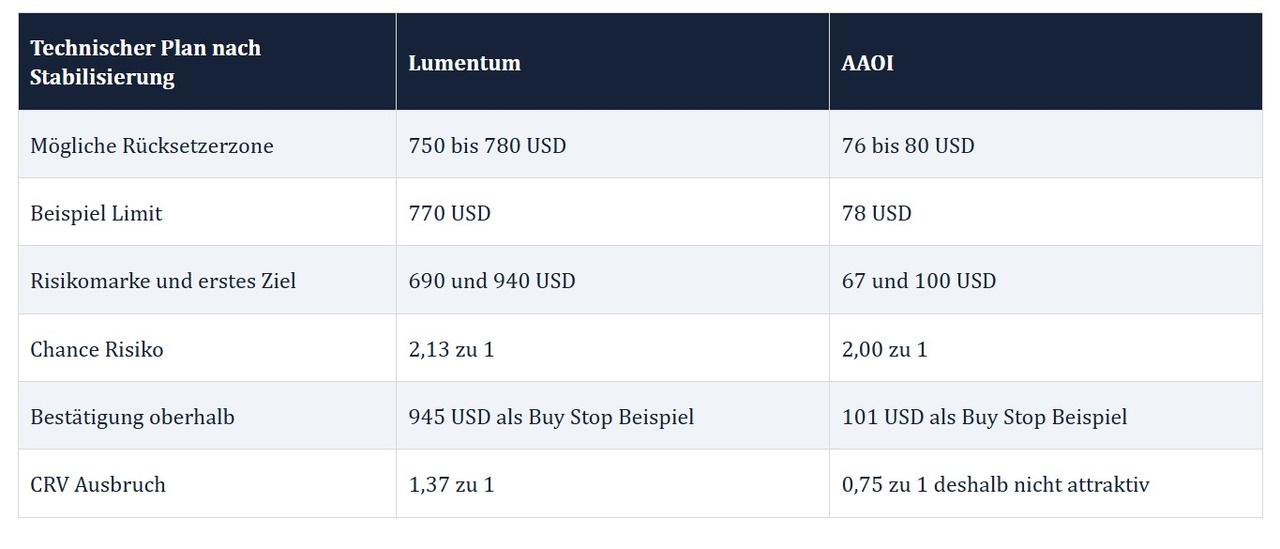
On the chart, Lumentum is relatively stronger. The price is still above the long-term daily moving average but has broken below the shorter-term trend line.
AAOI is trading below both the 50-day and 200-day moving averages.
For both, I don’t see a confirmed bottom at the moment. A red chart doesn’t turn green just because the stock was more expensive last week.
These levels are trading plans in case of stabilization; they are not a call to place blind orders immediately. In a pullback trade, I would assess the first target zones to determine whether to reduce my position or let the recovery continue. For a long-term investment, I would additionally require a reasonable valuation and stronger operational evidence.
A technical stop may be executed significantly worse in the event of a price gap.
A normal buy stop does not wait for a confirmed closing price.
Anyone who wants this confirmation will have to reassess the situation afterward. Limit orders and breakout orders are alternative approaches; an entry OCO order is only an option if the broker supports this order type. The upcoming earnings report on November 5, in particular, could lead to significant price swings.
My conclusion on this showdown
If I were to choose, independently of any portfolio strategy, I’d have to choose one of the two companies , it would be Lumentum.
Its operational profitability, broader product portfolio, and stronger cash flow base convince me more.
If AAOI successfully expands, it could offer greater upside potential.
However, this requires putting up with significantly more uncertainty regarding margins, financing, and customer dependence.
For an entry today, my verdict on both is: wait a little longer.
Lumentum remains my preferred stock to watch.
With AAOI, before making a long-term purchase, I’d first like to see not only new factories and new shares being added, but also a sustainable increase in free cash flow per share.
The AI boom is interesting enough on its own. I don’t need to chase every valuation associated with it.
The strongest counterargument to my caution is a prolonged shortage leading to much higher future profits.
In that case, the market could be right, and my conservative estimate might be too low. That’s exactly why I’m looking forward to both companies’ next earnings reports on November 5. Solid new evidence would change my assessment; another high analyst target alone wouldn’t be enough.
What do you think: would you rather go with Lumentum’s already proven earnings power or the bigger catch-up bet on AAOI?
Feel free to share your arguments in the comments, along with two other stocks for an upcoming showdown.
Ideally, they should be from the same sector and have comparable business models.
Constructive counterarguments are expressly welcome.
Greetings from Denmark
Raketentoni
Sources:
S1 Lumentum Q4 and FY2026 Earnings Report, August 11
S2 Lumentum FY2026 Annual Report, including Form 10-K
S3 AAOI Q2 2026 Results and GAAP-to-Non-GAAP Reconciliation
S4 AAOI Form 10-Q as of June 30, 2026
S5 AAOI 2025 Annual Report (Form 10-K)
S6 AAOI Completion of Capital Increase, October 5
S7 NVIDIA Strategic Partnership with Lumentum, March 2
S8 Lumentum, Astera Labs, and Corning OCP Demonstration, October 12
S9 U.S. Senate Bill S 5548 Introduced, September 24
S10 Lumentum Stock Price and Valuation Data
S11 AAOI Stock Price and Valuation Data
S15 Lumentum Investor Relations Calendar
S16 AAOI Investor Relations Calendar
S17 AAOI Company History
and, of course, all the others :)
+ 3

According to Lumentum CEO Michael Hurlston, capacity for optoelectronic products is fully booked through nearly 2029.
This is driven by strong demand from technology companies for components for AI data centers.
A potential U.S. FCC initiative regarding 3.2-T transceivers could further benefit U.S. laser suppliers.
On October 5, Rosenblatt reaffirmed its “Buy” rating for Lumentum and a price target of $1,300.

Principais criadores desta semana


