
CrowdStrike agrees to buy Zscaler for $43.9B, the largest cybersecurity deal ever. Zscaler jumps 13% while CrowdStrike drops about 9%.
CrowdStrike Hldg
Ação
Ação
Ticker: CRWD
CRWD
Price
Discussão sobre CRWD
Postos
261

1D·
A Mega Deal in the Cybersecurity Industry Is in the Works
CrowdStrike $CRWD (-0,7%) plans to acquire Zscaler $ZS (-0,04%) for $43.9 billion. This could create one of the world’s largest cybersecurity companies. But not all investors are reacting positively to the news.
The cybersecurity industry is on the verge of a mega-takeover. Crowdstrike On Monday, it made a $43.9 billion offer for its competitor Zscaler on Monday.
The merger would create one of the world’s largest cybersecurity companies with total annual recurring revenue of more than $10 billion. The cost savings are expected to amount to $1 billion.
Existing Zscaler shareholders will receive 1.135 CrowdStrike shares for each of their Zscaler shares. This results in a purchase price of $260.41 per Zscaler share. This represents a 34 percent premium over Friday’s closing price of $194.82. Prior to the offer, Zscaler was valued at approximately $31.8 billion.
For CrowdStrike, the acquisition would be a significant step into the business of protecting corporate networks. The Austin, Texas-based company is best known for its software that protects computers and servers.
Zscaler, based in Santa Clara, California, offers cloud-based products that replace traditional VPN access. Employees use these to access their employer’s systems. The software more precisely controls who is allowed to access which networks and applications. This reduces the risk that an intruder, after gaining access to a system, will be able to move freely throughout the network. Recently, older VPN products from providers such as Citrix and Ivanti have repeatedly been targeted by hackers believed to be Chinese or otherwise state-sponsored.
Wave of Acquisitions in the Industry
The deal is part of a wave of major transactions. Google recently acquired the cloud security specialist Wiz for $32 billion. ServiceNow is acquiring the cybersecurity startup Armis for $7.75 billion. Palo Alto Networks It completed the acquisition of CyberArk for approximately $25 billion in February and last week acquired AI model provider Applied Compute for $4.5 billion in stock.
This trend is driven by growing concerns about AI-powered cyberattacks and the risks posed by increasingly autonomous AI agents. These factors are driving up valuations of security firms and accelerating consolidation.
The market reaction was mixed. In premarket trading on Wall Street on Monday, Zscaler shares rose 13 percent to $215. CrowdStrike shares, on the other hand, fell 7.5 percent to $210.
Source and image: Handelsblatt, November 23, 2026

1616
3 Comentários
emppsb@emppsb
1D
•
11
•Mostrar resposta


1D·
They should have cared
$CRWD (-0,7%) acquires $ZS (-0,04%) for 40 billion USD.
https://finance.yahoo.com/technology/article/crowdstrike-is-spending-439-billion-to-buy-zscaler-in-a-huge-cybersecurity-deal-as-tech-outages-spread-110645119.html
5Mês·
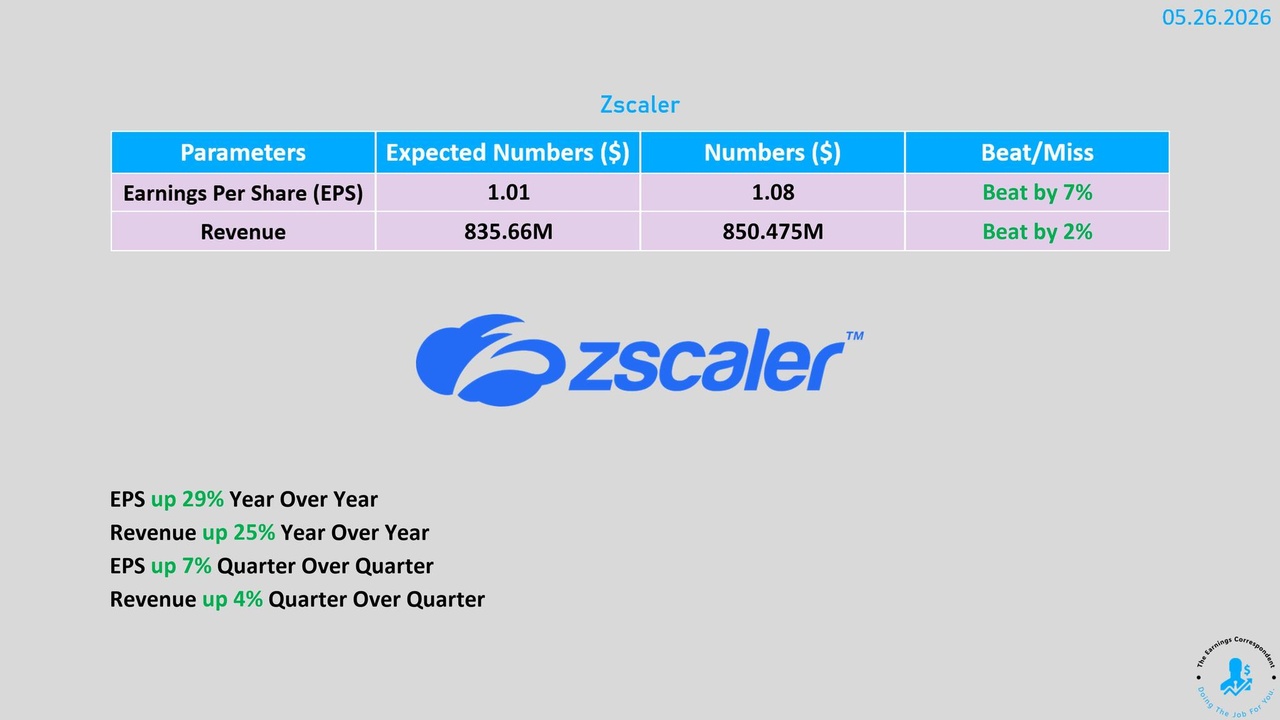
Zscaler just dropped 19%+ after hours 🔴
Q3 earnings actually beat expectations - but nobody cared.
Why? The revenue guidance was the problem. And when guidance disappoints, it wipes out everything else.
The market is worried about two things: → Competition in cybersecurity is heating fast → Core business growth is starting to slow down
Strong quarter. Ugly reaction. That's the power of forward guidance.
I think it is just an overreaction. The company is still strong, the cybersecurity industry has never had more potential, so I stay invested! I probably would buy more if my position weren't already full. 💸
22

3D·
🚨 Cybersecurity Mega-Deal? CrowdStrike Apparently Plans to Acquire Zscaler
An exciting acquisition could be on the horizon in the cybersecurity sector.
According to recent media reports, CrowdStrike ($CRWD) is in talks regarding a potential acquisition of Zscaler ($ZS).
No binding agreement has been reached yet. Talks are ongoing, and a deal is by no means guaranteed.
“My 2 Cents”:
1️⃣ Why does the acquisition make sense?
CrowdStrike and Zscaler are not traditional competitors. Rather, they cover different but closely related areas of cybersecurity.
CrowdStrike ($CRWD):
- Endpoint Security (protection of end devices)
- Threat Detection & Response
- Cloud Security
- Identity Security
- AI-powered threat detection
At the heart of it all is the Falcon platform.
Zscaler ($ZS):
- Zero Trust Network Access
- Cloud-based network security
- Securing data traffic
- Secure access to enterprise applications
- Control of user and device access
At the heart of it all is the Zero Trust platform.
The strategic logic behind it:
CrowdStrike detects and combats attacks on endpoints and within IT systems.
Zscaler controls who is allowed to access which applications and networks.
Together, the two companies could cover a significantly larger portion of the overall IT security architecture.
CrowdStrike would thus close one of its strategic gaps: comprehensive network security.
2️⃣ What are the financial implications?
The figures are substantial.
At the time of this report, market capitalizations were approximately:
- CrowdStrike: $233 billion
- Zscaler: $32 billion
This would bring the combined group’s market capitalization to approximately $265 billion.
Important: This is the combined market capitalization and not a confirmed acquisition price. An acquisition would likely also require a corresponding premium on Zscaler’s market value.
The initial reactions were quite interesting:
📈 Zscaler rose by about 17% in after-hours trading following the announcement of the talks.
📉 CrowdStrike temporarily lost about 8%.
So, for now, the market seems to be viewing the potential acquisition premium for Zscaler positively, while CrowdStrike’s financing and the costs of such a mega-deal are raising questions.
3️⃣ What would come of this?
I find this very exciting.
A merger could create one of the most comprehensive cybersecurity platforms on the market.
Imagine the following architecture:
🛡️ Endpoint Security: CrowdStrike protects laptops, servers, and other endpoints.
☁️ Cloud Security: Protection for cloud infrastructures and workloads.
🔐 Identity Security: Monitoring and securing digital identities.
🌐 Network Security: Zscaler controls access to networks and applications.
🤖 AI Security: Detection and defense against AI-powered attacks, as well as securing AI applications and agents.
📊 Security Operations: Consolidating data and automating responses to threats.
The key would be integrating this information into a single platform.
For example, an attack might begin with a compromised identity, spread through an endpoint device, and then attempt to access cloud applications and corporate data.
By combining both platforms, such an attack could be detected more comprehensively and automatically stopped.
4️⃣ The Real Competitive Advantage: A Platform Instead of a Standalone Solution
Companies increasingly want to avoid having to integrate and manage multiple security providers.
They are looking for holistic solutions that communicate with one another, exchange data, and respond as automatically as possible. This is precisely where the opportunity lies.
A combined provider could:
- Sell more products to existing customers.
- Achieve higher customer loyalty.
- Collect more data for AI-powered threat detection.
- Tap into cross-selling potential.
- Compete more directly with Palo Alto Networks.
Particularly exciting: CrowdStrike and Zscaler are already collaborating strategically. Their existing partnership was further expanded in 2026. So the technical collaboration is already in place.
5️⃣ What are the risks?
Of course, such an acquisition is not a sure thing. Three points are crucial:
1. Purchase price and financing
Zscaler is not a bargain. CrowdStrike would likely have to finance a transaction of this magnitude largely through stock. That could dilute existing shareholders.
2. Integration
Merging two large technology platforms is complex. Product integration, corporate culture, and customer relationships must all work out.
3. Competition and regulation
A cybersecurity conglomerate with a combined market capitalization of around $265 billion would be a heavyweight. Antitrust authorities are likely to scrutinize such a transaction closely.
6️⃣ My personal perspective—and a little stock market lesson (for myself)
I’ve been invested in Zscaler since October 2025.
Even though I haven’t been actively trading on the stock market for very long myself (since 2023), this investment has already taught me a thing or two.
There have certainly been deep troughs, difficult market phases, and moments when one might question one’s investment decision. But this is precisely where an important insight lies for me:
If you’ve thoroughly researched a company, are convinced of its business model, and are following a clear investment thesis, you shouldn’t throw your convictions overboard at every dip.
Of course, that doesn’t mean I hold on to every stock at any cost. The investment thesis must be reviewed regularly. If the fundamental reasons change, I must be prepared to change my mind. (A challenge over the past 5–6 weeks)
But as long as my thesis remains intact, it can be worthwhile to weather even difficult market phases.
Whether or not the potential acquisition actually happens now: For me, it’s exciting to see how the original investment thesis for Zscaler continues to unfold.
7️⃣ My Conclusion
I find the strategic implications of such an acquisition very interesting.
CrowdStrike would evolve from a leading provider of endpoint and threat security into an even more comprehensive cybersecurity platform provider.
Zscaler brings exactly the expertise that could further strengthen CrowdStrike in the areas of network access and Zero Trust.
The real leverage here doesn’t necessarily lie in cost savings, but in the combination of data, technologies, and customer relationships.
The grand vision: an integrated security platform that detects and automatically defends against attacks across endpoints, identities, networks, and cloud infrastructures.
This would significantly strengthen CrowdStrike’s position relative to Palo Alto Networks and position it for the next generation of AI-driven cybersecurity.
However, it’s important to note that these are still acquisition talks and not a confirmed deal. The purchase price and financing will be decisive factors.
💬 What do you think?
Do you view CrowdStrike’s acquisition of Zscaler as strategically positive?
And who do you think would be the bigger winner in the long run: CrowdStrike or Palo Alto Networks $PANW (-0,72%) ?
I’m looking forward to hearing your thoughts! 🚀
@Multibagger
@Tenbagger-Capital
@Pazzzi
@Get_Rich_or_Die_Tryin
@Da_Fischi
@Bertl
@SchmonInvest
@robinhold
@Klein-Anleger
@HoldTheMike
@Keineui
@Aktienhauptmeister
@BavarianLion
@Simpson @Raketentoni @DonkeyInvestor
1616
36 Comentários
I find the strategic rationale understandable, but I would draw a distinction between a sensible merger and a good deal for shareholders.
**The takeover talks have in fact been reported by reputable sources:** Reuters reported them on November 20, citing two people familiar with the matter. According to this report, there is no binding agreement as of yet. The after-hours price movements mentioned—approximately +17% for Zscaler and −8% for CrowdStrike—also align with this. The percentage figures displayed in the article, however, may reflect different time points.
What I find particularly interesting about this argument is that **the two companies are already working closely together.** The expansion announced in September includes, among other things, the exchange of risk signals, automated responses, and the consolidation of security data. However, according to the company’s press release, some integrations are still under development. My question, therefore, is: How much additional value does a takeover offer compared to this existing partnership—and what price is CrowdStrike paying for it?
Here’s how I see the potential consequences:
**For Zscaler shareholders**, a binding offer could result in a takeover premium. If the talks fail, the corresponding premium could disappear again. In the case of a cash offer, the stake would be sold for cash upon completion; in the case of a stock swap, shareholders would subsequently hold a stake in the combined company. In that case, the value would also depend on CrowdStrike’s stock price and the specific terms of the exchange.
**For CrowdStrike shareholders**, additional products and sales opportunities are initially offset by the purchase price, integration costs, and financing risks. New shares would reduce the percentage ownership of existing shareholders. Whether this also results in a loss of value per share depends on what CrowdStrike receives in return. The assumption that the deal will be predominantly equity-financed is just that—an assumption—not a published term of the deal.
I wouldn’t overestimate the **$265 billion** figure either. Simply adding today’s market capitalizations of the two companies says little about what the merged group would be worth in the future. The purchase price, financing, and the market’s revaluation all affect this calculation.
**For Palo Alto, this would mean a stronger competitor in the long term, but it wouldn’t automatically mean they’ve lost the race.** Palo Alto already covers network access, endpoints, the cloud, and security operations with Prisma SASE and Cortex. My assessment: If the integration succeeds, CrowdStrike could become significantly stronger in joint offerings and contract negotiations. If it takes a long time or unsettles customers, Palo Alto could win contracts, especially during this transition phase.
For customers, simpler processes and better-aligned products would be a potential benefit. At the same time, dependence on a single provider and price pressure on smaller competitors could increase. In my view, market overlaps and potential restrictions on competition would be the key factors in an antitrust review; market capitalization alone says little about this.
**My preliminary assessment: strategically plausible, financially still up in the air.** In the short term, Zscaler shareholders are benefiting from takeover speculation. In the long term, CrowdStrike will only come out ahead if the additional revenue justifies the purchase price and the integration risks. After all, two strong products do not necessarily make for a successful merger.
Greetings from Denmark, Toni
•
44
•1Semana·
Free trade
$CRWD (-0,7%) 235C 11/20
Entry: 3.60
Setup: Watching for a move higher.
Personal tracking only not advice.
11
1 Comentar
1Semana
TRADE RUNNING
$CRWD showing a 23% gain
SIGNAL DELIVERED 🟢🔥🔥🔥
TURN MY NOTIFICATIONS ON
••

3Semana·
A Million with Satellite - MSCI World Momentum Champions - Monthly Closing, October 2026
🥹 Month 10 since launch has been less than stellar. 🥹
So far this year, things actually only went downhill from mid-June through the end of July, and we were able to continue our upward trend through August and September. But due to a very weak October, we’re once again far from the 30k mark. We’ve now fallen so far that we’re scraping the maximum drawdown from the backtest.
According to the algorithm, I was using Lumentum ($LITE (-12,07%) ), Kioxia ($285A (-8,84%) ), Micron ($MU (-11,86%) ), Hewlett Packard Enterprise ($HPE (-12,48%)), Marvell Tech ($MRVL (-9,67%)), SanDisk ($SNDK (-13,54%)) and Dell ($DELL (-12,07%) ).
The initial investment was approximately 30,000 euros. Upon the sale of Recruit Holdings ($6098 (+0,19%)) and when I bought Marvell Tech ($MRVL (-9,67%)), I kept about 200 euros.
Overall, October resulted in a loss of almost exactly -22% for the satellite portfolio.
-6,600 euros.
Who was in the portfolio and how it performed:
- Lumentum -17% 🥹🥹
- Kioxia -39% 🥹🥹🥹
- SanDisk -33% 🥹🥹🥹
- Micron -17% 🥹🥹
- Dell -20% 🥹🥹
- HPE -13% 🥹
- Marvell Tech -25% 🥹🥹
Kioxia’s decline, in particular, really hurt. After at one point more than doubling in value, the position is now in the red.
YTD, the momentum performance now stands at just +61% TTWROR.
The changes for October have already been made, with the exception of the pending sale of SanDisk. The rotation is massive and shows that the first major AI wave has crashed against the outlook, despite strong numbers.
Exits:
- Micron
- Lumentum
- Marvell Tech
- Kioxia
- SanDisk
Additions:
- Recruit Holdings ($6098 (+0,19%))
- Marathon Petroleum ($MPC (-1,57%))
- Genmab ($GMAB (+5,28%))
- CrowdStrike ($CRWD (-0,7%))
- Okta ($OKTA (-4,49%))
This means the portfolio is now diversified across multiple sectors for the first time. Hoping quietly for a small year-end rally...
Another 44x to reach a million 🥹
7Posições
€ 23.406,47
0,48%
1010
2 Comentários
3Semana
I feel for you. What's striking, though, is that despite the "Top 7 Assets to Hold," diversification still resulted in such a large monthly loss. Here's hoping for better months ahead.
•
11
•
3Semana·
Partial sale?
Hi everyone,
What does the community think about this stock's price trend? I'm currently considering selling a portion of my holdings (up about 280%) because I expect a correction. I'd be interested in hearing your thoughts. Thank you very much, and best regards
66
4 Comentários
3Semana
Maybe it will correct, but maybe it won't. 
Personally, I don't rush to sell my winning stocks.  If my investment thesis no longer holds, then I have to sell the stock.
If I have doubts after a sharp rise but the investment thesis still holds, I set a stop-loss.
•
55
•4Semana·
Info
So, the next purchases have been made—here’s a brief overview of the structure.
95% goes into securities, just under 2.5% into gold, and 2.5% into fixed-income securities.
Of that, just under 78% is in ETPs and the remaining 22% in stocks.
As for sector weighting, currently just under 28% is in financials, 22% in information technology, 9% in semiconductors, 8% in real estate stocks, and ~6% in major banks; the rest is further diversified.
What is the goal? Well, part of the goal is to preserve and grow capital—as we all know.
To that end, my father and I decided to use a ready-made ETF ($GERD (-0,94%) ) that has a weighting of just under 75%. About 5% is in gold and an overnight swap. The remaining 20% consists of individual stocks, such as $MP (+0,08%) ,$PG (+0,67%) ,$JNJ (+1,43%) , $CAT (-2,33%) or even $KHC (+1,38%) .
How do we determine which stocks to include in the portfolio—specifically, the background stocks required for Ki, such as $MP (+0,08%)
$CMS (+0,25%)
$CRWD (-0,7%)
$RKLB (-7,48%)
$SYM (+5,41%) and $AVGO (-3,39%) . The key factors for these companies are, first and foremost, energy consumption, security, raw materials, robotics, and systems.
However, we’ll also include a few standard holdings in the portfolio, such as $SHEL (+0,05%)
$MCD (+0,97%)
$TSLA (-1,25%)
$CVX (+1,14%) or $BAC (-0,28%) . Since, in our opinion, these are strong and important fundamentals.
As I said, in a few days there will most likely be a portfolio post where you can critique it however you like.
This is currently our decision and strategy, and thanks to it, we’re already up nearly 20k in profit since our first purchases this week.
Best regards. ✌🏻
66
17 Comentários
4Semana
Awesome!? 🤷
What do you want from us?
You're just doing your own thing anyway.
•
1313
•4Semana·
First Major Purchases
Since I have permission to manage the family's liquid assets, some funds have already been transferred to my brokerage account, but much of it is still pending because the banks are reviewing the transactions.
The first purchases I made are $CRWD (-0,7%)
$SYM (+5,41%)
$RBOT (-2,88%)
$TTE (+0,65%) and $RKLB (-7,48%)
1515
47 Comentários4Semana
You can't be serious, right? Is this what sound estate management looks like to you?
I can only agree with Busch:
“But woe, woe, woe!
When I look toward the end!!”
Or are you just trying to troll all of us here? 😬
•
4141
•1Mês·
The market's selling? I'm selling too 👀
I've decided to withdraw my original investment from a few positions that are now up at least 100%.
In addition $CRWD (-0,7%) I also $ASML (-3,92%)
$NVDA (-7,92%)
$GOOGL (-2,53%) caught. So at least I’ve built up a small cash cushion again and am in a slightly more flexible position in case interesting entry opportunities arise in the coming weeks or months. 👀
2323
8 Comentários1Mês
I don't quite understand the economic logic behind "I'm taking my stake out." Could you please explain it to me?
•
99
•Títulos em alta
Principais criadores desta semana
Dados tempo real da LSX · Dados financeiros e EOD da FactSet