
And hopefully my portfolio will be too, soon.

Fujikura
Ação
Ação
ISIN: JP3811000003
Ticker: 5803
JP3811000003
5803
Price
Discussão sobre 5803
Postos
9

3Mês·
Fujikura Posts a Strong Quarter: Strong Growth, Strong Margin, Strong Guidance
My dear friends, of course I'm staying invested.
Fujikura Ltd. – Q1 Earnings Summary
Operating Income
- Profit (GAAP): ¥80.434 billion
- Previous Year: ¥31.318 billion
- +157% YoY
- EPS (GAAP): ¥48.58
- Previous year: ¥18.92
- +157% YoY
Revenue
- ¥402.009 billion
- Previous year: ¥267.908 billion
- +50.1% YoY
Outlook (Guidance)
- Full-Year EPS: ¥196.88
- Full-Year Revenue: ¥1.755 trillion JPY
Analysis
- Extremely strong earnings growth → operational levers taking effect.
- 50% revenue growth → significant expansion in demand, presumably in core businesses (cables, electronics, infrastructure).
- Revenue growth of over 50% is exceptional and points to strong demand or significant new business areas.
- The upward revision of the full-year forecast reflects management’s confidence and confirms the company’s momentum.
The update to the FY2027 outlook signals that Fujikura is more optimistic about the medium term or has undergone a strategic realignment.
5Mês·
Fujikura share: 11 percent slump despite forecast increase
" No risk, no fun "
- small repurchase
Fujikura raises forecast and plans price increases, but the share price falls by over 11%. The AI boom is driving demand for fiber optic cables.
Brief summary
- Share loses despite positive forecast
- AI boom boosts demand for fiber optic cables
- Price increases planned for key products
- Production capacities reach their limits
Japanese cable manufacturer Fujikura presents an unusual picture. The Management Board raises its forecast and announces price increases. Nevertheless, the share price plummets by over eleven percent.
On Tuesday, the share is quoted at 22.49 euros. The drop of 11.12 percent continues a downward slide: over a 30-day period, the loss amounts to almost 41 percent.
AI boom as a driver
Fujikura's CEO stated on June 9 that the company had exceeded its own expectations. The reason: massive demand from US data centers that specialize in artificial intelligence. These facilities require significantly more fiber optic cable than conventional cloud centers. The supply bottlenecks on the market are correspondingly large.
Production capacities are reaching their limits. The company is responding with a pricing strategy. Customers are already accepting higher prices for key products, and further adjustments are planned. The Group can thus convert the limited capacities into higher sales per unit.
Contradictory signals from the market
Just a month ago, Fujikura triggered a sell-off in Japanese tech stocks with a disappointing profit forecast for the financial year ending March 2027. The outlook was below analysts' estimates. Concerns about production bottlenecks, competitive pressure and supply chain problems weighed on sentiment.
At the time, the Group had factored in worst-case scenarios, such as hydrogen bottlenecks. The Management Board is now confident that it will exceed its own plans for the current quarter.
The fiber optic market as a whole is benefiting from the AI boom. Competitors such as Sumitomo Electric and Furukawa Electric are also following suit. If Fujikura's price increases and the expansion of optical components succeed as planned, the results should be positive.

2222
6 Comentários

And the project is thrilled about this, too. Not to mention $INDI —they really delivered as well.
•
22
•4Mês·
According to reports, Nittobo plans to launch Next-Gen-T-Glass in 2028; customers could include NVIDIA, Apple, and others
Hello, everyone,
After I $5803 (+11,99%) introduced Fujikura as a player in the fiber optics sector,
I didn’t want to keep another company from this sector from you.
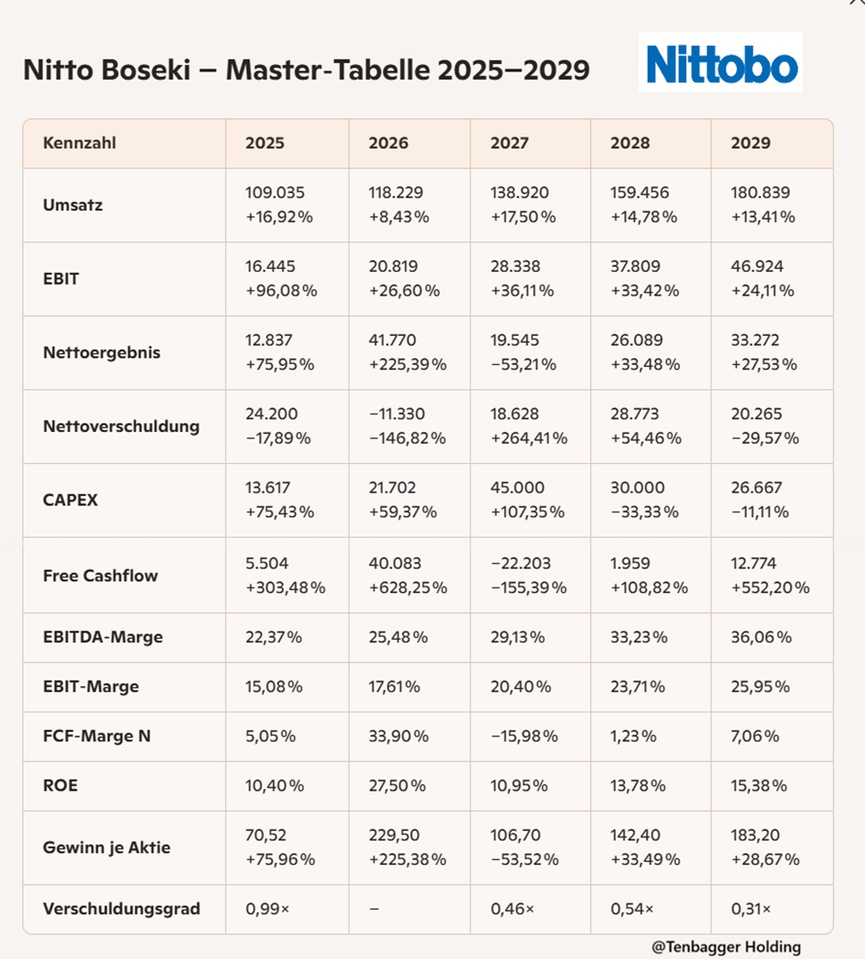
2026 is an exceptional year, with a 225% increase in net income.
Starting next year, Capex spending will rise to over 100% and will be directed toward expansion and new technologies.
This will bring net income back to a normal level.
My friends, could the stock enter a downtrend for the time being due to this decline and normalization?
Or do you still see the company as an exciting investment because of new technology and expansion?
Nitto Boseki Co., Ltd.. operates primarily in the business areas of electronic materials, medical products, composites, materials and chemicals, insulation materials, and other business areas. The company operates in six business segments. The Electronic Materials segment develops, manufactures, and sells glass fiber products for electronic materials. The Medical segment develops, manufactures, and distributes reagents for in vitro diagnostics. The Composites segment develops, manufactures, and distributes glass fiber products for plastic reinforcement materials. The “Materials and Chemicals” segment develops, manufactures, and markets glass fiber products for industrial materials, chemical products, interlinings, functional materials, and dishcloths. The “Insulation Materials” segment develops, manufactures, and distributes glass wool products for insulation, heat storage, and sound absorption. The “Other” segment designs industrial machinery and equipment.
Number of employees: 2,793
Founding dates:
February 1898 — Koriyama Kenshi Boseki Co., Ltd. (Koriyama)
April 1918 — Fukushima Seiren Seishi Co., Ltd. (Fukushima)
April 1923 — NITTO BOSEKI CO., LTD.
Business Activities
Electronic Materials:
- • Product development, manufacturing, and sales of glass fiber yarn and fabrics for electronic materials.
- • Glass fibers used in electronic applications have properties such as electrical insulation and heat resistance, and glass fabric is made from glass fiber yarn (thread). Applications include electrically insulating base materials for printed circuit boards.
- • Specialty glass is developed with unique compositions and is characterized by a low dielectric constant and low dielectric loss factor—properties required for broadband communication—as well as low thermal expansion. These properties make Nitto Boseki’s glass fibers a key material for high-frequency components in data centers and base stations, for infrastructure equipment such as servers, and for personal computers, smartphones, and other edge devices, as well as for vehicles. Their outstanding quality has earned high recognition worldwide.
Medical:
- NITTOBO MEDICAL CO., LTD., a wholly owned subsidiary of Nittobo, operates in the medical sector and focuses on in vitro diagnostic reagents.
- • In-vitro diagnostic reagents are used for testing samples such as blood and urine to diagnose diseases, both during doctor’s visits and during health screenings.
- • By managing a global value chain that spans from the production of raw materials in the U.S. to the commercialization of the final product, the Group ensures a stable supply of high-quality in vitro diagnostic reagents. Thanks to these supply capabilities, the Group has achieved the top market share in many categories, such as inflammatory biomarkers.
Composite Materials:
- Product development, manufacturing, and sales of glass fibers for plastic reinforcement materials and other composite materials
- • Glass fiber for composite materials leverages the properties of dimensional stability and processability and has established itself as a reinforcing material for plastics in a wide range of applications, including various automotive components, household appliances, and home furnishings.
- • By using different cross-sections—such as oval shapes instead of conventional round shapes—the proprietary high-performance glass with a unique cross-section developed by Nitto Boseki not only improves the impact resistance of the molded product but also prevents its deformation and offers additional outstanding properties. These characteristics have led to its use in the casings of smartphones, personal computers, tablets, and other devices.
Materials Solution:
- • Its industrial-use glass fiber business covers a wide range of applications, from membranes for large buildings to vibration-damping materials for automobiles. It has been adopted by the automotive and aerospace industries, where there is a need for improved fuel efficiency and reduced weight, and contributes to solving global environmental problems.
- • The Chemicals business is dedicated to the development and sale of highly innovative functional polymers and inorganic/organic nanocomposite materials (SSG).
- • In the textile sector, we will expand the use of the unique adhesive technology they have developed for adhesive interlinings and other applications from clothing to home products and industrial materials, providing functional materials.
Insulation Materials:
- • Nitto Boseki is engaged in the product development, manufacturing, and distribution of glass wool insulation materials that achieve a high level of thermal insulation performance.
- • Since all types of buildings must reduce their energy consumption to prevent global warming, glass wool is primarily used as an insulation material in residential buildings.
- • In addition to its energy-saving properties, well-insulated housing is also gaining attention from a health perspective, and NB is promoting the development of high-performance glass wool to meet the demand for improved insulation performance. Glass wool is also frequently used in ships and vehicles.
- • The glass wool manufacturing process helps reduce resource consumption by using recycled glass; more than 80% of the glass raw materials come from household glass bottles and other sources.
[News] Nittobo reportedly plans to launch Next-Gen T-Glass in 2028; customers may include NVIDIA, Apple, and others
Nittobo Group Financial Results for FY2025 (From April 2025 to March 2026)
2025/11/12Versuchserfolg: Recycelte Flachglasfaser aus Abfall-Solarpaneelabdeckungsglas (270KB)
2026/05/08Neue Materialtechnologie bietet eine Hochleistungsaufnahme von Kohlendioxid (916KB)
Revenue Breakdown by Business Segment:
2026 (JPY)
Electronic Materials Business 61.42 billion
Insulation Materials Business 15.16 billion
Composite Materials Business 14.46 billion
Medical Business 13.94 billion
Materials and Chemicals Business 11.73 billion
Unallocated Adjustment -20.6 billion
Other 22.13 billion
Geographic Revenue Breakdown:
2026 (JPY)
Japan 65.02 billion
Taiwan 17.56 billion
South Korea 14.16 billion
Other (Excl. Asia) 8.71 billion
Europe 7.26 billion
North America 5.08 billion
Others 442 million
Juan’s Conclusion (short, clear, nerdily precise)
Bro, Nitto Boseki is delivering—but with a fair amount of volatility in tow.
Revenue & EBIT are rising steadily every year, really nice scaling, and the margins are rising like clockwork. That’s textbook operating leverage.
2026 is an outlier on the upside for profit, after which everything returns to normal. FCF is all over the place—first it skyrockets, then it crashes, then it skyrockets again. Typical for companies with large CAPEX cycles.
The Net debt fluctuates back and forth, but the trend heading toward 2029 is clear: The balance sheet becomes more stable, and the debt-to-equity ratio falls to 0.31×, which is really solid.
ROE is rising steadily, which shows that management is using capital more efficiently.
Bottom line: Nitto Boseki is a structural growth stock with margin expansion, but you have to take the FCF volatility . 2029 looks really strong—that’s when the company will be in the “sweet spot” between growth and profitability.
Quick Take (Juan-Style)
Bro, the company is set to go on a monster investment cycle. CAPEX is going through the roof because Nitto Boseki is massively expanding its production capacity. Years like this are always toxic for profits: Depreciation rises, operating costs rise, cash flow plummets—and net income returns to normal after the outlier year of 2026.
Starting in 2028/2029, however, it’s already clear: Margins are rising again, ROE is increasing, and the debt-to-equity ratio is falling. The investments are beginning to pay off.
Nittobo is deliberately pursuing a multi-year investment peakthat aligns perfectly with its “Big VISION 2030.”
Quick summary (Juan-style)
Bro, Nittobo is ramping up CAPEX because they’re pushing through their “Big VISION 2030.” New plants, new capacity, new technologies—that costs a lot of money at first. That’s why profits are falling in the short term. But starting in 2028/2029, you’ll already see: Margins are rising, ROE is rising, and the debt-to-equity ratio is falling. The investments are starting to pay off.
Market Value 719,001
Number of Shares (in thousands) 182,026
Date of Publication 05/12/2026
Juan’s Conclusion (short & to the point)
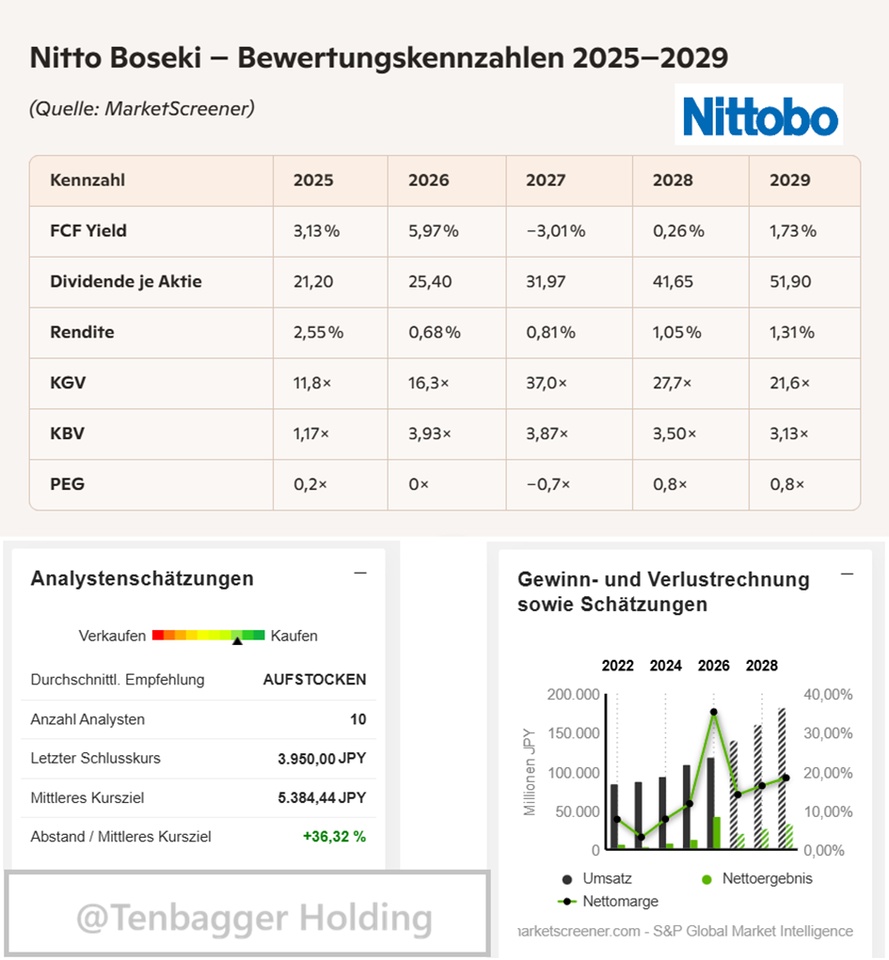
Bro, Nitto Boseki’s valuation is a total rollercoaster.
FCF yield swings wildly back and forth —first strong, then negative, then positive again. This shows that the market doesn’t consistently trust the cash flow because the CAPEX waves disrupt the model in the short term.
The P/E ratio is completely overvalued in 2027 (37×), but it normalizes back to a much more comfortable level by 2029. This is typical for companies that have had an outlier year and then return to normal operations.
The P/B ratio rises sharply, indicating that the market values the balance sheet quality more highly—despite the volatility.
The PEG is negative in 2027, which is always a warning sign: growth and valuation are diverging. Things look healthy again starting in 2028/2029.
Dividends per share are rising steadily every year, which is a strong sign of management discipline and a commitment to cash returns.
In short: Valuation is volatile, dividends are stable, and 2029 is clearly more attractive than 2027. The market is pricing in the investment cycles—and will reward the company as soon as margins pick up again.
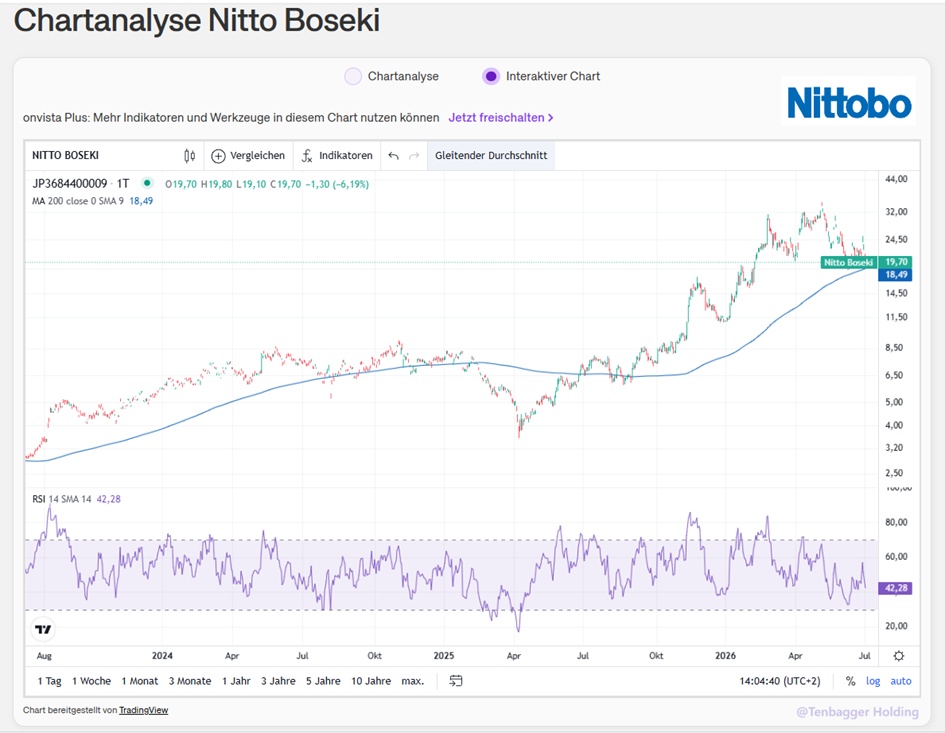
Performance
1 week -2.78%
1 month -19.23%
6 months +89.19%
1 year +201.72%
3 years +639.44%
July 2, 2026, 5:32:29 PM •
gettex (EUR)
19.70 EUR
+ 1
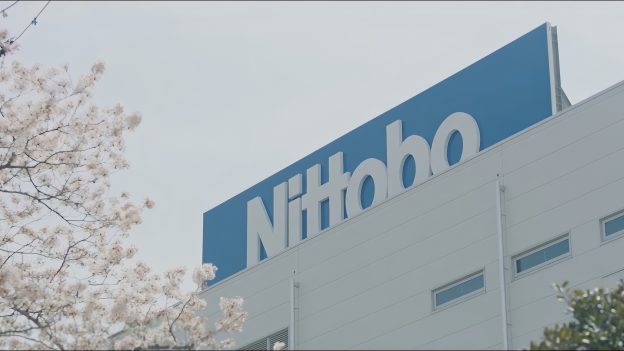
www.trendforce.com[News] Nittobo Reportedly Plans 2028 Next-Gen T-Glass; Customers May Include NVIDIA, Apple, and Others
1919
17 Comentários
Tenbagger, my friend—haven’t we dissected one in a while? Let’s get started.
Digging into the AI Substrate Gold Rush
Nitto Boseki (Nittobo) isn’t a hyped-up chip designer, but rather a critical, behind-the-scenes physical monopolist. With an estimated global market share of over 80% in ultra-thin specialty glass (NE-Glass), the company supplies the fundamental base material for high-end printed circuit boards (PCBs). Anyone looking to build the next generation of Nvidia or AMD AI server architectures cannot do without Nittobo’s glass fibers, which reduce signal loss.
🛠️ DNA Check
Monopolist in transition: The historical figures still reflect the company’s past in textiles (ROIC 7.8%, gross margin 28.4%). The future belongs to high-margin specialty glass.
Operating leverage kicks in: As soon as the new plants reach full capacity, operating margins (currently 9.5%) will surge significantly due to the product mix shift.
Financial Health: The balance sheet is rock-solid. The debt ratio (net debt/EBITDA) stands at a comfortable 1.4x for the year 2026.
Value-Adding Expansion Capex: The high capex ratio (11.8% of revenue) is an approved capex exception, as it involves aggressively ramping up capacity for the booming AI infrastructure market.
🚀 Growth Leverage & Catalysts
AI Infrastructure Boom: The rollout of new server platforms necessitates printed circuit boards with an extremely low dielectric constant. Nittobo holds the greatest leverage in this area.
Pricing Power: Due to the technological barriers involved in manufacturing ultra-thin glass, Nittobo can pass on increased raw material and energy costs to Taiwanese PCB manufacturers almost on a one-to-one basis.
Healthy Shareholder Structure: No dilution of shareholders due to excessive stock options (SBC < 1% of revenue).
⚠️ Valuation & Risks:
Ambitious valuation despite the correction: Following the recent stock split (1:5) and the pullback to ~€21.30 (~3,635 JPY), the stock still trades at a forward P/E ratio of ~26.5x. The market is demanding aggressive FCF growth of 14.5% per year over the next 10 years.
Taiwan & Nvidia Concentration Risk: The entire business model hangs by a thread tied to the Taiwanese supply chain. Any geopolitical disruption or technological design change at Nvidia would have an unmitigated impact here.
My Verdict:
“Nittobo is the ultimate ‘pick-and-shovel’ play for the physical layer of the AI revolution. Its historical balance sheet looks like a boring textile shop, but the future is high-tech glass. Following the stock split and the recent correction, realism is finally returning to the share price. However, my risk radar prevents me from blindly chasing the stock, as the concentration risk in Taiwan is real. A first-class company where we’re waiting for the right price.”
Reaper Rating: WATCH
Reaper Score: 5/10
Digging into the AI Substrate Gold Rush
Nitto Boseki (Nittobo) isn’t a hyped-up chip designer, but rather a critical, behind-the-scenes physical monopolist. With an estimated global market share of over 80% in ultra-thin specialty glass (NE-Glass), the company supplies the fundamental base material for high-end printed circuit boards (PCBs). Anyone looking to build the next generation of Nvidia or AMD AI server architectures cannot do without Nittobo’s glass fibers, which reduce signal loss.
🛠️ DNA Check
Monopolist in transition: The historical figures still reflect the company’s past in textiles (ROIC 7.8%, gross margin 28.4%). The future belongs to high-margin specialty glass.
Operating leverage kicks in: As soon as the new plants reach full capacity, operating margins (currently 9.5%) will surge significantly due to the product mix shift.
Financial Health: The balance sheet is rock-solid. The debt ratio (net debt/EBITDA) stands at a comfortable 1.4x for the year 2026.
Value-Adding Expansion Capex: The high capex ratio (11.8% of revenue) is an approved capex exception, as it involves aggressively ramping up capacity for the booming AI infrastructure market.
🚀 Growth Leverage & Catalysts
AI Infrastructure Boom: The rollout of new server platforms necessitates printed circuit boards with an extremely low dielectric constant. Nittobo holds the greatest leverage in this area.
Pricing Power: Due to the technological barriers involved in manufacturing ultra-thin glass, Nittobo can pass on increased raw material and energy costs to Taiwanese PCB manufacturers almost on a one-to-one basis.
Healthy Shareholder Structure: No dilution of shareholders due to excessive stock options (SBC < 1% of revenue).
⚠️ Valuation & Risks:
Ambitious valuation despite the correction: Following the recent stock split (1:5) and the pullback to ~€21.30 (~3,635 JPY), the stock still trades at a forward P/E ratio of ~26.5x. The market is demanding aggressive FCF growth of 14.5% per year over the next 10 years.
Taiwan & Nvidia Concentration Risk: The entire business model hangs by a thread tied to the Taiwanese supply chain. Any geopolitical disruption or technological design change at Nvidia would have an unmitigated impact here.
My Verdict:
“Nittobo is the ultimate ‘pick-and-shovel’ play for the physical layer of the AI revolution. Its historical balance sheet looks like a boring textile shop, but the future is high-tech glass. Following the stock split and the recent correction, realism is finally returning to the share price. However, my risk radar prevents me from blindly chasing the stock, as the concentration risk in Taiwan is real. A first-class company where we’re waiting for the right price.”
Reaper Rating: WATCH
Reaper Score: 5/10
•
77
•5Mês·
Fujikura share: 11 percent slump despite forecast increase
" No risk, no fun "
- small repurchase
Fujikura raises forecast and plans price increases, but the share price falls by over 11%. The AI boom is driving demand for fiber optic cables.
Brief summary
- Share loses despite positive forecast
- AI boom boosts demand for fiber optic cables
- Price increases planned for key products
- Production capacities reach their limits
Japanese cable manufacturer Fujikura presents an unusual picture. The Management Board raises its forecast and announces price increases. Nevertheless, the share price plummets by over eleven percent.
On Tuesday, the share is quoted at 22.49 euros. The drop of 11.12 percent continues a downward slide: over a 30-day period, the loss amounts to almost 41 percent.
AI boom as a driver
Fujikura's CEO stated on June 9 that the company had exceeded its own expectations. The reason: massive demand from US data centers that specialize in artificial intelligence. These facilities require significantly more fiber optic cable than conventional cloud centers. The supply bottlenecks on the market are correspondingly large.
Production capacities are reaching their limits. The company is responding with a pricing strategy. Customers are already accepting higher prices for key products, and further adjustments are planned. The Group can thus convert the limited capacities into higher sales per unit.
Contradictory signals from the market
Just a month ago, Fujikura triggered a sell-off in Japanese tech stocks with a disappointing profit forecast for the financial year ending March 2027. The outlook was below analysts' estimates. Concerns about production bottlenecks, competitive pressure and supply chain problems weighed on sentiment.
At the time, the Group had factored in worst-case scenarios, such as hydrogen bottlenecks. The Management Board is now confident that it will exceed its own plans for the current quarter.
The fiber optic market as a whole is benefiting from the AI boom. Competitors such as Sumitomo Electric and Furukawa Electric are also following suit. If Fujikura's price increases and the expansion of optical components succeed as planned, the results should be positive.
2222
37 Comentários
Did you get in two weeks ago? I have it on my watchlist and am still waiting for the SMA200 test. If it comes, then I'm in, otherwise not 😅
•
33
•
5Mês·
Keep it simple or open a new position
Hi everyone,
through you I have learned back and forth make bags empty, first thanks😘
$LVMH I've had LVMH in my portfolio for a very long time, it's like my own ETF, but thanks to the wars etc. it's getting weaker and weaker, hence the idea of selling LVMH and getting into $5803 (+11,99%) boring to put into the ETF or to increase the positions? Thank you in advance:)
Am also open to further suggestions:)
25Posições
€ 106.955,72
18,71%
1313
12 Comentários
5Mês
You already have some mini items at the bottom. I wouldn't start anything new until that's tidied up.
At 100k I would think about a minimum position size.
At 100k I would think about a minimum position size.
•
11
•5Mês·
Fujikura achieves record net profit, but weak outlook for 2027 disappoints analysts and causes share price to plummet by 20%
Hello my dears,
Today I would like to discuss one of the strongest Japanese stocks with you once again. That's why Juan has picked out the current financial and valuation ratios for you.
After good figures but a somewhat disappointing outlook, which in my opinion could also improve with peace in Iran.
And could therefore also provide a surprise. In the long term, we are in a growth segment in which Fujikura is continuing to expand.
I also see the current share price losses as being due to a weak Japanese market.
At a glance:
- Record profit of 157.2 billion yen
- Outlook for 2027 well below analysts' expectations
- Provision for US tariffs a burden
- Dividend raised to 40 percent
Record profits, and yet the share price plummets by 20 percent. What is currently happening at Fujikura illustrates a classic stock market phenomenon: it is not looking back that determines the share price, but looking forward.
Outlook falls well short of expectations
Fujikura reported a net profit of 157.2 billion yen for the financial year to March 2026 - an increase of 73% compared to the previous year. Sounds strong. The problem lies in the next step.
For the current financial year to March 2027, the company expects a net profit of 156 billion yen - a marginal drop compared to the record year. Analysts had around 207.7 billion yen on the cards. The gap is around 25 percent. No wonder investors are reacting nervously.
To make matters worse, Fujikura had to make a provision of 12.8 billion yen for US tariffs on fiber optic imports from a subsidiary in China. The company intends to contest the customs decision and the damage has been priced in for the time being.
Strong core business, but rising costs
The operating picture is actually robust. Last year, sales rose by around 21 percent to 1.182 trillion yen, while the operating result climbed 39 percent to 188.7 billion yen. Growth was driven by the telecommunications, automotive and energy systems segments.
For the new financial year, Fujikura is expecting sales of 1.243 trillion yen - i.e. further growth. However, rising raw material costs and geopolitical risks are putting pressure on the profit margin. The management explicitly mentioned a possible conflict in the Middle East and a potential blockade of the Strait of Hormuz as scenarios that have been factored in.
Dividend high, investments underway
To bolster shareholder confidence, Fujikura is raising the payout ratio from 30% to 40%. A final dividend of 130 yen per share has been proposed for the past financial year - before the 1:6 stock split completed in the spring. For the new year, the company is planning 38 yen per share on an adjusted basis.
Strategic investments are running in parallel. The new US subsidiary Fujikura Cable Systems LLC is to be founded in Delaware in June 2026. The plant in Sakura will receive up to 40 billion yen to expand the production of fiber optic cables for AI data centers - commissioning is planned by the end of 2030. Fujikura has also developed a technology for precise three-dimensional nanostructuring together with MIT, which is intended for optical communication and AI applications.
Thursday's fall in the share price is less a reflection of the past than of uncertainty about the pace of recovery. Whether the conservative guidance contains buffers or reflects the actual expectations will become clearer with the half-year figures in the fall at the latest.
Fujikura Aktie: Guidance 25 Prozent unter Analystenschätzung - Finanztrends
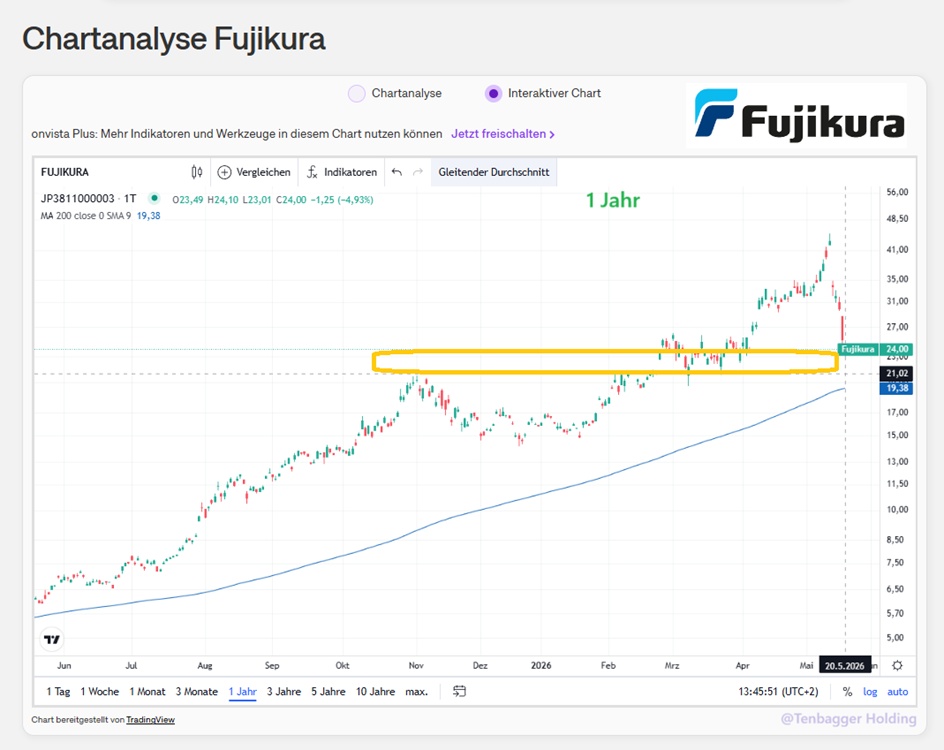
Dear all, would you play the hero and get in now?
Or wait for a further correction to €21?
Or perhaps wait for an improvement in sentiment in the end?
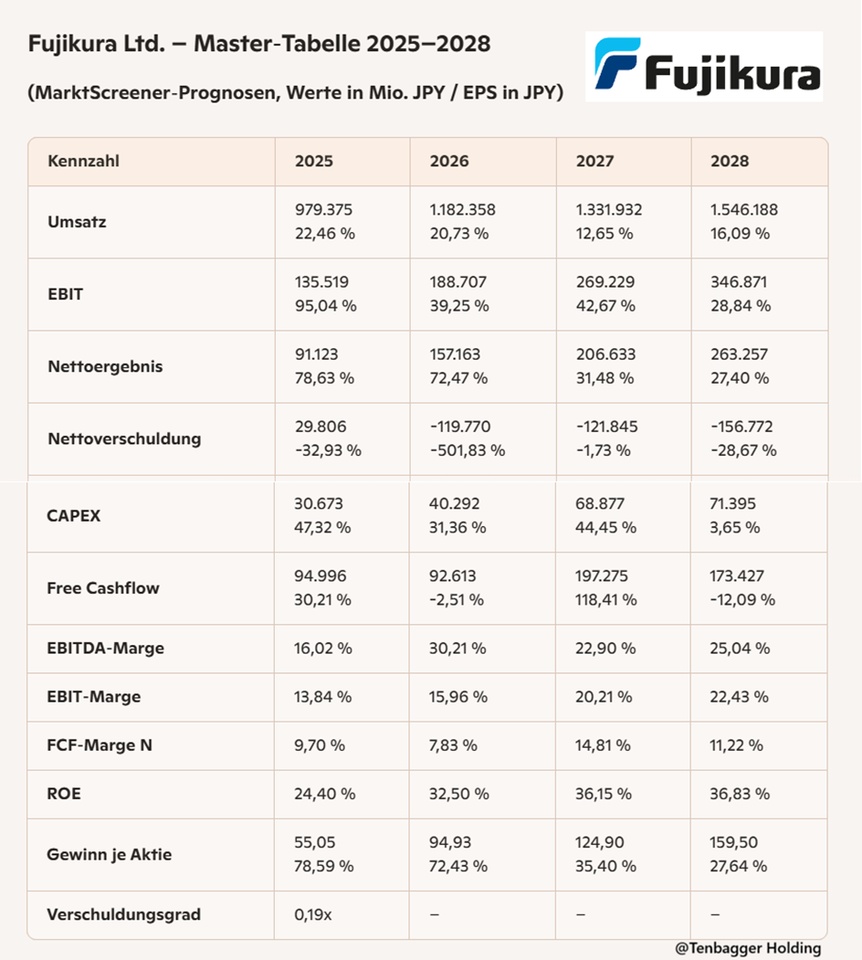
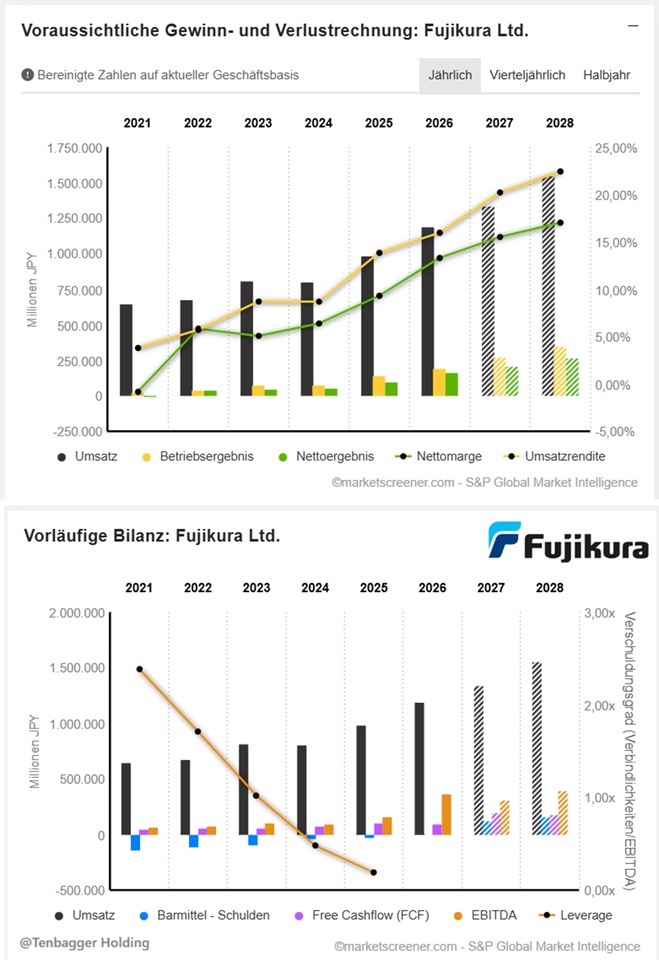
Juan-Investment-Summary - Fujikura (2025-2028)
(compact, investor-focused, without marketing bullshit)
1) Growth & scaling
- Sales increase from JPY 979 bn → JPY 1,546 bn (2025-2028).
- Solid double-digit annual growth → Clear scaling path.
- EBIT grows disproportionately → Operating levers are working.
2) Profitability
- EBIT margin increases from 13,8 % → 22,4 %.
- EBITDA margin 2028 at 25 % → Top tier for Industrials.
- FCF margin volatile, but 2027 peak (14,8 %) shows cash power.
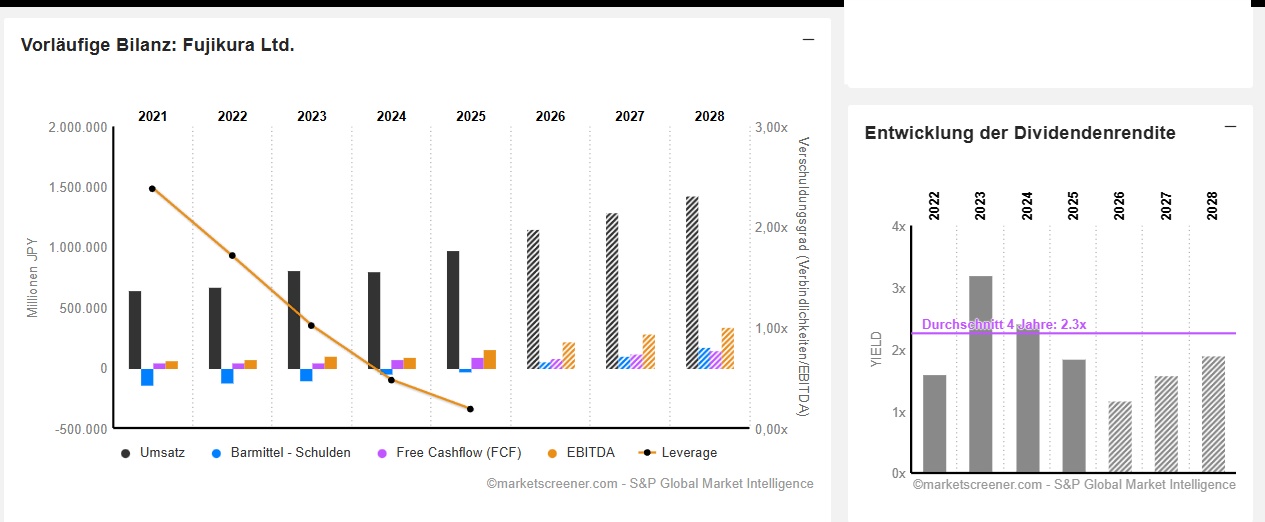
3) Balance sheet & capital structure
- Net debt turns deep into net cash in 2026 net cash.
- 2028: JPY -156 billion → Extremely solid balance sheet.
- Leverage ratio practically irrelevant → Financial risk minimal.
4) Yields & quality
- ROE increases to 36-37 % → High-quality compounder level.
- EPS grows from 55 → 160 JPY (2025-2028).
- Growth + margins + balance sheet = Quality profile clearly confirmed.
- 5) Juan conclusion
Fujikura is a structurally growing high quality industrial stock with massive margin expansion, net cash balance sheet and strong EPS compounding. The combination of scale, balance sheet strength and increasing profitability is rare and attractive.
Market value 7,773,320
Number of shares (in thousands) 1,655,659
Date of publication 14,05,2026
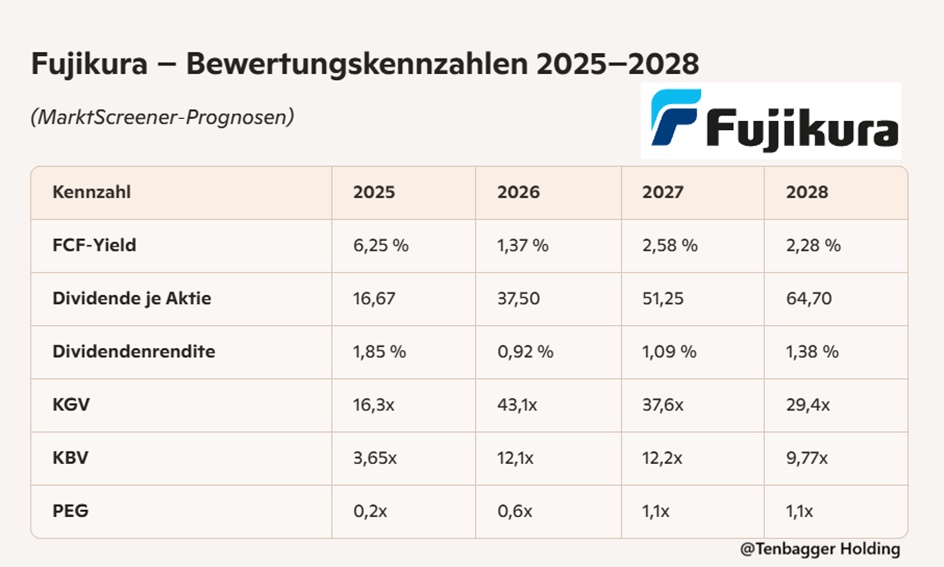
Juan conclusion (valuation)
Fujikura is traded as a high quality growth play: high multiples but supported by real EPS and margin compounding. The share is not cheapbut fundamentally well-founded expensive. For investors who are looking for quality + growth, this is a coherent valuation story.
20,05,2026
today, 13:52:01 -
Tradegate BSX (EUR)
24.10 EUR
-1.15 EUR-4.56 %
Ladies and gentlemen, would €21 be a good entry level for you?

www.finanztrends.deFujikura Aktie: Guidance 25 Prozent unter Analystenschätzung
10Mês·
Japan's century-old Fujikura benefits from AI data center boom and becomes Nikkei highlight
Hello my dears,
due to the great correction in AI stocks and the upcoming interest rate hike in Japan from Thursday evening to Friday. I went through my Japanese stocks again.
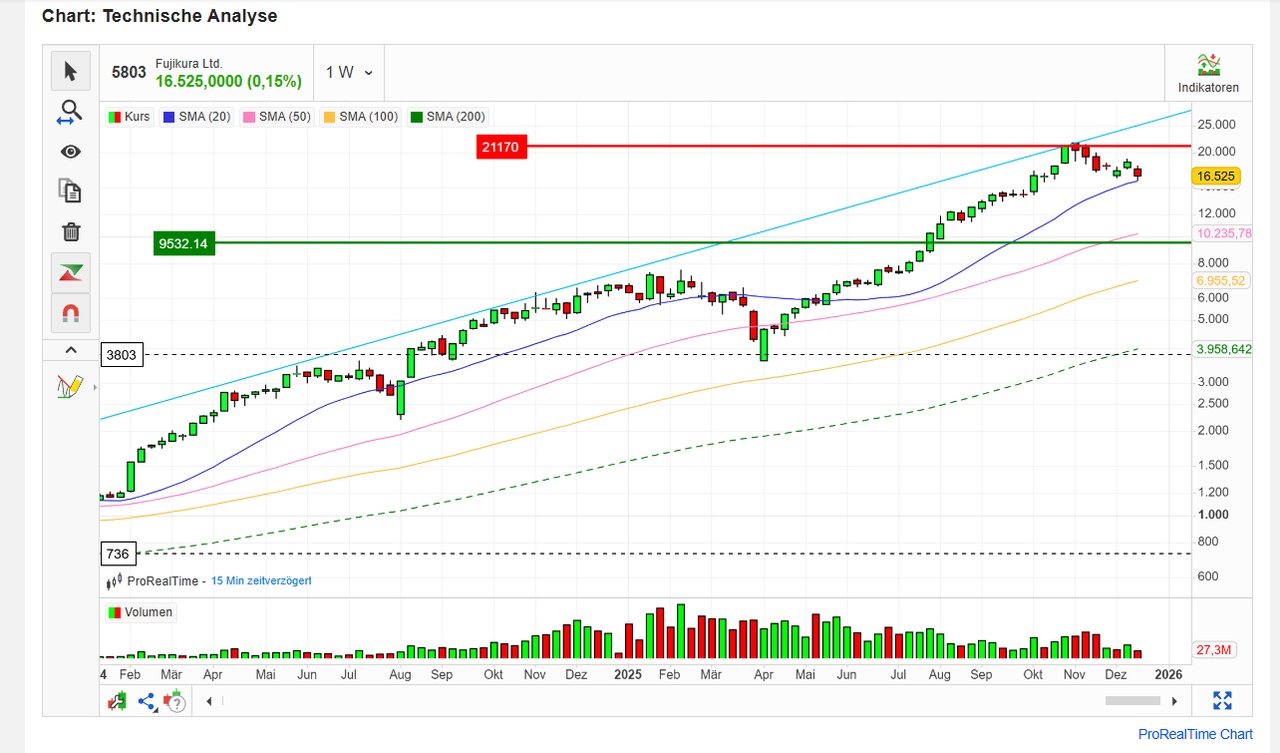
And here could be a good entry opportunity with Fujikura $5803 (+11,99%) could arise.
What do you think of the share?
I look forward to many comments.
At the very end, I have a little more exciting information about the
" Next Generation "
inserted
TOKYO: Japan's Fujikura has become a standout profile on the hot Nikkei share scale on expectations that the century-old wire maker will benefit from increased investment in artificial intelligence data centers that use its optical fibers.
Fujikura's shares have risen more than 160 percent since the start of 2025, outpacing the Nikkei's 22 percent rise to an all-time high. Its market value of around 33 billion dollars now rivals that of better-known Japanese manufacturers such as air conditioner maker Daikin and construction equipment maker Komatsu.
In Japan, this euphoria has spread to major suppliers and investors in the AI sector such as Advantest, Tokyo Electron and SoftBank Group. These companies alone have accounted for the majority of the Nikkei's gains since the beginning of September.
Fujikura, founded in 1885 during the Meiji era of Japan's modernization, is a focal point for investors scouring the AI supply chain to find the next winning group.
"Generative AI is a big topic and a key driver for the Japanese market," said Kazuaki Shimada, chief strategist at IwaiCosmo Securities. "Now investors have started to look for new targets that could become the next Fujikura."
Mitsui Kinzoku, which makes materials for data center servers, is another AI-related top flyer in the Japanese market, up 192 percent so far in 2025. Another supplier, JX Advanced Metals, has quadrupled since entering the market in March.
Fujikura began as a manufacturer of silk and insulated wires and produced the world's first glass fiber in 1959. Today, these optical fibers are a key component of AI data centers, with around 75 percent of the company's production going to foreign customers such as Google owner Alphabet.
A spokesman said Fujikura increased fiber optic production capacity at its existing plant in February and announced in August it would spend 45 billion yen ($298.45 million) to build another factory.
($1 = 150.7800 yen)
Source: Reuters
Fujikura Ltd. specializes in the development, manufacture and marketing of electronic devices, cabling systems and telecommunications equipment. The breakdown of net sales by activity is as follows:
- Sales of electronic and electronic devices (38%): printed circuits, connectors, switches, pressure transducers, etc;
- Sale of cables (37.2%): Power cables, coaxial cables, special cables for industrial installations, telecommunication cables, line wires, etc. The Group is also developing an activity for the sale of telecommunications equipment (fiber optic connectors, photometers, reflectometers, optical connectors, couplers, optical transceivers, etc.);
- Sale of automotive products (22.4%);
- Real estate leasing (1.3%);
- Other (1.1%).
The geographical breakdown of net sales is as follows: Japan (28.4%), Asia (12.7%), North America (41.1%), Europe (13.7%) and Other (4.1%).
Number of employees: 51,262
JPY in millions
Estimates
year
Turnover
Change in
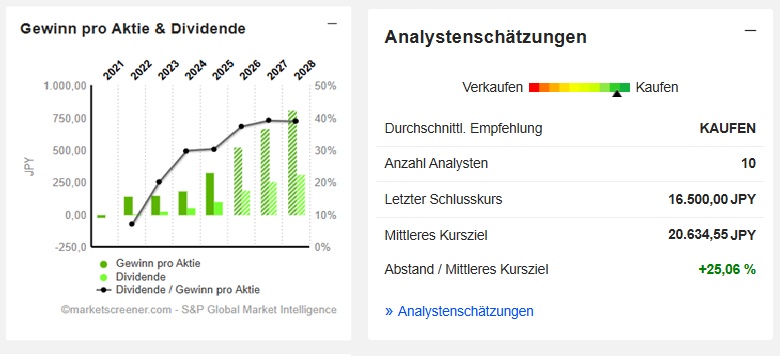
2025 979.375 22,46 %
2026 1.152.166 17,64 %
2027 1.288.595 11,84 %
2028 1.425.244 10,6 %
Year
EBIT
Change in
2025 135.519 95,04 %
2026 195.397 44,18 %
2027 245.553 25,67 %
2028 291.675 18,78 %
Year
Net result
Change in
2025 91.123 78,63 %
2026 143.808 57,82 %
2027 181.362 26,11 %
2028 215.838 19,01 %
Year
Net debt
CAPEX
2025 29.806 30.673
2026 -50.919 58.672
2027 -98.386 66.000
2028 -174.329 71.503
Year to date
Free cash flow
Change in
2025 94.996 30,21 %
2026 80.466 -15,3 %
2027 121.086 50,48 %
2028 147.955 22,19 %
Year
EBIT margin
ROE
2025 13,84 % 24,4 %
2026 16,96 % 31,46 %
2027 19,06 % 33,39 %
2028 20,46 % 32,93 %
Year
Earnings per share Change
2025 330,3 78,59 %
2026 521,3 57,81 %
2027 666,4 27,83 %
2028 809,7 21,5 %
(number of shares 275,931)
Year
P/E RATIO
PEG
2025 16.3x 0.2x
2026 31.7x 0.5x
2027 24.8x 0.9x
2028 20.4x 0.9x
Year
Dividend p share
Yield
2025 100 1,85 %
2026 193,9 1,18 %
2027 259,9 1,58 %
2028 314,1 1,9 %
Market value 4,559,762
On the way to a sustainable growth phase, we are striving
to become an extremely profitable company through strategic portfolio management.
R&D topics @EpsEra
Research and development on the way to realizing the next generation of optical communication technology
Next generation optical communication
Next-generation optical communication is a technology field that meets the growing demand for higher speeds, greater capacity and lower latency in the communications infrastructure, as well as the need to reduce power consumption in line with the increasing volume of data worldwide.
Research and development towards the realization of a carbon-neutral society
Next generation energy
In the field of next-generation energy, we plan to apply high-temperature superconductor technology, which has world-class properties, to areas such as nuclear fusion generation and aircraft electrification.
Through wireless
implementation of ultra-high speed and low latency, R & D aimed at full-field millimeter wave
Millimeter wave applications
In the field of "millimeter wave applications"
promote
we promote the development and commercialization of high-performance devices and systems using antenna modules and other devices with millimeter wave frequency bands.
In order to realize an advanced information society, we have identified three core business areas in which Fujikura Group technologies can be utilized and are focusing resources on these areas.
We aim to create customer value and contribute to society through Fujikura's "Tsunagu" Technology™, a technology leader.
Information storage
We will contribute to data construction centers to store huge amounts of data through unique electronic components and ultra-high density optical wiring technologies.
Information terminal
We will contribute to the development of high-speed, high-performance and high-performance information terminals through high-resolution electronic components and wiring and assembly technology. We also regard automobiles as information terminals and will contribute to the realization and further development of CASE.
Information infrastructure
Through optical connectivity solutions via innovative optical technologies and future high-speed wireless communication technologies, we will contribute to the technologies, construction of information and communication infrastructure to realize a digitized society.
+ 6
2323
19 Comentários
Good company, but after +4000% (until recently over 6000%) in 5 years, it has run out of steam a bit. Perhaps it would be better to wait for a moderate valuation level again. No longer interesting for high growth investors either.
•
44
•5Mês·
Fall
$5803 (+11,99%) Has anyone noticed why there was such a drastic fall today?
22
5 Comentários

Ask @Nosferatu. According to the name, he already knew about the fall yesterday 👍
•
33
•10Mês·
Japan's century-old Fujikura benefits from AI data center boom and becomes Nikkei highlight
Hello my dears,
due to the great correction in AI stocks and the upcoming interest rate hike in Japan from Thursday evening to Friday. I went through my Japanese stocks again.
And here could be a good entry opportunity with Fujikura $5803 (+11,99%) could arise.
What do you think of the share?
I look forward to many comments.
At the very end, I have a little more exciting information about the
" Next Generation "
inserted
TOKYO: Japan's Fujikura has become a standout profile on the hot Nikkei share scale on expectations that the century-old wire maker will benefit from increased investment in artificial intelligence data centers that use its optical fibers.
Fujikura's shares have risen more than 160 percent since the start of 2025, outpacing the Nikkei's 22 percent rise to an all-time high. Its market value of around 33 billion dollars now rivals that of better-known Japanese manufacturers such as air conditioner maker Daikin and construction equipment maker Komatsu.
In Japan, this euphoria has spread to major suppliers and investors in the AI sector such as Advantest, Tokyo Electron and SoftBank Group. These companies alone have accounted for the majority of the Nikkei's gains since the beginning of September.
Fujikura, founded in 1885 during the Meiji era of Japan's modernization, is a focal point for investors scouring the AI supply chain to find the next winning group.
"Generative AI is a big topic and a key driver for the Japanese market," said Kazuaki Shimada, chief strategist at IwaiCosmo Securities. "Now investors have started to look for new targets that could become the next Fujikura."
Mitsui Kinzoku, which makes materials for data center servers, is another AI-related top flyer in the Japanese market, up 192 percent so far in 2025. Another supplier, JX Advanced Metals, has quadrupled since entering the market in March.
Fujikura began as a manufacturer of silk and insulated wires and produced the world's first glass fiber in 1959. Today, these optical fibers are a key component of AI data centers, with around 75 percent of the company's production going to foreign customers such as Google owner Alphabet.
A spokesman said Fujikura increased fiber optic production capacity at its existing plant in February and announced in August it would spend 45 billion yen ($298.45 million) to build another factory.
($1 = 150.7800 yen)
Source: Reuters
Fujikura Ltd. specializes in the development, manufacture and marketing of electronic devices, cabling systems and telecommunications equipment. The breakdown of net sales by activity is as follows:
- Sales of electronic and electronic devices (38%): printed circuits, connectors, switches, pressure transducers, etc;
- Sale of cables (37.2%): Power cables, coaxial cables, special cables for industrial installations, telecommunication cables, line wires, etc. The Group is also developing an activity for the sale of telecommunications equipment (fiber optic connectors, photometers, reflectometers, optical connectors, couplers, optical transceivers, etc.);
- Sale of automotive products (22.4%);
- Real estate leasing (1.3%);
- Other (1.1%).
The geographical breakdown of net sales is as follows: Japan (28.4%), Asia (12.7%), North America (41.1%), Europe (13.7%) and Other (4.1%).
Number of employees: 51,262
JPY in millions
Estimates
year
Turnover
Change in
2025 979.375 22,46 %
2026 1.152.166 17,64 %
2027 1.288.595 11,84 %
2028 1.425.244 10,6 %
Year
EBIT
Change in
2025 135.519 95,04 %
2026 195.397 44,18 %
2027 245.553 25,67 %
2028 291.675 18,78 %
Year
Net result
Change in
2025 91.123 78,63 %
2026 143.808 57,82 %
2027 181.362 26,11 %
2028 215.838 19,01 %
Year
Net debt
CAPEX
2025 29.806 30.673
2026 -50.919 58.672
2027 -98.386 66.000
2028 -174.329 71.503
Year to date
Free cash flow
Change in
2025 94.996 30,21 %
2026 80.466 -15,3 %
2027 121.086 50,48 %
2028 147.955 22,19 %
Year
EBIT margin
ROE
2025 13,84 % 24,4 %
2026 16,96 % 31,46 %
2027 19,06 % 33,39 %
2028 20,46 % 32,93 %
Year
Earnings per share Change
2025 330,3 78,59 %
2026 521,3 57,81 %
2027 666,4 27,83 %
2028 809,7 21,5 %
(number of shares 275,931)
Year
P/E RATIO
PEG
2025 16.3x 0.2x
2026 31.7x 0.5x
2027 24.8x 0.9x
2028 20.4x 0.9x
Year
Dividend p share
Yield
2025 100 1,85 %
2026 193,9 1,18 %
2027 259,9 1,58 %
2028 314,1 1,9 %
Market value 4,559,762
On the way to a sustainable growth phase, we are striving
to become an extremely profitable company through strategic portfolio management.
R&D topics @EpsEra
Research and development on the way to realizing the next generation of optical communication technology
Next generation optical communication
Next-generation optical communication is a technology field that meets the growing demand for higher speeds, greater capacity and lower latency in the communications infrastructure, as well as the need to reduce power consumption in line with the increasing volume of data worldwide.
Research and development towards the realization of a carbon-neutral society
Next generation energy
In the field of next-generation energy, we plan to apply high-temperature superconductor technology, which has world-class properties, to areas such as nuclear fusion generation and aircraft electrification.
Through wireless
implementation of ultra-high speed and low latency, R & D aimed at full-field millimeter wave
Millimeter wave applications
In the field of "millimeter wave applications"
promote
we promote the development and commercialization of high-performance devices and systems using antenna modules and other devices with millimeter wave frequency bands.
In order to realize an advanced information society, we have identified three core business areas in which Fujikura Group technologies can be utilized and are focusing resources on these areas.
We aim to create customer value and contribute to society through Fujikura's "Tsunagu" Technology™, a technology leader.
Information storage
We will contribute to data construction centers to store huge amounts of data through unique electronic components and ultra-high density optical wiring technologies.
Information terminal
We will contribute to the development of high-speed, high-performance and high-performance information terminals through high-resolution electronic components and wiring and assembly technology. We also regard automobiles as information terminals and will contribute to the realization and further development of CASE.
Information infrastructure
Through optical connectivity solutions via innovative optical technologies and future high-speed wireless communication technologies, we will contribute to the technologies, construction of information and communication infrastructure to realize a digitized society.
+ 6
1212
47 Comentários10Mês
Very interesting, I don't know the share at all yet! I will keep an eye on the development
•
11
•1Ano·
Advantest share price goes through the roof
Hello my dears, the spirit of 🍊 has further boosted the Japanese stock market. That's why I remain invested in Advantest.
Unfortunately, my top picks of Japanese stocks on the watch have run away from me.
$7012 (+0,13%) and $5803 (+11,99%) .
Which Japanese companies do you still see potential for an acceptable valuation?
$2768 (+3,06%) Soijitz could be an interesting value with regard to raw materials. Please share your opinion in the comments.
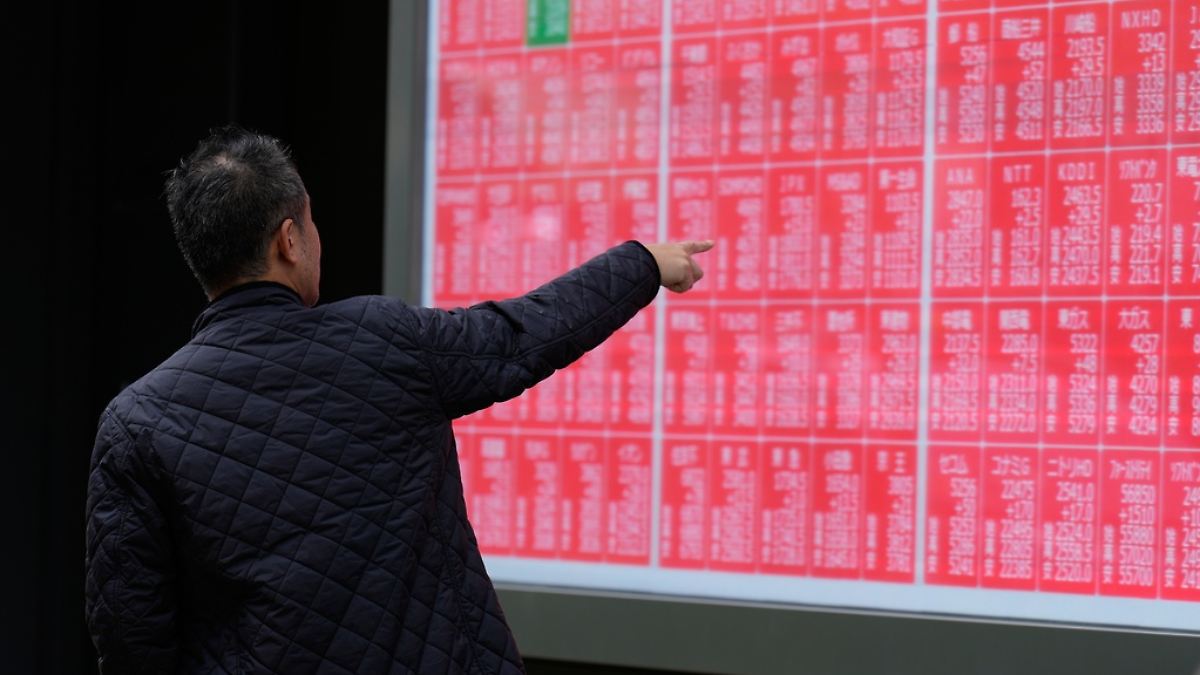
Optimism about the artificial intelligence (AI) business and the prospect of a reduction in US tariffs are shaping the Asian stock markets. In Tokyo, the export-oriented Nikkei index, which comprises 225 stocks, rose by 2% to 51,222 points. By contrast, the broader Topix was down 0.1 percent at 3,282 points.
On the Japanese market, shares in chip equipment manufacturer Advantest shot up by more than 20 percent after the company raised its profit forecast. Shares related to chip giant Nvidia also rose in China.
The Shanghai stock exchange gained 0.4 percent to 4002 points and the index of the most important companies in Shanghai and Shenzhen rose by 0.5 percent to 4714 points. The Hong Kong stock exchange is closed for a public holiday. The South Korean Kospi index reaches a new record high, boosted by strong figures from chip manufacturer SK Hynix.
www.n-tv.deAdvantest-Aktienkurs geht durch die Decke
1010
5 Comentários•
11
•Títulos em alta
Principais criadores desta semana
Dados tempo real da LSX · Dados financeiros e EOD da FactSet