
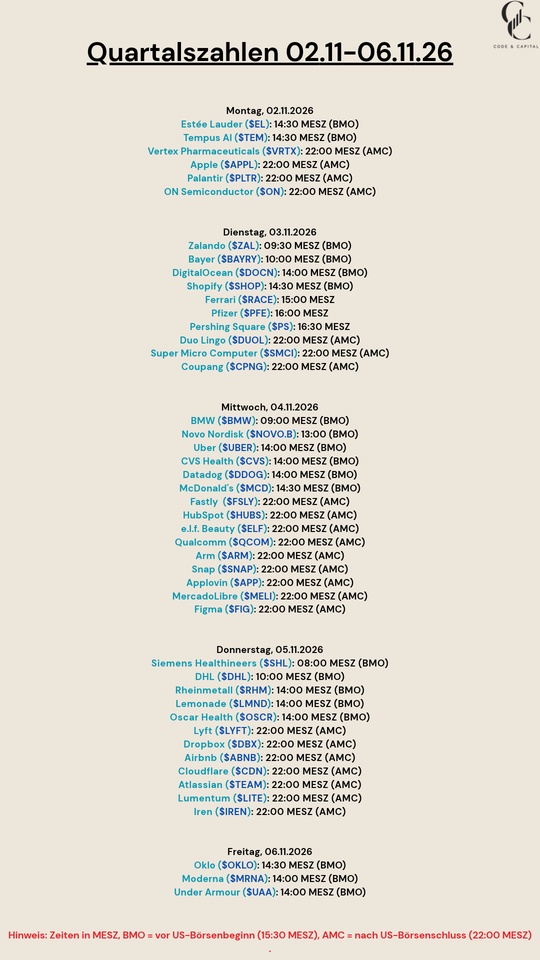
$EL (-0,38%)
$TEM (-1,79%)
$VRTX (+0,42%)
$AAPL (+0,3%)
$PLTR (-1,79%)
$ON (-2,5%)
$ZAL (+3,11%)
$BAYN (+3,09%)
$DOCN (-1,35%)
$SHOP (-1,67%)
$RACE (-1,22%)
$PFE (+0,69%)
$PS (+1,56%)
$DUOL
$SMCI (-2,34%)
$CPNG (-0,6%)
$BMW (+0,28%)
$NOVO B (-1,02%)
$UBER (+0,93%)
$CVS (+0,15%)
$DDOG (-2,19%)
$MCD (+0,89%)
$FSLY (+3,65%)
$HUBS (-3,67%)
$ELF (+0,52%)
$QCOM (-5,56%)
$ARM (-2,37%)
$SNAP (-2,68%)
$APP (-3,01%)
$MELI (-4,34%)
$FIG (+3,88%)
$SHL (-2,08%)
$DHL (-0,79%)
$RHM (-11,22%)
$LMND (+0,05%)
$OSCR (-0,32%)
$LYFT (-0,45%)
$DBX (-0,58%)
$ABNB (-0,38%)
$NET (-3,21%)
$TEAM (-0,48%)
$LITE (-2,64%)
$IREN (-2,36%)
$OKLO
$MRNA (-0,64%)
$UAA (-1,26%)

Siemens Healthineers
Ação
Ação
ISIN: DE000SHL1006
Ticker: SHL
DE000SHL1006
SHL
Price
Discussão sobre SHL
Postos
524D·
Quarterly Results Nov. 2–Nov. 6, 26
1212

2Mês·
The “One Trillion Thesis” for Siemens
Today’s newsletter from “WELT | Alles auf Aktien” presents a bold thesis $SIE (+0,18%) that I’d like to share and quote here.
The authors put forward the bold thesis that Siemens is capable of joining the “trillion-Club” in the foreseeable future. That would be nearly five times its current value. While there’s still a long way to go, Siemens is already Germany’s most valuable publicly traded company. And in a few weeks, a decision could be made that will help determine whether this long-established industrial conglomerate will indeed one day become a global tech champion of this magnitude.
On October 1, Siemens plans to officially present itself as “One Tech Company.” From that moment on, CEO Roland Busch will massively ramp up his big bet on AI. Is now the right time to get on board?
Siemens underwent a radical transformation under Joe Kaeser. Siemens Energy
$ENR (+0,34%) and Siemens Healthineers
$SHL (-2,08%) were spun off. This met with fierce resistance at the time. Today, one can at least say that the remaining group is performing exceptionally well. Siemens posted a record profit of more than ten billion euros and margins exceeding 17 percent.
Siemens CEO Roland Busch now aims to build on this success. His program is called “One Tech Company.” The three major divisions—Digital Industries, Smart Infrastructure, and Mobility—will remain in place. Under this structure, Siemens aims to become leaner: less hierarchy, larger units, and clearer responsibilities.
The real stock market story is artificial intelligence (AI). Siemens aims to make industrial AI the connecting element of the group. Siemens operates where AI meets the real world: in factories, power grids, buildings, and infrastructure. It’s about machines that produce more efficiently, grids that are controlled more intelligently, and factories that operate with greater automation.
Our bullish thesis is therefore this: Siemens could increasingly evolve from a traditional industrial conglomerate into a technology and software company. That would also be decisive for its valuation. Industrial companies typically receive lower multiples on the stock market than tech conglomerates.
If Siemens proves that software, data, and AI can be monetized at scale, the market could eventually grant the company a higher valuation. This represents a potential path to a trillion. The catch: there is no such proof yet.
That is the central weakness of the narrative. Siemens still talks a lot about industrial AI, but does not report separately how much revenue and order intake it actually generates from it. So investors do not yet know exactly through what mechanism AI increases profits.
That is precisely why October 1 is so important. On that day, Busch must explain whether “One Tech Company” is more than just a new corporate slide and how it will specifically lead to more growth, higher margins, and stronger customer loyalty.
Even if the AI strategy pays off, there’s still a risk that Siemens has become more dependent on the AI cycle than one might assume at first glance. Data centers, semiconductors, electrification, and automation are all driven by the same investment boom. Should the AI euphoria fizzle out, it could hit several of Siemens’ businesses at once.
With medical technology and energy, Siemens has divested two stabilizing pillars. Siemens Energy, in particular, has since become a star on the German stock market. The works council openly states that Siemens would be even more valuable today if it still owned Siemens Energy and Siemens Healthineers. On the other hand, the record margins might not have been possible at all without this focus.
For investors, it’s the future that counts. Siemens must maintain high growth and margins; the restructuring must actually make everything more efficient; and the company must demonstrate that AI works not only technologically but also financially. To that end, concrete results must be evident by October 1.
If it succeeds, Siemens could become a European industrial conglomerate with an increasingly technology-driven valuation.
Source: WELT | Alles auf Aktien, August 19, 2026
2626
1 Comentar
H.S.@financial_ninja
2Mês
•
11
•
2Mês·
Welcome to the Darkside
July 2026 Review
📊 Performance & Markets
🏆 Hot Factor Favorite: $NVDA (-1,16%)
👑 King Midas Factor: $CRM (+1,12%)
💶 1 Swiss franc traded at 1.06 euros.
₿ Crypto & Alternative Investments
Crypto savings plans are underway
There were no new purchases or sales at Timeless; Timeless is now planning to launch a tradable product for the general public. There’s also no news regarding NFTs and music rights.
🍷 Winery
No news.
📈 Individual Stocks, ETFs & Savings Plans
🟢 Buy: Individual stocks on hold until November
🔴 Sale: $SHL (-2,08%)
, $BAS (+1,57%)
🏅 Top of the Month: $BTO (+3,78%)
📉 Flop of the Month: $LIFT (+0,53%)
🚀 Crowdcube & Startups
I’m thinking about buying shares in Lemonaid through the GLS Crowd platform.
🧠 Nao
My savings plans are still on track.
🌴 Personal Recap
I actually won some travel credit in the CHECK24 prediction game and a 10-franc gift card from Kickstr. Unfortunately, starting with the quarterfinals, practically all my predictions were wrong.
I still don’t have a new smartphone, and the special payment hasn’t been made yet either.
Berlin, on the other hand, was absolutely amazing—the Finch concert was truly a world of its own.
Right now, I’m thinking about placing a bet on the price of coffee. I’m also very happy that my $NA9 (-0,19%) stock is being acquired.
I went to a rum and meat tasting with a very good friend. It was incredibly delicious, and with the heat, the rum really went to my head.
Through an acquaintance I met there, I learned that the owner isn’t averse to investments. That’s why I had the idea to combine a finance get-together with a tasting. Would you book something like that?
To my great delight, I’m getting a refund of about €11,000 from the tax office. I haven’t decided yet what I’ll do with it or how I’ll use the money, though.
Unitplus is going as planned.
🎙️ Podcast Season 3, Episode 1 has launched. Topic: Financial Goals.
🔮 Outlook for August
Various events at work. Family visiting. Another 10 days of vacation starting at the end of August
How about you? How was your July?
If you’d like to learn more, feel free to follow me. And if you don’t like my investments: The block feature still works great. 😄



3Mês·
Hits & Misses
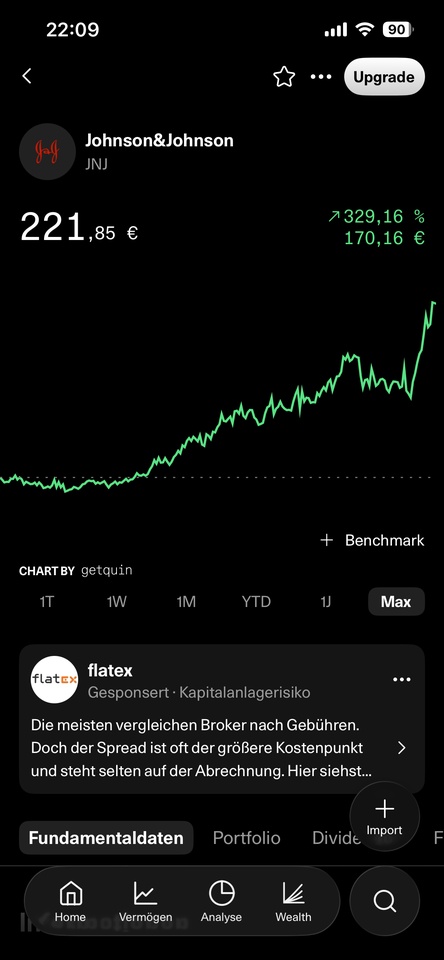
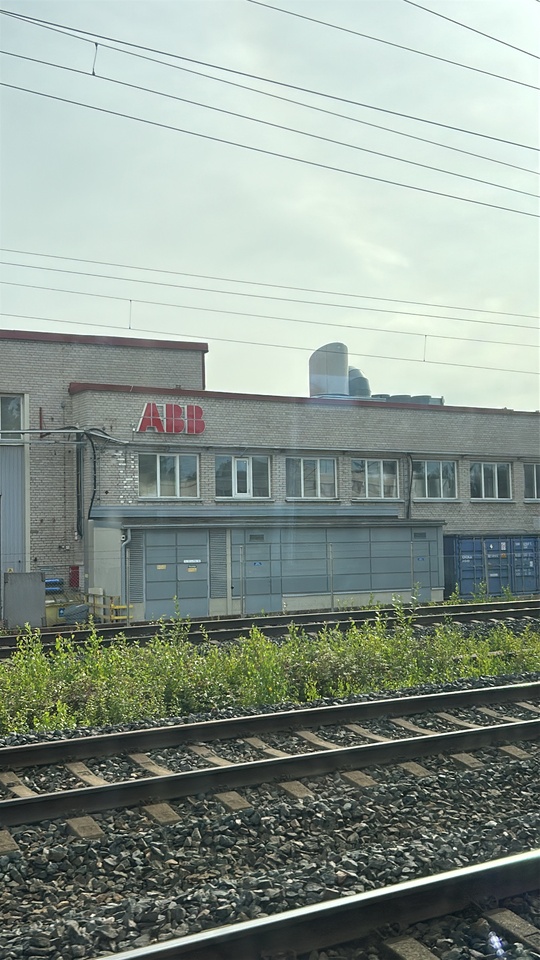
I'm on vacation again—this time in Helsinki—and, of course, I'm keeping an eye out for the companies I come across. One that really stood out was $ABBN (-1,17%) . The factory buildings look a bit like Autoteile Unger. Hard to believe that these are—or will be—the AI robotics winners of the coming years. But it doesn’t have to look pretty; all that matters is the money being made. Congratulations to whoever got in early here.
$JNJ (+0,68%) A classic
and
$RMD (+0,09%) also worth considering
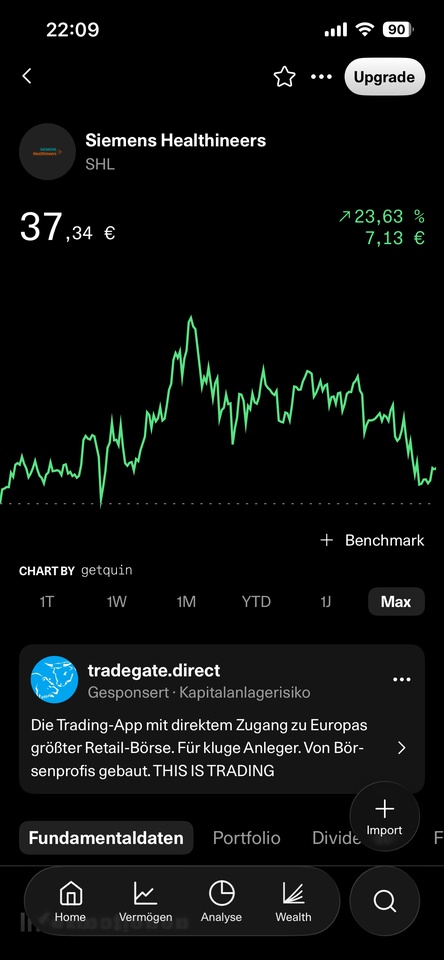
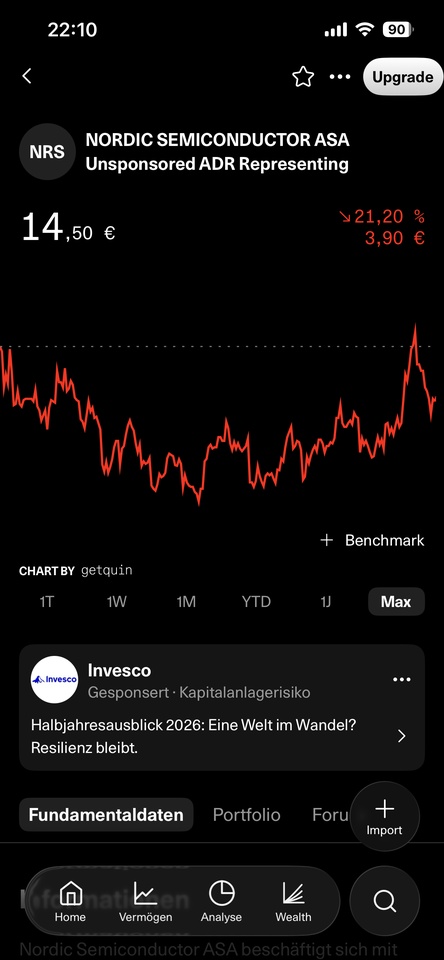
Not so great so far: Nordic Semi and $SHL (-2,08%)
edit: of course, I $CELH forgot that one.
+ 5
1313

4Mês·
We'd like to hear your opinion
Hello, everyone,
In my portfolio, I'm investing in, among other things, the $DBXD (-0,28%) with a position of just under 13,000 euros and $ISAC (-0,31%) with a holding of just under 3,500 euros.
I’ve had $SIE (+0,18%) shares in my portfolio that have yielded a gain of just under 123% and are currently worth 6,000 euros. I’m no longer adding to these, and they’re just sitting there :-)
When I look at the position sizes in the DAX ETF, Siemens has the highest weighting there, so I’m considering selling my Siemens shares and putting the entire amount into the $ISAC (-0,31%) .
On the other hand, there’s still the matter of the possible spin-off of $SHL (-2,08%) and the potential distribution of free shares to Siemens shareholders—which I’d still like to be a part of.
What do you guys think: should I just let things run their course—the ETFs are topped up monthly anyway—or should I sell the Siemens shares, forgo the annual 150-euro dividend, and put the money into the $ISAC (-0,31%) ?
22
8 Comentários
4Mês
•
33
•
5Mês·
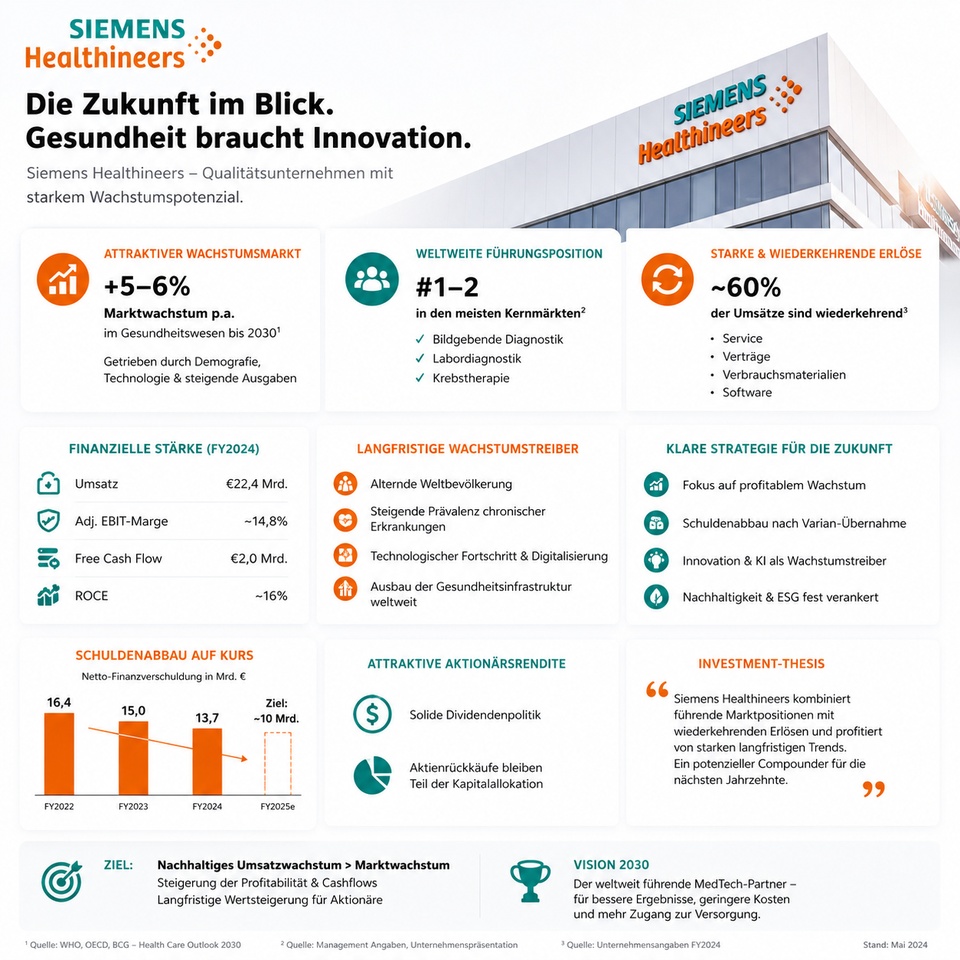
Siemens Healthineers - A potential compounder for the next 20 years
When I analyze Siemens Healthineers $SHL (-2,08%) I am not interested in the next quarterly figures, but in the question:
Will the company earn more in 10 to 20 years than it does today?
The figures speak for themselves.
Market position
- Global leader in MRI and CT
- Over 70,000 systems installed worldwide
- Customers are mainly hospitals, university clinics and laboratories
- High regulatory hurdles and switching costs
Business quality
- Turnover 2025: around € 22 billion
- Adjusted EBIT margin: around 15%
- Free cash flow: around € 2 billion
- Billions in sales from service, maintenance, software and consumables
A hospital does not replace an MRI system like a laptop. Devices often remain in use for 10-15 years and generate recurring revenue over their lifetime.
The moat
- High acquisition costs
- Long-term service contracts
- Trained personnel
- Regulatory approvals
- Integration into hospital processes
It is precisely factors like these that ensure that market leaders can defend their position for decades.
The tailwind
By 2050, the number of people over the age of 60 worldwide will increase to over 2 billion.
More older people means
- more diagnostics
- more cancer treatments
- more cardiovascular diseases
- more imaging procedures
Health expenditure is rising faster than GDP almost everywhere.
Varian takeover
Many investors focus on the debt.
I focus on the strategic position:
Today, Siemens Healthineers earns money not only from diagnosing cancer, but increasingly also from treating it.
This considerably expands the addressable market.
The crucial question
If Siemens Healthineers generates sales of around €22 billion today and healthcare spending continues to rise worldwide in the coming decades:
How likely is it that the company will be worth less in 2035 than it is today?
For me, Siemens Healthineers is not a speculative stock.
It is a quality company with:
Exactly the kind of company that often creates more value in the long term than most market participants expect.
- strong moat
- structural growth
- recurring revenues
- high return on capital
- global market leadership
1414
2 Comentários
Please mark $SHL 😉
Siemens Healthineers is a solid MedTech company. But I prefer Stryker $SYK, where I would like to get in slowly. They have higher margins (over 20% instead of 15%), a similar return on equity, but Stryker's free cash flow is growing at double-digit rates per year. I think the combination of efficiency and growth is even better, but Stryker is also valued at a permanently high P/E ratio. But it is already lower than usual;)
Siemens Healthineers is a solid MedTech company. But I prefer Stryker $SYK, where I would like to get in slowly. They have higher margins (over 20% instead of 15%), a similar return on equity, but Stryker's free cash flow is growing at double-digit rates per year. I think the combination of efficiency and growth is even better, but Stryker is also valued at a permanently high P/E ratio. But it is already lower than usual;)
•
22
•
5Mês·
Next Milestone Reached
On this occasion - a strong last few weeks for my portfolio.
Target 1: €350,000 in 2026
Target 2: €400,000 in 2026
Below is an overview of the savings plans.
(Let's see how long I can maintain them in this form. A few costly events are on the horizon 😌)
$HMWO (-0,14%) 1.000€
$IUIT (-0,79%) 1.000€
$TDIV (+0,08%) 1.000€
$SHL (-2,08%) 250€
$MUV2 (+0,84%) 250€
Now my current thoughts - feel free to give your opinions. Maybe they'll help me to sort things out 😉.
1) My portfolio is tech-heavy. As a result, I'm wondering whether now would be the right time to take a few chips off the table.
This means, for example, selling the $XAIX (-0,57%) and put them in the $TDIV (+0,08%) for example.
2) $LVMH and $PG (+0,57%) )
I don't know... I don't see much chance of an improvement in the near future. I'm quite heavily in the red. Would rather put the money in an ETF to reduce the individual share positions. The only question is whether I should "speculate" on a bounce and then sell or hold for the long term. Difficult.
3) Savings plan $MUV2 (+0,84%)
The share cools down a little. Is it possible to cancel the savings plan here in order to do something good for the call money again?
The share is doing... Badly.
Savings plan is running because of an employee program.
It should be checked whether the program pays off at all given the performance.
The remaining positions, i.e. $GOOGL (-0,2%) , $AMZN (+0,76%) , $BLK (+0,69%) , $KO (+0,64%) , $MCD (+0,89%) , $RKLB (-1,28%) , $V (+0,67%)
I tend to leave them untouched. Maybe take a few profits now and then to benefit from the brutal rise in some shares - but it will remain within reasonable bounds.
Thanks for reading 😉
Feel free to give feedback.
Also on other points that you think need attention.
Have a great weekend!
17Posições
€ 361.573,67
32,87%
2323
7 Comentários
Very nice savings rate! 😄
•
22
•
7Mês·
Strong dividend season ahead💶
15 increases
13 unchanged
7 decreases
Insurance
Banks
Utilities
Auto stocks
Tap here if you like to collect dividends: https://shorturl.at/83W8R
$MBG (+0,33%)
$ALV (+0,58%)
$VOW3 (+1,09%)
$MUV2 (+0,84%)
$BMW (+0,28%)
$AIR (+0,8%)
$CBK (-3,05%)
$523232
$DTG (+1,3%)
$DHL (-0,79%)
$FME (-0,01%)
$FRE (+0,18%)
$HNR1 (+0,8%)
$MTX (+2,39%)
$RHM (-11,22%)
$SAP (+1,85%)
$ENR (+0,34%)
$BAS (+1,57%)
$BAYN (+3,09%)
$BEI (-1,62%)
$DBK (+1,89%)
$DTE (-2,7%)
$EOAN (+1,07%)
$GEA (-1,42%)
$IFX (-2,78%)
$RWE (+0,56%)
$SY1 (+0,16%)
$ZAL (+3,11%)
$ADS (+1,35%)
$BNR (-0,38%)
$HEN (+0,07%)
$MRK (+1,94%)
$SIE (+0,18%)
$SHL (-2,08%)

8Mês·
Germany's most valuable group is also top for shareholders
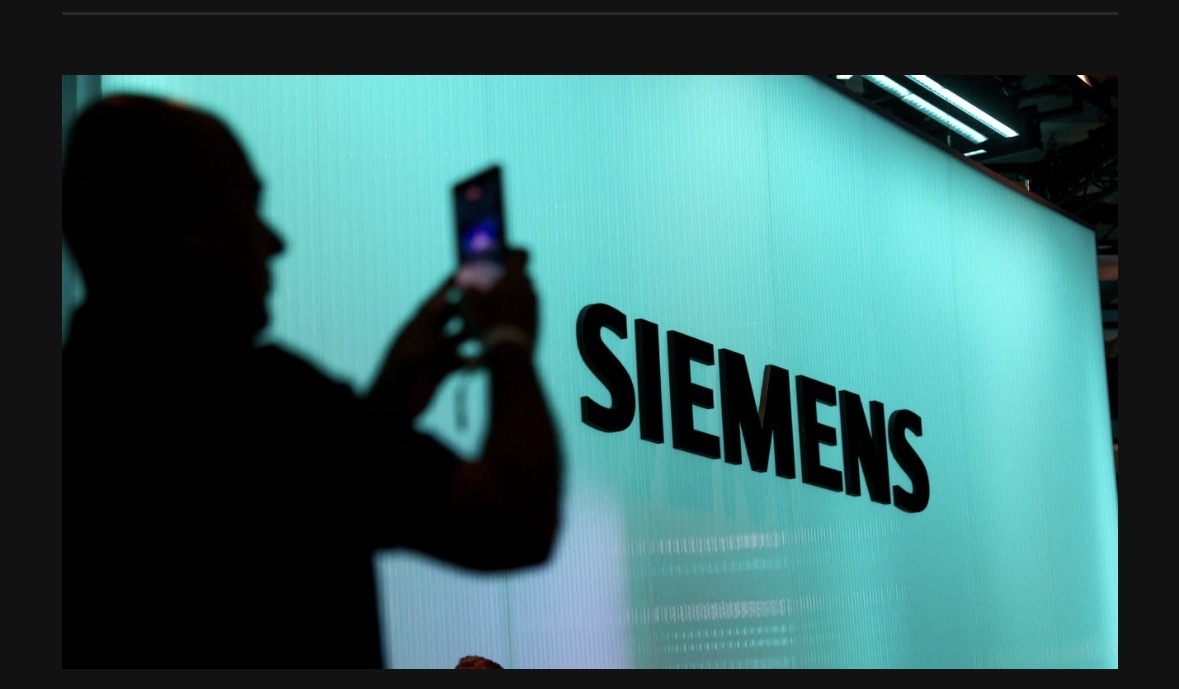
Last week, Siemens was $SIE (+0,18%) had overtaken SAP $SAP (+1,85%) then SAP was ahead again on Thursday. The two companies are currently on an equal footing with a market capitalization of around 200 billion euros each.
In the 38-year history of the Dax, which was launched on July 1, 1988, no other company has been at the top as often as Siemens, according to Handelsblatt calculations. One of the Munich-based company's recipes for success is reliability in the form of steadily rising earnings and dividends. Added to this is the ability to constantly adapt to industrial developments.
Ten of the current 40 DAX companies have been represented in the selection index, which originally only included 30 stocks, from the very beginning: Allianz, BASF, Bayer, BMW, Deutsche Bank, Henkel, Mercedes-Benz (then still under the name Daimler-Benz), RWE, Volkswagen and Siemens.
According to calculations by the Handelsblatt Research Institute, Siemens shares have performed best among these Dax veterans, with a price increase of almost 2300 percent. Anyone who has held the share since the Dax was founded has achieved an average price gain of 8.7 percent per year.
This does not include the many dividends paid to shareholders. Siemens shares have risen by around 5,850 percent when price gains and dividends are added together. This results in an average annual return of 11.3 percent.
No share that has been listed on the Dax since the beginning has performed better. By way of comparison, the Dax as a whole, including all dividends, has achieved an average annual return of 8.8 percent since its inception.
This Siemens return does not even take into account a particularly rewarding transaction for investors. Anyone who held Siemens shares at the end of September 2020 automatically received one Siemens Energy share free of charge for every two shares held. $ENR (+0,34%) booked into the securities account.
With this step, Siemens spun off its power plant division. The new shares ended the first trading day on September 28, 2020 at €21.21 each. One share currently costs 153 euros. This corresponds to an increase of 621 percent in just five and a half years.
Siemens shareholders will soon receive another substantial bonus. After its power plant business, Siemens is spinning off its medical division. This is already listed on the stock exchange under the name Siemens Healthineers $SHL (-2,08%) and is also listed on the Dax. However, Siemens currently holds around 67 percent of the shares.
This means that Healthineers is still fully consolidated in Siemens' balance sheet, i.e. Siemens recognizes the profits in its balance sheet. This will soon change, as 30 percent of Healthineers shares are to go to Siemens shareholders in a direct spin-off. They are to receive the new shares in their securities account, similar to Siemens Energy. What the distribution ratio will look like is still open.
With this deconsolidation of the medical technology unit, which has been listed on the stock exchange since 2018, the Siemens Group will lose almost a third of its sales, and the spin-off will also leave its mark on profits. For the current fiscal year, analysts are forecasting an average net profit of €8.1 billion for Siemens, compared to €9.6 billion last year. The reason for this is the loss of Healthineers.
Nevertheless, this strategy makes sense from an investor's point of view, as Siemens' priority is to grow faster and become more profitable. This shareholder-friendly focus is the reason why there are more and more different shares in the Siemens family.
Infineon $IFX (-2,78%) is one of them, as Siemens floated its semiconductor division on the stock market back in 2000. There are now four Siemens shares in the Dax.
One reason for the many buy recommendations by analysts (currently: 21 buy | 4 hold | 4 sell) for Siemens is, in addition to the ambitious, but compared to its competitors, more favorable valuation, the profit sharing for shareholders. The Managing Board intends to increase the dividend from €5.20 to €5.35 for the past fiscal year, which at Siemens ended on September 30, 2025. This is the fifth increase in a row. The dividend has more than tripled since 2010.
At 2.1%, the dividend yield is rather low by historical standards. In the last 20 years, there has almost always been at least three percent to be had. However, the lower yield is by no means the result of slower rising, let alone falling, dividends, but solely due to the enormous increase in the share price. Over the past three years, the share price has risen by 80 percent.
The dividends have not been able to keep up with this rapid development. As a result, the dividend yield for new entrants has fallen. However, this is not a real problem in view of the sharp rise in the share price.
Source text (excerpt) & image: Handelsblatt, 05.02.2026
3434
9Mês·
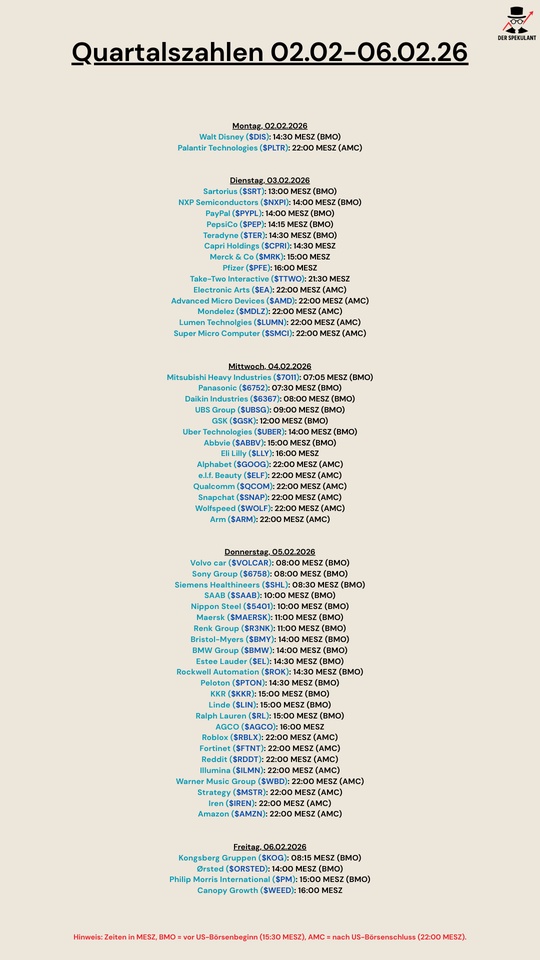
Quarterly figures 02.02-06.02.26
$DIS (+0,45%)
$PLTR (-1,79%)
$SRT (+1,54%)
$NXPI (-1%)
$PYPL (-0,25%)
$PEP (+0,85%)
$TER (-3,42%)
$CPRI (+0,45%)
$MRK (+1,94%)
$PFE (+0,69%)
$TTWO (+0,56%)
$EA
$AMD (-3,24%)
$MDLZ (+0,44%)
$LUMN (-0,44%)
$SMCI (-2,34%)
$7011 (-5,88%)
$6752 (-10,67%)
$6367 (+0,96%)
$UBSG (-0,75%)
$GSK (-0,24%)
$UBER (+0,93%)
$ABBV (+1,36%)
$LLY (+0,8%)
$GOOG (-0,16%)
$ELF (+0,52%)
$QCOM (-5,56%)
$SNAP (-2,68%)
$WOLF (-1,29%)
$ARM (-2,37%)
$VOLCAR B (+0,14%)
$6758 (+5,38%)
$SHL (-2,08%)
$SAAB B (-1,55%)
$5401 (+3,23%)
$MAERSK A (-8,43%)
$R3NK (-5,12%)
$BMY (+1,81%)
$BMW (+0,28%)
$EL (-0,38%)
$ROK (+0,34%)
$PTON (-1,33%)
$KKR (+0,47%)
$LIN (+0,54%)
$RL (-0,46%)
$AGCO (+0,37%)
$RBLX (-0,23%)
$FTNT (-1,49%)
$REDDIT
$ILMN (+0,25%)
$WMG (-1,25%)
$IREN (-2,36%)
$MSTR (-0,32%)
$AMZN (+0,76%)
$KOG (-2,94%)
$ORSTED (+4,32%)
$PM (+0,38%)
$WEED (+4,08%)
1919
4 Comentários
In the current situation, the figures are still exciting. Let's see where the journey takes us.
•
22
•Títulos em alta
Principais criadores desta semana
Dados tempo real da LSX · Dados financeiros e EOD da FactSet