What are the current key metrics for the Telekom stock?
The Telekom stock is trading at 24.68 EUR with a 2026e P/E ratio of approximately 11.2, adjusted earnings per share of 0.58 EUR in the second quarter, and a dividend yield of approximately 4.0%.
Key FigureValueDate
Price (XETRA: DTE), closing price
24.68 EUR (−8.0% for the day)
Oct. 9, 2026
52-week high
34.35 EUR
Feb. 2026
52-Week Low
23.54 EUR
June 30, 2026
Distance from 52-Week High
approx. −28%
Oct. 9, 2026
Distance from 52-Week Low
approx. +5%
Oct. 9, 2026
Market Capitalization
approx. 118 billion EUR
Oct. 9, 2026
Revenue Q2 2026
29.9 billion EUR (+4.4%)
August 6, 2026
Adjusted EBITDA AL Q2 2026
11.8 billion EUR (+7.5%)
August 6, 2026
Adjusted Free Cash Flow Q2 2026
5.0 billion EUR (+3.1%)
August 6, 2026
Adjusted Earnings Per Share Q2 2026
0.58 EUR (+12.7%)
August 6, 2026
Consolidated Net Income Q2 2026
2.45 billion EUR (−6.3%)
August 6, 2026
2026 Forecast
Adjusted EBITDA approx. 47.5 billion EUR, Adjusted Free Cash Flow approx. 20.0 billion EUR (raised), Adjusted EPS approx. 2.20 EUR
August 6, 2026
P/E Ratio 2026e (Based on: EPS target of EUR 2.20, our own calculations)
approx. 11.2
October 9, 2026
Net financial liabilities, including leases
EUR 138.4 billion (+9.4% year-over-year)
June 30, 2026
2025 dividend / yield
EUR 1.00 (+11%) / approx. 4.0%
Oct. 9, 2026
Share buyback 2026
up to EUR 2 billion
Feb. 2026
Stake in T-Mobile US
54.2%
June 30, 2026
Analyst Ratings (finanzen.net)
8 firms: 7 Buy, 1 Hold, 0 Sell
Oct. 9, 2026
Average Price Target (7 targets, own calculation)
34.13 EUR (range 27.50–40.00 EUR), approx. +38%
Oct. 9, 2026
WKN / ISIN / Ticker
555750 / DE0005557508 / DTE
—
Next Report (Q3)
November 5, 2026
—
What news is currently driving the Telekom stock?
The most important news regarding the Telekom stock from the past few weeks at a glance:
Date | News | Details | Assessment
November 5, 2026
Next Event: Third-Quarter Results
Telekom will release its Q3 results on November 5. The focus will be on free cash flow, customer growth at T-Mobile US, and statements regarding the competitive landscape.
Watch
October 9, 2026
Share Price Plunge: Telekom Closes Down 8.0%
The stock falls to 24.68 EUR, its lowest level since early July. T-Mobile US loses about 12%, while AT&T and Verizon drop about 10%. European telecom stocks such as Orange, Telefónica, Vodafone, and BT also decline, while cell tower operators rise.
Alert
October 8, 2026
SpaceX purchases 800 MHz spectrum from Grain Management
Up to 14 MHz of paired spectrum that Grain had received from T-Mobile US in August (in exchange for cash and 600 MHz spectrum). The price has not been disclosed; the FCC must approve the deal. Musk calls it the final, crucial piece of the puzzle for a nationwide network. That same week, the FCC approves up to 15,000 additional Starlink satellites.
Bearish
Oct. 5–7, 2026
Analysts Confirm “Buy” Ratings Ahead of the Shock
Goldman Sachs lowers its price target from 40 to 38 EUR (Buy); Deutsche Bank sets it at 40 EUR (Buy); UBS at 35.10 EUR (Buy). These ratings were issued before the October 9 price plunge.
Bullish
October 5, 2026
AI Investor Day in Bonn
Telekom demonstrates how AI is expected to boost growth, efficiency, and quality. The event page does not provide specific figures on AI revenue or cost savings.
Watch
September 25, 2026
Bernstein downgrades to Market Perform
Price target lowered from 37 to 28.10 EUR. A merger with T-Mobile US would make strategic sense, but the benefits depend on price, financing, and corporate structure.
Bearish
September 2, 2026
Report: Elliott takes a stake in Telekom
According to reports, Elliott is demanding that the company abandon a merger with T-Mobile US (reported value of approximately $300 billion) and undertake larger share buybacks. No official statement was available.
Watch
August 6, 2026
Q2 Results: Free Cash Flow Outlook Raised
Revenue: EUR 29.9 billion (+4.4%), adjusted EBITDA AL: EUR 11.8 billion (+7.5%), adjusted EPS: EUR 0.58 (+12.7%). The free cash flow outlook rises to approximately 20.0 billion EUR, following an adjustment at T-Mobile US. Net income −6.3%, net debt 138.4 billion EUR.
Very bullish
July 3, 2026
Starlink concerns weigh on the stock
The stock falls to 24.89 EUR; UBS warns of a risk from satellite internet that is barely priced in. On June 30, the stock hit a 52-week low of 23.54 EUR.
Bearish
What does Deutsche Telekom do—and how does it make its money?
Company Description
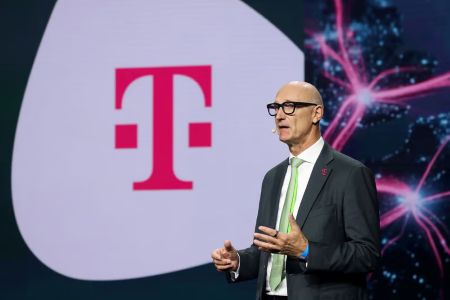
Deutsche Deutsche Telekom (ISIN: DE0005557508, WKN: 555750) is headquartered in Bonn and led by CEO Tim Höttges. The German federal government is the largest single shareholder, holding 28.6% as of the end of June, including KfW. The business is divided into four segments. In the second quarter of 2026, the group generated revenue of 29.9 billion EUR and adjusted EBITDA AL of 11.8 billion EUR.
The four segments—and how Telekom specifically generates revenue:
U.S. (T-Mobile US): Mobile services for residential and business customers. In the second quarter, service revenue totaled $19.0 billion (+8.9%), and adjusted EBITDA AL was $9.3 billion (+12.1%), with 34.7 million postpaid accounts. Telekom holds a 54.2% stake and is thus directly affected by competition in the U.S.—which is precisely where SpaceX is making its move. Germany: Mobile, landline, broadband, and fiber-optic services. In the first quarter, the segment generated EUR 6.3 billion in revenue; over 13 million households can be connected to the fiber-optic network, and the FTTH penetration rate rose to 17.1%. In the second quarter, Telekom lost approximately 20,000 customers in its broadband business. Europe: Mobile, landline, and TV services in the European subsidiaries, with revenue of EUR 3.1 billion and EBITDA of EUR 1.2 billion in the first quarter. ALT-Systems: IT and digitalization solutions for business customers, with first-quarter revenue of EUR 1.0 billion and order intake of EUR 994 million
Fundamental Analysis: How Much of a Threat Is SpaceX Really to Telekom?
Fundamental Analysis of Telekom Stock (as of October 12, 2026)
Minimal in the short term, but not off the table in the long term: According to Bernstein, the spectrum purchase does not oblige SpaceX to build a nationwide network, and JPMorgan sees only limited short-term risk due to time, infrastructure, and capital requirements. Nevertheless, the market reaction shows that investors are pricing in a new competitor in the U.S. market.
Here’s what the deal entails: SpaceX is purchasing Grain Management’s nationwide 800 MHz portfolio, consisting of up to 14 MHz of paired spectrum. Grain had acquired it from T-Mobile US in August in exchange for cash and 600 MHz spectrum. The price has not been disclosed, and the FCC must approve the deal. At the same time, the FCC approved up to 15,000 next-generation Starlink satellites that same week. Meanwhile, T-Mobile US is collaborating with Starlink on satellite messaging via T-Satellite; that partner is now becoming a potential competitor.
Valuation and Debt: Based on the adjusted EPS target of approximately 2.20 EUR, the P/E ratio stands at around 11.2. This is low, but for telecom stocks, it is often the price paid for high debt: Net financial liabilities, including leases, rose to EUR 138.4 billion (+9.4% year-over-year). Consolidated net income fell by 6.3% to EUR 2.45 billion in the second quarter, partly because one-time items were excluded from adjusted earnings.
Cash Flow and Dividends: Adjusted free cash flow (AL) stood at EUR 5.0 billion in the second quarter (+3.1%); Telekom expects approximately EUR 20.0 billion for 2026. The dividend for 2025 is 1.00 EUR (+11%); the share buyback program for 2026 amounts to up to 2 billion EUR. Investors looking at the dividend will also find Münchener Rück Aktie a dividend play following a pullback.
Corporate Structure: According to reports, Telekom is exploring a closer alliance with T-Mobile US. Bernstein considers this strategically sound but downgraded the stock to “Market Perform” at the end of September and lowered the price target from 37 to 28.10 EUR because the price, financing, and structure remain unresolved. According to reports, Elliott opposes a merger and is calling for larger buybacks.
AI as a Lever: On October 5, Telekom demonstrated at its AI Investor Day in Bonn how AI is expected to drive growth and efficiency. My analysis of how the stock market evaluates AI-related stories is available at SAP Aktie.
Telekom Stock Price Targets and Forecast for 2026
How is the Telekom stock price performing? (As of October 12, 2026)
According to finanzen.net, the average price targets for Telekom stock are 34.13 EUR (our own calculation based on seven targets, ranging from 27.50 to 40.00 EUR), about 38% above the current price of 24.68 EUR, and 7 out of 8 brokerages recommend buying. Timing is key: Most of these targets were set before the SpaceX shock. Deutsche Bank cites 40.00 EUR (Buy, Oct. 6), Goldman Sachs 38.00 EUR (Buy, lowered from 40.00 EUR on Oct. 5), Berenberg at 35.20 EUR (Buy, Oct. 1), UBS at 35.10 EUR (Buy, Oct. 7), and Barclays at 35.00 EUR (Overweight, Sept. 3). Bernstein (Market Perform, 28.10 EUR) and JPMorgan (Overweight, 27.50 EUR, Sept. 3) are more cautious. You can also see just how widely price targets can vary with Porsche Aktie.
Key price levels:
52-week high: 34.35 EUR (February 2026)Current price: 24.68 EUR (closing price on Oct. 9, 2026, daily low of 24.61 EUR)First resistance level: approx. 25.30 EUR (closing price on July 2, upper end of the July range)Second resistance: approx. 26.15 EUR (closing price on July 10) to 26.88 EUR (price on September 25, shortly before the crash)Third resistance level: approx. 28.77 EUR (September high on September 2)Year-to-date low: 23.54 EUR (June 30, 2026), only about 5% below the current priceAnalysts’ price targets: Average 34.13 EUR, Deutsche Bank 40.00 EUR, Goldman Sachs: 38.00 EUR, Berenberg: 35.20 EUR, UBS: 35.10 EUR, Barclays: 35.00 EUR, Bernstein: 28.10 EUR, JPMorgan: 27.50 EUR Critical support level: Closing prices below the yearly low of 23.54 EUR would mark a new 52-week low if there is no technical support below that level; prior to that, the daily low from October 9 (24.61 EUR) serves as the final support level
Chart Analysis
The price action shows how quickly the picture has changed: From the 52-week high of 34.35 EUR in February, the stock fell to the yearly low of 23.54 EUR on June 30, recovered to 28.77 EUR by early September (September 2) and then slipped back to EUR 24.68 following the SpaceX shock. The annual low of 23.54 EUR is only about 5% below that level. The outlook for 2026 hinges on the Q3 results on November 5 and the FCC’s decision on the spectrum deal.
I can well imagine that the Telekom stock will turn upward again around 23.50 EUR, even if only as high as 26.50 EUR. Beyond that, a potential rise to 29.50 EUR is even possible. Overall, however, the stock remains under pressure. If it fails to hold at 23.50 EUR, another wave of selling is likely.
Conclusion: Should you buy Telekom stock after the SpaceX shock, or wait and see?
My assessment: Wait and see
Should you buy Telekom after the SpaceX shock? The shock is real on the stock market, but has not yet materialized in the company’s operations: Adjusted EBITDA AL is growing, the free cash flow outlook has been raised, the dividend yield is approximately 4.0%, and 7 out of 8 analysts recommend buying. The shock will only become lasting if SpaceX actually turns the spectrum into a network and customers start leaving T-Mobile US. Just how quickly a single trigger can turn an entire stock around is demonstrated by Hensoldt Aktie: All it took was a single cautious statement from management; at Telekom, a report about a spectrum purchase was enough.
Those who believe in the company’s fundamentals will find a price of 24.68 EUR—about 28% below the high—an average analyst target of 34.13 EUR, and a dividend yield of approximately 4.0%. Those who remain cautious will wait for the earnings report on November 5 and the FCC decision, and watch to see if the price holds the yearly low of 23.54 EUR.
✅ Opportunities
⚠️ Risks
- Average price target: 34.13 EUR — about 38% upside potential; Deutsche Bank at 40.00 EUR
- 7 out of 8 brokerages recommend buying; none recommend selling
- Free cash flow outlook for 2026 raised to approximately EUR 20.0 billion; adjusted EBITDA up 7.5% in Q2
- Dividend of 1.00 EUR (yield approx. 4.0%) and share buyback of up to 2 billion EUR in 2026
- T-Mobile US is growing: service revenue +8.9%, adjusted EBITDA +12.1% in the second quarter
- JPMorgan sees only limited short-term risk from SpaceX
- SpaceX as a new competitor in the U.S. mobile market: spectrum purchased, FCC approval pending, up to 15,000 new satellites approved
- Stock price is about 28% below its high and only about 5% above its annual low of 23.54 EUR
- Merger and holding company speculation: Bernstein sees unanswered questions regarding price and financing; Elliott rejects the idea
- Net financial liabilities at EUR 138.4 billion (+9.4%)
- Consolidated net income down 6.3% in Q2; broadband in Germany lost 20,000 customers
- Most price targets still date from before the shock
FAQ: Frequently Asked Questions About the Telekom Stock
Is the Telekom stock a buy in 2026?
Seven out of eight firms listed on finanzen.net recommend buying; only Bernstein rates it “Market Perform.” The average price target is EUR 34.13, which is about 38% above the current price of EUR 24.68. However, this is countered by the SpaceX shock, which caused an 8.0% drop on October 9; a price roughly 28% below the 52-week high of 34.35 EUR; and the fact that most price targets date from before the shock.
Why did the Telekom stock drop?
The trigger was the October 8 announcement that SpaceX was purchasing a nationwide 800-MHz spectrum package from Grain Management, which Grain had acquired from T-Mobile US in August. Musk called it the final, crucial piece of the puzzle for a nationwide mobile network. T-Mobile US lost about 12%; Telekom, as the parent company (54.2% stake), closed 8.0% lower on October 9 at 24.68 EUR, its lowest level since early July.
What is the price target for Telekom stock?
The average price target is EUR 34.13 (our own calculation based on seven targets listed on finanzen.net, ranging from EUR 27.50 to EUR 40.00). Deutsche Bank cites EUR 40.00, Goldman Sachs EUR 38.00, Berenberg EUR 35.20, UBS EUR 35.10, Barclays EUR 35.00, Bernstein EUR 28.10, and JPMorgan EUR 27.50. Compared to the current price of 24.68 EUR, the average represents an upside potential of approximately 38%.
What is the forecast for the Telekom stock in 2026?
Telekom expects adjusted EBITDA AL of approximately 47.5 billion EUR for 2026, free cash flow AL of approximately 20.0 billion EUR (raised in August from more than 19.8 billion EUR), and adjusted earnings per share of approximately 2.20 EUR. Based on this, the P/E ratio stands at around 11.2. Whether the stock reaches its price targets depends primarily on the competitive landscape in the U.S. and on the Q3 results to be released on November 5.
When will Telekom release its next earnings report?
According to the financial calendar, Telekom will publish its Q3 2026 results on November 5, 2026, its full-year results on February 25, 2027, and the annual shareholders’ meeting will take place on April 14, 2027 (all dates are tentative).
How much is Telekom’s dividend?
For 2025, Telekom is paying EUR 1.00 per share, 11% more than in the previous year (EUR 0.90). At a share price of EUR 24.68, this corresponds to a dividend yield of approximately 4.0%. Telekom distributes 40 to 60% of its adjusted consolidated net income per share.
How does Telekom make money?
Telekom generates revenue from mobile communications, landline and broadband services, fiber optics, business solutions, and IT services. It is organized into the following segments: Germany, the U.S. (T-Mobile US), Europe, and T-Systems. In the second quarter of 2026, the Group generated revenue of 29.9 billion EUR, and adjusted EBITDA AL was 11.8 billion EUR.
What does the SpaceX deal mean for T-Mobile US and Telekom?
According to Bernstein, the acquisition does not obligate SpaceX to build a nationwide network; JPMorgan sees only limited short-term risk due to time, infrastructure, and capital requirements. The deal still requires FCC approval, and the purchase price has not been disclosed. In the long term, a new competitor will emerge in the U.S. market, although T-Mobile US is also partnering with SpaceX on satellite messaging via T-Satellite.
Is Telekom planning a merger with T-Mobile US?
According to reports, Telekom is exploring a closer relationship with T-Mobile US, perhaps through a holding company; this has not been officially confirmed. According to reports, Elliott has acquired a stake in Telekom; it opposes the merger and is calling for larger share buybacks. Bernstein considers a merger strategically sensible but believes the benefits depend on price, financing, and corporate structure.
Do you think Elon Musk can $DTE (-3,73%) and take market share $TMUS (-6,92%) ?