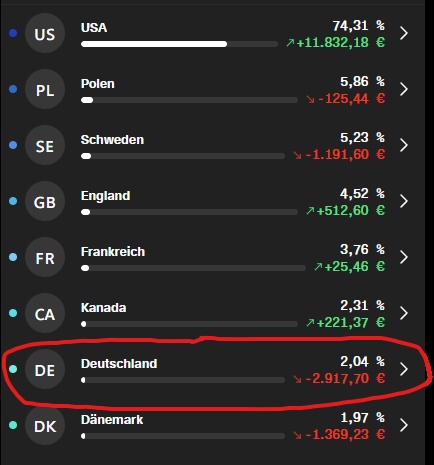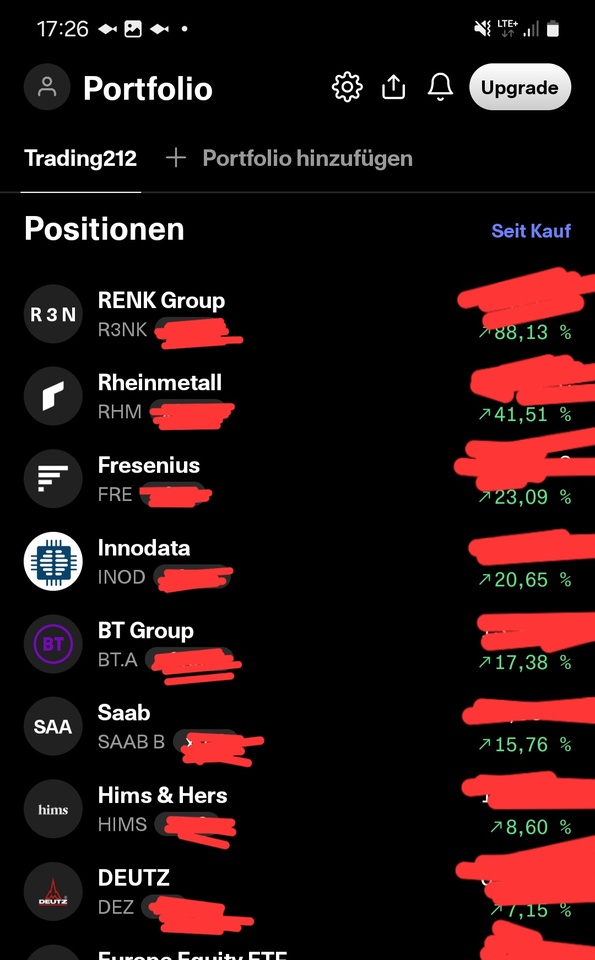
It's interesting how the distribution has shifted...
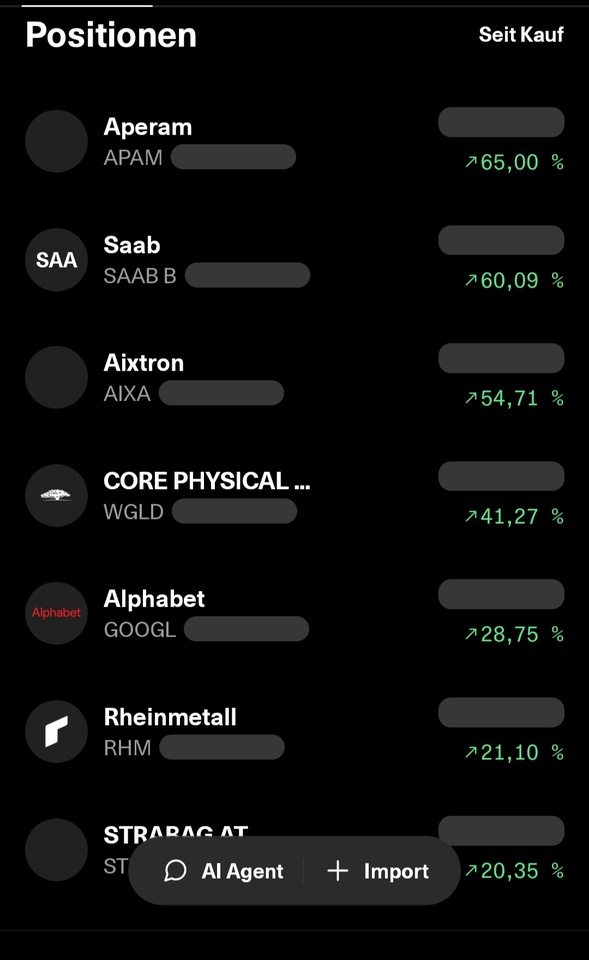
$FRE (+0,23%) , $INOD (+1,63%) , $BT.A (+0%) and $HIMS (+3,34%) no longer in the portfolio...

Postos
96It's interesting how the distribution has shifted...
$FRE (+0,23%) , $INOD (+1,63%) , $BT.A (+0%) and $HIMS (+3,34%) no longer in the portfolio...
The sensible use of saved capital in retirement requires good planning. Especially if you want money to flow out of it regularly to secure or sweeten the third stage of your life.
Financial brokers then like to offer pension insurance based on a single payment, often called an immediate annuity.
With a normal life expectancy, the return is usually not generous because insurers usually invest very conservatively. In addition, the costs and profit margins of the insurance company further reduce the return. Consumer advocates point out that you usually have to live to be 94 years or older before you receive the investment sum back via guaranteed pensions.
It is often more profitable to park the money in a call money account.
Investments with regular distributions are an alternative. Investors are spoiled for choice between several thousand dividend-paying equity funds.
What are the relevant selection criteria? Quality and cost structure.
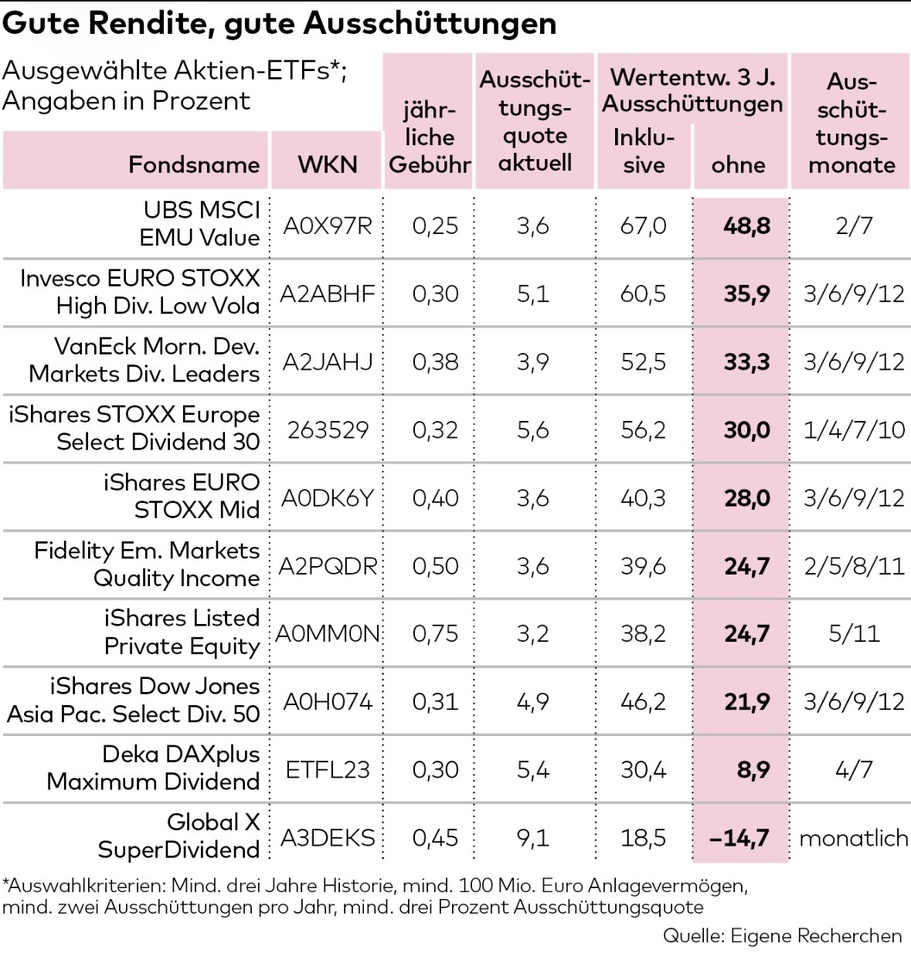
For some, the level of distributions may also be an important criterion in the selection process. But caution is advised here: For example, the payout ratio of the Global X Super Dividend ETF $SDIP (-0,63%) is currently over nine percent. With an investment sum of 100,000 euros, this results in a monthly inflow of around 750 euros before tax.
This is possible because the ETF invests stubbornly in the 100 companies with the highest dividends worldwide, but without any consideration of the sustainability of these distributions and the quality of the companies.
This in turn means that, without the dividends, the ETF generated a return of zero over one year and even minus 14% over three years. Investors therefore received high regular payouts, but the investment capital decreased significantly at the same time.
Savers should therefore always pay attention to how the ETF invests. There are various positive counter-examples, such as the Invesco Euro Stoxx High Dividend Low Volatility ETF $EUHD (-0,4%). Although this also focuses on high-dividend companies, it also selects according to qualitative criteria. Result: Although the payout ratio is currently "only" 5.1% per year, this amounts to around EUR 425 per month before tax for an investment sum of EUR 100,000.
However, the ETF has also achieved growth of almost 36% over the past three years, and including distributions, the gain was even over 60%. There are similarly good ETFs for various other investment regions or sectors.
Bond ETFs, on the other hand, are rarely a real alternative for private investors. Although distribution rates of four or five percent can be achieved, this is ultimately only possible with high-risk bonds or US securities with a corresponding currency risk. In addition, a positive return can rarely be achieved over and above the distribution.
A (possibly riskier) alternative is to invest in individual shares with high dividends. However, quality is even more important here. "We value companies with a strong balance sheet that are characterized by a high equity ratio and above-average returns on capital and sales," says Franz Kaim from Kidron Vermögensverwaltung in Stuttgart.
Continuity is also important. "The so-called dividend aristocrats are the gold standard for income-oriented investors," says Rainer Laborenz, Managing Partner of Azemos Vermögensverwaltung in Offenburg. "Companies that have increased their dividends for at least 25 consecutive years are included in this select group."
There are currently around 150 dividend aristocrats worldwide, 117 of which are from the USA and 33 from the rest of the world. The best-known names include Coca-Cola $KO (-0,47%)Procter & Gamble $PG (-0,66%) and Johnson & Johnson $JNJ (-0,39%) from the USA, Fresenius from Germany $FRE (+0,23%) and Unilever $ULVR (+1,79%) from Great Britain.
Other attractive dividend stocks recommended in a WELT survey of ten leading asset managers in Germany include Allianz $ALV (-0,18%)BASF $BAS (-1,09%)Beiersdorf $BEI (+1,12%)Deutsche Post $DHL (+0,62%) and Munich Re $MUV2 (-1,9%).
In other European countries, they rely on BAT $BATS (-0,99%), BP $BP. (+0,14%), Nestlé $NESN (+1,31%), NN Group $NN (-3,58%)Shell $SHEL (+0,37%) and Swiss Life $SLHN (-0,05%).
In the USA, names such as Altria $MO (+0,39%), Chevron $CVX (+0,47%)Cisco $CSCO (+2,8%), Coca-Cola, Kimberly-Clark $KMB (+1,22%) , McDonald's $MCD (-1,32%) or Pepsi $PEP (-1,3%).
Source: Text (excerpt) & table: Welt, 05.12.25
$BNTX (-0,55%)
$ON (+1,95%)
$HIMS (+3,34%)
$PLTR (+1,89%)
$O (+1,33%)
$8058 (-0,58%)
$7974 (-1,33%)
$BP. (+0,14%)
$BOSS (+0,6%)
$SWK (+1%)
$SPOT (+2,56%)
$N1CL34
$UBER (-1,86%)
$CPRI (+1,24%)
$SHOP (+2,08%)
$RACE (-3,08%)
$HOG (+4,22%)
$HTZ (-1,62%)
$PFIZER
$UPST (+1,18%)
$ANET (-8,83%)
$PINS (-2,62%)
$TEM (+1,4%)
$AMD (+0,05%)
$SMCI (+0,16%)
$RIVN (+10,27%)
$BYND (+2,56%)
$KTOS (+2,58%)
$CPNG (-0,72%)
$BMW (+0,96%)
$NOVO B (+1,22%)
$FRE (+0,23%)
$ORSTED (+1,73%)
$AG1 (-2,35%)
$EVT (+5,19%)
$CCO (-2,97%)
$DOCN (+8,31%)
$LMND (+4,57%)
$SONO (-4,81%)
$MCD (-1,32%)
$HOOD (+6%)
$QCOM (+1,44%)
$FTNT (+1,07%)
$FSLY (+12,22%)
$HUBS (+7,41%)
$ELF (+8,89%)
$ARM (+2,53%)
$SNAP (+0,37%)
$DASH (-0,57%)
$APP (+6,06%)
$AMC (+0,96%)
$ZIP (+3,57%)
$FIG (+1,07%)
$LCID (+3,26%)
$DUOL
$UN0 (-0,07%)
$CBK (-6,04%)
$DEZ (-0,09%)
$ZAL (-0,77%)
$HEN (-0,13%)
$MAERSK A (+3,99%)
$HEI (-2,57%)
$CON (+0,67%)
$AZN (+1,08%)
$ALB (+3,39%)
$MRNA (+6,61%)
$QBTS (+3,06%)
$WBD (+0,02%)
$LI (-2,21%)
$RHM (+1,66%)
$DDOG (-0,91%)
$RL (+1,63%)
$OPEN (+1,35%)
$ABNB (+0,9%)
$PTON (+0,84%)
$MP (+1,14%)
$TTD (-1,32%)
$STNE (+1,5%)
$SQ (+1,59%)
$GRND (+2,42%)
$IREN (+4,22%)
$AFRM (-0,05%)
$CRISP (-0,02%)
$RUN (+5,03%)
$7011 (+3,58%)
$DTG (-0,36%)
$HAG (+2,56%)
$DKNG (+2,38%)
$LAC (+2,89%)
$KKR (+0,63%)
$PETR3 (+0,58%)
$CEG
$WEED (+3,41%)
This consists of dividend shareswhose distributions are automatically reinvested.
In addition to my ETFs (MSCI World, Nasdaq), I would like to use this approach a little more return deliberately with slightly higher risk.
Diversification is the key for me: ETFs for the broad base, dividends for the extra boost.
The Swiss food group Nestlé ($NESN (+1,31%) ) has dismissed CEO Laurent Freixe with immediate effect. The move follows an investigation into an undisclosed "romantic relationship" between Freixe and a female employee who reported directly to him, the company announced in Vevey.
The Board of Directors saw Freixe's behavior as a violation of the Nestlé Code of Conduct and internal guidelines, according to the statement. "This was a necessary decision," said Nestlé Chairman Paul Bulcke. He thanked Freixe for his many years of service to Nestlé.
The Board of Directors appointed Nespresso boss Philipp Navratil as the new CEO. The Board emphasized that the strategic direction would remain unchanged, but that the aim was to increase the pace of growth and efficiency.
Navratil has been with Nestlé for 24 years. He began his career with the company in 2001 in Internal Audit. A year ago, he was appointed head of Nespresso. Navratil has been a member of the Executive Board since the beginning of January.
Nestlé does not come to rest
For Nestlé, this is the next abrupt change of leadership in a comparatively short space of time. Freixe only took the helm at Nestlé in September 2024, replacing the German manager and former Fresenius ($FRE (+0,23%)) CEO Mark Schneider at the time.
With around 277,000 employees, Nestlé is the largest food company in the world. According to its own figures, the company sells more than 2,000 brands in 185 countries and has a market capitalization of more than 200 billion euros. The share price has performed poorly in recent years, prompting criticism from investors.
The Fed's interest rate decision + AMD's quarterly figures + Siemens Healthineers grows strongly + Fresenius also surprises at the start of the year + BMW expects tariff cuts + Quarterly figures from the USA in brief
The Fed's interest rate decision
Quarterly figures from AMD $AMD (+0,05%)
Siemens Healthineers $SHL (+1,09%)grows strongly
Fresenius $FRE (+0,23%)also surprises at the start of the year
BMW $BMW (+0,96%)expects tariff reductions
Quarterly figures from the USA in a nutshell
Wednesday: Stock market dates, economic data, quarterly figures
08:00 DE: New orders March seasonally adjusted FORECAST: +1.0% yoy previous: 0.0% yoy | Manufacturing turnover March
11:00 EU: Retail Sales March Eurozone PROGNOSE: +0.1% yoy previous: +0.3% yoy
20:00 US: Fed, outcome of FOMC meeting Fed funds target rate FORECAST: 4.25% to 4.50% previously: 4.25% to 4.50%
No time given: PO: ECB annual meeting

$FRE (+0,23%) Fresenius will propose a dividend of €1.00 per share for the financial year 2024
At 53 billion euros, the 40 DAX companies are likely to pay out almost one billion euros more this year than a year ago - more than ever before.
The reason for the strong development is high consolidated profits and unexpectedly rising dividends at a good dozen companies, including $ALV (-0,18%) Allianz, $MUV2 (-1,9%) Munich Re and $RHM (+1,66%) Rheinmetall.
At 109 billion euros net profit, the DAX companies are likely to have earned as much in 2024 as in the previous year, according to Handelsblatt calculations. Slump in earnings for the three car manufacturers $BMW (+0,96%) BMW, $MBG (+1,16%) Mercedes and $VOW (-0,15%) VW will be offset by companies in other sectors, in particular the major insurers Allianz, Munich Re and $HNR1 (-0,72%) Hannover Re, but also $DTE (+0,7%) Deutsche Telekom, $HEN (-0,13%) Henkel and $EOAN (+1,52%) Eon.
More than a dozen DAX companies have announced higher dividends than the market had previously expected. For example $ALV (-0,18%) 15.40 euros per share after 13.80 euros in the previous year. Analysts had forecast just under 15 euros. The insurer is thus distributing just under six billion euros. This is a record in the German corporate landscape.
The biggest jump is at $MUV2 (-1,9%) Munich Re: The reinsurer is increasing its dividend by five euros per share to 20 euros.
The two healthcare specialists $FRE (+0,23%) Fresenius and $FME (+0,13%) Fresenius Medical Care, the brand manufacturer $HEN (-0,13%) Henkel, the automotive supplier $BTR Continental, the $CBK (-6,04%) Commerzbank, $RHM (+1,66%) Rheinmetall and $HNR1 (-0,72%) Hannover Re have raised their dividends, in some cases significantly more than expected. This is also due to rising profits, which justify a higher profit share for shareholders.
The largest dividend payers in the DAX are
Like the car manufacturers, a number of companies in the DAX remain below the usual international payout ratios, including the family-run groups $BEI (+1,12%) Beiersdorf and $MRK (+1,25%) Merck. They pass on less than 30 percent of their profits. This leaves enough of a buffer so that dividends do not have to be reduced immediately in more difficult times.
Germany's most valuable group, $SAP (+0%) SAP, with a payout ratio of 85%, is pushing the limit: net profit of 3.1 billion euros in the past year compares with a total dividend payout of 2.7 billion euros. However, the profit was burdened by a one-off effect.
So far, a total of 20 companies have increased their dividends, with only $BAS (-1,09%) BASF and the three car manufacturers. Four companies have yet to do so: $RWE (-3,98%) RWE, $SY1 (+0,26%) Symrise and $VNA (-0,69%) Vonovia are likely to increase their dividends, while analysts expect $PAH3 (+0,14%) analysts expect a reduction at Porsche Holding.
Source (excerpt) & chart: Handelsblatt, 15.03.25

As was announced on Monday evening, the healthcare group Fresenius $FRE (+0,23%) intends to reduce its stake in the dialysis subsidiary Fresenius Medical Care $FME (+0,13%) (FMC) in the dialysis subsidiary. Fresenius currently still holds around 32.2 percent. In future, the stake is to be reduced to 25 percent plus one share.
Fresenius announced that it intends to sell approximately 10.5 million shares in Fresenius Medical Care by way of an accelerated bookbuilding process. This corresponds to approximately 3.6 percent of FMC's issued share capital. Fresenius describes the transaction as a further strategic milestone on the way to a more focused and stronger company. A strengthened balance sheet and further deleveraging will increase strategic flexibility and improve the financial profile.
Analysts have recently been positive about Fresenius shares. The US bank JPMorgan praised the company's continued good progress. It has raised its target price for Fresenius from 41.90 euros to 56.90 euros.
Source: Der Aktionär

Good news from the German healthcare industry! Fresenius $FRE (+0,23%) reported adjusted operating profit above market expectations in the fourth quarter. The strong performance of the Kabi and Helios segments contributed to this.
The results show that the company achieved an EBIT (earnings before interest and taxes) of 646 million euros (approx. USD 678 million), which is above the analysts' estimate of 634 million euros. This is a positive signal for investors and underlines the stability of the company.
For 2025, Fresenius expects organic sales growth of 4 % to 6 % before exceptional items and EBIT growth in constant currencies of between 3 % and 7 %. The company also plans to propose a dividend of EUR 1 per share for the 2024 financial year.
The results are also a good sign for the former dialysis division, Fresenius Medical Care, which also exceeded market expectations on Tuesday. An exciting year ahead! 👍
Principais criadores desta semana