
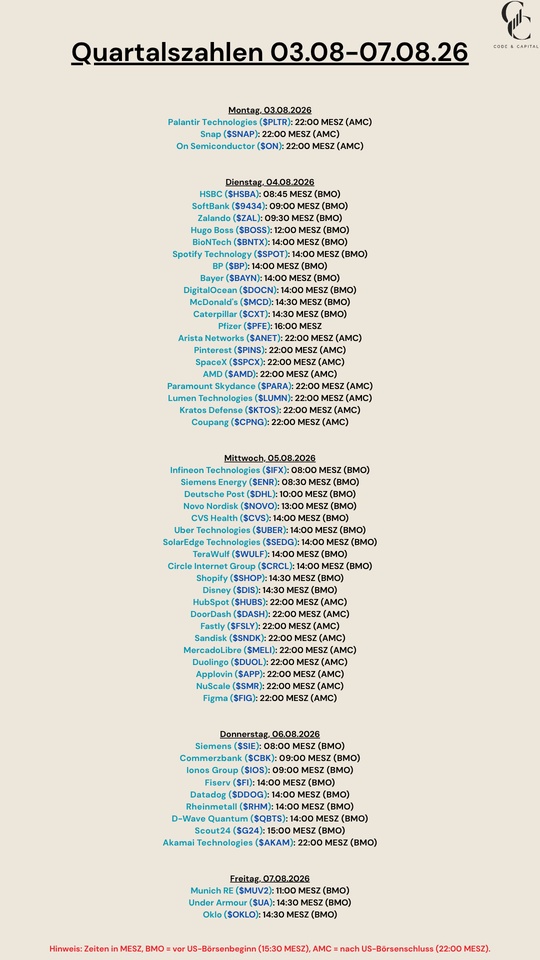
$PLTR (-0,35%)
$SNAP (+5,13%)
$HSBA (-0,84%)
$9434 (+1,47%)
$ZAL (+3,98%)
$BOSS (+0,34%)
$BNTX (+1,13%)
$SPOT (+1,29%)
$BP. (-1,48%)
$BAYN (-0,99%)
$DOCN (-0,64%)
$MCD (+1,19%)
$CAT (-1,89%)
$PFE (+0,23%)
$ANET (-5,25%)
$PINS (+3,35%)
$SPCX (-2,4%)
$AMD (-2,13%)
$PARA (+2,37%)
$LUMN (+4,61%)
$KTOS (+3,21%)
$CPNG (+2,09%)
$IFX (-2,57%)
$ENR (-0,98%)
$DHL (+2,1%)
$NOVO B (+2,74%)
$CVS (+1,58%)
$UBER (+2,3%)
$SEDG (+2,56%)
$WULF (+9,6%)
$CRCL (+7,74%)
$SHOP (+2,69%)
$DIS (+1,28%)
$HUBS (+5,46%)
$DASH (+3,95%)
$FSLY (+0,09%)
$SNDK (-1,61%)
$MELI (+0,56%)
$DUOL
$APP (+5,92%)
$SMR
$FIG (+6,64%)
$SIE (-1,12%)
$CBK (-0,3%)
$IOS (+2,85%)
$FI (+2,5%)
$DDOG (-1,25%)
$RHM (+5,78%)
$QBTS (+5,46%)
$G24 (+7,29%)
$AKAM (+0,23%)
$MUV2 (+2,31%)
$UA (+0,96%)
$OKLO

Coupang
Ação
Ação
Ticker: CPNG
CPNG
Price
Discussão sobre CPNG
Postos
322Mês·
Quarterly Results August 3–7, 2026
1313

3Mês·
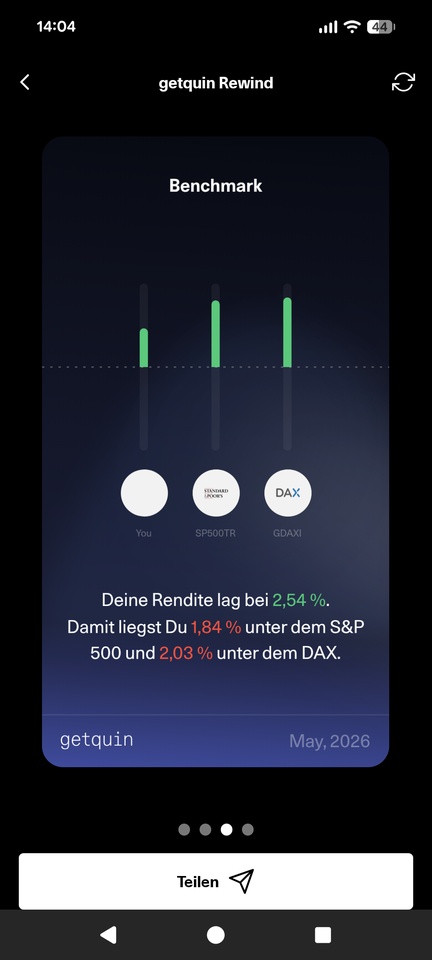
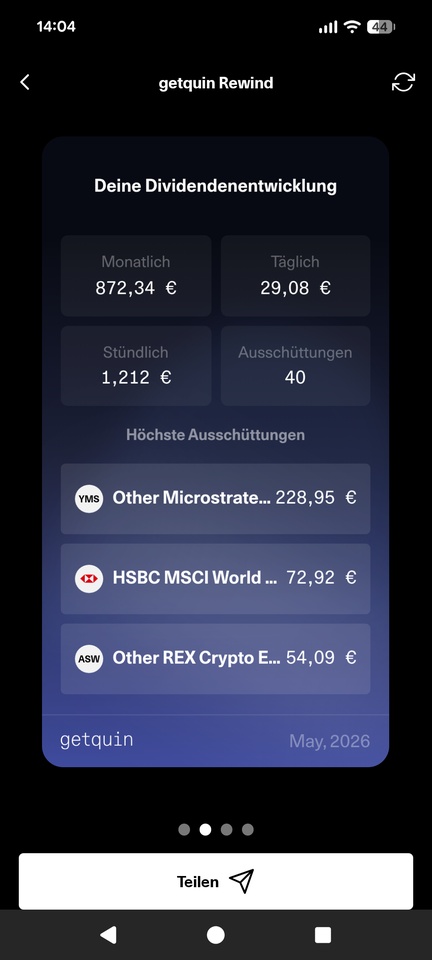
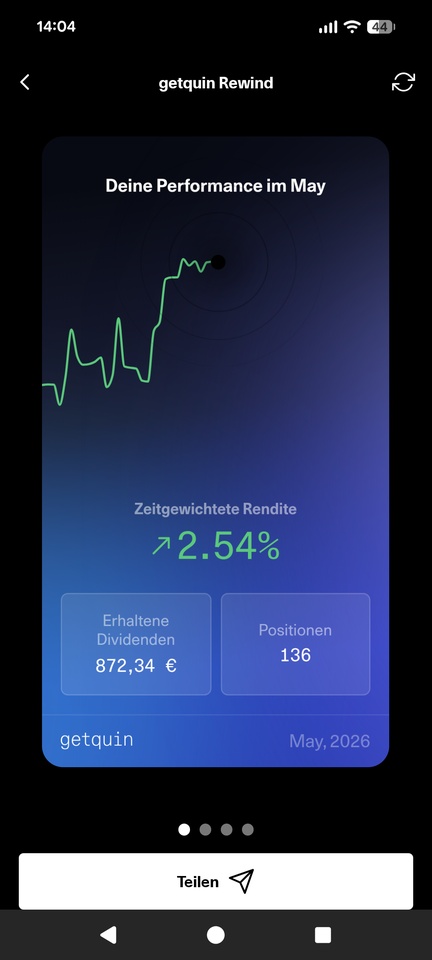
Mai 2026 Rewind
Top Performer:
$ENPH (+3,62%) +122%
$QCOM (+2,32%) +40%
$JEDI (+0,22%) +34%
$ARE (+1,4%) +23%
$ASWM (+0,71%) +15%
Low Performer
$ZTS (+3,23%) -23%
$CPNG (+2,09%) -20%
$8002 (+1,41%) -17%
$WSO (+1,06%) -15%
$ROL (+3,25%) -14%
99
5Mês·
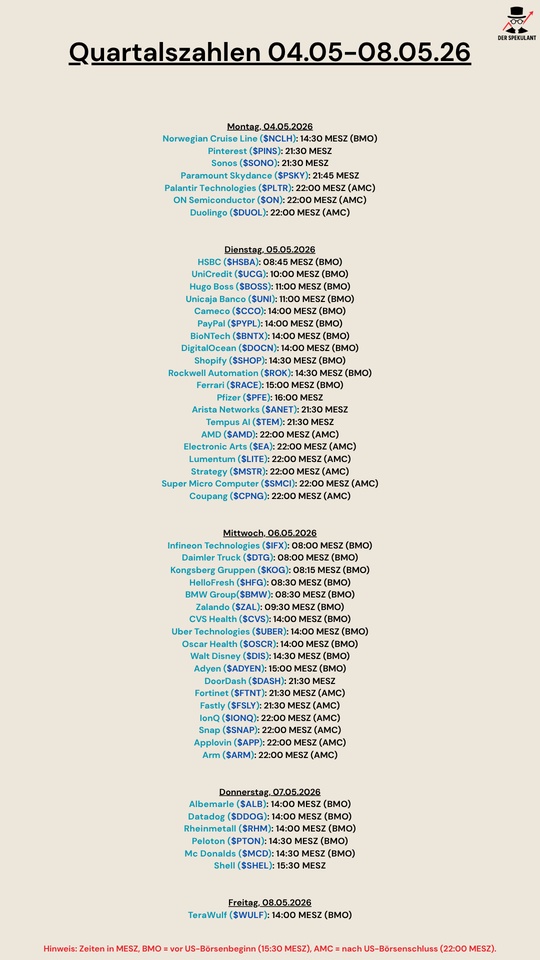
Quarterly figures 04.05-08.05.26
$NCLH (+2,71%)
$PINS (+3,35%)
$SONO (+0%)
$PARA (+2,37%)
$PLTR (-0,35%)
$DUOL
$HSBA (-0,84%)
$UCG (-1,09%)
$BOSS (+0,34%)
$UNI (+0%)
$CCO (+1,06%)
$PYPL (+0,96%)
$BNTX (+1,13%)
$DOCN (-0,64%)
$SHOP (+2,69%)
$ROK (-0,9%)
$RACE (+2,28%)
$PFE (+0,23%)
$ANET (-5,25%)
$TEM (+4,32%)
$AMD (-2,13%)
$EA
$LITE (-2,65%)
$MSTR (+1,24%)
$SMCI (-2,34%)
$CPNG (+2,09%)
$IFX (-2,57%)
$DTG (+0,92%)
$KOG (+1,26%)
$HFG (+5,5%)
$BMW (+1,15%)
$ZAL (+3,98%)
$CVS (+1,58%)
$UBER (+2,3%)
$OSCR (-2,84%)
$DIS (+1,28%)
$ADYEN (+3,07%)
$DASH (+3,95%)
$FTNT (-1,72%)
$FSLY (+0,09%)
$IONQ (+6,5%)
$SNAP (+5,13%)
$APP (+5,92%)
$ARM (+2,36%)
$ALB (-0,23%)
$DDOG (-1,25%)
$RHM (+5,78%)
$PTON (+4,69%)
$MCD (+1,19%)
$SHEL (-0,47%)
$WULF (+9,6%)
1212
7Mês·
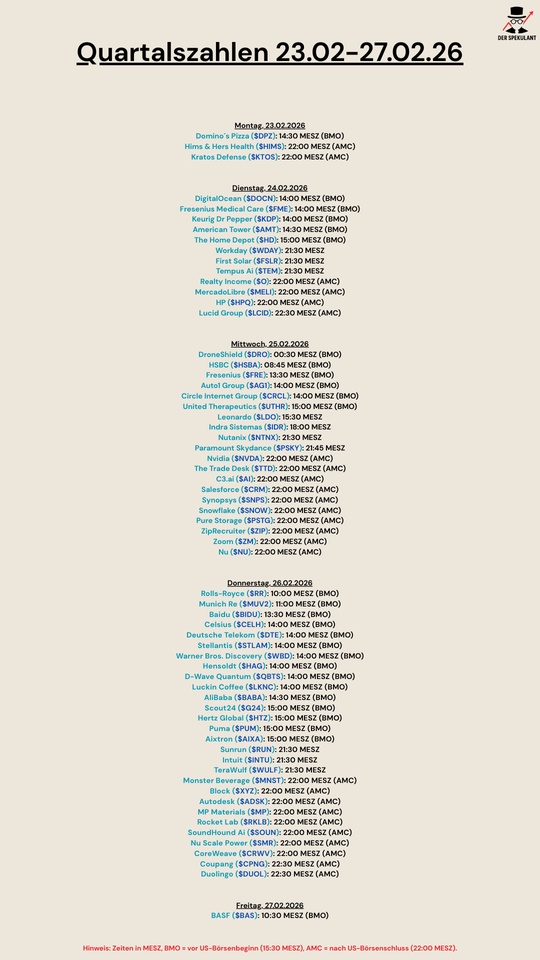
Quartalszahlen 23.02-27.02.2026
$DPZ (+2,66%)
$HIMS (+4,71%)
$KTOS (+3,21%)
$DOCN (-0,64%)
$FME (+2,66%)
$KDP (+2,59%)
$AMT (+0,51%)
$HD (+3,64%)
$WDAY (+3,51%)
$FSLR (-0,99%)
$TEM (+4,32%)
$O (+0,24%)
$MELI (+0,56%)
$HPQ (+1,18%)
$LCID (+5,42%)
$DRO (-4,33%)
$HSBA (-0,84%)
$FRE (+0,59%)
$AG1 (+4,89%)
$CRCL (+7,74%)
$UTHR (-0,3%)
$LDO (+2,79%)
$IDR (+0,56%)
$NTNX (-0,38%)
$PARA (+2,37%)
$NVDA (-2,34%)
$TTD (+7,22%)
$AI (+2,39%)
$CRM (+3,77%)
$SNPS (-2,73%)
$SNOW (-0,17%)
$PSTG (-5,64%)
$ZIP (+9,09%)
$ZM (+2,93%)
$NU (-1,27%)
$RR. (+1,69%)
$MUV2 (+2,31%)
$BIDU (+0,14%)
$CELH
$DTE (+1,09%)
$STLAM (+1,29%)
$WBD
$HAG (+3,43%)
$QBTS (+5,46%)
$LKNCY (+0%)
$BABA (-0,45%)
$G24 (+7,29%)
$HTZ (-0,61%)
$PUM (+3,49%)
$AIXA (-3,05%)
$RUN (+3,66%)
$INTU (+6,44%)
$WULF (+9,6%)
$MNST (+1,56%)
$SQ (+4,03%)
$ADSK (+5,37%)
$MP (+3,42%)
$RKLB (+0,66%)
$SOUN (+7,29%)
$SMR
$CRWV (+5,04%)
$CPNG (+2,09%)
$DUOL
2222
4 ComentáriosSolitair@Solitair
7Mês
•
33
•Mostrar resposta
8Mês·
Share in focus: Coupang ($CPNG) 🚀🇰🇷
Coupang ($CPNG (+2,09%)) is not a classic e-commerce tradebut a platform-based infrastructure group with a focus on logistics dominance, monetization per customer and operational economies of scale.
E-commerce is only the entry point. The real value comes from last-mile control, advertising, memberships & services.
Speed instead of price, infrastructure instead of marketplace, cash flow instead of growth at any price.
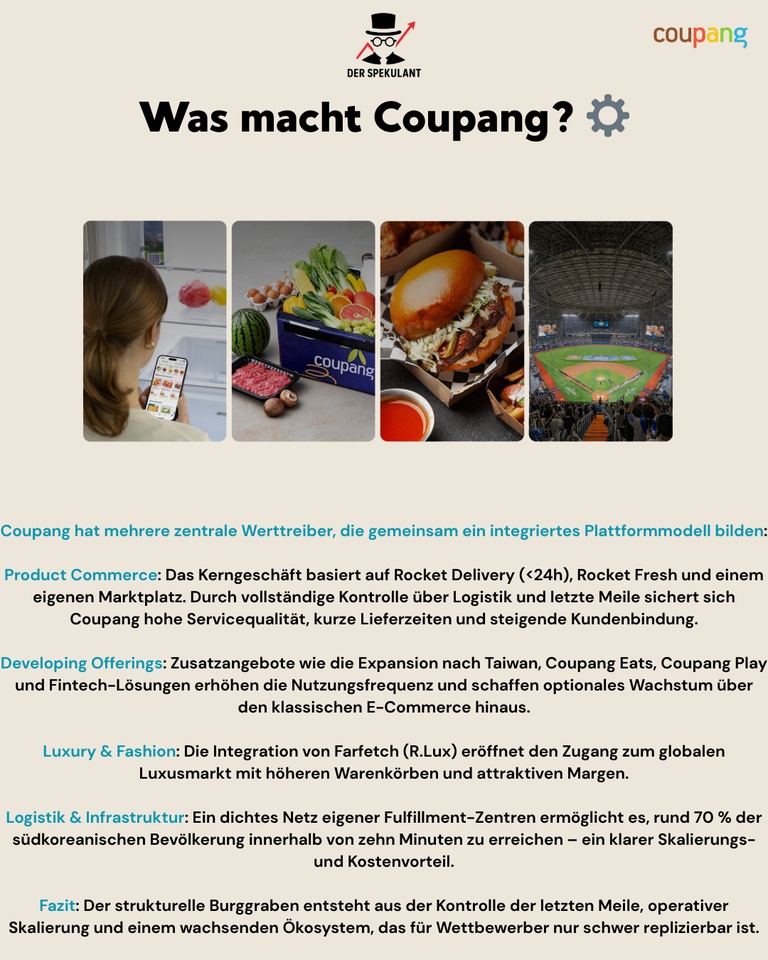
⚙️ What does Coupang do?
➡️ Product Commerce (Rocket Delivery): Own end-to-end model with Rocket Delivery (<24h), Rocket Fresh & controlled marketplace. Coupang owns the logistics - not just the app.
→ Service quality + data + repurchase rates.
➡️ Logistics & infrastructure: Dense network of own fulfillment centers. ~70 % of the Korean population can be reached within 10 minutes.
→ Structural moat by controlling the last mile.
➡️ Developing Offerings: Expansion into Taiwan, Coupang Eats, Coupang Play & Fintech.
Increase frequency of use and platform stickiness.
→ optional growth beyond traditional commerce.
➡️ Advertising: Performance-based advertising directly in the purchasing process. High purchase intent, growing retailer base, very attractive margins.
→ Highly scalable margins-leverage.
➡️ Luxury & Fashion (Farfetch / R.Lux): Integration of Farfetch opens up the global luxury market. Higher shopping baskets, better take rates, higher-margin segment.
→ Strategic upside-option.
👉 Coupang = integrated logistics & commerce platform.
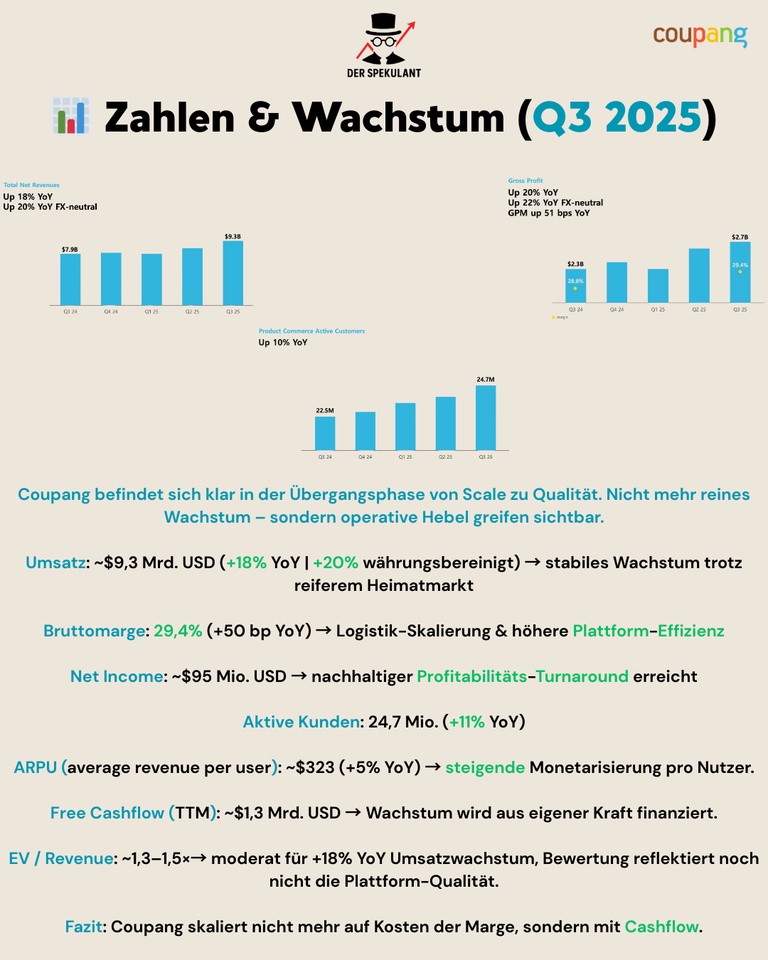
📊 Figures & growth (Q3 2025)
📈 Turnover: ~9.3 billion USD (+18 % YoY | +20 % FX-neutral)
→ Stable growth despite more mature domestic market.
📊 Gross profit: ~USD 2.7 billion (+20 % YoY)
📈 Gross margin: 29.4 (+50 bp YoY)
→ Logistics scaling & higher platform efficiency.
📈 Net Income: ~ 95 million USD
→ Sustainable profitability turnaround achieved.
👥 Active customers: 24.7 million (+11 % YoY)
💳 ARPU: ~323 USD (+5% YoY)
→ Increasing monetization per user.
💰 Free cash flow (TTM): ~USD 1.3 billion positive
→ Growth is financed from own resources.
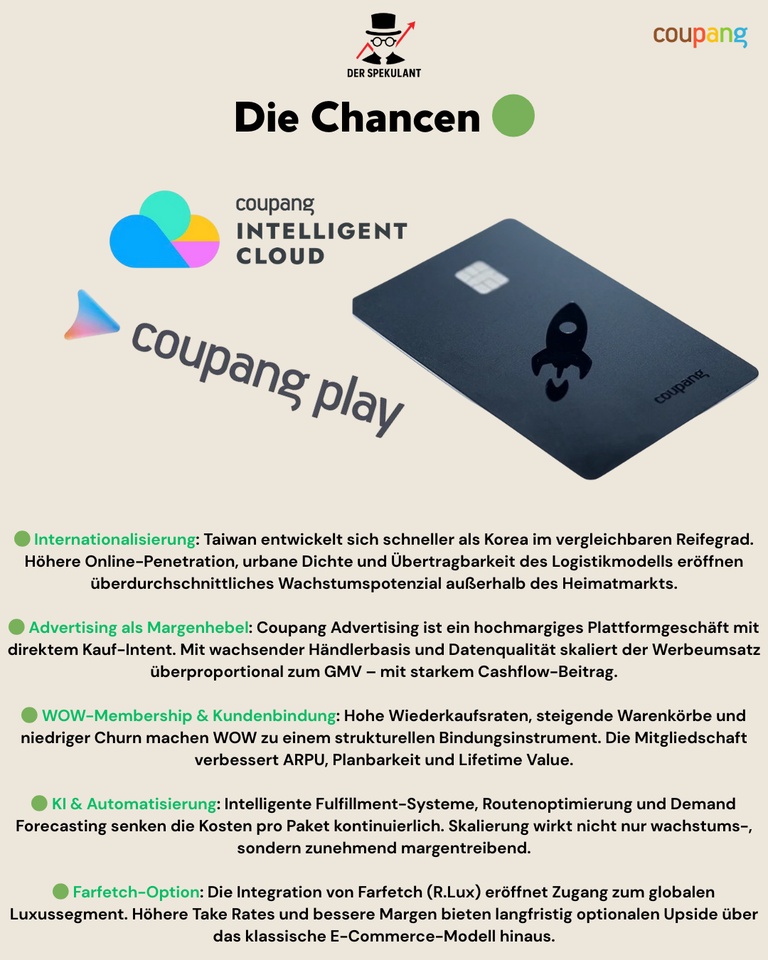
🟢 The opportunities
🟢 Internationalization (Taiwan): Growing faster than Korea at a comparable stage of maturity. High transferability of the logistics model.
🟢 Advertising as a margin lever: High-margin platform business with direct buying intent. Scales disproportionately to GMV.
🟢 WOW-Membership & customer loyalty: High repurchase rates, increasing shopping baskets, low churn. Improves ARPU, predictability & lifetime value.
🟢 AI & automation: Intelligent fulfillment systems continuously reduce costs per parcel. Scaling is increasingly driving up margins.
🟢 Farfetch option: Luxury segment with structurally higher margins.
Long-term upside beyond classic e-commerce.
🔴 The risks
⚠️ Margin-sensitive business model: E-commerce remains structurally cost-intensive.
Wage, energy and transportation costs can dampen progress.
⚠️ High capital intensity: Logistics is moat - but CapEx-intensive.
Requires disciplined capital allocation.
⚠️ Competitive pressure: Intense competition in Korea (Naver, local players).
Internationally strong incumbents.
⚠️ Execution risk with expansion: Scaling of logistics, service & costs simultaneously challenging.
⚠️ Farfetch integration: Luxury is high-margin but cyclical.
Integration requires operational discipline.
💡 Conclusion & outlook
Coupang is not a short-term e-commerce trade,
but a structural infrastructure bet on digital consumption in Asia.
🔹 Short term:
Sensitive to margin trends, CapEx cycles & growth sentiment.
🔹 Long-term:
Platform with a deep logistics moat, increasing monetization per customer
and growing profitability from its own resources.
🎯 Investment case:
Leverage on Logistics dominance + ARPU growth + Advertising + Internationalization
→ structurally growing, operationally scalable, attractive long-term ROI.
💬 Community question:
👉 Asian platform champion with underestimated cash flow potential
or
👉 too capital intensive for a real core position?
I am curious about your assessment 👇
+ 2
1010
1 Comentar
I've been invested for some time and added to my portfolio this week. Once again too early, of course.
•
22
•
8Mês·
Coupang: The “Amazon” of South Korea
“Now, a customer who realizes that she needs new tires on her car can purchase them online from home and have them delivered and installed the very next day… Now, a customer who forgets an important birthday can order with a few clicks on his phone just before midnight and have fresh flowers, ice cream, and a cake waiting at the door for his significant other when they wake up the next morning.”
“Our culture of relentless innovation fuels not only growth, but also continuous improvements in our processes and margins. We have always believed that customer experience and operational excellence can advance hand in hand. Better processes lead to better outcomes for customers. By innovating tirelessly on behalf of customers, we're simultaneously driving down costs and raising the bar on service quality.”
In 2014, a Harvard Business School dropout named Bom Suk Kim decided to pull the IPO of his promising social commerce company just one week before the offering prospectus was set to be published.
The 35 year old Korean-born founder was having second thoughts about the company he had started just 4 years earlier. At the time, Coupang had evolved from a “Groupon-like” daily deals site into a rapidly growing marketplace for 3rd party goods.
While this business model had seen massive adoption in South Korea (more than $1 billion in sales at the time), Kim had a “nagging feeling” that they weren’t providing enough value to customers.
Kim made the difficult decision to shelf the offering and go back to the drawing board.
Right then, he set out the blueprint for how they would build a company that customers “couldn’t live without”.
Coupang Today
Today, Coupang is the leading vertically integrated e-commerce provider in South Korea.
For all intents and purposes, the “Amazon of South Korea” analogy is a great fit here.
Coupang’s online marketplace is home to 24.7 million active customers (that’s ~48% of South Korea’s entire population), and consists of a mix between 1st party items and items from 3rd party sellers.
A customer can buy just about anything they need on Coupang from everyday necessities to fresh groceries or even a set of new tires for their car.
What truly makes Coupang stand out from other Korean e-commerce providers like Naver or Gmarket is the speed of delivery. When Bom Kim shelved the initial IPO in 2014, roughly half of Coupang’s customer complaints were about shipping times. To deliver a service that customers couldn’t live without, Kim knew they had to start investing heavily in the delivery side of the business.
That not only included investments in physical assets like fulfillment centers, warehouse robotics, and a custom vehicle fleet, but it meant optimizing their delivery algorithms with systems like dynamic route optimization and predictive demand modeling.
This gave Coupang an early leg up that still persists to this day.
Unparalleled Fulfillment
Just how fast is Coupang Delivery?
Today, 99% of Coupang’s orders are delivered in less than 24 hours. For comparison, roughly 60% of Amazon Prime orders are delivered same-day or faster in the U.S.
Coupang’s “Rocket” delivery service also includes a “Dawn Delivery” option on most items, which guarantees orders placed by midnight will be delivered to the customer’s doorstep by 7 a.m. the following morning.
How?
Network density.
In their 2021 IPO Prospectus, Coupang revealed that 70% of the South Korean population lived within 7 miles of a Coupang fulfillment center.
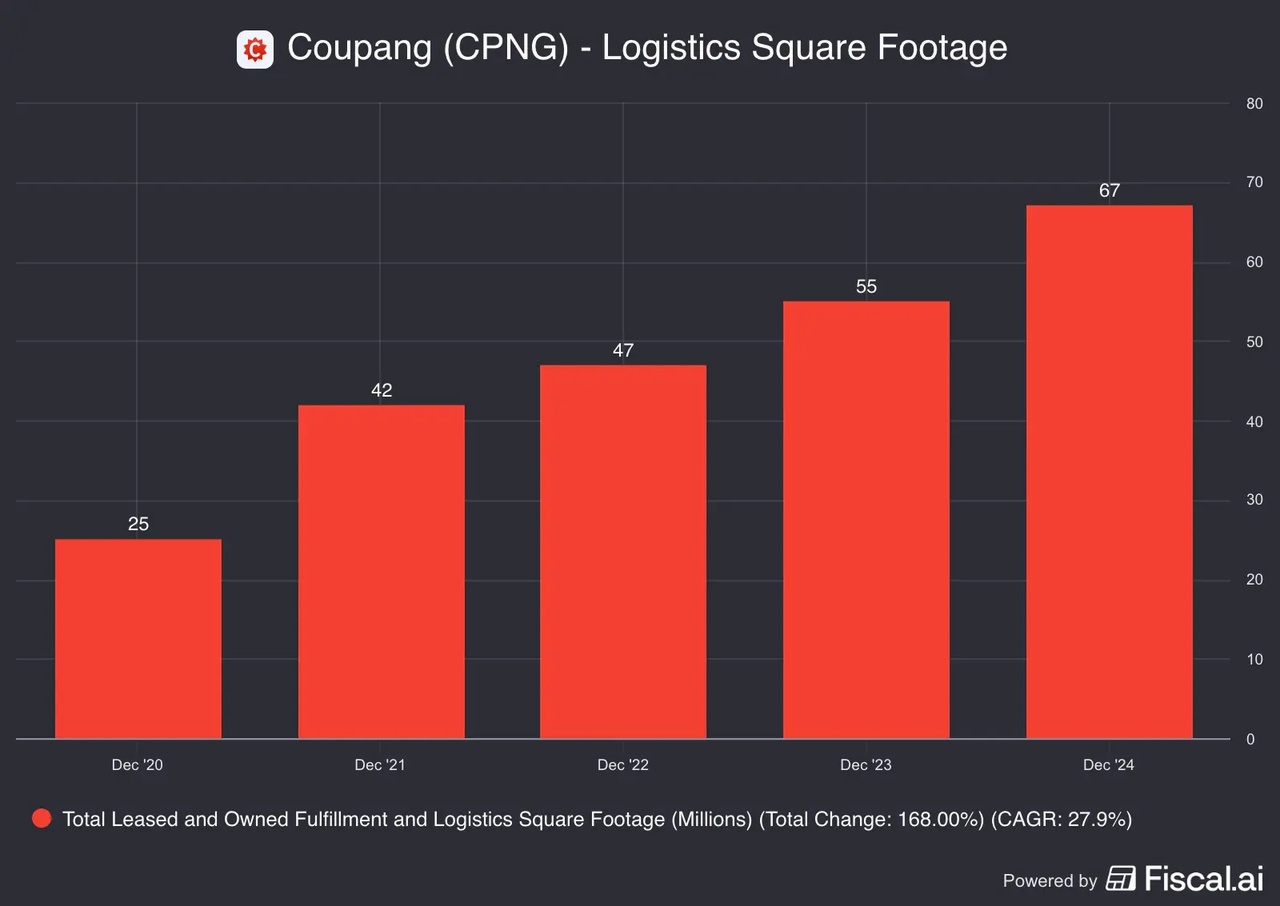
That was 2021, and Coupang has nearly tripled its fulfillment capacity since
It also helps that South Korea is one of the most densely populated countries in the world.
To put some numbers on it, in South Korea, there are about 531 people per square kilometer. In the US, that figure stands at ~38.
This remarkable population density enables Coupang to be more efficient. More deliveries per square kilometer means drivers are spending less time on the road in between deliveries.
This delivery advantage is also self-reinforcing.
- Better delivery times → More orders
- More orders → Better driver utilization
- Better driver utilization → Higher gross profit margins
- Higher gross profit margins → More money to reinvest in infrastructure
- More infrastructure investments → Better delivery times
And on, and on, the cycle repeats.
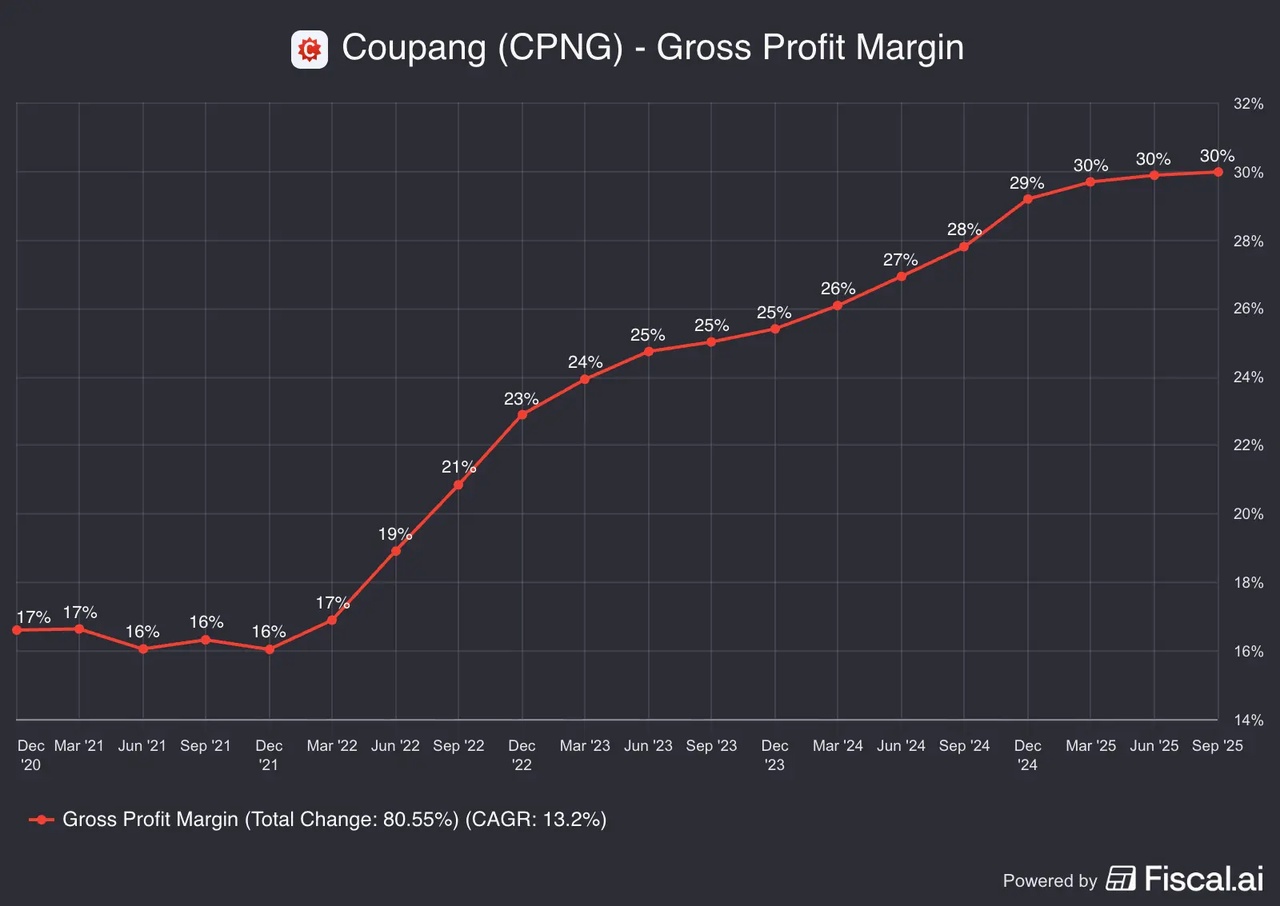
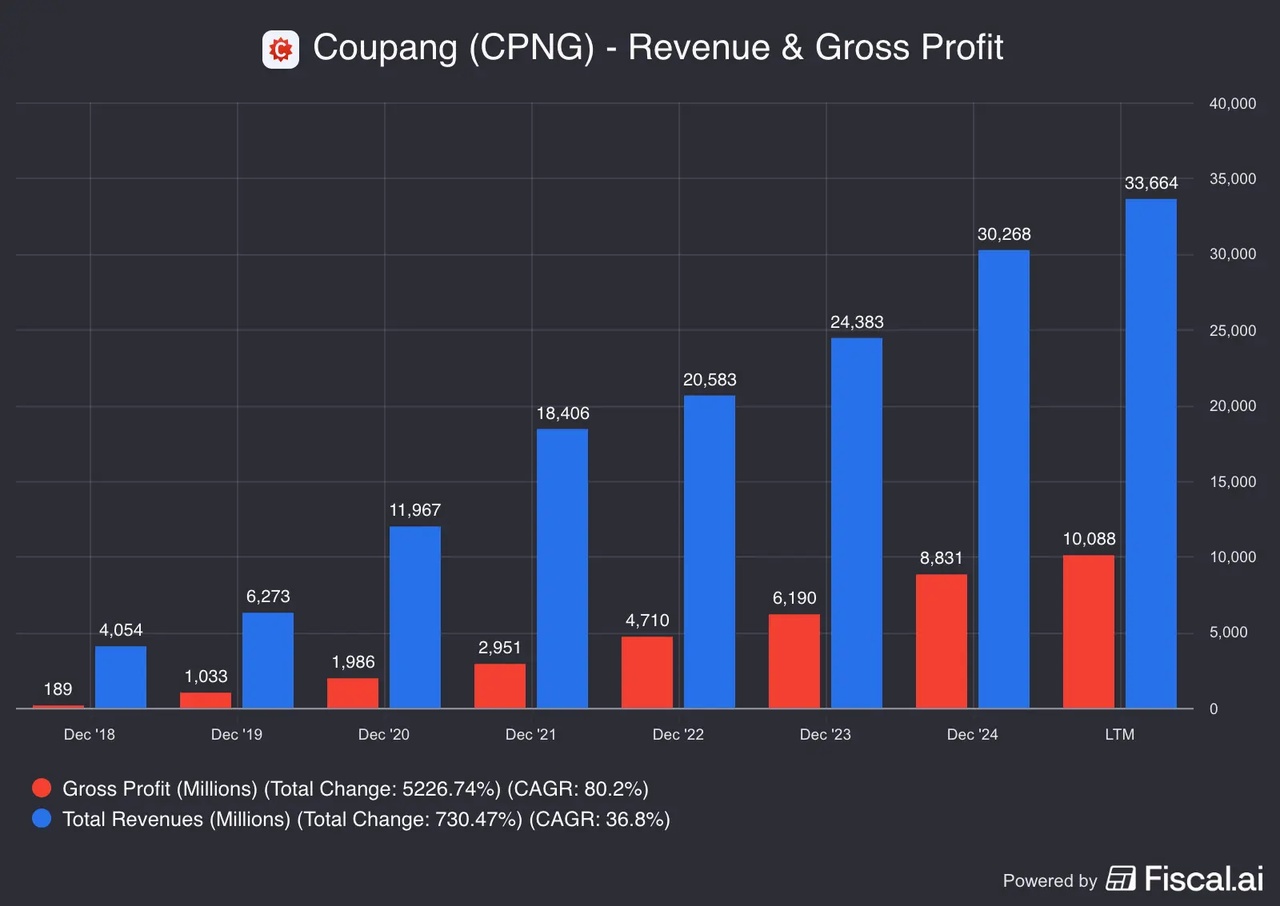
This greater efficiency is evident in their gross margins.
Building a Full Ecosystem
Much like Amazon, Coupang is leveraging the success of its core e-commerce business to expand into other services.
For example, Coupang has used its last-mile delivery network to enter both the restaurant and grocery delivery space. They’ve also introduced a video streaming service called Coupang Play that shows live sports, licenses 3rd party content, and even produces its own original content.
Coupang bundles these offerings and more into an Amazon Prime-like subscription known as the Rocket WOW Membership. At the end of 2024, Coupang had approximately 14 million Rocket WOW Members, meaning nearly 1-in-4 Koreans paid for the service.
But it’s not just buyers that Coupang is providing incremental value to.
Like most leading online marketplaces, Coupang offers advertising inventory to merchants. Coupang introduced sponsored listings in 2019, and although their advertising revenue isn’t specifically disclosed, it’s likely been a key contributor to the margin improvement the company has seen in its core product commerce segment.
Coupang also lets 3rd party merchants tap into its end-to-end logistics infrastructure through a service called Fulfillment and Logistics by Coupang (FLC). This service enables smaller merchants to offer the same premium delivery speeds as Coupang's own retail division.
Here’s what Bom Kim had to say on the segment in Coupang’s Q2 2025 conference call:
“Fulfillment and Logistics by Coupang (FLC) continues its impressive momentum with volumes, selection, and sellers all growing several times faster than the rate of the overall Product Commerce segment. We're making significant investments to enhance FLC's tools and services, empowering sellers to leverage our leading fulfillment and logistics infrastructure to expand their businesses.”
Beyond Korea
Coupang has only dipped its toe into international expansion a couple of times throughout its history. Much to no avail.
In 2021, they launched trial operations for grocery and general e-commerce services in parts of Tokyo.
Simultaneously, in 2021, they soft-launched in Singapore, which has contributed very little to the business.
Each time, these launches were methodical, slow, and limited. Management started with an initial trial in a specific test city to gauge product-market fit. These efforts bore little fruit, and in the case of Japan, were ultimately wound down by management.
In late 2022, however, Coupang found success in Taiwan. After an initial test period, Coupang launched its full rocket-delivery service and the company quickly began gaining steam.
Here’s what Bom Kim had to say on the Q3 2025 conference call:
“In Taiwan, our momentum continues to accelerate, generating exciting YoY and QoQ revenue growth again this quarter. Our focus on building the best overall customer experience is gaining meaningful traction with consumers, driving higher levels of adoption and retention.”
“These levels of customer adoption in Taiwan are similar to those we saw at the same stage in building our retail business in Korea, reinforcing our confidence in its long-term potential. As we look forward, we expect the continued growth in Taiwan to be driven primarily by two factors. First, our rapidly expanding selection. While still very early, we're making considerable progress in growing our first-party assortment. We also began rolling out our 3P marketplace recently, which we expect will allow us to significantly expand selection, increasing the value proposition for consumers. And second, we've begun building out our own last-mile logistics in Taiwan.”
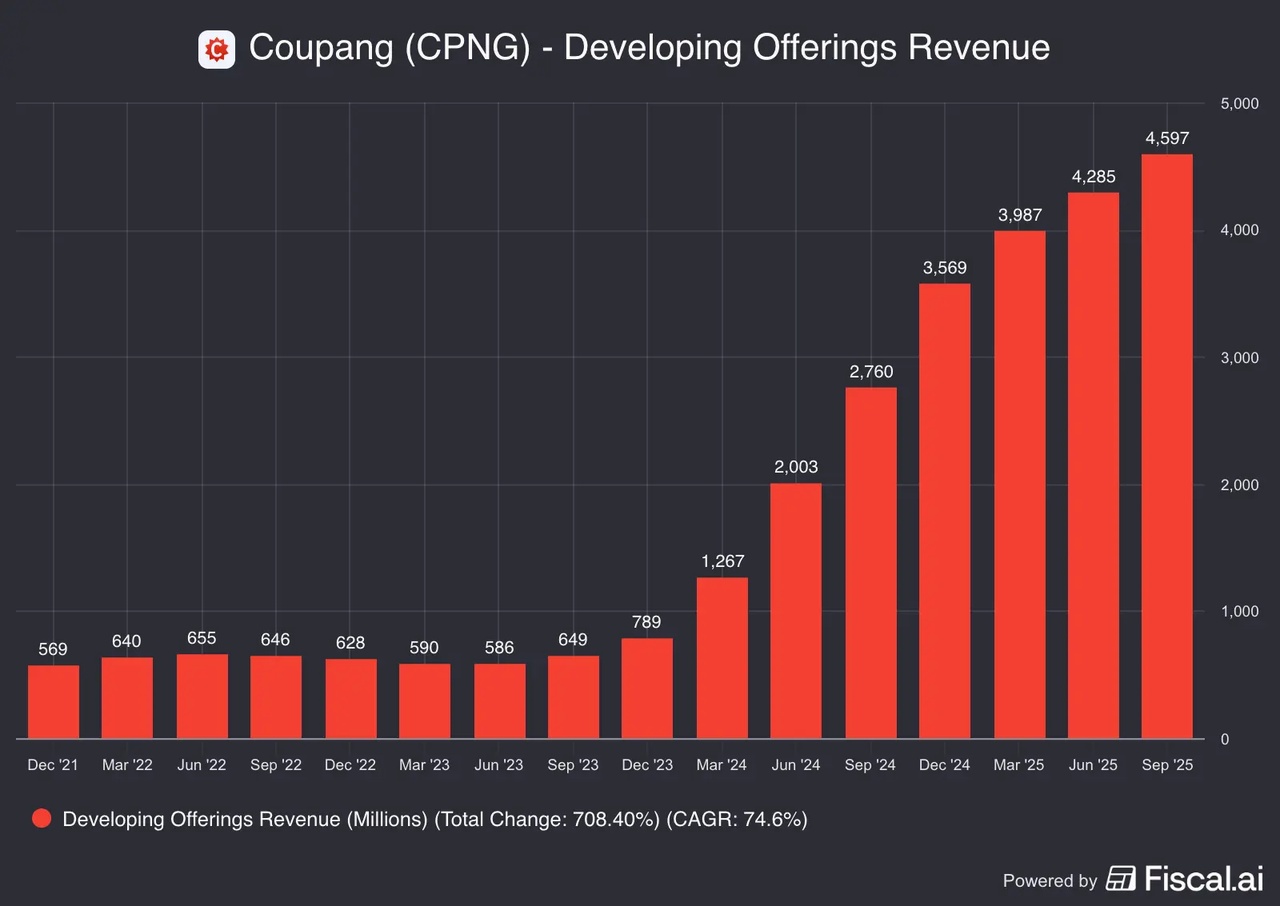
Coupang’s Taiwan retail operations has been a big contributor to the explosion the company has seen in its “Developing Offerings” segment over the last 2 years.
Financials: A Marketplace Built For Operating Leverage
Companies like Amazon and MercadoLibre have proven that running a vertically integrated e-commerce business can be increasingly profitable as they scale. Coupang is no exception.
As Coupang grows, not only does it benefit from higher utilization across its asset-base (warehouses, trucks, drivers, etc.), but it paves the way for new, higher margin offerings like advertising, licensing of their fulfillment network, and subscription services.
This has shown up in Coupang’s financials. Since 2018, Coupang has grown its revenue from $4 billion to $33.7 billion for an impressive 37% annual growth rate.
Meanwhile, gross profit has grown at a staggering 80% annual rate over that same time period.
While GAAP operating earnings have improved as well – from ($1.5) billion in 2018 to $777 million today – Coupang has opted to reinvest most of its gross profit dollars back into the business.
This reinvestment approach creates the flywheel effect that made Amazon so successful. A self-reinforcing advantage that relentlessly drives better customer experiences and better business outcomes for Coupang.
Quelle
fiscal.ai
88
2 Comentários
Exciting topic in the longer term, I've been taking a closer look at Coupang for some time now. I just don't like the development yet, the chart is technically not pretty. Let's see when the share turns around and some momentum comes in.
•
33
•
9Mês·
Dec 15 / Coupang vs. Sea — Same Playbook, Very Different Playing Fields
E-commerce is getting interesting again, but geography plays a role in growth
Online consumer stocks are looking really interesting right now. The global economic crisis seems to be off the table and geopolitical tensions are limited to a few specific regions. Time to let the undervalued giants rally? Yes, they aren’t flashy AI names, but through secular trends like growing consumer spending in emerging markets, top-line growth can reach similar heights. Looking at the whole industry, Amazon is the obvious one, with a bet on margin expansion driven by AI, robotics, and AWS. The e-commerce behemoth lagged behind its fellow Mag7, with no notable gains in the stock since the same time last year. MercadoLibre is basically the LatAm version of that story. Higher risk, but also higher reward, due to geographic factors in the region.
But beyond these two names, analysts and investors alike also like two more niche names: Sea and Coupang. Both promise long runways on a similar playing field, with subtle differences. So the question is which one actually offers the better risk/reward today.
On the surface, the business models look very similar: dominant regional e-commerce platforms, payments, logistics, and optionality beyond retail. But the underlying markets couldn’t be more different. Coupang operates primarily in South Korea, a highly developed, highly competitive, and very mature market. Sea, on the other hand, is concentrated in Southeast Asia, where rising income levels, improving infrastructure, and increasing digital adoption are doing a lot of the heavy lifting without additional effort needed. That also explains the divergence in outlook for the two companies. One can lean back and focus on mindful execution, while the other needs to come up with ways to force growth.
Coupang’s challenge is twofold. First, South Korea’s demographics are working against it. South Korea’s population is getting old. And it’s not like many countries in Europe that struggle to refinance their pension system with a birth rate of 1.5, it’s so much worse: South Korea has the world’s lowest birth rate, around 0.7, far below the replacement level of 2.1. This leads to long-term consumer growth being structurally capped. Therefore, to maintain high growth rates, Coupang will eventually need to expand internationally (like it already does in Taiwan), which means heavy reinvestment and execution risk. Growth is projected around ~15% annually, with margin expansion doing most of the earnings work. The balance sheet is solid, with roughly $5 billion in cash, but the FCF yield is still low at ~2% today, even if it’s projected to improve meaningfully over time (~7% by 2027).
Sea’s setup feels more organic, but also slightly more risky. Revenue growth is projected north of 20–30% annually through 2025–2027, with cash flow expanding at a similar pace. No debt, nearly $8 billion in cash, and a business that benefits directly from improving quality of life in emerging markets. The stock is down almost 40% from its YTD highs and trades at a ~5% FCF yield. Not dirt cheap, but more than fair given the growth. I used that weakness to open a position around $125. So, if you haven’t figured it out so far: Yes, I’m siding with Sea here. The positives and opportunities just outweigh any risks, especially at the current price.
I’m happy with Sea here, alongside MercadoLibre for LatAm. Coupang remains interesting, but Sea offers the cleaner growth story and better upside, in my view. Now, the only thing left is to build an Amazon position.
99


10Mês·
Farfetch parent company Coupang apologizes for massive data leak
"Bad news is good news"
Bad news leads to falling share prices, which can be a good opportunity for long-term investors to buy these shares.
Following a large-scale data leak, the South Korean online retailer Coupang has publicly apologized. Personal data of over 33 million customers was compromised. The government is investigating and a former employee is under suspicion.
Online retailer Coupang, whose holding company is also the new parent company of Farfetch, has publicly apologized for a massive data protection incident. The personal data of around 33.7 million customers was compromised. The incident is one of the most serious security breaches in the history of South Korean e-commerce.
Security breach affects millions of users
According to Reuters, the company announced on Saturday that it had already discovered the incident on November 18 and reported it to the relevant authorities. The tapped information includes names, email addresses, telephone numbers, delivery addresses and individual order histories. According to Coupang, payment data and access data were not affected. The unauthorized data retrieval is said to have begun on 24 June via servers abroad.
Former employee under suspicion
According to reports from the South Korean news agency Yonhap, a former Chinese employee of the company is suspected of having initiated the attack. Coupang has filed a complaint with the police, who have now begun an investigation. Yonhap did not disclose the sources of this information.
Government responds with emergency meeting
The South Korean Ministry of Science and Information and Communication Technology (ICT) convened an emergency meeting on Sunday. Minister Bae Kyung-hoon announced an investigation into whether Coupang had violated legal regulations on data protection. The incident is one in a series of similar data protection mishaps at major South Korean companies, including SK Telecom.
The company promised to work closely with the investigating authorities and reiterated its apology to the customers affected.
retail-news.deFarfetch-Mutterkonzern Coupang entschuldigt sich für massives Datenleck
1717
12 Comentários
I've never heard of this dealer. 🙈
•
44
•11Mês·
Coupang: Second chance for the bulls?
Facts, figures and data
In the last five years, turnover has increased massively from USD 11.97 billion to USD 30.27 billion.
This growth was financed entirely from current cash flow. Coupang currently has no net debt and the number of outstanding shares has Aktien has only decreased from Börsengang only increased from 1.71 billion to 1.79 billion in 2021.
After unprofitable growth shares fell out of favor on the Börse fell out of favor, a strategic realignment and a stronger focus on profitability was decided. One quarter after announcing its intention to grow profitably from then on, the company was already in the black.
Since then, Coupang has kept its free cash flow largely stable at USD 1 billion per year.
That speaks for itself
In the current financial year, the company has consistently built on its previous successes.
In the third quarter, earnings of USD 0.05 per share exceeded expectations of USD 0.04. With sales of USD 9.27 billion, analysts' estimates of USD 9.15 billion were also exceeded.
For the year as a whole, this corresponds to an 18% increase in sales and a 25% jump in profits.
In local currency, sales increased by 20 % and gross profit by 22 %. The gross margin improved from 28.9 % to 29.4 %.
The most relevant Kennzahl In my view, the most relevant indicator besides sales is the operating cash flow, as Coupang clearly focuses on growth, not profit maximization, and reinvests a large proportion of its current income. Operating cash flow improved from USD 1.85 billion to USD 2.40 billion and free cash flow from USD 1.0 billion to USD 1.3 billion.
After South Korea, now also Taiwan
The expansion into new business areas and regions appears to be bearing fruit. The segment recently recorded a 32% increase in sales to USD 1.29 billion. According to the Management Board, the company is currently in a phase of rapidly scaling Taiwan operations.
Furthermore, the focus is on automating logistics in order to reduce costs and further improve service. In the long term, these investments should lead to a significant improvement in profitability.
In addition, there are ongoing share buybacks. In the last quarter, 2.8 million treasury shares were retired for USD 81 million.
As cash reserves have risen from USD 5.88 billion to USD 7.22 billion over the year, Coupang could and should use considerably more funds for buybacks.
As the company's earnings and cash flow are more or less stable and the focus is on growth, a valuation based on the KGV is not really expedient. The P/E ratio is more useful, whereby the increasing gross margin and the rise in profitability over time also tend to speak in favor of a rising P/E ratio.
Since the IPO, the P/E ratio has been between 1 and 6, averaging 1.52. The current P/E ratio is 1.57.
By this yardstick, Coupang is fairly valued. However, as turnover will increase significantly in the current and coming financial year, there is still considerable upside potential.
With a P/E ratio of 1.52, this results in a price of Kursziel of USD 33.29 - provided Coupang does not exceed expectations again
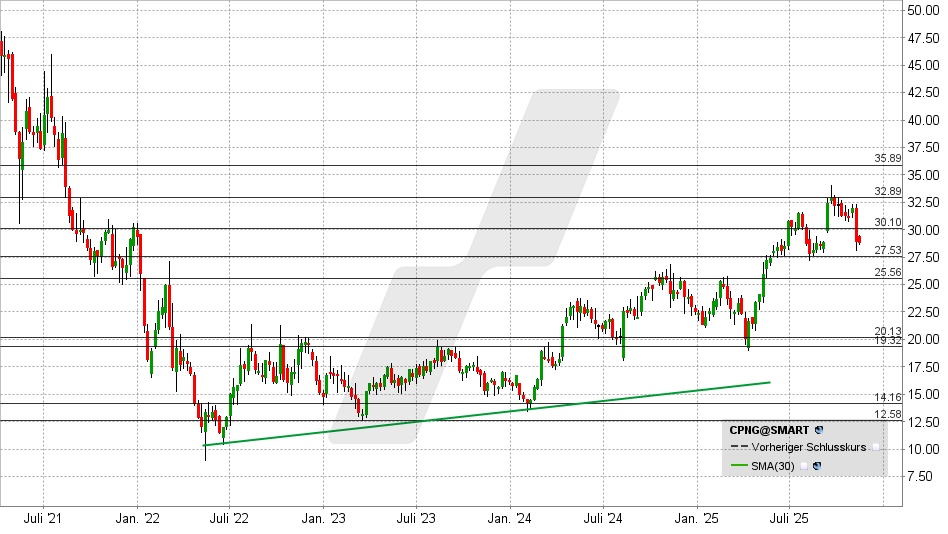
Coupang share: Chart from 10.11.2025, price: USD 28.70 - symbol: CPNG | Source: TWS
If the share now manages to return above USD 30, the correction could already be over. In this scenario, a renewed rise towards USD 33-34 is likely.
If, on the other hand, the share falls below USD 27.50, further price losses must be expected. Possible starting points are USD 25.50 or USD 23.50.
Source
11Mês·
Coupang's third-quarter net profit rises 51 percent thanks to product trading and new business areas
The additional purchase should have been worthwhile.
The US-listed e-commerce giant Coupang announced on Wednesday that its net profit in the third quarter had risen by 51% compared to the previous year. This is due to the strong performance in the product trading and new business segments.
In the three months ended Sept. 30, net profit rose to 131.6 billion won ($95 million) from 86.9 billion won a year earlier, the company said in a press release.
Operating profit rose 51.5 percent to 224.5 billion won from 148.1 billion won in the said period, while sales increased 20 percent to 12.84 trillion won from 10.69 trillion won.
Strong results in the company's core product trading business, including Coupang's signature delivery service Rocket Delivery, as well as the growth of new businesses such as luxury fashion platform Farfetch Holdings, operations in Taiwan and food delivery service Coupang Eats contributed to the solid quarterly performance, the company said.
Sales in the new growth businesses rose 31 percent year-on-year to 1.78 trillion won in the quarter.
Coupang acquired British luxury retailer Farfetch in January 2024, a move that positioned the company as a major player in the $400 billion global personal luxury goods market.

Títulos em alta
Principais criadores desta semana
Dados tempo real da LSX · Dados financeiros e EOD da FactSet