$ENR (+4,71%) is love :-)

Siemens Energy AG
Price
Discussão sobre ENR
Postos
179First post
Hi, I'm new to Getquin and would like some feedback on my portfolio.
To be on the safe side, I sold Parker Hannifin$PH (-0,41%) with 70% profit, Siemens Energy$ENR (+4,71%) with 210% and Trane Technologies with 30% profit.
Taking profits from time to time never hurts😉
"Hot money: the profiteers of industrial heat"
Dear Community,
In the last analysis, we saw how the nuclear renaissance and SMRs are set to satisfy the huge hunger for electricity of AI data centers. But while the world debates megawatt hours and power grids, the biggest challenge of decarbonization often remains in the shadows: industrial process heat. industrial process heat.
Steelworks, chemical parks and glass factories don't need batteries for laptops - they need constant heat of 500 to over 1,500 degrees Celsius. Until now, there was no alternative to natural gas. But a new generation of "shovel sellers" is preparing to revolutionize this market. Those who bridge the gap between energy generation and thermal storage will find companies that are building system-critical infrastructure for the next 50 years, far removed from the tech hype.
So after water and nuclear power, let's take a look at the "thermodynamic champions" - those companies that store heat, control steam and use the earth as an eternal battery. It is the next logical and still massively underestimated step.
While everyone is talking about electricity, industrial process heat is the "elephant in the room". Industry consumes more energy for heat than for electricity worldwide. A gigantic market is currently emerging here, closing the gap between fluctuating renewables and the constant hunger of factories.
The three pillars of the analysis:
- Thermal batteries (Iron & Brick Storage). Companies are developing systems that use surplus wind or solar power to heat huge blocks of graphite, firebrick or molten salt. These "batteries" then release the energy over days as process steam. Important players here are Rondo Energy (supported by Bill Gates) or listed companies such as Alfa Laval.
- Geothermal energy 2.0 (Next-Gen Geothermal). Thanks to drilling technology from the oil sector, it is now possible to drill deeper and more precisely than ever before (Enhanced Geothermal Systems). The aim is to tap into base load-capable geothermal energy all over the world, not just in volcanic hotspots.
- The interface to the nuclear report (VHTR). The new generation of Very High Temperature Reactors (VHTR) not only produces electricity, but also industrial heat directly. This makes them direct partners for chemical parks such as BASF or Dow. SMRs can not only feed data centers, but also decarbonize entire industrial clusters.
1. the specialists for heat transfer & storage
Alfa Laval ($ALFA (+0,79%)
) is a Swedish veteran and world market leader in heat exchangers. Without this technology, no thermal storage system and no district heating network can function. The company also manufactures separators and filter systems for the process industry.
- Business model: Turnover is generated through plant sales and project-related deliveries. However, recurring revenue from the global service and spare parts network (maintenance, inspection, retrofitting) is particularly lucrative.
- Opportunities & risks: As a technology leader, Alfa Laval is benefiting massively from decarbonization and green hydrogen. However, dependence on global cycles in shipbuilding and the oil industry remains a risk. Price pressure from cheaper competitors and fluctuating raw material costs can put pressure on margins. An important checkpoint is the order intake in the marine sector (CO2 capture).
GEA Group ($G1A (+0,2%)
) has established itself as a specialist for process technology, with a strong focus on the "Heating & Refrigeration" division. They build gigantic industrial heat pumps that make waste heat from factories or data centers usable again.
- Business model: GEA supplies both individual machines and complete production lines for the food and pharmaceutical industries. The after-sales business with high margins stabilizes sales and extends customer relationships through digital optimization tools.
- Opportunities & risks: The model is very defensive and benefits from the stable demand for hygiene and efficiency solutions. One disadvantage is the lower growth rates compared to tech players. In addition, fluctuating incoming orders for major projects can have a short-term negative impact on cash flow. Investors should keep a close eye on the margin development of the heat pump division.
Spirax-Sarco Engineering ($SPX (+0,86%)
) is the British market leader for steam systems. As energy in industry is usually transported via steam, Spirax converts factories worldwide to electric steam generation and highly efficient condensate systems.
- Business model: The company combines product sales (valves, pumps, control technology) with intensive engineering consulting and maintenance contracts. There is a strong focus on aftermarket relationships.
- Opportunities & risks: There is no alternative to steam in sectors such as chemicals or pharmaceuticals, which gives Spirax strong market leadership and pricing power (moat). However, the valuation (P/E ratio) is often very high and there is an exchange rate risk due to the British pound. It must be critically examined whether the integration of new acquisitions in the area of electrical thermal solutions will succeed smoothly.
2. geothermal energy & district heating infrastructure
Ormat Technologies ($ORA (+1,41%)
) is probably the best-known "pure play" for geothermal energy. They build and operate plants that convert geothermal energy into electricity and useful heat. Ormat Technologies is the established market leader in this field.
- Business model: As a vertically integrated provider, Ormat earns money from plant construction, the sale of OEM equipment and long-term power supply agreements (PPAs). The portfolio is currently being expanded to include energy storage and solar hybrid solutions.
- Opportunities & risks: Ormat is a beneficiary of the US Inflation Reduction Act and offers genuine, renewable base load capacity. Risks are inherent in the nature of the business: geothermal energy is capital intensive and there are drilling and permitting risks. An important milestone is the progress made with the "Enhanced Geothermal" pilot projects in cooperation with Google.
Ariston Group ($ARIS (+6,93%)
) produces highly efficient solutions for water and space heating. While many think of private homes, Ariston is increasingly supplying systems for commercial and industrial hot water applications.
- Opportunities & risks: The mandatory refurbishment of old heating systems in Europe is a massive driver. Ariston has a strong brand name and focus on the European continent. The risk lies in the tough competition with Asian giants such as Daikin or Samsung and the dependence on the construction sector, which is suffering from the economic downturn. Gaining market share in commercial hybrid solutions is the decisive factor here.
3. high temperature technology & materials
Vesuvius plc ($VSVS (+1,45%) ) specializes in refractory materials (refractories). These are essential to keep heat at up to 1,500 degrees in storage systems without the system melting.
- Opportunities & risks: As a niche specialist, Vesuvius is indispensable for the new storage infrastructure. However, the biggest risk is the close link to the currently struggling steel industry. Investors should pay attention to how quickly the share of sales outside the traditional metallurgy sector (e.g. new energy storage systems) grows.
SGL Carbon ($SGL (+0,71%)
) supplies specialty graphite, one of the best heat conductors for extreme temperatures, which is required in high-temperature furnaces and chemical processes.
- Business model: SGL operates in the areas of graphite materials and composite materials (carbon fibers). They offer customer-specific solutions, which are often specially coated or refined.
- Opportunities & risks: Graphite is a key material for semiconductor production and the heat management of modern thermal batteries. SGL is considered a turnaround candidate with a strategically important portfolio, but has historically struggled with a volatile share price and high expectations.
4. the system integrator: Siemens Energy ($ENR (+4,71%)
)
Siemens Energy covers the entire spectrum - from huge thermal energy storage systems based on volcanic rock (ETES) to hydrogen-capable gas turbines.
- Business model: Revenue is generated from plant sales, project engineering and long-term service contracts for grid infrastructure and power plants. Siemens often acts as a general contractor for the decarbonization of entire industrial sites.
- Opportunities & risks: The broad positioning makes the company a beneficiary of the global energy transition. However, the risks lie in the known legacy issues of the wind subsidiary Gamesa as well as in political risks and a complex Group structure. The stabilization of the wind division remains the basic prerequisite for being able to fully assess the potential of the heat assets.
Strategic conclusion
Why is this topic so exciting? There is hardly any "hype" at the moment, which allows for attractive entry prices compared to AI stocks. It is a real ESG magnet as it solves the most difficult problem of the energy transition. It also has a clear infrastructure character: it involves hard assets, patents and long-term industrial contracts - just like the water and nuclear sectors. The industrial heat transition is the missing piece of the puzzle to future-proof an energy portfolio.
How do you assess the situation? Is the industrial heat transition underestimated as a 'sleeping giant' because it receives less media hype than SMRs or e-mobility? And which of these companies do you think has the most convincing business model to benefit from the decarbonization of industry in the long term?
Best regards ✌🏼
Anderlé
Germany's most valuable group is also top for shareholders
Last week, Siemens was $SIE (+2,29%) had overtaken SAP $SAP (-0,18%) then SAP was ahead again on Thursday. The two companies are currently on an equal footing with a market capitalization of around 200 billion euros each.
In the 38-year history of the Dax, which was launched on July 1, 1988, no other company has been at the top as often as Siemens, according to Handelsblatt calculations. One of the Munich-based company's recipes for success is reliability in the form of steadily rising earnings and dividends. Added to this is the ability to constantly adapt to industrial developments.
Ten of the current 40 DAX companies have been represented in the selection index, which originally only included 30 stocks, from the very beginning: Allianz, BASF, Bayer, BMW, Deutsche Bank, Henkel, Mercedes-Benz (then still under the name Daimler-Benz), RWE, Volkswagen and Siemens.
According to calculations by the Handelsblatt Research Institute, Siemens shares have performed best among these Dax veterans, with a price increase of almost 2300 percent. Anyone who has held the share since the Dax was founded has achieved an average price gain of 8.7 percent per year.
This does not include the many dividends paid to shareholders. Siemens shares have risen by around 5,850 percent when price gains and dividends are added together. This results in an average annual return of 11.3 percent.
No share that has been listed on the Dax since the beginning has performed better. By way of comparison, the Dax as a whole, including all dividends, has achieved an average annual return of 8.8 percent since its inception.
This Siemens return does not even take into account a particularly rewarding transaction for investors. Anyone who held Siemens shares at the end of September 2020 automatically received one Siemens Energy share free of charge for every two shares held. $ENR (+4,71%) booked into the securities account.
With this step, Siemens spun off its power plant division. The new shares ended the first trading day on September 28, 2020 at €21.21 each. One share currently costs 153 euros. This corresponds to an increase of 621 percent in just five and a half years.
Siemens shareholders will soon receive another substantial bonus. After its power plant business, Siemens is spinning off its medical division. This is already listed on the stock exchange under the name Siemens Healthineers $SHL (+3,16%) and is also listed on the Dax. However, Siemens currently holds around 67 percent of the shares.
This means that Healthineers is still fully consolidated in Siemens' balance sheet, i.e. Siemens recognizes the profits in its balance sheet. This will soon change, as 30 percent of Healthineers shares are to go to Siemens shareholders in a direct spin-off. They are to receive the new shares in their securities account, similar to Siemens Energy. What the distribution ratio will look like is still open.
With this deconsolidation of the medical technology unit, which has been listed on the stock exchange since 2018, the Siemens Group will lose almost a third of its sales, and the spin-off will also leave its mark on profits. For the current fiscal year, analysts are forecasting an average net profit of €8.1 billion for Siemens, compared to €9.6 billion last year. The reason for this is the loss of Healthineers.
Nevertheless, this strategy makes sense from an investor's point of view, as Siemens' priority is to grow faster and become more profitable. This shareholder-friendly focus is the reason why there are more and more different shares in the Siemens family.
Infineon $IFX (+4,41%) is one of them, as Siemens floated its semiconductor division on the stock market back in 2000. There are now four Siemens shares in the Dax.
One reason for the many buy recommendations by analysts (currently: 21 buy | 4 hold | 4 sell) for Siemens is, in addition to the ambitious, but compared to its competitors, more favorable valuation, the profit sharing for shareholders. The Managing Board intends to increase the dividend from €5.20 to €5.35 for the past fiscal year, which at Siemens ended on September 30, 2025. This is the fifth increase in a row. The dividend has more than tripled since 2010.
At 2.1%, the dividend yield is rather low by historical standards. In the last 20 years, there has almost always been at least three percent to be had. However, the lower yield is by no means the result of slower rising, let alone falling, dividends, but solely due to the enormous increase in the share price. Over the past three years, the share price has risen by 80 percent.
The dividends have not been able to keep up with this rapid development. As a result, the dividend yield for new entrants has fallen. However, this is not a real problem in view of the sharp rise in the share price.
Source text (excerpt) & image: Handelsblatt, 05.02.2026

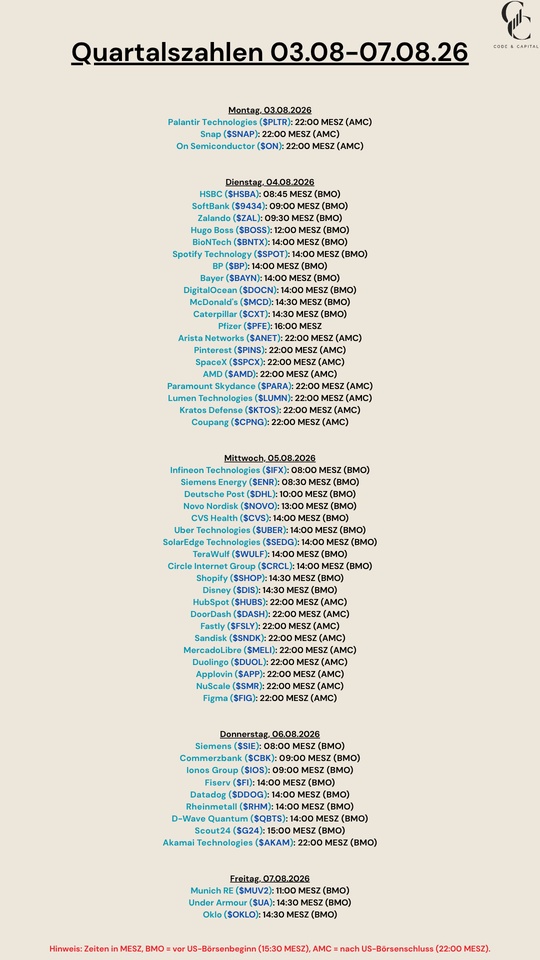
Quarterly figures 09.02-13.02.26
$UCG (+2,32%)
$MNDY (+3,08%)
$KER (+0,75%)
$BARC (+2,25%)
$OSCR (+10%)
$CVS (+0,28%)
$SPOT (+2,65%)
$DDOG (+6,07%)
$BP. (-0,86%)
$SPGI (+0,26%)
$HAS (-0,73%)
$KO (-1,87%)
$JMIA (+5,39%)
$MAR (-0,52%)
$RACE (+0,88%)
$UPST (+0,78%)
$NET (+3,44%)
$LYFT (+4,13%)
$981
$NCH2 (+2,59%)
$DSY (-1,05%)
$1SXP (-0,07%)
$HEIA (-2,27%)
$ENR (+4,71%)
$DOU (-0,73%)
$OTLY (-1,73%)
$TMUS (+0,35%)
$SHOP (+6,37%)
$KHC (-0,86%)
$FSLY (-5,01%)
$HUBS (+1,84%)
$CSCO (+2,4%)
$APP (+10,13%)
$SIE (+2,29%)
$RMS (+0,95%)
$BATS (+1,06%)
$MBG (+0,96%)
$TKA (+2,55%)
$VBK (+2,48%)
$DB1 (+0,06%)
$NBIS (+12,04%)
$ALB (+2,26%)
$BIRK (-0,06%)
$ADYEN (-0,3%)
$ANET (+7,98%)
$PINS (+1,22%)
$AMAT (+2,16%)
$ABNB (+1,49%)
$TWLO (-0,96%)
$RIVN (-1,84%)
$COIN (+14,13%)
$TOM (+0%)
$OR (+2,23%)
$MRNA (+5,58%)
$CCO (+1,28%)
$DKNG (+3,85%)
Bloom Energy boosts Siemens Energy share price
The shares of $ENR (+4,71%) have risen significantly again after two consecutive days of losses. Thanks to positive industry news from the USA, the shares of the German energy technology group rose by 3.2 percent to 150.55 euros at the top of the Dax on Friday. The leading German index gained 0.7 percent.
Bloom Energy, the manufacturer of solid oxide fuel cells, exceeded market expectations with its sales forecast for the current year. In addition, the Americans ended the final quarter in style with strong sales and margin growth, wrote analyst Christine Cho from the British investment bank Barclays. In New York $BE (+8,07%) rose by six percent.
Source: dpa-AFX
The quarterly figures of $ENR (+4,71%) are expected on February 11, 2026. The company will also pay a dividend of € 0.70 per share to its shareholders this year.
My company presentation for Sunday evening
Hello my dears,
Last year I always had one eye on the shares of Friedrich Vorwerk. $VH2 (+0,8%) with one eye. Sometimes it was too expensive for me, sometimes I forgot about it. In the end, I was looking for an investment in the holding company MBB. $MBB (+1,12%) But I completely missed the boat on both.
At Siemens Energy $ENR (+4,71%) I got involved by chance, perhaps we could call it luck.
Last week I was reminded of the ASTA Energy IPO, PFISTERER $PFSE (+2,33%) was brought back to my attention.
After the IPO in May, my opinion on Pfisterer was that the share must be an alternative to Friedrich Vorwerk and Siemens Energy. Both peer group shares were among the favorites. The topic of gigantic investments in the German electricity grid due to the energy transition and the age of AI was prominent on the stock market. After just over seven months, the Pfisterer share has risen well. I am very pleased with the development because the story has been discovered. A P/E ratio of 21 for 2027 is not too expensive for the growth.
Please share your opinion on PFISTERER in the comments.
Is the share now a buy for you after the decent correction on January 7?
(the share is currently hanging on to old lows, so if this is overcome I am positive). @TomTurboInvest
@Get_Rich_or_Die_Tryin ??
My dears, no light, no internet, no traffic - trains stopped, traffic lights went out. When there was a blackout in Spain and Portugal at the end of April last year, industry and more than 50 million people on the Iberian Peninsula were left without electricity. It took more than 12 hours for the electrical infrastructure to start working again to some extent.
Last year in Berlin, it wasn't just a few hours.
Pfisterer: The secret winner of Siemens Energy's power grid boom?
One of the success stories of the last stock market year was the shares of Siemens Energy and the very successful IPO of Pfisterer . The two companies are linked, as Pfisterer is a supplier to Siemens Energy in the field of electricity grids. Siemens Energy is doing excellently in this area, as it received EUR 6.9 billion in orders in the last quarter and has an order backlog of EUR 42 billion. The segment is benefiting from new high-voltage direct current projects, among other things. Siemens Energy expects the positive trends in the energy sector to continue.
Demand for electricity in the USA is expected to grow by 2.2% to 2.4% this year and next. The two main drivers are AI data centers and the electrification of industry and transport. Consequently, investments must be made in the expansion of the electricity grids. Germany is also facing huge investments. The 2037/2045 grid development plan is likely to lead to investments of 250 billion euros, if not 450 billion euros. As a provider of the necessary infrastructure with a global presence, Pfisterer is a winner of the gigantic investments.
The PFISTERER Holding SE is a globally active technology company based in Winterbach, Germany. The company develops, produces and sells innovative products for connecting and insulating electrical conductors for interfaces in power grids. With 17 operating sites in 15 countries and production facilities in Germany, the Czech Republic and the USA, PFISTERER is well positioned for sustainable growth.
Business activities are divided into five segments: Components (COM), Medium Voltage Cable Accessories (MVA), Overhead Lines (OHL), High Voltage Cable Accessories (HVA) and High Voltage Direct Current Cable Accessories (HVD). These segments offer a broad portfolio of connections, cable accessories and insulation solutions for voltages from low to extra-high voltage, including innovative high-voltage direct current transmission systems.
In the 2024 financial year, PFISTERER generated stable sales of EUR 383 million and a strong adjusted EBITDA of just under EUR 65 million. The company benefits from its technological expertise, global presence and diversified product portfolio, which is essential for the energy infrastructure of the future. The shares were placed as part of a public offering in Germany to finance further growth and expand the company's market position.
With a clear growth strategy, a solid financial base and an experienced management team, PFISTERER offers investors an attractive opportunity to participate in the energy transition and the modernization of the world's power grids.
Shareholders
Karl-Heinz Pfisterer 46.2 %
Dorothee Staengel 12.5 %
GS&P Kapitalanlagegesellschaft 0.5 %
Amplegest SAS 0.3779 %
Mandarine Gestion SA 0.3749 %
(I do not see the large funds invested here yet, which should perhaps mean potential for an investment) @Get_Rich_or_Die_Tryin ?
Projects
HVDC
OVERCOMING BOUNDARIES
Behind the four letters H, V, D and C lies an important driver of the energy infrastructure of the future. HVDC stands for High-Voltage Direct Current. The technology makes it possible to transport electricity over long distances with virtually no losses. It overcomes boundaries in both a figurative and a real sense. If we look into the future, we can see how HVDC connects countries and continents via supranational energy networks (so-called supergrids). We see how wind and solar power can be easily integrated into the grids in remote regions thanks to HVDC. And we will see a few more applications.
With PFISTERER's innovations in the field of HVDC cable accessories and the planned establishment of an in-house laboratory for product testing and development, PFISTERER is helping to ensure that this future technology can play to its strengths.
Manufacturing
INNOVATIVE PRODUCTS IN THE USA
The energy networks in the United States of America are in need of modernization. A number of extreme weather events have hit the country and its infrastructure hard in recent years. In order to support projects in the USA with innovative solutions, PFISTERER is setting up a site in Rochester in New York State. Its divisions: Production, sales, training center and cable assembly and testing.
Renewable energy
WITH TECHNOLOGY FOR FLOATING OFFSHORE WIND POWER
Offshore wind power is experiencing strong growth. And for good reason: floating offshore wind turbines can be used in deep waters with optimal wind conditions, opening up new areas for renewable energy.
With innovations for submarine cables and floating structures, PFISTERER is helping to bring this potential to full fruition.
SEANEX 145 kV
RELIABILITY FOR THE FUTURE
Offshore wind power is increasingly relying on higher voltage levels. They improve the efficiency of energy transmission, minimize transmission losses and increase the economic efficiency of large wind farms enormously.
This calls for technological upgrades to turbines, substations and cables. With SEANEX, PFISTERER has developed an innovative high-voltage connection system for offshore turbines up to 72.5 kV that has won over customers worldwide. We are currently working on the successor for voltage levels up to 145 kV.
Localization
IN SAUDI ARABIA
The economy in the Middle East is growing rapidly and with it the demand for energy. This calls for high levels of investment in the grid infrastructure - on two levels. It needs to be modernized on the one hand and expanded on the other in order to efficiently feed in renewable energies and ensure a reliable general energy supply. The combined solution is intelligent grids (smart grids) and regional interconnectors. Both increase grid stability and promote cross-border energy trading. Smart grids make use of modern communication technology and coordinate the different parts of the energy system, such as electricity generation and electricity consumption, while interconnectors link the electricity grids of two countries.
With the establishment of a new location in Saudi Arabia, including a sales and training center and a local production partner, PFISTERER is also contributing to the exciting development in the region.
Development of
THE FIRST PLUGGABLE UNIVERSAL SUBMARINE CABLE REPAIR JOINT UP TO 170 KV
PFISTERER is developing a universal repair joint for submarine cables up to 170 kV for the transmission system operator TenneT. Universal means: the one-size-fits-all solution will repair cable faults safely and quickly with minimal storage costs - completely independent of the structure or manufacturer of the respective cable.
(My dear @Klein-Anleger here we are in the oceans again, and at $PNG (-2,63%) )
A global distribution network - always close by
With a sales network that covers all continents, PFISTERER offers local expertise on a global scale. They rely on a direct presence in numerous countries, through their own factories, test laboratories and sales offices, which enables PFISTERER to meet their customers' requirements quickly and efficiently.
Where PFISTERER is not located itself, it works with long-standing, trustworthy distribution partners who have in-depth expertise and a strong network in their respective markets. They have been working with some of their partners for several decades. They know the specifics of the local market and are available to PFISTERER customers worldwide. This gives them a considerable competitive advantage.
Power generation solutions
Offshore wind
- PFISTERER connection technology can already be found in offshore wind farms all over the planet. Operators of offshore wind farms trust the solutions because they know they can rely on PFISTERER.
Onshore wind
- Using onshore wind to generate renewable energy to meet the growing energy demand of the future - this requires effective wind turbines. In the recent past, technological innovations have ensured that the efficiency of turbines has continuously increased and their costs have been reduced at the same time. PFISTERER technology ensures the safe and reliable integration of onshore wind power into power grids worldwide.
Solar
- The sun has the power needed for decarbonization. The importance of solar energy for the energy mix is constantly growing. Large-scale projects with enormous capacities are being built around the world. And thus a great need for efficient and reliable transportation of solar power. PFISTERER is meeting this demand with proven products for reliable energy transmission and distribution.
Conventional generation
- The transition to a renewable energy supply is taking place gradually. Until it is complete, conventional generation sources will remain an important part of the global energy mix. This also means that the associated infrastructure must remain up to date. PFISTERER supports conventional energy generation with reliable connection technologies for generators and substations.
Power transmission solutions
Underground cables
- The importance of underground cable systems in global power grids is growing. Urbanization, more frequent weather extremes and environmental and nature conservation goals make underground cables attractive. Increasing loads, resulting for example from the increasing use of volatile electricity from renewable energy sources, are increasing the demands on the systems. PFISTERER's solutions up to 550 kV ensure a reliable flow of electricity at sensitive interfaces.
Submarine cable
- In April 2025, the PFISTERER Group acquired the complete Akquisition von Power CSL bekanntgegebena leading specialist engineering company offering products and services for the connection of submarine cables for the global offshore industry.
Overhead lines
- Overhead lines transport electricity over long distances - and the increasing global demand means they have a lot of work to do. In order for them to do what they are supposed to do, advanced technologies and materials are needed for the efficient transmission of electricity.
- PFISTERER knows what is needed. And PFISTERER supplies it. They are a global partner for systems and components in overhead line projects - in the tropics and deserts with their extreme heat, in coastal regions and the northern latitudes with their ultra-low temperatures.
Substation
- Substations are central hubs in power grids - and therefore central to the energy supply. If operators want to ensure that transformers and gas-insulated switchgear are safe and economical, they should first make sure that their connection components and accessories work efficiently and reliably. PFISTERER technologies combine progressiveness and component diversity in a modular system - for a grid connection and system protection that operators can rely on.
Modular solutions
- Plug-in modular cable solutions are becoming increasingly attractive. They enable fast, flexible and safe installations in high and extra-high voltage grids. The advantages for energy suppliers, grid operators and OEMs are obvious: less downtime, easy maintenance, quick adaptation or expansion of systems - and therefore greater efficiency and future-proofing of the energy infrastructure. The largest selection of advanced plug-in technology components is available from PFISTERER.
Power distribution solutions
Distribution stations
- Substations in distribution grids are enablers and shapers of the future. They need to be robust and powerful because they are essential when energy sources are to be integrated into the grids. Or if smart grid technologies are to improve grid stability. Or when it comes to efficiently meeting the growing demand for energy in urban areas. PFISTERER offers innovative, reliable connection technologies for medium and low-voltage grids that harmonize with a wide range of cable types.
E-mobility
- Electrically powered vehicles will play a key role in the global mobility of the future. PFISTERER Technologie equips modern high-charger e-charging parks with advanced distribution technology. It can be described as advanced because it allows large amounts of electricity to be charged - at many columns simultaneously at full power. Its contact technology is also widely used in electric trains, for example for battery connections, air conditioning systems and carriage connections.
Industrial systems
- If industrial systems fail too often, their efficiency suffers. This happens, for example, when connection components for electrical drives and power supply systems are not precisely matched to the requirements of the system. Customized PFISTERER solutions reduce downtimes to a minimum.
Safety technology for distribution grids
- "Better safe than sorry" applies in particular to safety technology across all voltage levels. This is because safety technology is one of the most sensitive areas of energy supply. Operation should be correspondingly simple and unambiguous. And, of course, the same applies here in particular: Reliability is essential. PFISTERE's products - voltage detectors, earthing and short-circuiting devices, earthing and operating rods or continuous testing systems - fulfill these premises perfectly for every requirement.
The future
realize
In the (big) city and in the countryside, on the coast and on the high seas, in this country and elsewhere in the world - in numerous successful projects, innovative products and reliable services from PFISTERER have helped to make the energy infrastructure fit for the future. This is a selection of these projects.
"PFISTERER has shown that the company also offers ALSO MEETS THE HIGHEST REQUIREMENTS AS A PROVIDER OF COMPLETE SOLUTIONS."
Juan Carlos Sanchez, Canary Islands Project Director of Red Eléctrica de España (REE)
"AS THE WORLD MARKET LEADER IN THEIR FIELD, we have chosen PFISTERER
for the 220 kV EQUIPMENT FOR THE MORAY FIRTH WINDPARK."
Peter Cooke, Technical Development Director, Volkerinfra.
29.01.2026 at 09:01 am
27.11.2025 at 13:16
EQS-News: Johannes Linden als CFO des Jahres 2025 ausgezeichnet (deutsch)
PFISTERER continues its growth trajectory in the first nine months of 2025 - Significant increase in earnings and incoming orders
PFISTERER significantly increases sales and earnings in the first half of 2025
PFISTERER PFISTERER steigert Umsatz und Ergebnis im ersten Halbjahr 2025 deutlich
PFISTERER erhält Auszeichnung für herausragenden Börsengang des Jahres bei der IPO Night 2025
Wed, 29/10/2025
EUR in millions
Estimates
Year Turnover Change
2025 442,4
2026 500,6 13,16 %
2027 561,5 12,17 %
Year EBIT Change
2025 65,43
2026 73,17 11,83 %
2027 84,42 15,37 %
Year Net result Change
2024 32,18
2025 45,05 39,99 %
2026 52,81 17,21 %
2027 61,59 16,63 %
2028 26,98 %
Year Net debt CAPEX
2025 -13,7 41,5
2026 -4,6 50
2027 -7,75 50
Year Free cash flow Change
2025 -21,74
2026 -0,7667 +96,47 %
2027 26,11 +3505,64 % 🚀🚀
Year EBIT margin ROE
2025 14,79 % 34,8 %
2026 14,62 % 25,2 %
2027 15,03 % 24,5 %
Year Earnings per share Change
2025 2,21
2026 2,57 16,29 %
2027 2,92 13,62 %
Year Dividend Yield
2025 0,7633 1,04 %
2026 0,9033 1,24 %
2027 1,023 1,4 %
Year P/E ratio PEG
2025 28.4x 1.7x
2026 25x 1.8x
2027 21.5x 1.3x
2028 16.99x -0.17x
Market value 1,323
Number of shares (in thousands) 18,100
Performance
1 week +0.83 %
1 month -4.44 %
6 months +26.91 %
+ 4
North Sea Pact | Opportunities for investors?
For centuries, the North Sea has been regarded as a rough marginal sea. Now it is set to become the heart of Europe's energy supply. There are already 1600 wind turbines off the coasts, but this is just the beginning: electricity generation from offshore wind power is to be increased almost tenfold by 2050. This was decided by the energy ministers at the North Sea Summit in Hamburg on Monday.
The pact has the clear aim of dovetailing energy and industrial policy with increasingly important security interests. The ministers' plans go far beyond wind farms. The North Sea is to become a cross-border electricity hub that will make Europe less dependent on fossil fuel imports, stabilize electricity prices and give industry long-term planning security.
It is a course-setting move that is also being perceived on the financial markets. The long-term expansion plans are changing expectations for a sector that already celebrated a strong comeback last year. The industry is receiving an additional tailwind from the rapidly growing and ongoing energy requirements of digital technologies of the future, above all artificial intelligence, whose data centers require enormous amounts of reliable and affordable electricity. The sector is currently experiencing the perfect moment to become the new megatrend itself.
This should give investors hope, especially in combination with upcoming projects such as the North Sea Pact. After all, this involves up to 100 gigawatts of generation capacity being made available across borders. This would give both the wind energy and grid industries planning and investment security beyond 2030.
In return, the industry undertakes to reduce the costs of electricity generation by a total of 30 percent by 2040. In addition, around 9.5 billion euros are to be invested in new production capacities in Europe by 2030 and 91,000 additional jobs are to be created. According to "Wind Europe", a wind association, 32 million households can already be supplied with electricity from offshore wind energy today. With 300 gigawatts in 2050, this figure could grow to more than 330 million.
It is a new long-term perspective in the sector that should arouse the curiosity of private investors. It feeds the hope that the financial recovery in the sector reflects a lasting change in fundamentals - and that it will not fade away as quickly as it started. For example, UBS expects earnings growth in Europe this year. "The most attractive opportunities come from renewable energies and structural investments in Europe," says strategist Gerry Fowler.
Renewable energies are particularly in focus, supported by more than two trillion euros of investment in power grids and clean energy. Electrification companies are likely to benefit from supportive regulation and continued infrastructure spending.
The strategist leads Energias de Portugal
$EDP (-0,47%) as an example. EDP is one of the largest energy suppliers in Europe. With a market value of 17.5 billion euros, the company is currently the most valuable Portuguese company. The shares are currently trading at 4.24 euros. That is an increase of 6 percent since the beginning of the year and an increase of 50 percent in the past year. And: according to analysts, EDP's potential has not yet been exhausted. Ten experts recommend buying the share. The average target price is around 4.6 euros, with some firms even expecting the share to rise to around 5.9 euros. The Group's dividend yield is 4.7 percent.
According to Gerry Fowler from UBS, the general conditions are currently creating new global champions in the areas of renewable energies, electrification, defense and infrastructure. He specifically highlighted European stocks such as Acciona
$ANA (+1,37%) and Rexel
$RXL (+2,97%) as companies that are turning local advantages into international growth. Another example is Prysmian $PRY (+4,21%). The Italian company is the world's largest and most successful manufacturer of energy and telecommunications cables. The shares are trading at 98.06 euros, up 9 percent since the beginning of the year.
While UBS is putting the green underdogs in the spotlight, other analysts continue to focus on big names such as Siemens Energy $ENR (+4,71%), Ørsted $ORSTED (+0,04%) and Engie (GDF Suez) $ENGI (+0,66%).
Also First Solar
$FSLR (+0,8%) analysts also believe that First Solar will achieve a turnaround after a weak start to the new year with a drop of 11 percent. With a market capitalization of around 26 billion US dollars, the solar giant production power plant for large-scale systems is a heavyweight. Analysts are expecting a sharp jump in profits.
Earnings per share are expected to rise from an estimated USD 14.61 last year to USD 23.30 this year. An increase of more than 56 percent. The drivers are the high order backlog and new production capacities, including a planned 3.7 gigawatt factory in the USA, with which the company intends to convert additional demand directly into revenue.
The analysts also see potential in Longi Green Energy Technology $601012. The Chinese company specializes in the manufacture and sale of photovoltaic panels and solar energy products. The company is not only active on the Asian market, but is also increasingly present on the global market.
Source text (excerpt) & graphic: WELT

Dividend of € 0.70/share proposed
$ENR (+4,71%) proposes a dividend of € 0.70 per share at the Annual General Meeting. This is the first time a dividend has been distributed since 2022. Yield is only a tender 0.49%, but as this was not to be expected, I am happy to accept it.
Multibagger Challenge
I lead the way with 8 multibaggers 🙈
$APP (+10,13%)
$NVDA (+1,53%)
$GFT (+5,63%)
$ENR (+4,71%)
$VRT (+3,05%)
$HY9H (+3,29%)
$GOOGL (+0,19%)
$PNG (-2,63%)
Títulos em alta
Principais criadores desta semana