
$ABBN (-0,86%)
$GE
$RTX (+0,22%)
$HAL (-1,37%)
$MMM (-0,65%)
$NOC (+0,34%)
$MSCI (-0,97%)
$ISRG (+1,77%)
$SPCX (+1,15%)
$NFLX (-0,92%)
$DB1 (-0,49%)
$CME (+0,77%)
$T (-0,14%)
$PM (-1,05%)
$MCO (-0,7%)
$NEE (-1,75%)
$UAL (-0,35%)
$MONC (-1,3%)
$TXN (+0,13%)
$META (-0,51%)
$IBM (+2,9%)
$SAP (+1,5%)
$QS (-2,79%)
$LRCX (+2,99%)
$TSLA (+4,79%)
$RMS (+0,49%)
$NESN (+0,37%)
$BARC (-3,83%)
$ROP (+0,65%)
$DOW (+0,98%)
$SPOT (-2,01%)
$NDAQ (-0,24%)
$AAL (-0,91%)
$LMT (+0,58%)
$PG (-0,37%)
$BX (+0,8%)
$BESI (+3,75%)
$VLO (-2%)
$KER (-0,04%)
$OR (-0,53%)
$VRSN (+1,58%)
$WDC (+5,39%)
$BE (+2,26%)
$NEM (+0,47%)
$TOM (+1,79%)
$AXP (+1,45%)
$FIX (+2,83%)

SpaceX
Ação
Ação
Ticker: SPCX
SPCX
Price
Discussão sobre SPCX
Postos
851D·
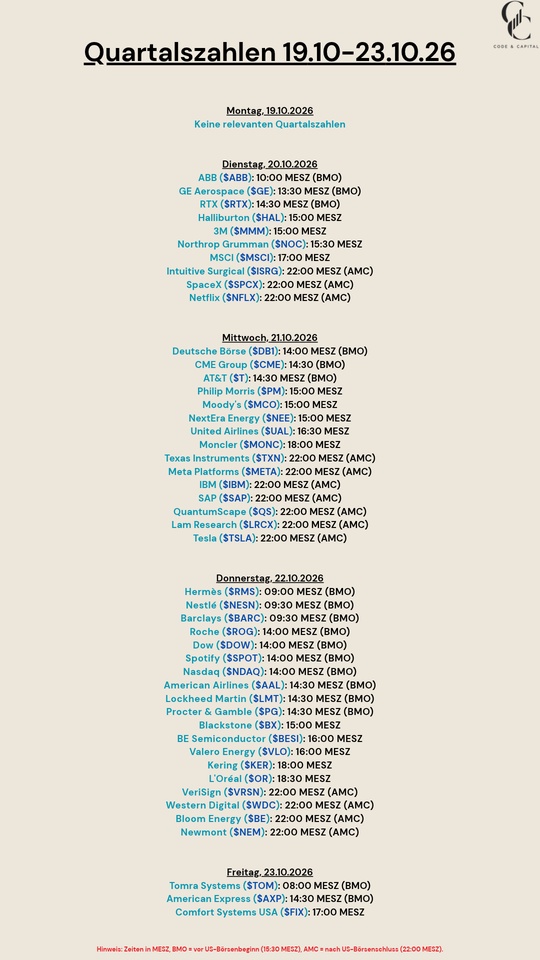
Quarterly Results: Oct. 19–23, 2026
99

4D·
Big Bang in One Time | Elon Musk Era
Elon Musk story in tweet 2015 then more take its for supporting get market trends and now bigger plan with technology industries.
• XRP story makes crazy people from waiting time get performance and tesla in same time have momentum and story, faster movement and get high from 180 to 400 price lines position.
• Elon roadway in right time and right political frameworks get market plan. Reflection makes score for speed time and get to score on board
In high level position. Smart, Crazy and Rookie
• One think for someday and he get thats for all
• Now get to spot standing in lower wave cycle frame time they have all its to run and movement with super platform and strategy on market trends for the future.
• $ITA (+0,11%) , $TSLA (+4,79%) , $SPCX (+1,15%) , $TMUS (+0,22%) , $T (-0,14%) , $VZ (-0,48%)
• Information Technology and Energy on sector with on strategy market plan and longterm with stock market get to large market cap for historical story.


22




5D·
SpaceX Stock Forecast & Price Targets for 2026: Mobile Communications Breakthrough, Flood of Lock-Up Expirations — Should You Buy?
Summary
Opportunity or Bubble? SpaceX stock is trading at 146.26 EUR (October 13, 2026), about 25% below the record high of 194.46 EUR set on June 16, but about 61% above the 52-week low of 91.04 EUR. Two announcements this week are driving the stock price: On October 6, the FCC approved Starlink Mobile, and according to reports, SpaceX is purchasing nationwide 800-MHz spectrum from Grain Management for $8 billion. Musk called it the final crucial piece of the puzzle for a nationwide mobile network; Telekom fell 8.0% on October 9, and T-Mobile US dropped by about 12%. Operationally, SpaceX is growing rapidly: In the second quarter, revenue rose 92% to $7.8 billion, and Starlink has 12 million subscribers. At the same time, the company remains unprofitable (net loss in Q2: $541 million), invested $28 billion in the first half of the year, and the lock-up periods expire in stages through 2027. About 82% of analysts recommend buying the stock; the average price target is $227.54, with estimates ranging from $118 to $450. The next test will be the Q3 results, which, according to market data, are scheduled to be released on November 3.
Key Points
Price: 146.26 EUR (Oct. 13, 2026), about 25% below the all-time high (194.46 EUR on June 16), Offering price: $135 Drivers: FCC approves Starlink Mobile (Oct. 6), spectrum acquisition from Grain Management (Oct. 8, reportedly $8 billion), price target increases Q2 2026: Revenue: $7.8 billion (+92%), net loss of $541 million, Starlink 12 million subscribers. Analysts: approx. 82% “Buy,” average price target $227.54 (range $118 to $450), Morgan Stanley: $300, HSBC: $115 Valuation: Market capitalization approx. 1.13 trillion EUR, 2026e EPS $0.15, P/E ratio not meaningful, no dividend Risks: Losses, high capital expenditures, lock-up expirations through 2027, FCC approval of the spectrum deal. Next Earnings Release: November 3, 2026 (Q3, according to market data, unconfirmed)
What are SpaceX’s current key metrics?
SpaceX stock is trading at $157, about 25% below its all-time high, with a market capitalization of approximately 1.13 trillion EUR, a 92% increase in revenue in the second quarter, and an average price target of $227.54.
Key FigureValueAs of
Price (Nasdaq: SPCX, Tradegate in EUR)
146.26 EUR (−0.25% for the day)
October 13, 2026
Previous day’s closing price
146.62 EUR
Oct. 12, 2026
Offering Price (IPO)
$135
June 12, 2026
All-Time High
194.46 EUR (intraday shortly after the IPO: $225.64)
June 16, 2026
52-week low
91.04 EUR
—
Distance from all-time high
approx. −25%
October 13, 2026
Change from 52-week low
approx. +61%
Oct. 13, 2026
Performance over 1 week / 1 month
−4% / +13%
Oct. 13, 2026
Market Capitalization
approx. 1.13 trillion EUR
October 13, 2026
Revenue Q2 2026
7.8 billion USD (+92%)
August 4, 2026
Net Loss Q2 2026
$541 million (Q1: over $4 billion)
August 4, 2026
Starlink subscribers
12 million (doubled from the previous year)
August 4, 2026
Investments in the first half of 2026
$28 billion (rockets, AI, data centers)
August 4, 2026
Net loss 2025 / EPS 2026e
$4.94 billion / $0.15 (P/E ratio not meaningful)
October 13, 2026
Analyst Ratings (37 firms)
Approx. 82% Buy, 14% Hold, 6% Sell
October 13, 2026
Average Price Target
$227.54 (range $118–$450)
October 13, 2026
Individual Price Targets
Morgan Stanley: Outperform $300; Pivotal: Buy $230; Susquehanna: Neutral $173; HSBC: Hold $115
July–Oct. 2026
Lock-up
Staggered releases through 2027; Musk’s shares locked up until June 12, 2027
October 13, 2026
WKN / ISIN / Ticker
A42D4F / US84615Q1031 / SPCX
—
Next Report (Q3), according to market data
Nov. 3, 2026 (date unconfirmed)
—
What news is currently driving SpaceX stock?
The most important news regarding SpaceX stock from the past few weeks at a glance:
Date | News | Details | Assessment
November 3, 2026
Next Date: Third-Quarter Earnings
According to wallstreet-online, the Q3 report is scheduled to be released on November 3; however, this date has not been confirmed. The focus will be on Starlink growth, losses, and investments.
Watch
Oct.–Dec. 2026
Additional lock-up expirations
According to Aktien.news, 328.4 million shares will be released on October 24, 1.3 billion in November, and 797.6 million in December. Other sources cite December as the next date. More shares entering the market could weigh on the stock price.
Bearish
Oct. 13, 2026
Pivotal Research raises the price target to $230
“Buy” rating confirmed; target raised from $220 to $230. Pivotal expects approximately 160 million mobile Starlink customers by 2036. Analysts’ target range extends from $118 to $450.
Bullish
October 9, 2026
Telecom stocks plunge following the SpaceX deal
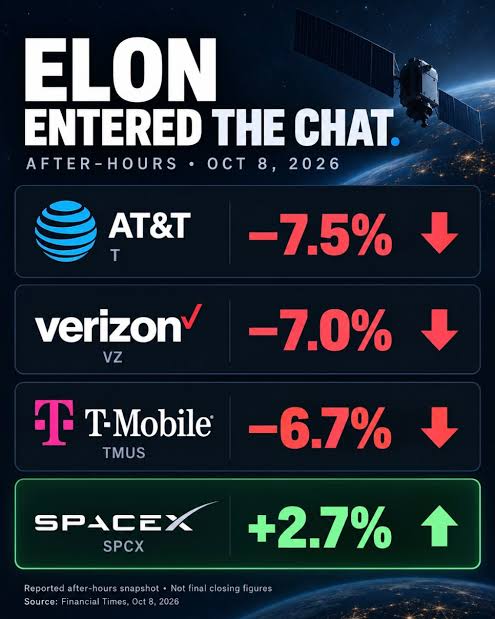
Deutsche Telekom closes down 8.0%, T-Mobile US loses about 12%, and AT&T and Verizon each lose about 10%. SpaceX itself gains ground, and cell tower operators also rise.
Bullish
October 8, 2026
SpaceX buys 800 MHz spectrum from Grain Management
According to reports, the deal is worth $8 billion in cash; other sources do not specify a price. The FCC must approve the deal. Musk calls it the final, crucial piece of the puzzle for a nationwide cellular network.
Very bullish
October 6, 2026
FCC Approves Starlink Mobile
The U.S. agency approves a mobile satellite system with up to 15,000 satellites for direct reception on cell phones. Morgan Stanley reaffirms its “Outperform” rating with a price target of $300.
Very bullish
August 4, 2026
Q2 Results: Revenue Doubles, Loss Persists
Revenue of $7.8 billion (+92%), net loss of $541 million following over $4 billion in Q1. Starlink doubles subscribers to 12 million; capital expenditures in the first half totaled $28 billion.
Watch
August 6 and 20, 2026
First Lock-Up Expirations
On August 6, 911.5 million shares become available; on August 20, an additional 319 million. The stock temporarily falls below its offering price of $135.
Bearish
June 16, 2026
Record high after the IPO
After trading began on June 12 (offering price: $135), the stock reached a record high of €194.46 on June 16. This was followed by a decline of nearly half to the annual low.
Watch
What does SpaceX do—and how does the company make its money?
Company Description
The SpaceX stock (ISIN: US84615Q1031, WKN: A42D4F) represents Space Exploration Technologies, Elon Musk’s aerospace and satellite company. The initial public offering on the Nasdaq (ticker SPCX) took place on June 12, 2026, at $135 per share. In the second quarter of 2026, SpaceX generated revenue of $7.8 billion and reported a net loss of $541 million.
The business segments—and how SpaceX actually makes money:
Starlink: Satellite internet for residential and business customers, with approximately 12 million subscribers—twice as many as a year earlier. Starlink is the only profitable division and provides the foundation for the new mobile communications business: The FCC has approved Starlink Mobile with up to 15,000 satellites. Rocket launches (Falcon, Starship): Launches for governments and companies using reusable rockets, which provide a cost advantage over competitors. The 13th Starship test flight in July was successful, but the booster stage failed to land. AI and data centers: A growing, but so far loss-making, business into which SpaceX, along with its rocket operations, poured a large portion of the $28 billion in investments made in the first half of 2026. Morgan Stanley argues that the market has so far valued this segment at zero
Fundamental Analysis: How Much Speculation Is Already Factored Into SpaceX’s Stock Price?
Fundamental Analysis of SpaceX Stock (as of October 13, 2026)
A great deal: With a market capitalization of approximately 1.13 trillion EUR amid ongoing losses, the market continues to price in high growth; a P/E ratio cannot be calculated. Earnings per share in 2026 are estimated at $0.15, which would result in a P/E ratio of over 1,000 based on that figure. Anyone valuing SpaceX must therefore rely on growth projections and scenarios rather than traditional financial metrics.
Growth: Revenue rose by 92% to $7.8 billion in the second quarter. HSBC expects revenue to double to $38.2 billion by 2026, but anticipates GAAP losses through 2027 and positive free cash flow no earlier than 2030. By comparison: According to Börse Express, established aerospace and defense stocks such as Boeing, Lockheed Martin, and RTX are trading at P/E ratios ranging from about 19 to 50.
Losses and Investments: The net loss in the second quarter was $541 million, following over $4 billion in the first quarter and $4.94 billion for the full year 2025. In the first half of 2026, $28 billion was invested in missiles, AI, and data centers. My analysis of Palantir Aktie, and when it comes to AI infrastructure, it’s worth taking a look at the Bloom Energy Aktie.
Mobile communications as a new lever: With Starlink Mobile and Grain’s spectrum, SpaceX aims to target mobile phones directly. The deal still requires FCC approval, so a nationwide network hasn’t been built yet. My analysis of the Telekom Aktie.
Government Contracts and Politics: SpaceX relies heavily on U.S. government contracts, which provides predictability but also creates political concentration risk. You can also see how such government contracts drive stock prices in the Rheinmetall Aktie.
Lock-up periods: Following the first releases (August 6: 911.5 million shares; August 20: 319 million), additional tranches will follow through 2027. The dates vary depending on the source; Elon Musk is locked in until June 12, 2027. More freely tradable shares can weigh on the stock price, as was the case in July and August.
SpaceX Stock Price Targets and Forecast for 2026
How is the SpaceX stock price performing? (As of October 13, 2026)
According to wallstreet-online, the average price targets for SpaceX stock are $227.54 (range: $118 to $450), and approximately 82% of the 37 analysts recommend buying. Morgan Stanley (Outperform) cites $300, Pivotal Research (Buy) cites $230 following an increase from $220, Susquehanna (Neutral) cites $173 following an increase from $144, and HSBC (Hold) cites $115. The range is unusually wide because analysts have very different views on the company’s AI and mobile business segments. The 2026 forecast hinges on the Q3 results—which, according to market data, are scheduled to be released on November 3—and on the FCC’s decision regarding the spectrum deal.
The stock’s price history illustrates this volatility: After its initial public offering at $135, the stock reached a record high of $226.48 on June 16, fell below the offering price in July to an annual low of $9,105.23, and has since recovered to approximately $157 (+13% in one month).
Key price levels:
52-week high and all-time high since the IPO: $225.64 (intraday, June 16, 2026)Current price: approx. $157 (Oct. 13, 2026, intraday), closing price on Oct. 12: $163.42 First resistance level: $172.60 Second resistance level: $190.64 Analyst price targets: Average: $227.54, Morgan Stanley: $300, Pivotal: $230, Susquehanna: $173, HSBC: $115 Critical downside level: Closing prices below $150
Chart Analysis
News flow and the expiration of lock-up periods are currently driving the SpaceX stock higher. Most recently, it bounced lower off the $170 resistance level. However, it is well supported there. I expect buying interest to emerge at that level. From there, the stock could climb to $190.62. If selling pressure intensifies and the stock breaks below $150 sustainably, a further sell-off to $130.43 is realistic.
SpaceX Stock Chart Analysis and Price Targets for 2026 (as of Oct. 13, 2026) – Source: Stock3 / Christian Lill
Conclusion: Should you buy SpaceX stock now or wait?
My Assessment: Buy
Should you buy SpaceX now? From an operational standpoint, there are many positives for the stock: revenue up 92%, 12 million Starlink subscribers, an approved cellular network, and approximately 82% buy recommendations. At the same time, a valuation of approximately 1.13 trillion EUR is offset by ongoing losses, high investments, and lock-up periods that will release additional shares by 2027. October 9 demonstrated just how quickly a single catalyst can shake up an entire industry: Telekom fell by 8.0%, while SpaceX rose.
Those who believe in Starlink Mobile and the AI narrative will find the stock trading at around $150—about 25% below its all-time high—with an average analyst price target of $227.54. Those who remain cautious will wait for the Q3 earnings report on November 3 and the lock-up expiration dates, and watch to see if the stock holds its support level at $150.
✅ Opportunities
⚠️ Risks
- Average price target: $227.54; Morgan Stanley: $300; range up to $450
- About 82% of analysts recommend buying
- Starlink is growing strongly: 12 million subscribers, Q2 revenue up 92%, the only profitable segment
- Starlink Mobile approved, spectrum acquired from Grain: new markets for direct reception
- Reusable rockets provide a cost advantage; Starship test flight 13 successful in July
- Stock is about 61% above its 52-week low; price targets raised (Pivotal, Susquehanna)
- Losses: $541 million in Q2, $4.94 billion for the full year 2025, $28 billion in investments in the first half of the year
- Lock-up periods: phased releases through 2027 could bring additional shares to the market
- High valuation: Market capitalization approx. 1.13 trillion EUR; P/E ratio not meaningful
- Spectrum purchase does not yet constitute a nationwide network: FCC approval and network rollout are pending
- Dependence on U.S. government contracts and Starship approvals
- Share price remains about 25% below its all-time high; HSBC expects positive free cash flow no earlier than 2030
FAQ: Frequently Asked Questions About SpaceX Stock
Is SpaceX stock a buy in 2026?
About 82% of the 37 analysts listed on wallstreet-online recommend buying, 14% recommend holding, and 6% recommend selling; the average price target is $227.54. On the other hand, the stock is trading approximately 25% below its all-time high of 194.46 EUR, is experiencing ongoing losses, has a very high valuation (market capitalization of approximately 1.13 trillion EUR), and faces additional lock-up periods that could bring more shares to the market.
Why has SpaceX stock fallen from its record high?
There is no single identifiable cause. The fact is: Following the initial public offering on June 12, 2026, at $135, the stock reached a record high of 194.46 EUR on June 16, fell below the offering price in July, and hit a yearly low of 91.04 EUR. During this period, the first major lock-up expirations occurred (911.5 million shares on August 6, 319 million on August 20), along with a loss of $541 million in the second quarter. Since then, the stock has recovered to approximately 146 EUR.
What is the price target for SpaceX stock?
According to wallstreet-online, the average price target is $227.54, with a range from $118 to $450. Morgan Stanley cites $300 (Outperform), Pivotal Research at $230 (Buy, raised from $220), Susquehanna at $173 (Neutral, raised from $144), and HSBC at $115 (Hold, as of July). This range shows just how differently the market views the potential of AI and mobile communications.
What is the forecast for SpaceX stock in 2026?
For 2026, analysts expect SpaceX to see continued revenue growth and ongoing losses. HSBC anticipates revenue will double to $38.2 billion, with GAAP losses continuing through 2027 and positive free cash flow not expected until 2030 at the earliest. In the second quarter, revenue rose 92% to $7.8 billion. Earnings per share for 2026 are estimated at $0.15, so there is no meaningful P/E ratio.
When will SpaceX release its next earnings report?
According to wallstreet-online, the next quarterly report (Q3 2026) is scheduled for November 3, 2026; however, the company has not yet confirmed this date. The Q2 report was released on August 4, 2026.
How much is SpaceX’s dividend?
No dividend has been announced. SpaceX continues to report losses and invested approximately $28 billion in the first half of 2026, primarily in rockets, AI, and data centers.
How does SpaceX make money?
SpaceX generates revenue from its Starlink satellite internet service (12 million subscribers, its only profitable segment), rocket launches (Falcon, Starship) for clients such as governments, and is building out an AI and data center business. In the second quarter of 2026, revenue totaled $7.8 billion (+92%), while the net loss was $541 million.
What does SpaceX’s spectrum purchase mean for the mobile communications market?
According to reports, SpaceX is purchasing a nationwide 800 MHz spectrum package from Grain Management for $8 billion in cash; other sources do not specify a price. The deal still requires FCC approval. At the same time, the FCC approved Starlink Mobile with up to 15,000 satellites. Musk called the spectrum the final crucial piece of the puzzle for a nationwide network. U.S. network operators and Telekom came under pressure following the announcement, but SpaceX still has to build a nationwide network.
When do the lock-up periods at SpaceX expire?
The lock-up periods expire in stages through 2027. On August 6, 911.5 million shares were released, and on August 20, another 319 million. Sources cite additional tranches for the coming months; according to Aktien.news, among others, report 328.4 million shares on October 24, 1.3 billion in November, and 797.6 million in December; other sources cite December as the next date. Elon Musk is subject to lock-up restrictions until June 12, 2027.
Is this $SPCX (+1,15%) a buy right now?? The Starlink story has certainly made a big splash, at least
66
8 Comentários

Phew, next one @Raketentoni… unbelievable, unreadable, unnecessary in this form…
•
1212
•
1Semana·
Podcast Episode 167: "Buy High. Sell Low."
Subscribe to the podcast so you don’t miss the year-end rally.
00:00:00 Crime Pays
00:07:17 JPMorgan Money Market Fund, 5% interest p.a.
00:10:54 SpaceX
00:18:00 Market Environment
00:34:00 Micron
00:50:30 Nike
01:00:00 Brazil ETF, Nu Holdings
01:27:45 Novo Nordisk
01:56:00 McDonald’s
Spotify
https://open.spotify.com/episode/6CMFiN9KKsX5EWIct1dgnJ?si=BXqto32nSeSrdUJg6qEoUw
YouTube
https://openyoutu.be/3TehNLK2NZg
Apple Podcasts
$NVO (-0,52%)
$MU (+3,48%)
$NU (-0,25%)
$MCD (+0,56%)
$SPCX (+1,15%)
open.spotify.com#167 Novo, SpaceX, Micron, Nike, McDonald's, Brasilien-ETF, Nu
99
2Semana·
In-Depth Analysis of SpaceX Stock 🚀🌕
- Five Reasons to Buy
- Four Risks
- Nasdaq Listing
- Starlink
- Space Exploration
- xAI/Grok/Compute
- Other Future Markets
- Intense Competition
- High Customer Concentration
- Elon Musk: A Success Factor or a Risk Factor?
99
1 Comentar
2Semana
Let me rephrase the question… What do you think their EPS will be in 10 years?
•
55
•
2Semana·
Alphabet is sending AI chips into space on a SpaceX rocket
I’m also keeping Alphabet in my 2036 portfolio.
Investing.com – Alphabet plans to launch its artificial intelligence (AI) chips into Earth’s orbit on Thursday using a SpaceX Falcon 9 rocket. This is part of efforts to build data centers in space.
The launch is scheduled for 11:15 a.m. PT from Vandenberg Air Force Base in Santa Barbara County, California.
As part of the uncrewed Transporter-18 mission, SpaceX will transport satellites from Planet Labs, including a solar-powered prototype equipped with Google’s Tensor Processing Units (TPUs). The mission marks the first in-orbit test for Alphabet’s “Project Suncatcher,” an initiative the company first announced in November 2025.
According to Alphabet, “Project Suncatcher” aims to investigate whether space can host an infrastructure for machine learning. The company plans to develop a solar-powered AI computing infrastructure designed for continuous operation in space.
Alphabet holds a stake in SpaceX valued at over $82 billion.
In low Earth orbit, Alphabet says, satellites can access nearly constant sunlight and generate up to eight times more solar energy than on Earth. The company expects to eventually network multiple satellite constellations to handle larger AI workloads in orbit.
Alphabet has already tested its Tensor Processing Units, which execute AI workloads, at a facility at the University of California, Davis. However, it remains unclear how the chips will perform under the conditions of low Earth orbit.
SpaceX has announced plans to build and launch its own orbital data centers based on satellite swarms developed in Redmond, Washington. The satellites are to be equipped with graphics processing units and solar panels that SpaceX plans to produce in collaboration with Tesla.
Earlier this year, Elon Musk stated that data centers in space would become the most cost-effective method for AI training within two to three years. Gwynne Shotwell, SpaceX’s chief operating officer, said at an event in September that the company would deploy supercomputing capabilities in space by 2027.
2Semana·
Our Spaceport, Depot 2036
Hello, everyone,
We’ve already looked at my Depot 2036 portfolio from the perspective of humanoids and data centers in growth markets.
Today, we’ll focus on the growth market of space technology.
Some of you have already invested in SpaceX.
I’m not taking that route with Portfolio 2036 because SpaceX is too big a gamble for me.
Anyone who knows me should already know that I tend to seek out the beneficiaries—namely, the suppliers of the necessary equipment.
If we look at the Portfolio 2036 as a spaceport , the structure actually becomes quite exciting: A spaceport needs not only rockets, but also energy, power electronics, semiconductors, storage, communications, optical data transmission, precision timing, control systems, test technology, and rugged electronics.
And that’s exactly where my portfolio has a surprising number of points of connection. Global space activity is growing rapidly: According to the OECD, there were 329 launches and approximately 4,900 objects sent into space in 2025; by mid-2026, there were nearly 15,000 active satellites in orbit.
🚀 The 2036 Portfolio as a Spaceport
1. STMicroelectronics – the spaceport’s chip supplier
The connection to space here much stronger than one might think at first glance.
ST itself now refers to LEO as a highly scalable communications and computing platform and expects cumulative more than $3 billion in space revenue. The company also supplies radiation-hardened components for satellites, including data converters, logic, and power products.
This fits perfectly with my Depot 2036 thesis:
More satellites → more electronics → more semiconductors → more ST.
And particularly interesting: In addition to communications and direct-to-cell, ST even sees orbital computing as a potential additional area of development.
https://newsroom.st.com/media-center/press-item.html/f0021.html?utm_source=chatgpt.com
Space significance: 🔥🔥🔥🔥🔥
2. Vicor – the power supplier in orbit
For me, this is one of the most exciting space-related holdings in the portfolio.
Vicor explicitly offers radiation-tolerant power supply modules for LEO/MEO satellites. For example, the modules efficiently convert the satellite’s voltage to the voltages required for processors and other components.
And this is particularly interesting right now: At the end of September 2026, Vicor presented solutions for space power systems at the European Space Power Conference.
Even more exciting for the 2036 vision:
The more computing power satellites gain, the more important efficient power supply becomes.
Vicor is already describing space AI systems in which power supply for high computational loads becomes a decisive factor.
Space significance: 🔥🔥🔥🔥🔥
3. Celestica – the Space Manufacturing Plant
This is where it really becomes tangible.
Celestica explicitly refers to Space explicitly as its own market and produces, among other things:
- satellite communications electronics
- circuit board assemblies
- optical systems
- Cables/harnesses
- reaction wheels
- Test systems
- LEO Satellite Components
- https://www.celestica.com/our-expertise/markets/aerospace-and-defense?utm_source=chatgpt.com
This means:
As the space industry transitions from individual projects to industrial mass production, Celestica could find itself right at this intersection.
And it is precisely this scaling that is one of the major differences between traditional spaceflight and New Space.
Space Significance: 🔥🔥🔥🔥🔥
4. Micron – Memory for Satellites
Micron also fits surprisingly well into the picture.
Micron now has a space-qualified memory portfolio and offers radiation-tolerant NAND memory for space applications.
https://www.micron.com/markets-industries/industrial/aerospace-defense?utm_source=chatgpt.com
This becomes particularly interesting as satellites process more and more data directly in orbit.
In other words:
Camera/Sensor → Memory → AI/Compute → Decision → Communication
instead of
Camera → send everything to Earth → process there.
Micron is therefore not a traditional “space player,” but rather a supplier to the digital space industry.
Space relevance: 🔥🔥🔥🔥
5. Frequency Electronics – a small-cap stock, but with an extremely specialized connection to space
I find FEIM particularly interesting in this context.
Frequency Electronics supplies precision time and frequency for ground, air, sea, and space platforms as well as for government and military systems.
https://frequencyelectronics.com/about/?utm_source=chatgpt.com
Why is this important?
Satellites must be synchronized with extreme precision.
In:
- satellite communications
- Navigation
- Radar
- military systems
- satellite networks
time accuracy is a fundamental part of the infrastructure.
FEIM is therefore more like the “timekeeper of the spaceport”.
Space significance: 🔥🔥🔥🔥
6. Gilat Satellite Networks—a central hub between satellites and Earth
Gilat is a more direct space-related stock. Gilat develops satellite communication solutions for GEO, MEO, and LEO, including ground stations, terminals, and network management.
Particularly relevant to the Depot 2036 narrative: By 2026, Gilat will already have over $20 million in SkyEdge orders from a major satellite operator by 2026. In addition, the planned acquisition of Comtech’s space and satellite business is expected to significantly strengthen Gilat’s position in the space and defense communications .
Gilat is essentially the communications bridge from space back to Earth. 🌍↔️🛰️
7. Exosens — definitely fits into the space narrative
Exosens is known for its predecessor, Xenicsand Photonistechnology in the field of high-precision image sensors, SWIR/IR, and low-light imaging . Exosens explicitly cites space exploration explicitly as an application area.
https://www.exosens.com/applications/scientific?utm_source=chatgpt.com
🛰️ Direct evidence of space applications
Of particular interest is the Xenics Bobcat SWIR sensor system:
- Xenics/Exosens collaborates with the DLR on the NASA/JPLVERITAS mission.
- The sensor is intended for use on the Venus mission.
- The ESA mission EnVision is also mentioned.
- The sensor is specifically designed for extreme conditions, including space exploration .
https://www.exosens.com/news/veritas-mission?utm_source=chatgpt.com
So this isn’t just a theoretical “space might become interesting someday” story.
And Exosens has another interesting aspect: Its imaging ranges from UV through visible light and SWIR to LWIR. This means it’s not just about traditional cameras, but about “seeing” in spectral ranges that are important for scientific and military applications.
https://www.exosens.com/product-types/image-intensifier-tubes?utm_source=chatgpt.com
And Exosens currently has a strong defense/sensor driver: In the first half of 2026, revenue rose by 15.3%, with Detection & Imaging growing by 24.3%. The company specifically cites defense imaging, drones, and counter-drone applications as growth drivers.
https://www.exosens.com/news/h1-2026-exosens-results?utm_source=chatgpt.com
🛰️ And then there’s Lumentum + Fujikura
Here, I’d like to tie in the previous photonics theme .
Fujikura is already conducting research on radiation-resistant optical fibers for communication between satellites.
https://www.fujikura.co.jp/en/research/technical-report/no055.html?utm_source=chatgpt.com
This is extremely interesting for a world with thousands or tens of thousands of satellites:
Satellite ↔ Satellite ↔ Satellite ↔ Ground Station
instead of each satellite communicating exclusively with a single ground station.
Lumentum, on the other hand, I would currently view more as a photonic/data center beneficiary with an additional space option . Lumentum’s current operational momentum stems primarily from AI and data center optics; however, the company is fundamentally deeply positioned in optical communications technology.
My key point for the 2036 portfolio
The exciting thing is notthat my portfolio is suddenly turning into a “space portfolio.”
What’s much more interesting is:
These companies are selling the infrastructure that makes a rapidly growing space industry possible in the first place.
The aerospace industry is increasingly becoming a combination of:
🚀 Aerospace + 🛰️ Satellites + ⚡ Energy + 🧠 Semiconductors + 💾 Storage + 📡 Communications + 🔭 Photonics + 🤖 Robotics + 🔐 Cybersecurity + AI
And it is precisely this combination that is already found surprisingly often in the 2036 portfolio.
My Space Matrix for the 2036 Portfolio
Direct Space Leverage
- 🥇 STMicroelectronics
- 🥇 Vicor
- 🥇 Celestica
- 🥇Gilat
- 🥈 Frequency Electronics
- 🥈 TransDigm
- 🥈 Micron
- 🥈 Fujikura
- 🥈 Exosens
Indirect Space/Infrastructure Leverage
- Lumentum
Kitron
Advantest
Kawasaki
Vincorion
Siemens
Nvidia
Generac
Digital Level
- Wallix
Innodata
GFT
This gives the Depot 2036 adds the following to its existing pillars humanoids, data centers, AI, cybersecurity, defense, and energy :
🚀 SPACE ECONOMY
And the best part is: You don’t necessarily have to own a pure-play space stock to benefit from it. I already own several companies that could profit from the technological bottlenecks in the space industry.
I find the following chain particularly strong: STMicro → Vicor → Celestica → Micron → Fujikura → Frequency Electronics. It covers chips, power, manufacturing, storage, communications, and synchronization.
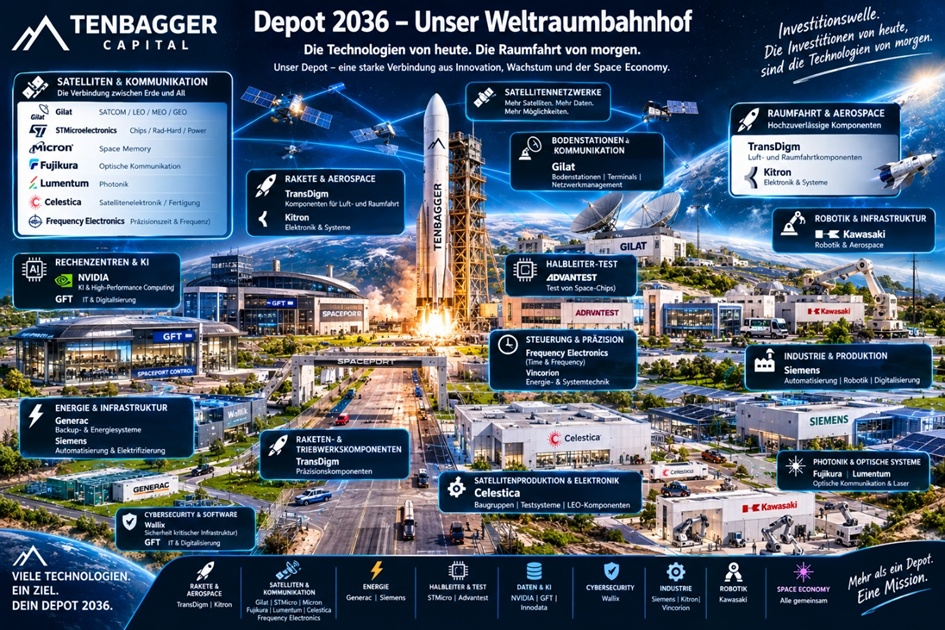
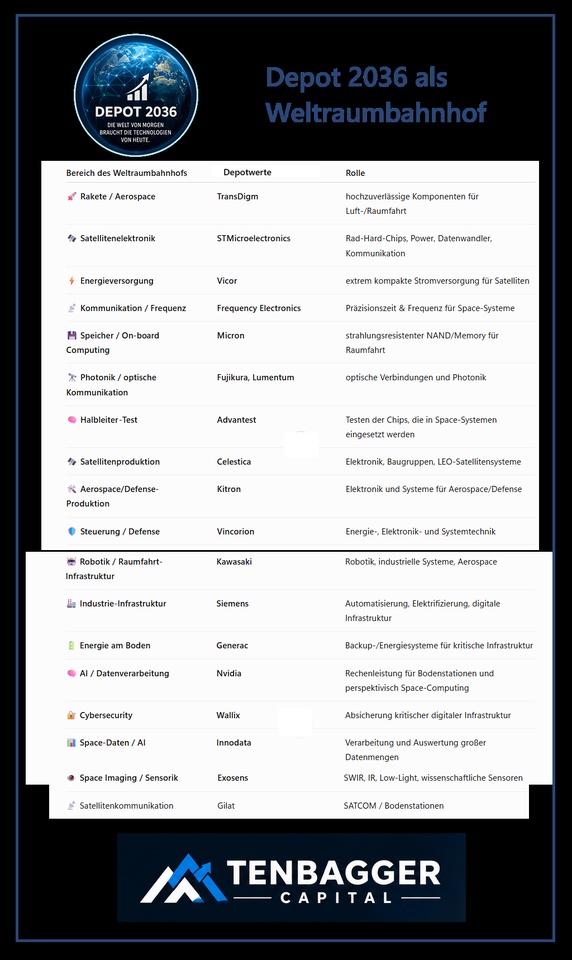
1818

2Semana·
Topic: SpaceX
Hello everyone,
I’ve been keeping an eye on the $SPCX (+1,15%) stock for some time now. Following the latest test flight a few days ago, the stock price hasn’t changed much from a fundamental standpoint.
What’s your current take on this, and where do you see an opportunity to open an initial position?
I’d really appreciate hearing your thoughts on this.....
22
5 Comentários
It's too expensive for me personally. But I think SpaceX will remain a player in the "space race" in the long run. Say what you will about Musk, but he's so obsessed with the dream of space that he can't help but be a major player. In 10 years, the stock price will be significantly higher than it is now.
•
44
•2Semana·
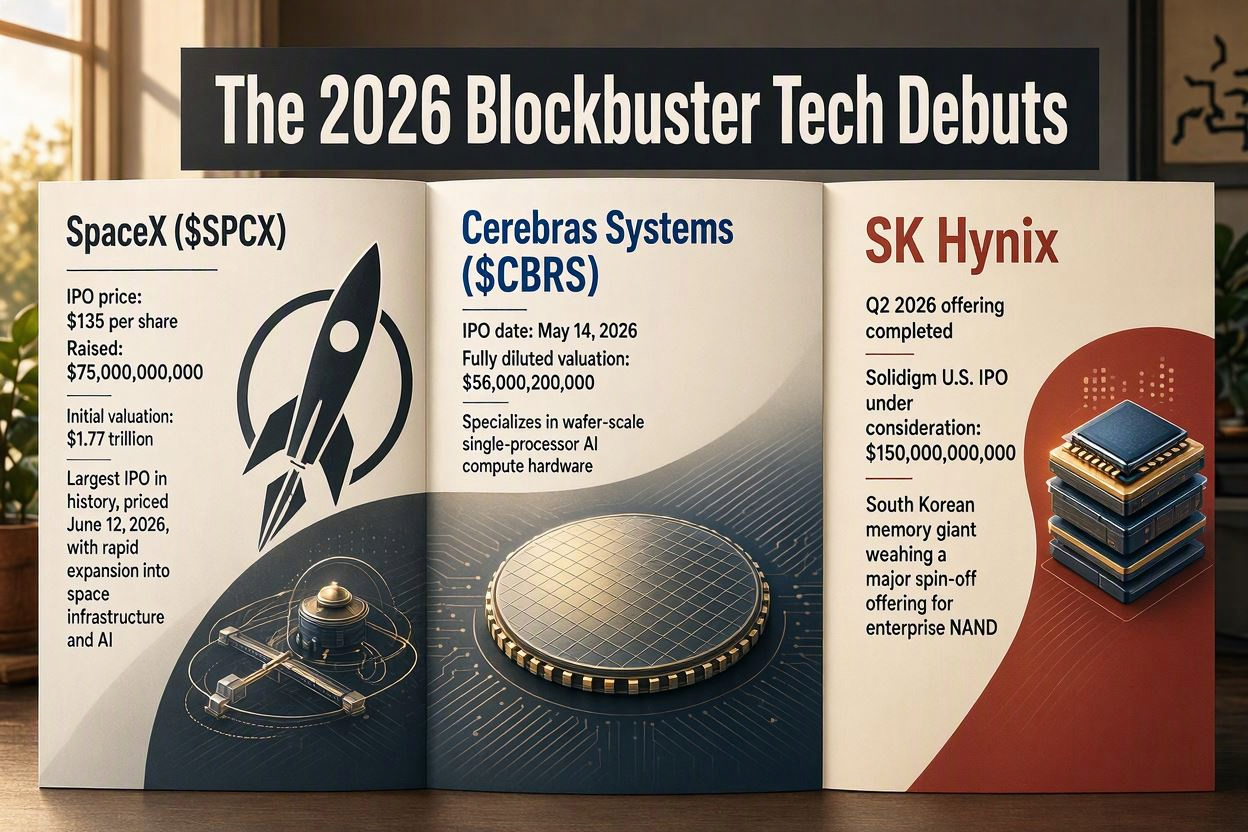
IPO get spot market |Energy & Semiconductor
■ $SKHYX (+5,85%) , $CBRS , $SPCX (+1,15%)
• From IPO in stock market 2026 after oil makes peak top position on market cycle in traditional event every 4 years, they makes spot point to get momentum.
• Best prices to start in get market position with 90 day and starting to find market cap still have on trade market from option and ETF. ✅️⌛️
• Keep on stay to hold and get in 12 month performance with cycle time frame next years.
• Agenda Split Stock from $SNDK (+6,06%) , $LITE (+1,79%) , $STX (+3,53%) , $ASML (+1,69%) , $MU (+3,48%)
11

1Mês·
🚀 Added SpaceX to my portfolio—and the real buying pressure is yet to come! 💥
Why did I $SPCX (+1,15%) ? The simple answer is: Index mechanics. 📊
With a market capitalization of around 2 trillion U.S. dollars, no major index can ignore SpaceX anymore.
What many people underestimate:
Index funds (ETFs) must hold the stock as soon as it’s included in indices like the Nasdaq-100 or the Russell 1000/MSCI World.
When trillions in ETF capital flow mechanically into a stock with a relatively small free float, it creates enormous buying pressure.
Some indices are already adjusting their rules, and the S&P 500 will follow suit over time. Those who get in before the broad ETF wave positions themselves precisely for this flow. 📈
This is not investment advice!
88
5 Comentários
What if I told you that's already factored into the price 😬?
•
1010
•Títulos em alta
Principais criadores desta semana
Dados tempo real da LSX · Dados financeiros e EOD da FactSet