
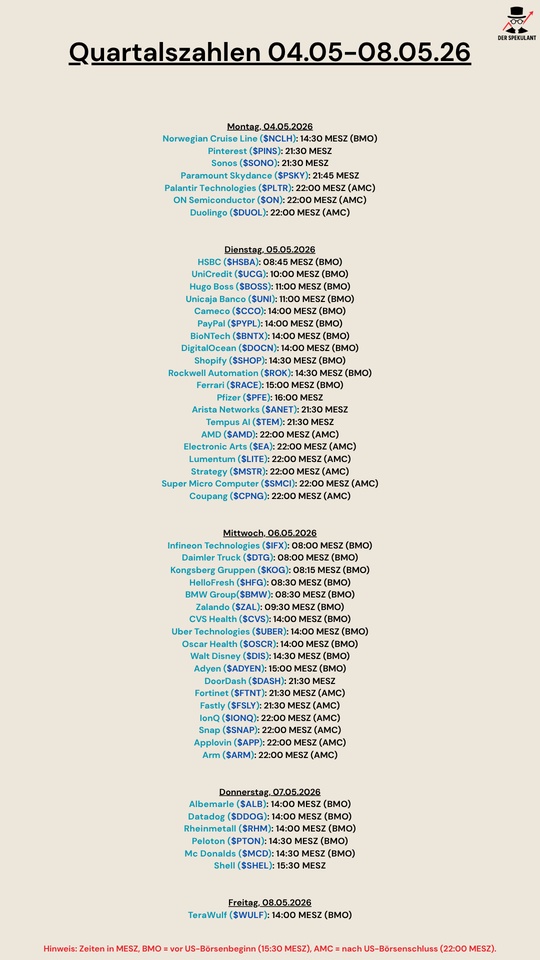
$NCLH (+2,71%)
$PINS (+3,35%)
$SONO (+0%)
$PARA (+2,37%)
$PLTR (-0,35%)
$DUOL
$HSBA (-0,84%)
$UCG (-1,09%)
$BOSS (+0,34%)
$UNI (+0%)
$CCO (+1,06%)
$PYPL (+0,96%)
$BNTX (+1,13%)
$DOCN (-0,64%)
$SHOP (+2,69%)
$ROK (-0,9%)
$RACE (+2,28%)
$PFE (+0,23%)
$ANET (-5,25%)
$TEM (+4,32%)
$AMD (-2,13%)
$EA
$LITE (-2,65%)
$MSTR (+1,24%)
$SMCI (-2,34%)
$CPNG (+2,09%)
$IFX (-2,57%)
$DTG (+0,92%)
$KOG (+1,26%)
$HFG (+5,5%)
$BMW (+1,15%)
$ZAL (+3,98%)
$CVS (+1,58%)
$UBER (+2,3%)
$OSCR (-2,84%)
$DIS (+1,28%)
$ADYEN (+3,07%)
$DASH (+3,95%)
$FTNT (-1,72%)
$FSLY (+0,09%)
$IONQ (+6,5%)
$SNAP (+5,13%)
$APP (+5,92%)
$ARM (+2,36%)
$ALB (-0,23%)
$DDOG (-1,25%)
$RHM (+5,78%)
$PTON (+4,69%)
$MCD (+1,19%)
$SHEL (-0,47%)
$WULF (+9,6%)

Albemarle
Ação
Ação
Ticker: ALB
ALB
Price
Discussão sobre ALB
Postos
465Mês·
Quarterly figures 04.05-08.05.26
1212

5Mês·
Nightmares
$ALB (-0,23%) to new highs ? what do you think?
99
1 Comentar
Cashflow I.@Cashflow_Investor
5Mês
•
22
•

6Mês·
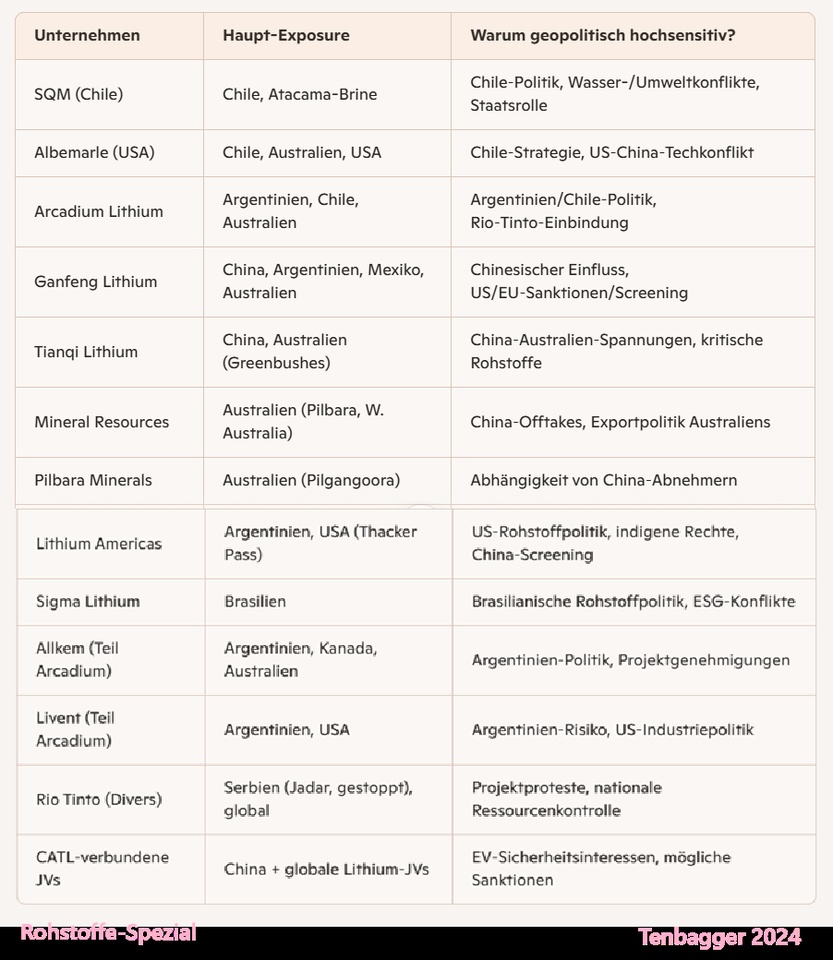
Why the Iran war is affecting lithium
$ALB (-0,23%)
$LAC (+7,39%)
$SLI (+1,56%)
My dears, I remain invested in Albemarle.
In short, the Iran war is driving lithium prices significantly higher because geopolitical risks, supply chain disruptions and the strategic importance of the metal are increasing massively. The fear of shortages and the use of lithium as geopolitical leverage is having a particularly strong impact.
🔍 Why the Iran war is affecting lithium
🌍 1. geopolitical uncertainty → price shock
- The price of lithium has risen sharply since the escalation began: +130 % over the year and +12 % in the last month. This correlates directly with the military tensions and concerns about blockades of important trade routes.
🚢 2. blockade of the Strait of Hormuz
- Although the Strait of Hormuz is not a major route for lithium, it is a critical route for energy and global trade.
- The blockade leads to massive disruption to global tradewhich also makes the transportation of other raw materials more expensive and slower.
🛡️ 3. Lithium becomes a defense raw material
- In 2026, lithium is no longer just a battery raw material, but a strategic strategic defense commodity.
- Military demand (drones, energy storage, mobile systems) is increasing - and with it prices.
🇮🇷 4. Iran claims large lithium reserves
- Iran speaks of 8.5 million tons of lithium reserves.
- In a conflict scenario, this can be used as political leverage similar to oil in previous crises.
🔗 5. supply chain stress due to energy crisis
- The war leads to extreme oil and gas priceswhich makes the entire extraction of raw materials more expensive - including lithium mining and transportation.
📈 What does this mean for lithium investors?
In the short term
- Extremely high volatility
- Prices react sensitively to every headline from the Middle East
- Lithium shares benefit disproportionately
Medium term
- Sustained high prices likelyas long as the conflict remains unresolved
- Military demand + energy transition = structurally increasing demand
- Risk: Should Iran actually develop large reserves, this could have a dampening effect in the long term
Long-term
- New geopolitical alliances could reorganize the lithium market
- Countries without their own deposits (EU, Japan, South Korea) will expand strategic partnerships
- Diversification of supply chains (Chile, Australia, Canada, Africa) will be accelerated
🧭 Conclusion for you
The Iran war acts as a catalyst for lithium: higher prices, greater strategic importance, higher volatility. For investors, this means opportunities - but also geopolitical risks that need to be actively managed.
1313

6Mês·
LIT
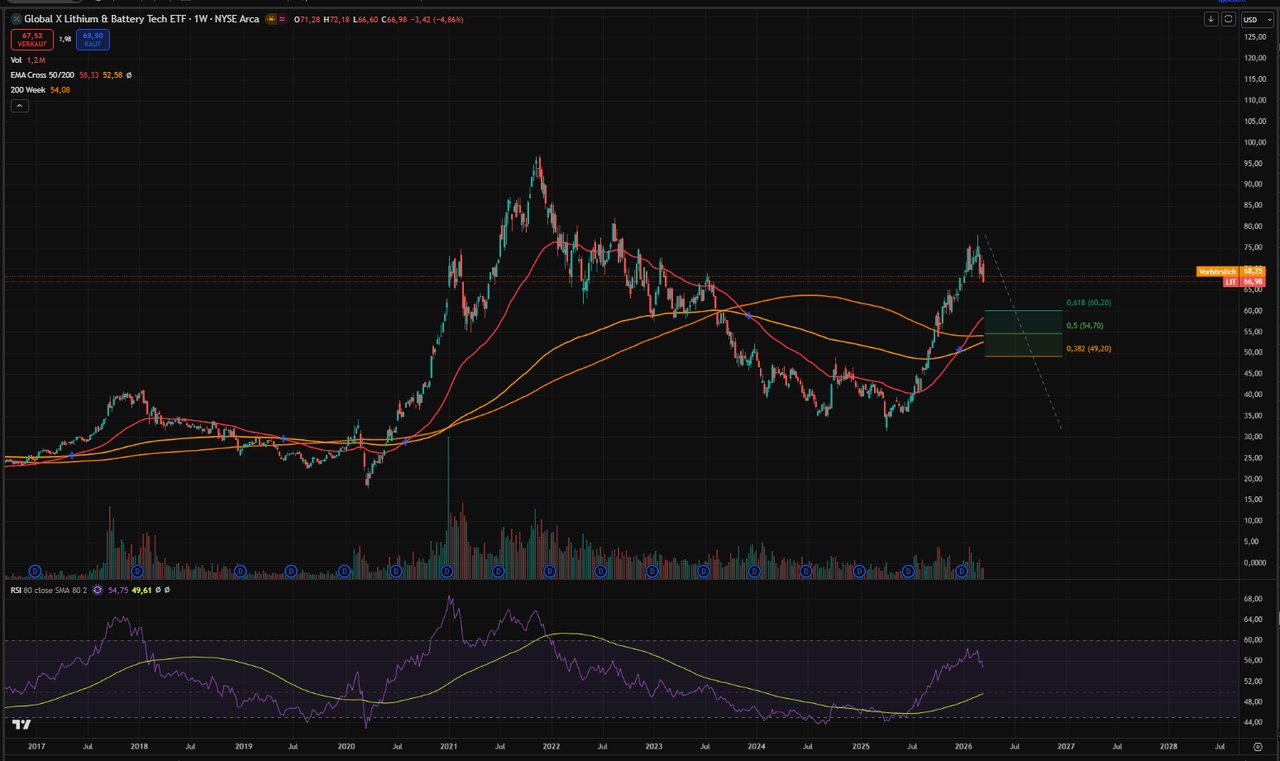
A small find from the weekend in the $LIT (-1,62%)
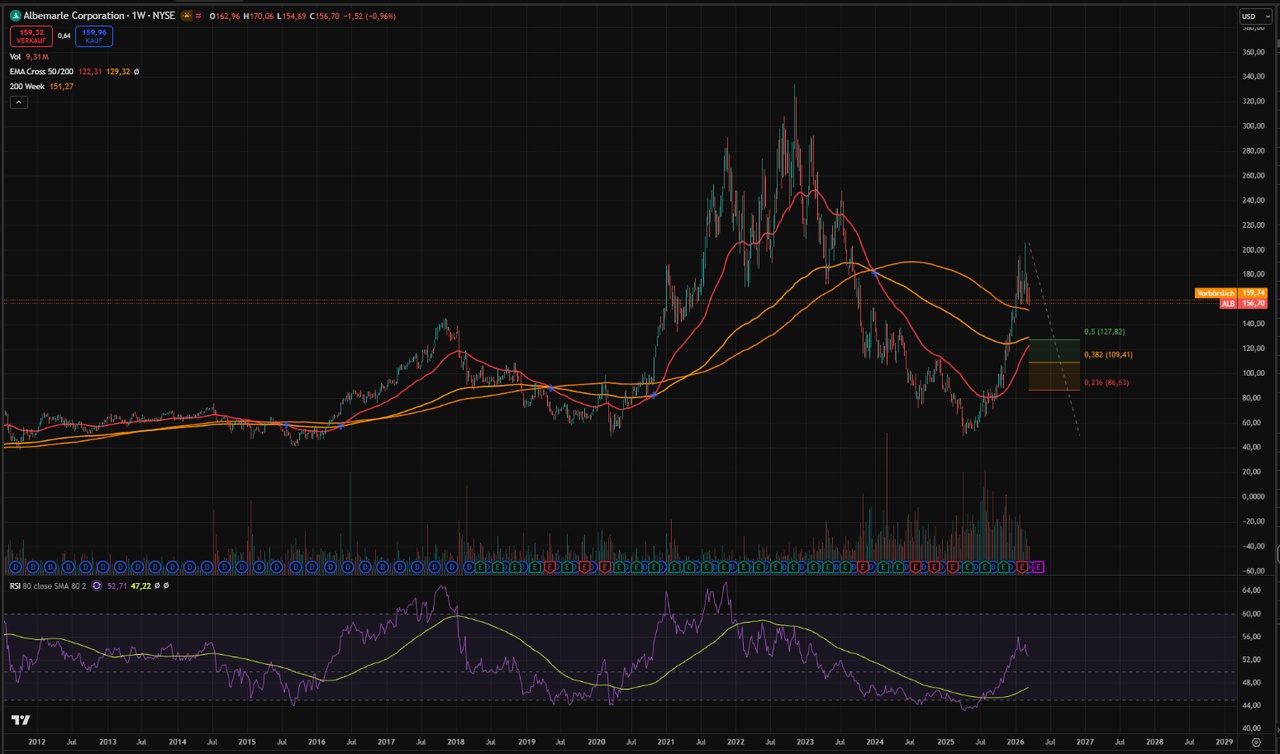
The charts and also the RSIs look juicy at the moment, exactly how you want to see it. The weekly RSI has turned upwards again for the first time after 4 years of correction, and quite strongly at that. After the next retest of the averages, things could get really interesting.
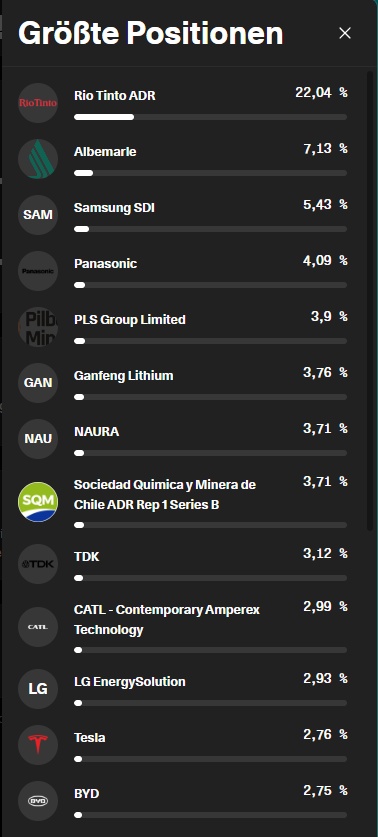
The composition of the stocks in the $LIT (-1,62%) is absolutely wild.
$RIO (-1,39%) , $ALB (-0,23%) , $0L2T (-6,81%) , $3750 (-3,68%) , $TSLA (-1,87%) , $1211 (+0,9%) ....that always reminds me of the legendary DSF indoor tournaments with Ailton and co. The ETF could also be called Budenzauber.
Otherwise, charts from $ALB (-0,23%) look similar. Nice breakout above the moving averages and could become interesting after the next correction.
Does anyone else happen to be watching these stocks?
44
8Mês·
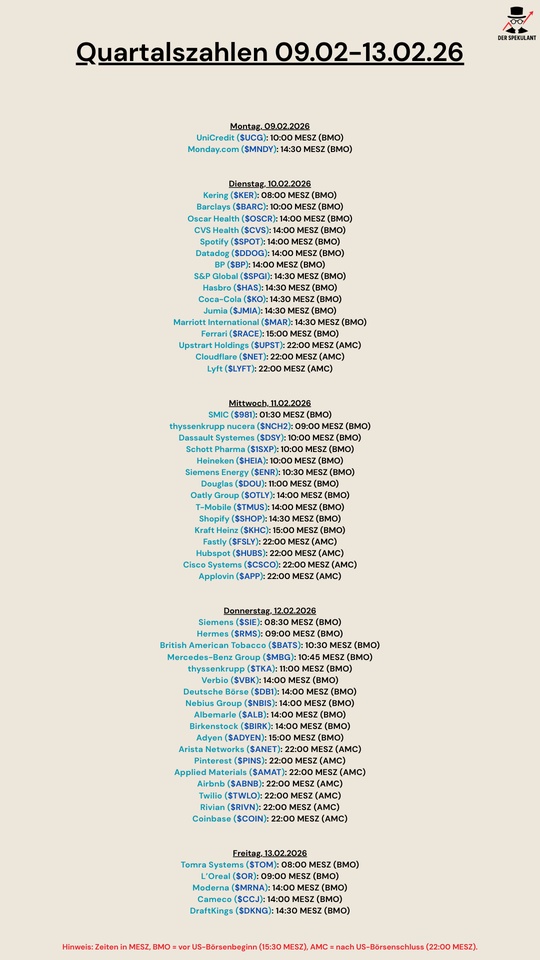
Quarterly figures 09.02-13.02.26
$UCG (-1,09%)
$MNDY (+7,74%)
$KER (+2,52%)
$BARC (+0,69%)
$OSCR (-2,84%)
$CVS (+1,58%)
$SPOT (+1,29%)
$DDOG (-1,25%)
$BP. (-1,48%)
$SPGI (+3,46%)
$HAS (+2,5%)
$KO (-0,55%)
$JMIA (+5,01%)
$MAR (+3,04%)
$RACE (+2,28%)
$UPST (+7,79%)
$NET (-2,79%)
$LYFT (+3,73%)
$981
$NCH2 (-6,87%)
$DSY (+3,37%)
$1SXP (-0,1%)
$HEIA (+1,52%)
$ENR (-0,98%)
$DOU (+2,59%)
$OTLY (+0%)
$TMUS (-0,91%)
$SHOP (+2,69%)
$KHC (+1,97%)
$FSLY (+0,09%)
$HUBS (+5,46%)
$CSCO (-4,35%)
$APP (+5,92%)
$SIE (-1,12%)
$RMS (+3,78%)
$BATS (+2,08%)
$MBG (+1,28%)
$TKA (+1,85%)
$VBK (-3,92%)
$DB1 (+0,64%)
$NBIS (+0,44%)
$ALB (-0,23%)
$BIRK (+5,27%)
$ADYEN (+3,07%)
$ANET (-5,25%)
$PINS (+3,35%)
$AMAT (-4,16%)
$ABNB (+3,66%)
$TWLO (+0,27%)
$RIVN (+0,44%)
$COIN (+4,59%)
$TOM (-0,64%)
$OR (+3,5%)
$MRNA (+3,98%)
$CCO (+1,06%)
$DKNG (+1,03%)
1313
1 Comentar

8Mês
•
22
•
8Mês·
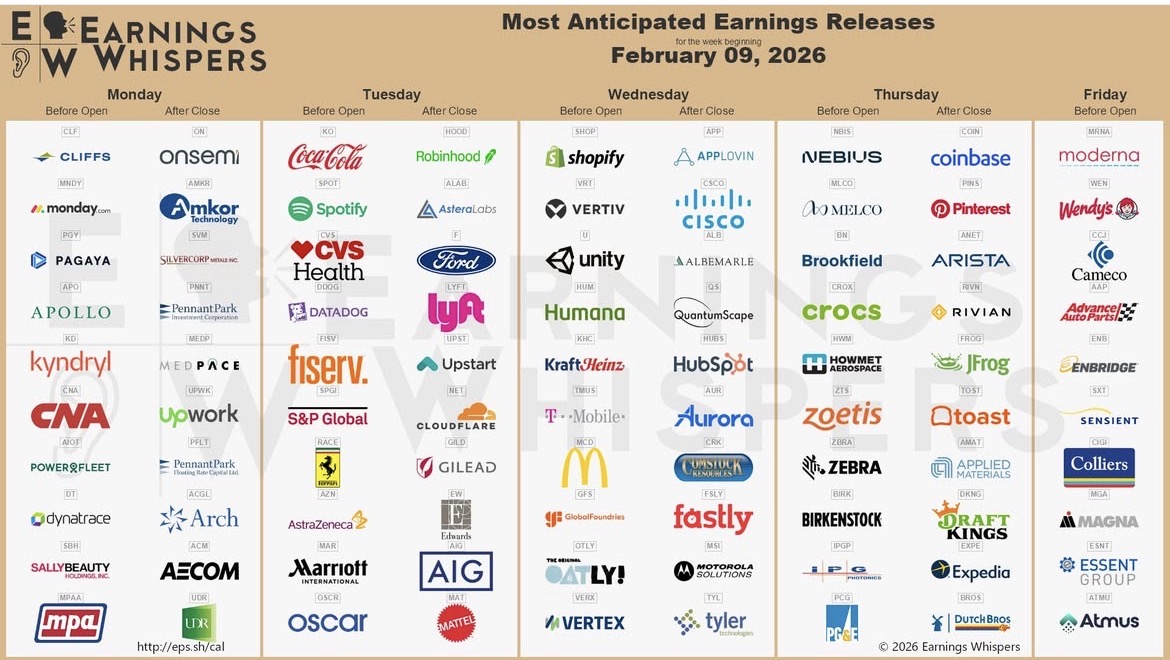
Will the sell-off continue next week?
$MNDY (+7,74%)
$PGY
$APO (-1,82%)
$ON (-0,38%)
$AMKR (-1,85%)
$MEDP (+1,36%)
$UPWK (+3,06%)
$ACGL (+1,69%)
$ACM (+0,96%)
$KO (-0,55%)
$SPOT (+1,29%)
$CVS (+1,58%)
$DDOG (-1,25%)
$FI (+2,5%)
$SPGI (+3,46%)
$RACE (+2,28%)
$AZN (+2,27%)
$MAR (+3,04%)
$OSCR (-2,84%)
$HOOD (+1,96%)
$ALAB (+1,12%)
$F (+1,76%)
$LYFT (+3,73%)
$UPST (+7,79%)
$NET (-2,79%)
$GILD (+1,91%)
$EW (+1,47%)
$SHOP (+2,69%)
$VRT (-4,37%)
$HUM (+0,52%)
$KHC (+1,97%)
$MCD (+1,19%)
$9ZX1
$TMUS (-0,91%)
$APP (+5,92%)
$CSCO (-4,35%)
$ALB (-0,23%)
$HUBS (+5,46%)
$TYL (+2,46%)
$NBIS (+0,44%)
$BN (+1,96%)
$CROX (+5,7%)
$ZTS (+3,23%)
$BIRK (+5,27%)
$COIN (+4,59%)
$ANET (-5,25%)
$RIVN (+0,44%)
$TOST (+7,67%)
$AMAT (-4,16%)
$DKNG (+1,03%)
$WEN (+4%)
$CCO (+1,06%)
$ENB (-1,7%)

8Mês·
📊 Weekly Stock Market Outlook: Key Stocks to Watch This Week
🔍 Market Context
This week, markets remain highly sensitive to macroeconomic data, interest rate expectations, and sector rotation. While broad indices are holding up, the underlying tone is selective rather than euphoric.
Investors are increasingly focusing on:
- Inflation and growth signals
- Central bank policy expectations
- Geopolitical risks
- Rotation between growth, defensive, and cyclical sectors
This is a market where clear catalysts and strong narratives matter more than ever.
📌 Macro Overview & Key Events of the Week
👉 This is a shortened trading week in the U.S. due to the Martin Luther King Jr. holiday (markets closed on Monday), which could increase volatility.
- Trump is expected to speak at the World Economic Forum (Davos), potentially impacting global market sentiment.
- Key macroeconomic data (PCE inflation, GDP) will be released and could drive broad market moves.
- Geopolitical tensions, particularly related to tariffs and European defense spending, may support specific sectors.
Market sentiment summary: mixed — elevated geopolitical risk, but continued strength in cyclical and materials sectors.
📈 Stocks to Watch This Week
🔹 NVIDIA ($NVDA (-2,34%) ) – Technology / Artificial Intelligence
Investment Thesis:
NVIDIA remains the backbone of the artificial intelligence revolution. Its dominance in high-performance GPUs and data-center infrastructure makes it the primary beneficiary of continued AI investment.
Key Catalysts This Week:
- Persistent capital flows into AI-related stocks
- Strong long-term revenue growth expectations
- Sustained technical momentum
Risks:
Valuation remains elevated, and any sign of slowing demand or negative macro surprises could trigger short-term pullbacks.
🔹 Lockheed Martin ($LMT ) – Defense
Investment Thesis:
Ongoing geopolitical tensions continue to support defense spending globally. Lockheed Martin benefits from long-term government contracts and stable cash flows.
Key Catalysts This Week:
- Increased focus on defense budgets
- Defensive sector appeal in volatile markets
- Attractive dividend yield
Risks:
Lower growth profile compared to technology stocks; price moves tend to be more gradual.
🔹 Albemarle ($ALB (-0,23%) ) – Materials / Lithium
Investment Thesis:
After a prolonged downturn, lithium stocks are showing early signs of stabilization. Any improvement in EV demand or pricing expectations could lead to sharp rebounds.
Key Catalysts This Week:
- Potential bottoming in lithium prices
- Short-covering and renewed speculative interest
- Long-term EV and energy storage demand
Risks:
High volatility and strong dependence on commodity cycles.
🔹 GE Aerospace ($GE ) – Industrials
Investment Thesis:
GE Aerospace benefits from the recovery in global air travel and long-term aircraft engine contracts. It also offers exposure to industrial growth outside of technology.
Key Catalysts This Week:
- Earnings and guidance updates
- Strong order backlog
- Sector rotation toward industrials
Risks:
Sensitivity to economic slowdowns and global demand.
📉 Weekly Risks
🔻 Tariffs and Geopolitical Tensions
Dow Jones futures are under pressure following renewed tariff-related news involving Europe.
🔻 Volatility Driven by Economic Data
Upcoming PCE inflation and GDP data releases could move markets unexpectedly — risk positioning is key.
🔻 Weakness in Tech vs. the Broader Market
Sector rotation remains in place, with investors shifting capital toward industrials and materials.
33

9Mês·
Brief insight into my portfolio and how I'm approaching 2026
I thought I'd write a few thoughts on my portfolio and why I hold these positions.
Basically:
I don't try to time the market or rebalance every week. It's more important for me to understand what I'm holding and why, so that I can relax during weaker phases.
$IWDA (-0,1%) MSCI World
My foundation. Gives me stability and takes the pressure off having to solve everything via individual stocks.
$NVDA (-2,34%)
$AMD (-2,13%) NVIDIA & AMD
Clear focus on AI and computing power. High valuation, but also real demand and massive cash flows. Fluctuates strongly, but is a deliberate part of my portfolio.
$PATH (+3,85%) UiPath
Higher risk, but also high optionality. Automation is still a long way off. Small position that can grow.
$ILMN (-1,97%) Illumina
Heavily penalized, a lot of uncertainty, but still extremely relevant in technological terms. For me, a classic turnaround bet with patience and therefore higher weighting.
$ALB (-0,23%) Albemarle
Cyclical, unloved, which is precisely why it is interesting. Lithium will not disappear, even if the market feels otherwise.
$TTWO (+3,35%) Take-Two Interactive
GTA 6 is priced in.
The only question is how. Plan to hold the position tactically rather than forever.
$NOVO B (+2,74%) Novo Nordisk
Quality. Strong growth, huge market, clear market leadership.
$ADBE (+4,05%) Adobe
Market leader, recurring revenue, AI integration. Not a hype play, but a solid long-term business.
My plan for 2026:
Continue to invest monthly
Don't put everything into shares straight away
Use setbacks
don't sell anything just because it gets uncomfortable!
I realize that this is not a perfect portfolio.
But it's my system and I sleep soundly with it.
I would also be very happy to hear any thoughts or questions :)
I would be interested:
How are you positioned in 2026?
More defensive, more risk or just carry on as before?
Have a nice day!
9Posições
€ 6.643,16
32,14%
88
11 Comentários
Welcome to the active community. Apart from $NOVO B, I think your portfolio is good. I think there are more interesting stocks with more potential in the pharmaceutical sector. But that is a matter of taste and I only judge the individual stocks. I have no idea about ETFs.
Otherwise, I'll carry on as before. There's no reason to change anything.
Otherwise, I'll carry on as before. There's no reason to change anything.
•
55
•
9Mês·
🚀 Momentum strategy 2026: Update & objective 📈
Happy New Year everyone! 🎆 Just in time for the start of the year, I would like to share my portfolio update for the Top 8 share pool with you and give you an outlook for 2026.
First things first: no one knows whether 2026 will be a bull or bear year. Predictions for individual assets are often dubious. That's why I'm sticking to my rule-based model and present you with the current top 10.
🔝 My top 8 for the preselection 1st half of 2026:
Rank Share Sector Momentum Score
1 Western Digital ($WDC (-2,94%) IT / Storage solutions 115,2 %
2 Warner Bros. Discovery ($WBD ) Communication / Media 103,8 %
3 Micron Technology ($MU (+1,5%) ) IT / Semiconductor 103,2 %
4 Seagate Tech ($STX (-4,72%) IT / storage solutions 83,0 %
5 Albemarle ($ALB (-0,23%) Chemicals / Lithium 74,7 %
6 Teradyne ($TER (-5,02%) IT / semiconductor test 67,3 %
7 Newmont ($NEM (+3,89%) ) Commodities / Gold 66,4 %
8 AppLovin ($APP (+5,92%) Software / AdTech 64,4 %
(Closely followed by $HOOD (+1,96%)
and $LRCX (-3,49%)
in 9th & 10th place).
🔍 A few insights into the model:
The sector weighting is exciting this time. We see a strong cluster risk (but also momentum!) in the area of Memory technology and semiconductors.
Interesting: Almost all of the stocks did not perform until the 2nd half of 2025 generated. As my filter weights the most recent past more heavily than the older past, these stocks were flushed to the top. This could be a signal that the trend here is continuing to gather pace.
And which two stocks are we starting 2026 with?
They are still $MU (+1,5%) and $WDC (-2,94%) as these are the two leaders in the ranking within the share pool, in 3rd and 4th place by a relatively large margin.
This means that no action is required for the time being and the next check will not take place until the end of January.
🎯 My goal for 2026: The €50,000 mark
I'm starting with capital of 31.000 €. For motivation, I have created my projections based on various return scenarios:
My personal goal for the end of 2026 is a portfolio value of approx. 50.000 €. This requires a performance of around 60 %. Sporty? Yes. Impossible with momentum? No.
What is your assessment?
Especially with the memory values ($WDC (-2,94%) , $MU (+1,5%) , $STX (-4,72%) are often a divisive issue. Do you still see the sector as the leader in 2026 or will it soon run out of steam? 💬
I wish you all a successful year on the stock market and, above all, good health! 🍀
9Mês·
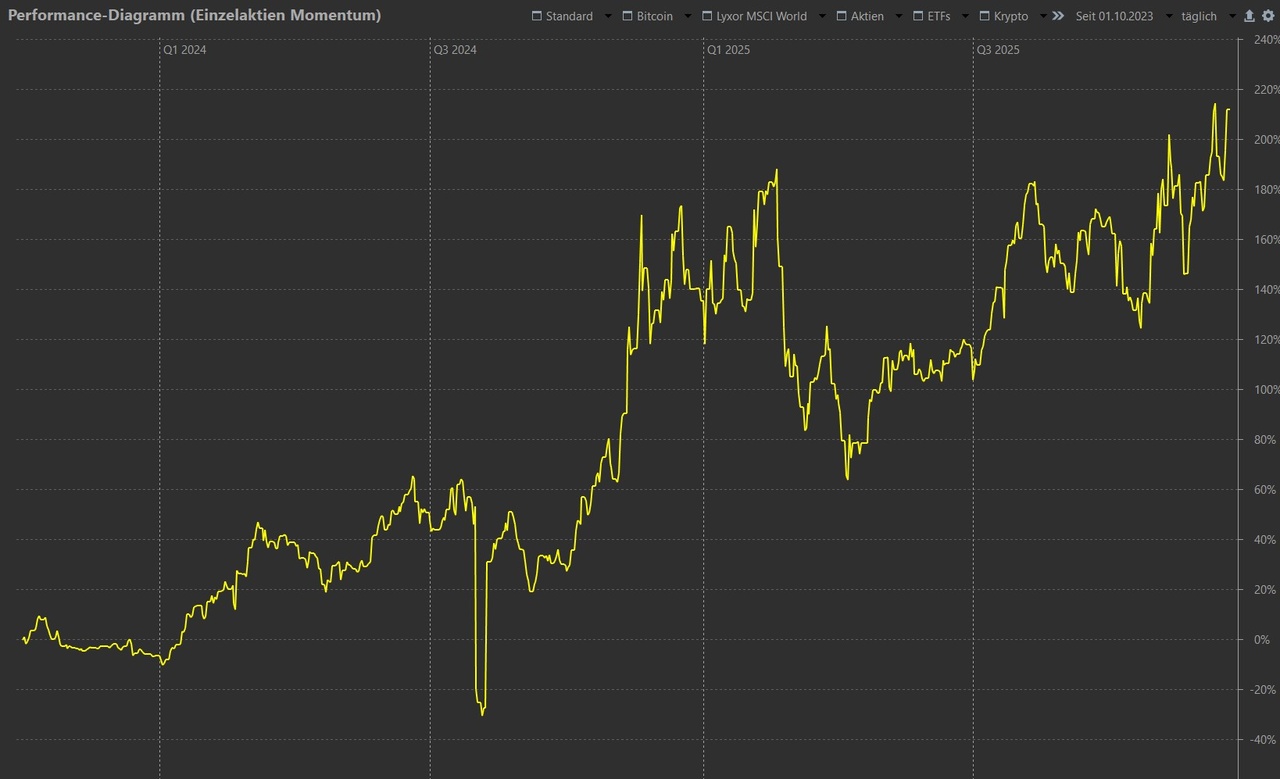
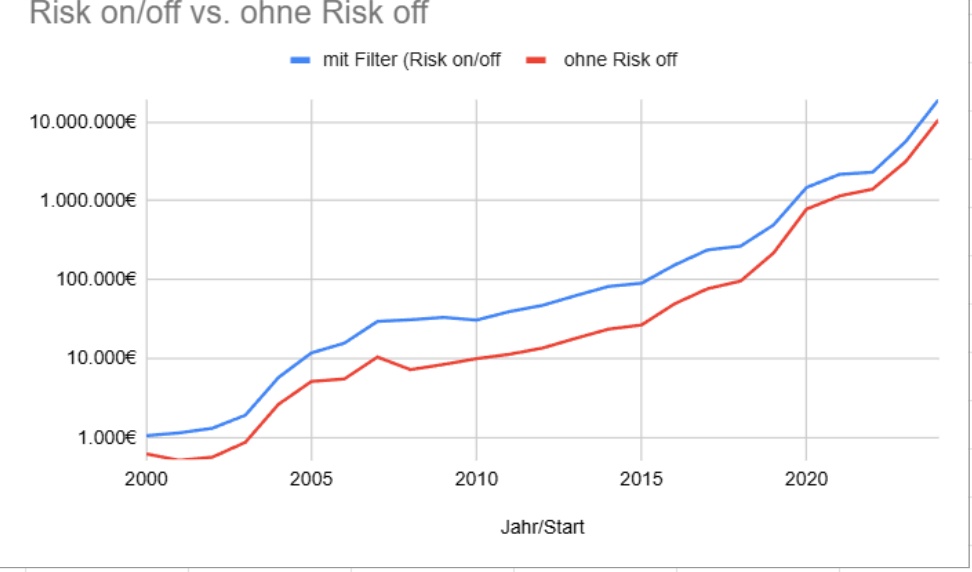
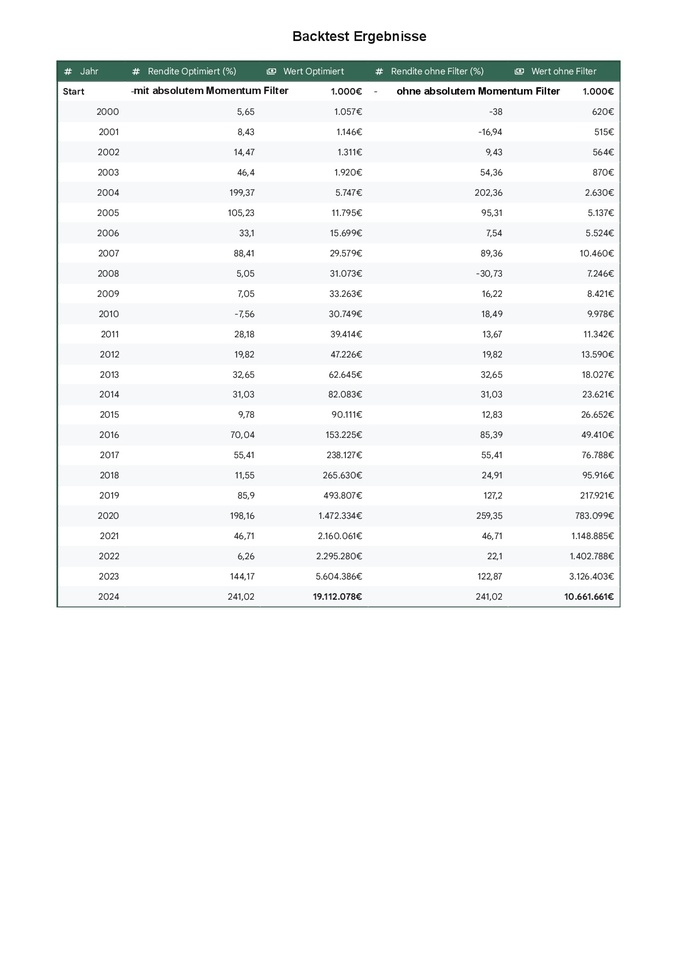
56% CAGR since 2000? Just utopian theory or actually possible? 📈🛡️ My path of single stock momentum investing
Foreword
I know what you're thinking. Is it time for finance porn again? You normally only see figures like this in dubious YouTube videos, WhatsApp or Telegram groups. But behind this theoretical performance is not a "magic trick", but a tough, quantitative set of rules. You will not only see the historical backtest returns below, but I will of course also show you the real returns that have been achieved since the start of the project. In the end, decide for yourself how realistic and how high the average annual return can be.
Introduction
Many private investors invest based on gut feeling, news headlines or "hot tips". I have decided to tune out the noise and put my trust in the bare figures. After months of development and intensive backtesting, today I present to you the logic of my S&P 500 Hybrid Momentum Model.
My goal: to motivate you to understand momentum not as "gambling" but as quantitative engineering and, of course, to get as close as possible to the returns of the backtest.
🔍 The origin: From ETF to individual stocks
It all started with classic momentum ETFs and strategies such as GTAA (Global Tactical Asset Allocation). But I wanted to know: Could this principle be transferred to individual stocks to significantly beat the market? After hundreds of backtests, analyzing various universes (SPY, QQQ) and sectors, I now have my set of rules.
💡 The basic idea: "Buy high, sell higher"
Winners" statistically continue to run, while "losers" continue to fall - Buying at the ATH is historically more profitable than buying at the ATL.
While value investors act according to the motto "buy low, sell high", momentum uses the statistical tendency: Winners keep on running.
- An all-time high (ATH) is not a warning signal, but a sign of strength.
- The opportunity costs (waiting on the sidelines) are historically often higher than the risk of buying at the peak.
🧩 The concept: a selective powerhouse
My approach is a purely quantitative set of rules that isolates the strongest trends in the S&P 500:
The Universe: Focus on the 500 most liquid US large caps (S&P 500).
The selection: A pool of 8 stocks is selected through a time-weighted momentum scoring filtered. More recent price developments (last 6 months) weigh more heavily in order to capture trend reversals early.
The anchors: Oil & crypto proxies flow in as strategic counterweights to generate additional performance in specific cycles (inflation/risk-on).
The safety belt (absolute momentum): To avoid massive drawdowns like in 2000 or 2008, the S&P 500 Index acts as a market filter. If the signal is negative, the model consistently switches to cash or money market cash or money market ETFs.
⚙️ Execution: focus on the leaders
A review takes place every month. Only the top 2 assets with the highest average score are held.
- Why only two? The model is optimized for maximum performance. Diversification (top 3 or top 5) would reduce the maximum drawdown slightly, but would significantly dilute performance. If you prefer a more relaxed and less volatile approach, it is better to diversify here.
- Capital preservation as a turbo: Those who lose less in crises benefit exponentially more from the next upswing due to compound interest.
📊 Performance & live results
The theoretical data (2000-2024) shows an impressive CAGR of 56 %. I have been actively implementing the model since the end of 2023 - with approx. 80% of my total portfolio out of full conviction:
Returns
- 2024 +152,1 %
- 2025 YTD: approx. +30 %
⚠️ Transparency on risk & volatility
High potential returns require iron discipline. The strategy is not for the faint-hearted:
- Maximum drawdown: In the backtest there were setbacks of up to -37% (dotcom bubble 2000).
- Psychology: The biggest enemy is not the market, but deviating from the rulebook in volatile phases.
- Costs & taxes: Since it is a theoretical model, transaction costs and taxes reduce the result in reality. Nevertheless, the alpha advantage remains massive.
Conclusion
I will provide regular updates here on how the model assesses the current phase. This is not the only way to be successful - but it is my systematic way.
Become the engineer of your own portfolio. Test, optimize and stay disciplined.
Do you have any questions about the topic or anything else? Let me know in the comments! 👇
#Momentum
#Investing
#SP500
#SystematicTrading
#Finanzen
#TradingStrategy
#Backtest
#Wealth
Risk warning: No investment advice. Historical prices do not guarantee future profits. Any investment can lead to a total loss.
PS: The strategy can now also be viewed/bookmarked as a wikifolio:
3838
87 Comentários
9Mês
Superbly written! I still think your model is a candidate for the gold standard for single stock momentum.
Perhaps I will use it for part of my trading portfolio? It's exciting and promising in any case!
Perhaps I will use it for part of my trading portfolio? It's exciting and promising in any case!
•
66
•
9Mês·
Investment decisions
Dear Getquinners,
I would be interested in your opinion again.
I would like to expand my portfolio with a few shares in the long term.
Long-term investment is my goal with good growth (target at least 10-12% annually), dividends are nice but not a must, may also have some risk (of course the position size will be adjusted accordingly).
Which positions would you punch (Austrian for sell🤣) from the existing ones in the portfolio or just add to them?
Stocks that I find interesting as additions:
-Netflix $NFLX (+2,29%)
-Broadcom $AVGO (-1,2%)
-Waste Management $WM (+2,86%)
-Zoetis $ZTS (+3,23%)
-Kawasaki Heavy $7012 (-2,87%)
-Intuitive $ISRG (+1,93%)
-Chipotle $CMG (-0,09%)
-Amgen $AMGN (+1,43%)
-Crowdstrike Hldg $CRWD (-2,63%)
-Vistra Corp $VST (+1,45%)
-Constellation PA $CEG (-2,07%)
-Amphenol $APH (-2,04%)
-Nestle $NESN (+2,69%)
-Monster Beverage $MNST (+1,56%) (I love Monster)
-AMD $AMD (-2,13%)
-Palo Alto Networks $PANW (-1,61%)
-Contemporary Amperex $3750 (-3,68%)
-Albermale $ALB (-0,23%)
-Synopsys $SNPS (-2,73%)
-Taiwan Semiconductor $TSM (-2,59%)
-Datadog $DDOG (-1,25%)
-Itochu $8001 (+0,48%)
-Eaton $ETN (-1,95%)
-Procter&Gamble $PG (-0,21%)
-Pepsico $PEP (-1,21%)
-Coca Cola $KO (-0,55%)
-Hims&Hers $HIMS (+4,71%)
-Kraken Robotics $PNG (-3,56%)
etc.
There are so many interesting titles that you can easily be overwhelmed.^^
At the moment mainly the $VWRL (-0,25%) and $BTC (-0,49%) monthly, share purchases are made when opportunities arise. (Financially and chart-wise).
I look forward to your opinion.
14Posições
€ 58.880,41
13,67%
1010
Títulos em alta
Principais criadores desta semana
Dados tempo real da LSX · Dados financeiros e EOD da FactSet