2Mês·

56% CAGR since 2000? Just utopian theory or actually possible? 📈🛡️ My path of single stock momentum investing

Foreword


I know what you're thinking. Is it time for finance porn again? You normally only see figures like this in dubious YouTube videos, WhatsApp or Telegram groups. But behind this theoretical performance is not a "magic trick", but a tough, quantitative set of rules. You will not only see the historical backtest returns below, but I will of course also show you the real returns that have been achieved since the start of the project. In the end, decide for yourself how realistic and how high the average annual return can be.


Introduction


Many private investors invest based on gut feeling, news headlines or "hot tips". I have decided to tune out the noise and put my trust in the bare figures. After months of development and intensive backtesting, today I present to you the logic of my S&P 500 Hybrid Momentum Model.


My goal: to motivate you to understand momentum not as "gambling" but as quantitative engineering and, of course, to get as close as possible to the returns of the backtest.


🔍 The origin: From ETF to individual stocks


It all started with classic momentum ETFs and strategies such as GTAA (Global Tactical Asset Allocation). But I wanted to know: Could this principle be transferred to individual stocks to significantly beat the market? After hundreds of backtests, analyzing various universes (SPY, QQQ) and sectors, I now have my set of rules.


💡 The basic idea: "Buy high, sell higher"


Winners" statistically continue to run, while "losers" continue to fall - Buying at the ATH is historically more profitable than buying at the ATL.


While value investors act according to the motto "buy low, sell high", momentum uses the statistical tendency: Winners keep on running.


  • An all-time high (ATH) is not a warning signal, but a sign of strength.
  • The opportunity costs (waiting on the sidelines) are historically often higher than the risk of buying at the peak.


🧩 The concept: a selective powerhouse


My approach is a purely quantitative set of rules that isolates the strongest trends in the S&P 500:


The Universe: Focus on the 500 most liquid US large caps (S&P 500).

The selection: A pool of 8 stocks is selected through a time-weighted momentum scoring filtered. More recent price developments (last 6 months) weigh more heavily in order to capture trend reversals early.

The anchors: Oil & crypto proxies flow in as strategic counterweights to generate additional performance in specific cycles (inflation/risk-on).

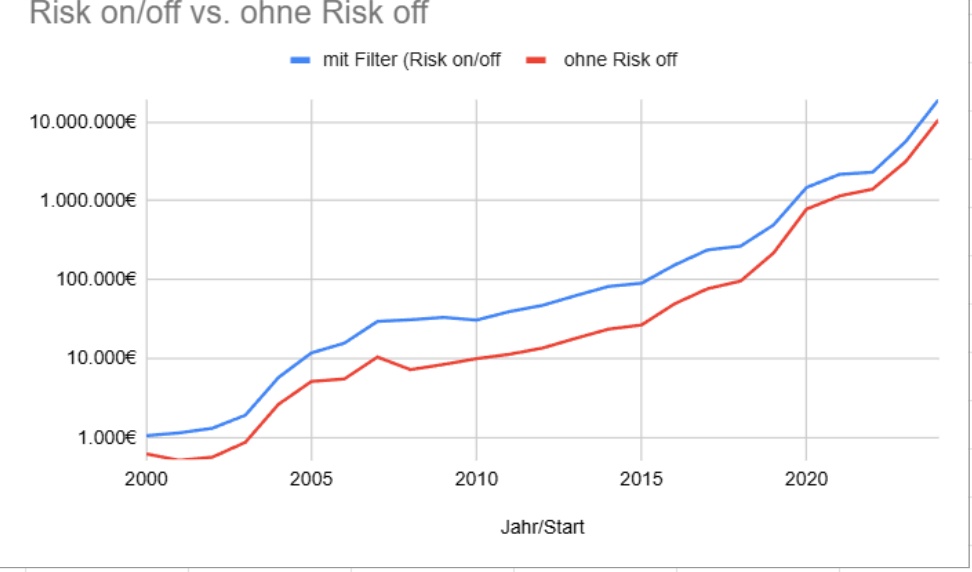
The safety belt (absolute momentum): To avoid massive drawdowns like in 2000 or 2008, the S&P 500 Index acts as a market filter. If the signal is negative, the model consistently switches to cash or money market cash or money market ETFs.


⚙️ Execution: focus on the leaders


A review takes place every month. Only the top 2 assets with the highest average score are held.


  • Why only two? The model is optimized for maximum performance. Diversification (top 3 or top 5) would reduce the maximum drawdown slightly, but would significantly dilute performance. If you prefer a more relaxed and less volatile approach, it is better to diversify here.


  • Capital preservation as a turbo: Those who lose less in crises benefit exponentially more from the next upswing due to compound interest.


📊 Performance & live results


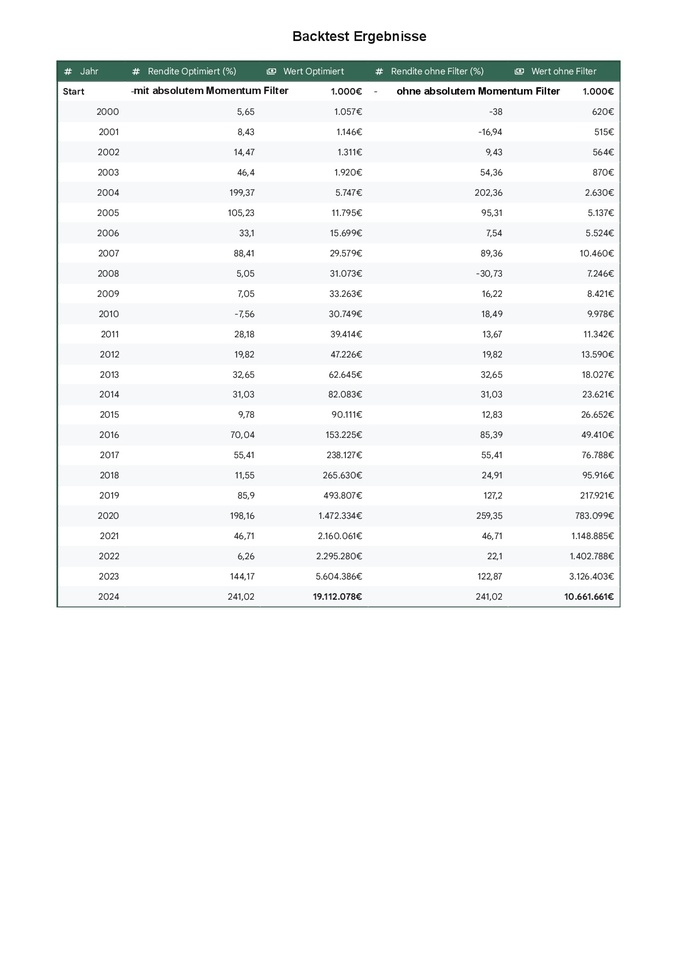
The theoretical data (2000-2024) shows an impressive CAGR of 56 %. I have been actively implementing the model since the end of 2023 - with approx. 80% of my total portfolio out of full conviction:
attachment
attachment


Returns

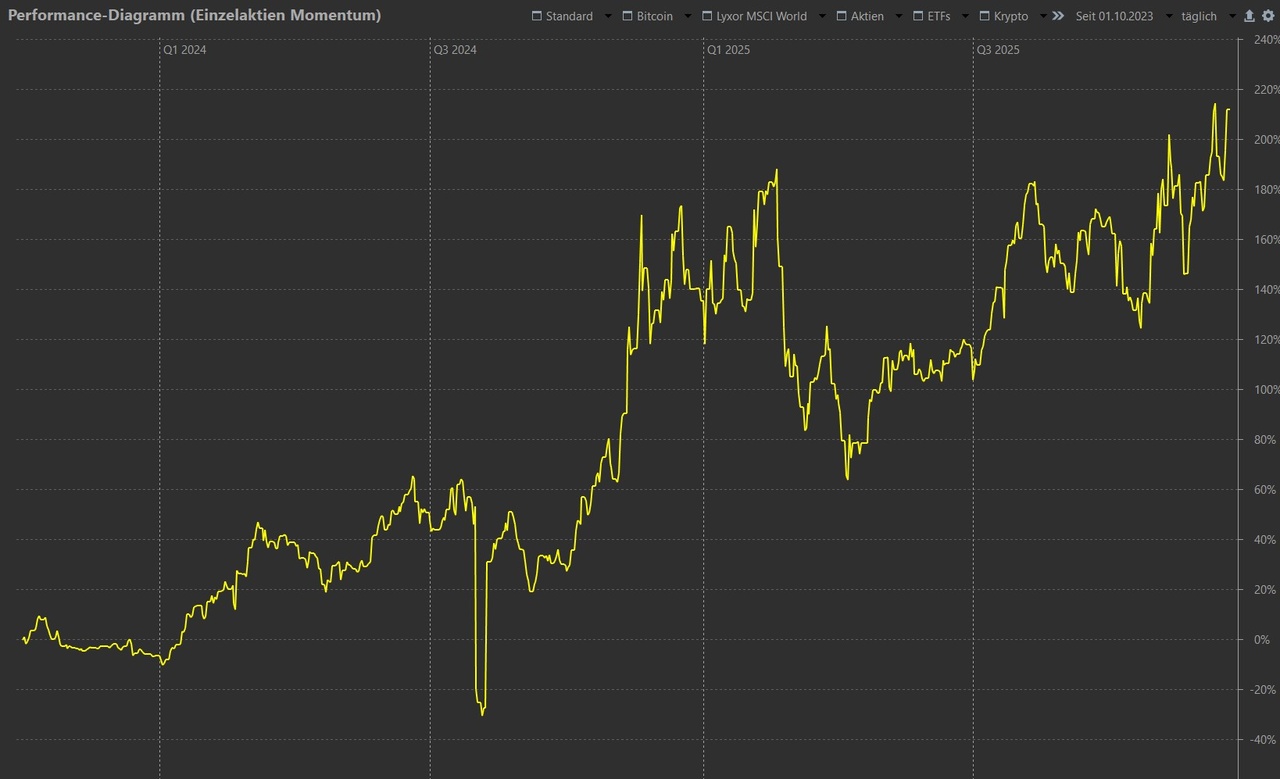
  • 2024 +152,1 %
  • 2025 YTD: approx. +30 %


attachment


⚠️ Transparency on risk & volatility

High potential returns require iron discipline. The strategy is not for the faint-hearted:

  • Maximum drawdown: In the backtest there were setbacks of up to -37% (dotcom bubble 2000).
  • Psychology: The biggest enemy is not the market, but deviating from the rulebook in volatile phases.
  • Costs & taxes: Since it is a theoretical model, transaction costs and taxes reduce the result in reality. Nevertheless, the alpha advantage remains massive.


Conclusion

I will provide regular updates here on how the model assesses the current phase. This is not the only way to be successful - but it is my systematic way.


Become the engineer of your own portfolio. Test, optimize and stay disciplined.


Do you have any questions about the topic or anything else? Let me know in the comments! 👇


#Momentum
#Investing
#SP500
#SystematicTrading
#Finanzen
#TradingStrategy
#Backtest
#Wealth


Risk warning: No investment advice. Historical prices do not guarantee future profits. Any investment can lead to a total loss.


PS: The strategy can now also be viewed/bookmarked as a wikifolio:


US Momentum Leaders | wikifolio.com

47
57 Comentários

imagem de perfil
Very interesting! I would be interested to know how you implement this strategy: Do you place your orders manually? What is a sell signal in your strategy? (Touching the 200/100/50 day line, or a percentage below the ATH?)
7
Ver todas as 7 restantes respostas
imagem de perfil
This year I also selected stocks based on momentum in my stock ideas. However, I still filtered for a falling P/E ratio and earnings growth of over 20%. And some USERS who bought after the presentation. Were grateful for that.
@Multibagger @Crash-Propheteus.
Can you perhaps tell us about your individual stocks in between?
5
Ver todas as 4 restantes respostas
imagem de perfil
Interesting, the return corresponds to my expectations! However, due to my small capital, it is very difficult to implement. So I will probably stick with my high-risk approach to achieve an excess return until my portfolio has reached a relevant size in terms of volume.
3
Ver todas as 3 restantes respostas
imagem de perfil
Really very interesting. I look forward to the updates. 👍
3
imagem de perfil
Very interesting!

I have some questions about the math behind it:
- How exactly do you calculate the momentum score - e.g. sum[weights_time_window * normalized momentum_time_window]?
- How high do you weight which time windows?
- What method do you use to evaluate the momentum of the S&P 500 for the possible switch to cash?
4
Mostrar resposta
imagem de perfil
2Mês
Superb work!
What do you think is the capital framework with which the model can be implemented?
Below €1k, transaction costs are likely to have an impact, above €1m, market liquidity is likely to be difficult. Or what do you think?
3
Mostrar resposta
imagem de perfil
Interesting to note: There is a wikifolio that almost exactly replicates this strategy, only with Top10 instead of Top2 and without pre-selection (pool) as far as I know.
However, it has performed very lousily so far and has tended to move sideways.
ISIN: DE000LS9SHS4
Have you ever thought about publishing your strategy as a wikifolio?
1
Ver todas as 9 restantes respostas
imagem de perfil
@Krush82 Is there any news on which 2 stocks will continue on Monday?
1
Mostrar resposta
imagem de perfil
Hi @Krush82 ☺️ Very strong model! How exactly do you choose your stocks? So which ones come into question at all? Or really all large caps in the S&P 500 and then "stubbornly" according to dual momentum?
1
Mostrar resposta
imagem de perfil
In my opinion, the filter only protected against the drawdown of 2000. The 2008 drawdown was actually only spread over several years by the SPY filter (2008-2011), but not really prevented. In general, you can see that the outperformance of the filter was actually only stabilized in 2000 and was otherwise even better in 2003-2024 without the filter. But could it be that the risk is reduced if you install the filter? Are you currently doing this with a filter? 🤔
Ver todas as 10 restantes respostas
@Krush82 This is insane strategy, great work.. When you say “More recent price developments (last 6 months) weigh more heavily in order to capture trend reversals early”, does this mean, for example, that the weights are something like:
1M 20%, 3M 30%, 6M 40%, 9M 10%?
What weights do you actually use in the selection process?
And does this also apply when assessing the momentum of the S&P 500?

I saw a reply above where you wrote: “I have always achieved the best results when the average time period is 4.5–5 months. So simply use the sum of the monthly performance from 1, 3, 6, and 9 months”, but it’s not very clear.
Is it enough to simply sum the returns at 1, 3, 6, and 9 months, and does this apply both to individual stocks and to the index?
If you could clarify this, that would be fantastic.
imagem de perfil
@Kyagi "Thank you for the kind words! To clarify the calculation:

The weighting of recent price developments is actually only applied during the pre-selection of the Top 8. For this step, I don't use the 1, 3, 6, and 9-month periods, but specifically two separate 6-month periods.

For the measurement within the actual stock pool, it is much simpler: I just take the average of the 1, 3, 6, and 9-month performance. That’s all there is to it.

I hope this clears up the process!"
1
@Krush82 thanks so much! For the momentum on index sp500 do you use the average of 1,3,6 and 9 months?
1
imagem de perfil
@Krush82 Is the 200 SMA of the S&P 500 evaluated daily or only monthly when rebalancing?
Ver todas as 3 restantes respostas
imagem de perfil
Have you by chance tested what happens if you go into an S&p500 short ETF in phases of negative market signals when you go into cash according to your strategy? Maybe even with moderate leverage? (2-3)
Mostrar resposta
Participar na conversa