
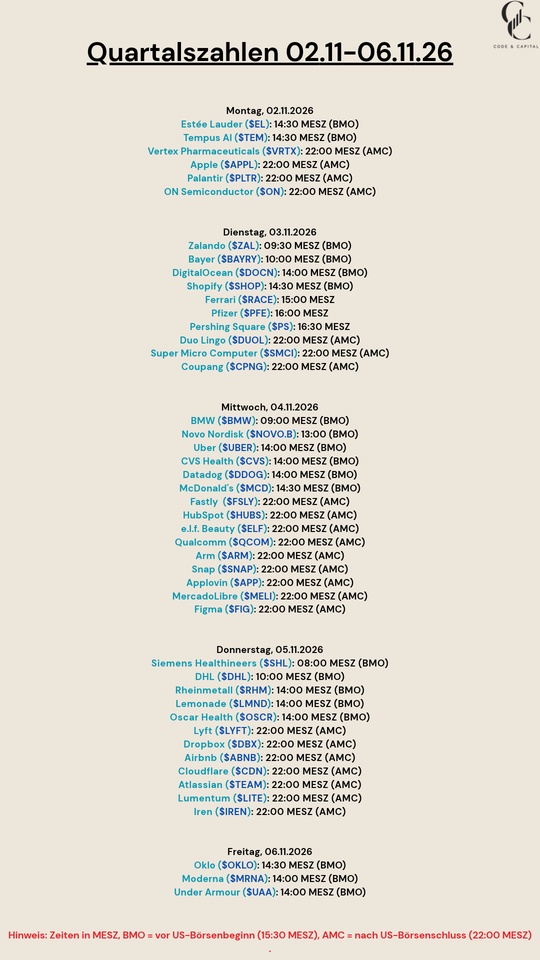
$EL (-0,04%)
$TEM (-2,22%)
$VRTX (+0,17%)
$AAPL (+0,19%)
$PLTR (-2,08%)
$ON (-2,72%)
$ZAL (+4,09%)
$BAYN (+3,29%)
$DOCN (-1,79%)
$SHOP (-1,7%)
$RACE (-0,48%)
$PFE (+0,8%)
$PS (+1,29%)
$DUOL
$SMCI (-3,28%)
$CPNG (-1,23%)
$BMW (+1,7%)
$NOVO B (-0,7%)
$UBER (+0,85%)
$CVS (-0,13%)
$DDOG (-1,77%)
$MCD (+0,95%)
$FSLY (+1,25%)
$HUBS (-3,1%)
$ELF (+0,07%)
$QCOM (-5,94%)
$ARM (-3,02%)
$SNAP (-2,42%)
$APP (+0,29%)
$MELI (-5,18%)
$FIG (+3,67%)
$SHL (-0,44%)
$DHL (-0,68%)
$RHM (-12,81%)
$LMND (-1,33%)
$OSCR (+0,02%)
$LYFT (-1,05%)
$DBX (-0,87%)
$ABNB (-0,52%)
$NET (-2,29%)
$TEAM (-0,12%)
$LITE (-4,08%)
$IREN (-5,04%)
$OKLO
$MRNA (-0,56%)
$UAA (-1,65%)

Mercadolibre
Ação
Ação
Ticker: MELI
MELI
Price
Discussão sobre MELI
Postos
1584D·
Quarterly Results Nov. 2–Nov. 6, 26
1212

6D·
List of stock recommendations from a leading Swiss bank—This is not investment advice on my part!
I received something quite interesting from a colleague today.
The exact source remains confidential for security reasons, and I’m only sharing a redacted version:
I’d like to show you the stock recommendation list from one of Switzerland’s largest universal banks and hear your thoughts on it:
THIS DOES NOT CONSTITUTE INVESTMENT ADVICE AND IS FOR INFORMATIONAL PURPOSES ONLY.
International growth stocks:
Technology (Top 3 – BUY):
$GOOGL (-0,16%): BUY – Price target at 584.55 USD – Revenue growth 15.2%, net profit margin 32.8%
$MSFT (+0,16%): BUY – Price target of 810 USD – Revenue growth 14.93%, net profit margin 36.15%
$NVDA (-1,83%): BUY - Price target of 542 USD - Revenue growth 114.2%, net profit margin 55.85%
Consumer Staples (BUY):
$LISN (-0,35%) Lindt & Sprüngli: BUY - Price target of 12,500 CHF - Revenue growth of 8.18%, net margin of 12.29%
Consumer Discretionary (BUY):
$AMZN (+0,99%) Amazon: BUY - Price target at $405 - Revenue 12.38%, net margin 10.83%
$MELI (-5,18%) Mercado Libre: BUY - Price target of 3,487 USD - Revenue 39%, net margin 6.9%
Also a BUY: $MC (+1,15%)
LVMH and $CFR (+0,68%) Richemont
Note:
Please keep in mind that this is a snapshot. The rating could change from BUY to SELL by the next day without being updated in this post.
If you find this post interesting, I may share something similar again in the future.
I find all the stocks mentioned here very interesting and have already given them some thought myself.
Just for fun, I opened a test portfolio and bought each of the mentioned positions at the current price for about CHF 1,000. Depending on the situation, I’ll sell them when they reach the stated price targets.
Let’s see what happens...
Let’s get rich... or something like that...
Feel free to save this post for later!
8Posições
CHF 7.860,67
1,96%
77
6 Comentários
Chris@Chris98_
6D
•
22
•Mostrar resposta

1Mês·
2030 Strategic Model | Mercado Libre
Mercado Coin Shutdown: MercadoLibre shut down its proprietary loyalty crypto token (Mercado Coin) in early 2026 to refocus its ecosystem.
• 52-weeks low and high range 1.495,00 - 2.427,99
• interest point since 2020 they have boom momentum with bitcoin halving time and makes more at the same in time with bitcoin halving 2024.
• Now around -50% get downward trend its like before they have momentum.
• Fears or Panics on cycle time with bitcoin performance or geopolitical have in pressure to makes a reason for this time. Unique Time 2026
• $MELI (-5,18%) , $BTC (-0,84%) , $ZEC (+1,17%)
• Faster Growth Up and Down, players need time

22

2Mês·
Mercadolibre Blows Estimates Out of the Water
Here's the hottest stuff from MercadoLibre
$MELI (-5,18%) (NASDAQ: MELI) Q2 2026 Earnings Release, delivered fresh on August 5, 2026, after the U.S. market closed:
🚀 Top-line Performance & Record Growth
Latin America’s undisputed e-commerce and fintech giant kicked it into high gear in the second quarter of 2026, delivering its fastest revenue growth in four years:
Total revenue: Soared by +50% YoY to $10.17 billion (up from $6.78 billion in the same quarter of the previous year), breaking the $10 billion mark for the first time in a single quarter! Wall Street expectations of ~$9.66 billion were exceeded by a wide margin.
Gross Merchandise Volume (GMV): Climbed in the e-commerce segment by +44% YoY to $21.9 billion.
Brazil as the driving force: The strategy of lowering free shipping thresholds remains the key driver—the number of items purchased per customer in Brazil rose by +19% YoY.
💳 FinTech & Mercado Pago Boom
The FinTech ecosystem surrounding Mercado Pago is increasingly becoming a massive cash cow:
Total Payment Volume (TPV): Skyrocketed by +56% YoY to 101.0 billion USD (transaction volume exceeded 100 billion USD for the first time in three months!).
Active users: The number of monthly active FinTech users rose to 88 million (up from 68 million in the same quarter last year).
🔮 Profitability & EPS Beat vs. Margin
MELI significantly beat estimates for earnings per share, while the margin is under short-term pressure due to deliberate growth investments:
Adjusted EPS: Stood at $9.19 per share and blew away the analyst consensus of $8.75 per share!
Income from Operations: Declined by -17% year-over-year to $683 million.
Margin Pressure: The operating margin fell to 6.7% (a decline of 550 basis points). This is due to targeted investments in acquiring new customers in the Mexican payments business as well as aggressive credit card issuance.
⚡ 💡 Jack’s takeaway
An absolute behemoth in terms of revenue and volume! With over $10 billion in quarterly revenue (+50%) and a TPV of over $100 billion (+56%), MercadoLibre proves that no one in Latin America can even come close to competing with them. The fact that the stock is dipping slightly in after-hours trading (~ -3%) is solely because Wall Street is, once again, taking a short-sighted view of the compressed operating margin. However, the deliberate investments in shipping advantages and credit card scaling are inexorably widening the moat—a dream scenario for any long-term compounder investor!
3232
4 Comentários
Yes, I totally agree with you...!!! :)
•
55
•3Mês·
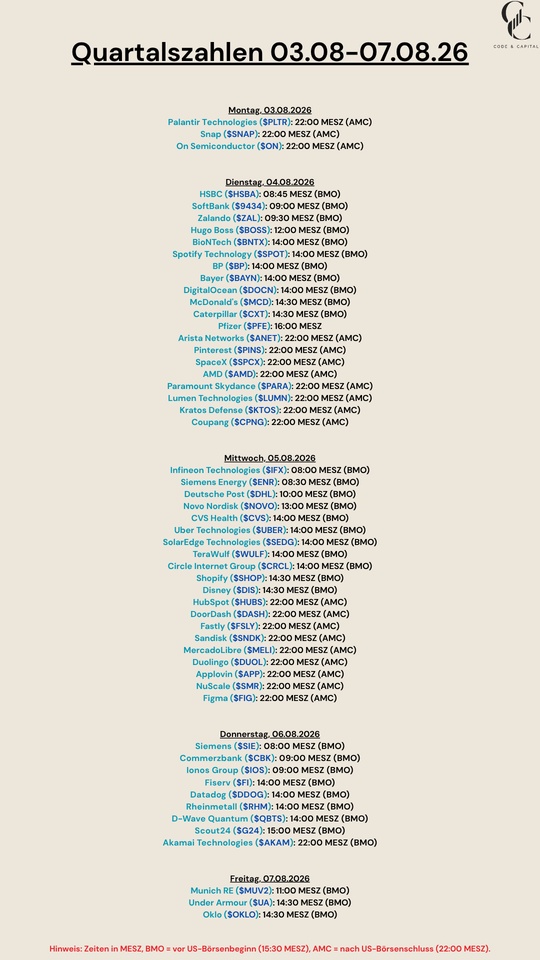
Quarterly Results August 3–7, 2026
$PLTR (-2,08%)
$SNAP (-2,42%)
$HSBA (+0,5%)
$9434 (+3,19%)
$ZAL (+4,09%)
$BOSS (-0,28%)
$BNTX (+0,09%)
$SPOT (+0,27%)
$BP. (+0,18%)
$BAYN (+3,29%)
$DOCN (-1,79%)
$MCD (+0,95%)
$CAT (-1,79%)
$PFE (+0,8%)
$ANET (-2,86%)
$PINS (-0,79%)
$SPCX (-1,97%)
$AMD (-4,08%)
$PARA (-0,66%)
$LUMN (-0,81%)
$KTOS (-1,52%)
$CPNG (-1,23%)
$IFX (-3,36%)
$ENR (-1,27%)
$DHL (-0,68%)
$NOVO B (-0,7%)
$CVS (-0,13%)
$UBER (+0,85%)
$SEDG (-2,22%)
$WULF (-2,18%)
$CRCL (-1,29%)
$SHOP (-1,7%)
$DIS (+0,41%)
$HUBS (-3,1%)
$DASH (+0,06%)
$FSLY (+1,25%)
$SNDK (-4,57%)
$MELI (-5,18%)
$DUOL
$APP (+0,29%)
$SMR
$FIG (+3,67%)
$SIE (+0,43%)
$CBK (-2,71%)
$IOS (+0,08%)
$FI (-0,36%)
$DDOG (-1,77%)
$RHM (-12,81%)
$QBTS (-1,94%)
$G24 (+1,53%)
$AKAM (-1,33%)
$MUV2 (+1,39%)
$UA (-0,95%)
$OKLO
1313
3Mês·
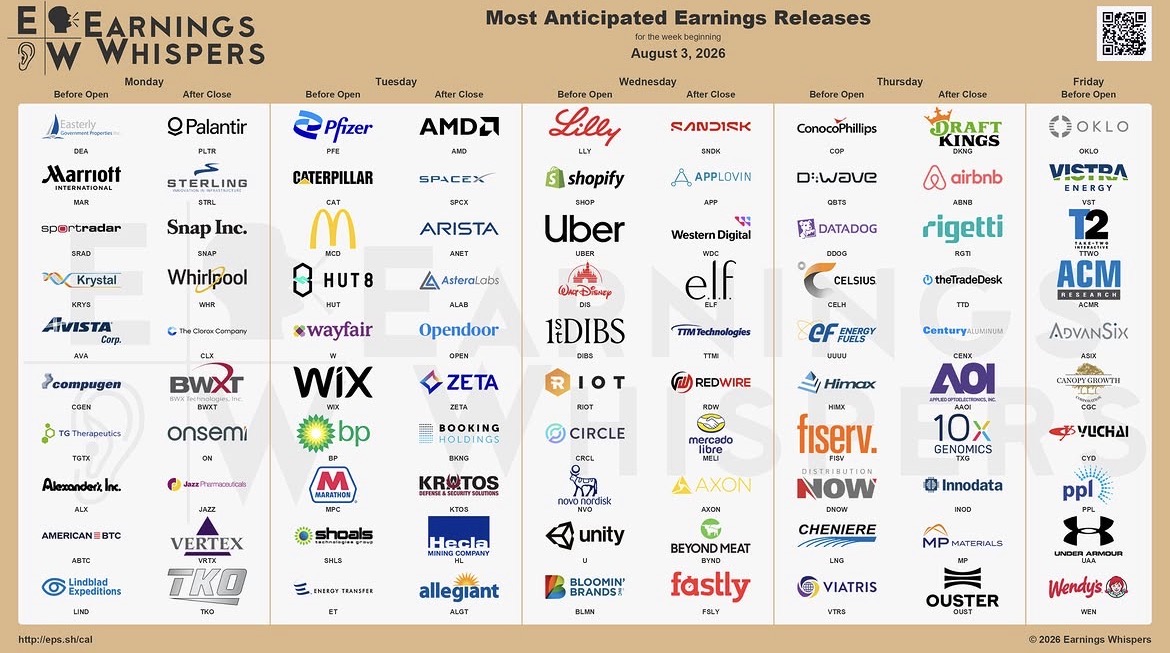
Let's move on to the next round!
$MAR (-0,22%)
$KRYS (+0,94%)
$PLTR (-2,08%)
$STRL (-2,85%)
$SNAP (-2,42%)
$WHR (-0,1%)
$CLX (+0,28%)
$BWXT (-1,9%)
$ON (-2,72%)
$VRTX (+0,17%)
$PFIZER
$CAT (-1,79%)
$MCD (+0,95%)
$HUT (-1,93%)
$WIX (-0,97%)
$W (-0,81%)
$BP. (+0,18%)
$SHLS
$AMD (-4,08%)
$SPCX (-1,97%)
$ANET (-2,86%)
$ALAB (-3,17%)
$OPEN (-0,2%)
$ZETA (-1,73%)
$BKNG (-0,35%)
$KTOS (-1,52%)
$HL (+3,1%)
$LLY (+1,13%)
$SHOP (-1,7%)
$UBER (+0,85%)
$DIS (+0,41%)
$RIOT (-1%)
$CIRC
$NOVO B (-0,7%)
$U (+3,75%)
$SNDK (-4,57%)
$APP (+0,29%)
$WDC (-5,21%)
$ELF (+0,07%)
$MELI (-5,18%)
$AXON (-0,5%)
$TTMI (-2,72%)
$RDW (+0,68%)
$QBTS (-1,94%)
$DDOG (-1,77%)
$CLA (+0%)
$FI (-0,36%)
$LNG (-0,15%)
$UUUU (-0,79%)
$HIMX (-1,88%)
$ABNB (-0,52%)
$RGTI (-2,1%)
$TTD (-0,25%)
$AAOI (-5,23%)
$TXG (-0,5%)
$INOD (-0,64%)
$OUST
$MP (-0,85%)
$OKLO
$VST (-2,57%)
$TTWO (+0,35%)
$ACMR (-1,7%)
$WEED (+3,18%)
$UAA (-1,65%)
2626
13 Comentários
And all this while on vacation🫣😂😭
•
1010
•4Mês·
This is what it looks like
Every now and then, I like to share my portfolio with you to get your feedback and tips :-)
I’ve further consolidated it to 26 holdings (if you exclude the duplicate ETFs, which exist for historical and tax reasons, and the very small positions that I can’t sell).
I’m currently contributing $IEMA (-1,19%)
$TDIV (+0,21%) and $EQAC (-1,26%) contributing 250/month, $IWDA (-0,31%) 1,000/month, and $MELI (-5,18%) and $NU (-0,28%) 200/month.
I plan to liquidate my $VOW (+3,12%) position in the next few days, but I don’t know yet where the money will go.
Tips, feedback, etc. are urgently needed :-)
34Posições
€ 572.484,95
53,61%
3030
7 Comentários
You have a nice, well-diversified portfolio there.
Personally, I don’t really see the appeal of Metaplanet, Verve, and Welltower. Visa and Coca-Cola are classics—but I don’t expect them to skyrocket in the future. I think selling the Volkswagen shares (and the auto industry in general) is the right move.
Where should the money from the VW sale go? Hard to say—your Deopt portfolio includes tech stocks (Micron, AMD, Alphabet) and defensive positions (Reality Income, Coca-Cola, Allianz)—so based on the individual holdings, I can’t quite tell where you’re headed. Do you want more growth, or more dividends? It seems to me a bit of both. Maybe just go with $TDIV and/or $IWDA for now, as long as nothing else stands out. 🙂
Personally, I don’t really see the appeal of Metaplanet, Verve, and Welltower. Visa and Coca-Cola are classics—but I don’t expect them to skyrocket in the future. I think selling the Volkswagen shares (and the auto industry in general) is the right move.
Where should the money from the VW sale go? Hard to say—your Deopt portfolio includes tech stocks (Micron, AMD, Alphabet) and defensive positions (Reality Income, Coca-Cola, Allianz)—so based on the individual holdings, I can’t quite tell where you’re headed. Do you want more growth, or more dividends? It seems to me a bit of both. Maybe just go with $TDIV and/or $IWDA for now, as long as nothing else stands out. 🙂
•
55
•4Mês·
My portfolio evaluated using my own model
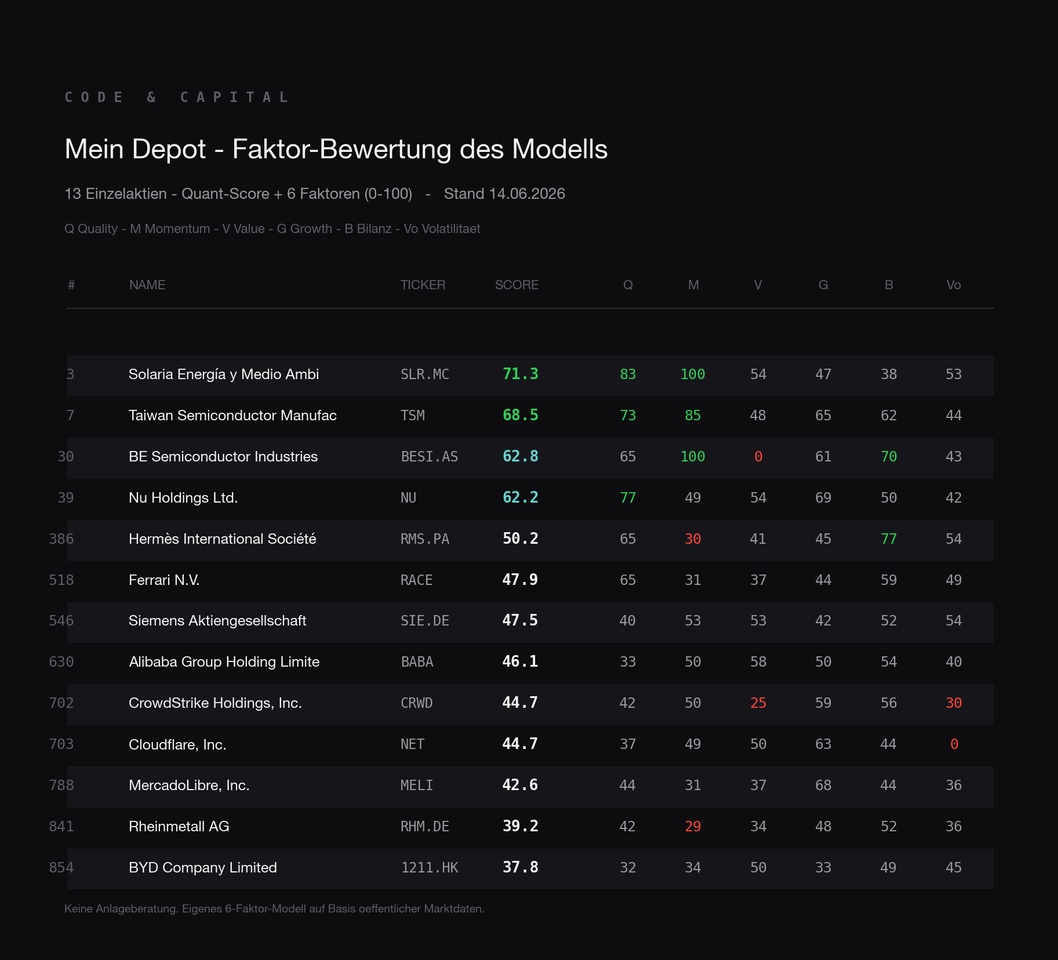
I evaluate around 1,400 stocks using a multidimensional factor model, with each dimension on a scale from 0 to 100. Recently, I’ve started applying this analysis to my own portfolio as well—so each of my positions receives the same score as every other stock in the universe. The results are revealing, especially where the model rates my stocks poorly.
Let’s start at the top:
$SLR (-0,93%) Ranked 3 out of 865, $TSM (-2,12%) at 7, $BESI (-2,63%) at 30, $NU (-0,28%) at 39. At BE Semiconductor, I find the breakdown particularly instructive: an extremely strong momentum score meets a valuation score of practically zero, with a P/E ratio of around 149. So the model doesn’t say “good stock” or “bad stock,” but describes exactly what you’re holding—a strong trend at a high price. This distinction is more important to me than a single overall score.
Now for the bottom half:
Because that’s actually the more interesting part. $RHM (-12,81%) It’s way down the list, $1211 (+2,51%) almost at the end of the universe, $MELI (-5,18%) and also deep. The reason is almost the same everywhere: The 12-month momentum has collapsed following the correction, and at the same time, valuations are high. So two factors are pulling it down at the same time. With Rheinmetall, there’s the added factor that the stock is simply no longer cheap after its strong run—the model sees this objectively, regardless of the story surrounding it.
My software stocks are a special case:
$NET (-2,29%) , $CRWD (-2,53%) and $NOW (+0,11%) . They also end up in the lower range because their high stock-based compensation weighs on quality and balance sheet metrics. This is a well-known issue with growth-oriented software companies: A large portion of employee compensation is paid in stock, which dilutes and burdens margins when factored in honestly. I tested exactly that—I built a variant that excludes the SBC burden and thus rates these stocks more leniently. The backtest yielded a worse result. So I discarded it again and am sticking with the stricter approach. I’d rather have a consistent model that measures all stocks the same way in a verifiable manner than one I tweak for individual favorites. It’s precisely this tweaking that’s the fastest way to a model that looks great in backtesting but doesn’t work in real-world trading.
Bottom line:
for me, these are two types of positions. I bought some because of their scores—Solaria and BESI, for example; the model is what led me to them in the first place. I hold the others deliberately against the score, out of my own conviction. But I want to see the number and take it seriously, rather than pretending it doesn’t exist. That’s the whole point of the exercise.
The purely systematic version—that is, strictly the top-scoring stocks, excluding my conviction-based positions—has been running as a Wikifolio (ISIN: DE000LS9V052) since March and became tradable this week.
What do you think:
Do you tend to trust your own thesis, or the system behind it?
99
2 Comentários
Using a valuation model or score is one approach. That might make investing easier. But it’s not quite that simple. Emotions are hard to gauge. A great deal of stock performance is also driven by the news. And with a U.S. president who loves to make headlines, things haven’t gotten any easier.
•
1010
•
4Mês·
Interesting growth stocks offering a good entry point
Good evening, everyone. Which growth stocks do you think are a good buy right now? I think $UBER (+0,85%) and $MELI (-5,18%) are extremely interesting right now
66
3 Comentários
•
44
•5Mês·
Company presentation: Boku
Hello to Community✌️
At the end of the month, I would like to introduce you to another stock that I personally find extremely exciting. After that, that's it for the next few weeks. 👀
In my opinion, this stock is interesting for both short-term gamblers and long-term investors. The former 🫵 @Multibagger will primarily celebrate the momentum and the potentially rapid price movements. 📈
Others could discover an exciting growth story with long-term potential. 👀🤔
Today it's all about Boku $BOKU
BOKU INC. : The invisible tollbooth of the global tech giants:
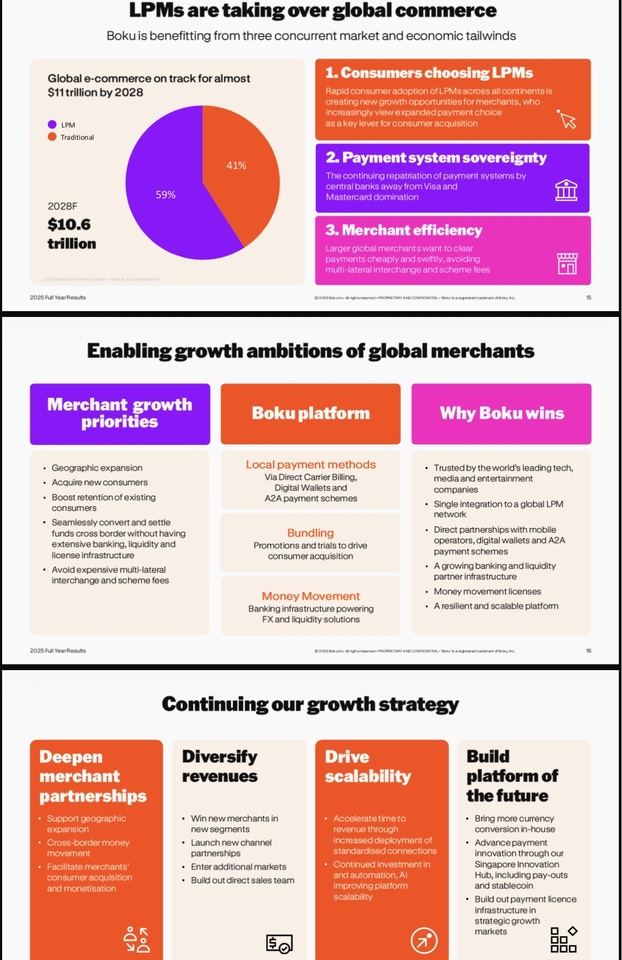
Boku $BOKU is not a hyped, unprofitable FinTech dream that thrives on venture capital. It's a highly profitable, UK-based network powerhouse that's carving out the niche of Alternative Payment Methods (APMs) has occupied. While traditional credit card giants are reaching their limits in emerging markets and with Generation Z, Boku $BOKU acts as the invisible digital toll booth for the world's biggest companies. If someone is on Spotify, $SPOT (+0,27%) Netflix $NFLX (+0,97%) or the $GOOGL (-0,16%) Google Play Store via cell phone bill (direct carrier billing) or local eWallet (such as Pix, Mercado Pago $MELI (-5,18%) , Alipay $9988 (+4,77%) or GrabPay $GRAB (-0,49%) ), Boku mercilessly cuts off its fee in the background. Boku $BOKU benefits from the unstoppable global trend of digital consumption - regardless of which app is currently in vogue.
📱The business model: the 3-pillar transaction rocket 💳🌐📈
Boku $BOKU has transformed itself from a pure SMS payment service into a state-of-the-art, global identity and payment network (Boku Platform):
The insatiable eWallet & Account-to-Account (A2A) lever: Traditional business mobile operators (DCB) is solid, but the real hyper growth is coming from local wallets (Pix in Brazil, PromptPay in Thailand, Twint in Switzerland). Boku connects these fragmented local markets via a single API for the tech giants. This segment is growing rapidly and driving up transaction value (TPV) massively.
The fortress customer base (The "Whale" portfolio): Boku's client list reads like a who's-who of Silicon Valley: Apple $AAPL (+0,19%)
, Google $GOOGL (-0,16%)
, Meta $META (+0,12%)
, Microsoft $MSFT (+0,16%)
, Netflix $NFLX (+0,97%)
, Spotify $SPOT (+0,27%)
, Amazon $AMZN (+0,99%)
, Tencent $700 (+3,09%) . These giants won't just throw Boku out of their checkout infrastructure because setting up their own local connections in 60+ countries would be regulatory and technical suicide. High switching costs par excellence.
The recurring network effect premium (NRR 124%): Boku grows organically with the success of its customers. The more subscriptions $AMZN (+0,99%) Amazon Prime or Spotify $SPOT (+0,27%) sell in India or Southeast Asia, the more transaction volume automatically flows through Boku's servers - without Boku having to burn new marketing money.
📊The key figures (as of Q1 2026 / FY25 history)
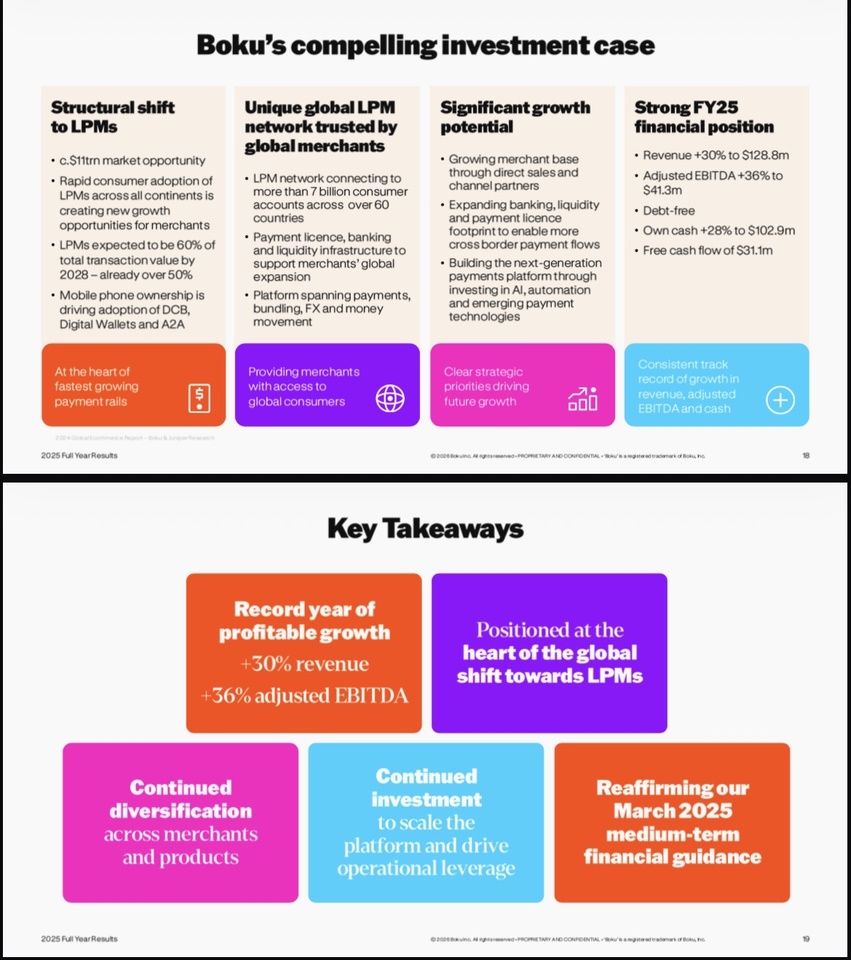
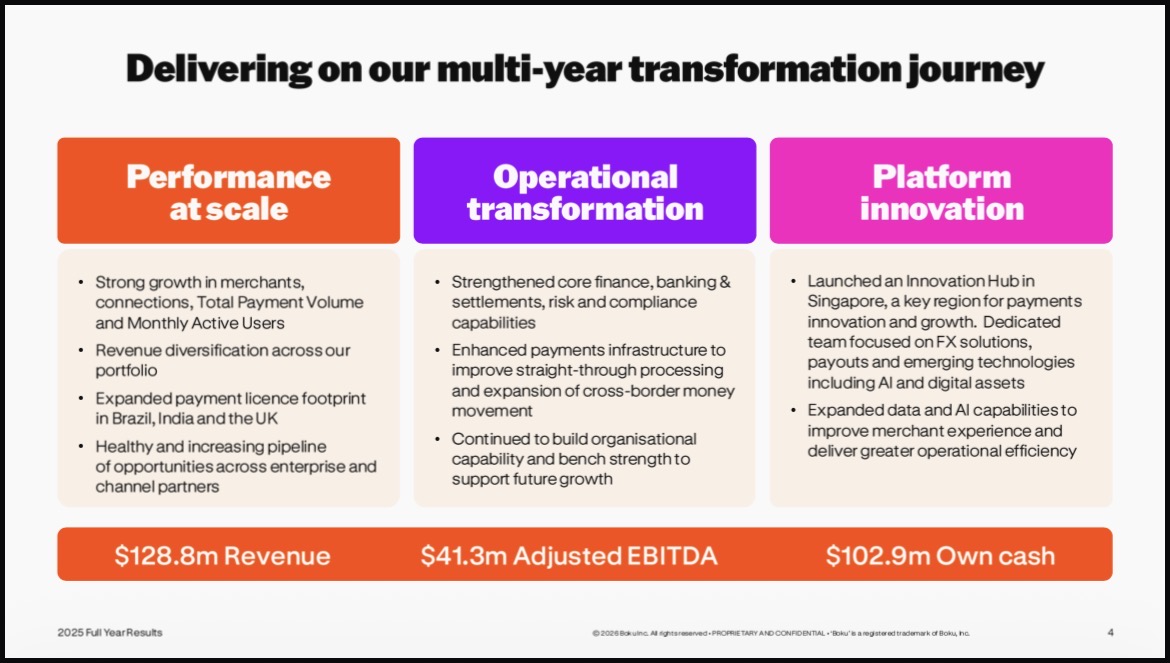
Market capitalization: Approx. GBP 540 million / ~EUR 635 million (Listed on the London Stock Exchange, AIM). A genuine, profitable small cap.
Sales momentum: Continuous growth of around +15% p.a. The shift from pure mobile billing to eWallets and A2A payments is taking off completely and is compensating for the maturity of the old DCB business.
EBITDA levers & margins: The adjusted EBITDA margin is scratching the 35% mark. As the platform infrastructure is in place, almost every additional dollar in transaction fees flows directly through to the bottom line (Gross margin of a proud ~68.5%).
Real FCF margin (SBC-adjusted): Strong ~24,0% of sales. Boku is a cash machine that easily digests its share compensation from operating cash flow without painfully diluting shareholders.
Balance sheet solidity (net cash): No long-term financial debt. Boku is sitting on a net cash position of around USD 50-60 million. This means zero refinancing risk in the current interest rate environment and maximum flexibility for smaller, strategic tech acquisitions.
🚀Why is the share exciting?
✅The demographic bet in e-commerce: In the growth regions (South East Asia, Latin America, Africa), billions of people don't have a credit card, but almost everyone has a smartphone and a local wallet. If you want to sell subscriptions there as a Western tech company, you have to use Boku.
✅The win-win shield against big tech: The often criticized cluster risk is not a one-way street. In markets such as Indonesia, Brazil and India, Boku is $BOKU for Apple $AAPL (+0,19%) and Google $GOOGL (-0,16%) not an annoying cost factor, but the exclusive revenue enabler. Without Boku's local infrastructure, the tech giants would have to do without millions of customers who are willing to pay and simply do not have a credit card. Apple $AAPL (+0,19%) and Google $GOOGL (-0,16%) are therefore structural partners 🤝not opponents - Boku brings them incremental revenue that they could not generate on their own.
✅Evolution of the moat & diversification: Management understood the historical "what if" scenario (the loss of a major customer) and proactively mitigated the risk. Through aggressive expansion into digital wallets and account-to-account (A2A) payments (which now account for 45% of revenue), Boku has fundamentally diversified. The moat today is of a technical, regulatory and geographical nature - not even a Silicon Valley giant can copy that in two quarters.
✅Operating leverage beats inflation: Boku's cost base consists primarily of IT infrastructure and developers. If the price of digital subscriptions rises worldwide due to inflation, Boku's transaction volume and thus its fee income automatically increases with it. A perfect inflation hedge.
✅Consolidation of the FinTech infrastructure: Boku $BOKU has spent years digging the regulatory foundation (licenses in dozens of countries). You don't rebuild this moat in two quarters. This also makes the company a permanent, highly attractive takeover target for larger payment groups.
⚠️Die Risks
❗️Brutal cluster risks (whale dependency): Apple $AAPL (+0,19%) , Google $GOOGL (-0,16%) and Amazon $AMZN (+0,99%) account for a lion's share of the volume. If one of these giants decides to slash fees or build its own global wallet infrastructure, the Boku story will be fundamentally shaken
❗️Commercial pressure on margins: Unit economics for eWallets are often thinner than for the old Direct Carrier Billing (DCB). Boku has to bolt on massive volumes to cushion the structural decline in margins per transaction
❗️Currency effects (FX risk): As Boku collects fees worldwide in local currencies (and accounts in GBP), severe currency turbulence in the emerging markets can visually spoil operating performance .
✍️Mein personal conclusion + Reaper verdict 💀
I personally find Boku Inc. extremely exciting. Boku $BOKU has an amazingly strong business in the background. For me, this is a highly profitable niche champion with a strong balance sheet and a business model that is much more robust than it appears at first glance.
What I particularly like is that without Boku $BOKU companies like Google $GOOGL (-0,16%) or Apple $AAPL (+0,19%) would miss out on millions of potential customers that they would not be able to reach via their traditional payment channels. Boku $BOKU opens up sales for them that would otherwise simply not exist. Why should the tech giants invest hundreds of millions of dollars to apply for their own regulatory licenses in dozens of emerging countries and connect local payment systems when they can simply use Boku's ready-made infrastructure instead? Boku $BOKU solves a complex problem that its customers could only solve themselves with considerable effort and is paid well for doing so. This also seems to me to limit the risk of major customers suddenly ending the collaboration. The benefit is simply too great and the alternative too costly.
BONUS MATERIAL:
💀Jack's Verdict:
"Let's not kid ourselves: Boku's operating business is sexy as a perfectly oiled money printing press. The NRR of 124% shows that the tech giants are becoming more and more dependent on Boku's API. But on the stock market, the music is also made by the price. A fwd P/E ratio of over 31x and a PEG of 1.7 for 15% growth? Once again, the market has looked a little too deeply into the hype bowl. The market is currently pricing in that the next 10 years will be flawless. If Apple coughs tomorrow and pushes down the fees by one basis point, the valuation will plummet. Therefore: stock on the watchlist, no emotional market purchases. We are laying down at 135 GBX on the lookout. If the impatient retail investors lose their nerve at the next macroeconomic dip and the stock corrects there, we will grab it. Before that, the capital stays in the holster."
Reaper rating: WATCH, TEND TO BUY 🔥
Reaper Score:
6,8/10
@Get_Rich_or_Die_Tryin
@Tenbagger2024
@Raketentoni
@schlimmschlimm
@Stocktective and of course all other ✌️
+ 4

3636
17 ComentáriosOnce again a great presentation, thanks for that. At the moment, however, I am taking advantage of the momentum in SoFi and will remain invested there for the time being. Then I hope to see momentum at NU Bank soon. But thanks for the effort, dear. Juan was called by Mateo earlier
•
66
•Títulos em alta
Principais criadores desta semana
Dados tempo real da LSX · Dados financeiros e EOD da FactSet