
$EL (-5,63%)
$TEM (+15,42%)
$VRTX (+0,53%)
$AAPL (-2,48%)
$PLTR (-0,56%)
$ON (+0,46%)
$ZAL (+0,66%)
$BAYN (-1,04%)
$DOCN (+0,88%)
$SHOP (+1,01%)
$RACE (+1,38%)
$PFE (+0,15%)
$PS (+0,37%)
$DUOL
$SMCI (-4,54%)
$CPNG (+3,17%)
$BMW (+1,65%)
$NOVO B (+1,36%)
$UBER (+2,51%)
$CVS (-2,38%)
$DDOG (-6,07%)
$MCD (+1,71%)
$FSLY (-7,37%)
$HUBS (+1,43%)
$ELF (-0,34%)
$QCOM (-0,14%)
$ARM (-2,49%)
$SNAP (+4,15%)
$APP (+2,85%)
$MELI (+4,34%)
$FIG (+5,24%)
$SHL (+1,99%)
$DHL (+1,23%)
$RHM (-2,95%)
$LMND (-0,74%)
$OSCR (+0,12%)
$LYFT (+3,63%)
$DBX (-1,09%)
$ABNB (+4,11%)
$NET (-3,74%)
$TEAM (-0,93%)
$LITE (-15,57%)
$IREN (-4,5%)
$OKLO
$MRNA (+1,36%)
$UAA (+4,78%)

Atlassian
Ação
Ação
Ticker: TEAM
TEAM
Price
Discussão sobre TEAM
Postos
171D·
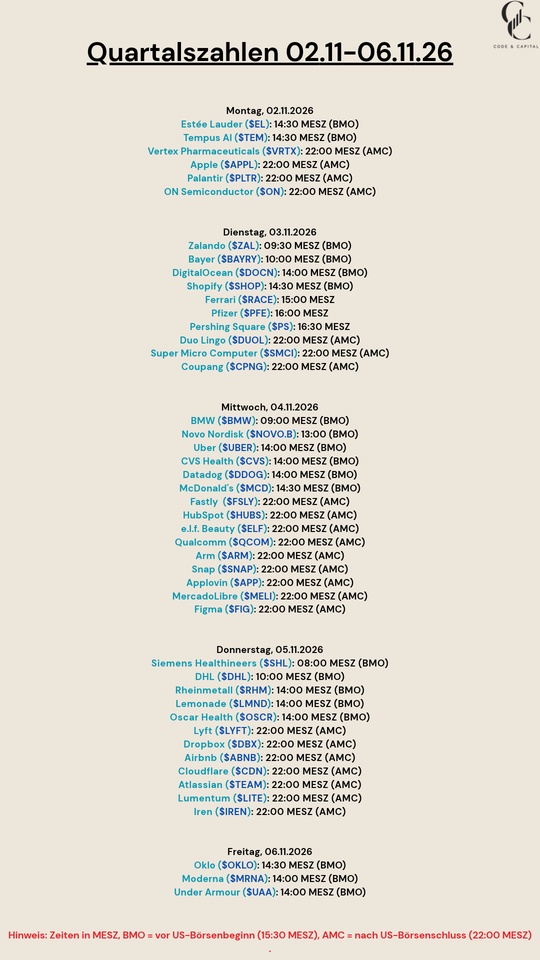
Quarterly Results Nov. 2–Nov. 6, 26
1212

1Mês·
My mistake with the stop/limit order on Atlassian 😅
On August 27 I made a mistake on Trade Republic.
I actually just wanted to $TEAM (-0,93%) actually just sell 1 share and keep the rest.
After that, I set a sell limit of 140 € —I thought that would protect me against a price drop.
My mistake:
A normal limit sell order means:
Sell for at least €140.
Since the price was already significantly higher, my remaining 2 shares were automatically sold.
In the end, I did sell at a profit, but I was still sad at first because I $TEAM (-0,93%) actually wanted to hold onto Atlassian longer.
But maybe it’s also a good sign:
I made a mistake, didn’t lose any money, and learned something important.
From now on, I know:
A limit order ≠ a stop-loss.
What do you think?
Have you ever made an order mistake like that yourself?
1111
8 Comentários
Raketentoni@Raketentoni
1Mês
•
66
•Ver todas as 3 restantes respostas
2Mês·
🚀 Atlassian Surprises with Strong Quarterly Results!
The figures exceeded expectations, and the outlook was also raised. The market immediately rewarded this with a significant jump in the stock price. $TEAM (-0,93%) Atlassian is an exciting software company for the long term. After seeing the results, I will not sellbut will let the position run its course.
What do you think of $TEAM (-0,93%)
Atlassian?
- 🟢 More upside potential?
- 🟡 Too expensive for now after the sharp rise?
- 🔴 Time to take profits?
This is not investment advice—just my personal opinion, and I look forward to the discussion.
88
1 Comentar
THE INVISIBLE GLUE OF THE TECH WORLD
Atlassian (TEAM) doesn’t sell pretty interfaces; it sells the digital nervous system of modern software and project teams. With flagship products like Jira and Confluence, Atlassian holds a virtual monopoly on workflow management for developers and IT organizations. Due to its deeply entrenched ecosystem (“Teamwork Graph”), the risk of switching is enormous for large corporations. By integrating AI agents (Rovo), Atlassian transforms historical collaboration data into irreplaceable business context—an area where pure LLM providers fall short.
🛠️DNA-CHECK
Net Retention Rate (NRR): Consistently exceeds 120%. Existing enterprise customers are continuously expanding their license packages and AI modules.
Scaling cash flow power: In fiscal year 2026, TEAM achieved an operating free cash flow margin of 20% (USD 1.32 billion FCF).
Strong enterprise momentum: The segment of large enterprise customers with over $3 million in ARR grew by over 50% year-over-year, while contracts with $5 million or more in ARR grew by over 70%.
Operating Leverage: The non-GAAP operating margin climbed to 30% for the full year 2026 (and as high as 36% in Q4).
🚀 GROWTH LEVERAGES & CATALYSTS
AI Monetization (Rovo): Over 80% of Fortune 500 customers are already using the AI assistant Rovo. Customers using Rovo double their ARR growth compared to non-users.
Cloud Migration & Consolidation: The acceleration of cloud revenue to 31% YoY in Q4 shows that the shift from legacy servers to the Atlassian Cloud is in full swing.
RPO Surge: Remaining Performance Obligations (RPO) rose 44% to $4.8 billion—a strong indicator of long-term locked-in revenue.
⚠️ VALUATION & RISKS
Dilution Monster (SBC): The discrepancy between GAAP profitability (0.2% margin FY26) and non-GAAP (30%) is primarily driven by excessive stock-based compensation (SBC). Adjusted for SBC, real FCF shrinks drastically.
Outlook Downturn for FY27: Management is scaling back expectations for the upcoming fiscal year 2027 and forecasts a slowdown in subscription ARR growth to approximately 18% (down from 23% in FY26).
Aggressive Valuation: At a share price of ~$141 USD, following the recent surge, Atlassian is trading at a high multiple relative to its real (SBC-adjusted) cash flow, which means any execution missteps will be severely punished.
JACK’S CONCLUSION ON ATLASSIAN (TEAM)
“Atlassian is the undisputed SaaS leader in software development. The moats created by Jira and the Teamwork Graph are deep, and Rovo demonstrates how to profitably monetize AI. However, TEAM continues to finance this growth through massive stock dilution at the expense of existing shareholders. The recent jump in the stock price following the Q4 earnings report reflects a great deal of optimism. Top-notch quality, but the dilution calls for discipline when entering the position.”
Status: 🟡 WATCH
Reaper Score: 7.2/10
Atlassian (TEAM) doesn’t sell pretty interfaces; it sells the digital nervous system of modern software and project teams. With flagship products like Jira and Confluence, Atlassian holds a virtual monopoly on workflow management for developers and IT organizations. Due to its deeply entrenched ecosystem (“Teamwork Graph”), the risk of switching is enormous for large corporations. By integrating AI agents (Rovo), Atlassian transforms historical collaboration data into irreplaceable business context—an area where pure LLM providers fall short.
🛠️DNA-CHECK
Net Retention Rate (NRR): Consistently exceeds 120%. Existing enterprise customers are continuously expanding their license packages and AI modules.
Scaling cash flow power: In fiscal year 2026, TEAM achieved an operating free cash flow margin of 20% (USD 1.32 billion FCF).
Strong enterprise momentum: The segment of large enterprise customers with over $3 million in ARR grew by over 50% year-over-year, while contracts with $5 million or more in ARR grew by over 70%.
Operating Leverage: The non-GAAP operating margin climbed to 30% for the full year 2026 (and as high as 36% in Q4).
🚀 GROWTH LEVERAGES & CATALYSTS
AI Monetization (Rovo): Over 80% of Fortune 500 customers are already using the AI assistant Rovo. Customers using Rovo double their ARR growth compared to non-users.
Cloud Migration & Consolidation: The acceleration of cloud revenue to 31% YoY in Q4 shows that the shift from legacy servers to the Atlassian Cloud is in full swing.
RPO Surge: Remaining Performance Obligations (RPO) rose 44% to $4.8 billion—a strong indicator of long-term locked-in revenue.
⚠️ VALUATION & RISKS
Dilution Monster (SBC): The discrepancy between GAAP profitability (0.2% margin FY26) and non-GAAP (30%) is primarily driven by excessive stock-based compensation (SBC). Adjusted for SBC, real FCF shrinks drastically.
Outlook Downturn for FY27: Management is scaling back expectations for the upcoming fiscal year 2027 and forecasts a slowdown in subscription ARR growth to approximately 18% (down from 23% in FY26).
Aggressive Valuation: At a share price of ~$141 USD, following the recent surge, Atlassian is trading at a high multiple relative to its real (SBC-adjusted) cash flow, which means any execution missteps will be severely punished.
JACK’S CONCLUSION ON ATLASSIAN (TEAM)
“Atlassian is the undisputed SaaS leader in software development. The moats created by Jira and the Teamwork Graph are deep, and Rovo demonstrates how to profitably monetize AI. However, TEAM continues to finance this growth through massive stock dilution at the expense of existing shareholders. The recent jump in the stock price following the Q4 earnings report reflects a great deal of optimism. Top-notch quality, but the dilution calls for discipline when entering the position.”
Status: 🟡 WATCH
Reaper Score: 7.2/10
•
66
•
8Mês·
Bitcoin entry
I plan to enter Bitcoin and have placed the order at 59000$ or 50000€ to use the support there as an entry point.
Do you think it is realistic that the limit will be broken by Monday?
I have two plans:
Sell with 1000€ to take advantage of the tax-free limit for private sales transactions.
HODL
Brings a little more diversification to the money market ETF (house purchase) and the MSCI Wolrd in the savings plan. Size of the BTC approx. 5%
small addendum: My decision at the end of 2025 to shift all shares into the two positions has saved me a lot of money. I only say $PYPL (+2,61%)
$ADBE (+1,06%)
$NOVO B (+1,36%)
$TEAM (-0,93%)
2Posições
17,02%
33
6 Comentários
We will see $50,000, but not on Monday
•
11
•

8Mês·
Software Stocks That Can Survive AI...
- $MSFT (-0,93%) Microsoft Corp.
- $NOW (+3,17%) ServiceNow
- $TWLO (+2,01%) Twilio
$OKTA (-8,51%) Okta
$CRWD (-1,8%) CrowdStrike Holdings
$PANW (-1,26%) Palo Alto Networks
$ZS (-3,33%) Zscaler
$CHKP (-4,09%) Check Point Software Technologies
$S (-5,48%) SentinelOne
$NTSK (-6,1%) Netstoke
$SNOW (-2,56%) Snowflare
$DDOG (-6,07%) DataDog
$TYL (+3,41%) Tyler Technologies
$CSGP (+5,29%) CoStar Group
$GWRE (+1,08%) Guidewire Software
$VEEV (-0,05%) Veeva Systems
$FROG (-7,94%) JFrog, Lda.
$SAIL (-4,01%) SailPoint- $TEAM (-0,93%) Atlassian Corp.
$ORCL (-7,06%) Oracle Corp.
$PLTR (-0,56%) Palantir Technologies
$CRM (+1,12%) Salesforce
Source: https://www.barrons.com/articles/microsoft-stock-price-ai-survivors-software-servicenow-6781fc99
🎯 Analysts have identified these 22 stocks as the best bets that will survive and thrive through the "Software Apocalypse".
- - - // - - -
What Are You Going To Do ??
A) Create a Shopping List, or,
B) Just going to suffer 'Armageddon'

8Mês·
Subsequent purchase
$TEAM (-0,93%) I am very convinced and have bought 3 more shares today. Every year there are strong business figures. That's why I believe it will rise. It's so cheap right now. What do you think?
33
2 Comentários
I'm convinced by the products: I wouldn't want to work without Jira, Bitbucket and Confluence. But the course looks like shit 😅
•
22
•
9Mês·
Jan 14 / Enterprise Software — Same Cycle, Very Different Quality
Salesforce vs. Atlassian vs. ServiceNow
Enterprise software has been out of favor for a while now, but last week in particular was painful. The main concern, once again, is AI. And yet, business quality remains unchanged for many of the heavy hitters. Balance sheets look rock-solid and contracts haven’t suddenly “heard of AI.” Currently, I hold all three of the big names in the SaaS space: Salesforce, Atlassian, and ServiceNow. However, they play very different roles in my portfolio, and my conviction levels are no longer equal.
Let’s start with positioning. Salesforce sits at roughly 3.3% of my portfolio. ServiceNow is slightly smaller at ~2.8%, while Atlassian is the largest of the three at ~4.5%. Yes — from a pure business-quality standpoint, ServiceNow is clearly the best company here.
ServiceNow is not just another SaaS tool. It’s enterprise workflow infrastructure. IT, HR, security, governance — once ServiceNow is embedded, it becomes organizationally impossible to rip out. This is not about switching software; it’s about rewiring how a company functions. In downturns, enterprises cut tools, not their workflow backbone. Add AI to that equation, and ServiceNow becomes even more valuable. Structured workflow data is exactly what enterprise-grade AI needs to function reliably, and products like Now Assist are additive rather than disruptive.
Financially, this quality shows. ServiceNow consistently delivers ~20% revenue growth, ~30% free cash flow growth, FCF margins around 34%, and a Rule of 40 score of ~54. The stock currently trades at an FCF yield of ~3.5%, expanding toward ~5.7% on FY27 estimates. It’s expensive, no doubt — but deservedly so. I genuinely love this company and, long term, I want it to be my largest enterprise software position. My only hesitation right now is timing and valuation, not quality.
Salesforce is a different story. It remains mission-critical at its core, but the CRM empire arguably has to rethink its pricing approach. AI here is more defensive than transformative, but Agentforce is growing at a respectable pace. That said, Salesforce throws off enormous cash. Revenue growth sits closer to ~10%, but the company trades at a 6–6.5% FCF yield today, expanding toward ~9.5% on FY27 estimates, with a Rule of 40 around 43. Salesforce increasingly behaves like a mature software compounder rather than a growth engine. I’m comfortable holding it around current levels, and I’m not trimming it into this software downturn. I’m betting this cycle is temporary.
Then there’s Atlassian. Deeply embedded with developers, culturally loved, and clearly one of the more interesting turnaround candidates in enterprise software right now. Jira and Confluence remain powerful products, and Atlassian is probably at the forefront of a sentiment-driven rebound if software multiples re-rate. Revenue growth is still projected around ~20% annually, with a current FCF yield of ~6%, expanding toward ~9.5% on FY27 estimates, and a Rule of 40 close to 49.
At the same time, this is where my concerns are highest. Seat-based pricing, exposure to hiring freezes, and direct AI substitution risk are real. Task tracking and documentation are exactly where AI copilots excel, and Atlassian’s AI monetization remains weak so far, with Rovo largely bundled. The valuation already reflects part of that risk, which is why I’m not rushing to sell. But this is a medium-term turnaround bet (30–50% upside) not a multidecade compounder at any price.
So the conclusion is clear. I want to concentrate more, not diversify more, over the long term. ServiceNow is my highest-conviction play structurally. Atlassian and Salesforce, however, are more interesting cyclical opportunities right now. The forward selloff across enterprise software looks massively overblown, and fundamentally, these businesses show no signs of real weakness.
66
9Mês·
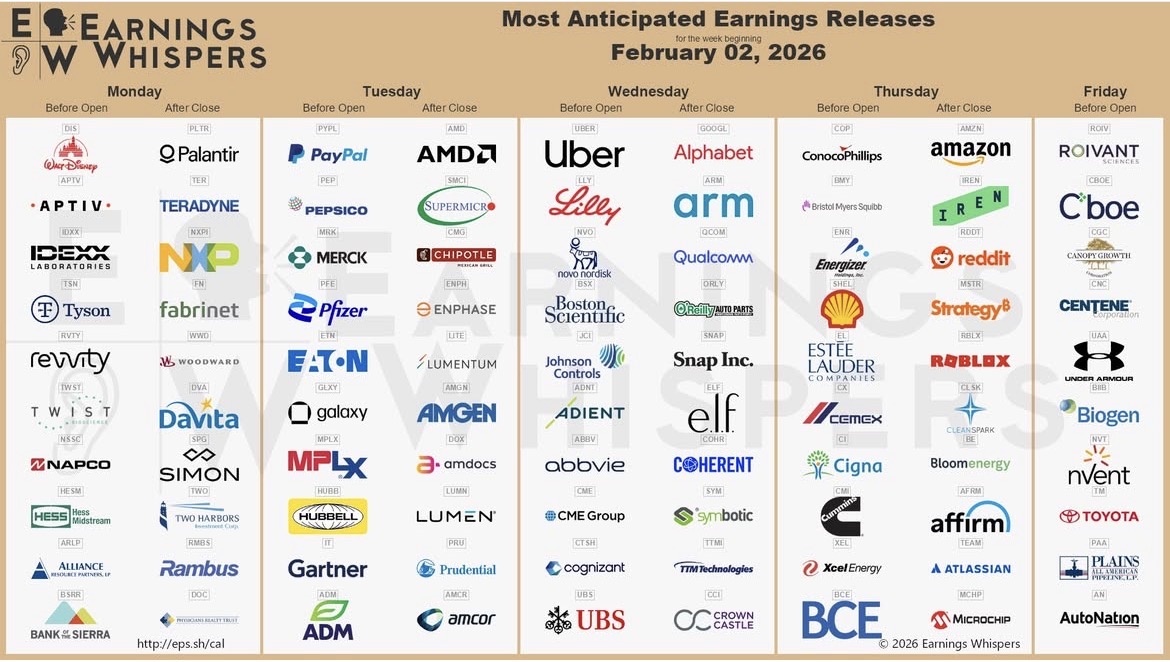
Next week will be really interesting
$PLTR (-0,56%)
$GOOGL (-0,04%)
$AMZN (+3,84%)
$IDXX (+21,54%)
$RMBS (+0,75%)
$AMD (-5,05%)
$PEP (+1,37%)
$MRK (-0,99%)
$ETN (-1,09%)
$AMGN (-0,25%)
$ADM (-2,59%)
$PFE (+0,15%)
$UBER (+2,51%)
$LLY (-1,16%)
$NOVO B (+1,36%)
$BSX (+4,3%)
$ABBV (-2,33%)
$QCOM (-0,14%)
$ARM (-2,49%)
$ELF (-0,34%)
$CCI (-2,51%)
$IREN (-4,5%)
$BMY (-0,56%)
$MSTR (+1,48%)
$RBLX (+0,52%)
$TEAM (-0,93%)
$EL (-5,63%)
$SYM (+1,39%)
$DIS (+1,72%)
$PYPL (+2,61%)
$CMG (+2,89%)
$ALV (+0,63%)
$LIN (+0,63%)
Which figures do you pay particular attention to?
3737
19 Comentários
Irish. Things could really go up. There must be a reason why they pushed the numbers forward. I think I'll go long
•
66
•
9Mês·
Is this the end?
$ADBE (+1,06%)
$CSU (+1,34%)
$TEAM (-0,93%)
$CRM (+1,12%)
$NOW (+3,17%)
The End of Software?
If you’re a software investor, this week probably didn’t feel too good.
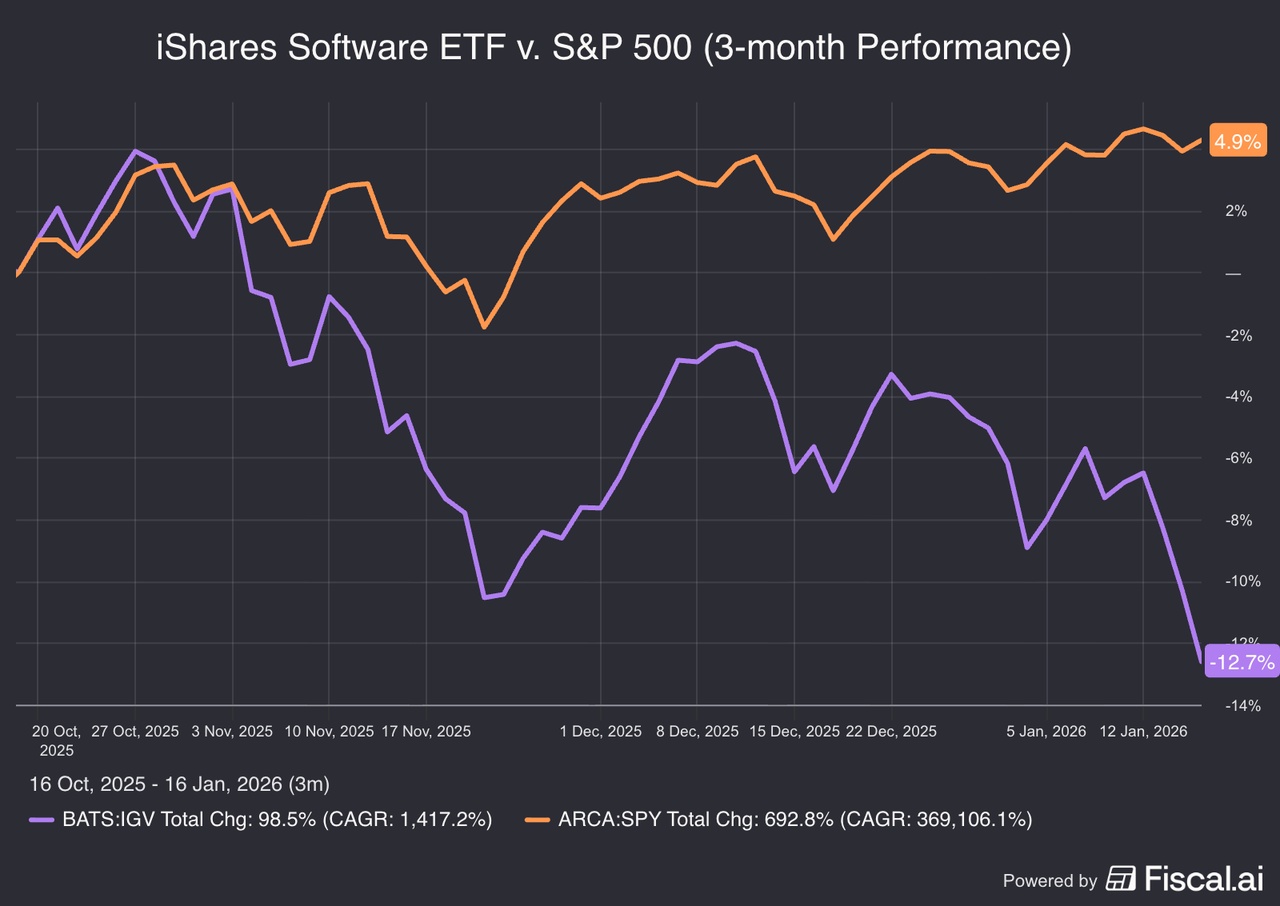
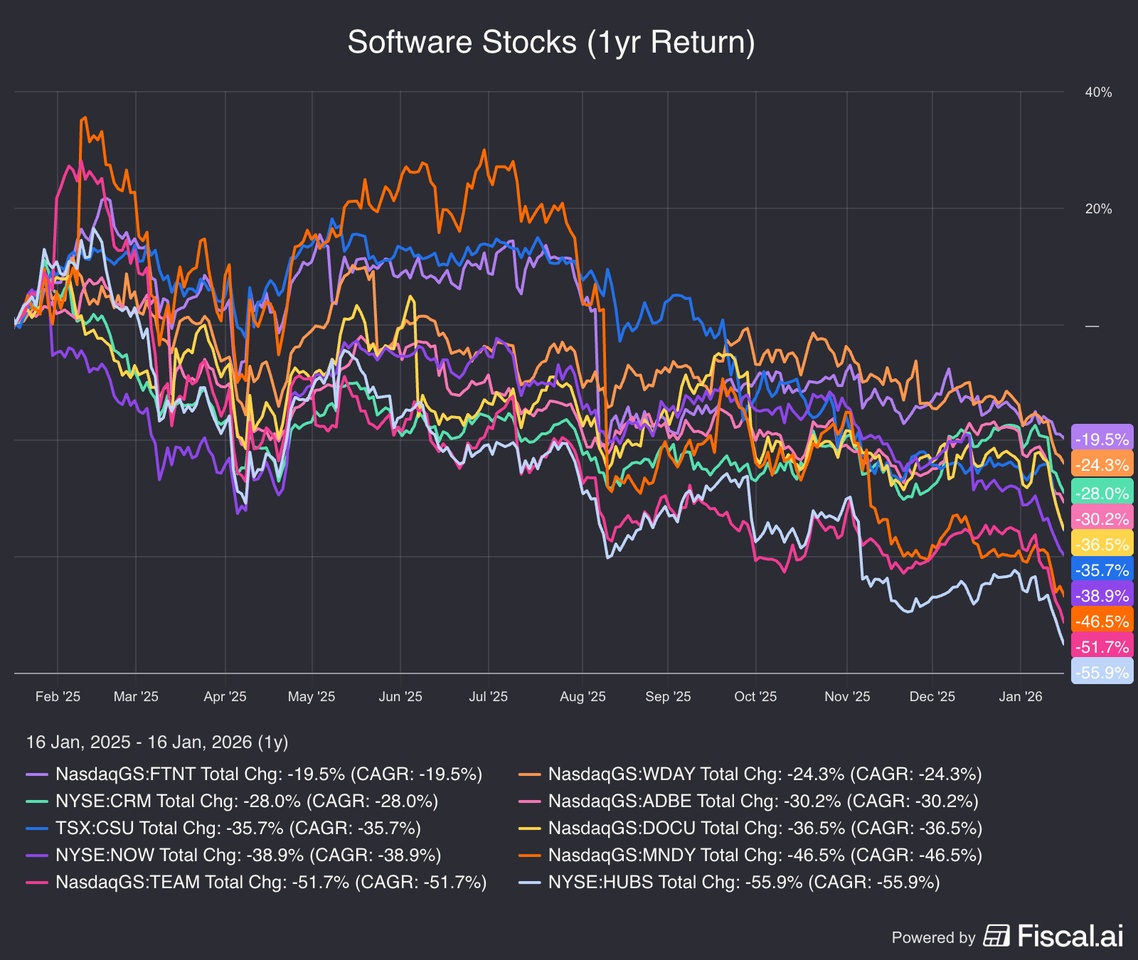
Software stocks saw large drawdowns across the board, which caps off one of the worst years for the sector in recent history.
Here are a few notable companies in large drawdowns:
What’s causing the collapse?
While it’s hard to point a finger at a single cause of a multi-year drawdown, AI has been the recurring culprit.
For the last several years, companies all over the AI space have reduced the barriers to entry of web development through robust coding agents. Anthropic’s Claude Code is considered one of the most advanced, and this week they made their complex problem-solving capabilities available to non-developers with their launch of Claude Cowork.
This release spooked investors.
There now seems to be a pervasive belief among Wall Street that with lower barriers to entry in web development, companies will be less reliant on 3rd party software vendors.
Is the AI threat real?
While Claude’s advancements will no doubt inspire many companies to try to build more systems in-house, the likelihood that a “vibe-coded” prototype is good enough to rip and replace critical software systems at the enterprise level seems quite low.
Imagine for a second, going to the Chief Accounting Officer of a Fortune 500 company and telling them that they need to pivot from SAP to a new in-house tool built by a couple developers and Claude Code. They’ll have to migrate all their data, train their employees on the new system, oh, and not mess up any reporting because they have a 10-Q to deliver in a month. Yeah… tough sell.
That’s an extreme example, but you get the point. Critical systems are sticky, and switching is risky.
Beyond that, as any developer knows, building large-scale software systems for multiple use cases isn’t exactly a “set-it and forget it” process. Things break, improvements are needed, and ultimately, these systems need a team to maintain them. Is that cheaper than buying from an outside vendor? Is it an improvement for the departments using these systems?
While the above might sound dismissive of the AI threat entirely, it’s not. AI certainly brings about real long-term risks to legacy software companies.
Here’s what Jeff Bezos had to say on the topic:
“AI is a horizontal enabling layer. It can be used to improve everything. It will be in everything… I guarantee there is not a single application that you can think of, that is not going to be made better by AI.”
- Jeff Bezos
AI advancements (like Claude Code) will surely introduce new competitors to the software industry. Many of which may not even exist today.
But as a “horizontal enabling layer”, it can also benefit incumbents.
The Salesforce’s, Adobe’s, and ServiceNow’s of the world will likely improve their product velocity and ship new features at a faster cadence to their already massive installed bases.
Let’s take a look at a few software companies investors think are on the wrong side of the innovator’s dilemma.
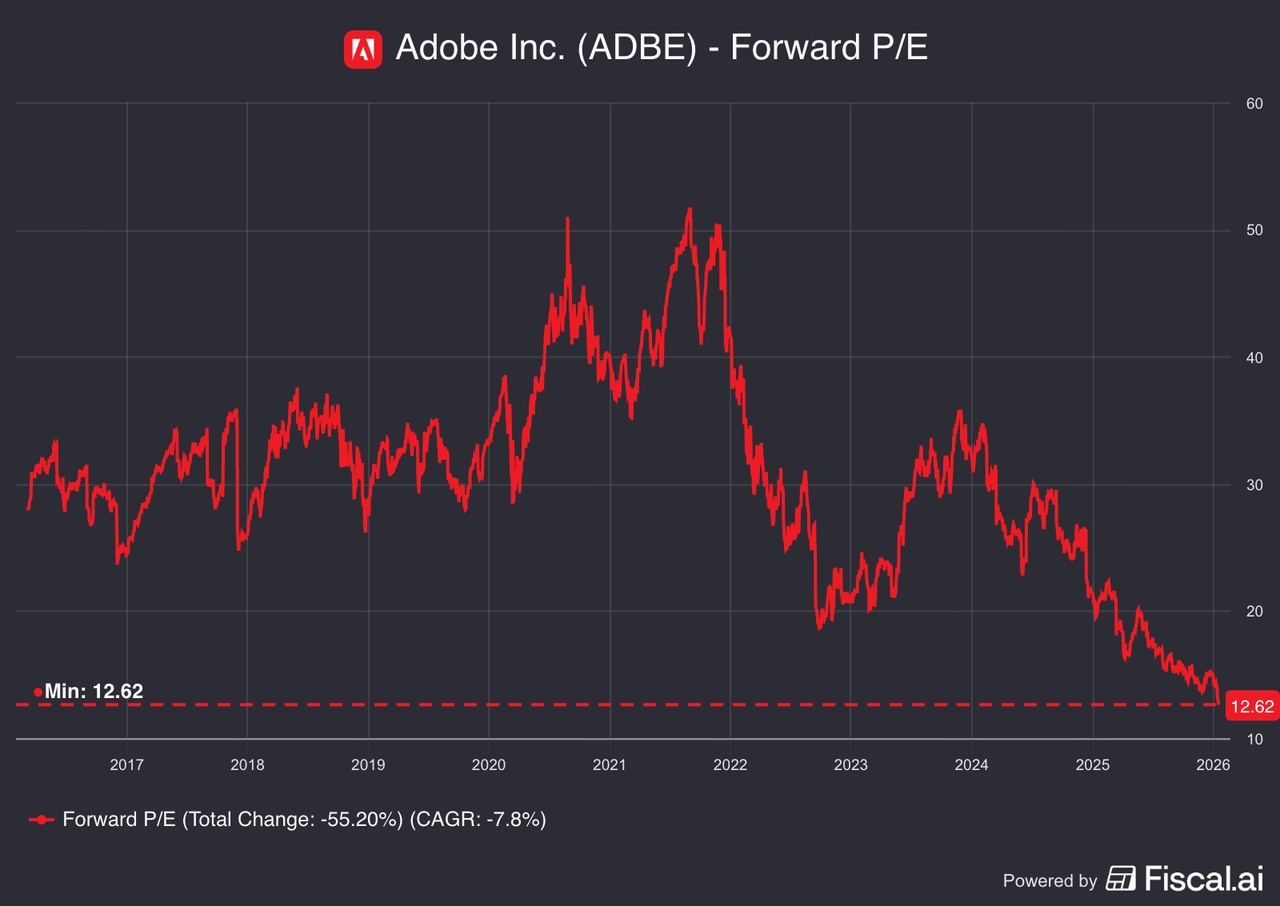
AI Threat: Adobe is perhaps the biggest battleground stock in the software space today.
They’ve been the leader in creativity software (Photoshop, Illustrator, Premiere Pro, etc.) for nearly 40 years, and are now facing pressure from not only text-to-image and text-to-video models, but heightened competition from the likes of Canva and Figma.
Rebuttal: While the two-sided pressure here has likely been a headwind to new customer growth (they don’t disclose it), Adobe’s stickiness within Enterprises shouldn’t be underestimated. There are high switching costs to learning a new system in the creative space, which is why Adobe has been able to flex its pricing power over the years.
Additionally, while competitors can replicate an individual point solution, it’s hard for anyone to replicate the value of Adobe’s full bundle. Even if a marketing department churns off of one Adobe product, there are other solutions in the Creative Suite likely getting used.
- Current Drawdown: -57%
- 5yr Revenue CAGR: +13%
- Forward P/E: 12.5x
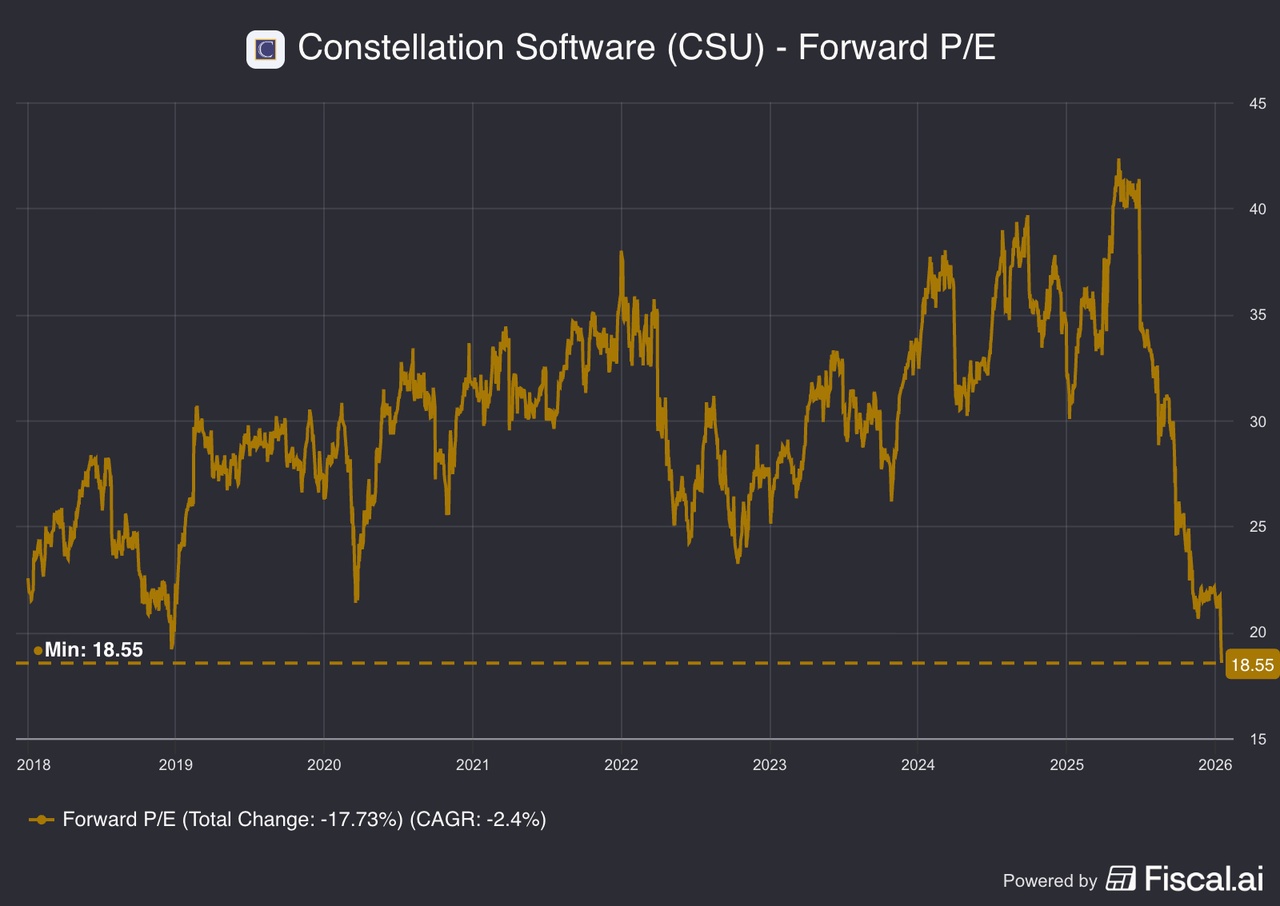
AI Threat: Constellation Software is in its largest drawdown ever.
While their sell-off was also impacted by the sudden resignation of their founder and long-time President Mark Leonard due to health reasons, the serial acquirer of vertical market software companies is perceived to be one of the most at risk to AI disruption.
Investors fear that Constellation’s niche, more specialized software systems could more easily be replicated by AI.
Rebuttal: Constellation’s products cater to clients that are highly risk averse (water billing utilities, cemeteries, banks, etc.) so sticking with existing systems is usually the safe play.
Constellation’s products also primarily provide value thanks to specialized industry-specific data that’s hard to replicate for new providers without experience in the industry.
- Current Drawdown: -45%
- 5yr Revenue CAGR: +24%
- Forward P/E: 18.6x
AI Threat: Atlassian is the parent company of Jira, one of the largest IT ticketing management platforms in the world.
Over the last few months, fears have risen that AI will allow companies to build lightweight task management platforms that can mirror certain functions in Jira.
Additionally, AI presents the risk of “seat compression”. In other words, if companies can gain efficiencies through AI, they won’t need as large of a team. Since Atlassian charges on a per-seat model, this would be a headwind to growth.
Rebuttal: For many enterprise customers, Jira is the system-of-record. Teams have poured years (or even decades) of data, bugs, and tasks into the software. Compliance, Auditing, the C-Suite, and other departments across an organization use Jira as a source of truth. Getting a whole organization to switch away would be difficult.
Additionally, Atlassian themselves are being proactive in layering on AI agents within their use experience so customers can benefit from the AI advances while remaining on the software they already know so well.
- Current Drawdown: -74%
- 5yr Revenue CAGR: +26%
- Forward P/E: 23.4x
Persönlich beobachte ich ausgewählte Softwareaktien gerade sehr genau, teilweise bin ich investiert, und plane Einstiege bzw Aufstockungen. Ein panikartiger Abverkauf wäre noch das i Tüpfelchen :)
Was denkst du? Frisst AI Software? Ist es die Jahrhundertchance zum Einstieg in Software Outperformer?
Schreib es in die Kommentare!
Quelle: fiscal.ai
+ 1
1818
24 Comentários
I see it as an opportunity. Companies have integrated AI themselves and are continuing to expand it. Team $NOW 😉
•
1515
•Títulos em alta
Principais criadores desta semana
Dados tempo real da LSX · Dados financeiros e EOD da FactSet