At $PLTR (-0,76%) I got out too early, but it's also too hot for me... maybe time to gradually build up a position? $DBXD (-1,04%) gradually?!

Xtrackers DAX ETF
Price
Discussão sobre DBXD
Postos
15What really makes a successful investor?
$LXS (+1,19%)
$DBXD (-1,04%)
$IWDA (-0,16%)
$CSNDX (+0,41%)
$CSPX (-0,08%)
Eight percent reality, fifty percent hysteria? The psychology behind price jumps and how investors can deal with them correctly.
Volatility: normality instead of risk?
Hardly a day goes by without some share in the DAX environment recording a significant price swing. This could look like this, for example: A Quartalsberichtminimally misses expectations - minus ten percent. An outlook sounds a touch more optimistic than feared - up eight percent.
But a look at the long-term figures reveals this daily excitement for what it usually is: Irrationality.
Because the bottom line is that the DAX over the past 25 years - including Dividenden - around eight percent per year. Eight percent. Not 20, not 30, eight.
And since the Index is ultimately nothing more than a basket of its constituent companies, this inevitably means that the share prices of these companies have also risen by an average of around eight percent per year over the long term.
Expectations, forecasts, whispered estimates
Anyone who realizes this should find the daily Volatilität seem absurd. If the "fair" value of a company grows by eight percent annually over the long term, how rational can it be that the share price of most Aktienfluctuate by 50% during the year?
Or plummet by eight to ten percent or shoot up after the publication of individual quarterly figures - even though the long-term earning power has often hardly changed?
Of course: information must be priced in. Profits, margins, outlooks, risks - all this is part of the valuation. But in reality, companies Märkte rarely react to facts, but to expectations upon expectations.
In addition, there is a structural problem of modern capital markets: the time horizon has shrunk. It is now only about whether the share price will rise tomorrow - and no longer about where a company will be in a few years' time.
Algorithms, ETFs, short-term funds and a media news cycle that declares every decimal place a "game changer" amplify minimal signals into drastic price movements.
Drama vs. reality
If the daily price fluctuations were taken seriously, the economic reality of DAX companies would have to change radically on a permanent basis. But it doesn't. Mechanical engineering companies, chemical groups or insurers are not suddenly worth ten percent less just because one quarter was a little weaker. Nor are they fundamentally ten percent better overnight because an analyst raises his forecast slightly.
The long-term return of the DAX shows how little remains of all the drama. Eight percent per year - calm, steady, unspectacular. The daily swings are the noise around this trend, nothing more.
And that is exactly what investors should understand. Don't let yourself go crazy if share XY comes under pressure again. In most cases, there is little or hardly anything behind it.
From depression to euphoria - a lesson
Industries and sectors fall out of favor and come under pressure. A few months later, they are back in vogue.
In 2022, for example, we experienced a major tech depression. Meta, NetflixGoogle and many more were on the hit list, only to go on to soar to incredible heights.
Today, everything labeled "AI loser" or "software" is on the brink. In retrospect, the current sell-off in many of these stocks is probably just as incomprehensible as the fact that Meta collapsed to below USD 100 in 2022 from today's perspective.
Those who understand this separation between price and value experience volatility in a completely different way. Price fluctuations lose their horror because they are no longer perceived as a threat, but as the normal state of an irrational market. The Börse is not a precise measuring instrument, but a barometer of sentiment - and sentiment fluctuates more than fundamental data
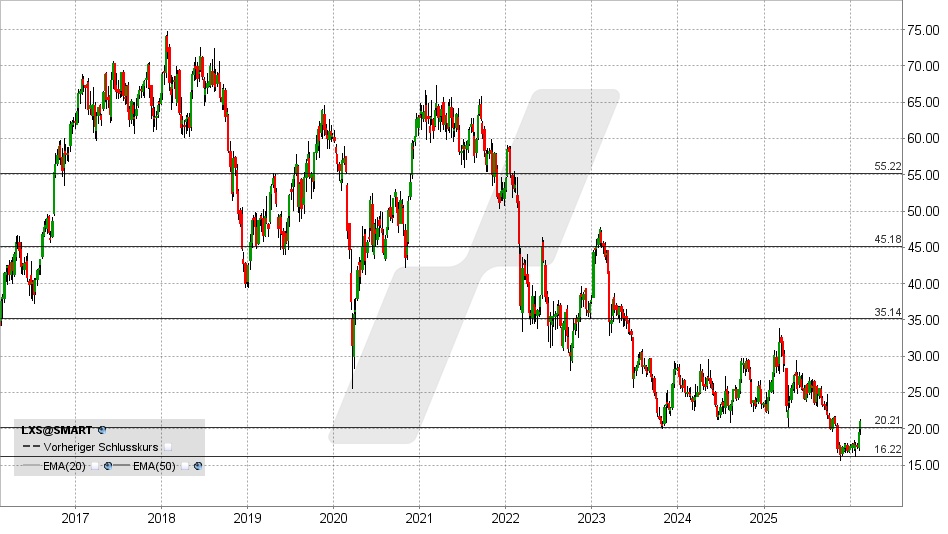
Lanxess share: Chart from 10/02/2026, price: EUR 20.91 - symbol: LXS | source: TWS
Lanxess, for example, is trading up 7.6% today at EUR 20.91. The only relevant news I could find on the company was an upgrade by Goldman Sachsfrom sell to neutral and an accompanying price target increase from 10 to 23 euros.
What could better illustrate all the short-term madness than this Rating? It fits like a glove. Yesterday Lanxess was only worth EUR 10, today it is worth EUR 23.
New factories must have sprung up overnight.
Source
When it comes to capital market investments as a retirement provision, vola is anything but irrelevant. With maxDD of 73%, as with the Dax, the safe withdrawal rate drops to 2-3%pa. That comes close to a savings account.
Anyone who dismisses vola as market noise has never experienced a 73% drawdown. The psychological strain is enormous if the entire pension provision is invested there. And the risk of selling in panic is also very high.
Finally, the irrationalities you mentioned follow certain rules. You can use them to get more than 8%pa with less than 73% mDD. Momentum investing is the key word. 😬
5 years on the stock market and 100k later
A brief look back:
I started investing 5 years ago (still 23 years young at the time).
At the time, I was still in the final stages of my dual studies when Corona suddenly hit.
My original plan to buy my own car was quickly changed to a loan-financed purchase.
The 17k that became available went public in April 2020. Looking back, there was probably no better time.
First learning:
The father of my current fiancée advised me to invest in 50% Msci World $IWDA (-0,16%) and 50% Dax $DBXD (-1,04%) to invest. This in the form of two ETFs.
Without any knowledge of the stock market, I went to my bank (Sparkasse) and told the advisor that I would like to invest in the two ETFs mentioned and open a custody account for them.
I was presented with two funds. Deka Champions and DWS Dax or something like that.
When I asked her that these were not ETFs but funds, she simply said that the benchmark was the same and that the nice saleswoman would also invest in the products mentioned.
So 10k was invested. The 3% and 4% issue and sales charges were thus paid.
Later, after I got to grips with the stock market, these were liquidated and I switched to Smart Broker for individual shares and Trade Republic for ETFs.
2nd learning what goes up can also go down:
One of my first stocks was $KO (+0,85%) and $ALV (-1,67%) the good $ETSY (-2,85%) . EK was 53€ and about 1.5k was invested.
Etsy went up to 110€ and I made my first 50% partial sale ever. Etsy rose to 240€ and nothing was done on my part. Etsy sinks to 90€ and I got back in with the partial sale. Etsy was finally sold completely at 70€.
My first learning on individual stocks was followed by the second. FOMO:
Cannabis = Bevcanna Enterprise 1.5k invested 99% loss
Independent mining corp. = 1k invested sold with 60% loss.
Today I am very thankful that I only paid 2k in tuition fees. I seriously believe that it saved me from bigger losses in the following years.
3rd learning:
An investment in a pure ETF $VWRL (-0,17%) from the beginning would have given me almost 15k more return by 2024.
I spent 2022 to 2024 reducing a difference of almost 20k, from mistakes made in 2020 and 2021, to my what if portfolio (ETF only). In 2025, however, I settled the amount for the first time to now plus minus zero through my portfolio outperformance.
4th learning:
In all this time, I have been studying the stock market in depth. I don't think I would have gone long with a pure ETF. All the non-fiction books, conferences, streams and videos have also given me a more comprehensive understanding of world events beyond the stock market. I have also made a noticeable change on the subject of money. And no, I don't turn over every penny. My savings ratio is 50% consumption / vacation and 50% retirement provision.
My latest learning:
Being debt free at 29 and having 100k gives you peace of mind. You shouldn't live your 20s in complete consumption, but you shouldn't oversleep either. My trips around the world to Asia, Central America, Europe and Africa, some with friends, some with family, have brought me more than just money.
But everyone is different. I am happy to have taken the middle path.
I have now increased my initial savings rate of €400 per month to €840. However, the €800 for vacations and consumption are just as important to me.
Thoughts on my current portfolio:
Trade Republic:
About the ETFs $IWDA (-0,16%)
$EIMI (-0,02%) and $XSX6 (-0,96%) I don't have to say anything. This is my core investment.
$SGBS (-0,21%) and $GDXJ (-1,22%) are my way of diversifying with gold. When I added gold to my savings plan on December 31, 2024, both positions almost automatically reached the 5% weighting.
What is new $VNA (-3,25%) . I selected these at the end of 2025 together with $O (-0,15%) for my 10% weighting in the real estate sector. For me, Vonovia is wrongly valued too much as an interest rate bet. Fundamentally, there is a lot right with the exception of the debt. I hope for a nice turnaround and even if not just under 6% dividends are very attractive.
As my individual stocks have performed very strongly, my allocation has become unbalanced. The goal is 50% ETFs, gold, real estate, cash and 50% individual stocks.
I won't say anything about my individual shares so as not to prolong the article too much.
Except:
$ALV (-1,67%)
$BATS (+0%)
$SHEL (+2,17%)
$GOOGL (+1,57%) are long-term stocks
$AAPL (+0,36%)
$BABA (+0,53%)
$1211 (+5,89%)
$EUZ (-0,74%)
$AXON (-3,72%) medium-term
$OXY (+2,7%)
$ARM (+1,01%)
$UNH (-1,68%) short term bets
and unfortunately I can't get the tracking 100% correct. Getquin crashed in March, which is why only Trade Republic is displayed as the previous value and Smart Broker as the capital invested in March / April.
In addition, due to the change of custody account Sparkasse -> Smart Broker -> Smart Broker plus -> Trade Republic (Etfs sorted out) I had no power to enter everything since 2020

It would be desirable if everyone who presents their portfolio here or asks for feedback would design it so creatively
https://getqu.in/ixm7aV/
Attractive investments in Europe - according to UBS
The UBS recently carried out an extensive screening of the European equity market. There are a few stocks that were rated very positively by the analysts.
These include the French energy supply group Engie $ENGI (-1,97%) the Italian logistics and postal company Poste Italiane $PST (-0,6%) the British online real estate broker Rightmove
$RMV (-1,86%) and the French technology service provider SPIE $SPIE (-2,67%).
In addition, the Irish specialist insurer Beazley $BEZ (-0,33%) the Spanish energy group Iberdrola
$IBE (-0,48%) and the Swedish telecommunications company Telia
$TELIA (-1,25%) are on the list.
The chances of a positive development are good - according to "Welt". Reason:
In Europe, politicians are investing massive amounts of money in infrastructure and defense while promising reforms to stimulate the economy. Added to this are interest rate cuts by the European Central Bank (ECB) and bulging savings accounts, which could flow into consumption and investment if the mood improves.
And overall, it is all about long-term growth: government investments are planned for years to come and the ECB is likely to cut interest rates even further.
The combination of government stimulus, cheap financing and private capital is providing a tailwind on the markets. There are some European ETFs that have been performing very well since the beginning of the year.
At the forefront is the Global X Euro Infrastructure Development $BRIP (+0,04%) with a return of 23.1 percent.
Also strong is the Xtrackers Dax $DBXD. (-1,04%)
The ETF achieves 20.3 percent and costs just 0.09 percent per year.
Also exciting is the WisdomTree Europe Defensive $EUDF (+1,69%). With 18.9 percent since its launch in March, it has made a solid start and costs just 0.40 percent.
The classic among the European ETFs, the iShares Core Euro STOXX 50 $CSSX5E (-0,79%)is somewhat more defensive at 11.8 percent, but scores with minimal fees. Europe is therefore back on the ETF radar.
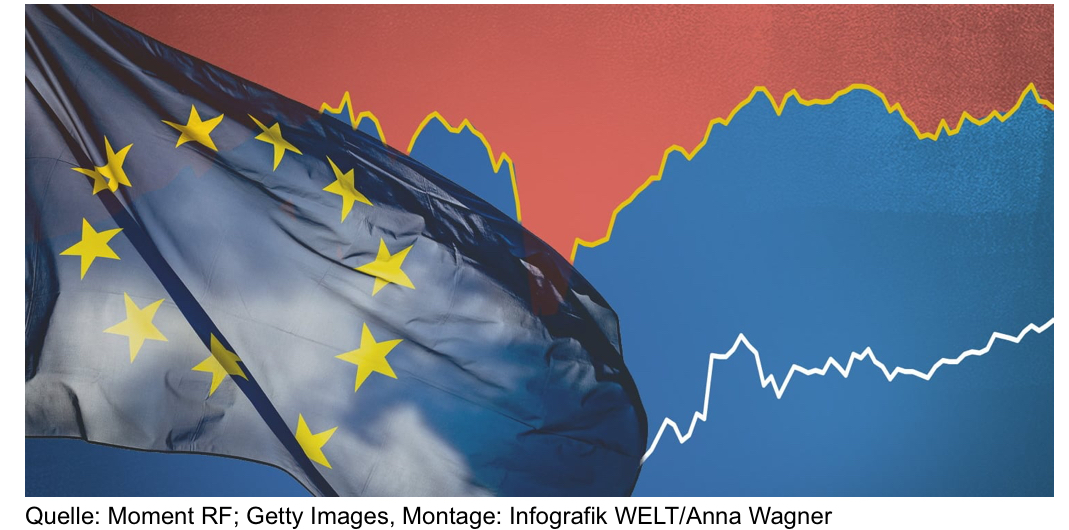
Source (excerpt) & image: "Welt", 17.07.2025

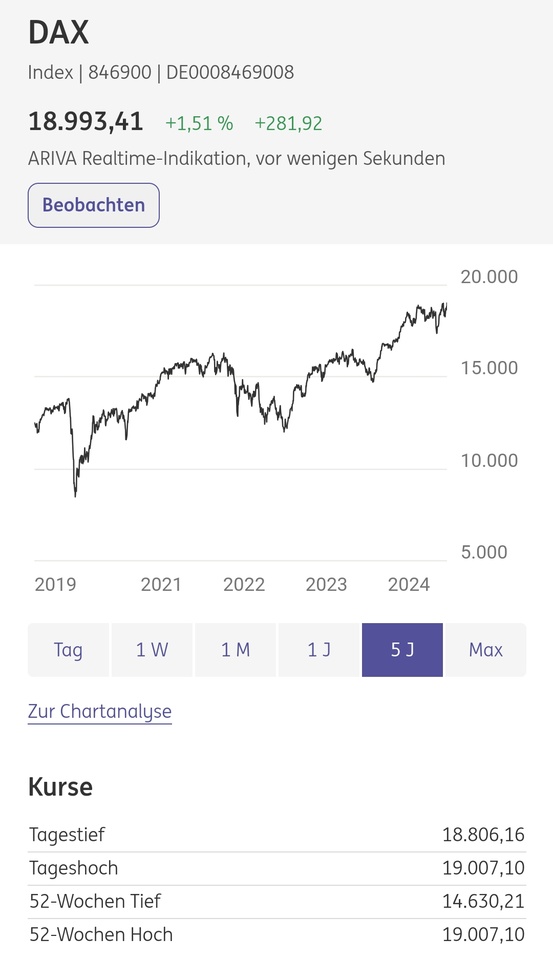
DAX breaks 19,000 points for the first time today. New all-time high. +21% in 12 months. 🇩🇪📈💶👑🏆🥇 #dax
$GDAXI
$DBXD (-1,04%)
$LYY7 (-1,11%)
$DAX
Portfolio feedback is welcome. For the ETFs, only $DBXD (-1,04%) ,$VWRL (-0,17%) ,$LCUW and
$IUIT (+0,26%) with a savings plan.
📈 DIVIDEND SEASON 2024 - WHICH COMPANIES WILL SURPRISE POSITIVELY WITH THEIR DISTRIBUTIONS AND WHICH WILL DISAPPOINT? 📊
Many here tend to attach more importance to regular distributions when investing in shares; an exciting comparison of returns here in a current Artikel which I will briefly discuss:
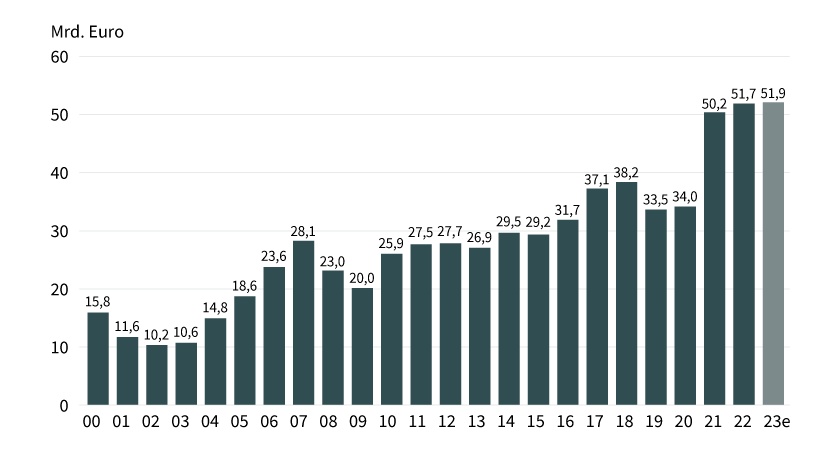
Despite challenges such as the war in Ukraine and persistent inflation, the $DBXD (-1,04%) recorded strong price gains last year. But is this development also in line with the dividends? The dividend amount does not necessarily correlate with the share price performance. (1)
30 of the 40 DAX members have already announced their dividends. Some surprised positively, while others (e.g. $BAYN (+3,15%) ) were disappointing.
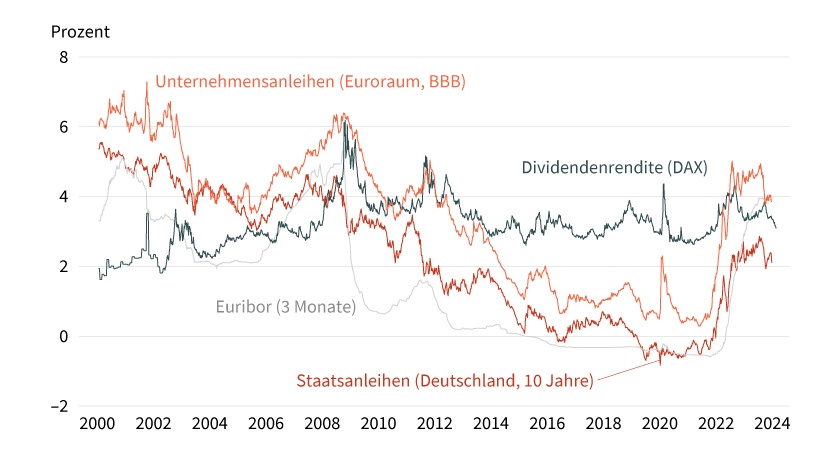
The change in the attractiveness of dividend yields in relation to corporate bonds will also be very relevant in the future...
For example $SIE (-1,99%) offers a dividend yield of 2.6 %. However, investors in corporate bonds can expect an attractive yield of 3.0%. (3)
In the article you will find among others for $DHL (-1,8%)
$BMW (-1,78%) and many other DAX companies the comparison of corporate bonds to dividend yields :)
https://www.ideas-magazin.de/2024/ausgabe-264/titelthema/
(1) Introduction
(2) Section "Eleven positive and 5 negative DAX surprises"
(3) ibid. "DAX dividends 100 basis points above the bond yield?"
#Rohstoffe
#Finanzen
#Marktausblick
#commodities
#marketsentiment
#finance 📊
This article is part of an advertising partnership with Société Générale
According to a study by the Deutsche Schutzvereinigung für Wertpapierbesitz (DSW) and the Technical University of Munich, the executive boards of the 40 companies listed on the German DAX earned less on average last year than before, despite increased group profits. The total compensation of DAX board members, including group CEOs, averaged €3.34 million, a year-on-year decline of 8.4%. The pay gap with average employees has narrowed and now stands at a ratio of 38 to 1. Still quite a difference. This decrease is explained by the increase in personnel expenses per employee and the decrease in executive compensation. In 2021, top managers still earned 52 times as much as average employees.
Although DAX companies increased sales and profits overall in 2022, the stock market falls depressed the earnings of top executives. Part of the executive board's compensation is variable and linked to the development of the company's share price. The $DBXD (-1,04%) recorded a loss of 12.3% for the full year 2022.
The study also shared the top 3 salaries, among others:
🥇 $DBK (-1,75%) Chief executive Christian Sewing with 9.2 million euros
🥈 $VOW (-1,66%) Chief Oliver Blume with 8.8 million euros + 0.5 million euros as Chairman of the Executive Board of Porsche AG
🥉 $MRK (+0,6%) Chief Belen Garijo with 8.3 million euros
Pretty fat sums, but nice to see that a woman is also involved.
Do you think that executive salaries will change again in the near future? If so, will they increase or decrease?
Hello dear community,
My name is Maurice and I have been dealing with the topic of investments since about my 18th birthday (June 2022). I have acquired some knowledge, but I still classify myself as a beginner. In the meantime, I have built up a small portfolio, in order to find my way in the "new world" for me. Currently I am doing an apprenticeship as a technical product designer and invest 200€ per month in a savings plan, which consists of stocks, ETFs and a small part of crypto, but more about that later. I will increase my monthly savings rate over the next few years depending on my salary. My goal is to invest for the long term in order to be financially independent shortly before my retirement. In addition, I would like to increase my motivation through dividend distributions. I would like to reinvest the dividends afterwards.
Let's move on to my investment strategy:
I will soon, so at the end of December restructure my portfolio, and namely I have thought there to go with a 60/35/5 strategy. So 60% in ETFs, 35% in stocks and 5% in cryptos.
In terms of ETFs, I will continue to hold almost all of my current stocks.
This includes for the most part the Core MSCI World $EUNL (-0,16%) , a smaller part in the DAX $DBXD (-1,04%) , a constant small part in Global Clean Energy $IQQH (+2,4%) , Automatioson & Robotic $RBOT , Digital Security $L0CK (+0,25%) and in the Stoxx Global Dividend 100 $ISPA (-0,76%) . I have divided the ETFs so that I also get a small part of dividends from two ETFs.
For the stocks, I split the 35% from the monthly savings rate into 60% distributing stocks and 40% accumulating stocks. Among the distributing stocks are BlackRock $BLK, Microsoft $MSFT (-0,56%)Allianz $ALV (-1,67%) and British American Tobacco $BATS (+0%). For the accumulating stocks, I will go for Amazon $AMZN (-1,4%), Alphabet $GOOGL (+1,57%) and Tesla $TSLA (-0,66%) choose.
Lastly, the cryptos. There I will also split the 5% into 60% and 40%. 60% will be in Ethereum $ETH (+3,28%) and 40% in Bitcoin $BTC (+3,18%) invested. However, I will invest the 5% of the monthly savings rate only every 6 months in Ethereum and every 8 months in Bitcoin, because otherwise the transaction costs would put a spoke in my wheel 😉.
Why I would choose these values:
Core MSCI World forms the core of the ETF portfolio. This provides a high degree of diversification of risk. I also splurged on DAX with a slightly higher splurge, although it is not the best investment for long term as it is only split between the 40 largest companies in Germany. In the long term I see gloabal clean energy, automation and digital security with high growth potential as the mediated values should become more and more important for us. Stoxx Global I cover because it is spread over several large countries and also covers many industries.
When it comes to stocks, I tend to go with the big companies because I believe in their products and services and consume some of them myself. BlackRock I find interesting because they are the largest asset manager and their dividend growth in recent years is also worth mentioning.
I invest in technology through Microsoft and Alphabet. Longer term, I see a big market there because technology will continue to advance.
I would also invest in Allianz because it is one of the largest insurance companies and its business model appeals to me.
British American Tobacco is fine for me personally at the moment because there are still enough people who smoke or are also addicted.
I think Amazon is a safe and profitable investment because it is the largest e-commerce company and the consumption of goods over the Internet will not decrease in the next few years.
Finally, I would invest in LVMH because luxury goods are bought steadily. Through this, I would also like to invest in another or in another industry to continue my dividend strategy.
As for cryptocurrencies, I believe Ethereum has more potential than Bitcoin because Bitcoin is a pure digital currency. Ethereum serves as a complete network and decentralized applications. Nevertheless, I invest in both to diversify again.
I welcome tips and suggestions for improvement!
Ps. Thanks @DonkeyInvestor for the structure.
Títulos em alta
Principais criadores desta semana