
For a long time, Trade Desk was considered an almost untouchable growth stock. But competition, KI and Amazon have shaken the narrative.
Now is the time to strike?
A few months ago, I wrote an analysis of The Trade Desk (Trade Desk: Ein Börsenmärchen mit ungewissem Ausgang). At first glance, the share was a perfect fit. A long-term outperformer that had undergone a considerable correction.
At that time, the share price had already plummeted from USD 141 to USD 59. The conclusion was nevertheless sobering: "All in all, the risk/reward ratio is surprisingly modest despite the enormous price losses."
Since then, the share price has slumped further from USD 59 to USD 36.55, causing the valuation to fall considerably once again - especially as the business has developed better than expected.
Has the time finally come to get in?
Advertising technology is a billion-dollar market
Trade Desk is one of the world's leading advertising technology and marketing groups. This is a gigantic market.
Some of the largest companies in the world earn most of their money from advertising, including Google, Facebook and, increasingly, Amazon.
Trade Desk has set itself the task of increasing the effectiveness of marketing measures and operates the world's largest demand-side platform. In simple terms, advertising space is purchased via this platform.
Instead of booking blindly, advertisers can define target groups, run tests and regulate budgets dynamically. The platform provides transparency, reporting and - increasingly - AI-supported decision-making mechanisms. The Trade Desk itself describes Kokai and its AI modules as the heart of this automation.
The Trade Desk complements the DSP with data management and a marketplace. Customers can integrate their own data, purchase third-party data and build models to meet their own target group as precisely as possible or find new target groups.
The platform can be connected to planning tools, purchasing workflows and reporting systems. The result is a comprehensive offering for data-driven marketing: planning, activation, measurement and automation.
Trade Desk against Goliath
This approach has proven to be a success story. Since the IPO in 2016, turnover, profit and cash flow have multiplied and the share price has risen more than tenfold.
Recently, however, the share price has taken a massive hit. There is a fear on the stock market that Meta, Google and Amazon will grab more and more of the cake.
Amazon in particular is expanding aggressively in this segment.
On the other hand, offline channels still account for a surprisingly high proportion of advertising budgets. However, the trend is clear. The market for Trade Desk and its competitors is therefore continuing to grow.
Furthermore, the bears argue that AI reduces switching costs and Trade Desk could lose customers as a result - but they seem to forget that the reverse is also true.
The biggest threat seems to come from Amazon. Google and Meta are relying on their own ecosystems in the advertising business and are largely sticking to their prices.
The two companies seem to be convinced that there is no way around them anyway, and realistically they are probably right.
Why Amazon has become the biggest threat
The biggest threat comes from Amazon, which primarily uses two Hebel uses. Amazon's core business provides in-house purchasing and retail data that no one else can offer.
This makes Amazon the better alternative for many advertisers and puts pressure on Trade Desk.
At the same time, Amazon is aggressively expanding its own demand-side platform, particularly in the streaming sector, where the company is already strongly positioned thanks to Prime Video and Twitch.
Amazon is thus directly attacking Trade Desk's core business and experience shows that competing with Amazon rarely ends well.
It can therefore be described as a drumbeat within the industry that Amazon has signed an exclusive deal with Netflix has concluded an exclusive deal with
Amazon's frontal attack
Amazon has also massively expanded its market share through far-reaching exclusive contracts in the sports and technology sector. One key example is the exclusive broadcasting of NBA and WNBA games from the 2025/26 season.
In addition, there were partnerships with Roku, Spotify, Pinterest and Nascar.
But there are also cases in which Amazon has emerged like a spectre in an industry, shares in the sector went into a tailspin and in the end it turned out that coexistence was possible after all.
Take the logistics sector, for example. FedEx It still exists today, as does Deutsche Post.
Or when Amazon took over Whole Foods, the share price of Sprouts Farmers Marketwent into a decline lasting several years, even though the business continued to perform well.
At some point, the good business figures could no longer be ignored and the share went through the roof.
When fear obscures the figures
Perhaps a similar development will occur at Trade Desk. Because as scary as the news on the Amazon front sounds, Trade Desk's business figures continue to look good.
Since the last analysis, the company has presented quarterly figures three times and has consistently delivered. In the first quarter, sales increased by 25 %, in Q2 by 19 % and in the third quarter by 18 %.
Growth momentum is somewhat lower than in previous years, but still high.
Profitability has also improved, which indicates that price pressure is being contained. Operating cash flow increased by 26% to USD 681.1 million in the first nine months.
The Executive Board responded to the fall in the share price with substantial share buy-backs. Over the course of the year, almost USD 1 billion was invested in buybacks, reducing the number of shares outstanding from 502.6 million to 493.0 million.
Free cash flow is currently expected to have increased by 23% to USD 1.56 per share in financial year 2025.
The Trade Desk therefore arrives at a P/FCF of 23.4.
If FCF increases by 20% to USD 1.90 per share in the 2026 financial year as expected, the P/FCF would fall to 19.2.
Before the share price collapse last year, the share never traded for a P/FCF of less than 40
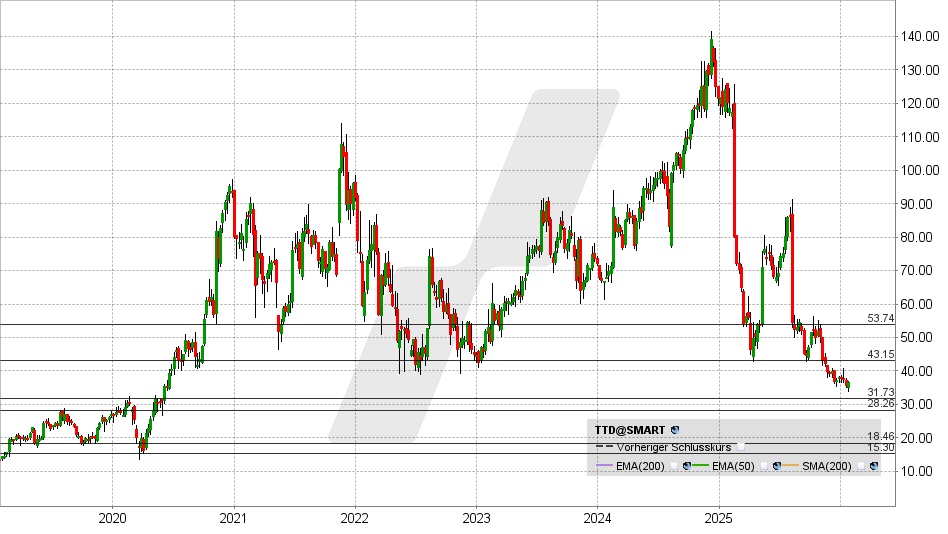
The Trade Desk share: Chart from 26.01.2026, price: USD 36.28 - symbol: TTD | Source: TWS
If it manages to rise above USD 40, this could trigger a recovery towards USD 43. The chart picture would brighten considerably above this level. In this scenario, a rise to USD 50 or 54 would also be possible.
If, on the other hand, the share falls below the low for the year to date, further price losses to the support zone at USD 28 - 32 must be expected.
Source


