
$HAUTO (-2,33%) It's out…
What should I put in now? 🤔
Hoegh actually was a pretty good fit for my portfolio (logistics sector)
So now, maybe $MAERSK A (-0,64%) or $HLAG (-1,34%) add it?
So many questions…
GaLiGrü

Postos
26$HAUTO (-2,33%) It's out…
What should I put in now? 🤔
Hoegh actually was a pretty good fit for my portfolio (logistics sector)
So now, maybe $MAERSK A (-0,64%) or $HLAG (-1,34%) add it?
So many questions…
GaLiGrü


Hey there, community ✌️
I’m a bit short on time right now, but I’d still like to introduce you to a stock—or rather, a sector—that not many people are paying attention to at the moment 👀
Today’s topic is container ships 😬—more specifically, Danaos Corp $DAC (-0,64%)
🧬 Danaos Corp: The Unshakable Cash Flow Colossus of the World’s Oceans
Danaos Corporation $DAC (-0,64%) is not a traditional shipping company that gambles on volatile spot markets in the hope that freight rates will rise. Danaos is the “Fortress” of the global logistics infrastructure. While competitors are reeling from fluctuating rates, Danaos $DAC (-0,64%) as a highly disciplined “tonnage provider.” The company owns and operates one of the world’s most modern and efficient container shipping fleets and leases it on a long-term basis to the industry’s giants (Maersk $MAERSK A (-0,64%) , Hapag-Lloyd $HLAG (-1,34%) , MSC). Danaos $DAC (-0,64%) is the epitome of operational excellence, having transformed itself from a heavily indebted maritime problem child into a debt-free cash cow.
1. The Business Model: The Triad of Freight Dominance ⚓💻💰
Danaos $DAC (-0,64%) controls value creation not through the trading of goods, but through the provision of critical infrastructure:
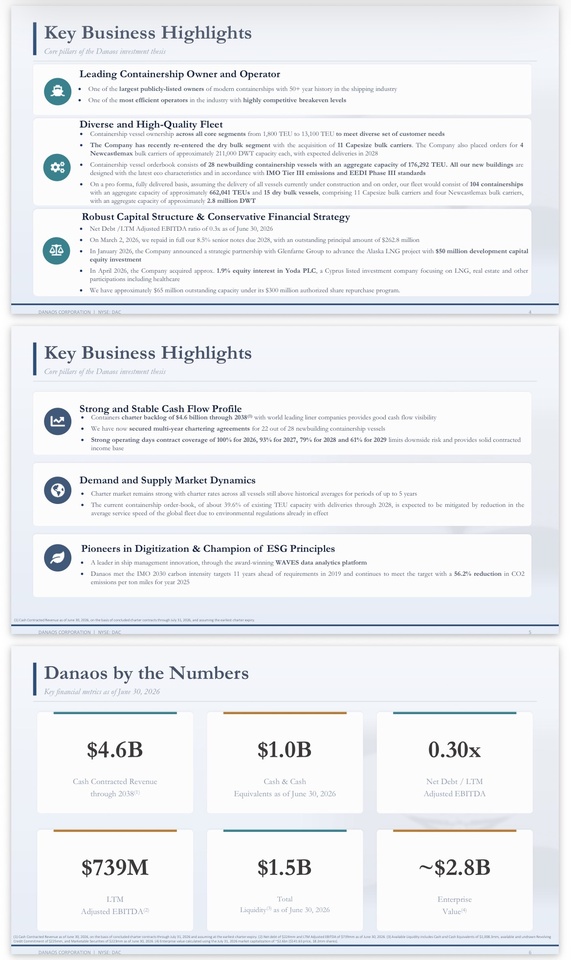
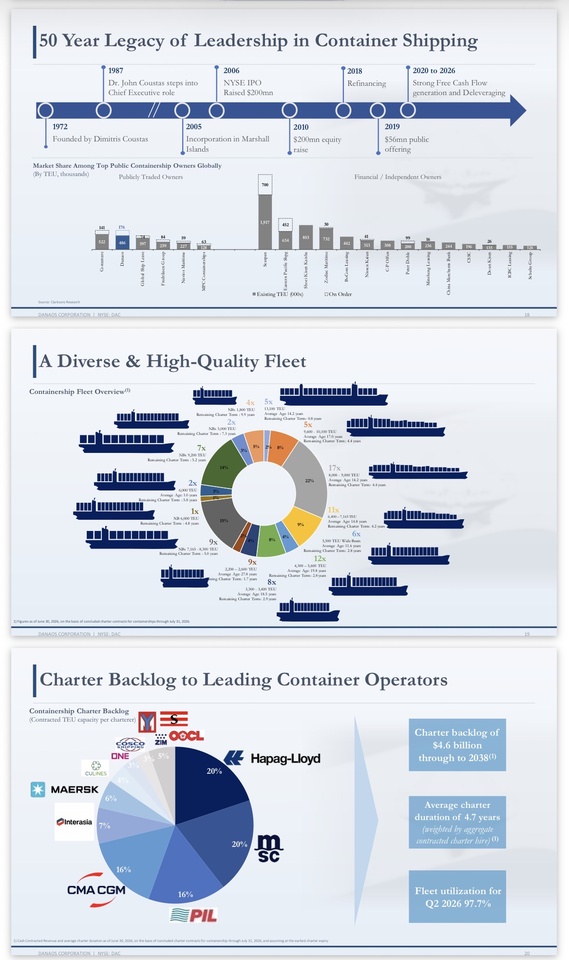
The Assets (The Fleet): With a fleet of 75 modern container ships, 15 dry-bulk carriers, and 29 highly efficient newbuilds in its order book, Danaos offers exactly what liner companies need: reliability, energy efficiency, and scalability.
The Software Layer (Backlog Management): Danaos’s true “product” $DAC (-0,64%) is not the ship itself, but the contractually secured backlog. With an astronomical order backlog of over $4.6 billion extending well into 2038, Danaos is virtually immune to short-term economic fluctuations. Coverage for container ships stands at 100% and 93%.
Strategic Expansion (Dry Bulk Booster): The re-entry into the dry bulk segment (Capesize) on the spot market serves as an additional cash catalyst, while the core container ship business remains firmly secured.
2. Key Figures (as of Q2 2026) 📊
Market capitalization: approx. $2.66 billion (listed on the NYSE under the ticker $DAC (-0,64%) at a current price of around $146.30). The stock has risen sharply but remains fundamentally undervalued.
Balance Sheet Strength (The Fortress): This is the absolute game-changer. Danaos has reduced its leverage ratio (net debt / adj. EBITDA) from over 7.0x in 2017 to its current level of 0.30x . The company holds cash reserves of over $1.4 billion, and 78 of its 87 vessels in the fleet are completely debt-free (unencumbered).
Profitability (Margin Power): With an operating margin consistently above 50% , Danaos outperforms most big-tech companies.
Free Cash Flow: The FCF margin remains stable at ~40% . Despite massive reinvestments in fuel-efficient new dual-fuel vessels, cash flow is abundant enough for dividends ($0.90/quarter) and buybacks.
3. Why is this stock so exciting? 🚀
1. The massive valuation discount: A P/E ratio (TTM) of just under 4.9x with a trailing EPS of ~$29.50 is absurdly low. The market is pricing in a panic scenario, while the $4.6 billion backlog guarantees revenue for years to come.
2. The “Fortress” security: With a net debt/EBITDA ratio of 0.3x and $1.4 billion in liquidity, Danaos can easily weather even a multi-year global downturn without having to borrow a single cent.
3. Disciplined capital allocation: Instead of buying overpriced ships at market peaks, CEO Dr. Coustas makes highly accretive investments, renews the fleet with an ESG focus, and capitalizes on selective opportunities (e.g., a $50 million investment in the Alaska LNG project).
4. Risks ⚠️
❗️Cyclicality of global trade: A severe global recession would weigh on renegotiation rates for expiring charter contracts after 2027 in the medium term.
put pressure on.
❗️Geopolitics & Trade Routes: Rerouting (e.g., Red Sea/Strait of Hormuz/Suez) is currently keeping rates extremely high. A sudden return to peace along trade routes would free up capacity and normalize rates.
push down.
❗️Fleet Oversupply: If the industry’s global container ship order book hits the market in full starting in 2027/2028, this could drive down charter rates for older vessels
5. Personal Conclusion & Reaper Bonus 🧐
Danaos $DAC (-0,64%) has risen from a formerly debt-ridden problem child to the undisputed cash powerhouse of the shipping industry. Danaos $DAC (-0,64%) is delivering exactly what was outlined in the playbook! An absolutely overlooked, underestimated player in the sector.
Anyone who understands its rock-solid balance sheet and $4.6 billion backlog knows that this cash compounder is far from having run its course.
💀Jack’s Verdict:
"Forget the outdated prejudices about ailing shipping companies. Danaos is a mathematical marvel of cash generation. You’re not buying crisis-prone ships here, but a contractually secured $4.6 billion cash stream. While others are fighting for every percentage point of return at 20x P/E ratios, Danaos is printing cash and has virtually no debt left. Anyone who bought in under $120 can sit back and collect the dividends. For newcomers: Don’t chase the 52-week high out of FOMO—the new target price for additional purchases is a solid ~$132.00 USD."
Reaper Rating: 🔥 HOLD / ACCUMULATE ON DIPS (Deep Value Cash Flow Compounder)
DIP-BUYING LIMIT: ~$132.00
Reaper Score:
8.5/10 (50% margins and a P/E ratio below 5x; minor point deduction only due to the current price being near the 52-week high)
@Get_Rich_or_Die_Tryin
@Tenbagger2024
@Raketentoni
@Multibagger
@Dividendenopi
@Stocktective
@NichtRelevant
@SAUgut777
@PikaPika0105 and, of course, all the others ✌️

+ 4

The military escalation between the USA, Israel and Iran is causing strong market movements worldwide. Investors are shifting out of cyclical sectors and into security, energy and defense.
_________________________
Bitcoin $BTC (+0,19%) shows surprising stability
Despite geopolitical risks, Bitcoin is apparently being used as a liquidity parking lot in the short term. At the same time, volatility remains high - further escalations could trigger new spikes.
_________________________
🛢 Oil prices up significantly
According to the report, the USA is currently no release from the strategic oil reserve. The market is still considered to be supplied, but the situation remains tense.
_________________________
🏦 Banks under pressure
The European banking index loses around 3,5 % - sharpest decline since April 2025.
Particularly affected:
In the USA also weaker until the US opening:
Reason: Strong Middle East business of many institutions and general risk aversion of investors.
_________________________
✈️ Travel industry collapses
High oil prices and uncertainty weigh heavily on tourism stocks:
Flights to the region are canceled, travel offers suspended. Investors fear rising costs and falling booking figures.
_________________________
💎 Luxury stocks clearly in the red
The European luxury index loses almost 4 %.
Strongly affected:
Background:
Luxury is heavily dependent on global travel. Capital flows out of cyclical stocks.
_________________________
🛡 Defense stocks as clear winners
Geopolitical tensions drive up defense stocks:
Partial price increases of 3-6 %.
The focus is particularly on missile defense systems and possible increases in defense budgets.
_________________________
🚢 Shipping companies benefit
Transport values increase due to detour (avoidance of Hormuz, Suez Canal & Bab al-Mandab):
Reason: Shortage of transport capacity and speculation on rising freight rates.
_________________________
🥇 Gold in demand
Profiteers in mining stocks:
The sector has been showing relative strength for several days.
$4GLD (-0,13%)
$GOLD
$GOLD (+2,76%)
_________________________
📊 Market logic clearly recognizable
Winner:
🛡 Armaments
🚢 Shipping companies
🥇 Gold
₿ Bitcoin (short-term)
Losers:
🏦 Banks
✈️ Travel
💎 Luxury
_________________________
🔎 Conclusion
The market reaction follows the classic pattern of geopolitical crises:
The decisive factor remains whether the situation eases diplomatically - or escalates further.
_________________________
Source:
Reuters: Anleger greifen bei Bitcoin als "Fluchtvehikel" zu (Via TradingView)


Hoegh Autoliners ASA is a Norwegian shipping company with over 90 years of history. The focus is on the transport of vehicles, machinery and other rolling stock across the world's oceans using specialized RoRo (roll-on/roll-off) vessels. The shipping company has developed into one of the most important players in global vehicle and heavy goods transportation and has significantly expanded its fleet.
Why dividend hunters should take a look here
What particularly interests dividend investors is the dividend policy, and Höegh Autoliners is exceptional in this respect:
🟦 Quarterly dividend payment
The company pays dividends several times a year, usually quarterly in March, May, September and November.
🟦 Very high dividend yield
The dividend yield is one of the highest on the market. Depending on the calculation period, it is clearly in the high double-digit range - around 19% to 25% compared to current share prices.
For example:
These are all yields that traditional dividend stocks in Europe or the USA can usually only dream of.
Total return ≠ dividend only
An often overlooked point about extremely high dividends is that they should not be viewed in isolation:
Nevertheless, quarterly distributions combined with an attractive valuation (low P/E ratio) are an interesting package for investors who prioritize current income.
Opportunities for dividend hunters
🟦 "Cash yield" instead of "price yield"
A large part of the dividend yield comes from actual cash distributions, not just theoretical calculations. This is a clear advantage for investors who want real income or rely on dividends for financial independence.
🟦 Quarterly payments instead of annual dividends
Many traditional dividend stocks only pay once a year. Four payments per year reduce reinvestment risks and improve cash flow.
🟦 Low valuation can mean further upside potential
A currently low P/E ratio (e.g. below 5) signals that the market is valuing the share very favorably. This can mean for dividend hunters:
➡️ High current distribution and potential for the share price to catch up.
Risks you should be aware of
As with any strong dividend stock, there are risks:
A dividend hunter should therefore see this share not just as an "interest payment", but as a company with operational risks and opportunities.
For whom is this share really interesting?
Ideal for:
Less suitable for:
Conclusion
The Hoegh Autoliners ASA share is a particularly exciting stock for yield and dividend hunters: it offers above-average current income, regular quarterly dividends and a business model with global reach in vehicle and heavy goods transportation. However, this attractiveness does not come without risk and volatility.
So if you prioritize "cash flow in the portfolio" over share price capitalization and are prepared to endure short-term fluctuations, this stock definitely belongs on your watchlist - because where else can you find similar dividend yields in established companies?
Of course, this is not a top analysis as you can see for yourselves. This is my personal opinion and I wanted to share it with you. Of course, it is not intended to encourage anyone to buy or sell. Everyone has to form their own opinion and start their own analysis.
$HAUTO (-2,33%)
$MAERSK A (-0,64%)
#dividende
#cashflow
#dividend
#transport

$DIS (-0,55%)
$PLTR (-0,58%)
$SRT (+1,73%)
$NXPI (+0,51%)
$PYPL (-0,27%)
$PEP (-0,3%)
$TER (+3,18%)
$CPRI (-0,51%)
$MRK (-0,91%)
$PFE (+0,01%)
$TTWO (-0,03%)
$EA
$AMD (+1,2%)
$MDLZ (-0,35%)
$LUMN (-0,25%)
$SMCI (+1,93%)
$7011 (-1,62%)
$6752 (-1,52%)
$6367 (-0,27%)
$UBSG (-0,14%)
$GSK (-0,94%)
$UBER (+0,01%)
$ABBV (-0,51%)
$LLY (-0,36%)
$GOOG (-0,2%)
$ELF (+0,54%)
$QCOM (+0,62%)
$SNAP (-0,18%)
$WOLF (+3,2%)
$ARM (+1,77%)
$VOLCAR B (-26,83%)
$6758 (+0,35%)
$SHL (+0,4%)
$SAAB B (+1,39%)
$5401 (-1,55%)
$MAERSK A (-0,64%)
$R3NK (-1,48%)
$BMY (-0,89%)
$BMW (+0,5%)
$EL (-0,41%)
$ROK (+0,41%)
$PTON (-0,1%)
$KKR (-0,59%)
$LIN (-0,11%)
$RL (-0,25%)
$AGCO (-0,48%)
$RBLX (+0,42%)
$FTNT (-0,26%)
$REDDIT
$ILMN (-0,25%)
$WMG (+0,02%)
$IREN (+1,81%)
$MSTR (+1,22%)
$AMZN (-0,3%)
$KOG (+1,36%)
$ORSTED (+1,29%)
$PM (+0,13%)
$WEED (-2,46%)

$BNTX (+0,38%)
$ON (+1,2%)
$HIMS (+0,27%)
$PLTR (-0,58%)
$O (+0,39%)
$8058 (-1,86%)
$7974 (-2,41%)
$BP. (+1,19%)
$BOSS (+0,35%)
$SWK (+0,02%)
$SPOT (-0,58%)
$N1CL34
$UBER (+0,01%)
$CPRI (-0,51%)
$SHOP (+0,51%)
$RACE (-0,97%)
$HOG (-0,58%)
$HTZ (+0,26%)
$PFIZER
$UPST (+0,38%)
$ANET (+0,74%)
$PINS (+0%)
$TEM (+0,74%)
$AMD (+1,2%)
$SMCI (+1,93%)
$RIVN (+0,4%)
$BYND (+0,51%)
$KTOS (+0,49%)
$CPNG (-0,04%)
$BMW (+0,5%)
$NOVO B (-0,18%)
$FRE (+0,1%)
$ORSTED (+1,29%)
$AG1 (+0,62%)
$EVT (-0,5%)
$CCO (+0,91%)
$DOCN (+2,28%)
$LMND (-0,06%)
$SONO (-0,24%)
$MCD (-0,36%)
$HOOD (+0,84%)
$QCOM (+0,62%)
$FTNT (-0,26%)
$FSLY (+2,08%)
$HUBS (-0,84%)
$ELF (+0,54%)
$ARM (+1,77%)
$SNAP (-0,18%)
$DASH (-0,62%)
$APP (+0,14%)
$AMC (+0,11%)
$ZIP (-0,1%)
$FIG (-0,35%)
$LCID (+0,49%)
$DUOL
$UN0 (-0,51%)
$CBK (+0,17%)
$DEZ (+1,18%)
$ZAL (+0,9%)
$HEN (+0,24%)
$MAERSK A (-0,64%)
$HEI (+1,64%)
$CON (-0,67%)
$AZN (-1,22%)
$ALB (+1,56%)
$MRNA (-2,18%)
$QBTS (+0,87%)
$WBD
$LI (+0,98%)
$RHM (+0,71%)
$DDOG (-0,33%)
$RL (-0,25%)
$OPEN (-0,58%)
$ABNB (-0,3%)
$PTON (-0,1%)
$MP (+0,73%)
$TTD (+0,09%)
$STNE (+0,07%)
$SQ (-0,07%)
$GRND (+0%)
$IREN (+1,81%)
$AFRM (-0,02%)
$CRISP
$RUN (+0,29%)
$7011 (-1,62%)
$DTG (-0,15%)
$HAG (+0,82%)
$DKNG (+0,27%)
$LAC (+0,69%)
$KKR (-0,59%)
$PETR3 (+1,78%)
$CEG
$WEED (-2,46%)
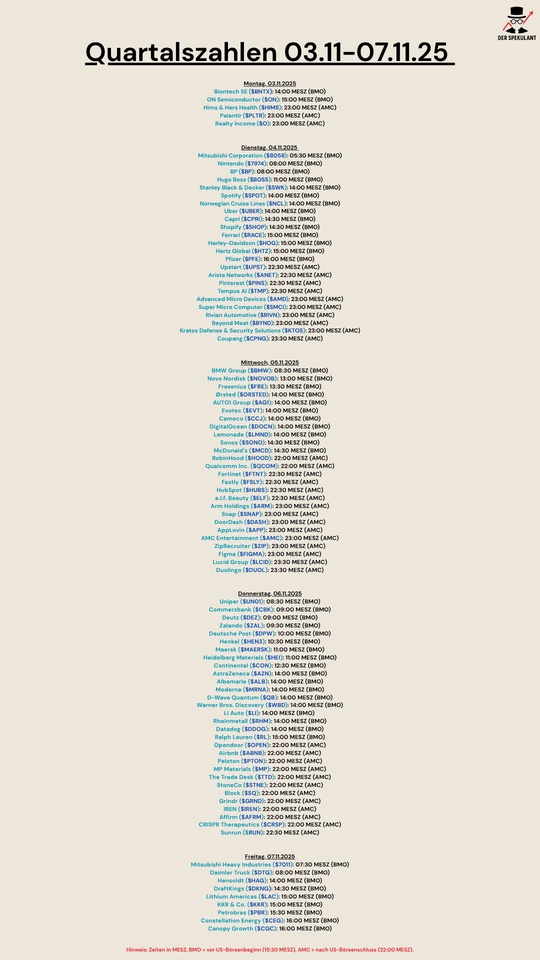
What do you think of these companies? I've been thinking about getting in here for a while. Would you do it or would you unload it?
A small overview in the article below 🙌
Who or what is Mærsk?
Mærsk is not just any shipping company - it is THE global champion in the container business. At the same time, the company has undergone a strategic transformation in recent years: from a traditional shipping company to an end-to-end logistics provider. In concrete terms, Mærsk not only wants to transport goods for Amazon & Co. but also map the entire logistics process - including warehousing, customs, digitalization and more.
Facts, figures and data (as of mid-2024)
Why is the share so cheap?
The market has punished Mærsk - partly rightly so:
📉 After the corona high (logistics boom, disrupted supply chains, high freight rates), profits slumped massively.
🌍 Geopolitical uncertainties (Suez/Red Sea), a weaker global economy and overcapacities are also having a negative impact.
But: many risks are priced in. And the management will show in 2024 that it is possible to operate profitably even with lower freight rates - with a focus on higher-margin logistics areas.
#maersk
#valueaktie
#dividendenstrategie
#zykliker
#logistik
#getquin
#aktiendepot
#langfristinvestor
#passiveseinkommen

Impact of Iran Closing the Strait of Hormuz on Global Markets
The Strait of Hormuz is one of the most important oil transit routes in the world. About 20% of global oil supply passes through this narrow waterway. If Iran decides to close it, oil prices could skyrocket above $200 per barrel, according to Macquarie Commodities Strategy Head Marcus Garvey. While this is not the expected scenario, even a temporary disruption could cause major economic consequences.
Who Benefits?
Companies involved in oil production and energy supply would likely see higher profits due to rising oil prices. Some stocks that could benefit include:
Who Suffers?
Industries that rely on oil for production and transportation would struggle with higher costs. Some of the most affected sectors include:
Likelihood of Closure
Iran has threatened to close the Strait of Hormuz multiple times, but it has never fully blocked it. The last major disruption occurred during the Iran-Iraq War (1980-1988), when both sides attacked oil tankers. More recently, in 2019, ships were attacked near the strait, raising concerns about security. Experts believe a full closure is unlikely, as it would also hurt Iran’s economy and provoke military retaliation.
Conclusion
If Iran closes the Strait of Hormuz, oil prices would surge, benefiting energy companies while hurting industries dependent on oil. However, history suggests that a full blockade is not likely, though tensions in the region remain high. Investors should watch oil markets closely as geopolitical risks evolve.
$XOM (+0,19%)
$CVX (+0,28%)
$SHEL (+0,66%)
$BP. (+1,19%)
$LHA (-1,24%)
$VOW (+0,22%)
$MAERSK A (-0,64%)
$TSLA (+1%)
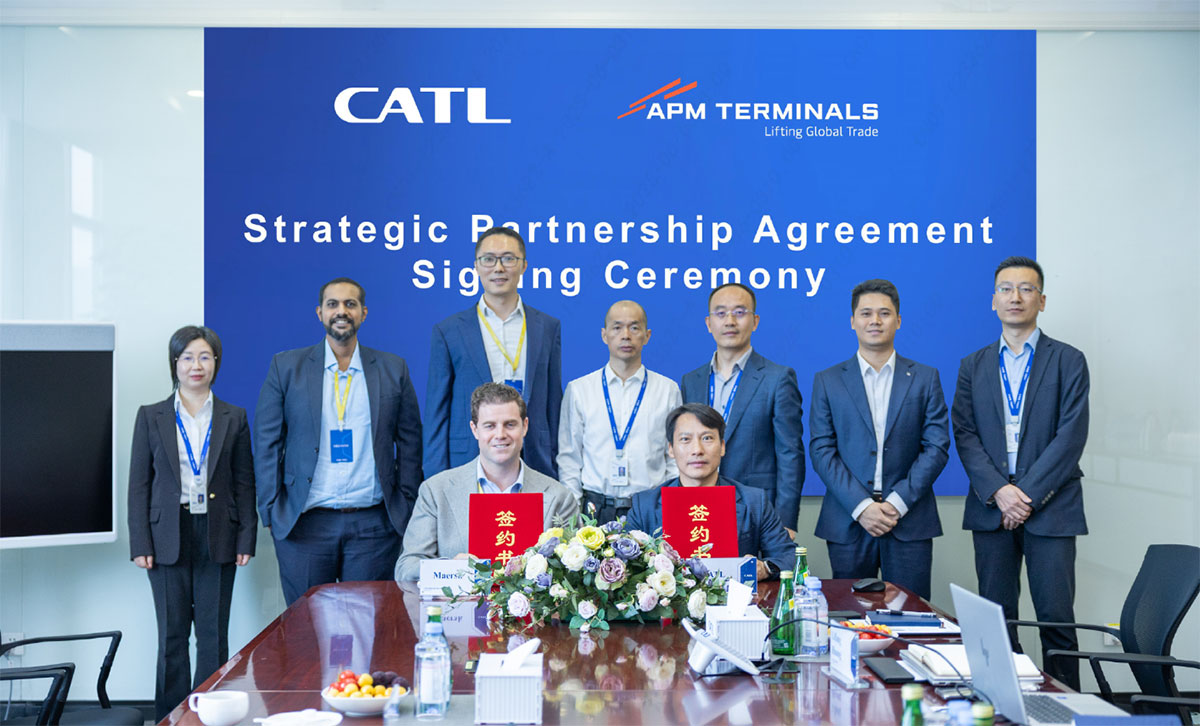
The Chinese battery giant CATL $3750 (+6,01%) has joined forces with the Danish shipping company Maersk $MAERSK A (-0,64%)
$MAERSK B (-0,78%) to drive electrification in the global logistics industry.
CATL entered into a strategic partnership with APM Terminals, a subsidiary of Maersk, on June 4, it was announced yesterday.
The two parties will use high-performance batteries and system solutions to accelerate the electrification of container handling equipment and drive the energy transition in the global logistics industry, CATL said in the announcement.
"APM Terminals is committed to decarbonization and has a clear roadmap in place. Today's collaboration is an important milestone in accelerating the future transition," said Grant Morrison, the company's Global Asset Procurement Director.
This represents a further deepening of the partnership between APM Terminals and CATL and is an important step towards the company's decarbonization strategy through the electrification of container handling equipment, he added.
CATL has previously worked with APM Terminals as part of the Zero Emission Port Alliance (ZEPA) to promote the use of electric container handling equipment.
This strategic partnership will further accelerate the development of "industry-leading solutions" to reduce greenhouse gas emissions in terminals, said Li Xiaoning, executive president of CATL's overseas business.
ZEPA was established in December 2023, with APM Terminals as one of the main initiators and CATL as a member.
According to its website, ZEPA aims to accelerate the decarbonization of ports by making battery electric container handling equipment affordable and accessible in this decade.
According to South Korean market research firm SNE Research, CATL is the world's largest manufacturer of power batteries and held a 38.3 percent share of the global electric car battery market in the first quarter.
Subscribe to the podcast so we can hit bottom soon.
00:00:00 Market Environment
00:21:40 Nike, Adidas, Puma, On Holdings, Lululemon, Under Armour
00:35:50 Finding the Bottom: VIX, Oil Price, Baltic Dry Index, Gold, Bonds, CME Fed Watch Tool, St. Louis FRED Overnight Reverse Repurchase Agreements, COT
01:18:30 Chevron, Exxon, Occidental Petroleum, BP, Shell
Oil & Gas Exploration & Production A1JKQL
WisdomTree WTI Crude Oil A0KRKU
iShares MSCI World Energy Sector A2PHCF
01:29:35 Chinese Stocks
01:44:25 Container Ship Stocks
Spotify
https://open.spotify.com/episode/28RlbWBRC6xGUJ8AkHVcFU?si=w1t0GJtDTWOwNuUADqWoPQ
YouTube
Apple Podcast
$ZIM (+0,58%)
$MAERSK A (-0,64%)
$SHEL (+0,66%)
$XOM (+0,19%)
$CVX (+0,28%)
$BP. (+1,19%)
$OXY (+0,9%)
$ADS (-1,6%)
$NKE (-0,23%)
$PUM (-0,78%)
$UAA (-1,65%)
$LULU (+0,49%)
$WTI
$1BRN (+1,19%)
$SPOT (-0,58%)
$AAPL (-0,31%)
$GOOG (-0,2%)
$GOOGL (-0,28%)
$BABA (-1,32%)
$700 (-0,88%)
$BYD (+0%)
#china
#zoll
#podcast
Principais criadores desta semana


