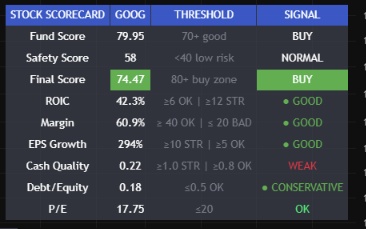


I’m also keeping Alphabet in my 2036 portfolio.
Investing.com – Alphabet plans to launch its artificial intelligence (AI) chips into Earth’s orbit on Thursday using a SpaceX Falcon 9 rocket. This is part of efforts to build data centers in space.
The launch is scheduled for 11:15 a.m. PT from Vandenberg Air Force Base in Santa Barbara County, California.
As part of the uncrewed Transporter-18 mission, SpaceX will transport satellites from Planet Labs, including a solar-powered prototype equipped with Google’s Tensor Processing Units (TPUs). The mission marks the first in-orbit test for Alphabet’s “Project Suncatcher,” an initiative the company first announced in November 2025.
According to Alphabet, “Project Suncatcher” aims to investigate whether space can host an infrastructure for machine learning. The company plans to develop a solar-powered AI computing infrastructure designed for continuous operation in space.
Alphabet holds a stake in SpaceX valued at over $82 billion.
In low Earth orbit, Alphabet says, satellites can access nearly constant sunlight and generate up to eight times more solar energy than on Earth. The company expects to eventually network multiple satellite constellations to handle larger AI workloads in orbit.
Alphabet has already tested its Tensor Processing Units, which execute AI workloads, at a facility at the University of California, Davis. However, it remains unclear how the chips will perform under the conditions of low Earth orbit.
SpaceX has announced plans to build and launch its own orbital data centers based on satellite swarms developed in Redmond, Washington. The satellites are to be equipped with graphics processing units and solar panels that SpaceX plans to produce in collaboration with Tesla.
Earlier this year, Elon Musk stated that data centers in space would become the most cost-effective method for AI training within two to three years. Gwynne Shotwell, SpaceX’s chief operating officer, said at an event in September that the company would deploy supercomputing capabilities in space by 2027.