Hello, everyone,
We’ve already looked at my Depot 2036 portfolio from the perspective of humanoids and data centers in growth markets.
Today, we’ll focus on the growth market of space technology.
Some of you have already invested in SpaceX.
I’m not taking that route with Portfolio 2036 because SpaceX is too big a gamble for me.
Anyone who knows me should already know that I tend to seek out the beneficiaries—namely, the suppliers of the necessary equipment.
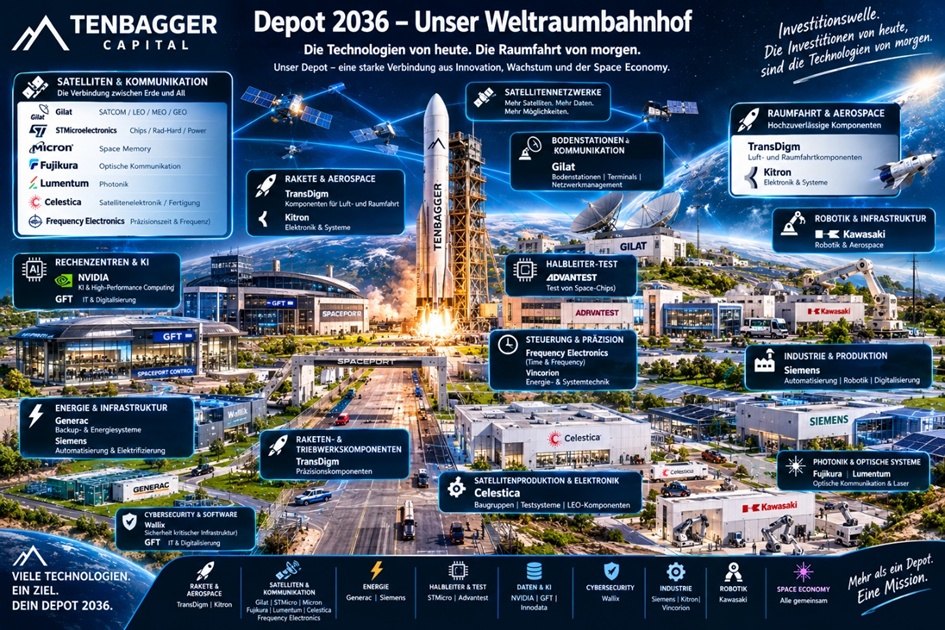
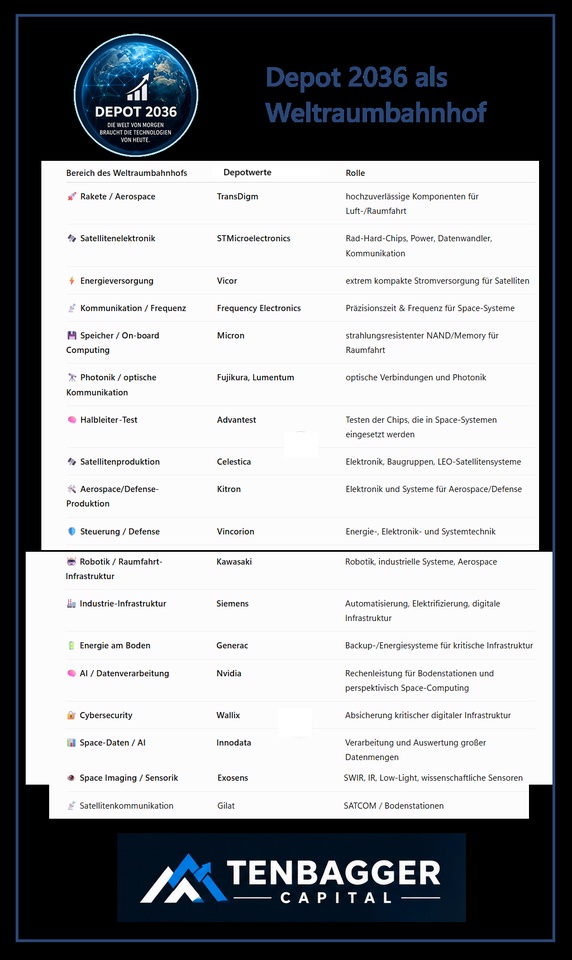
If we look at the Portfolio 2036 as a spaceport , the structure actually becomes quite exciting: A spaceport needs not only rockets, but also energy, power electronics, semiconductors, storage, communications, optical data transmission, precision timing, control systems, test technology, and rugged electronics.
And that’s exactly where my portfolio has a surprising number of points of connection. Global space activity is growing rapidly: According to the OECD, there were 329 launches and approximately 4,900 objects sent into space in 2025; by mid-2026, there were nearly 15,000 active satellites in orbit.
🚀 The 2036 Portfolio as a Spaceport
1. STMicroelectronics – the spaceport’s chip supplier
The connection to space here much stronger than one might think at first glance.
ST itself now refers to LEO as a highly scalable communications and computing platform and expects cumulative more than $3 billion in space revenue. The company also supplies radiation-hardened components for satellites, including data converters, logic, and power products.
This fits perfectly with my Depot 2036 thesis:
More satellites → more electronics → more semiconductors → more ST.
And particularly interesting: In addition to communications and direct-to-cell, ST even sees orbital computing as a potential additional area of development.
https://newsroom.st.com/media-center/press-item.html/f0021.html?utm_source=chatgpt.com
Space significance: 🔥🔥🔥🔥🔥
2. Vicor – the power supplier in orbit
For me, this is one of the most exciting space-related holdings in the portfolio.
Vicor explicitly offers radiation-tolerant power supply modules for LEO/MEO satellites. For example, the modules efficiently convert the satellite’s voltage to the voltages required for processors and other components.
And this is particularly interesting right now: At the end of September 2026, Vicor presented solutions for space power systems at the European Space Power Conference.
Even more exciting for the 2036 vision:
The more computing power satellites gain, the more important efficient power supply becomes.
Vicor is already describing space AI systems in which power supply for high computational loads becomes a decisive factor.
Space significance: 🔥🔥🔥🔥🔥
3. Celestica – the Space Manufacturing Plant
This is where it really becomes tangible.
Celestica explicitly refers to Space explicitly as its own market and produces, among other things:
- satellite communications electronics
- circuit board assemblies
- optical systems
- Cables/harnesses
- reaction wheels
- Test systems
- LEO Satellite Components
- https://www.celestica.com/our-expertise/markets/aerospace-and-defense?utm_source=chatgpt.com
This means:
As the space industry transitions from individual projects to industrial mass production, Celestica could find itself right at this intersection.
And it is precisely this scaling that is one of the major differences between traditional spaceflight and New Space.
Space Significance: 🔥🔥🔥🔥🔥
4. Micron – Memory for Satellites
Micron also fits surprisingly well into the picture.
Micron now has a space-qualified memory portfolio and offers radiation-tolerant NAND memory for space applications.
https://www.micron.com/markets-industries/industrial/aerospace-defense?utm_source=chatgpt.com
This becomes particularly interesting as satellites process more and more data directly in orbit.
In other words:
Camera/Sensor → Memory → AI/Compute → Decision → Communication
instead of
Camera → send everything to Earth → process there.
Micron is therefore not a traditional “space player,” but rather a supplier to the digital space industry.
Space relevance: 🔥🔥🔥🔥
5. Frequency Electronics – a small-cap stock, but with an extremely specialized connection to space
I find FEIM particularly interesting in this context.
Frequency Electronics supplies precision time and frequency for ground, air, sea, and space platforms as well as for government and military systems.
https://frequencyelectronics.com/about/?utm_source=chatgpt.com
Why is this important?
Satellites must be synchronized with extreme precision.
In:
- satellite communications
- Navigation
- Radar
- military systems
- satellite networks
time accuracy is a fundamental part of the infrastructure.
FEIM is therefore more like the “timekeeper of the spaceport”.
Space significance: 🔥🔥🔥🔥
6. Gilat Satellite Networks—a central hub between satellites and Earth
Gilat is a more direct space-related stock. Gilat develops satellite communication solutions for GEO, MEO, and LEO, including ground stations, terminals, and network management.
Particularly relevant to the Depot 2036 narrative: By 2026, Gilat will already have over $20 million in SkyEdge orders from a major satellite operator by 2026. In addition, the planned acquisition of Comtech’s space and satellite business is expected to significantly strengthen Gilat’s position in the space and defense communications .
Gilat is essentially the communications bridge from space back to Earth. 🌍↔️🛰️
7. Exosens — definitely fits into the space narrative
Exosens is known for its predecessor, Xenicsand Photonistechnology in the field of high-precision image sensors, SWIR/IR, and low-light imaging . Exosens explicitly cites space exploration explicitly as an application area.
https://www.exosens.com/applications/scientific?utm_source=chatgpt.com
🛰️ Direct evidence of space applications
Of particular interest is the Xenics Bobcat SWIR sensor system:
- Xenics/Exosens collaborates with the DLR on the NASA/JPLVERITAS mission.
- The sensor is intended for use on the Venus mission.
- The ESA mission EnVision is also mentioned.
- The sensor is specifically designed for extreme conditions, including space exploration .
https://www.exosens.com/news/veritas-mission?utm_source=chatgpt.com
So this isn’t just a theoretical “space might become interesting someday” story.
And Exosens has another interesting aspect: Its imaging ranges from UV through visible light and SWIR to LWIR. This means it’s not just about traditional cameras, but about “seeing” in spectral ranges that are important for scientific and military applications.
https://www.exosens.com/product-types/image-intensifier-tubes?utm_source=chatgpt.com
And Exosens currently has a strong defense/sensor driver: In the first half of 2026, revenue rose by 15.3%, with Detection & Imaging growing by 24.3%. The company specifically cites defense imaging, drones, and counter-drone applications as growth drivers.
https://www.exosens.com/news/h1-2026-exosens-results?utm_source=chatgpt.com
🛰️ And then there’s Lumentum + Fujikura
Here, I’d like to tie in the previous photonics theme .
Fujikura is already conducting research on radiation-resistant optical fibers for communication between satellites.
https://www.fujikura.co.jp/en/research/technical-report/no055.html?utm_source=chatgpt.com
This is extremely interesting for a world with thousands or tens of thousands of satellites:
Satellite ↔ Satellite ↔ Satellite ↔ Ground Station
instead of each satellite communicating exclusively with a single ground station.
Lumentum, on the other hand, I would currently view more as a photonic/data center beneficiary with an additional space option . Lumentum’s current operational momentum stems primarily from AI and data center optics; however, the company is fundamentally deeply positioned in optical communications technology.
My key point for the 2036 portfolio
The exciting thing is notthat my portfolio is suddenly turning into a “space portfolio.”
What’s much more interesting is:
These companies are selling the infrastructure that makes a rapidly growing space industry possible in the first place.
The aerospace industry is increasingly becoming a combination of:
🚀 Aerospace + 🛰️ Satellites + ⚡ Energy + 🧠 Semiconductors + 💾 Storage + 📡 Communications + 🔭 Photonics + 🤖 Robotics + 🔐 Cybersecurity + AI
And it is precisely this combination that is already found surprisingly often in the 2036 portfolio.
My Space Matrix for the 2036 Portfolio
Direct Space Leverage
- 🥇 STMicroelectronics
- 🥇 Vicor
- 🥇 Celestica
- 🥇Gilat
- 🥈 Frequency Electronics
- 🥈 TransDigm
- 🥈 Micron
- 🥈 Fujikura
- 🥈 Exosens
Indirect Space/Infrastructure Leverage
- Lumentum
Kitron
Advantest
Kawasaki
Vincorion
Siemens
Nvidia
Generac
Digital Level
- Wallix
Innodata
GFT
This gives the Depot 2036 adds the following to its existing pillars humanoids, data centers, AI, cybersecurity, defense, and energy :
🚀 SPACE ECONOMY
And the best part is: You don’t necessarily have to own a pure-play space stock to benefit from it. I already own several companies that could profit from the technological bottlenecks in the space industry.
I find the following chain particularly strong: STMicro → Vicor → Celestica → Micron → Fujikura → Frequency Electronics. It covers chips, power, manufacturing, storage, communications, and synchronization.