
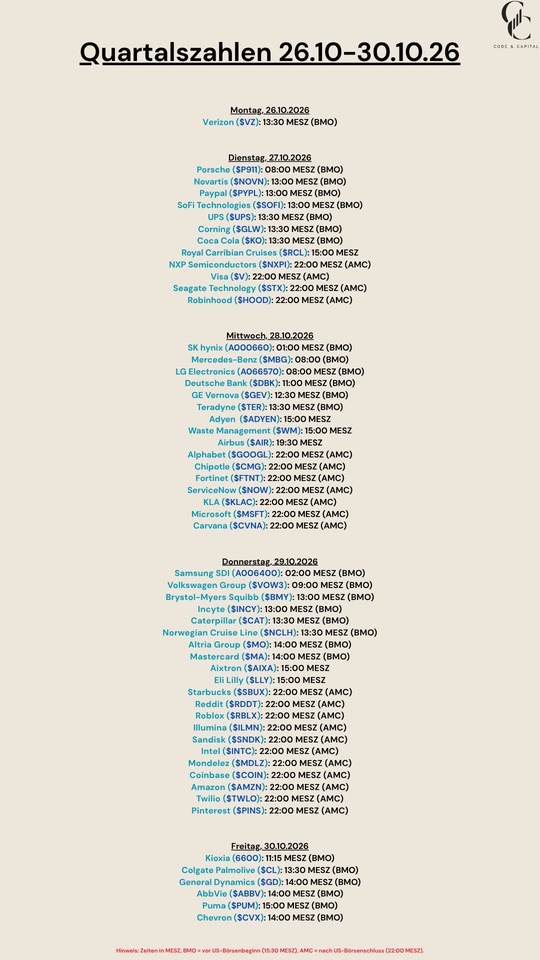
$VZ (+2.09%)
$P911 (+1.28%)
$NOVN (-0.3%)
$PYPL (-0.8%)
$SOFI (-1.83%)
$UPS (+1.14%)
$GLW (-0.55%)
$KO (+0.52%)
$RCL (-0.58%)
$NXPI (+0.11%)
$V (+0.49%)
$STX (-4.94%)
$HOOD (-3.29%)
$SKHY (-4.32%)
$MBG (+0.45%)
$DBK (-2.44%)
$GEV (-0.94%)
$TER (-4.38%)
$ADYEN (+0.92%)
$WM (+0.43%)
$AIR (-2.68%)
$GOOGL (+0%)
$CMG (+2.8%)
$FTNT (-0.99%)
$NOW (-2.64%)
$KLAC (-3.2%)
$MSFT (-0.97%)
$CVNA (+0.81%)
$006400
$VOW3 (-0.46%)
$BMY (+2%)
$INCY (+3.25%)
$CAT (-2.99%)
$N1CL34
$MO (+1.32%)
$MA (-0.23%)
$AIXA (-4.06%)
$LLY (+2.49%)
$SBUX (+0.27%)
$RDDT (-13.65%)
$RBLX (-0.51%)
$ILMN (-6.74%)
$SNDK (-10.82%)
$INTC (-10.36%)
$MDLZ (-1.33%)
$COIN (-7.18%)
$AMZN (+4.71%)
$TWLO (+1.51%)
$PINS (+9.46%)
$285A (-13.04%)
$CL (+1.2%)
$GD (+0.68%)
$ABBV (+0.23%)
$PUM (+4.91%)
$CVX (+1.29%)
- Markets
- Stocks
- Deutsche Bank Aktiengesellschaft
- Forum Discussion

Deutsche Bank Aktiengesellschaft
Stock
Stock
ISIN: DE0005140008
Ticker: DBK
DE0005140008
DBK
Price
Discussion about DBK
Posts
1075D·
Quarterly Results: Oct. 26–30, 2016
1919
2 Comments
OberstvonGatow@OberstvonGatow
5D
•
11
•
2Wk·
Deutsche Bank Stock Forecast & Price Targets for 2026: Record Profits, Stock Price Plunge — Why?
Summary
Record profits, yet a drop in the stock price? It all makes sense: Deutsche Bank has almost entirely given up its September rally, which peaked at 35.85 EUR (the highest level in many years); the stock is now trading at around 30 EUR, about 16% below that high. The main trigger was a warning from CFO Raja Akram on September 23 that investment banking revenues in the third quarter were likely to stagnate or come in slightly below the strong prior-year figures. This was compounded by concerns over interest rates and inflation, as well as a weak banking sector: On October 7, the stock temporarily fell by about 5.5% to EUR 29.69. From an operational perspective, the picture remains solid: In the second quarter, profit after taxes rose 10% to EUR 1.9 billion—a record for a second quarter—while earnings per share increased 19% to EUR 0.57, and return on equity (RoTE) stood at 11.0%. Analysts remain largely positive: Of the eight firms listed on finanzen.net, six recommend buying and none recommend selling; the average price target is EUR 37.75, about 26% above the current price. The €500 million share buyback program was completed on September 25; the next test will be the third-quarter results on October 28, 2026.
Key Points
Share price: approx. 30.00 EUR (Oct. 9, 2026), about 16% below the September high of 35.85 EUR. Triggers for the pullback: CFO’s warning regarding investment banking in the third quarter (September 23), concerns over interest rates and inflation, and a weak banking sector. Q2 2026: Profit after taxes: 1.9 billion EUR (+10%), earnings per share: 0.57 EUR (+19%), revenue: 8.5 billion EUR (+9%), ROE 11.0%Analysts (finanzen.net): 6 out of 8 recommend buying, none recommend selling, average price target EUR 37.75 (range EUR 32.00 to EUR 43.75)Valuation: P/E ratio approx. 9.5, dividend EUR 1.00 per share (yield approx. 3.3%), share buybacks in 2026: EUR 1.5 billionTechnical analysis: Price just below the 200-day moving average at approx. 30.4 EUR, below the 50-day moving average at approx. 33.1 EUR Risks: Weaker investment banking, loan loss provisions, interest rate and economic fluctuations. Next Earnings Release: October 28, 2026 (Q3)
What are the current key metrics for Deutsche Bank stock?
The Deutsche Bank stock is trading at approximately 30.00 EUR with a P/E ratio of around 9.5, earnings per share of 0.57 EUR in the second quarter, and a dividend yield of approximately 3.3%.
Key FigureValueDate
Price (XETRA: DBK)
approx. 30.00 EUR
Oct. 9, 2026
52-week high (September high)
35.85 EUR
Sept. 2026
52-week low
23.82 EUR
March 23, 2026
Distance from 52-week high
approx. −16%
Oct. 9, 2026
Distance from 52-week low
approx. +26%
Oct. 9, 2026
Profit after taxes Q2 2026
1.9 billion EUR (+10%), a record for a second quarter
July 29, 2026
Earnings per share Q2 2026 (EPS)
EUR 0.57 (+19%)
July 29, 2026
Net revenue Q2 2026
EUR 8.5 billion (+9%)
July 29, 2026
Return on Equity (RoTE) for Q2
11.0% (previous year: 10.1%)
July 29, 2026
Cost-to-Income Ratio for Q2
63.0% (previous year: 63.6%)
July 29, 2026
CET1 Ratio (End of Q2)
13.9% (Target range 13.5–14%)
June 30, 2026
P/E Ratio / Price-to-Book Ratio
approx. 9.5 / approx. 0.7
Oct. 2026
2025 Dividend / Payout Ratio
1.00 EUR / 60%
—
Dividend Yield
approx. 3.3%
Oct. 2026
Share Buyback 2026
1.5 billion EUR total; last program (500 million EUR) completed on Sept. 25
Sept. 25, 2026
Analyst Consensus (finanzen.net)
8 firms: 6 Buy, 2 Hold, 0 Sell
Oct. 7, 2026
Average price target (finanzen.net)
37.75 EUR (range 32.00–43.75 EUR), approx. +26%
October 7, 2026
Broader consensus (Investing.com)
18 analysts: 9 Buy, 9 Hold, 0 Sell, average 34.13 EUR
October 8, 2026
Goldman Sachs Rating
Buy (previously Neutral), price target 43.75 EUR (previously 37.00 EUR)
September 2, 2026
WKN / ISIN / Ticker
514000 / DE0005140008 / DBK
—
Next Report (Q3)
October 28, 2026
—
What news is currently driving Deutsche Bank stock?
The most important news regarding Deutsche Bank stock from the past few weeks at a glance:
Date | News | Details | Assessment
October 28, 2026
Next Event: Third-Quarter Results
The bank will release its Q3 results on October 28. The focus will be on investment banking revenues and provisions for credit losses. Warburg Research expects retail and corporate clients to offset the weakness in investment banking.
Watch
October 7, 2026
Share price slips below 30 EUR
The stock temporarily falls by about 5.5% to 29.69 EUR (intraday low of approx. 29.6 EUR); since the end of September, it has fallen by about 12.5%. Barclays and BNP Paribas are also falling. Warburg Research maintains a “Buy” rating with a price target of 41.50 EUR.
Bearish
October 6, 2026
Analysts Maintain Buy Recommendations
JPMorgan confirms an “Overweight” rating with a price target of 41.00 EUR; RBC Capital Markets rated the stock “Outperform” with a price target of 36.00 EUR on October 5. According to finanzen.net, 6 out of 8 firms recommend buying, none recommend selling.
Bullish
October 1, 2026
Interest rate and inflation concerns weigh on the stock
The stock falls by up to 3% and drops below the 50- and 100-day moving averages. According to Bloomberg, the bank is considering a risk transfer for a portfolio of subscription lines worth approximately $2 billion; terms and structure are still to be determined.
Neutral
September 25, 2026
Share buyback of over EUR 500 million completed
Between August 25 and September 25, the bank repurchased approximately 15.1 million shares (0.8% of the share capital) at an average price of EUR 33.19. The total buyback volume for 2026 thus amounts to EUR 1.5 billion.
Bullish
September 23, 2026
CFO Tones Down Expectations for Investment Banking
Raja Akram expects investment banking revenues for the third quarter to remain flat or decline slightly compared to the strong prior-year quarter. Provisions for credit losses are expected to fall between the levels seen in the first and second quarters, weighed down in part by an exposure to a corporate client. The stock falls by about 3% to EUR 31.86.
Bearish
September 2, 2026
Goldman Sachs: Neutral → Buy
Goldman Sachs raises the rating to Buy and the price target from 37.00 to 43.75 EUR (+18.2%). This is the highest price target to date among the analysts listed on finanzen.net.
Very Bullish
July 29, 2026
Q2 Results: Record Profit After Tax
Profit after tax: 1.9 billion EUR (+10%); profit before tax: 2.7 billion EUR (+11%); earnings per share: 0.57 EUR (+19%); Revenue: 8.5 billion EUR (+9%), RoTE: 11.0%. The bank sees itself firmly on track to meet its revenue target of approximately 33 billion EUR in 2026 and announces a new share buyback program worth 500 million EUR.
Very bullish
What does Deutsche Bank do—and how does it make its money?
Company Description
The Deutsche Bank (ISIN: DE0005140008, WKN: 514000) was founded on March 10, 1870, in Berlin and is currently headquartered in Frankfurt am Main. Christian Sewing has been CEO since 2018. The business is divided into investment banking, private client banking, corporate client banking, and asset management (DWS). In the second quarter of 2026, the group generated net revenue of EUR 8.5 billion and a profit after taxes of EUR 1.9 billion.
The four business segments—and how the bank actually makes money:
Corporate Bank: Payment processing, cash management, and trade finance for corporate clients. Generates revenue primarily through fees and commissions—a business with stable margins and high switching costs, as companies rarely change their primary bank for payment transactions.Investment Bank: Trading in bonds, foreign exchange, and derivatives (Fixed Income & Currencies), as well as advisory services for mergers, acquisitions, and capital market issuances. Generates revenue through trading spreads, underwriting fees, and advisory fees—the most volatile but highest-margin segment, and precisely the one for which the CFO expects weaker earnings in the third quarter. Private Banking: Traditional retail banking—checking accounts, mortgages, consumer loans, and investment advice in Germany and internationally. Generates revenue through the interest margin between deposit and loan rates, as well as through advisory fees—this is where interest rate levels have the strongest impact. Asset Management (DWS): Management of funds and institutional capital. Generates revenue through management fees based on assets under management—a stable, predictable revenue stream independent of the interest rate cycle
Why interest rates are so important for a bank: Banks derive a large portion of their core business revenue from the so-called interest margin—the difference between what they pay on deposits and what they charge on loans. When interest rates rise, this margin typically widens, which boosts profits. The downside became apparent in early October: Concerns about interest rates and inflation, combined with a growing number of loan defaults, can also weigh on bank stocks, and in the trading business, earnings fluctuate sharply from quarter to quarter.
The bank also benefits structurally from two other German special factors: the special infrastructure fund worth billions and rising defense spending, which is likely to create credit demand for years to come—an area in which Deutsche Bank, as Germany’s largest financial institution with a broad corporate client base, can benefit disproportionately.
Similar to the Coinbase Aktie , the following becomes clear here: A business model with several pillars of varying cyclicality can cushion fluctuations in one area with stability in another.
Fundamental Analysis: To what extent does investment banking weigh on profits?
To a limited but noticeable extent: Investment banking accounts for the most volatile portion of profits, and it is precisely in this area that the bank expects revenues to stagnate or decline slightly in the third quarter.
Valuation Compared to the Sector: The P/E ratio stands at around 9.5, the price-to-book ratio at approximately 0.7, with a return on equity (RoTE) of 11.0% in the second quarter. This is favorable for a bank with rising profits, but not exceptional: According to data from Börse Express, the expected P/E ratio for 2026 is 9.2, while the peer median is 8.7, meaning the stock is trading at a slight premium of about 6%. The significant valuation discount that many assume is thus smaller than expected. Rally, euphoria, sell-off: You’re familiar with this trio from the RENK Aktie, and it shows just how quickly expectations for quarterly earnings translate into price movements.
Margin trends and earnings quality: In the second quarter, pre-tax profit rose 11% to EUR 2.7 billion and net profit rose 10% to EUR 1.9 billion on revenue of EUR 8.5 billion (+9%). The cost-to-income ratio improved from 63.6% to 63.0%. Administrative expenses rose by 8% to EUR 5.3 billion (adjusted: +4%), growing at a slightly slower pace than revenue. Provisions for credit losses totaled EUR 460 million, down 11% from the previous quarter. For the third quarter, the bank expects a figure between the levels seen in the first and second quarters, weighed down, among other things, by a single corporate client exposure.
Balance Sheet Quality and Capital Repayment: The CET1 ratio stood at 13.9% at the end of June, within the target range of 13.5% to 14% confirmed by management. The payout ratio is 60%; for 2025, a dividend of EUR 1.00 per share was declared (yield approx. 3.3%). In addition, there will be share buybacks totaling EUR 1.5 billion in 2026: The most recent program, worth EUR 500 million, acquired approximately 15.1 million shares at an average price of EUR 33.19—above the current market price. According to Bloomberg, the bank is also exploring a risk transfer for subscription lines totaling approximately USD 2 billion, which could ease pressure on its capital base but does not yet represent a concrete contribution to earnings.
Segment Overview: In investment banking, trading in credit products is slowing; according to the CFO, September was mixed, while advisory and underwriting (M&A, Debt Capital Markets) gained ground and partially offset weaknesses in leveraged finance. July was dynamic, while August was seasonally weak. The Corporate Bank remains the most stable component with its payment processing and cash management services, as corporate clients rarely switch their primary bank; Warburg Research expects retail and corporate clients to offset the weakness in investment banking.
Conclusion of the fundamental analysis: The figures continue to support a buy recommendation: record second-quarter profit, RoTE of 11%, high dividend payout. However, following the stock price slide, the valuation is fair rather than cheap compared to peers, and earnings are more heavily dependent on investment banking than the September rally suggested. The key question is whether retail and corporate clients will offset the weakness in investment banking on October 28.
Deutsche Bank Stock Price Targets and Forecast for 2026
How is the Deutsche Bank stock price performing? (As of October 9, 2026)
According to finanzen.net, the average price targets for Deutsche Bank stock are 37.75 EUR (range: 32.00 to 43.75 EUR), about 26% above the current price of approximately 30.00 EUR, and 6 out of 8 firms recommend buying. Investing.com’s broader analysis (18 analysts: 9 Buy, 9 Hold, 0 Sell) yields an average of 34.13 EUR with a maximum target of 44.25 EUR. The outlook for 2026 hinges on the Q3 results on October 28: Goldman Sachs (Buy, 43.75 EUR), Warburg Research (Buy, 41.50 EUR), and JPMorgan (Overweight, 41.00 EUR) are optimistic, while UBS (Buy, 37.00 EUR) and RBC (Outperform, 36.00 EUR) are more cautious, and Jefferies (Hold, 33.00 EUR) and Barclays (Equal Weight, 32.00 EUR) are neutral.
The stock’s price performance shows just how quickly the picture has changed: From a low of 23.82 EUR on March 23, the stock rose by about 50% to its September high of 35.85 EUR, but has since fallen back by about 16%. Following the CFO’s warning on September 23, the stock slipped below the 50-day moving average (approx. 33.1 EUR) and the 100-day moving average (approx. 31.3 EUR), followed by a drop below 30 EUR on October 7. A broken trend line after a record rally: You saw this with Siemens Energy Aktie , and now you’re seeing a similar pattern in the banking sector.
Key price levels:
52-week high: 35.85 EUR (Sept. 2026)52-week low: 23.82 EUR (March 23, 2026)Current price: approx. 30.00 EUR (Oct. 9, 2026)First resistance level: approx. 33.1 EUR (50-day moving average)Second resistance level: 50.30 EUR (medium-term price target)Analysts’ price targets: Ø 37.75 EUR (finanzen.net), Goldman Sachs 43.75 EUR, Warburg Research 41.50 EUR, JPMorgan 41.00 EUR Critical support level: approx. 28.50 EUR; below that, the annual low of 23.82 EUR comes into focus
Technical Analysis:
Deutsche Bank is undergoing a correction following the rally. With the stock falling below the 50- and 100-day moving averages and testing the 200-day moving average at approximately 30.4 EUR, the coming days will determine whether the September rally is merely pausing or coming to an end. As long as the stock trades below approximately 30.4 EUR, the short-term outlook remains weak. A recovery to the 34.50 EUR range would be an initial sign of relief, with a procyclical breakout signal toward 50.30 EUR. On the downside, the next key level is around 29.3 EUR; a break below this level would open the way toward the annual low. Fundamentally, record profits and analyst targets point to recovery potential, but technically, this first requires stabilization above the 200-day moving average.
Deutsche Bank Stock Forecast and Price Targets for 2026 (as of October 9, 2026) – Source: Stock3 / Christian Lill
Conclusion: Buy Deutsche Bank now or wait?
My assessment: Buy
Should you buy Deutsche Bank now? Fundamentally, there are still strong arguments in favor: Profit after taxes reached a record high for a second quarter at EUR 1.9 billion; the return on equity stands at 11.0%, the P/E ratio at approximately 9.5, and the dividend yield at approximately 3.3%; and 6 out of 8 analysts recommend buying. At the same time, the stock has given up its September rally, and the warning regarding investment banking shows how quickly a bank stock can come under pressure. Just how quickly an entire rally can turn on a dime is illustrated by the Hensoldt Aktie: There, a single cautious statement from management was enough; at Deutsche Bank, a single statement from the CFO regarding the third quarter was sufficient.
Those who believe in the bank’s structural improvement will find a price of 30 EUR—about 16% below the high—and an average analyst target of 37.75 EUR. Those who want to play it safe should wait for the earnings report on October 28 and see if the stock regains the 200-day moving average at around 30.4 EUR.
✅ Opportunities
⚠️ Risks
- Average price target: 37.75 EUR (finanzen.net) — about 26% upside potential; Goldman Sachs at 43.75 EUR
- 6 out of 8 analysts recommend buying; none recommend selling
- Record after-tax profit in Q2: 1.9 billion EUR (+10%), earnings per share +19%
- Dividend of 1.00 EUR (yield approx. 3.3%) and share buybacks totaling 1.5 billion EUR in 2026
- P/E ratio of approximately 9.5 with a return on equity (RoTE) of 11.0%
- German fiscal expansion (infrastructure, defense) as a multi-year driver of credit demand
- Investment banking in Q3 was flat to slightly down, according to the CFO
- Loan loss provisions in Q3 weighed down, among other things, by a corporate client exposure
- Share price just below the 200-day moving average and about 16% below the September high
- Interest rate and inflation concerns, weak banking sector (Barclays and BNP Paribas also down on October 7)
- No clear valuation discount: 2026e P/E ratio of 9.2 versus peer median of 8.7
- Administrative expenses up 8% in Q2 — cost discipline must be maintained
FAQ: Frequently Asked Questions About Deutsche Bank Stock
Is the Deutsche Bank stock a buy in 2026?
Six out of eight analysts listed on finanzen.net recommend buying; none recommend selling. The average price target is EUR 37.75, which is about 26% above the current price of approximately EUR 30.00. However, the stock is trading about 16% below its September high of 35.85 EUR, the CFO has issued a warning regarding investment banking in the third quarter, and the price is just below the 200-day moving average at approximately 30.4 EUR.
Why has the Deutsche Bank stock fallen?
No single cause can be pinpointed. The fact is: Since its September high of 35.85 EUR, the stock has lost about 16% to approximately 30.00 EUR. On September 23, CFO Raja Akram anticipated stagnant to slightly declining revenues in investment banking for the third quarter; on October 1, concerns about interest rates and inflation weighed on the stock, and on October 7, amid a broad sell-off in banking stocks, the stock temporarily fell by about 5.5% to 29.69 EUR.
What is the price target for Deutsche Bank stock?
According to finanzen.net, the average price target is 37.75 EUR (7 analysts with price targets, range 32.00 to 43.75 EUR). Goldman Sachs cites EUR 43.75, Warburg Research EUR 41.50, and JPMorgan EUR 41.00. Investing.com’s broader analysis (18 analysts) comes in at EUR 34.13. Compared to the current price of approximately 30.00 EUR, this represents upside potential of around 14 to 26%.
What is the forecast for Deutsche Bank stock in 2026?
According to its Q2 report, the bank is firmly on track to meet its revenue target of around EUR 33 billion in 2026. For the third quarter, the CFO of Investment Banking expects revenue to remain flat or decline slightly, with risk provisions falling between the levels seen in the first and second quarters. Analysts such as Warburg Research expect retail and corporate clients to offset this weakness; the figures on October 28, 2026, will provide clarity.
When will Deutsche Bank release its next earnings report?
The figures for the third quarter of 2026 will be released on October 28, 2026. The bank last reported on July 29: profit after taxes of EUR 1.9 billion (+10%), earnings per share of EUR 0.57 (+19%), and revenue of EUR 8.5 billion (+9%).
How much is Deutsche Bank’s dividend?
Deutsche Bank paid a dividend of EUR 1.00 per share for 2025; at a share price of approximately EUR 30.00, this corresponds to a yield of approximately 3.3%. The payout ratio is 60%. In addition, there are share buybacks: for 2026, the total is 1.5 billion EUR.
How does Deutsche Bank make money?
Deutsche Bank generates its revenue in four areas: Corporate Banking (payment transactions, cash management, trade finance), Investment Banking (trading in bonds, foreign exchange, and derivatives, as well as advisory services for mergers and acquisitions and securities offerings), Private Banking (interest margins and advisory fees in the private client business), and Asset Management (DWS, management fees). In the second quarter of 2026, the Group generated revenue of 8.5 billion EUR.
Does Deutsche Bank buy back its own shares?
Yes, in 2026 the buyback volume totaled EUR 1.5 billion. The most recent program, worth EUR 500 million, was completed on September 25 and acquired approximately 15.1 million shares (0.8% of the capital) at an average price of EUR 33.19. According to Investing.com, no further program has been announced to date.
I expect the banking sector, especially $DBK (-2.44%) —will bounce back—what do you think?
55
1 Comment
I find other banks more interesting. In Europe, for example, I would go with $BNP if I wanted to invest in the banking sector.
•
11
•1Mon·
Deutsche Bank Stock in 2026: High Interest Rates Are Driving the Stock to Unprecedented Heights — Should You Buy Now?
Summary
Yes, higher interest rates are indeed one of the strongest drivers behind the current rally—and that is precisely what makes this investment thesis both attractive and risky at the same time. On September 3, 2026, Deutsche Bank hit a new 10-year high of 35.66 EUR—driven by a real bombshell: On September 2, Goldman Sachs upgraded the stock from “Neutral” to “Buy” and raised its price target from EUR 37.00 to EUR 43.75, a premium of 18.2%. Reasoning: With a P/E ratio of just 11.4, the stock price does not yet fully reflect the recent earnings momentum. This momentum is real and is driven primarily by the interest-income business: Earnings per share rose 71% in the second quarter to EUR 0.84 (previous year: EUR 0.49). Of the seven brokerage firms covering the stock, a clear majority recommend buying, and none recommend selling. On September 4, the stock dipped slightly following the strong performance of the previous weeks—a normal pause after a spectacular rally, not a warning sign.
Key points:
New 10-year high: 35.66 EUR (September 3, 2026)Goldman Sachs upgrades: Neutral → Buy, price target 37.00 → 43.75 EUR (+18.2%)Q2 earnings per share: 0.84 EUR (+71% YoY, prior year: 0.49 EUR) — driven by strong interest incomeAnalyst consensus: 7 firms, clear majority of Buy ratings, no Sell ratingsP/E ratio of just 11.1 — undervalued according to Goldman Sachs given the earnings momentumDividend payout ratio to rise to 60% starting in 2026, 2026 dividend estimate: 1.16 EURCurrent dividend yield approx. 2.80%German fiscal expansion (special infrastructure fund, defense spending) as a multi-year driver of credit demandRisk: Rising interest rates could reverse—direct headwind for the interest-rate business. Additional risk: Share price already near its 52-week high—much of the recovery story is already priced in
Current Key Figures – Deutsche Share (as of September 4, 2026)
Key FigureValueAs of
Price (XETRA: DBK)
approx. 35.30–35.45 EUR
September 4, 2026
52-week high (10-year high)
35.66 EUR
September 3, 2026
52-week low
23.82 EUR
March 23, 2026
Distance from 52-week high
approx. −1%
September 4, 2026
Distance from 52-week low
+49%
September 4, 2026
EPS Q2 2026
0.84 EUR (previous year: 0.49 EUR, +71%)
July 29, 2026
Consolidated Revenue (Q2 2026, reported)
16.30 billion EUR (+8.44% YoY)
July 29, 2026
P/E ratio
11.4
Sept. 2026
Dividend 2025 / Estimate 2026
EUR 1.00 / EUR 1.16
—
Dividend Yield
approx. 2.80%
Sept. 2026
Payout Ratio (Target starting in 2026)
60% of net income
Forecast
Goldman Sachs Rating (New)
Buy (previously Neutral), price target 43.75 EUR (previously 37.00 EUR)
Sept. 2, 2026
Analyst Consensus
7 firms: clear majority of Buy ratings, 0 Sell ratings
Aug. 2026
Upside Potential (Goldman Target)
approx. +25% from current price
Sept. 2026
WKN / ISIN / Ticker
514000 / DE0005140008 / DBK
—
Next Full Report (Q3)
Approx. end of October 2026
—
Deutsche Bank Stock News — All Current Reports at a Glance
DateReportDetailsAssessment
September 4, 2026
Slight pullback after strong previous weeks
The stock is down slightly as falling yields impact European bank stocks overall—a first small sign that the interest rate environment could be changing. Focus is shifting to interest rate trends and the German industrial order backlog as the next key factors.
Neutral
September 3, 2026
New 10-Year High: 35.66 EUR
Stock hits its highest level in ten years—a direct result of the Goldman Sachs upgrade the previous day. Trading volume on this day: just under 1 million shares traded via XETRA.
Very Bullish
September 2, 2026
Goldman Sachs: Neutral → Buy
Goldman Sachs raises its rating to Buy, with the price target increasing from EUR 37.00 to EUR 43.75 (+18.2%). Rationale: The P/E ratio of 11.4 does not fully reflect recent earnings momentum. Points to progress in the group’s restructuring and robust profitability in the interest rate and trading businesses.
Very bullish
July 29, 2026
Q2 Results: EPS +71% thanks to strong interest income
Earnings per share: EUR 0.84 (previous year: EUR 0.49). Consolidated revenue of EUR 16.30 billion (+8.44% YoY). The ECB’s higher interest rates are a major driver of net interest income and account for a large portion of the jump in profits.
Very bullish
Ongoing
Interest rate turnaround as a latent risk
Analysts point out: The ECB’s current higher interest rates are supporting earnings but are simultaneously limiting predictability for the coming years—if interest rate policy shifts, there is a risk of direct headwinds for precisely the business segment that is currently contributing the most to profits.
Watch
What is Deutsche Bank doing—and why, of all things, is the interest rate level driving the stock price so strongly?
Company Description
Deutsche Deutsche Bank (ISIN: DE0005140008, WKN: 514000) was founded on March 10, 1870, in Berlin and is headquartered in Frankfurt am Main. The stock has been publicly traded since 1988, and Christian Sewing has served as CEO since 2018. The business is divided into investment banking, private client banking, corporate client banking, and asset management (DWS).
The four business segments—and how the bank actually makes money:
Corporate Bank: Payment processing, cash management, and trade finance for corporate clients. Generates revenue primarily through fees and commissions—a business with stable margins and high switching costs, as companies rarely change their primary bank for payment transactions.Investment Bank: Trading in bonds, foreign exchange, and derivatives (Fixed Income & Currencies), as well as advisory services for mergers, acquisitions, and capital market issuances. Generates revenue through trading spreads, underwriting fees, and advisory fees—the most volatile but highest-margin segment. Private Banking: Traditional private client business—checking accounts, mortgage financing, consumer loans, and wealth management in Germany and internationally. Generates revenue from the interest margin between deposit and loan rates as well as from advisory fees—this is precisely where the current rise in interest rates is having the greatest impact. Asset Management (DWS): Management of funds and institutional capital. Generates revenue through management fees based on assets under management—a stable, predictable revenue stream independent of the interest rate cycle
Why interest rates are so important for a bank: Banks generate a large portion of their core business revenue through the so-called interest margin—the difference between what they pay on deposits and what they charge on loans. When interest rates are high, as the ECB is currently maintaining, this margin typically widens, which directly boosts profits. This is precisely what explains a significant portion of the 71 percent jump in profits in the second quarter. The downside: This source of revenue is not guaranteed in the long term—if interest rates fall again, this tailwind would noticeably weaken.
The bank also benefits structurally from two other German special factors: the special infrastructure fund worth billions and rising defense spending, which will create demand for credit over the coming years—an area in which Deutsche Bank, as Germany’s largest financial institution with a broad corporate client base, is likely to benefit more than average.
Similar to the Coinbase Aktie , the following becomes clear here: A business model with several pillars of varying cyclicality can cushion fluctuations in one area with stability in another.
Fundamental Analysis: To what extent do the record profits actually depend on interest rates?
Fundamental Analysis of Deutsche Bank Stock 2026
Significantly—and that is precisely the most important point investors need to understand about this stock.
Valuation Compared to the Sector: A P/E ratio of 11.1 with 71% earnings growth in the last quarter is a combination rarely found in more mature industries. This is precisely the crux of Goldman’s argument: The market still values the stock as if it were a bank undergoing restructuring, even though its earnings momentum has long since matched that of an established, growing institution. For comparison, take a look at what’s currently happening with RENK Aktie — there’s an almost identical gap between the realistic share price and the euphoric analyst consensus, and no one can really explain why the market has hesitated for so long to close this gap.
Margin Development and Earnings Quality — Interest Rate Sensitivity in Detail: The jump in earnings per share from 0.49 to 0.84 EUR is no flash in the pan, but rather the result of several structural improvements: greater capital discipline, an increased return on equity, and, above all, the historically high interest rate environment, which is currently benefiting the interest-rate business significantly. It is precisely this last point that deserves special attention—it is both the most important driver of the current rally and its greatest risk. Analysts explicitly point out that the ECB’s higher interest rates limit predictability for the coming years, as a reversal in interest rates would create direct headwinds for earnings.
Balance Sheet Quality and Capital Return: With the planned increase in the payout ratio to 60% starting in 2026 and the recent significant dividend hike, management is demonstrating exceptional confidence in the bank’s capital base. This combination of profit growth and more aggressive capital returns is precisely the pattern that institutional investors currently value highly in European bank stocks—as long as the interest rate environment remains favorable.
Segment Analysis: The leadership in cash management within the German corporate banking business remains the most stable and least interest-rate-sensitive component of the entire investment thesis — a business with high switching costs that delivers reliable fee income regardless of the interest rate cycle and thus provides an important counterbalance to the interest rate sensitivity of the core business.
Conclusion of the Fundamental Analysis: The fundamental data supports Goldman Sachs’ thesis that earnings momentum has not yet been fully priced in—with the important caveat that a significant portion of this momentum depends directly on current interest rate levels. The strongest counterargument remains technical in nature: Following an already very strong stock price rally and a new 10-year high, a significant portion of the turnaround story is already priced in.
How is the Deutsche Bank stock price performing?
Current chart analysis and price targets for Deutsche Bank stock (as of September 5, 2026)
Since hitting a 52-week low of 23.82 EUR on March 23, 2026, Deutsche Bank stock has been in one of the strongest and most consistent upward trends on the entire DAX—a gain of about 49% within just a few months. On September 3, 2026, the stock reached a new 10-year high of 35.66 EUR, driven directly by Goldman Sachs’ upgrade the previous day. On September 4, there was a slight pullback, fueled by falling yields across the entire European banking sector—a first small sign of how quickly the picture can change as soon as the interest rate environment shifts. Do you remember the Siemens Energy Aktie? You’re currently witnessing exactly the same pattern—years of pent-up skepticism, a sudden record rally, and a subsequent nervous pause—unfolding in real time, only this time in the banking sector instead of the energy industry.
Key price levels:
52-week high (10-year high): 35.66 EUR (Sept. 3, 2026)52-week low: 23.82 EUR (March 23, 2026)Current price: approx. 35.30–35.45 EUR (September 5, 2026)First resistance level: 43.75 EUR (new Goldman price target)Second resistance level: 50.30 EUR (medium-term technical price target)Critical support level: A drop below 32 EUR would weaken momentum
Chart Analysis:
The stock is currently breaking out upward above a decades-long resistance zone around 34 EUR. Driven by interest rate trends, we now see a strong technical buy signal. Over the next few months, it is quite likely that Deutsche Bank shares could even rise to 50.30 EUR, as long as the interest rate environment does not weaken. Any further upward momentum in interest rates could even fuel this scenario.
A drop below 32 EUR, on the other hand, would trigger a consolidation down to 29 EUR; however, this is not a significant decline and could be bought back immediately by bullish market participants.
Conclusion: Strong interest rates are driving the stock to unprecedented heights—should you buy now?
My assessment: Buy
The Goldman Sachs upgrade provides a strong, well-reasoned argument for this: A P/E ratio of 11.1 with 71% earnings growth is a rare combination that can justify a revaluation. The key caveat: A significant portion of this earnings growth stems from the current rise in interest rates—a source of income that could weaken noticeably with the ECB’s next rate hike. Moreover, following a new 10-year high and a rally of nearly 50% since the yearly low, a significant portion of this positive story has already been priced in. And if you’re wondering how quickly euphoria can suddenly turn into a hangover: Take a look at Hensoldt Aktie — there, a single cautious statement from management was enough to wipe out an entire rally within days. This exact risk also looms over Deutsche Bank should the ECB even hint at lowering interest rates again.
Those who believe in the bank’s structural improvement and expect interest rates to remain elevated for even longer will still find upside potential here—despite the new high—with a strong procyclical buy signal. Those who want to play it safe should keep an eye on the ECB’s interest rate policy and wait for a pullback toward previous support levels before entering the market.
✅ Opportunities
⚠️ Risks
- Goldman Sachs: Buy rating, price target of 43.75 EUR — approx. 25% upside potential
- EPS +71% — robust earnings momentum driven by strong interest-rate business
- P/E ratio of just 11.4 despite strong growth rates
- Analyst consensus clearly positive: 7 firms, 0 sell ratings
- Dividend payout ratio rises to 60% — more capital returned to shareholders
- German fiscal expansion (infrastructure, defense) provides tailwind for several years
- High sensitivity to interest rates — earnings strongly tied to current ECB rates
- An ECB rate hike would represent a direct headwind for the core source of earnings
- New 10-year high — much of the recovery story already priced in
- Short-term pullback on September 4 signals the start of consolidation
- The banking sector remains sensitive to economic and interest rate fluctuations
- Potential for disappointment increases if interest rate tailwinds subside
Are you still buying $DBK (-2.44%) still buying them now?
33

2Mon·
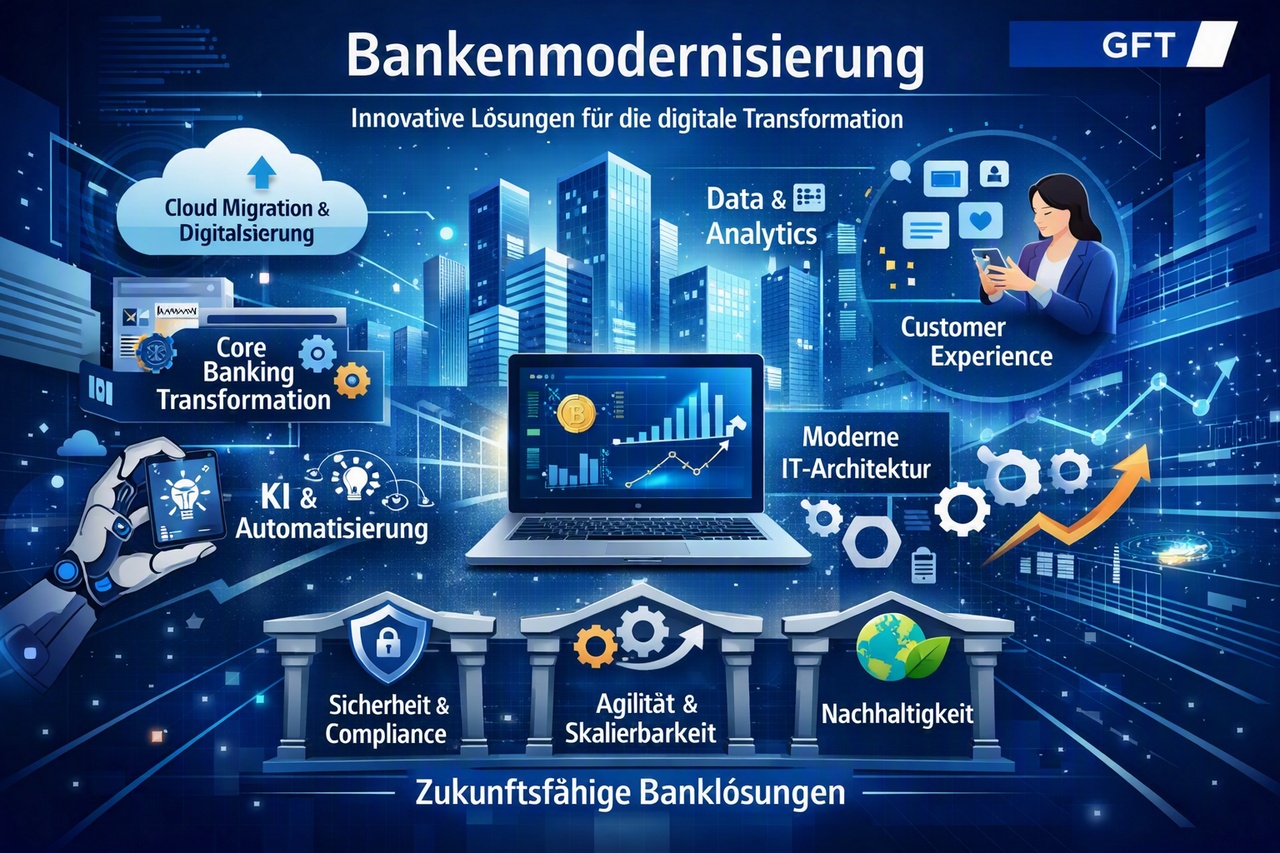
Deutsche Bank Selects GFT as Its Transformation Partner for Core Banking Modernization
I'll stick with it, and we're committed to the project, too.
Deutsche Bank Selects GFT as Transformation Partner for Core Banking Modernization
GFT brings extensive experience from complex transformation and integration projects to the modernization of Deutsche Bank’s retail banking core banking technology in Germany
Stuttgart, August 27, 2026 – Deutsche Bank has selected GFT Technologies as its transformation and systems integration partner for the implementation of a new core banking platform in its private client banking division. Through this transformation, the bank aims to simplify its technology landscape, strengthen its operational resilience, and create a more flexible and scalable foundation for greater efficiency, innovation, and long-term growth.
The project represents a major milestone in the ongoing transformation of Deutsche Bank’s technology landscape. It focuses on one of the central technological foundations of the banking business: the core banking systems for banking and credit products in retail banking and wealth management in Germany.
Deutsche Bank has selected Vault Core from Thought Machine as its new core banking platform. As a global delivery partner of Thought Machine, GFT is supporting Deutsche Bank with the transformation and system integration required to roll out the new platform.
GFT combines in-depth banking expertise with comprehensive cloud engineering capabilities and AI-powered solutions to accelerate implementation. In this way, GFT is helping Deutsche Bank implement this complex transformation program more quickly, efficiently, and predictably within a highly regulated environment. An integrated team across onshore, nearshore, and offshore locations combines local expertise with GFT’s global delivery capabilities.
Yiping Li, Chief Operating Officer of Deutsche Bank’s Private Client Bank, said: “With the selection of our future core banking platform, we are now putting our strategy into action. Modernizing our core banking infrastructure will help us simplify our technology landscape, reduce complexity, and create a more scalable foundation for future growth. Ultimately, this transformation is about improving the experience for our clients and employees while strengthening the foundation of our business for years to come.”
Christian Rhino, Chief Information Officer of Deutsche Bank’s Private Client Bank, said: “The modernization of our core banking landscape is one of the most significant technological transformations currently underway at the Private Client Bank. Vault Core provides us with a modern, cloud-native foundation that improves resilience, scalability, and flexibility. By separating product logic from the underlying infrastructure, we will be able to develop, adapt, and deploy products more efficiently over time, while gradually reducing our dependence on fragmented legacy systems.”
“Modernizing the core banking system is a fundamental step in any bank’s technological transformation. Together with Deutsche Bank and Thought Machine, we are helping to build a modern, scalable platform that supports innovation, operational efficiency, and future growth. At the same time, this creates the technological foundation for harnessing the potential of AI,” said Christopher Ortiz, Group Executive Board Member and Chief Executive of Global Accounts & Offerings at GFT Technologies.
More than 25 years of successful collaboration
The project builds on more than 25 years of collaboration between Deutsche Bank and GFT. GFT combines its long-standing understanding of the bank’s technology environment with extensive experience from large-scale transformation projects in the core banking sector. Added to this is GFT’s extensive international expertise in implementing Thought Machine and deploying Vault Core in modern, cloud-native banking environments.
Paul Taylor, CEO and founder of Thought Machine, said: “Deutsche Bank is setting a clear example of how major international banks can successfully modernize their core banking infrastructure. By replacing fragmented legacy systems with a modern architecture, it is creating the real-time capabilities needed to streamline operations, increase system reliability, and improve the customer experience at scale. We look forward to this ten-year partnership.”


5Mon·
Infrastructure shares
Transportation
Utilities
Social affairs
Digital
Future needs until 2040
Private Markets Infrastructure
Modernization
Infrastructure programs
Link: https://shorturl.at/maYS2
$IFX (-4.37%)
$NDA (-3.01%)
$ENR (-6.07%)
$SIE (-3.4%)
$DEZ (-6.6%)
$TKA (-3.02%)
$CBK (-1.73%)
$NKT (-4.29%)
$DHL (-0.71%)
$NEM (+1.22%)
$BZU (-2.68%)
$DBK (-2.44%)
$SPIE (-0.98%)
$ELI (-0.15%)
$GBF (+0%)

44
6Mon·
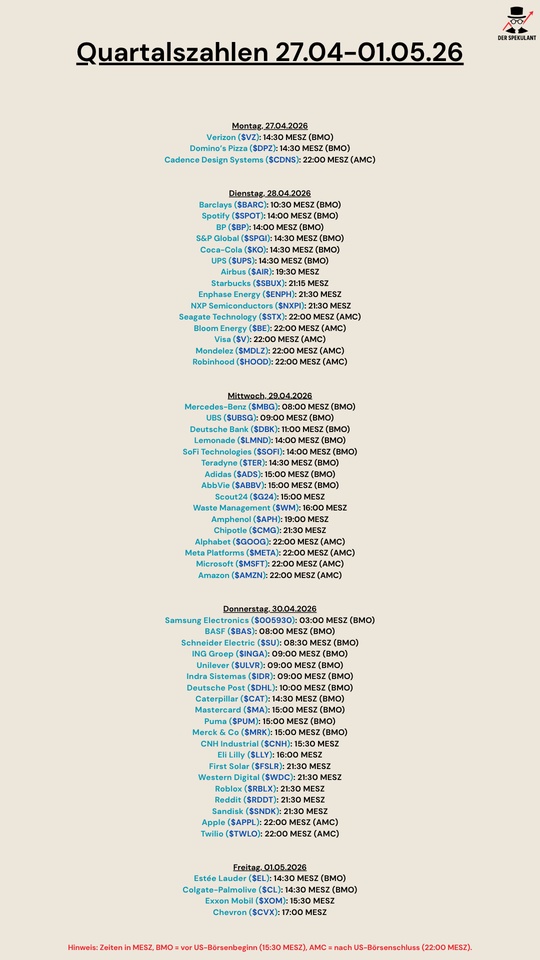
Quarterly figures 27.04-01.05.26
$VZ (+2.09%)
$DPZ (+1.44%)
$CDNS (-2.96%)
$BARC (-3.81%)
$SPOT (+7.14%)
$BP. (-0.32%)
$SPGI (+0.83%)
$KO (+0.52%)
$UPS (+1.14%)
$AIR (-2.68%)
$SBUX (+0.27%)
$ENPH (+1.77%)
$NXPI (+0.11%)
$STX (-4.94%)
$BE (-2.67%)
$V (+0.49%)
$MDLZ (-1.33%)
$HOOD (-3.29%)
$MBG (+0.45%)
$UBSG (-0.72%)
$DBK (-2.44%)
$LMND (-5.38%)
$SOFI (-1.83%)
$TER (-4.38%)
$ADS (+0.63%)
$ABBV (+0.23%)
$G24 (+2.08%)
$WM (+0.43%)
$APH (-2.59%)
$CMG (+2.8%)
$GOOG (+0.06%)
$META (-0.98%)
$MSFT (-0.97%)
$AMZN (+4.71%)
$005930
$BAS (-0.07%)
$SU (-3.37%)
$INGA (-1.7%)
$ULVR (+1.44%)
$IDR (-1.67%)
$DHL (-0.71%)
$CAT (-2.99%)
$MA (-0.23%)
$PUM (+4.91%)
$MRK (+1.66%)
$CNHI (+3.37%)
$LLY (+2.49%)
$FSLR (+0.45%)
$WDC (-4.37%)
$RBLX (-0.51%)
$RDDT (-13.65%)
$SNDK (-10.82%)
$AAPL (-1.58%)
$TWLO (+1.51%)
$EL (+2.78%)
$CL (+1.2%)
$XOM (+1.7%)
$CVX (+1.29%)
2121
2 Comments
Lemonade will be interesting and may already point the way forward.
Mercedes could hurt...
Mercedes could hurt...
•
22
•6Mon·
Strong dividend season ahead💶
15 increases
13 unchanged
7 decreases
Insurance
Banks
Utilities
Auto stocks
Tap here if you like to collect dividends: https://shorturl.at/83W8R
$MBG (+0.45%)
$ALV (-0.19%)
$VOW3 (-0.46%)
$MUV2 (+1.83%)
$BMW (-0.05%)
$AIR (-2.68%)
$CBK (-1.73%)
$523232
$DTG (-0.16%)
$DHL (-0.71%)
$FME (-2.29%)
$FRE (+1.22%)
$HNR1 (+2.26%)
$MTX (-1.29%)
$RHM (-2.1%)
$SAP (+0.67%)
$ENR (-6.07%)
$BAS (-0.07%)
$BAYN (+5.27%)
$BEI (+1.86%)
$DBK (-2.44%)
$DTE (+1.82%)
$EOAN (-0.26%)
$GEA (-0.71%)
$IFX (-4.37%)
$RWE (-2.06%)
$SY1 (+1.18%)
$ZAL (-0.52%)
$ADS (+0.63%)
$BNR (+0.7%)
$HEN (+0.69%)
$MRK (+1.66%)
$SIE (-3.4%)
$SHL (-0.43%)


6Mon·
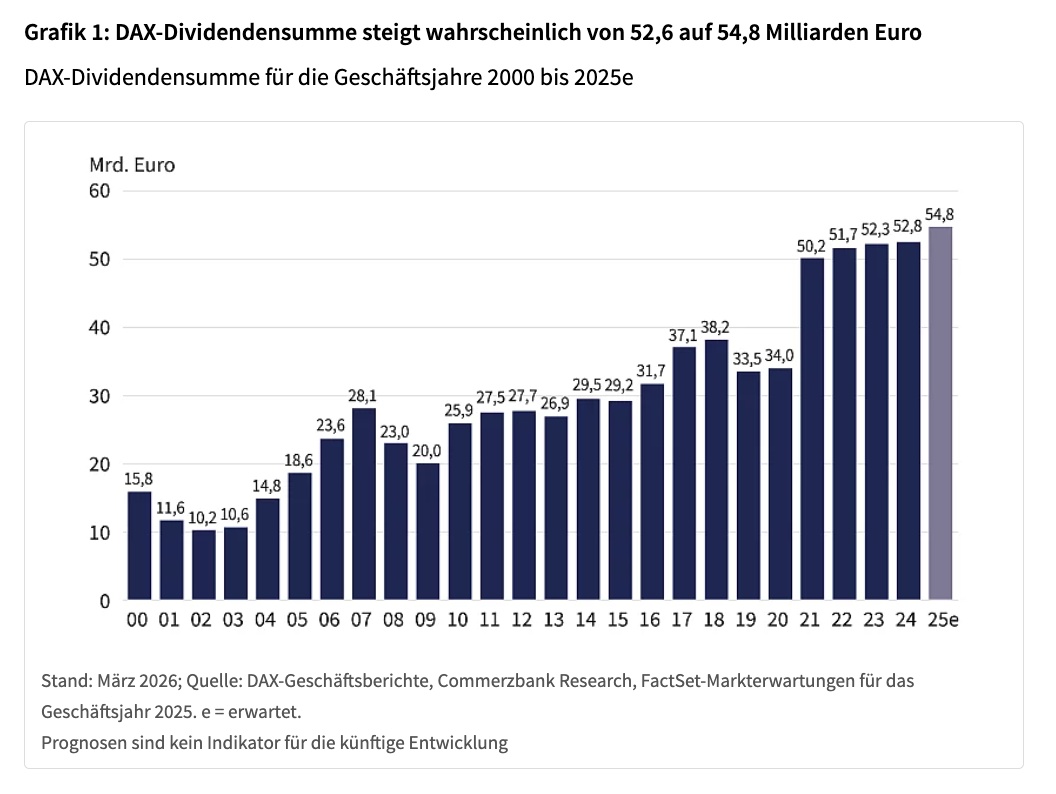
Dividend season 2026: Records, shifts and new favorites in the DAX
The 2026 dividend season is stronger than expected. Despite economic uncertainties, payouts remain at a high level, many companies are robust and confirm the role of dividends as a key driver of returns.
Around 25 companies in the DAX are expected to increase their dividends. Overall, the level remains attractive, even if the momentum varies from sector to sector and not all sectors are benefiting equally.
The shift within the sectors is particularly striking. While traditional dividend payers from the automotive industry such as$MBG (+0.45%)
$VOW (-1.64%) or $BMW (-0.05%) are paying weaker dividends, other sectors are gaining in importance:
Insurance companies and financial stocks in particular are moving more into focus. Companies such as $ALV (-0.19%) or the $DBK (-2.44%) are among the beneficiaries of this development and could play an increasingly important role for dividend investors. At the same time, there are also individual cases such as$ENR (-6.07%) which are paying dividends again after a break.
For investors, this means that selecting the right sectors is becoming more important than the dividend yield alone.
If you want to understand the most important trends, figures and individual stocks in detail, you can find the complete analysis here in the new Artikel the complete analysis.
This article is part of an advertising partnership with Société Générale

7Mon·
🌍 Middle East escalation moves the markets - capital flees to security & defense
The military escalation between the USA, Israel and Iran is causing strong market movements worldwide. Investors are shifting out of cyclical sectors and into security, energy and defense.
_________________________
Bitcoin $BTC (+1.04%) shows surprising stability
- 📈 In the meantime +8,1 %
- 💰 Just over 70,000 dollars
- Stabilization at around 69,000 dollars
Despite geopolitical risks, Bitcoin is apparently being used as a liquidity parking lot in the short term. At the same time, volatility remains high - further escalations could trigger new spikes.
_________________________
🛢 Oil prices up significantly
- Brent: + just under 6 %
- WTI: + a good 5 %
- In the meantime even +13 %
According to the report, the USA is currently no release from the strategic oil reserve. The market is still considered to be supplied, but the situation remains tense.
_________________________
🏦 Banks under pressure
The European banking index loses around 3,5 % - sharpest decline since April 2025.
Particularly affected:
- HSBC - $HSBA (-2.53%)
- Barclays - $BARC (-3.81%)
- Standard Chartered - $STAN (-2.45%)
- Deutsche Bank - $DBK (-2.44%)
- BNP Paribas - $BNP (-2.04%)
- BBVA - $BBVA (-3.55%)
- Commerzbank - $CBK (-1.73%)
In the USA also weaker until the US opening:
- Bank of America - $BAC (-2.25%)
- Citigroup - $C (-2.48%)
Reason: Strong Middle East business of many institutions and general risk aversion of investors.
_________________________
✈️ Travel industry collapses
High oil prices and uncertainty weigh heavily on tourism stocks:
- TUI - $TUI1 (+0.75%) (-11 %)
- Lufthansa - $LHA (-0.51%) (-11 %)
Flights to the region are canceled, travel offers suspended. Investors fear rising costs and falling booking figures.
_________________________
💎 Luxury stocks clearly in the red
The European luxury index loses almost 4 %.
Strongly affected:
- Richemont - $CFR (+1.21%)
- Swatch - $UHR (+4.13%)
- LVMH - $MC (+0.48%)
- Hermès - $RMS (+1.74%)
- Kering - $KER (+1.89%)
- Brunello Cucinelli - $BC (+1.35%)
- Moncler - $MONC (+2.58%)
- Ferragamo - $SFER (+0.16%)
Background:
Luxury is heavily dependent on global travel. Capital flows out of cyclical stocks.
_________________________
🛡 Defense stocks as clear winners
Geopolitical tensions drive up defense stocks:
- BAE Systems - $BA. (-0.9%)
- Lockheed Martin - $LMT (-1.57%)
- RTX - $RTX (-0.25%)
- Kratos - $KTOS (-3.37%)
- Hensoldt - $HAG (-2.81%)
- Leonardo - $LDO (+0%)
- Renk - $R3NK (-1.68%)
- Rheinmetall - $RHM (-2.1%)
Partial price increases of 3-6 %.
The focus is particularly on missile defense systems and possible increases in defense budgets.
_________________________
🚢 Shipping companies benefit
Transport values increase due to detour (avoidance of Hormuz, Suez Canal & Bab al-Mandab):
- Maersk - $MAERSK A (-0.43%)
- Hapag-Lloyd - $HLAG (-0.52%)
- Torm - $TRMD A (-0.88%)
- Frontline - $FRO (+0.87%)
- Hoegh Autoliners $HAUTO (-1.7%)
Reason: Shortage of transport capacity and speculation on rising freight rates.
_________________________
🥇 Gold in demand
- Gold price: +2,5 %
Profiteers in mining stocks:
- Evolution Mining - $EVN (-7.1%)
- Northern Star - $NST (-4.08%)
The sector has been showing relative strength for several days.
$4GLD (-3.44%)
$GOLD
$GOLD (-1.49%)
_________________________
📊 Market logic clearly recognizable
Winner:
🛡 Armaments
🚢 Shipping companies
🥇 Gold
₿ Bitcoin (short-term)
Losers:
🏦 Banks
✈️ Travel
💎 Luxury
_________________________
🔎 Conclusion
The market reaction follows the classic pattern of geopolitical crises:
- Risk is reduced
- Capital seeks security
- Energy prices rise
- Defense stocks benefit
The decisive factor remains whether the situation eases diplomatically - or escalates further.
_________________________
Source:
Reuters: Anleger greifen bei Bitcoin als "Fluchtvehikel" zu (Via TradingView)

de.tradingview.comAnleger greifen bei Bitcoin als "Fluchtvehikel" zu
2323
2 CommentsNice summary of the trading day. $HAUTO is also one of the winners of the last few days.
•
44
•9Mon·
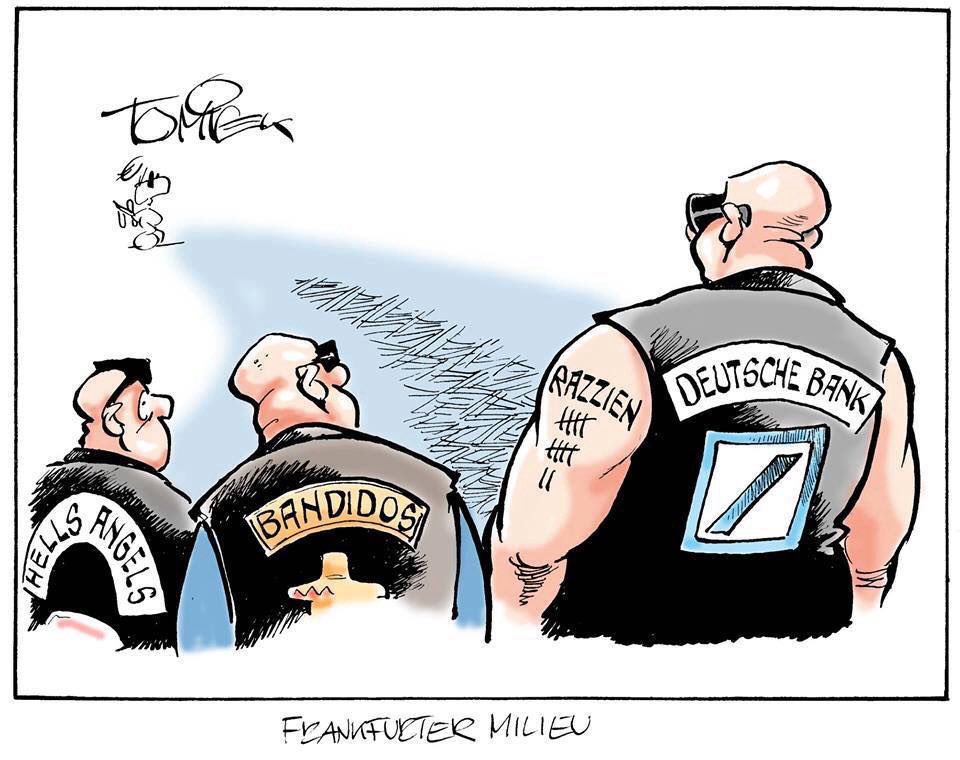
Searches at Deutsche Bank have a long tradition 🇩🇪🏦🔍🚨👮♂️👨⚖️
2010 - VAT fraud / fraud with CO₂ certificates
2012 - VAT fraud / fraud with CO₂ certificates (continued)
2012 - Tax evasion / tax fraud
2015 - Cum-ex transactions / aiding and abetting tax evasion
2018 - Panama Papers / suspicion of money laundering (delayed suspicious activity reports)
2022 - Suspected money laundering (late reports, including Syria/Assad clan)
2022 - Greenwashing allegations (with affiliated DWS)
2026 - Suspicion of money laundering (delayed suspicious activity reports on Roman Abramovich's companies)
-14% the share fell in 16 years 📉 but +74% in one year 📈. Which bank shares do you have and how did they perform? $DBK (-2.44%)
99
6 Comments
Trending Securities
Top creators this week
Real-time data from LSX · Fundamentals & EOD data from FactSet