
$ABBN (-1.67%)
$GE
$RTX (+3.61%)
$HAL (+2.01%)
$MMM (-0.51%)
$NOC (+4.37%)
$MSCI (-1.21%)
$ISRG (-0.56%)
$SPCX (-1.88%)
$NFLX (-2.93%)
$DB1 (+1.05%)
$CME (+0.79%)
$T (-0.24%)
$PM (+1.8%)
$MCO (-0.12%)
$NEE (+1.07%)
$UAL (-5.09%)
$MONC (-2.91%)
$TXN (-0.48%)
$META (-3.46%)
$IBM (-1.11%)
$SAP (-0.79%)
$QS (-4.77%)
$LRCX (-4.43%)
$TSLA (-2.72%)
$RMS (-0.8%)
$NESN (+2.23%)
$BARC (-0.02%)
$ROP (-0.62%)
$DOW (+0.64%)
$SPOT (+0%)
$NDAQ (+1.15%)
$AAL (-3.55%)
$LMT (+3.31%)
$PG (+1.17%)
$BX (-2.81%)
$BESI (-6.52%)
$VLO (-0.65%)
$KER (-1.77%)
$OR (-0.46%)
$VRSN (-0.74%)
$WDC (-6.56%)
$BE (-7.17%)
$NEM (+2.11%)
$TOM (+0.26%)
$AXP (-0.32%)
$FIX (-3.63%)
Moncler
Stock
Stock
ISIN: IT0004965148
Ticker: MONC
IT0004965148
MONC
Price
Discussion about MONC
Posts
209H·
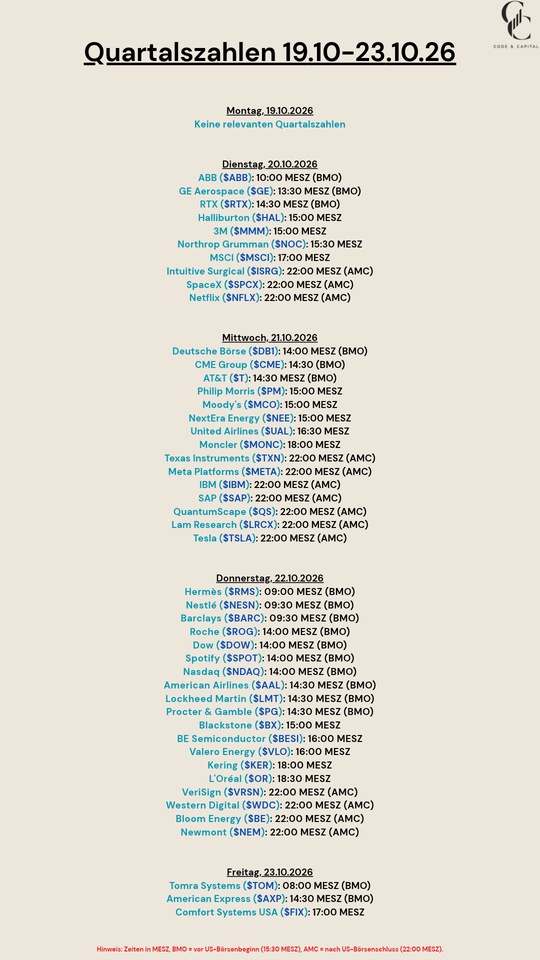
Quarterly Results: Oct. 19–23, 2026
77

1Mon·
New look & New position in Italy!
Decided to revamp the profile to bring a bit of humor and originality to the feed. Same disciplined strategy, just with a proper Conquistador style to hunt down those high-quality businesses. 🏰🛡️
Speaking of hunting... I’ve officially opened a position in Moncler ($MONC (-2.91%)).
Turns out the search for gold brought me straight to Italy. Couldn't resist adding a world-class luxury moat to the portfolio at these levels.

88


2Mon·
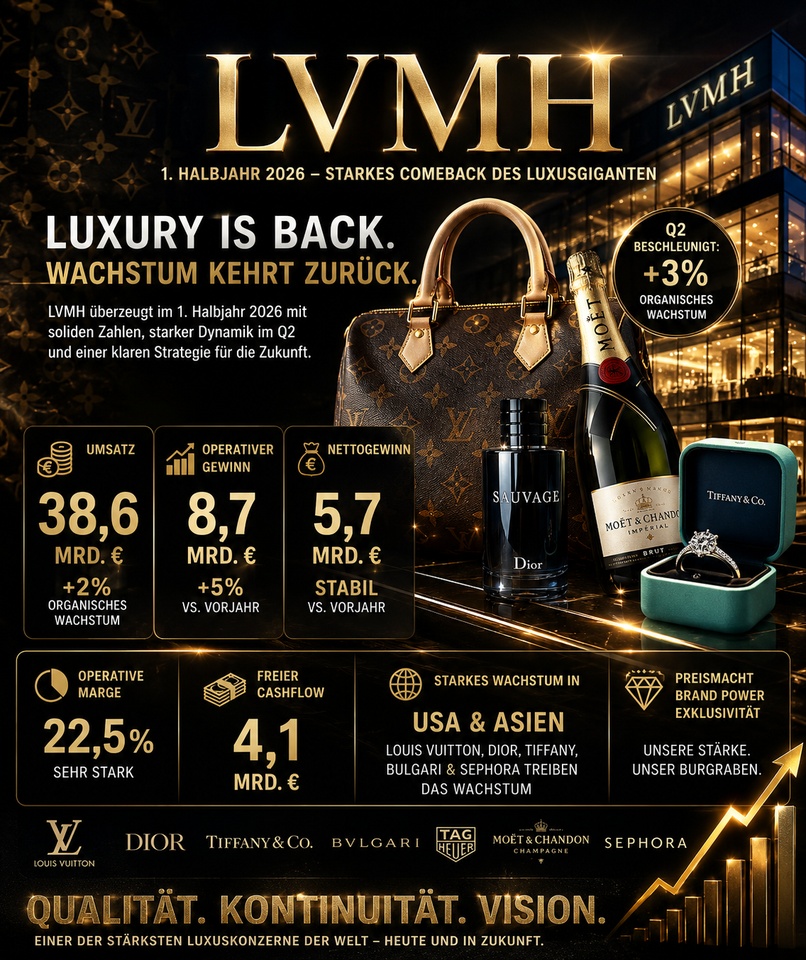
LVMH is making an impressive comeback—and the luxury giant is sending an important signal to the market.
Key figures for the first half of 2026:
• Revenue: €38.6 billion
• Organic growth: +2%
• Growth accelerated to +3% in the second quarter
• Operating profit: €8.7 billion
• Net profit: €5.7 billion
• Free cash flow: €4.1 billion
• Operating margin: a strong 22.5%
I find it particularly exciting that momentum improved again in the second quarter. After a prolonged period of weakness, growth is returning—primarily thanks to strong demand in the U.S., a recovery at Dior, and outstanding results from Tiffany, Bulgari, and Sephora. (Reuters)
Why I continue to view LVMH as exceptional in the long term:
LVMH doesn’t sell products—LVMH sells desirability. Brands like Louis Vuitton, Dior, Tiffany, Bulgari, TAG Heuer, Moët & Chandon, and Sephora have an enormous moat. These brands cannot simply be copied.
In addition:
• enormous pricing power
• billions in free cash flow
• one of the strongest balance sheets in Europe
• continuous dividend increases
• family-led management with a long-term perspective
Of course, the luxury business remains cyclical. When the global economy weakens, LVMH also faces headwinds. That’s exactly why I’m currently paying close attention to the return to growth—because it could mark the beginning of a new cycle. (Investing.com)
For me, LVMH remains one of Europe’s highest-quality companies.
I’m not investing here for the next quarter—but for the next 10 to 20 years.
#LVMH
#LouisVuitton
#Dior
#Luxury
#Dividenden
#DividendGrowth
#Qualitätsaktien
#ValueInvesting
#Langfristig
#Cashflow
#Europa
#Aktien
#Börse
#Investieren
#Getquin
$MC (-1.51%)
$CDI (-1.86%)
$CHDRY (-1.63%)
$BRBY (-1.14%)
$MONC (-2.91%)
$1913 (+9.06%)
1818
1 Comment
Dirty30@Dirty30
2Mon
••


7Mon·
LVMH - The luxury ETF with pricing power
When you talk about quality companies with structural growth, it's hard to avoid LVMH. For me, the Group is basically something like an actively managed ETF in the global luxury segment - only with real entrepreneurial leadership and a remarkable dividend history.
What makes LVMH special is the breadth of its portfolio. We're not talking about a single fashion brand here, but a diversified empire of fashion, leather goods, watches, jewelry, perfume, cosmetics and spirits.
The portfolio includes, among others:
- Fendi
These brands have one thing in common: extreme pricing power. Anyone who believes that luxury is cyclical like normal retail is overlooking the crucial point - real luxury goods are status assets. And status rarely loses value, even if the economy fluctuates.
Structural growth instead of short-term hype
Prosperity in Asia continues to grow. The global upper-middle class is expanding. At the same time, luxury is becoming increasingly digital and global. LVMH is investing heavily in its own stores, brand staging and vertical integration - from production to the point of sale.
The result:
- High margins
- Strong cash flows
- Solid balance sheet
- Reliable dividend policy
And this in a business that has built up brand value over decades, which cannot simply be copied.
Dividend with substance
LVMH is not a high-yield stock, but the combination of growth and continuously rising dividends makes the share attractive in the long term. This is not a speculative story investment, but a global market leader with real substance.
Why I see it as a "luxury ETF"
Instead of valuing individual fashion brands or betting on trends, LVMH bundles numerous icons under one roof. Diversification within a premium segment - steered by a management that has proven for decades how to scale brands without diluting them.
For investors who:
- are looking for quality instead of a turnaround
- value global brand strength
- believe in rising prosperity
- like dividend growth
... LVMH is at least worth a closer look.
Not cheap, but quality has never been discounted.
$MC (-1.51%)
$LVMH
$LVMUY (-1.13%)
$CDI (-1.86%)
$RMS (-0.8%)
$1913 (+9.06%)
$MONC (-2.91%)



7Mon·
🌍 Middle East escalation moves the markets - capital flees to security & defense
The military escalation between the USA, Israel and Iran is causing strong market movements worldwide. Investors are shifting out of cyclical sectors and into security, energy and defense.
_________________________
Bitcoin $BTC (+1.21%) shows surprising stability
- 📈 In the meantime +8,1 %
- 💰 Just over 70,000 dollars
- Stabilization at around 69,000 dollars
Despite geopolitical risks, Bitcoin is apparently being used as a liquidity parking lot in the short term. At the same time, volatility remains high - further escalations could trigger new spikes.
_________________________
🛢 Oil prices up significantly
- Brent: + just under 6 %
- WTI: + a good 5 %
- In the meantime even +13 %
According to the report, the USA is currently no release from the strategic oil reserve. The market is still considered to be supplied, but the situation remains tense.
_________________________
🏦 Banks under pressure
The European banking index loses around 3,5 % - sharpest decline since April 2025.
Particularly affected:
- HSBC - $HSBA (+0.08%)
- Barclays - $BARC (-0.02%)
- Standard Chartered - $STAN (+0.48%)
- Deutsche Bank - $DBK (-1.06%)
- BNP Paribas - $BNP (+0.24%)
- BBVA - $BBVA (-1.23%)
- Commerzbank - $CBK (-0.67%)
In the USA also weaker until the US opening:
- Bank of America - $BAC (-0.89%)
- Citigroup - $C (+0.62%)
Reason: Strong Middle East business of many institutions and general risk aversion of investors.
_________________________
✈️ Travel industry collapses
High oil prices and uncertainty weigh heavily on tourism stocks:
- TUI - $TUI1 (-0.04%) (-11 %)
- Lufthansa - $LHA (-1.45%) (-11 %)
Flights to the region are canceled, travel offers suspended. Investors fear rising costs and falling booking figures.
_________________________
💎 Luxury stocks clearly in the red
The European luxury index loses almost 4 %.
Strongly affected:
- Richemont - $CFR (-0.59%)
- Swatch - $UHR (-0.97%)
- LVMH - $MC (-1.51%)
- Hermès - $RMS (-0.8%)
- Kering - $KER (-1.77%)
- Brunello Cucinelli - $BC (+0.87%)
- Moncler - $MONC (-2.91%)
- Ferragamo - $SFER (+1.34%)
Background:
Luxury is heavily dependent on global travel. Capital flows out of cyclical stocks.
_________________________
🛡 Defense stocks as clear winners
Geopolitical tensions drive up defense stocks:
- BAE Systems - $BA. (+2.48%)
- Lockheed Martin - $LMT (+3.31%)
- RTX - $RTX (+3.61%)
- Kratos - $KTOS (-0.93%)
- Hensoldt - $HAG (+5.8%)
- Leonardo - $LDO (+3.2%)
- Renk - $R3NK (+5.08%)
- Rheinmetall - $RHM (+5.29%)
Partial price increases of 3-6 %.
The focus is particularly on missile defense systems and possible increases in defense budgets.
_________________________
🚢 Shipping companies benefit
Transport values increase due to detour (avoidance of Hormuz, Suez Canal & Bab al-Mandab):
- Maersk - $MAERSK A (+0.03%)
- Hapag-Lloyd - $HLAG (+0.3%)
- Torm - $TRMD A (-1.16%)
- Frontline - $FRO (-0.28%)
- Hoegh Autoliners $HAUTO (-0.54%)
Reason: Shortage of transport capacity and speculation on rising freight rates.
_________________________
🥇 Gold in demand
- Gold price: +2,5 %
Profiteers in mining stocks:
- Evolution Mining - $EVN (+2.18%)
- Northern Star - $NST (+1.08%)
The sector has been showing relative strength for several days.
$4GLD (-0.02%)
$GOLD
$GOLD (+1.37%)
_________________________
📊 Market logic clearly recognizable
Winner:
🛡 Armaments
🚢 Shipping companies
🥇 Gold
₿ Bitcoin (short-term)
Losers:
🏦 Banks
✈️ Travel
💎 Luxury
_________________________
🔎 Conclusion
The market reaction follows the classic pattern of geopolitical crises:
- Risk is reduced
- Capital seeks security
- Energy prices rise
- Defense stocks benefit
The decisive factor remains whether the situation eases diplomatically - or escalates further.
_________________________
Source:
Reuters: Anleger greifen bei Bitcoin als "Fluchtvehikel" zu (Via TradingView)

de.tradingview.comAnleger greifen bei Bitcoin als "Fluchtvehikel" zu
2323
2 Comments
Nice summary of the trading day. $HAUTO is also one of the winners of the last few days.
•
44
•8Mon·
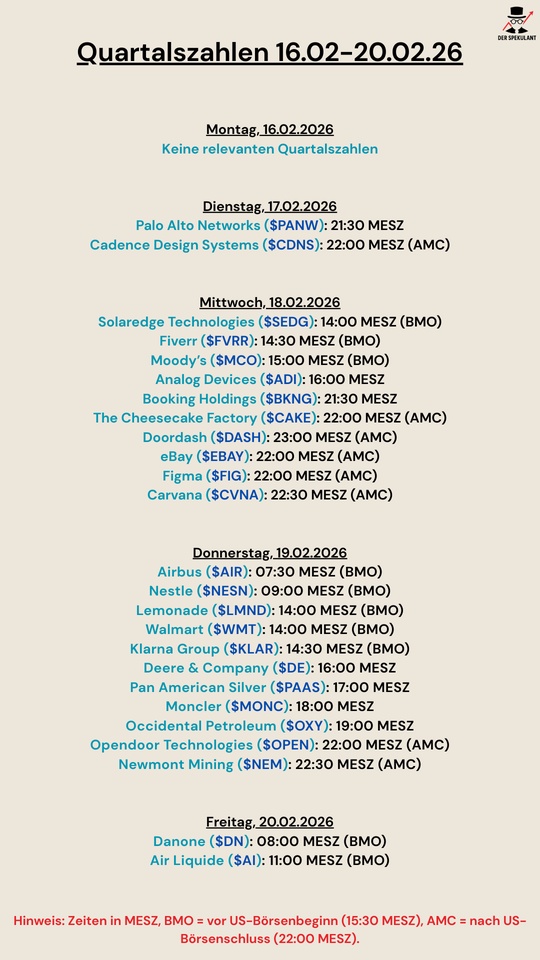
Quarterly figures 16.02-20.02.26
$PANW (-8.17%)
$CDNS (-1%)
$SEDG (-0.36%)
$FVRR (-3.48%)
$MCO (-0.12%)
$ADI (-1.55%)
$BKNG (-1.73%)
$CAKE (-2.06%)
$DASH (-1.76%)
$EBAY (-2.63%)
$FIG (-6.57%)
$CVNA (-2.9%)
$AIR (+0.9%)
$NESN (+2.23%)
$LMND (-2.77%)
$WMT (+0.55%)
$KLAR (-4.06%)
$DE (-1.84%)
$PAAS (+0.36%)
$MONC (-2.91%)
$OXY (+2.55%)
$OPEN (-9.66%)
$NEM (+2.18%)
$BN (-0.42%)
$AI (-0.88%)


11Mon·
Prada is the best luxury stock on the market
While all about $MC (-1.51%) and $RMS (-0.8%) one share is flying under the radar of many investors: Prada $1913 (+9.06%) . Thanks to Miu Miu, the company is growing despite the recessionary environment. In recent years, it has achieved 17 % sales growth per year - the best figure in the industry.
Basics about Prada
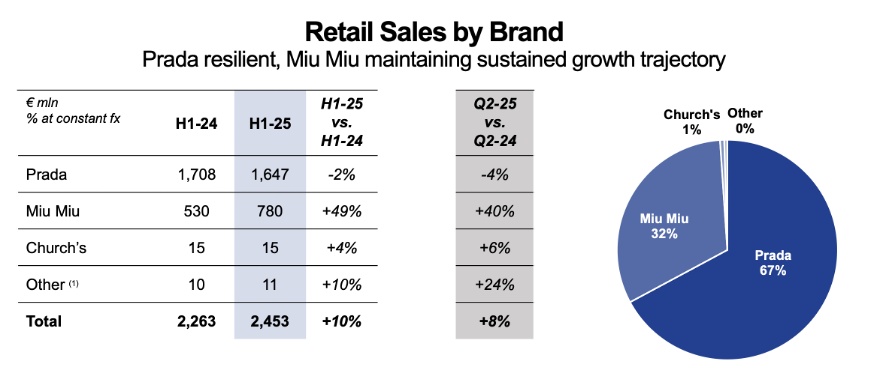
The Italian fashion group is listed in Hong Kong - which could also be a reason for its favorable valuation. In addition to Miu Miu and Prada, the company also owns other brands. However, these are not relevant for sales. Prada currently accounts for 67% of sales and Miu Miu for a further 32%.
Most of the items are produced in Italy. A small proportion is produced by "selected producers" - a paraphrase for production in low-wage countries such as China. This is the first potential risk for Prada. Made in Italy is probably the most important figurehead, together with the brand history.
The rise of Miu Miu
The brand is the reason for Prada's strong growth. It originates from Prada itself and has been experiencing a sustained boom for years. While it still accounted for 15% of sales in 2018, it now accounts for 32% - and the trend continues to rise. The larger the share of total sales, the greater the impact of Miu Miu's growth on the Group as a whole.
The combination of Prada and Miu Miu is exciting, as Prada can focus on classic and timeless fashion, while Miu Miu is more in tune with the times. The clear demarcation ensures that each brand can remain true to its target group.
This clear brand identity is important for the long-term relevance of a brand. Gucci and Louis Vuitton have been less loyal to their core customers in recent years and have sacrificed long-term brand identity for short-term growth.
Additional growth through the Versace takeover
Even though the management ruled out becoming a fashion holding company similar to LVMH some time ago, Prada took over the Italian fashion label Versace from Capri Holdings this year. $CPRI (+0.42%) The Versace takeover is to be completed by the end of 2025. Prada paid 1.25 billion euros for the struggling luxury company. The expected Versace turnover for 2025 was 810 million euros. The favorable purchase price is due to the fact that Versace is not profitable and its turnover shrank by around 20% in the previous year.
Versace has become too mainstream in recent years and, like Gucci (part of: $KER (-1.77%) ), has lost its core clientele. Prada now has the task of returning the company to its roots. In the valuation, I therefore assume that Versace will be slimmed down by 20%. More on this in a moment. Versace is a bargain overall - but only if Prada manages to bring Versace back to its roots.
Competition
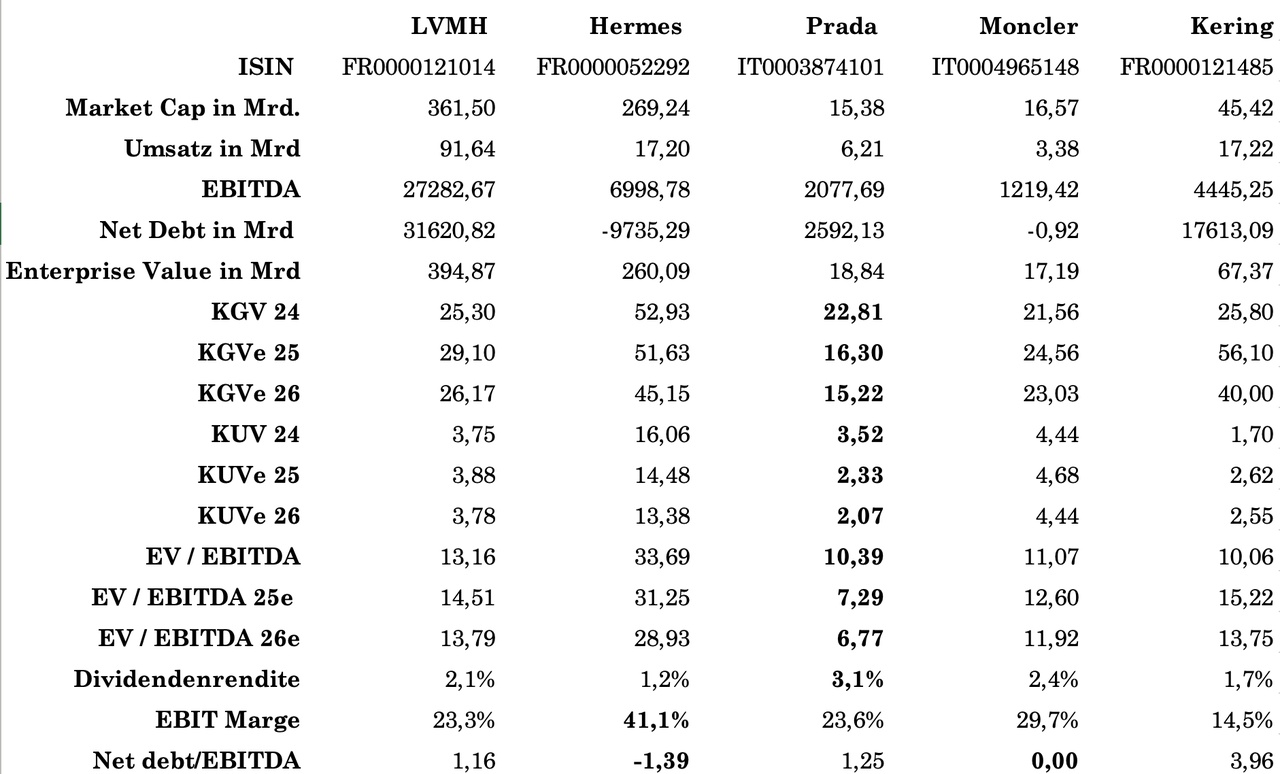
In order to better assess the current valuation multiple, I have compared Prada with its most important competitors.
It is immediately apparent that the EBIT margin of 24% is significantly lower than that of Hermès or $MONC (-2.91%) . This justifies a certain valuation discount - but However, with an EV/EBITDA of 10, Prada is worth around two thirds of Hermès. The multiples are also falling further due to the strong growth.
Prada is currently valued similarly to LVMH, but the valuation is falling much faster. There is also a 3.1% dividend yield. The debt is conservative at 1.25 net debt/EBITDA.
Valuation
The Prada brand is growing organically only slightly. Future growth depends heavily on Miu Miu. I have created a multiple valuation model to better estimate the influence of Miu Miu and Versace.
My assumptions:
- Miu Miu's growth is leveling off. Growth is expected to fall to 8% per year by 2029.
- The other brands will grow organically by 2% in line with inflation.
- Profitability will decrease due to Versace, but will recover within the next five years.
- Versace sales decline by 20% due to efficiency measures and artificial scarcity.
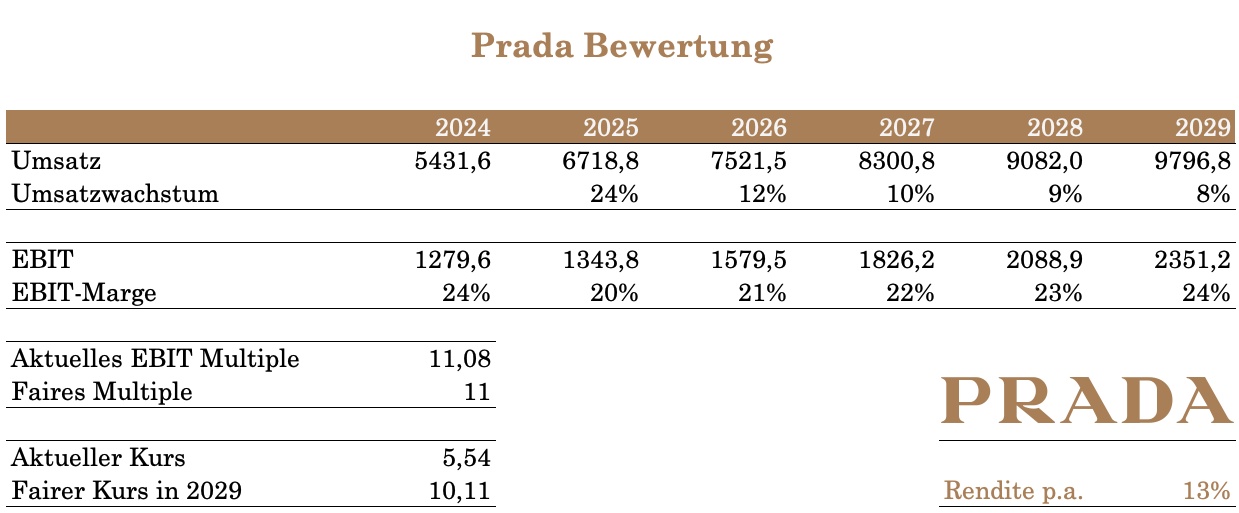
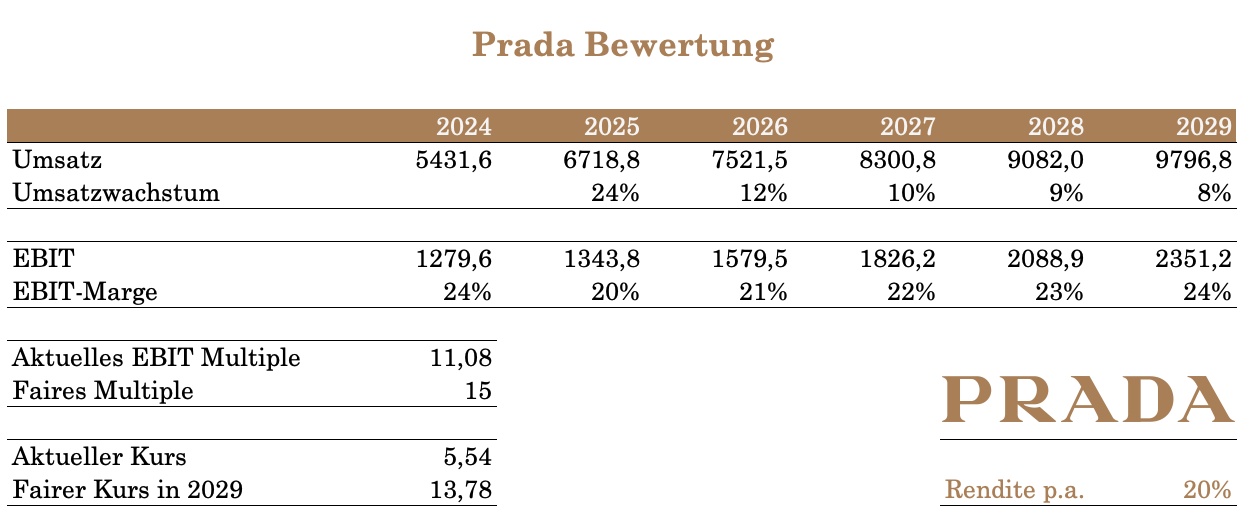
I am also of the opinion that the valuation multiple is currently too low. is currently too low. The industry is in crisis and is punishing Prada as well. In addition, the EBIT margin is currently lower. I have therefore created a conservative estimate with a constant multiple and a (for me) realistic model with a multiple increase from 11 to 14.
With multiple increase
Without multiple increase
Even without the increase in the multiple, Prada currently looks attractive. The expected return together with the products make Prada the best luxury stock in my eyes!
Note: The article contains my personal opinion and is not investment advice! The share is in my personal portfolio.
ps: this is my first post. Leave some love or constructive feedback there😘
4141
10 Comments
11Mon
Even if it is not an investment case for me, thank you very much for the introduction, the work you have done and most importantly, that you have decided to actively enrich the community with your posts.
•
1818
•
1Yr·
Purchases Arnault family
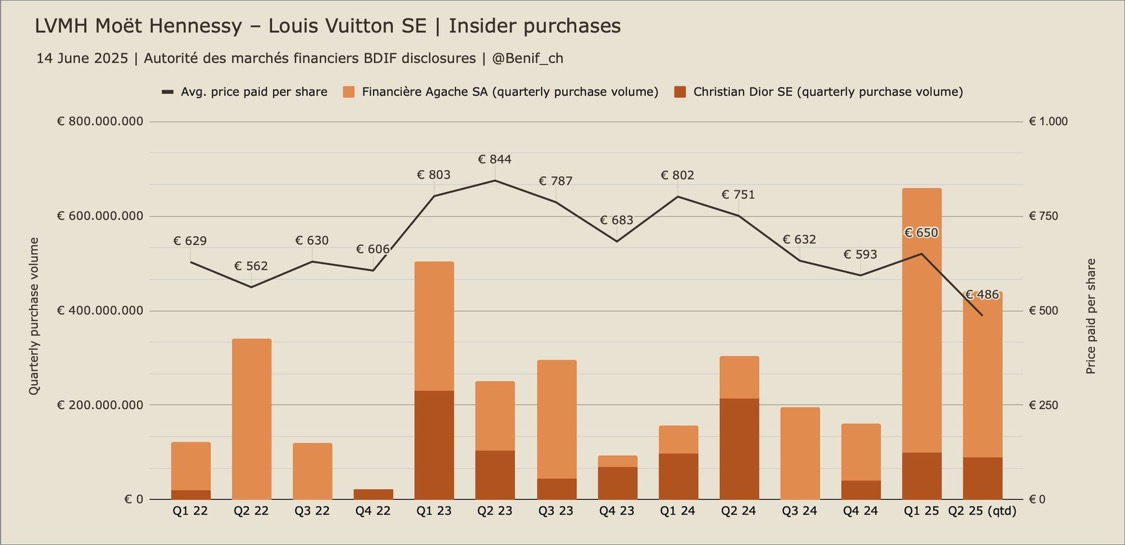
The Arnault family has bought almost € 3.7 billion in the last 3.5 years. $MC (-1.51%) in the last 3.5 years.
The average price per share was € 659.
The current share price is € 455.50
$LVMUY (-1.13%)
$MC (-1.51%)
$RMS (-0.8%)
$MONC (-2.91%)
$KER (-1.77%)
1Yr·
$MC (-1.51%) - Failed takeovers of LVMH
and activities of the children of Bernard
Arnault
Did you know the following:
In the late 90s, LVMH tried to take over Gucci, but CEO Domenico De Sole resisted.
He diluted the share price and gave employees a stake, weakening LVMH's control. Then Kering stepped in and secured Gucci.
He also tried Hermes:
In 2010, LVMH secretly acquired 17 percent of Hermès ($RMS (-0.8%) ), triggering a storm of indignation. Hermès fought back with legal disputes and accused LVMH of insider trading and share manipulation.
After years of conflict, LVMH agreed to sell its 23% stake in 2014, ending the intense rivalry.
Who will be the next takeover candidate?
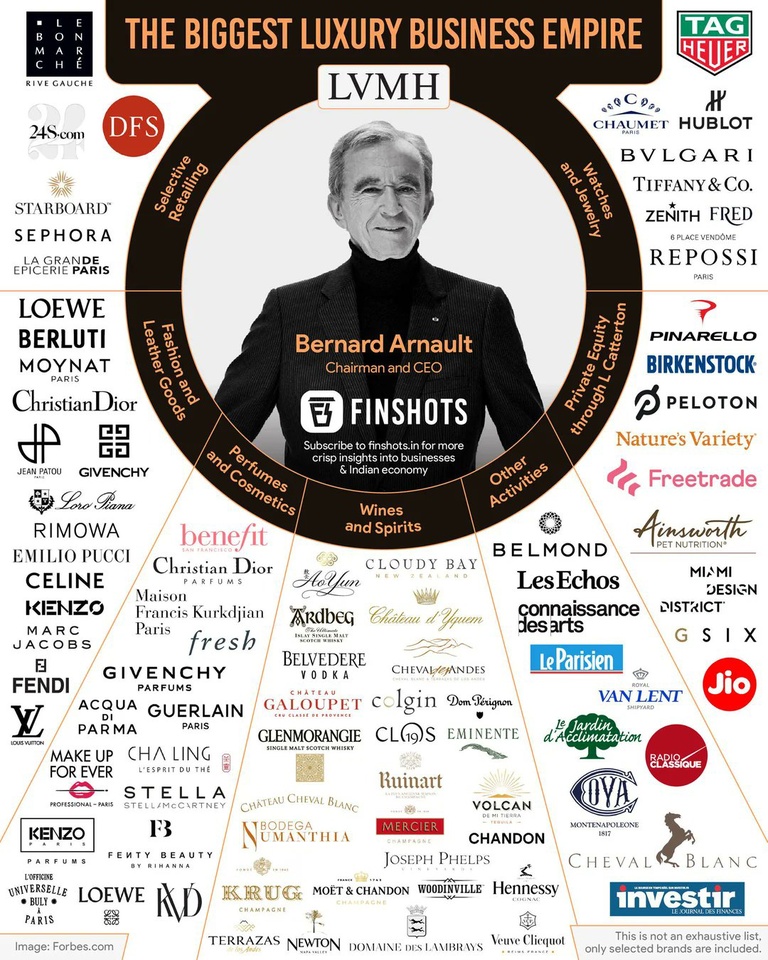
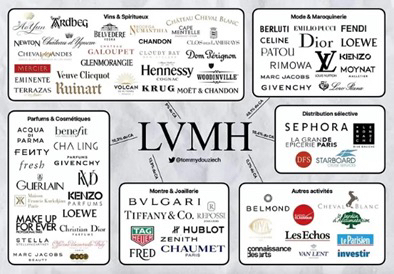
Thanks to all the successful takeovers, LVMH now has an extensive portfolio of 75 brands, which can be seen in the picture.
LVMH is the largest luxury company in the world.
The Arnault family:
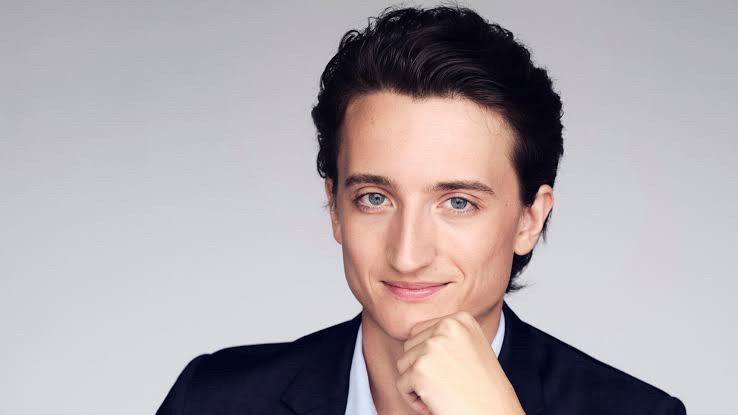
Bernard will probably keep the company in the family. As he has five children who are already integrated into the company, these are the potential successors:
1. Delphine
2. Antoine
3. Alexandre
4. Frederic
5. Jean
Delphine (49) is Executive VP of Louis Vuitton.
Delphine has been with LVMH since 2001 and is in charge of brand development and strategy. She plays an important role in the success of LV.
Antoine (47) is CEO of Berluti and Chairman of Loro Piana.
Antoine focuses on expanding LVMH's presence in luxury fashion and plays a role in brand communication and acquisitions.
Alexandre Arnault (32) is CEO of Tiffany & Co.
Alexandre revitalized Tiffany by targeting younger audiences and improving its digital presence. As a result, profits doubled within a year.
Frédéric Arnault (29) is CEO of LVMH Watches. After being CEO of Tag Heuer.
Jean Arnault (26) is Director of Product & Communications at Louis Vuitton Watches.
Finally, a few examples of LVMH's pricing power and price trends:
$MC (-1.51%)
$KER (-1.77%)
$RMS (-0.8%)
$MONC (-2.91%)
$BRBY (-1.14%)
$BOSS (-0.29%)
+ 6

1Yr·
April Rebalancing: Strategic Shifts in the Portfolio
The semi-annual rebalancing of the SPDR S&P Developed Quality Aristocrats ETF ($QDEV (-1.34%) ) has just been completed, bringing notable changes to the composition of this quality-focused investment vehicle.
Outgoing Companies:
- RELX PLC$REL (+2.05%)
- Keyence Corporation $6861 (+0.08%)
- London Stock Exchange Group plc $LSEG (+1.59%)
- Booking Holdings Inc. $BKNG (-1.73%)
- Industria de Diseno Textil S.A. (Inditex) $ITX (-0.91%)
- Texas Instruments Incorporated $TXN (-0.48%)
- Cencora Inc.$COR (+0.26%)
- Coloplast A/S Class B$COLO B (+0.28%)
- Moncler SpA $MONC (-2.91%)
- Cardinal Health Inc. $CAH (+0.71%)
- CAR Group Limited $CAR (+2.82%)
- Waters Corporat $WAT (-1.87%)
- Nova Ltd. $NVMI (-2.4%)
- Monolithic Power Systems Inc. $MPWR (-3.23%)
Incoming Companies:
- Alphabet Inc. Class C$GOOG (-2.22%)
- Nintendo Co. Ltd.$7974 (+2.03%)
- S&P Global Inc. $SPGI (+0.53%)
- InterContinental Hotels Group PLC $IHG (+1.01%)
- Bristol-Myers Squibb Company $BMY (-1.22%)
- Intercontinental Exchange Inc. $ICE (+1.82%)
- Regeneron Pharmaceuticals Inc. $REGN (-0.45%)
- Motorola Solutions Inc. $MSI (+0.86%)
- Marriott International Inc. Class A $MAR (+0.63%)
- Hilton Worldwide Holdings Inc. $HLT (+0.99%)
- Industrivarden AB Class C$INDU C (+0.25%)
- EMS-CHEMIE HOLDING AG$EMSN (-0.21%)
- D'Ieteren Group SA/NV $DIE (+0.49%)
- Electronic Arts Inc. $EA
- CK Infrastructure Holdings Limited $1038 (+0.05%)
This rebalancing aligns QDEV with evolving market conditions while maintaining its focus on quality companies with strong financial foundations. For investors seeking exposure to financially robust global corporations, these changes appear strategically sound, particularly with the inclusion of resilient tech giants and hospitality leaders positioned for growth.
Will this prove to be a winning choice? The fundamentals certainly suggest so.
66
Trending Securities
Top creators this week
Real-time data from LSX · Fundamentals & EOD data from FactSet