$VWCE (-0.7%) 30%
$WSML (-0.36%) 20%
$INTL (-3.01%) 15%
$ISPY (-2.46%) 10%
$ESIF (+0.64%) 10%
$NUE (-0.41%) currently holding a bag but think it might be unnecessary
feedback appreciated :)

Posts
297$VWCE (-0.7%) 30%
$WSML (-0.36%) 20%
$INTL (-3.01%) 15%
$ISPY (-2.46%) 10%
$ESIF (+0.64%) 10%
$NUE (-0.41%) currently holding a bag but think it might be unnecessary
feedback appreciated :)

In July, Tempus AI was my biggest loser, down 25 percent. In August, it was my biggest winner, up 42 percent. I didn’t buy or sell anything in either month.
August had two sides to it. At the beginning of the month, mild inflation data was released, and the S&P 500 hit an all-time high of 7,816 points on August 13. After that, sentiment in the bond markets shifted. The 30-year U.S. Treasury yield rose to its highest level in nearly twenty years, and U.S. gross debt exceeded forty trillion dollars. At the end of the month, Nvidia reported quarterly revenue of 96.2 billion, an increase of 106 percent. The very next day, Fed Chair Warsh signaled a pause in Jackson Hole, and the market priced in an interest rate hike in September.
Following the chip sell-off in July, this was a significantly calmer month for my portfolio:
📊 Monthly performance: +3.15%
📊 Portfolio value: ~€45,506
📊 Max. performance (Jan. 6, 2022): +40.28%
📊 YTD performance: ~+11.88%
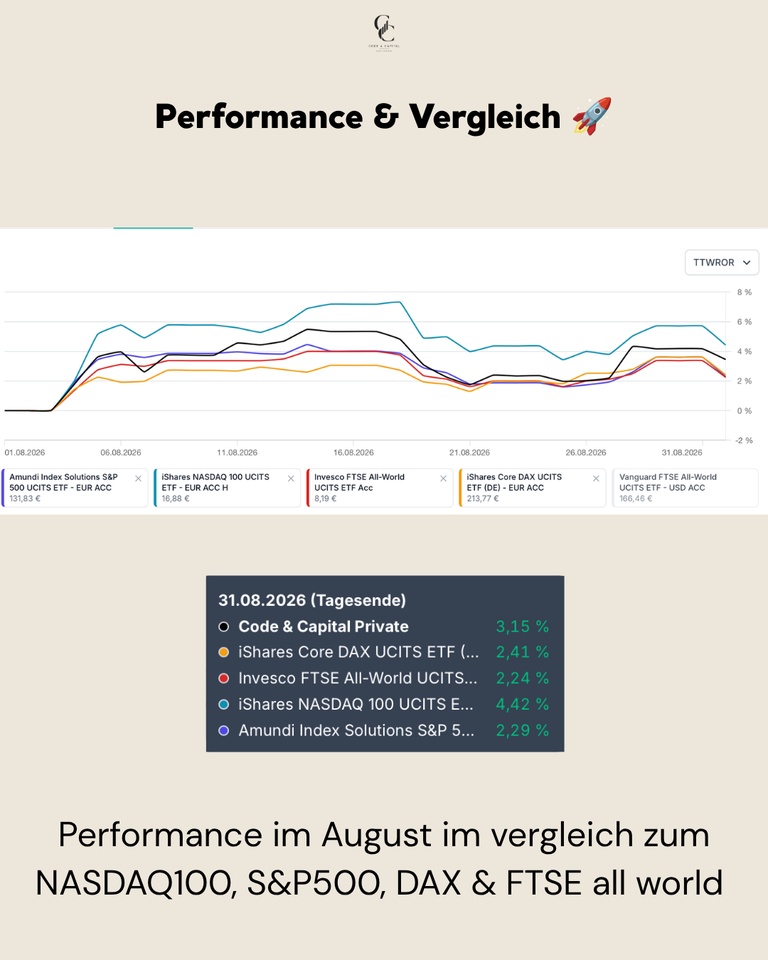
Performance & Comparison 🚀
August was a positive month for all major indices, led by the Nasdaq. My portfolio outperformed the DAX, S&P, and FTSE, but lagged behind the Nasdaq.
Performance Comparison (August 1–31, 2026, end of day):
My portfolio: +3.15%
NASDAQ 100: +4.42%
DAX: +2.41%
S&P 500: +2.29%
FTSE All-World: +2.24%
Purchases, Sales & Allocation 💶
None. In July, I reduced my cash position and invested in BE Semiconductor$BESI (-4.15%) , Solaria $SLR (-0.19%) and Hermès $RMS (+2.79%) . I didn’t make any changes in August.
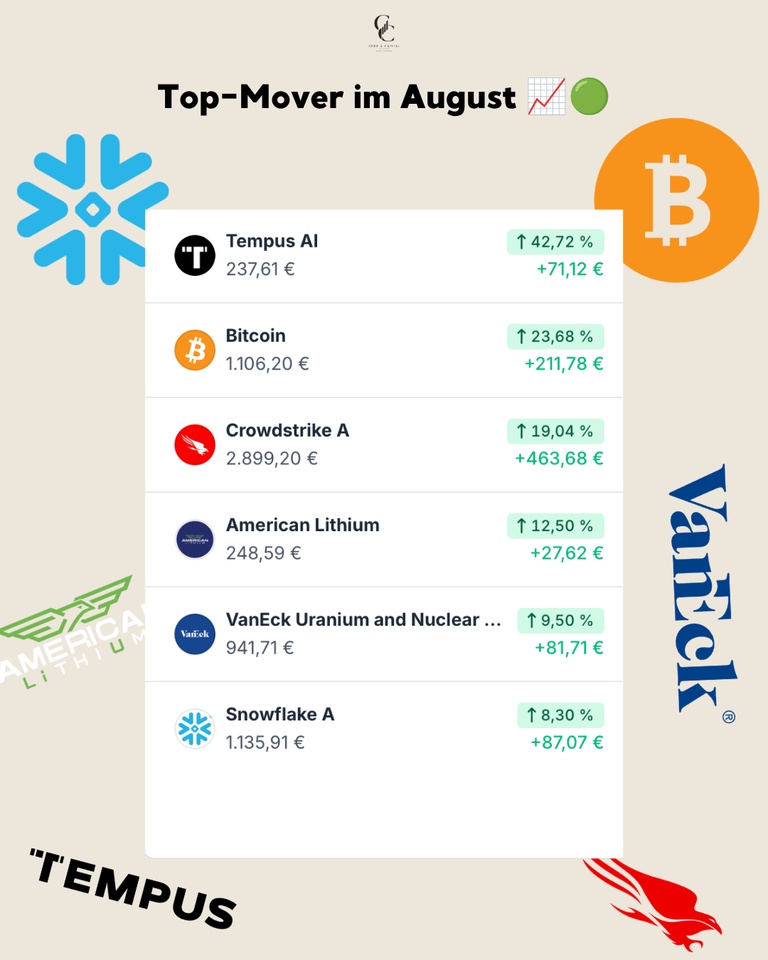
Top Movers in August 🟢
Tempus AI $TEM (-5.24%) posted the strongest gain at +42.72% (+71.12 €), marking a strong rebound following the July slump. Bitcoin $BTC (-1.54%) rose by +23.68% (+€211.78). CrowdStrike $CRWD (-2.37%) rose by +19.04% (+€463.68), making it the biggest euro gain in the portfolio; cybersecurity performed well in August regardless of the chip cycle. American Lithium gained +12.50% (+€27.62), while the VanEck Uranium and Nuclear ETF $NUKL (-2.74%) rose by +9.50% (+81.71 €). Snowflake $SNOW (-4.01%) rounded out the list with a gain of +8.30% (+€87.07).
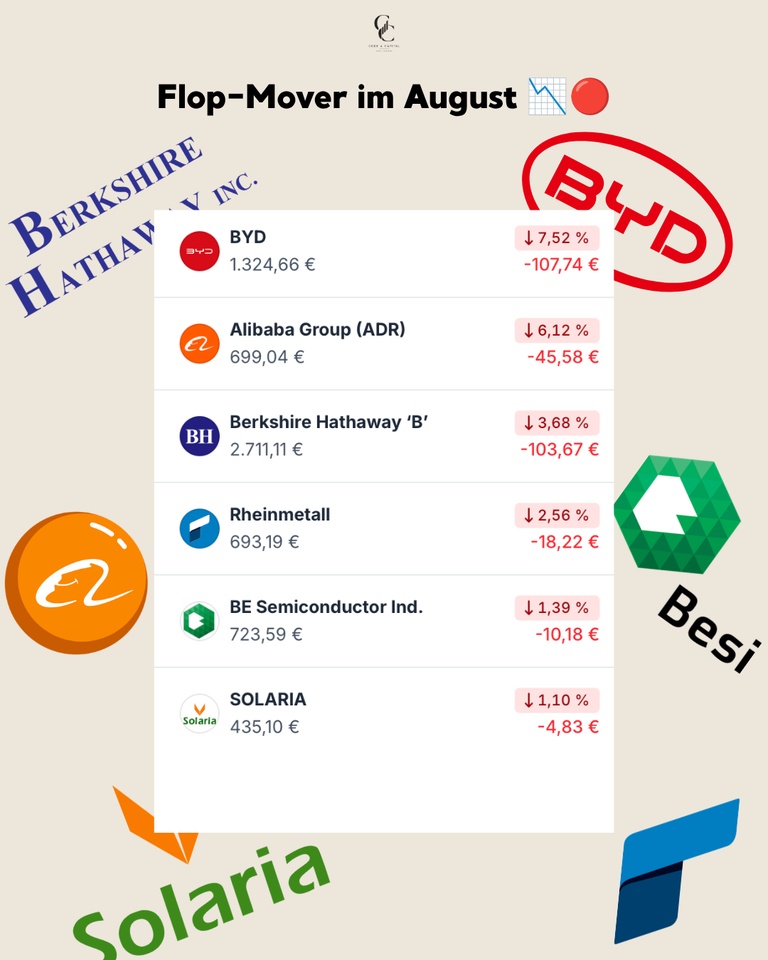
August’s Worst Performers 🔴
The losses were significantly smaller than in the previous month. BYD $1211 (-0.47%) fell -7.52% (-€107.74), taking a breather after a 27 percent gain in July. Alibaba $BABA (-1.96%) followed with a -6.12% drop (-€45.58); here, too, the China rally from July ran out of steam. Berkshire Hathaway $BRK.B (+0.5%) fell -3.68% (-103.67 €), and Rheinmetall $RHM (+3.84%) -2.56% (-€18.22). BE Semiconductor $BESI (-4.15%) fell by only -1.39% (-€10.18) and has stabilized following the slump in July. Solaria $SLR (-0.19%) closed down 1.10% (-€4.83).
Conclusion 💡
July was a month in which a lot happened. August was the month in which much of that reversed. Tempus AI $TEM (-5.24%) went from the biggest loser to the biggest winner, while BYD $1211 (-0.47%) and Alibaba $BABA (-1.96%) the other way around. Anyone who had sold in a panic in July would have been on the wrong side of the market in August.
❓ Question for the Community
Did the market fluctuations in August make you get cold feet, or did you hold onto your positions? And what was your best buy?
👇 Share your thoughts in the comments!
➡️ Every month, I post a portfolio update here, along with research from my quantitative model in between.
🗞️ Newsletter: codeandcapitalquant.beehiiv.com
📈 Wikifolio: https://www.wikifolio.com/de/de/w/wf0gquant6
+ 1
July was a month of contrasts. The Nasdaq slipped into its second correction of 2026, triggered by a sharp sell-off in semiconductor stocks—memory chip manufacturers and chip equipment suppliers saw losses, in some cases in the double digits, and even strong quarterly results were no longer enough to prop up share prices. The DAX, on the other hand, hit new record highs during the same period, driven by software stocks and a rebound at Rheinmetall. At the same time, a significant amount of capital rotated out of AI and chip stocks and into Chinese tech and electric vehicle stocks, which staged a strong comeback after months of decline.
My portfolio benefited from this rotation and is back in the black:
📊 Monthly performance: +1.02%
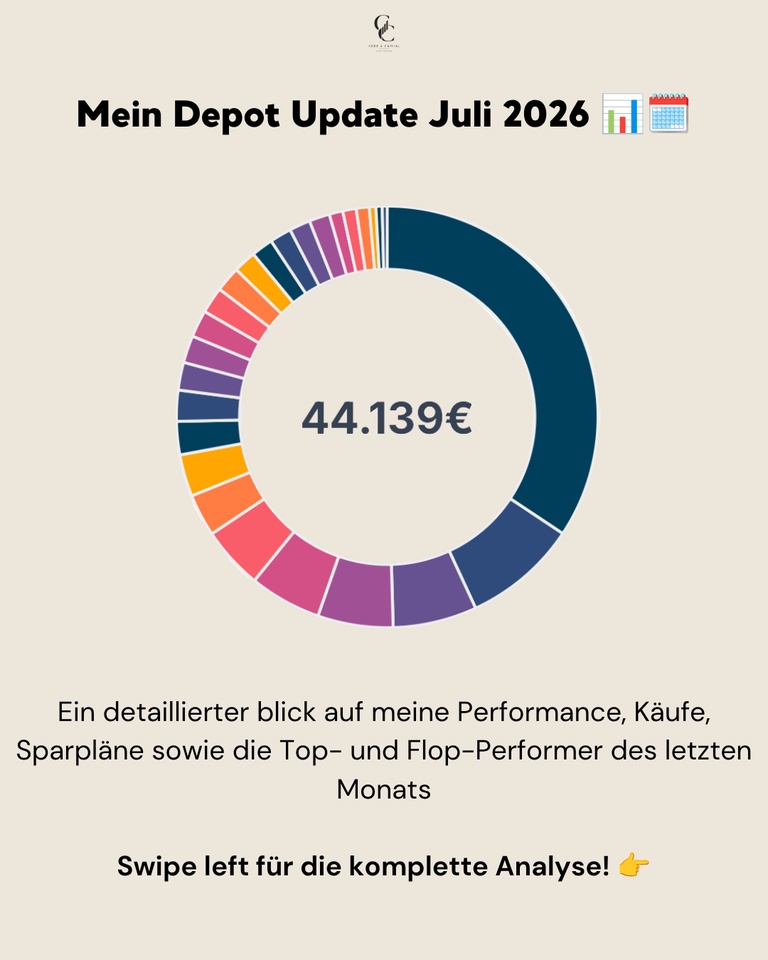
📊 Portfolio value: ~€44,139
📊 Peak performance (Jan. 6, 2022): +43%
📊 YTD performance: ~+14.09%
Performance & Comparison 🚀
July demonstrated how differently the indices could perform depending on their composition. While the Nasdaq suffered from the chip sell-off, the DAX benefited from its lower concentration of semiconductor stocks and the Rheinmetall recovery. My portfolio tracked the DAX more closely than the Nasdaq and ended the month in positive territory.
Performance Comparison (July 1–July 31, 2026, end of day):
My portfolio: +1.02%
DAX: +2.57%
S&P 500: -1.25%
FTSE All-World: -1.47%
NASDAQ 100: -6.97%
Purchases, Sales & Allocation 💶
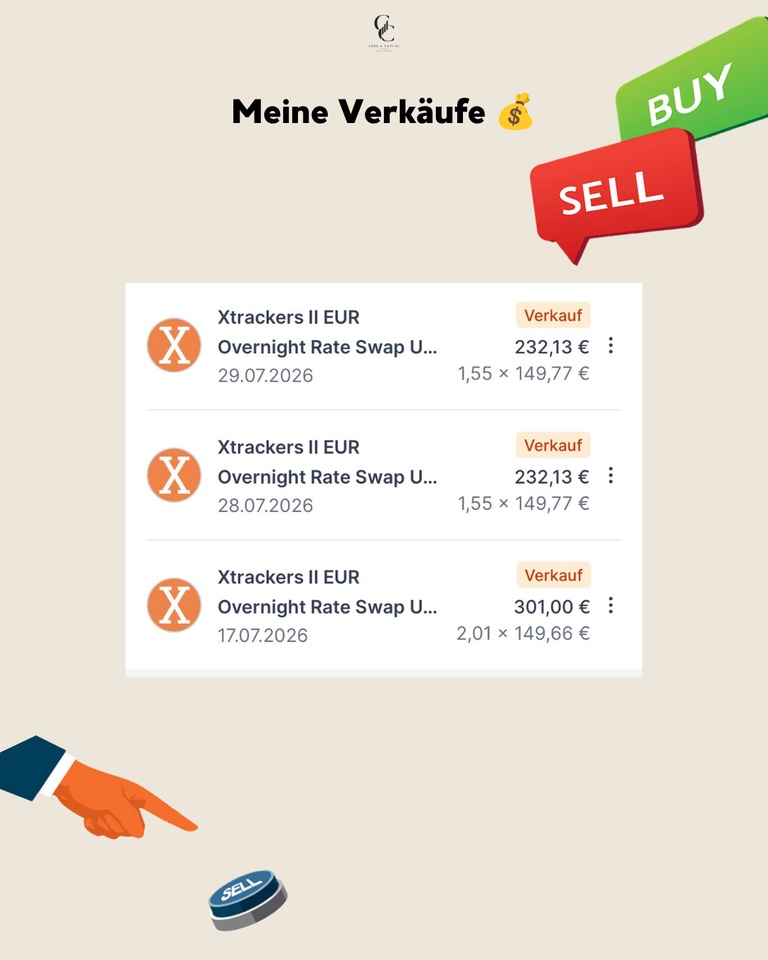
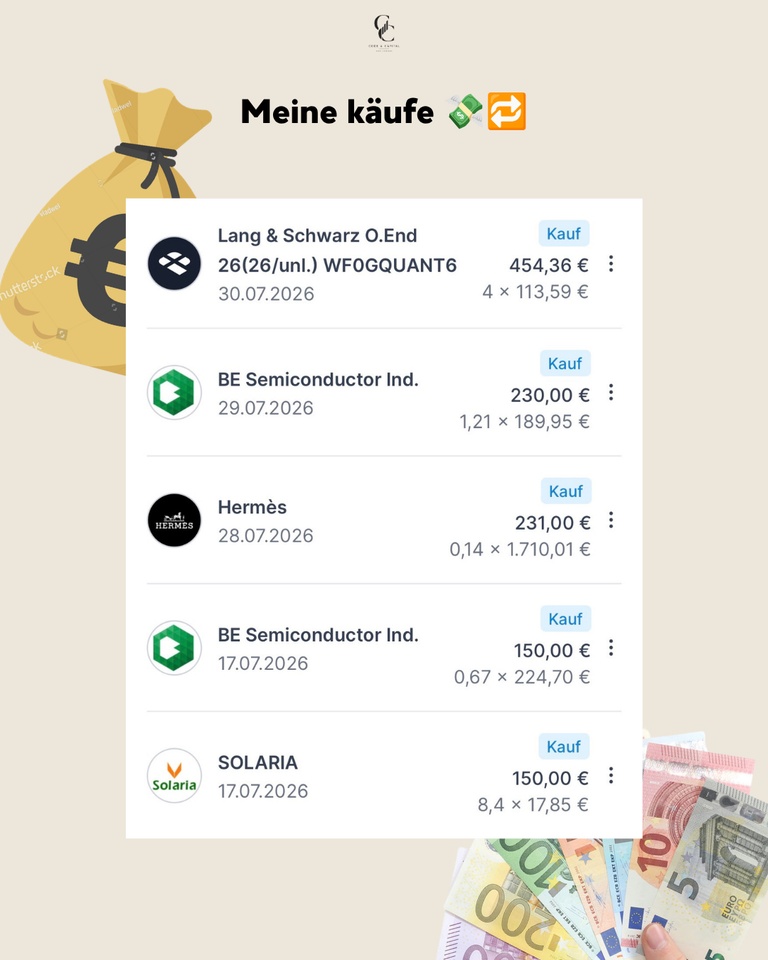
In July, I reduced my cash position. The Xtrackers II EUR Overnight Rate Swap ETF, which I had been using to park liquidity, was sold in three tranches: €301.00 on July 17, and €232.13 each on July 28 and July 29—totaling approximately €765. The freed-up funds were immediately allocated to three positions: BE Semiconductor Ind. $BESI (-4.15%) I increased my position in two steps: €150.00 on July 17 and €230.00 on July 29. For Solaria $SLR (-0.19%) , I added another €150.00 on July 17, and for Hermès $RMS (+2.79%) on July 28. In doing so, I deliberately reallocated cash into stocks rather than injecting new capital.
Additionally, on July 30, I invested €454.36 in my own Wikifolio certificate $DE000LS9V052 (-1.59%) —a private position separate from the rest of my portfolio.
Top Movers in July 🟢
The month clearly belonged to stocks that benefited from the rotation out of U.S. tech.
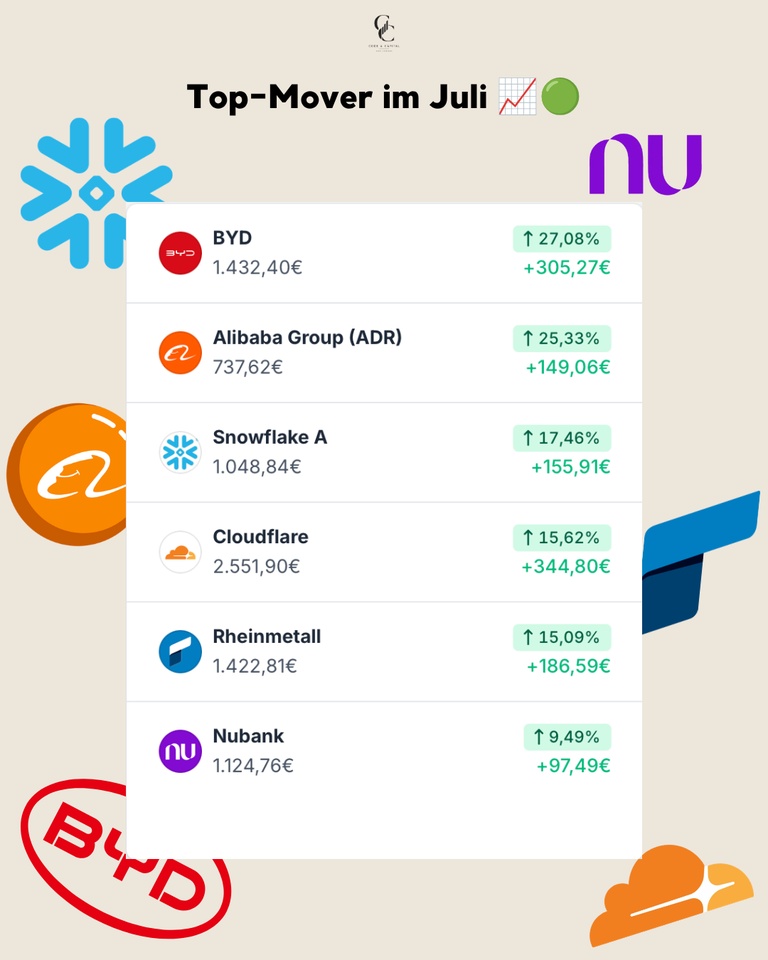
BYD posted the strongest gain at +27.08% (+€305.27). The stock received a double boost: capital flowed from AI and chip stocks into Chinese electric vehicle stocks, and BYD also reported $1211 (-0.47%) reported a nearly 22% jump in sales for July and more than a doubling of overseas deliveries. Alibaba $BABA (-1.96%) followed suit with a gain of +25.33% (+€149.06)—part of the same China-led rally that also swept up Tencent and Xiaomi. Snowflake $SNOW (-4.01%) rose by +17.46% (+€155.91) and Cloudflare $NET (-4.72%) by +15.62% (+344.80 €), the largest euro gain in the portfolio—both software stocks fared significantly better than hardware and chips in the rotation. Rheinmetall $RHM (+3.84%) rebounded by +15.09% (+€186.59) from its 52-week low following the frigate shock in June, supported by full order books and rising defense budgets in Europe. Nubank $NU (-2.77%) rounded out the list with a gain of +9.49% (+€97.49)—here, too, the rotation away from U.S. tech toward other regions played a role.
July’s Big Losers 🔴
On the other hand, the list consisted almost exclusively of stocks that were directly or indirectly hit by the chip sell-off.
Tempus AI $TEM (-5.24%) suffered the biggest loss at -25.08% (-€55.74)—AI-related stocks came under particular pressure during the broad sell-off. IREN $IREN (-3.71%) fell by -20.39% (-€179.15) and has remained weak since the price slump in early summer, still weighed down by the combination of Bitcoin weakness and skepticism regarding its transition to an AI cloud provider. BE Semiconductor Ind. $BESI (-4.15%) fell by -18.77% (-€169.56), directly impacted by the global sell-off among chip equipment manufacturers. TSMC $TSM (-3.17%) lost -15.04% (-€80.55)—despite a strong quarter, the stock was swept up in the general semiconductor correction. Hermès $RMS (+2.79%) dropped -10.27% (-24.26 €), with luxury goods following the downward trend of weaker growth stocks. Solaria $SLR (-0.19%) rounded out the list with a -9.50% (-€46.19) decline—solar and renewable energy stocks remain under pressure.
Conclusion 💡
July showed just how quickly capital flows can shift. While the chip sector underwent one of the sharpest corrections of the year, Chinese tech and electric vehicle stocks found their bottom. For my portfolio, this was a good example of why broad diversification across sectors and regions makes all the difference.
❓ Question for the Community
That was my month in numbers—how did the July chip sell-off affect you? Did you rotate into Chinese stocks, or are you holding onto your U.S. tech positions?
👇 Let us know in the comments!
➡️ Follow @codeandcapital26 for transparent portfolio updates!
🗞️ Newsletter: codeandcapitalquant.beehiiv.com
📈 Wikifolio: https://www.wikifolio.com/de/de/w/wf0gquant6
+ 2
$RHM (+3.84%) It has now recovered well from its last severe drop. The price has now risen by €400 since the crash, reaching €900. Will Rheinmetall recover enough for us to ultimately reach the expected targets of around €1,800, or is the hype short-lived, which would result in another crash or collapse?
I’m curious to see what the future holds.

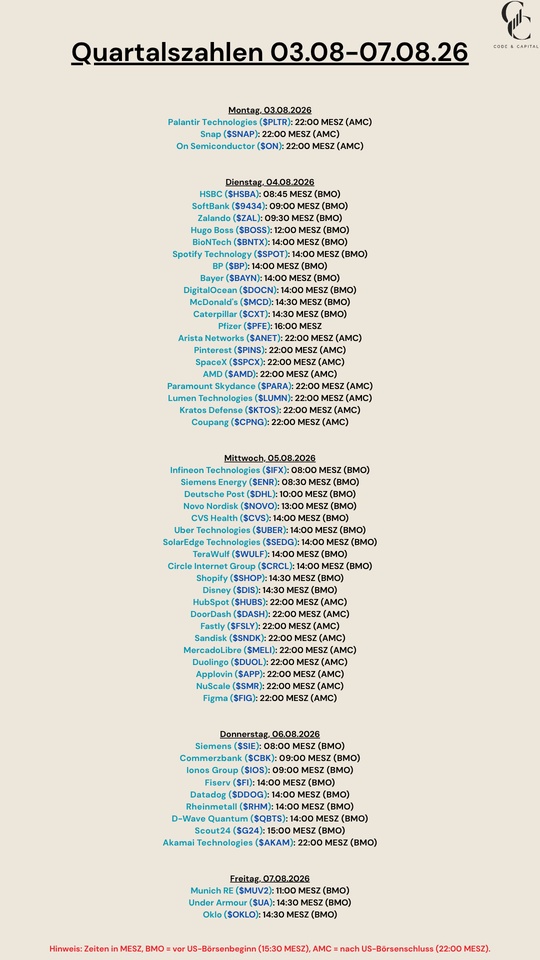
$PLTR (-2.05%)
$SNAP (-1.92%)
$HSBA (+0.04%)
$9434 (+0.4%)
$ZAL (+2.45%)
$BOSS (+0.38%)
$BNTX (-0.16%)
$SPOT (-0.05%)
$BP. (+0.08%)
$BAYN (-1.38%)
$DOCN (-4.11%)
$MCD (+0.98%)
$CAT (-2.31%)
$PFE (+0.99%)
$ANET (-2.77%)
$PINS (-0.52%)
$SPCX (-2.47%)
$AMD (-3.13%)
$PARA (-0.52%)
$LUMN (-1.88%)
$KTOS (-2.73%)
$CPNG (-1.12%)
$IFX (-7.01%)
$ENR (-4.83%)
$DHL (+1.29%)
$NOVO B (+1.52%)
$CVS (+0.33%)
$UBER (-0.77%)
$SEDG (-2.47%)
$WULF (-6.06%)
$CRCL (-4.29%)
$SHOP (-2.96%)
$DIS (+0.55%)
$HUBS (+1.24%)
$DASH (-0.93%)
$FSLY (-3%)
$SNDK (-4.42%)
$MELI (-1%)
$DUOL
$APP (-1.71%)
$SMR
$FIG (-1.46%)
$SIE (-2.05%)
$CBK (-0.05%)
$IOS (+1.4%)
$FI (-0.24%)
$DDOG (-3.33%)
$RHM (+3.84%)
$QBTS (-3.52%)
$G24 (+4.31%)
$AKAM (-2.7%)
$MUV2 (+2.29%)
$UA (-0.43%)
$OKLO
Summary:
Perhaps—the preliminary figures certainly provide a strong case for it. On July 29, 2026, Rheinmetall reported preliminary Q2 results in an ad hoc announcement that surprised even optimistic analysts: Revenue climbed by about 69% to EUR 3.289 billion—well above the company’s own forecast of “over 60% growth,” which had been communicated in early July. The jump in earnings was even more pronounced: Operating profit rose to EUR 562 million, about 20% above the analyst consensus of EUR 469.9 million. All business segments contributed to this increase. The stock reacted promptly—rising from around EUR 1,078 in the morning to as high as EUR 1,167.40 at one point, an increase of over 7% during the trading day. The downside: Rheinmetall expects a significantly negative operating free cash flow for the quarter, due to deferred advance payments and preparations for capacity expansions. The company will not provide the full details of its half-year results until August 6, 2026.
Key highlights:
• Q2 2026 (preliminary): Revenue of EUR 3.289 billion (+69% YoY) — exceeds the company’s own forecast by over 60%
• Operating profit: EUR 562 million — approximately 20% above the analyst consensus (EUR 469.9 million)
• Order backlog: over EUR 80 billion
• New orders: Loitering munitions contract with the Bundeswehr, SAFE order package with Romania
• Stock: +7.42% during the trading day to as high as EUR 1,167.40
• Warning sign: significantly negative operating free cash flow expected for the quarter
• F126 delivery (July 2, 2026) remains a drag, but has long been offset operationally
• Full half-year report: August 6, 2026
Buy now $RHM (+3.84%) ?

$RHM (+3.84%) It has reached a stable position, but will not be funded for the time being. Thanks to $MNST (+1.51%) , $BAC (+0.5%) and $ADS (+1.61%) the loss has been manageable given the size of the portfolio. For me, the future still lies more in consumer stocks, as well as expanding my ETF holdings.
Who knows what other great ideas I’ll come up with for these speculative stocks :D
June was marked by a Fed shock and a rotation away from the winners of the previous months. On June 17, the Fed, under its new chair Kevin
Warsh , the Fed kept interest rates at 3.50–3.75%, the dot plot signaled a possible rate hike rather than a cut—after months of hopes for easing —a real blow to the markets. On top of that came a bombshell regarding defense stocks: The Ministry of Defense scrapped the multi-billion-euro F126 frigate program, and Rheinmetall $RHM (+3.84%) subsequently lost over 16% —one of the stock’s worst trading days in decades. While speculative and cyclical stocks were sold off, investors fled to quality: defensive large-cap stocks and established software stocks held up significantly better.
In line with this more selective market environment, my portfolio slipped slightly into the red but held up more robustly than the DAX and Nasdaq:
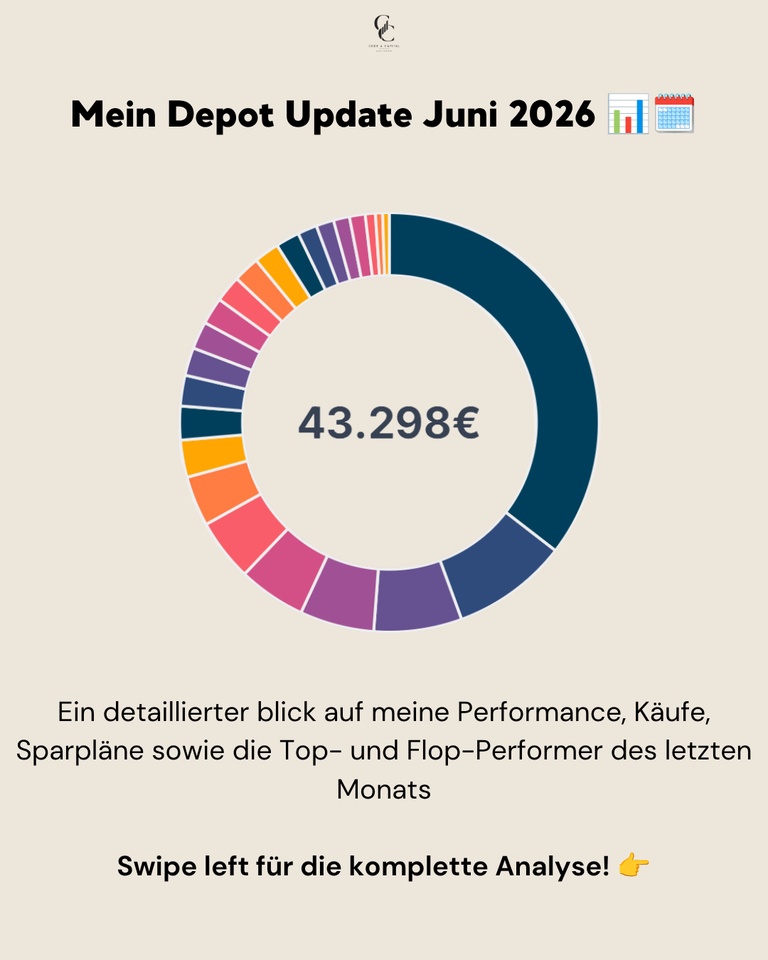
📊 Monthly performance: -0.39%
📊 Portfolio value: ~€43,298
📊 Peak performance (Jan. 6, 2022): +39.16%
📊 YTD performance: ~+7.68%
Performance & Comparison 🚀
June was a month of contrasts: While the DAX and Nasdaq suffered from the Fed shock and the rotation out of risk assets, the S&P 500 and FTSE All-World held up significantly better thanks to their broader, more defensive composition. My portfolio was in the middle of the pack at -0.39%—more stable than the DAX and Nasdaq, but weaker than the two broad U.S. and global indices.
Performance Comparison (June 1–June 30, 2026, end of day):
My portfolio: -0.39%
FTSE All-World: +1.24%
S&P 500: +0.85%
DAX: -0.53%
NASDAQ 100: -0.96%
Purchases, Sales & Allocation 💶
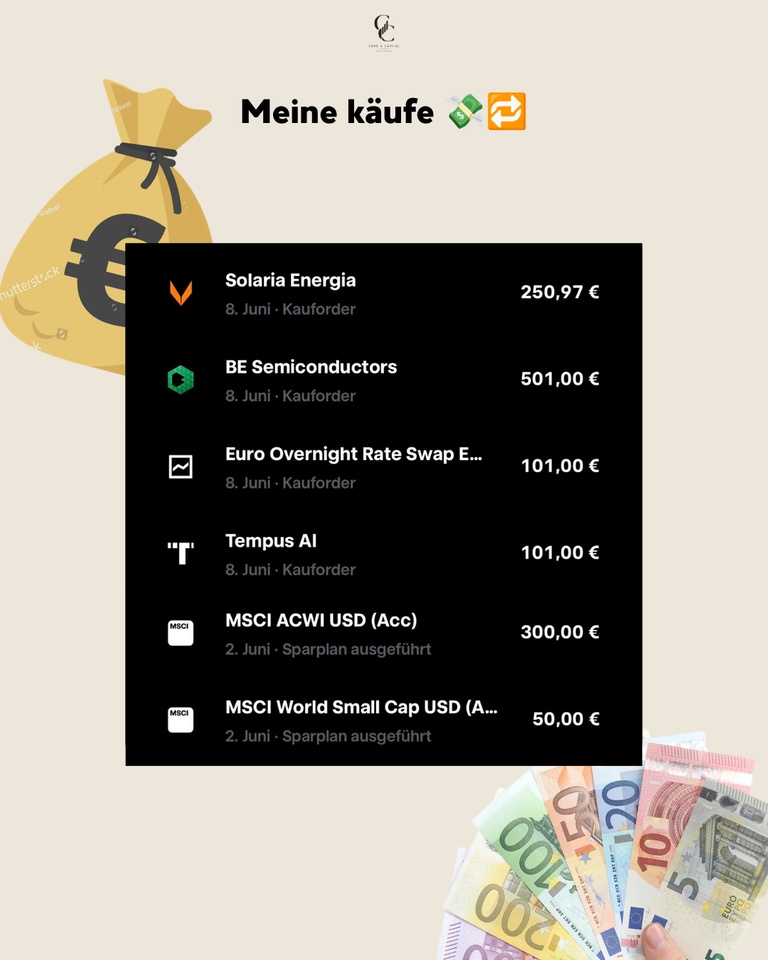
In June, €300.00 was invested in the MSCI ACWI USD (Acc) $ACWI and €50.00 into the MSCI World Small Cap $WSML via the ongoing savings plans. The following were added via buy orders: Solaria Energia $SLR (€250.97), BE Semiconductors (€501.00), a Euro Overnight Rate Swap ETF (€101.00), and Tempus AI $TEM (€101.00).
On the selling side, I took profits on two positions in which I’ve been a shareholder for a good two years: In Datadog $DDOG (-3.33%) , I closed out the entire position after the stock had performed strongly in recent months. With Snowflake $SNOW (-4.01%) , I sold about a quarter of the position and am holding onto the rest. Both were purely profit-taking after a strong run; there has been no fundamental change in my assessment of the companies.
Top Movers in June 🟢
Despite the generally nervous sentiment, there were a few stocks that bucked the rotation trend and benefited from the flight to quality.
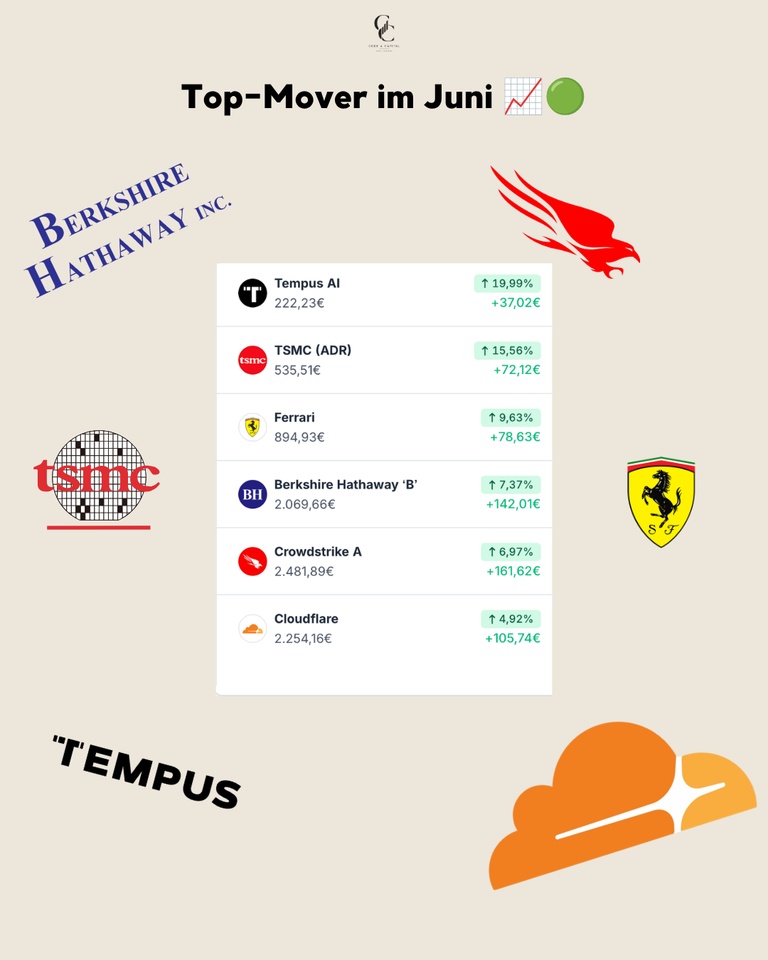
Tempus AI $TEM (-5.24%) posted the strongest gain at +19.99% (+37.02 €)—AI diagnostics remain in demand, even as more speculative stocks were sold off. TSMC $2330 followed with a gain of +15.56% (+€72.12): Demand for chips related to AI expansion remains consistently high, regardless of the interest rate debate. Ferrari $RACE (+0.5%) rose by +9.63% (+€78.63)—luxury goods proved resilient in the face of macroeconomic concerns. Berkshire Hathaway $BRK.B (+0.5%) benefited significantly from the flight to defensive quality, rising +7.37% (+€142.01), while Crowdstrike $CRWD (-2.37%) posted the largest euro gain in the portfolio with a +6.97% (+161.62 €) rise—cybersecurity remains structurally in demand. Cloudflare $NET (-4.72%) rounded out the list of winners with a gain of +4.92% (+€105.74).
June’s Biggest Losers 🔴
The losers in June were almost exclusively the stocks that had performed the strongest in previous months or are particularly sensitive to interest rates.
IREN was hit the hardest $IREN (-3.71%) , down -26.48% (-€316.39): Falling Bitcoin prices and ongoing disagreement among analysts regarding the company’s transition from a Bitcoin miner to an AI cloud provider weighed on the stock. Rheinmetall $RHM (+3.84%) lost -23.36% (-€376.76) after the Ministry of Defense scrapped the F126 frigate program, which affected the entire defense sector. Alibaba $BABA (-1.96%) fell by -21.25% (-€158.86)—Chinese tech remains under pressure due to general risk aversion toward Chinese stocks. American Lithium fell -21.21% (-€64.45), weighed down by persistently weak commodity prices and higher interest rate expectations, which particularly affect unprofitable growth stocks. BYD $1211 (-0.47%) fell by -18.40% (-254.16 €) amid the ongoing price war in the Chinese electric vehicle market. Solaria $SLR (-0.19%) rounded out the list of top losers with a -15.86% drop (-€63.35)—the hawkish Fed is weighing noticeably on interest-rate-sensitive solar and renewable energy stocks.
Conclusion 💡
June was a month of rotation: away from the more speculative winners of previous months, toward quality and established names. The Fed shock and the Rheinmetall slump showed how quickly sentiment can shift—a good reminder of why diversification across sectors and regions remains important.
❓ Question for the Community
That was my month in numbers—how did your portfolio fare through the Fed shock? Did you buy more Rheinmetall shares, or did you pull the plug?
👇 Let us know in the comments!
➡️ Follow @codeandcapital26 for transparent portfolio updates!
🔗 Link in bio: Wikifolio, Getquin & Parqet Portfolio
🗞️ Newsletter: codeandcapitalquant.beehiiv.com
📈 Wikifolio: https://www.wikifolio.com/de/de/w/wf0gquant6
+ 3
Top creators this week