
Either $ISPA (+0.37%) or $LDGL? (+0.5%)
- Markets
- ETFs
- iShares STOXX Global Select Dividend 100
- Forum Discussion

iShares STOXX Global Select Dividend 100
ETP
ETP
ISIN: DE000A0F5UH1
Ticker: ISPA
DE000A0F5UH1
ISPA
Price
Discussion about ISPA
Posts
117


1Mon·
+++ Why I'm Not Increasing My NGT Exposure Right Now +++
I remain convinced of my bottleneck thesis regarding Next-Gen Technologies (NGT). The expansion of AI infrastructure is encountering real bottlenecks in memory, photonics, power supply, cooling, packaging, materials, and other areas.
As far as I’m concerned, nothing fundamental has changed about this technological thesis. What has changed is the environment in which it must unfold.
The massive expansion of AI infrastructure requires enormous amounts of capital. Hyperscalers and other companies are financing ever-larger investment programs and are thus competing for funds in the capital market.
At the same time, the U.S. government also requires ever more capital. High and still-rising government debt thus collides with an additional, enormous need for financing in the private sector.
This can create a vicious cycle: High demand for capital can keep yields on the bond market high or drive them even higher. This makes financing more expensive—for the government as well as for companies. And the higher the discount rate, the less corporate profits that lie far in the future are worth today. Growth stocks, in particular, are sensitive to this.
Added to this is inflation. If inflation persists or rises again due to high government spending, tariffs, or other policy measures, the central bank’s leeway to lower interest rates is reduced. In the worst-case scenario, higher key interest rates .
The interesting thing about this is that: The AI narrative can remain fundamentally intact, and yet AI stocks can still come under pressure. Not because AI doesn’t work. Or because there’s a lack of demand. Or because supply bottlenecks are disappearing.
But because capital is becoming more expensive, investments are harder to finance, and future profits are being valued at lower levels.
And then there’s a second risk factor that I hadn’t fully accounted for: the economic and geopolitical policies of the U.S. government.
Tariffsthat are imposed, modified, or rescinded on short notice. Personnel decisions at the central bank and government agencies that call political independence into question. A Foreign policythat unsettles allies and turns supply chains into bargaining chips. To me, this is no longer just the usual political uncertainty that’s always been around. This is unpredictable and risky behavior with a direct impact on the cost of capital, supply chains, and predictability—and I have absolutely no influence over it.
This brings me to Aschenbrenner. His Situational Awarenessfund has also run into trouble because he bet on his AI thesis using leverage. A risk he chose and created himself.
My risk is different. I don’t use leverage. But I’m sitting on a position in NGT that’s relatively large by my standards in a market whose valuation framework is partly determined by a government that I can neither elect nor control nor reliably assess. This isn’t a bad decision that I can correct: it’s powerlessness, that I have to deal with.
For my overall private portfolio , this means I won’t be increasing my NGT exposure any further for the time being. New capital is now flowing more heavily into defensive and diversifying investments (e.g., iShares STOXX Global Select Dividend 100 $ISPA (+0.37%)). I am also reducing some of my weaker or riskier NGT positions slightly.
This is not the end of my NGT strategy, and certainly not the end of my AI thesis. It is risk management against a risk that I cannot simply ignore just because I don’t like it.
For my ScaleLimits wikifolios , nothing about the fundamental strategy is changing. The bottleneck thesis remains intact, and I will continue to actively manage the portfolios according to my NGT methodology, including rebalancing, cluster maintenance, and position selection. A “retreat” would be the opposite of active management. That is precisely why I remain committed and am closely monitoring the environment instead of simply waiting it out.
Because for me, the following still holds true: You don’t have to abandon a good investment thesis just because market conditions have worsened. But you also shouldn’t pretend that the risk hasn’t changed. And you should honestly identify where that risk comes from.
Does this worry you, too?

2121
9 Comments
No, I see it the same way you do, but I'm not overly concerned. As you wrote: The bottlenecks are—or will be—real (and will remain so); the thesis still holds.
•
22
•
2Mon·
MY PLAN TO LIVE OF DIVIDENDS
Hello everyone, I'm 24 y.o. my investments are currently worth 50 k eur. My plan is to save around 1000 eur per month and invest in growth product for 15 years.
Specifically:
35 % MSCI WORLD INFORMATION TECHNOLOGY $XDWT (+0.64%)
35 % MSCI WORLD MOMENTUM $XDEM (+0.58%)
15 % MSCI WORLD SMALL CAP $WSML (+1.05%)
15 % MSCI WORLD VALUE $XDEV (-0.14%)
note: they all have had better return (on long range) in comparision with sp500 and ofc msci core world or ftse all word. Plus these etf offer a real diversification from having the big 7 as first positions (not world tech obviusly).
Once I'll reach around 600 k I'II allocate everything in etf high dividend stocks:
Main idea:
100 % core $ISPA (+0.37%) (good annual dividends around 4.50 % + good growth around 5.40 % yearly, no yield trap, and GREAT global and sectorial diversification)
Second idea (great especially if you don’t have double tax to pay)
70 % core $ISPA (+0.37%)
30 % High dividend stocks with the hope that over the time they can growth at least for the purpose of betting inflaction. Their dividend is huge, maybe on avarege around 7 % annualy. Stocks I’m talking about: $ARCC (-0.19%)
$O (+0.29%)
$MAIN (-0.42%)
$PPL (+0.48%)
$WPC (+0.46%)
$OHI (+0.69%)
Note: if you have double tax problem, instead of all these single stocks I would add just $WINC (+0.55%) in the portafolio.
Since I live in center-south Italian countryside, no rent/mortage needed, for what are my life costs, having a total of about 600 k invested in $ISPA (+0.37%) to have 1.7 k per month (after italian taxes of 26 % over capital gains/dividend) it’s not bad at all . And that’s enought since my capital will keep on growing (composite growth) over the time togheter with the dividends.
do you have any comments or advice ?

99
24 Comments
Did I miss something? The " $TDIV " is only paying out 3% for me. Especially for strategies like this, getting 1.5% less return really makes a difference.
•
77
•
3Mon·
Invest the proceeds from the sale?!
Hello, I’ve sold my next property. I’d like to invest the profit as follows:
$TSWE (+0.79%) 36k,
$VHYL (+0.71%) 36K,
$ISPA (+0.37%) 36K,
$JEPQ (+1.06%) 36K,
$TDIV (-0.15%) 36K,
$LDGL (+0.5%) 30k
I'm also considering
$BHP (+2.5%) 20K,
$RIO (+1.49%) 20K, and
$O (+0.29%) 20K
$BRK.B (+0.53%) 30K
or directly in $BRK.B (+0.53%) 90k, since commodity stocks are trading a bit high for me right now! This position is like a high-risk money market account for me, which should be reallocated countercyclically.
My goal is to combine further dividend growth with modest portfolio growth. I no longer need high performers myself. I can still work for another 25 years, health permitting, and perform at a high level myself.
For me personally, individual stocks belong in my portfolio. Like the icing on the cake.
However, I will continue to focus on expanding my ETF positions through future asset reallocations.
In three years, my last major property in Germany will likely be sold. By then, the portfolio should be structured to enable my children to live a free, independent life anywhere on the globe.
What do you think? Would you change anything about the ETF positions? Wait on commodities too? Or put everything into SpaceX?
Thanks for the feedback.
88
9 CommentsIs it just the dividend income/dividend yield that matters to you, or the total return?
Are you familiar with the mechanics of covered calls, in terms of risk and limited upside?
$BRK.B as a money market account—phew. Ultimately, it’s a stock that, due to its structure, doesn’t correlate very strongly with the market, though it’s still far from having a correlation of 0 or below.
I’ll leave your last two questions about commodities and SpaceX aside. That’s something you have to figure out for yourself. You yourself say, “You don’t need high performers anymore,” but you want to invest in SpaceX (which doesn’t pay dividends). That’s a contradiction in terms, so tell me: emotions are driving your investment strategy. And no amount of facts can counteract emotions.
Are you familiar with the mechanics of covered calls, in terms of risk and limited upside?
$BRK.B as a money market account—phew. Ultimately, it’s a stock that, due to its structure, doesn’t correlate very strongly with the market, though it’s still far from having a correlation of 0 or below.
I’ll leave your last two questions about commodities and SpaceX aside. That’s something you have to figure out for yourself. You yourself say, “You don’t need high performers anymore,” but you want to invest in SpaceX (which doesn’t pay dividends). That’s a contradiction in terms, so tell me: emotions are driving your investment strategy. And no amount of facts can counteract emotions.
•
99
•
4Mon·
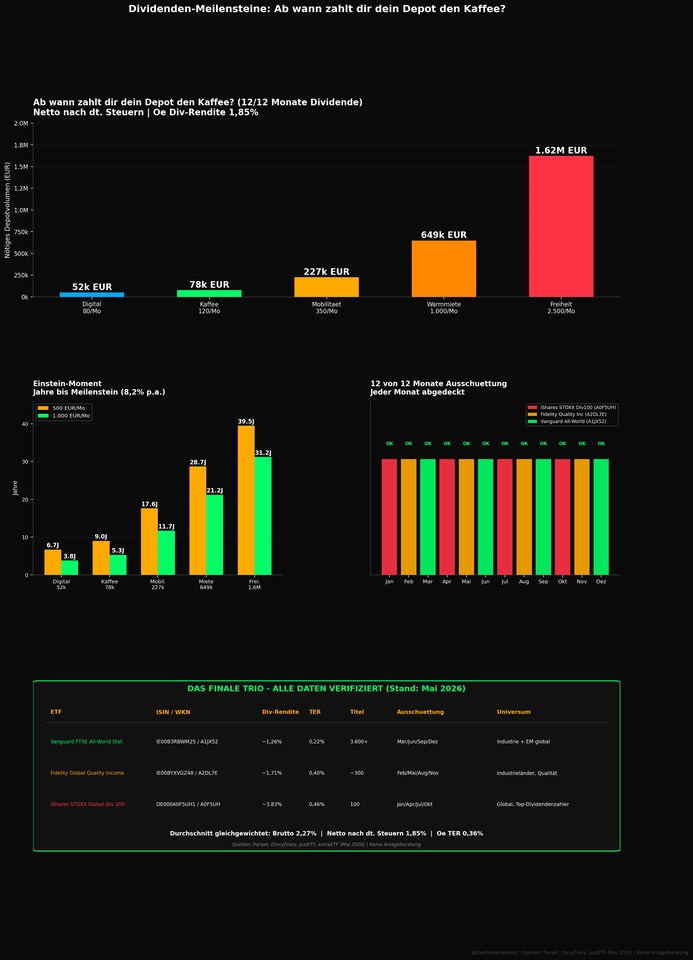
☕ When does your depot start paying for your coffee? Every month.
Three ETFs. Twelve months. Not a month without a distribution.
Dividends feel different from price increases. A price gain is paper. A distribution is money in the account. This is not a discussion about optimization, this is psychology.
The trio:
🟢 Vanguard FTSE All-World Dist. (A1JX52) 3,600+ stocks, developed and emerging markets, ~1.26% div yield, TER 0.19% Distribution: March / June / September / December
🟡 Fidelity Global Quality Income (A2DL7E) Quality focus on industrialized countries, ~1.71% div yield, TER 0.40% Distribution: February / May / August / November
🔴 iShares STOXX Global Select Dividend 100 (A0F5UH) 100 top dividend payers from Europe, North America and Asia-Pacific, ~3.83% div yield, TER 0.46% Distribution: January / April / July / October
Together: 12 out of 12 months.
The milestones (net after German taxes, Ø 1.85% net dividend yield):
📱 Digital lifestyle Netflix/Internet/mobile phone
80€/mo: 52,000€
Depot → €500/mo: 6.7 years | €1,000/mo: 3.8 years
☕ Daily coffee
120€/mo: 78,000€
Deposit → €500/mo: 9.0 years | €1,000/mo: 5.3 years
🚗 Mobility leasing and insurance
350€/mo: 227.000€
Depot → €500/mo: 17.6 years | €1,000/mo: 11.7 years
🏠 Warm rent
1,000€/mo: 649,000€
Deposit → €500/mo: 28.7 years | €1,000/mo: 21.2 years
🎯 Financial freedom
€2,500/mo: €1.62 million deposit → €500/mo: 39.5 years | €1,000/mo: 31.2 years
An important note that many people forget:
Dividends are not free money. On the ex-dividend date, the share price is reduced by exactly the amount distributed. The money is transferred from the securities account value to the account, not added to it. If you don't know this, you might wonder why your securities account falls slightly on the distribution date.
Honest classification:
This strategy is optimized for monthly cash flow and motivation, not maximum final return. An accumulating MSCI World benefits from tax deferral and almost always outperforms in the long term. But if you need the monthly confirmation in your account to keep going, you are doing absolutely everything right here. Discipline beats optimization.
PS: Why these three ETFs?
Yes, there are dividend ETFs with 4, 5 or 6% distribution yields. Yes, there are individual stocks that pay 8% or more. That's not the point of this post.
This trio was chosen because it does three things at once: pay out every month, be broadly diversified and not take extreme cluster risks. If you want higher yields, you take more concentrated stocks and bear more risk. Both are legitimate, both are a conscious decision. The aim here was to provide an example that works for as many people as possible as a starting point.
The TER correction:
The TER of the Vanguard FTSE All-World Dist. (A1JX52) is correctly 0.19% p.a., not 0.22% as stated in the chart. My mistake, thanks to anyone who reports it. The average of the trio thus drops minimally to approx. 0.35% TER. Nothing significant changes in the milestone calculations.
Sources: Parqet, DivvyDiary, justETF, extraETF (as of May 2026). Taxes: 30% partial exemption, 26.375% capital gains tax. No investment advice.
What is your next milestone? 👇
$VWRL (+0.81%)
$FGEQ (+0.56%)
$ISPA (+0.37%)
#getquin
#dividenden
#etf
#passiveseinkommen
#finanziellefreiheit
#investieren
#finanzen
#börse
#ausschüttend
#msciworld
1919
10 Comments

4Mon
This also worked for me until AllWorld's payday shifted from the end of one month to the beginning of the following month and there are now two payouts in these months, one at the beginning and one at the end. 😑
•
44
•
5Mon·
Between fog and consistency: my review for April 2026
The dip dribbled out perfectly! With bonus and tax refund, it's now cash flow season. 📈⚽
April showed that consistency is not a fair-weather project. While I was standing in thick fog in Saxon Switzerland and couldn't see the valley from the top of the rocks because of the fog, the depots reflected the turnaround in performance for the better. As soon as the sun broke through, the gray gave way to a lush green.
After a turbulent March, I seized the opportunity when my employer paid out my half-year bonus. I hit the low point very well and dribbled out. Broadcom did exactly what it usually does with my shares: be the engine of growth. The road to freedom is a hike through all kinds of weather. Sometimes the wind whips up, sometimes you enjoy the sunset at Leipziger Völki.
The key is to stubbornly continue investing. Intel is the best example. Anyone who wrote off the share too early missed the turnaround. Unfortunately, I was never invested in Intel. In any case, I don't know the future in five years' time, but I am securing my cash flow today. Time for a look back.
DISCLAIMER/RISK WARNING
Please remember that this article is for entertainment purposes only. At no point is it a buy or sell recommendation or professional legal, tax or investment advice. Don't just copy anything I do. I am merely describing what is happening in my portfolios, but in no way guarantee that it is up-to-date, correct or complete.
Investing in the capital market is always associated with risks such as loss of invested capital, price fluctuations, liquidation risks or market risks. In accordance with the current guidelines of ESMA and BaFin, I expressly point out that this review serves exclusively to document my personal investment strategy and does not constitute investment advice within the meaning of the WpIG. The securities presented by me are expressly not to be understood as investment advicebut are merely components of my personal portfolio at the time of reporting. Please also bear in mind that there is a conflict of interest, as I naturally hold the securities myself.
If necessary, seek professional advice and do your own research.
Overall performance
Intel shows it again. Just keep a broad base and stay tuned. Then your portfolios will turn out to be a rock in the surf.
My key performance indicators for my overall portfolio at a glance:
- TTWROR (month under review): + 5.29 % (previous month: -4.60 %)
- TTWROR (since inception): +88,98 %
- IZF (month under review): +87.17 % (previous month: -42.46 %)
- IZF (since inception): +11,49 %
- Delta: + € 4,935.78
- Absolute change: € +6,139.12
Data shown as "since inception" is valid since 31.05.2020
Performance & volume
After the fog lifted in April, the true strength of my allocation became apparent. My top of the class $AVGO (+0.21%) not only leads the green portfolio, but is actually marching ahead. In my top 5 $WMT (+0.71%) and $GOOGL (+0.84%) The $BAC, a stable financial anchor, moved back into the top group. Also $FAST (+0.58%) underpins my strategy of solid industrial stocks with consistency.
The highlight is the run at $TGT (-0.58%) My staying power is paying off massively, the minus has shrunk to just 8%. This is clear proof that discipline pays off in phases of weakness. Target seems to be regaining confidence through improved inventory management.
There are downsides to the current "problem children" $NKE (+0.03%) , $GIS (-0.79%) and $$CPB (-0.41%) which are feeling the headwind. But as long as the dividends flow reliably, I remain relaxed. I invest for the stable cash flow that finances my freedom.
Largest individual share positions by volume in the overall portfolio:
Share (%) of total portfolio (and associated securities account):
$AVGO (+0.21%) 3.26 % (main share portfolio)
$WMT (+0.71%) 1.87 % (main share portfolio)
$GOOGL (+0.84%) 1.67 % (main share portfolio)
$FAST (+0.58%) 1.37 % (main share portfolio)
$BAC (+1.87%) 1.35 % (main share portfolio)
$FDX (-0.08%) 1.29 % (main share portfolio)
Smallest individual share positions by volume in the overall portfolio:
Share (%) of the total portfolio (and associated securities account):
$GIS (-0.79%) : 0.40 % (main share portfolio)
$NOVO B (+1.09%) 0.41 % (main share portfolio)
$NKE (+0.03%) 0.44 % (main share portfolio)
$CPB (-0.41%) 0.44 % (main share portfolio)
$DHR (+1.17%) 0.55 % (main share portfolio)
Top-performing individual stocks
Shares with performance since initial purchase (%) (and the respective portfolio):
$AVGO (+0.21%) : +380 % (main share portfolio)
$GOOGL (+0.84%) +149 % (main share portfolio)
$WMT (+0.71%) +118 % (main share portfolio)
$NFLX (-1.81%) +93 % (main share portfolio)
$OHI (+0.69%) : +82 % (main share portfolio)
Flop performer individual stocks
Shares with performance since initial purchase (%) (and the respective portfolio):
$NKE (+0.03%) : -50 % (main share portfolio)
$GIS (-0.79%) -47 % (main share portfolio)
$CPB (-0.41%) : -43 % (main share portfolio)
$NOVO B (+1.09%) -32 % (main share portfolio)
$DHR (+1.17%) -27 % (main share portfolio)
Sector allocation of my individual stocks
My top 6 sectors are:
Consumer goods: 16.47% (previous month: 17.62%)
Miscellaneous: 16.40 % (previous month: 16.60 %)
Technology: 14.18 % [excluding information technology] (previous month: 12.07 %)
Financial sector: 11.55% (previous month: 11.39%)
Transportation: 9.57% (previous month: 9.13%)
Trade: 7.59% (previous month: 7.50%)
Asset allocation
Equities and ETFs currently determine my asset allocation, with ETFs growing steadily in recent months, which may be due to additional purchases.
ETFs: 42.8 % (previous month: 42.3 %)
Equities: 57.2 % (previous month: 57.7 %)
Investments and additional purchases
I have invested the following amounts in savings plans:
Planned savings plan amount from the fixed net salary: € 1,070
Savings ratio of savings plans to fixed net salary: 50.20
Planned savings plan amount from the fixed net salary, incl. reinvested dividends according to plan size: € 1,190
In addition, there were the following additional investments from returns, refunds, cashback, etc. as one-off savings plans/repurchases:
Repurchases/one-off savings plans as cashback annuities from refunds: € 85.00
Subsequent purchases/one-off savings plans as a cashback annuity from bonuses: € 774.97
Subsequent purchases from other surpluses: € 75.00
Automatically reinvested dividends by the broker: € 3.99 (Function is only activated for an old custody account, as I otherwise prefer to manage the reinvestment myself)
Number of unscheduled additional purchases: 7
Passive income from dividends and ETF distributions
Passive income in the month under review
I received € 192.02 in distributions in the month under review (€ 152.82 in the same month of the previous year). This corresponds to a change of +25.65 % compared to the same month last year. The growth can be explained to a small extent by the new positions in the crypto successor portfolio, the majority comes from continuous investing through savings plans, reinvestment of dividends and other surplus funds.
Number of dividend payments and ETF distributions: 33
Number of payment days: 13 days
Average dividend per payment: € 5.82
average dividend per payday: € 14.77
Passive income YTD
YTD I have received dividends in the amount of € 450.34. If you put this in relation to my annual dividend target of € 2,100, the target achievement of the distribution is 21.44% (target 25.00%). This puts me just below the target, but this will be reversed in the coming months with high dividend payments.
The three calculation methods result in the following distribution yields:
YTD distribution yields: 0.70%
Distribution yields since inception: 4.87 %
Distribution yields YoY: 2.25 %
The slightly falling distribution yield since inception and YoY shows the underpinning price increase. At 0.7% YTD, it shows that my asset accumulation is still comparatively a young project.
The distribution yield fell by 0.87% YoY, while the relative fluctuation was 21.88%. This shows that the distributions are constant, but still fluctuate quite strongly.
My top payers
The top 6 payers in the month under review were:
FIRE Number & Runway
Even though I don't want to sell shares later, I also calculate my FIRE number for comparability with investors who run an exclusively accumulating strategy.
My FIRE figure based on my 12-month spending (TTM) of €12,156.86 was €303,921.50 (previous month: €305,512.00).
This is the minimum volume my portfolio would need to reach in order to theoretically cover the expenses via a 4% withdrawal. And this figure has fallen slightly.
Of course, this figure fluctuates every month. But it's not the only metric to determine how long my assets could support me in an emergency (without taking taxes into account).
The rolling spending range (runway) expresses how long I could live off my assets.
On an annual basis, this is currently 7.92 years (previous month 7.41 years) or the equivalent of around 94.98 months (previous month: 88.86 months). Compared to the previous month, it is 0.51 years increased.
So I am effectively about half a year more "free", due to the recovery from the current global political events.
Compared to the same month last year, this is an increase of 2.80 years is available. I am still 17.08 years away from my runway target (25 years), which corresponds to the FIRE multiplier. 17.08 years away. So there is still a long way to go to financial freedom, assuming that everything continues as before.
The runway stability of 97.46% indicates that my system is in a solid position despite the market turbulence. Although the price fluctuations have advanced my theoretical range by a minimal 0.51 years, the high stability ratio proves that the core of my strategy remains unaffected.
Performance comparison: portfolio vs. benchmarks
To see where I really stand, I regularly compare my portfolio with the major market ETFs. This allows me to see immediately how well my performance (TTWROR) has done in the current month and since the start compared to the overall market.
My portfolio: -4.60 % (since I started: +88.49 %)
$VWRL (+0.81%) -5.55 % (since my start: 62.19 %)
$VUSA (+0.69%) -4.05 % (since my start: 53.23 %)
$IMEU (+0.77%) -6.87 % (since I started: 74.05 %)
Data shown as "since I started" is considered to be since 31.05.2020
Key risk figures
Here are my key risk figures for the month under review:
Maximum drawdown:
Since inception: 17.17 %
Month under review: 0.67
Maximum drawdown duration:
since inception: 702 days
Reporting month: 7+ days
Volatility:
since inception: 28.66
Month under review: 2.64 %
Sharpe Ratio:
since inception: 0.41
in the month under review: 41.68
Semi-volatility:
since inception: 21.26
Month under review: 1.59
The maximum drawdown in April of just 0.67 % clearly shows that the dust has settled. While March was still characterized by a correction, the impact in April was minimal. The Sharpe ratio of an impressive 41.68 in the month under review underlines the excellent risk-adjusted performance in this recovery phase.
With a monthly volatility of 2.64% and a semi-volatility of 1.59%, the fluctuations remain far below the historical average of over 28%. This confirms once again that my system is stable. While the long-term key figures are barely moving, I am using the calm to further consolidate my foundations. The focus remains on cash flow, while the risks remain absolutely controlled.
Outlook
After the implementation month of April, I look back with deep satisfaction. The employer bonus and the tax refund have been a real turbo boost for the market. I am extremely grateful for the opportunity to be able to fully invest such sums in order to massively broaden my passive income base.
Privately, April was the calm after the storm. A balanced month, characterized by stability and little hustle and bustle. Like hiking in Saxon Switzerland, the fog has lifted and allowed me to focus on the essentials. This calm is also reflected in my sport. My workouts and running sessions are now so ingrained, it's as if they've been automated. Without much motivational debate, I stubbornly and steadily follow my program, allowing my strength and endurance to grow almost automatically. And the words "stubborn" and "steady" are an important basic rule for us investors that we have internalized for investing. So you can see that these words dominate many areas of life.
I conclude this review with a feeling of serenity. When the foundation is right and the habits are in place, the noise on the markets loses its terror. Those who know their course will not be swayed by the wind.
Thank you for reading. Here's to May continuing to be a constant merry month! ☀️
👉 My related Instagram Carousel posts for the review will be published as follows:
08.05.2026: Portfolio review (Key performance indicators, share performance, allocation, sectors, additional purchases and performance comparisons)
09.05.2026: Budget review (Income, expenditure, cash flow, ratios, budget compliance and citizen's income check)
10.05.2026: Cash flow review (general, YTD and actual vs. target comparison of passive income, my top spenders, FIRE figure and capital reach)
📲 There you can find @frugalfreisein on Instagram and YouTube with regular videos, shorts, reels and carousel posts.
Please pay close attention to the spelling of my alias. Unfortunately, there are too many fake and phishing accounts on social media. I have already been "copied" several times.
👉 How do you personally feel the stock market year has started? (No investment advice!)
1616

7Mon·
Rebalancing S&P500
Dear gq community,
For some time now, the excessive weighting of the S&P500 in my portfolio has been a thorn in my side.
Now the time had come when I decided to sell 2/3 of the position and switch to the $ISPA (+0.37%) into the
I opted for this ETF because I wanted to increase my dividend position and at the same time reduce the weighting from 100% USA to 15% USA, which allowed me to increase the diversification in terms of the countries included.
Another reason for this decision was that I felt that the S&P500 was currently running quite hot.
What do you think of my decision?
Your bunny 🐰 André
1010
25 Comments
•
44
•
8Mon·
Now almost a month in... time for a first summary
First of all:
Thank you for the warm welcome to the getquin community!
Unfortunately, I did not read the HowTo:Portfolio feedback on GetQuin from @DonkeyInvestor
for a detailed presentation only later and this time I'm trying to write in more detail than the first time and to substantiate the decisions I made in order to possibly receive even more precise feedback from the community. 💛
My personal goal is to become completely debt-free and at the same time start steadily building up assets 📈to improve my private pension provision in 2026. I am expressly prepared to take a higher risk in the first year of my investment and am therefore trying out almost everything.
This year, I would like to operate according to the conscious principle of "set and forget" and consciously review my strategy at the end of 2026 between the holidays and adjust it if necessary.
Instead of "keep it simple", it's more likely to be "overenginerring."
I see your numerous tips as the reason for this, for which I would like to thank you again at
@Epi
@Gehebeltes-EFH
@Stullen-Portfolio
@Multibagger
@Sunrise-Mantis
@EisenEnte
@PositivePossum
@schlimmschlimm
and my general motto in life:
"Anyone can do simple!"
I think at this point in time, investing with "putting everything into the AllWorld ETF" would only be half as much fun for me and would rather bore me. Everything is still so new and unknown. 🤯
I'll then see whether the different investments were generally a good thumbs 👍🏻 or a very bad thumbs down 👎🏻Idee.
The sum of € 5,071.00 that I have already firmly capped and gradually planned to invest in this first year 2026 has already been completely written off in my mind as play money.
For the necessary diversification (ETF, ETC, individual shares and crypto) in my portfolio, I have taken further INCENTIVES and have switched from the initial €100 per month savings plan to an accumulating AllWorld ETF and have set up an additional savings plan of €40 per month on the same AllWorld ETF in distributing form in mid-January 2026.
In the meantime, I came up with the idea at the end of January 2026 and added the two existing savings plans $VWCE (+0.74%) and $VWGL additional savings plans ($AIQG (+1.61%)
$RENW (+0.78%)
$IGLN (+1.63%)
$BTC (+0.21%)
$VHYL (+0.71%)
$ISPA (+0.37%)
$FGEU (+0.48%) to a total of 9 savings plans with a monthly sum of €300.
Unfortunately, it was already too late to execute the savings plans by direct debit at Trade Republic at the beginning of 02/2026. Therefore, they will now only be executed in the middle of this month.
Yesterday I spontaneously decided to place a €50 single order in bitcoin. I just let myself be carried away by the postings. 🤑
The planned unscheduled repayment (€500 per month) for my car loan has now worked well for two months and will be prioritized in order to actually become debt-free more quickly.
The specific amounts and items invested to date and in the future can be seen in this Excel table.
Regarding the 6 suggestions from you @Epi (Yes, you'll get the promised feedback here), I've given the following thoughts in detail, from which my plan is then based.
Deka funds:
The two savings plans of €50 per month each were already suspended by me and were actively used to service the first savings plan of €100 per month.
In addition, I am now liquidating the two sub-custody accounts belonging to the savings plans one by one and selling €100 per month in order to achieve the best possible average value in the sale.
The €100 is then immediately reallocated in the form of five savings plans per month and reinvested as follows:
Core: 65%
Satellites: 35%
of which:
Clean Energy 10%
AI: 10%
Bitcoin: 10%
ETC Gold: 5%
VWL:
I will keep the monthly €40 VWL on the third sub-deposit with Deka until I develop the motivation to inform my employer of another contract. At the moment I have no need to be in contact with the HR department any more than necessary.
Nevertheless, I have set up an additional savings plan of €40 per month for the All World ETF distributing from February 2026.
I'm keeping the three individual shares plus the Xiaomi bonus share in my portfolio to develop a feel for shares.
No further individual stocks are currently planned. This fits quite well in this respect, as I have to hold the bonus share for a year before it can be sold.
Bonus savings contract:
The premium savings contract with a term of 99 years under the "old law" has an annual investment of €150 per month at €12.50 with a guaranteed premium of 50% plus interest and compound interest. After checking the terms and conditions of the contract, switching to 0 would result in an immediate loss of the premium. For this reason, I have decided to keep the contract.
Saving & winning without savings:
Just as I was about to decide whether to cancel the savings tickets, one of the tickets won €1,000 in January 2026. For this reason, I decided to keep my 10 tickets after all.
A key point of my savings lottery tickets is that I get €480 of the €600 back at the end of the year.
These will also be distributed by me to the 5 selected savings plans in December in the same weighting as for the reallocation from the Deka Depot.
The profit from the savings lots in the amount of €1,000 goes to$XEON (+0.02%) for "max. interest".
Nest egg:
My real nest egg, on the other hand, I keep completely in the call money account so that it is always immediately available to me.
To give me a feel for dividends, I've also picked out three dividend ETFs that I invest €20 a month in.
In combination, these three ETFs ensure that I receive a planned dividend every month. That sounds like a lot of dopamine, at least in theory, so I really like it.
What will actually still be there in 01/2027 from the €5,071 invested is already a 100% profit for me, because after I fell for the game "WOS" 🥶(who knows it?) almost a year ago and blew around 5k on digital crap in 3 months and above all to improve my stove 🔥🪵, this is clearly the better alternative to spend my money on dopamine boosts and pass the time. And being part of a community online at the same time. What more could you want?
So, I'm already looking forward to your feedback. Be honest, I can take it! 🤞🏻
VG
QW3RTY
PS: I could not share my portfolio. The function was grayed out.


1414
39 Comments
You've given it more thought. That's good. But I would have come to completely different conclusions.
I think a lot will change in your portfolio over the next few years. And that's a good thing 😁. Good luck with that
I think a lot will change in your portfolio over the next few years. And that's a good thing 😁. Good luck with that
•
88
•8Mon·
Ranklotzen and steadily uphill: my review for January 2026
The new year got off to a slow start for me. The turn of the year somehow passed me by this time. It wasn't until mid-January that I felt I had arrived in the new year.
But then things got moving: During the first of two hikes through wintry Saxon Switzerland, it occurred to me that there was still something on my to-do list. I just wanted to start making videos again. Whether reels, shorts or entire YouTube videos. That was on my list. And as I climbed the Lilienstein at 8 a.m. on a cold January Saturday, I simply picked up my cell phone and shared my thoughts. But one thing was not enough. During my tours over snow and icy paths and ascents from the Schrammsteine to the Bastei, there were more shots. I finally left my comfort zone again and started the next project on my list. I simply started imperfectly instead of continuing to put off perfection.
Everything continued to run automatically in the background, thanks to automation and savings plans. This time with a small strategic adjustment. Additional funds were not invested, but held back for the taxation of the advance lump sum. The tax-free amounts were just enough, so there will be plenty of additional investments next month.
And now enough preamble, time for a look back.
DISCLAIMER/RISK WARNING
Please remember that this article is for entertainment purposes only. At no point is it a buy or sell recommendation or professional legal, tax or investment advice. Don't just copy anything I do. I am merely describing what is happening in my portfolios, but in no way guarantee that it is up-to-date, correct or complete.
Investing in the capital market is always associated with risks such as loss of invested capital, price fluctuations, liquidation risks or market risks. In accordance with the current guidelines of ESMA and BaFin, I expressly point out that this review serves exclusively to document my personal investment strategy and does not constitute investment advice within the meaning of Section 2 (8) WpIG. The securities presented by me are expressly not to be understood as investment advicebut are merely components of my personal portfolio at the time of reporting.
Overall performance
We all know and appreciate the magic of automation in our portfolios. Except for one thing, the entire news cycle passed me by in January. I'll come back to that at the end.
My key performance indicators for my overall portfolio at a glance:
- TTWROR (month under review): +1.64% (previous month: -0.46%)
- TTWROR (since inception): +84,34%
- IZF (month under review): +21.13% (previous month: -5.23%)
- IZF (since inception): +11,50%
- Delta: +1,461.07€
- Absolute change: +€2,572.29
Performance & Volume
My class leader $AVGO (+0.21%) continues to decline as a proportion of the portfolio volume and, as in the previous month $NFLX (-1.81%) with it. The latter even drops out of my top 5 largest individual positions. However, the tide is turning for the giant $GOOGL (+0.84%) . But this is not a recommendation to you! It's just what happened to me. The other positions in my top 5 ($WMT (+0.71%) , $BAC (+1.87%) and $FAST (+0.58%) are also not to be begged and continue to improve, also in terms of performance.
The five red lanterns naturally go to the same weakening candidates (in terms of performance). However, the minus points are finally getting smaller, particularly noticeable in the case of $NOVO B (+1.09%) . And also with $TGT (-0.58%) .
Largest individual share positions by volume in the overall portfolio:
Share (%) of the total portfolio (and associated securities account):
$AVGO (+0.21%) 2.56% (main share portfolio)
$WMT (+0.71%) 1.93% (main share portfolio)
$GOOGL (+0.84%) 1.55% (main share portfolio)
$FAST (+0.58%) 1.52% (main share portfolio)
$BAC (+1.87%) 1.45% (main share portfolio)
Smallest individual share positions by volume in the overall portfolio:
Share (%) of the total portfolio (and associated securities account):
$NOVO B (+1.09%) 0.45% (main share portfolio)
$BATS (+0.06%) 0.56% (main share portfolio)
$GIS (-0.79%) 0.56% (crypto follow-on deposit)
$MDLZ (-0.02%) 0.60% (main share portfolio)
$CPB (-0.41%) 0.61% (main share portfolio)
Top-performing individual stocks
Shares with performance since initial purchase (%) (and the respective portfolio):
$AVGO (+0.21%) : +294% (main share portfolio)
$GOOGL (+0.84%) +129% (main share portfolio)
$WMT (+0.71%) : +104% (main share portfolio)
$NFLX (-1.81%) : +77% (main share portfolio)
$BAC (+1.87%) +75% (main share portfolio)
Flop performer individual stocks
Shares with performance since initial purchase (%) (and the respective portfolio):
$GIS (-0.79%) : -35% (main stock portfolio)
$NKE (+0.03%) -34% (main share portfolio)
$CPB (-0.41%) : -30% (main share portfolio)
$TGT (-0.58%) -26% (main share portfolio)
$NOVO B (+1.09%) : -13% (main share portfolio)
Asset allocation
Equities and ETFs currently determine my asset allocation.
ETFs: 41.9%
Equities: 58.1%
Investments and additional purchases
I have invested the following sums in savings plans:
Planned savings plan amount from the fixed net salary: €1,040
Planned savings plan amount from the fixed net salary, incl. reinvested dividends according to plan size: € 1,060
Savings ratio of the savings plans to the fixed net salary: 50.07%
In addition, there were the following additional investments from returns, refunds, cashback, etc. as one-off savings plans/repurchases:
Subsequent purchases/one-off savings plans as cashback annuities from refunds: € 0.00
Subsequent purchases/one-off savings plans as cashback annuities from bonuses: € 0.00
Subsequent purchases from other surpluses: € 0.00
Automatically reinvested dividends by the broker: €3.54 (function is only activated for an old custody account, as I otherwise prefer to control the reinvestment myself)
In the month under review, only the fixed savings plans were executed.
Number of unscheduled additional purchases: 0
Passive income from dividends
I received € 172.72 in dividends (€ 98.60 in the same month last year). This corresponds to a change of +75.15% compared to the same month last year. The reason for the strong increase, in addition to normal dividend growth, is that the distributions from my three large Vanguard ETFs slipped over the turn of the year, which makes January look unusually strong. Adjusted for this effect, growth is in line with expectations.
Number of dividend payments: 24
Number of payment days: 12 days
Average dividend per payment: €7.20
average dividend per payday: € 14.39
The top three payers in the month under review were:
My passive income from dividends (and some interest) mathematically covered 17.32% of my expenses in the month under review. For a rather weak month with medium-high expenses by my standards (due to the first annual bills), this is acceptable.
Performance comparison: portfolio vs. benchmarks
A comparison of my portfolio with two important ETFs shows the TTWROR in the current month (and since the beginning):
My portfolio: +1.64% (since I started: +84.34%)
$VWRL (+0.81%) +1.52% (since my start: 66.12%)
$VUSA (+0.69%) -0.26% (since my start: 63.76%)
After underperforming the ETFs last month, the tide has turned for the first month of the new year. 🤗
Key risk figures
Here are my key risk figures for the month under review:
Maximum drawdown:
since inception: 17.17%
Month under review: 2.06%
Maximum drawdown duration:
since inception:702 days
Month under review: 16+ days
Volatility:
since inception: 28.29%
Month under review: 2.28%
Sharpe Ratio:
since inception: 0.42
in the month under review: 9.26
Semi-volatility:
since inception: 21.01
Month under review: 1.36
The maximum drawdown of 702 days since the beginning is still reminiscent of the tough phase of 2022-2023 before the recovery began. In January itself, the decline was minimal at 2.06%, so a quiet start to the year, showing that no major dislocations were imminent.
My Sharpe ratio shot up to 9.26 in the month under review. This is an upward outlier that reflects the positive performance with low volatility. Since the beginning, it has been a solid 0.42. This means that for every unit of risk, I am achieving just under half a unit of return above the risk-free interest rate. Volatility was extremely low in January at 2.28%, compared with 28.29% since the beginning. Semi-volatility was even as low as 1.36%. This means that although the portfolio fluctuates, the actual risk of loss remains low.
What remains? The confirmation of my strategy: think long-term, keep calm, invest automatically. So January got off to a solid and uneventful start. Just the way I like it!
Outlook
As already explained, I will make provisions for the taxation of the advance lump sum in the markets in the second half of February. This will be accompanied by any expected refunds. If you want to know what, be sure to check back next time. 😊
I'll also bring AI as an off-topic topic.
Gemini 3 is simply amazing. I've already used it to create in-depth research on any topic and use it to create podcasts and information material. NotebookLM is now also on the list of tools I'm going to explore. That's the forward momentum in me, to keep my finger on the pulse and get the most out of the new possibilities.
This time I won't end my review with a personal point, but with an event that has not passed me by.
I actually keep politics and world events out of my social media and internet presence, unless they affect our finances, economy or portfolios. What is happening in Iran is absolutely shocking for me. It is inconceivable that the people there, who are fighting for the same rights that we take for granted, are being cut down en masse like cattle by an inhuman regime and its criminal henchmen
Of course you could say: What's it to us? But if we take a look at our country, we realize that such circumstances can also threaten us if we do not stand up for our free, democratic and liberal values and show the clear edge to everything that stands against them. Our women in particular have fought for rights that must be defended. We men also have a duty to defend these achievements. We must understand that all of us who were born and grew up here in the Western world, from Europe to North America to Australia, New Zealand and Japan, have won the ovarian lottery. Not only in terms of poverty and wealth, but also in terms of human rights and freedoms. And that is precisely why there have been and continue to be posts on my Instagram channel that address and share the situation in Iran. Because they are cut off from the outside world and continue to be brutally oppressed, tortured and executed, it is important to give people their own voice and make them visible.
The courageous people who risk everything in the fight for freedom, who have been injured and the countless people who have been murdered, are the greatest heroes this world has seen in recent times.
I wish the people of Iran, who are now risking everything, that they will finally drive out this criminal Islamic regime and its disgusting henchmen and find their way to peace, freedom and self-determination. I wish them all the best and all the happiness in the world. 🍀
Thank you for reading. And now off to an icy February! ❄️
👉 You can also see my portfolio review for January on Instagram from 08.02.2026 (and budget review from 09.02.2026).
📲 In addition to the portfolio and budget review, there are currently three posts a week: @frugalfreisein. Instagram reels and YouTube shorts currently appear irregularly under channels of the same name; the same applies to videos.
!!! Please pay close attention to the spelling of my alias. Unfortunately, there are too many fake and phishing accounts on social media. I have already been "copied" several times. !!!
👉 How do you personally feel the stock market year has started? (No investment advice!)
1717


Trending Securities
Top creators this week
Real-time data from LSX · Fundamentals & EOD data from FactSet