
Sandisk +16%. Micron +13%. Lumentum +14%. Coherent +12%. One CoreWeave report reignited the AI chip rally in a single session.
$SNDK (-16.22%)
$MU (-12.28%)
$LITE (-11.81%)
$COHR (-10.4%)
#AI
#Semiconductors

Posts
57Sandisk +16%. Micron +13%. Lumentum +14%. Coherent +12%. One CoreWeave report reignited the AI chip rally in a single session.
$SNDK (-16.22%)
$MU (-12.28%)
$LITE (-11.81%)
$COHR (-10.4%)
#AI
#Semiconductors
What are your trades for today?
The semiconductors were sold off brutally yesterday; the prices of, among others, $MU (-12.28%)
$ASML (-6.75%)
$NVDA (-11.98%)
$SNDK (-16.22%) are starting to look very attractive. It also seems that quite a few margin calls and stop-loss orders were triggered yesterday. What’s your take on this? Will the market return to more normal behavior today, or could it keep falling? In my opinion, the sell-off isn’t rational on this scale—but unfortunately, that doesn’t mean the selling won’t continue.
And if you’re looking to take action: which stocks have you got your eye on?

The bearish market today pushed $SNDK (-16.22%) down far enough to trigger my next rebuy level.
While many investors are worried about the next move in the semiconductor cycle, my strategy simply reacts to predefined levels.
My focus is different:
✅ Rebuy level reached
✅ Position increased
✅ Strategy executed
✅ Risk managed
Now it's up to the market to decide whether today's pessimism is justified.
#trading
#long
#tradingstrategy
#sandisk
#sndk
#stocks
#semiconductors
#ai
#aistocks
#usa
#mikeupegui
After roughly three months, $SNDK (-16.22%) has once again fallen below 50% of its ATH, triggering my buy order in my Blue Chip Fibonacci Portfolio.
The recent selloff came despite a very strong earnings report. Sandisk beat revenue and earnings expectations, announced an 8-for-1 stock split, raised guidance, and continues to benefit from strong AI-driven demand for data-center storage solutions.
The market seems worried about future growth rates and the sustainability of AI-driven memory demand. Maybe those concerns are justified. Maybe they're overdone. That's why I rely on predefined levels instead of predictions.
For me, the story is simple:
✅ Price reached a predefined Fibonacci level
✅ Buy order triggered automatically
✅ Risk management remains unchanged
🥹 Month 10 since launch has been less than stellar. 🥹
So far this year, things actually only went downhill from mid-June through the end of July, and we were able to continue our upward trend through August and September. But due to a very weak October, we’re once again far from the 30k mark. We’ve now fallen so far that we’re scraping the maximum drawdown from the backtest.
According to the algorithm, I was using Lumentum ($LITE (-11.81%) ), Kioxia ($285A (-16.93%) ), Micron ($MU (-12.28%) ), Hewlett Packard Enterprise ($HPE (-9.4%)), Marvell Tech ($MRVL (-9.94%)), SanDisk ($SNDK (-16.22%)) and Dell ($DELL (-10.37%) ).
The initial investment was approximately 30,000 euros. Upon the sale of Recruit Holdings ($6098 (-5.15%)) and when I bought Marvell Tech ($MRVL (-9.94%)), I kept about 200 euros.
Overall, October resulted in a loss of almost exactly -22% for the satellite portfolio.
-6,600 euros.
Who was in the portfolio and how it performed:
Kioxia’s decline, in particular, really hurt. After at one point more than doubling in value, the position is now in the red.
YTD, the momentum performance now stands at just +61% TTWROR.
The changes for October have already been made, with the exception of the pending sale of SanDisk. The rotation is massive and shows that the first major AI wave has crashed against the outlook, despite strong numbers.
Exits:
Additions:
This means the portfolio is now diversified across multiple sectors for the first time. Hoping quietly for a small year-end rally...
Another 44x to reach a million 🥹

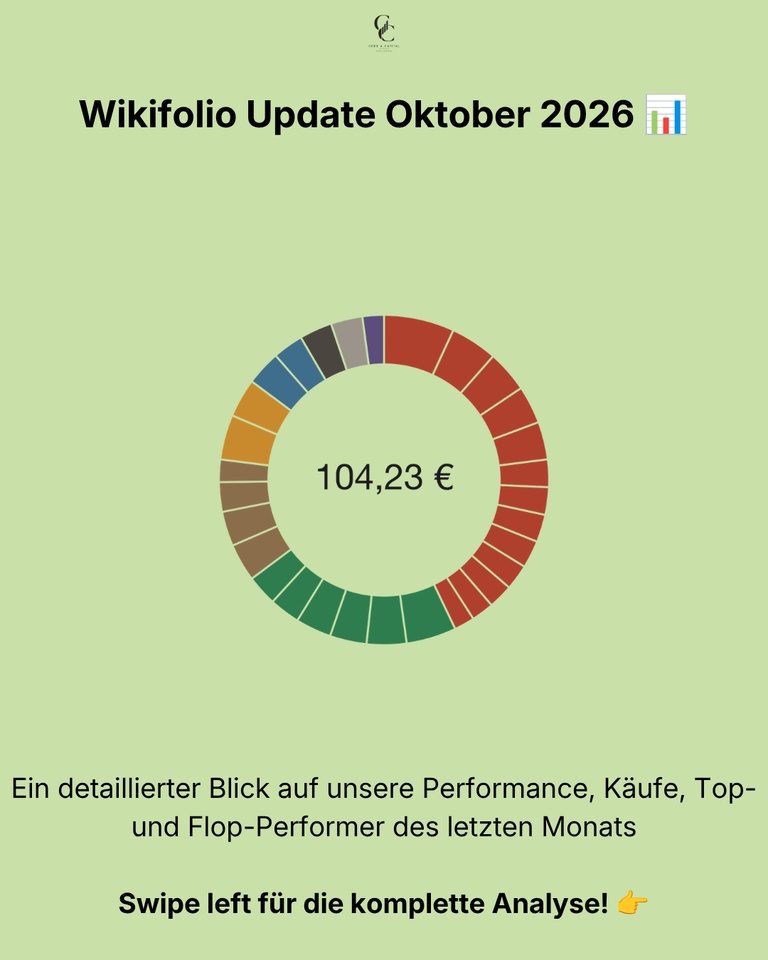
On October 1, the model replaced 18 of its 30 positions. One month later, all six of the month’s top-performing stocks are new additions resulting from that very rebalancing. However, three of the six worst-performing stocks are as well. The Wikifolio ended October down 11.64 percent, its weakest month since its launch in March.
October was not a good month for tech stocks. Concerns about AI spending by the major cloud companies have resurfaced; the SOX semiconductor index lost 15.4 percent over the month, and the Nasdaq fell 5.3 percent. That was its weakest month since March 2025. Quarterly earnings reports came out last week. Seagate and Teradyne beat expectations but still saw their shares fall. On October 30, $INTC (-5.29%) l issued a weak outlook for the fourth quarter and plummeted 28.6 percent in a single day. SanDisk $SNDK (-16.22%) , Marvell $MRVL (-9.94%) and $AMD (-10.57%) also saw double-digit declines. In the meantime, on October 28, the Fed kept interest rates at 3.75 to 4.00 percent; two members would have preferred to raise them already.
For a portfolio that, after rebalancing, is invested nearly half in semiconductors and memory
, this was the worst possible month:
📊 Monthly performance: −11.64%
📊 Price as of October 30: €104.23
📊 Performance since inception (March 13): +4.2%
📊 Largest loss since inception: −18.6% (previously −14.6%)
📊 Next rebalancing: Early January 2027
Performance & Comparison 🚀
The Nasdaq fell, the broad indices held steady, and the DAX even gained ground. The model clearly lagged behind this time, falling more than twice as far behind as the Nasdaq.
Performance Comparison (September 30–October 30, 2026, end of day, all as euro-denominated ETFs):
Global Quant 6-Factor: −11.64%
NASDAQ 100: −5.27%
FTSE All-World: −0.52%
S&P 500: +0.25%
DAX: +2.43%
The Wikifolio is now 17.5% below its high of €126.30 on June 22.
Buys & Sales 💶
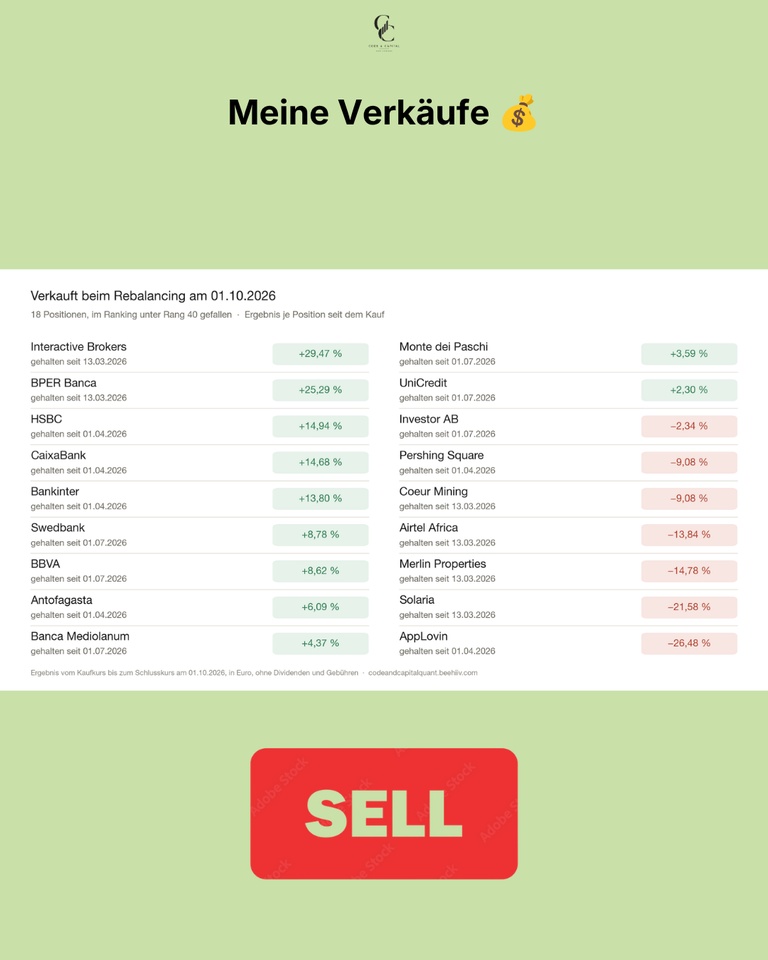
On October 1, the third rebalancing took place—the largest one yet. 18 stocks out, 18 in, 12 remained.
The model sold all nine banks: Bankinter $BKT (-2.89%) , Swedbank $SWED A (-2.43%) , UniCredit $UCG (-1.92%) , CaixaBank $CABK (-2.93%) , BBVA $BBVA (-1.84%) , BPER $BPE (-3.94%) , Monte dei Paschi $BMPS (-1.73%) , Banca Mediolanum $BMED (-3%) and HSBC $HSBA (-3.99%) . Also, Interactive Brokers $IBKR (-4.72%) , Antofagasta $ANTO (-4.24%) , Coeur Mining $CDE (-6.95%) , AppLovin $APP (-6.18%) , Airtel Africa $AAF (+0.18%) , Merlin Properties $MRL (-3.42%) , Solaria $SLR (-3.83%) , Investor AB $INVE B (-2.69%) and Pershing Square $PS (-8.71%) . All were ranked below 40th place. You can see the returns on each position since the purchase on the slides.
It bought six healthcare stocks (Eli Lilly $LLY (+0.31%) , Bristol-Myers Squibb $BMY (+0.8%) , Vertex $VRTX (-1.04%) , Incyte $INCY (-1.21%) , Illumina $ILMN (-3.85%) , WuXi AppTec $603259 ) and five semiconductor companies (Seagate $STX (-11.15%) , Marvell $MRVL (-9.94%) , Applied Materials $AMAT (-8.5%) , Teradyne $TER (-7.61%) , KLA $KLAC (-9.26%) ). Also included is Fortinet $FTNT (-5.3%) , CF Industries $CF (-0.05%) , Marathon Petroleum $MPC (-0.22%) , APA $APA (+1.23%) , Pop Mart, the Hong Kong Stock Exchange $HKXCY , and Lion Finance $BGEO (-7.4%) . Applied Materials and KLA had been sold by the model in July; now they’re back in the portfolio.
After the reshuffle, twelve of the thirty positions were semiconductor and memory stocks, accounting for a combined 44.8% of the portfolio.
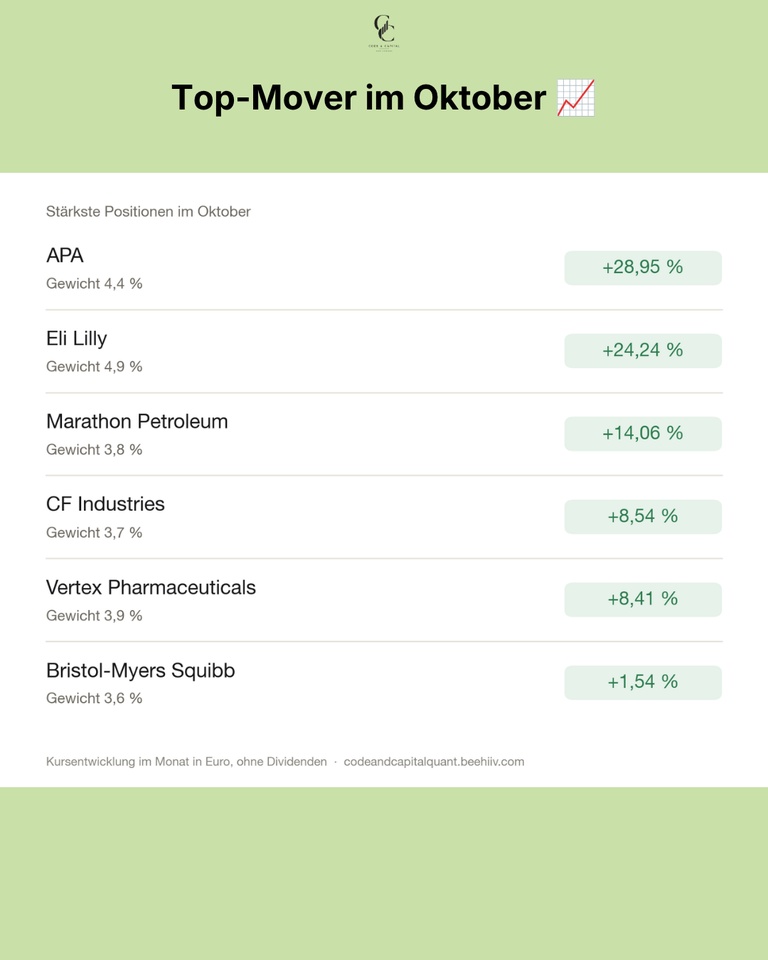
Top Movers in October 🟢
The sectors that gained were those unrelated to AI. APA topped the list with +28.95%. The oil company reported preliminary third-quarter results on October 7 and repurchased 10.5 million of its own shares. Eli Lilly rose +24.24%. Third-quarter revenue rose 39 percent to $24.4 billion, driven by Mounjaro and Zepbound, and Lilly raised its full-year revenue forecast to $91 billion to $92 billion.
Marathon Petroleum gained +14.06%, even though the stock fell 7.4% on October 27 along with other refiners. CF Industries rose by +8.54%, Vertex by +8.41%, and Bristol-Myers Squibb by +1.54%. All six have been in the portfolio since October 1.
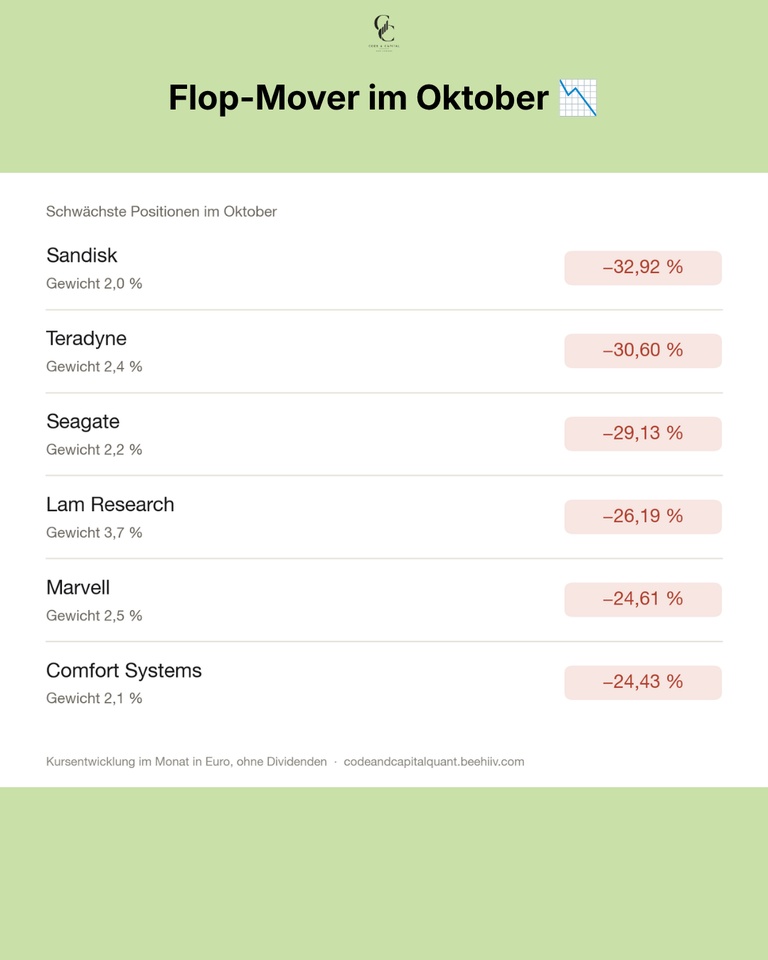
October’s Worst Performers 🔴
This list consists almost entirely of chip stocks. SanDisk saw the biggest loss at −32.92%; on October 30 alone, it fell by 13.5%. Teradyne dropped −30.60%. The earnings report on October 28 beat expectations, as did the outlook, yet the stock still fell. Seagate (−29.13%) saw the same pattern following its earnings report on October 27. Lam Research fell −26.19%, Marvell by −24.61%. Comfort Systems lost −24.43%. It’s not a chip stock, but the company manufactures climate control and electrical systems for data centers and is thus tied to the same sector. On October 23, following the quarterly earnings report—which did not include a 2027 outlook—the stock dropped about 8 percent in a single day.
Teradyne, Seagate, and Marvell were added to the portfolio on October 1. SanDisk, Lam Research, and Comfort Systems $FIX (-4.58%) were already in the portfolio and were still among the gainers in September.
What’s in the portfolio now 🔍
Stock prices have fallen. The companies’ financial results look different so far. Key metrics for the 30 positions, each showing the median value as of October 31:
P/E ratio: 24.6
Revenue growth: +21.2%
Earnings per share growth: +48.8%
Net margin: 39.0%
Return on equity: 39.4%
Debt-to-equity ratio: 0.2
With a P/E ratio of 24.6, this portfolio isn’t exactly cheap. However, revenue is growing by one-fifth per year, and debt plays virtually no role. The next earnings season will show whether these figures hold up.
Conclusion 💡
October showed what a 44.8% gain means in this sector. When the sector turns, the entire portfolio turns with it. The pharmaceutical and oil stocks added during the rebalancing performed well, but they couldn’t keep up with the chip stocks. A few weeks ago, I calculated a sector limit. At 20 percent, it reduced the maximum drawdown by 2.1 points, but I haven’t implemented it yet. I don’t tinker with the rules in the middle of a drawdown.
What I want to look into is the timing. Rebalancing always takes place just before earnings season, and this time the earnings reports came out right in the first few weeks after the purchase. I’ll run the numbers to see if this is a real disadvantage or if it just happened to look that way this time before I make any changes.
❓ Question for the community
How did October go for you? Did you also have chips in your portfolio, and did you buy more, sell, or just sit it out?
👇 Share your thoughts in the comments!
➡️ Every month, you’ll find the complete Wikifolio update here—even in bad months—along with research from the model.
🗞️ Newsletter: codeandcapitalquant.beehiiv.com
📈 Wikifolio: https://www.wikifolio.com/de/de/w/wf0gquant6
+ 2
After roughly three months, $SNDK (-16.22%) has once again fallen below 50% of its ATH, triggering my buy order in my Blue Chip Fibonacci Portfolio.
The recent selloff came despite a very strong earnings report. Sandisk beat revenue and earnings expectations, announced an 8-for-1 stock split, raised guidance, and continues to benefit from strong AI-driven demand for data-center storage solutions.
The market seems worried about future growth rates and the sustainability of AI-driven memory demand. Maybe those concerns are justified. Maybe they're overdone. That's why I rely on predefined levels instead of predictions.
For me, the story is simple:
✅ Price reached a predefined Fibonacci level
✅ Buy order triggered automatically
✅ Risk management remains unchanged
$SNDK (-16.22%)
A massive beat, 61% quarter-over-quarter growth in the data center segment, and an 85% gross margin are still not enough after the extreme rally
⠀
The key takeaway: The quarter itself was exceptionally strong. The sell-off centers on how long this cycle will last. Six analysts lowered their price targets but remain largely bullish. The key question now is how long NAND prices, margins, and earnings can remain at these extreme levels.
⠀
Average price target based on the 8 available targets: ~$2,303
Upside potential from the current price of $1,210.16: ~90%
⠀
Current analyst estimates:
• Susquehanna: $2,720 from $2,745 (+125%)
• Melius Research: $2,600 from $3,600 (+115%)
• Evercore ISI: $2,500 from $2,800 (+107%)
• Rosenblatt: Buy, $2,400 (unchanged) (+98%)
• Barclays: Buy, $2,300 (unchanged) (+90%)
• Goldman Sachs: Buy, $2,000 from $2,200 (+65%)
• BofA: Buy, $2,000 from $2,500 (+65%)
• Mizuho: Outperform, $1,900 from $2,050 (+57%)
⠀
What was truly exceptional this quarter:
• Revenue of $11.0 billion, up 23% quarter-over-quarter and nearly 5 times higher than a year ago
• Adjusted EPS of $49.51, above the consensus estimate of around $47
• Data center revenue jumped 61% quarter-over-quarter to $4.8 billion
• Non-GAAP gross margin reached 85.1%
• Adjusted free cash flow of $5.7 billion
• SanDisk repurchased $5 billion in its own shares during the quarter
• Q2 EPS guidance of $55–$57 remains above expectations
⠀
The real story is the data center: Nearly 45% of revenue now comes from the data center business. The hyperscalers’ AI investments are thus directly driving demand for enterprise SSDs. Canaccord called the segment the star of the quarter, while Goldman pointed to several eSSD wins with hyperscalers.
⠀
Why the stock is still down 9%:
• Sequential revenue growth slowed from 51% to 23%
• Consumer revenue fell 29% quarter-over-quarter
• Q2 revenue guidance of $12.2–$12.6 billion is strong but no longer significantly above expectations
• Investors doubt that a gross margin of 85% is sustainable in the long term
• Six analysts lowered their price targets, primarily due to valuation and cyclical risks, not because of weaker current fundamentals
• The stock had previously risen by more than 500% within a year
⠀
Supply remains tight: SanDisk’s new business model contracts already cover about 50% of FY27 bit production and roughly two-thirds of FY28. The non-binding revenue purchase obligations total just under $89 billion, providing an unusually high level of visibility for a memory company.
⠀
The Bull Case: AI inference is making high-density NAND memory increasingly important for context caching and storage. Data center demand continues to accelerate, additional capacity remains limited, and management expects strong bit growth through FY28. Even after numerous price target cuts, analysts’ targets remain well above the current share price.
⠀
The Real Risk: SanDisk has now become a bet on the duration of this cycle. With an 85% gross margin and extreme pricing, the current figures are already exceptional. As soon as additional supply enters the market, prices give way, or hyperscalers normalize their storage investments, profits could come back down very quickly.
⠀
Conclusion: SanDisk did not deliver a weak quarter. On the contrary, under normal circumstances, these figures would send the stock soaring. The market simply refuses to assume that 85% margins and explosive AI growth will continue indefinitely. The debate is no longer about whether demand is strong, but rather how long this memory supercycle can remain this extreme.
⠀
📊 𝐑𝐞𝐬𝐮𝐥𝐭𝐬
• Non-GAAP EPS: $49.51 (Est. $46.41) ✅, +26% QoQ.
• Revenue: $11.03B (Est. $10.70B) ✅, +378% YoY.
• GAAP EPS: $52.60, +20% QoQ.
• Non-GAAP Gross Margin: 85.1%, +55.2 pp YoY.
• GAAP Operating Income: $8.78B, +25% QoQ.
• Non-GAAP Operating Income: $8.87B, +25% QoQ.
• GAAP Net Income: $8.10B, +17% QoQ.
• Non-GAAP Net Income: $7.62B, +24% QoQ.
⠀
🎯 𝐆𝐮𝐢𝐝𝐚𝐧𝐜𝐞
• Q2 FY2027 Revenue: $12.2B–$12.6B, midpoint $12.4B (Est. $12.29B) ✅.
• Q2 FY2027 Non-GAAP EPS: $55.00–$57.00, midpoint $56.00 (Est. $53.35) ✅.
• Q2 FY2027 Non-GAAP Gross Margin: 84.5%–85.5%.
• Q2 FY2027 Non-GAAP Operating Expenses: $540M–$560M.
⠀
📌 𝐊𝐞𝐲 𝐓𝐚𝐤𝐞𝐚𝐰𝐚𝐲𝐬
• Q1 adjusted EPS beat consensus by ~6.7%, while revenue exceeded estimates by ~3.1%.
• Data Center revenue surged 61% QoQ to $4.80B, driven by strong demand for AI infrastructure storage.
• Edge revenue increased 7% QoQ to $5.83B, while Consumer revenue declined 29% to $397M.
• Revenue surged 378% YoY, with GAAP gross margin expanding from 29.8% to 85.0%.
• Announced an 8-for-1 forward stock split, with split-adjusted trading beginning November 20, 2026.
• Repurchased $5.0B in shares during Q1, bringing repurchases over the past two quarters to 6.0M shares, or ~4% of shares outstanding.
• Q2 revenue guidance midpoint implies ~12.4% sequential growth.
• Q2 adjusted EPS guidance midpoint stands ~5.0% above consensus.
• All reported EPS figures and guidance are on a pre-split basis.
⠀
💬 𝐌𝐚𝐧𝐚𝐠𝐞𝐦𝐞𝐧𝐭 𝐂𝐨𝐦𝐦𝐞𝐧𝐭𝐚𝐫𝐲
“We have started fiscal year 2027 with another quarter of strong performance, with robust and growing demand for our products driving outpaced growth in our data center business.”
$VZ (+1.82%)
$P911 (-0.28%)
$NOVN (-0.43%)
$PYPL (-4.89%)
$SOFI (-5.54%)
$UPS (-2.08%)
$GLW (-10.54%)
$KO (+0.76%)
$RCL (-1.66%)
$NXPI (-6.35%)
$V (-0.03%)
$STX (-11.15%)
$HOOD (-7.87%)
$SKHY (-12.89%)
$MBG (-1.93%)
$DBK (-4.11%)
$GEV (-7.66%)
$TER (-7.61%)
$ADYEN (-1.28%)
$WM (+0.32%)
$AIR (-4.19%)
$GOOGL (-2.03%)
$CMG (-1.74%)
$FTNT (-5.3%)
$NOW (+0.21%)
$KLAC (-9.26%)
$MSFT (-2.8%)
$CVNA (-6.14%)
$006400
$VOW3 (-2.96%)
$BMY (+0.8%)
$INCY (-1.21%)
$CAT (-3.98%)
$N1CL34
$MO (+0.96%)
$MA (+0%)
$AIXA (-8.76%)
$LLY (+0.31%)
$SBUX (-2.08%)
$RDDT (-3.08%)
$RBLX (+1.67%)
$ILMN (-3.85%)
$SNDK (-16.22%)
$INTC (-5.29%)
$MDLZ (+0.72%)
$COIN (-6.57%)
$AMZN (-3.32%)
$TWLO (-2.43%)
$PINS (-4.47%)
$285A (-16.93%)
$CL (+1.69%)
$GD (-1.24%)
$ABBV (+1.09%)
$PUM (-5.29%)
$CVX (+0.92%)
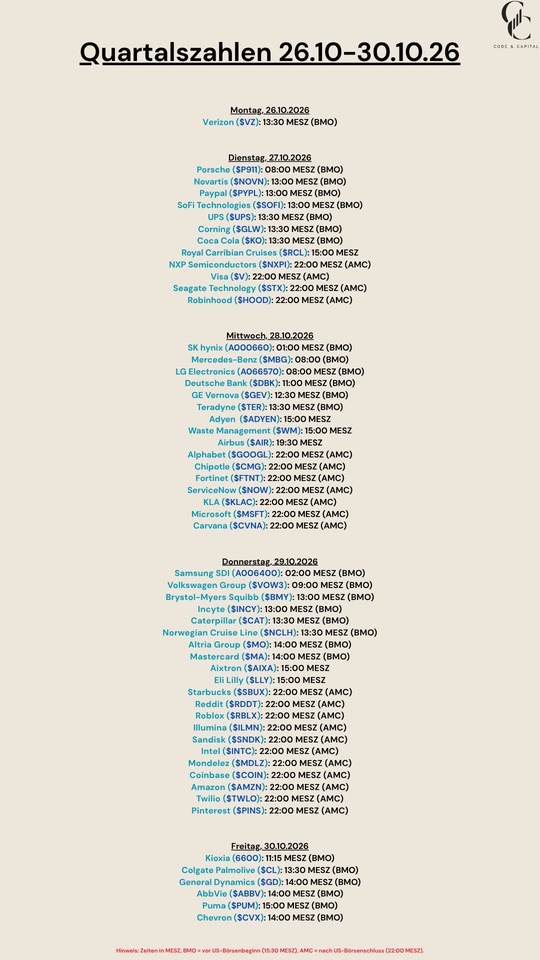
In August, gold mines were the market's top performers. In September, they were the most expensive. Fresnillo
$FRES (-1.53%) down 15 percent, Micron
$MU (-12.28%) up 17. At the end of the month, the Wikifolio was up 1.03 percent, and one day later, I swapped out 18 of 30 positions.
September was all about interest rates and oil. Brent rose above $100 in the second week and, following a Saudi pipeline outage, briefly hit $110. U.S. inflation stood at 3.4 percent in August. On September 16, the Fed raised the benchmark interest rate by a quarter point to 3.75 to 4.00 percent, for the first time since July 2023. The 10-year U.S. yield subsequently climbed to 5.19 percent, a level last seen in 2007. This hardly bothered tech stocks. The Nasdaq hit a record high on September 21, and AMD has been worth one trillion dollars ever since. The situation was different in Europe. German inflation jumped to 3.3 percent, and the DAX lost about four percent over the month.
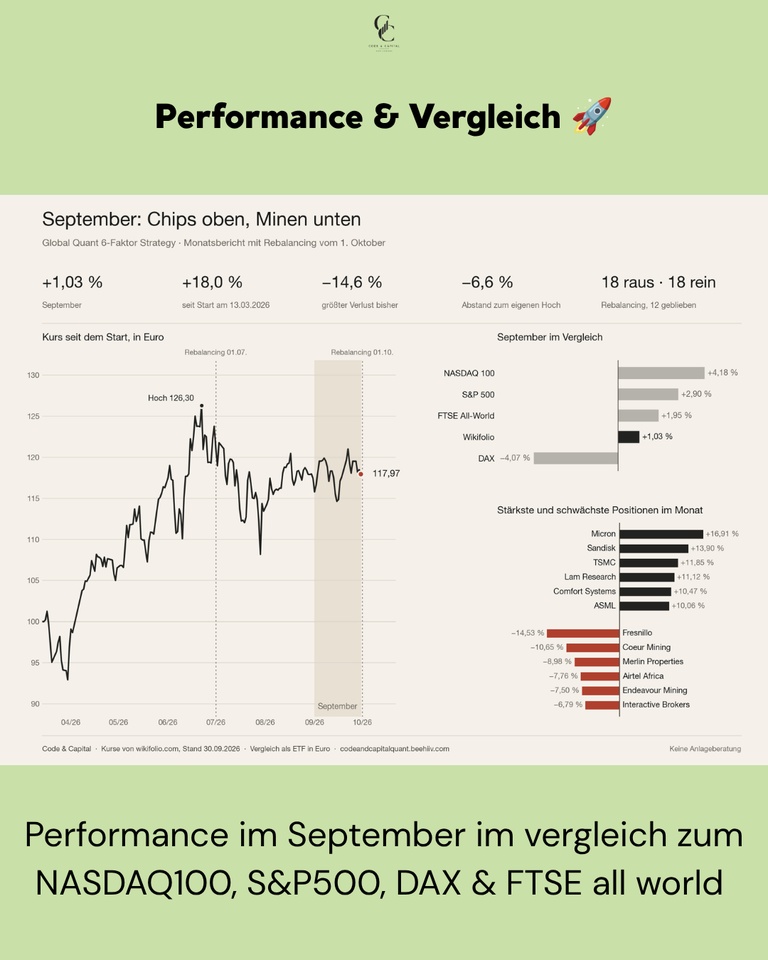
📊 Monthly performance: +1.03%
📊 Price as of September 30: €117.97
📊 Largest loss since inception: −14.6%
📊 Max performance: +18% (since March 13, 26)
Next rebalancing: Early January 2027
Performance & Comparison 🚀
The U.S. indices posted clear gains when calculated in euros, with the Nasdaq leading the way. The Wikifolio did not keep pace. It lagged behind the Nasdaq, S&P 500, and FTSE All-World, and outperformed only the DAX.
Performance Comparison (September 1–30, 2026, end of day):
Global Quant 6-Factor: +1.03%
NASDAQ 100: +4.18%
S&P 500: +2.90%
FTSE All-World: +1.95%
DAX: −4.07%
You can see what caused this in the two lists below. Tech stocks delivered, while mining stocks and a few individual stocks ate up a good chunk of those gains.
Purchases & Sales 💶
None in September itself. The model trades only on four dates per year, and the third was on October 1. What happened then is detailed in its own section below.
Top Movers in September 🟢
The month belonged to semiconductors and memory stocks. Midway through the month, Intel’s CEO said the company could currently only meet about half of the demand for processors. After that, the entire industry picked up steam. Micron
$MU (-12.28%) topped the list with +16.91%, followed by SanDisk
$SNDK (-16.22%) at +13.90% and TSMC
$2330 at +11.85%. Lam Research
$LRCX (-8.44%) rose +11.12%, ASML
$ASML (-6.75%) +10.06%. In between is Comfort Systems $FIX (-4.58%) , a stock that has nothing to do with chips, up 10.47%. In August, Comfort Systems was still among the losers.
September’s Big Losers 🔴
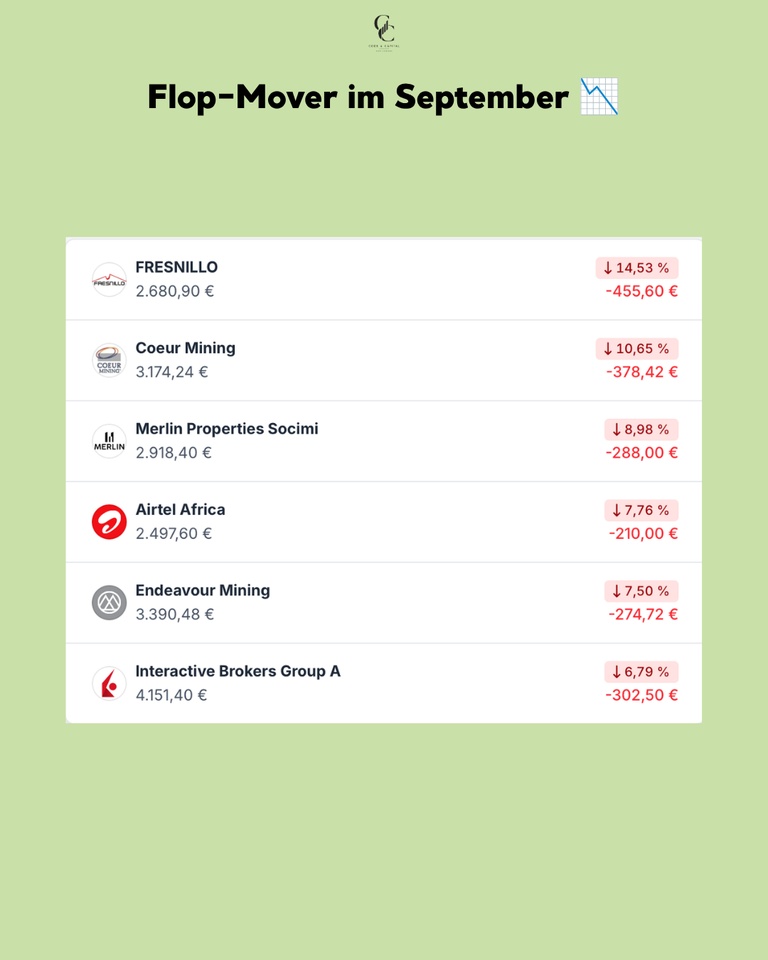
Gold and silver declined in September, with silver falling much more sharply. Rising yields and a stronger dollar weighed on prices. Mining stocks followed suit. Fresnillo
$FRES (-1.53%) lost −14.53%, Coeur Mining
$CDE (-6.95%) −10.65%, and Endeavour Mining $EDV (-3.76%) -7.50%. In August, all three were still on the other list with gains of over 25 percent. Merlin Properties fell −8.98%, Airtel Africa
$AAF (+0.18%) down 7.76%, and Interactive Brokers
$IBKR (-4.72%) fell by 6.79%.
Rebalancing on October 1 🔄
On October 1, the third rebalancing since the start took place. I swapped out 18 of 30 positions—more than ever before. In July, it was nine.
All nine banks are out: Bankinter
$BKT (-2.89%) , CaixaBank
$CABK (-2.93%) , BBVA
$BBVA (-2.93%) , UniCredit
$UCG (-1.92%) , BPER
$BPE (-3.94%) , Monte dei Paschi $BMPS (-1.73%) , Banca Mediolanum
$BMED (-3%) , Swedbank$SWED A (-2.43%) and HSBC
$HSBA (-3.99%) . In addition, Interactive Brokers $IBKR (-4.72%) , Antofagasta $ANTO (-4.24%) , Coeur Mining
$CDE (-6.95%) , AppLovin
$APP (-6.18%) , Airtel Africa
$AAF (+0.18%) , Merlin Properties and Solaria
$SLR (-3.83%) . Investor AB
$INVE B (-2.69%) and Pershing Square
$PSH (-2.01%) are also no longer in the portfolio. So four of the six underperformers listed above are no longer in the portfolio.
Six stocks from the healthcare sector were added: Eli Lilly
$LLY (+0.31%) , Bristol-Myers
Squibb
$BMY (+0.8%) , Vertex $VRTX , Incyte
$INCY (-1.21%) , Illumina
$ILMN (-3.85%) and WuXi AppTec
$603259 . Five are from the semiconductor and storage sectors: Seagate
$STX (-11.15%) , Marvell
$MRVL (-9.94%) , Applied
Materials
$AMAT (-8.5%), Teradyne
$TER (-7.61%) and KLA
$KLAC (-9.26%) . The rest is split among Fortinet
$FTNT (-5.3%) , CF Industries
$CF (-0.05%) , Marathon Petroleum
$MPC (-0.22%) , APA
$APA (+1.23%) , Pop Mart $9992 (-1.22%) , Hong Kong Exchanges
$388 (-3.24%) and Lion Finance
$BGEO (-7.4%) .
Twelve remain: SanDisk, Micron, Western Digital, Nvidia, Lam Research, TSMC, ASML, Alphabet, Comfort Systems, Fresnillo, Endeavour and Newmont. All six of September’s top movers are included.
Two names stand out. Applied Materials and KLA I sold on July 1, up 92 and a gain of 90 percent. Now both are back in my portfolio. The model doesn’t remember what it has sold in the past. It only looks at where a stock stands in the ranking today.
Conclusion 💡
The portfolio looks different after October 1 than it did before. In September, about 41 percent was still in financial stocks; now there are two positions out of 30. Instead, 12 out of 30 are in semiconductors and memory, and six are in the healthcare sector. There’s no sector limit; the model sorts by score, not by industry. Trading won’t resume until early January.
How was your September? And did you hold onto your stocks after the pullback, or did you sell them? 👇
➡️ Every month, you’ll find the complete Wikifolio update here, along with research in between.
📈 Wikifolio $DE000LS9V052 (-5.78%)

+ 1

Top creators this week


