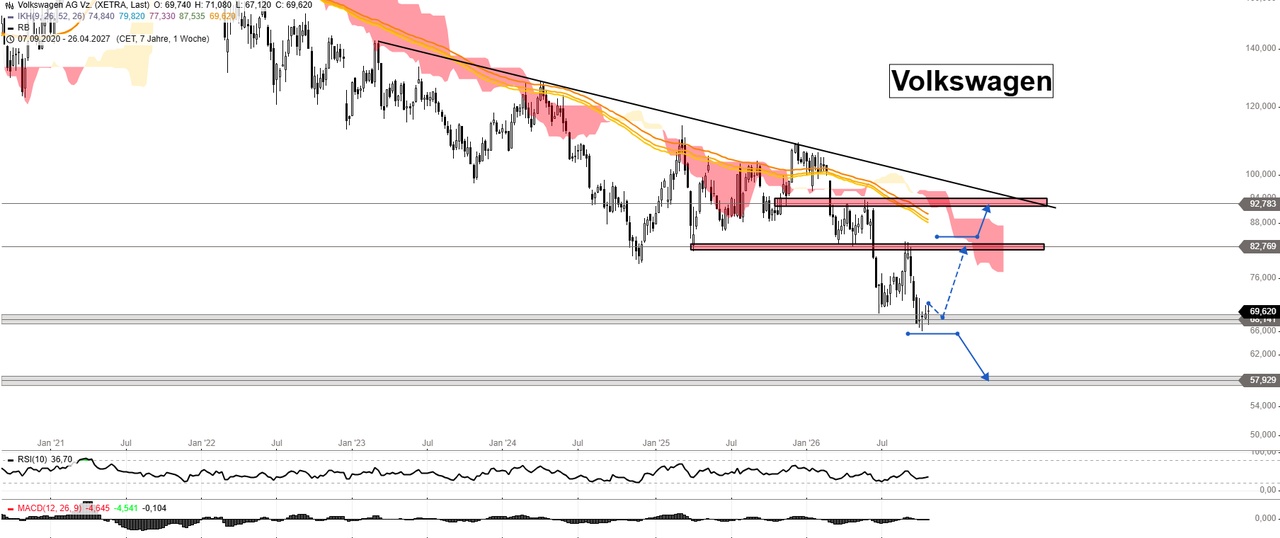

VW stock (Volkswagen preferred stock, WKN 766403) is under pressure following a loss in the billions: In the third quarter of 2026, Volkswagen reported an operating loss of −5.86 billion EUR, primarily due to a 6.4 billion EUR impairment charge on Porsche’s goodwill. At EUR 69.62 (Xetra closing price on Oct. 30, 2026), the stock is trading about 36% below its 52-week high of EUR 109.15 and just above its October low of EUR 65.92. For 2026, the Group now expects an operating profit margin of up to 1%; the original target was 4.0 to 5.5%. This is offset by net liquidity in the automotive business of EUR 33.0 billion—nearly as much as the company’s total market capitalization—and a dividend yield of around 7.6%. From a technical analysis perspective, the situation is similar to that of Mercedes: an interesting price level, with potential for a rebound to 82.76 EUR and, above that, to 92.78 EUR; below the October low, however, there is a risk of a slide to 57.92 EUR.
Key Points
- Share price: 69.62 EUR (Oct. 30, 2026), about 36% below the 52-week high of 109.15 EUR
- Q3 2026: operating profit −5.86 billion EUR, revenue 75.3 billion EUR (−6.3%)
- 2026 Forecast: Operating profit margin now only up to 1% (previously 4.0% to 5.5%)
- Dividend: 5.26 EUR per preferred share for 2025, approximately 7.6% yield
- Average price target from five analyst firms: 99 EUR (range 70 to 120 EUR)
- Chart: Targets of 82.76 and 92.78 EUR; a drop below 65.92 EUR could lead to 57.92 EUR
What are the current key figures for the VW stock?
- Price (XETRA: VOW3): 69.62 EUR (Oct. 30, 2026)
- 52-week high: 109.15 EUR (December 2025)
- 52-week low: 65.92 EUR (October 2026)
- Distance from 52-week high: approx. −36% (Oct. 30, 2026)
- Market capitalization: approx. 34.9 billion EUR (October 30, 2026)
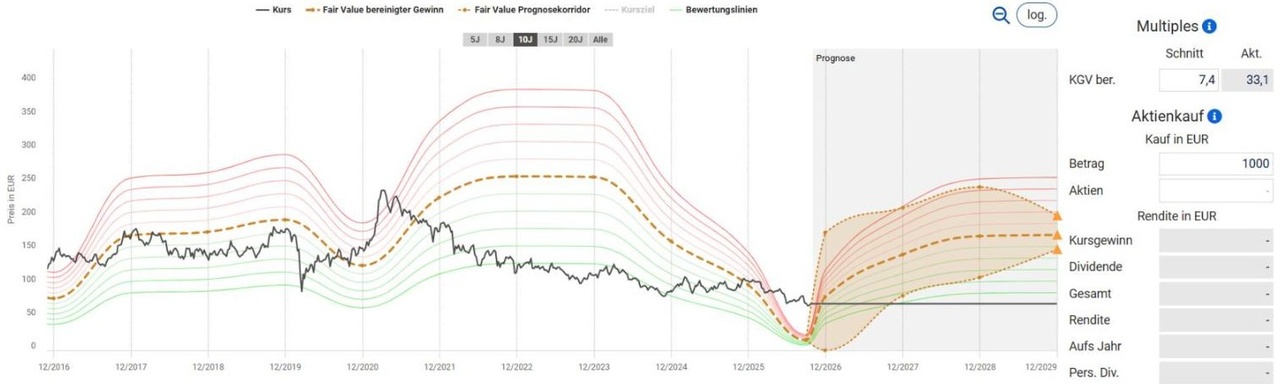
- Adjusted P/E ratio (10-year average 7.4): approx. 33.1 (November 2, 2026)
- Dividend for 2025 / Yield: 5.26 EUR / approx. 7.6% (June 18, 2026)
- Revenue for Q3 2026: 75.3 billion EUR (previous year: 80.3 billion EUR) (Oct. 29, 2026)
- Operating profit for Q3 2026: −5.86 billion EUR (previous year: −1.30 billion EUR) (October 29, 2026)
- Operating Income for 9M Excluding Special Items: EUR 8.8 billion (margin: 3.8%) (Oct. 29, 2026)
- Net income after taxes for 9M 2026: −2.7 billion EUR (previous year: +3.4 billion EUR) (Oct. 29, 2026)
- Deliveries for 9M 2026: approx. 5.9 million vehicles (−11%) (Oct. 29, 2026)
- Net cash flow from automotive operations for 9M: EUR 4.4 billion (Oct. 29, 2026)
- Net liquidity, Automotive: EUR 33.0 billion (September 30, 2026)
- Forecast operating return on sales for 2026: up to 1% (previously 4.0 to 5.5%) (September 18, 2026)
What news is currently affecting VW stock?
- Oct. 30, 2026: JPMorgan lowers price target to 85 EUR. Analyst Jose M. Asumendi lowers the target from 110 to 85 EUR following the Q3 results but maintains a “Neutral” rating. His estimates now factor in the high write-downs and one-time items.
- Oct. 29, 2026: Analysts are divided following the earnings report. RBC (115 EUR, Outperform) and Jefferies (120 EUR, Buy) view the results as in line with expectations; UBS remains neutral at 70 EUR and questions whether margin erosion will continue due to the rising share of electric vehicles.
- Oct. 29, 2026: Q3 Results: EUR 5.86 billion operating loss. Revenue of EUR 75.3 billion (−6.3%), operating result of −EUR 5.86 billion due to EUR 7.8 billion in one-time items during the quarter. After nine months: Net income after taxes of −2.7 billion EUR, deliveries down 11%, net liquidity of 33.0 billion EUR. Forecast confirmed.
- Mid-Oct. 2026: New 52-week low at EUR 65.92. The stock hits its annual low. This level is now the key support level on the chart.
- September 18, 2026: Ad hoc announcement: 2026 forecast drastically lowered. Operating return on sales now only up to 1% instead of 4.0% to 5.5%. The reasons include one-time items totaling approximately EUR 10 billion, including a write-down of approximately EUR 6 billion on Porsche’s goodwill, restructuring costs (early retirement, planned sale of Volkswagen Osnabrück), and impairment charges in China. The stock loses about 6% this week.
- June 24, 2026: Bain Capital acquires a majority stake in Everllence. Volkswagen sells a 51% stake in engine manufacturer Everllence (formerly MAN Energy Solutions) and raises approximately 7.4 billion EUR. The transaction is scheduled to close by the end of 2026.
What does Volkswagen do—and how does the company make its money?
Volkswagen AG, based in Wolfsburg, is one of the world’s largest automotive groups, delivering approximately 9 million vehicles annually, and generates its revenue from passenger cars, trucks, and financial services. When people look for VW stock, they almost always mean the preferred stock (ISIN DE0007664039, WKN 766403, ticker VOW3), which is listed on the DAX. It carries no voting rights but pays a dividend that is 6 cents higher than that of the common stock (VOW). The majority of voting rights is held by Porsche SE, owned by the Porsche and Piëch families, along with the state of Lower Saxony and Qatar.
Core Brand Group: VW Passenger Cars, Škoda, SEAT/Cupra, and VW Commercial Vehicles make up the volume business. In 2025, the group generated EUR 145.2 billion in revenue and EUR 6.8 billion in operating profit, representing a margin of 4.7%.
Progressive Brand Group: Audi, along with Bentley, Lamborghini, and Ducati, generated an operating profit of EUR 3.4 billion on revenue of EUR 65.5 billion in 2025 (margin: 5.1%). In the first nine months of 2026, it fell by 26% to EUR 1.2 billion.
Sport Luxury Brand Group: This group includes the publicly traded Porsche AG, in which Volkswagen holds about three-quarters of the shares. In 2025, operating profit plummeted to just 0.09 billion EUR, down from 5.3 billion EUR the previous year. The severity of the crisis at the sports car manufacturer is illustrated by the Porsche Aktie – it is precisely this weakness that has now cost Volkswagen a 6.4 billion EUR write-down.
Trucks (TRATON): MAN, Scania, International, and Volkswagen Truck & Bus generated an operating profit of 2.4 billion EUR on revenue of 42.5 billion EUR in 2025.
Group Mobility (Financial Services): Leasing, financing, and insurance generated an operating profit of 3.45 billion EUR in 2025, 15% more than the previous year—the Group’s most stable pillar.
Here’s how the profit is broken down: Of the approximately 16 billion EUR in operating profit generated by the brand groups in 2025, about 42% came from Core, about 21% each from Progressive and Group Mobility, 15% from Trucks, and only about 1% from Sport Luxury (based on our own calculations prior to consolidation). Group revenue in 2025 totaled 321.9 billion EUR.
Fundamental Analysis: Is the VW Stock Undervalued?
Based on current earnings, the VW stock is not cheap; however, when measured against balance sheet, cash flow, and revenue, it is extremely undervalued. According to Aktienfinder, the adjusted P/E ratio currently stands at around 33.1, well above the 10-year average of 7.4, because earnings plummeted in 2026. The fair value based on adjusted earnings is therefore currently below the market price. However, if the earnings recovery expected by analysts materializes in 2027 and 2028, it would be well above the market price, according to Aktienfinder.
Valuation Compared to the Industry: According to Aktienfinder, Mercedes has an adjusted P/E ratio of around 7.7, while BMW’s is 5.6. Based on earnings, Volkswagen is thus significantly more expensive than its competitors. The picture is quite different when it comes to revenue: With a price-to-revenue ratio of 0.1 (average 0.3) and a price-to-cash-flow ratio of 2.3 (average 3.4), the stock is as cheap as it has rarely been.
Margin Trends: That is the core problem. The operating return on sales fell from 5.9% (2024) to 2.8% (2025), and for 2026, Volkswagen expects only up to 1%. Excluding one-time items, the margin stood at 3.8% after nine months. China, U.S. tariffs, and the growing share of electric vehicles—which generate lower margins—are weighing on the bottom line. The extent to which the price war in the electric vehicle market is putting even the pioneer under pressure is illustrated by the Tesla Aktie.
Cash Flow and Balance Sheet: Here, Volkswagen is in significantly stronger shape than the profit figures suggest. Net cash flow in the automotive business rose by about 145% to 4.4 billion EUR after nine months, thanks in part to lower capital expenditures. Net liquidity stood at EUR 33.0 billion at the end of September—equivalent to about 95% of the company’s market capitalization of approximately EUR 35 billion. Added to this is approximately EUR 7.4 billion from the Everllence sale, which is expected to be received by the end of 2026.
2025 Results as a Basis: Revenue of EUR 321.9 billion (previous year: EUR 324.7 billion), operating profit of EUR 8.9 billion (previous year: EUR 19.1 billion), and net income of EUR 6.9 billion (previous year: EUR 12.4 billion). After nine months of 2026, the bottom line shows a loss of 2.7 billion EUR.
How much will the VW dividend be in 2026 and 2027?
Volkswagen paid a dividend of 5.26 EUR per preferred share for the 2025 fiscal year; at a share price of 69.62 EUR, this corresponds to a dividend yield of approximately 7.6%. Common shareholders received 5.20 EUR. The dividend was approved at the annual shareholders’ meeting in June 2026 and was 17% lower than the previous year (6.36 EUR per preferred share for 2024).
When will VW pay its next dividend? Volkswagen pays dividends once a year. The Executive Board and Supervisory Board will decide on the 2026 dividend in early 2027; according to the financial calendar, the Annual General Meeting will take place on June 11, 2027. The payment will follow shortly thereafter.
How secure is the 2027 dividend? The dividend is based on earnings, which, after nine months of 2026, stand at a negative EUR −2.7 billion. Another reduction is therefore likely—the 7.6% yield refers to the last payment and should not simply be extrapolated. The high net liquidity of EUR 33.0 billion argues in favor of a payout, while management’s clear cost-cutting measures argue against it.
VW Stock Price Targets and Forecast for 2026
The price targets for VW stock, as reported by five analyst firms that issued recommendations in October 2026, average EUR 99—about 42% above the current price. The range extends from EUR 70 (UBS) to EUR 120 (Jefferies): Three firms recommend buying, two remain neutral, and JPMorgan has significantly lowered its target following the Q3 results. The outlook for 2026 depends primarily on whether the fourth quarter proceeds without new one-time charges and whether the margin, excluding one-time items, improves again next year from its current level of 3.8%.
Key price levels:
- 52-week high: 109.15 EUR (December 2025)
- Current price: 69.62 EUR (Xetra close on Oct. 30, 2026)
- First resistance level: 82.76 EUR
- Second resistance level: 92.78 EUR (downward trend line)
- Critical support level: October low at 65.92 EUR, below which is 57.92 EUR
Analysts’ price targets:
- Average price target: 99.00 EUR (five firms, October 13–30, 2026)
- Jefferies: 120.00 EUR, Buy (October 29, 2026)
- RBC: 115.00 EUR, Outperform (October 29, 2026)
- Deutsche Bank: 105.00 EUR, Buy (October 13, 2026)
- JPMorgan: 85.00 EUR, Neutral (October 30, 2026, previously 110 EUR)
- UBS: 70.00 EUR, Neutral (October 29, 2026)
Chart Analysis
On the weekly chart, the VW stock has been in a clear downtrend since early 2023 and fell below the key support level of 82.76 EUR in June 2026—in September, a recovery was rejected precisely at this level. The picture closely resembles that of Mercedes Aktie: The VW stock is also reaching an interesting level at around 69.62 EUR, which could well trigger short-term price increases. The first target would be the former support level at 82.76 EUR, followed by 92.78 EUR, where the downtrend line dating back to 2023 also runs. Only a breakout above this line would end the overarching downtrend. A new low below the October low of 65.92 EUR, on the other hand, would further confirm the current downtrend and make price levels around 57.92 EUR likely.
Conclusion: Should you buy, hold, or sell VW stock now?
VW stock has reached an interesting level, but the overarching downtrend has not yet been broken. The billion-euro loss in the third quarter is largely non-cash; the Porsche write-down does not cost any money but rather cleans up the balance sheet. Operationally, however, the situation remains weak: a consolidated margin of up to 1%, declining deliveries, and margin pressure from electric vehicles highlight the extent of the need for restructuring. On the other hand, the company has EUR 33.0 billion in net liquidity, a market capitalization of only about EUR 35 billion, and analyst price targets averaging EUR 99.
From a technical analysis perspective, short-term price increases to 82.76 EUR and, beyond that, to 92.78 EUR are possible. The October low of 65.92 EUR is key: if the price falls below this level, it will confirm the downtrend, and prices around 57.92 EUR will become likely. Investors should not rely on the high dividend, as another cut is likely in 2026. Investors in Germany who prefer to focus on sectors with full order books rather than companies undergoing restructuring will find Rheinmetall Aktie the exact opposite—the next earnings release is scheduled for November 5.
Opportunities
✅ Automobile’s net liquidity: 33.0 billion EUR, approximately 95% of its market capitalization
✅ Automobile’s net cash flow after nine months: 4.4 billion EUR (+145%)
✅ Approximately EUR 7.4 billion in proceeds from the Everllence sale by the end of 2026
✅ Price-to-sales ratio of 0.1 and price-to-cash-flow ratio of 2.3, well below average
✅ Europe: Order intake +4%, electric vehicle orders +39%
✅ Average price target of 99 EUR, about 42% above the current price
Risks
⚠️ Operating loss of 5.86 billion EUR in the third quarter
⚠️ 2026 forecast: operating margin of only up to 1%
⚠️ Deliveries down 11% after nine months; China and tariffs weigh on results
⚠️ Adjusted P/E ratio around 33, well above the 10-year average of 7.4
⚠️ 2026 dividend likely to fall again
⚠️ Downward trend since 2023; a drop below 65.92 EUR could lead to 57.92 EUR
Sources
Volkswagen Group: Nine-Month Results Underscore Urgent Need for Action (Oct. 29, 2026) · Volkswagen AG: Ad Hoc Announcement on the 2026 Forecast (Sept. 18, 2026) · Volkswagen Group: Fiscal Year 2025 and Dividend Proposal (March 10, 2026) · Volkswagen Group: 2026 Annual Shareholders’ Meeting, Dividend of 5.26 EUR per preferred share · Volkswagen Group: Sale of Majority Stake in Everllence to Bain Capital (June 24, 2026) · Volkswagen Group: 2027 Financial Calendar · dpa-AFX: JPMorgan Rates Volkswagen as Neutral, Target Price 85 EUR (October 30, 2026) · dpa-AFX: UBS rates Volkswagen as Neutral, target price 70 EUR (Oct. 29, 2026) · dpa-AFX: RBC rates Volkswagen as Outperform, target price 115 EUR (Oct. 29, 2026) · dpa-AFX: Jefferies rates Volkswagen as “Buy,” target price 120 EUR (Oct. 29, 2026) · finanzen.net: Price targets for Volkswagen Preferred (including Deutsche Bank at 105 EUR) · Aktienfinder: Valuation, fair value, P/E ratio, and dividend for Volkswagen Preferred · Stock3: Weekly chart for Volkswagen Preferred (Xetra), chart analysis by Christian Lill · Alpha Vantage: Xetra price data for VOW3 (closing price, 52-week high and low) · Unsplash: Cover image (Unsplash license)
What do you currently think of the $VOW3 (+0.03%)?