
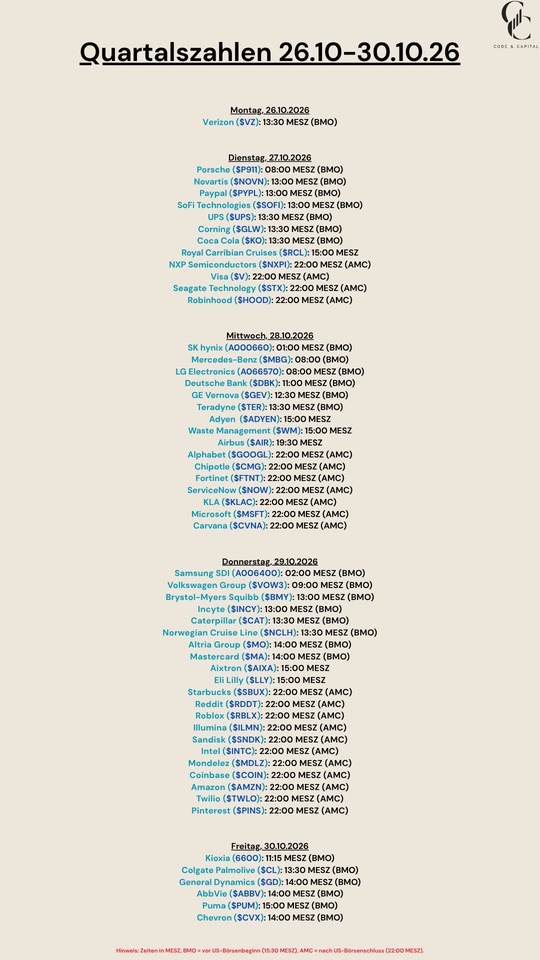
$VZ (+0.9%)
$P911 (+0.27%)
$NOVN (-0.67%)
$PYPL (+0.25%)
$SOFI (-0.06%)
$UPS (+0.32%)
$GLW (-3.68%)
$KO (+0.88%)
$RCL (-0.4%)
$NXPI (-1.15%)
$V (+0.85%)
$STX (-4.9%)
$HOOD (-1.09%)
$SKHY (-5.84%)
$MBG (+0.22%)
$DBK (+2.6%)
$GEV (-3.32%)
$TER (-4.44%)
$ADYEN (+3.49%)
$WM (+0.45%)
$AIR (+0.1%)
$GOOGL (+0.9%)
$CMG (+1.46%)
$FTNT (-1.85%)
$NOW (+0.16%)
$KLAC (-3.72%)
$MSFT (+0.61%)
$CVNA (-0.05%)
$006400
$VOW3 (+0.98%)
$BMY (+1.76%)
$INCY (+1.07%)
$CAT (-2%)
$N1CL34
$MO (+1.07%)
$MA (+1.27%)
$AIXA (-4.74%)
$LLY (+1.3%)
$SBUX (+0.64%)
$RDDT (-0.27%)
$RBLX (+0.23%)
$ILMN (+0.2%)
$SNDK (-5.65%)
$INTC (-2.93%)
$MDLZ (+0.78%)
$COIN (-1.09%)
$AMZN (+1.81%)
$TWLO (-0.47%)
$PINS (+0.26%)
$285A (-10.6%)
$CL (+0.78%)
$GD (+0.42%)
$ABBV (+1.84%)
$PUM (+1.98%)
$CVX (+1.29%)
- Markets
- Stocks
- Porsche (Vz.)
- Forum Discussion

Porsche (Vz.)
Stock
Stock
ISIN: DE000PAG9113
Ticker: P911
DE000PAG9113
P911
Price
Discussion about P911
Posts
1421Wk·
Quarterly Results: Oct. 26–30, 2016
1919
2 Comments
OberstvonGatow@OberstvonGatow
1Wk
•
11
•
3Wk·
Q3 VW Sales Figures — The Decline Is Accelerating
Because Volkswagen $VOW (+1.56%) and Porsche $P911 (+0.27%)
$PAH3 (+0.06%) are among my biggest investments, here’s an update on the Q3 sales figures released today...
...and they really don’t look good:
Global Global sales fell by 14.3% in the third quarter compared to Q3/25. That corresponds to about 315,000 fewer vehicles delivered. Once again, the main source of the crisis is CChina, with a decline of 38.5%. With the exception of Central and Eastern Europe, all global regions posted declines in the third quarter.
Particularly concerning is that the downward trend has accelerated. Here’s how the percentage change compares to the same quarter of the previous year (Q1, Q2, Q3; the worst quarter in each period is in bold):
🇪🇺 Western Europe: +4.2%, +1.8%, −2.8%
🌍 Central and Eastern Europe: +7.6%, +6.7%, +1.4%
🇺🇸 North America:
−13.3%, +7.7%, −5.8%
🌎 South America: +7.0%, +9.4%, −2.4%
🇨🇳 China: −14.8%, −36.6%, −38.5%
🌏 Rest of Asia/Pacific: −8.0%, −7.2%, −12.4%
🌍 Middle East/Africa: −5.3%, −1.9%, −10.0%
Total: −4.0%, −8.6%, −14.3%
The problems now affect virtually the entire group and are intensifying as the year progresses. So where do the problems lie?
🇨🇳 China: A toxic mix of consumer reluctance, an extremely competitive market, and the rapid rise of local manufacturers. When it comes to software, development speed, and, in some cases, price, Chinese brands are putting VW under enormous competitive pressure. A small glimmer of hope: VW reports that pure BEV deliveries in China rose by 30% in Q3? When measured against the total figures, however, this is likely completely negligible... unfortunately.
🇺🇸 U.S.: Tariffs and a more challenging market environment are weighing on business. Sales in North America fell by 5.8% in the third quarter. There’s likely no solution in sight here for the foreseeable future...
🇪🇺 Europe: Things are getting increasingly uncomfortable here as well. Chinese manufacturers are pushing into the market and putting pressure on VW, especially in the affordable electric car segment. While high gas prices are accelerating demand for electric cars, for VW this is both a blessing and a curse. Currently, capacity is insufficient to meet the demand for affordable electric models (e.g., the ID Polo), and margins in this segment aren’t high enough either.
The proposed plant closures in Germany suddenly no longer seem like a mere threat to me but are almost a necessity. Across the group, the plants are likely not operating at full capacity at the moment (especially in China). In the long term, production will likely have to be relocated. In Germany, only the luxury models will ultimately remain.
In any case, the sales figures are abysmal. There’s no sugarcoating it. Since Q3 was already largely over at the time the forecast was lowered, that should already be factored in. But I’m wondering about Q4. To meet the new forecast, Q4 has to be better than Q3; otherwise, they won’t even meet the new forecast. Or is the old “salami tactic” coming into play again here?? 🤔
But to end on a positive note:
The new entry-level electric models are apparently a hit 👍🏼
For the Electric Urban Car Family—which includes the VW ID. Polo, VW ID. Cross, Škoda Epiq, and CUPRA Raval—the group has now reported just under 150,000 orders. That’s a pretty impressive start, especially since deliveries haven’t even begun for all models yet.
The shared technical platform and production in Spain are expected to enable economies of scale. And I also see potential in the new ID. Tiguan (as far as I know, pre-orders start tomorrow?). They’ve done a lot right there (except for the charging speed)...
With that in mind, I really hope that VW finally gets its act together and stands up to the state of Lower Saxony and the IG Metall union once and for all. When I hear that they’re asking for another 5% pay raise here… It’s crazy.

77
10 Comments
The AI VW's front end failed twice right after hearing this news...
•
1212
•
4Wk·
German Auto Stocks as a Barometer of German Sentiment
I think many of you have $VOW (+1.56%)
$P911 (+0.27%) invested. The hoped-for turnaround hasn’t materialized yet, and I no longer believe that anything fundamental will change in Germany 🇩🇪. I’m still most optimistic about $BMW (-0.11%)
So I’m going to sell my shares.
What are your thoughts on this?
22
7 Comments

No, I got out almost two years ago. The writing was already clearly on the wall back then......At the very latest, after the dividend cuts, we should have pulled the plug. Anyone who’s still invested—it’s their own fault!!! Not an investment for me for at least the next 5 years!!!
•
1212
•
4Wk·
Porsche Stock in 2026: A Billion-Euro Write-Down and 5,000 Job Cuts — Is Porsche Losing Its Luster?
Summary
As a brand, no—but on the stock market, its luster is noticeably fading. On September 18, 2026, Volkswagen slashed its profit forecast and wrote down approximately 6 billion EUR on the value of its stake in Porsche after Porsche updated its medium-term plan and lowered its expectations for future performance. VW shares suffered their biggest single-day loss since 2022, while Porsche shares fell from around EUR 47 to below EUR 44 in the days that followed and crossed below their 200-day moving average on October 2. Porsche itself is sticking to its medium-term return targets and plans to provide details at its Capital Markets Day on October 7. The first half of 2026 presents a mixed picture: Revenue fell by 5.1% to EUR 17.23 billion, while operating profit rose to EUR 1.35 billion. The plan to cut 5,000 jobs by 2035 remains in place; CEO Michael Leiters has ruled out an additional 4,000 cuts. Analysts are divided: Deutsche Bank (Buy, 55 EUR) and UBS (Buy, 60 EUR) see significant potential, while Berenberg maintains its Hold rating (46 EUR). The stock is currently trading at approximately 43.03 EUR.
Key points:
VW is writing down its stake in Porsche by approximately 6 billion EUR and significantly lowering its 2026 group forecast (September 18, 2026)Porsche is sticking to its medium-term return target; according to VW, an operating return of 10 to 15% is expected. The “Sportwagenschmiede ’35” Capital Markets Day on October 7, 2026, is the next major catalyst. H1 2026: Revenue of EUR 17.23 billion (−5.1%), operating profit of EUR 1.35 billion, deliveries of 122,306 (−16%)Earnings per share: Q1: 0.44 EUR, Q2: 0.80 EUR (same quarter last year: 0.22 EUR)5,000 jobs by 2035 in Zuffenhausen and Weissach; CEO rejects plans for an additional 4,000Analysts are divided: 21% Buy, 39% Hold, 39% Sell, average price target 47.95 EUR; 200-day moving average crossed downward on October 2, 2026 (at 43.38 EUR), weekly decline of 4.3%52-week high of 50.66 EUR; current price is about 15% below thatNext quarterly results: October 27, 2026
Current Key Figures — Porsche Stock (as of October 5, 2026)
Key FigureValueDate
Price (XETRA: PAG911)
approx. 43.03 EUR
October 5, 2026
52-week high
50.66 EUR
June 16, 2026
52-week low
35.62 EUR
March 23, 2026
Difference from 52-week high
approx. −15%
October 5, 2026
Difference from 52-week low
approx. +21%
October 5, 2026
Weekly performance
−4.30%
October 5, 2026
Market capitalization
approx. 39.3 billion EUR
Oct. 2, 2026
VW write-down on Porsche stake
approx. 6 billion EUR
September 18, 2026
VW Group Forecast for 2026 (operating return)
approx. 1% (previously 4–5.5%)
September 18, 2026
Porsche’s medium-term return (according to VW)
10–15% operating return
September 18, 2026
Revenue for H1 2026
17.23 billion EUR (−5.1% YoY)
July 29, 2026
Operating income for H1 2026
EUR 1.35 billion
July 29, 2026
Revenue for Q2 2026
EUR 8.83 billion (−5.05% YoY)
July 29, 2026
Earnings per Share Q1 / Q2 2026
EUR 0.44 / EUR 0.80 (previous year: EUR 0.57 / EUR 0.22)
April 29 / July 29, 2026
Deliveries H1 2026
122,306 vehicles (−16% YoY)
July 9, 2026
911 / Cayenne (H1 deliveries)
30,534 (+19%) / 38,141 (−9%)
July 9, 2026
Job Cuts
5,000 additional jobs to be cut by 2035 (Zuffenhausen, Weissach)
End of July 2026
2025 Dividend / 2026 Estimate
1.01 EUR / approx. 1.04 EUR per preferred share
—
Dividend Yield
approx. 2.4%
October 5, 2026
200-Day Moving Average
Crossed below on Oct. 2, 2026 (at 43.38 EUR)
Oct. 2, 2026
WKN / ISIN / Ticker
PAG911 / DE000PAG9113 / P911
—
Average Analyst Price Target
47.95 EUR
September 30, 2026
Analyst Consensus
21% Buy · 39% Hold · 39% Sell
October 2, 2026
Deutsche Bank / UBS / Berenberg
Buy 55 EUR / Buy 60 EUR / Hold 46 EUR
Sept. 2026
Capital Markets Day (“Sports Car Forge ’35”)
October 7, 2026
—
Next Quarterly Results (Q3)
October 27, 2026
—
Porsche Stock News — All the Latest Updates at a Glance
The most important news about Porsche stock from the past few weeks at a glance:
Date | News | Details | Assessment
Oct. 7, 2026
Capital Markets Day “Sports Car Forge ’35”
Porsche will present its strategy through 2035 in Weissach and online (9:00 a.m. to 4:30 p.m.). Investors expect answers regarding productivity, portfolio simplification, the model lineup, and capital efficiency, as well as how Porsche plans to demonstrate its medium-term return targets.
Pending
October 2, 2026
200-day moving average crossed downward
Pullback to 43.38 EUR — the stock has fallen below the 200-day moving average, a clearly negative technical signal just a few days before the Capital Markets Day. On a weekly basis, the decline amounts to approximately 4.3%.
Bearish
September 29, 2026
UBS confirms “Buy” rating, price target of 60 EUR
The major Swiss bank maintains its “Buy” rating for Porsche AG with a price target of 60 EUR—the highest of the currently documented targets.
Bullish
September 18, 2026
VW Profit Warning Weighs on Porsche
Volkswagen lowers its 2026 forecast and writes down the value of its Porsche stake by approximately 6 billion EUR—due to lower expectations for Porsche’s future performance. Porsche stands by its medium-term return targets and refers to the Capital Markets Day. In the days that follow, the stock falls from around 47 EUR to below 44 EUR.
Bearish
September 17, 2026
Deutsche Bank raises price target to 55 EUR
Analyst Tim Rokossa raises the target from 45 to 55 EUR and reaffirms a “Buy” rating—citing potential progress in premiumization, the model lineup, productivity, and capital efficiency. The stock jumps by over 4% on that day to around 47 EUR.
Bullish
Sept. 2026
Analysts remain divided
Berenberg maintains its “Hold” rating and raises the target price from 43 to 46 EUR. According to aktien.guide, 21% recommend buying, 39% recommend holding, and 39% recommend selling.
Mixed
Aug. 2026
Leiters Rejects Further 4,000 Job Cuts
Following VW’s recommendation for additional cuts, CEO Michael Leiters clarifies: The “Future Package” includes 5,000 jobs—no more, no less. As an independently listed company, Porsche is not bound by VW’s directives.
Neutral
End of July 2026
Agreement on 5,000 additional job cuts by 2035
Porsche and IG Metall agree to cut 5,000 jobs in Zuffenhausen and Weissach—in a socially responsible manner through natural attrition, partial retirement, and voluntary severance packages.
Bearish
July 29, 2026
Half-Year Results: Profit Exceeds Expectations
H1 operating profit: EUR 1.35 billion; Q2 earnings per share: EUR 0.80, up from EUR 0.22 in the prior year. Revenue: EUR 17.23 billion (−5.1%), deliveries: −16%. According to MarketScreener, part of the jump in profit is attributable to one-time reversals of provisions.
Mixed
June 16, 2026
New 52-week high: EUR 50.66
The stock hit its annual high—the starting point of the correction of about 15% that has been underway since then.
History
What does Porsche do? — Who is behind the sports car manufacturer?
Company Description
The Dr. Ing. h.c. F. Porsche AG (ISIN: DE000PAG9113, WKN: P911) is one of the world’s best-known sports car manufacturers, headquartered in Stuttgart-Zuffenhausen. Founded in 1931 by Ferdinand Porsche, the company made its breakthrough as a sports car manufacturer in 1963 with the legendary Porsche 911. On September 29, 2022, the company went public in what was Germany’s largest initial public offering since Deutsche Telekom’s in 1996—at an IPO price of 82.50 EUR. Porsche AG is majority-owned by Volkswagen AG (75% of the common stock). In addition, Porsche SE—the holding company of the Porsche and Piëch families—holds 25% plus one
common share (block minority). The preferred shares traded on the stock exchange (ticker: P911) are in free float—they carry no voting rights but are fully entitled to dividends. As a buyer of preferred stock, you have an economic stake but no voting rights. Actual control lies with VW and the Porsche-Piëch family.
The model portfolio—from the icon to the SUV:
- 911: The icon—in production since 1963, still the group’s most profitable model. H1 2026: +19% growth despite an overall market slump
- Cayenne: Best-selling model—SUV available with internal combustion engine, PHEV, and now electric. Deliveries of the Cayenne Electric begin in late June 2026
- Macan: Compact SUV—electric version in production; production of the internal combustion engine model ends in July 2026
- Taycan: All-electric sedan — BEV share fell from 25.9% to 19.8% in H1
- Panamera: Luxury sedan and Sport Turismo — stable but low volume
- 718 (Boxster/Cayman): Discontinued in October 2025 — no direct successor planned; sales down 73% in H1
Last generation of the Porsche 718 - Source: hh-autos.com
At Porsche, the name itself is the most valuable asset, and that’s exactly why every report of doubt carries double the weight. Do you remember the Siemens Energy Aktie? A global corporation that paid around 300 million EUR in licensing fees per year for the “Siemens” name for years and now wants to get rid of it because it’s no longer worth the cost. Porsche can’t afford such experiments: Here, the brand is the product.
Fundamental Analysis: Is the parent company’s skepticism justified?
Fundamental Analysis of Porsche Stock (as of October 5, 2026)
Partially—earnings power remains solid, but future planning raises questions, and that is precisely what the parent company is currently factoring into its valuation.
Valuation in the Context of the Write-Down: With a market capitalization of around 39.3 billion EUR and a dividend yield of approximately 2.4%, the stock appears more moderately valued following the decline from its annual high. If you simply double the half-year earnings per share of 1.24 EUR (Q1: 0.44 EUR, Q2: EUR 0.80), ends up with a P/E ratio of around 17. However, this calculation is rough, as the second half of the year is generally considered weaker, and according to MarketScreener, part of the Q2 profit came from one-time reversals of provisions. Volkswagen’s EUR 6 billion write-down shows that it is not the company’s current profitability that is being questioned, but rather its planning for the coming years.
Margin Development and Cash Flow: In the first half of 2026, operating profit rose to 1.35 billion EUR, even though revenue fell by 5.1% and deliveries declined by 16%. This points to price discipline and a strong model mix, particularly driven by the 911. However, a look at 2025 puts this into perspective: The net cash flow margin for the automotive division fell to 4.7% (2024: 10.2%), and earnings per preferred share were only EUR 0.48. According to Volkswagen, Porsche is targeting an operating return of 10 to 15% in the medium term—a long way off, given that Volkswagen expects its own group to reach only about 1% by 2026.
Balance Sheet Quality and Capital Repayment: Porsche points to high net liquidity and a healthy balance sheet, which give the company flexibility during its restructuring. The dividend is expected to remain stable at around EUR 1.04 per preferred share. The elimination of 5,000 jobs by 2035 will reduce costs but will weigh on the bottom line in the short term due to restructuring expenses. The dispute with the parent company is also a factor: The VW supervisory board may only make recommendations to Porsche, not issue directives. Leiters has already rejected the demand for 4,000 additional job cuts.
Segment Analysis and Analyst Consensus: The 911 is growing, the Cayenne is struggling, and the Macan and 718 are in the midst of a transition to electric. It is precisely this transition phase that divides analysts: 21% recommend buying, 39% recommend holding, and 39% recommend selling; the average price target is 47.95 EUR. You’re familiar with the fact that analysts can have completely different views on the same stock from the Hensoldt Aktie — but at Porsche, the three camps are nearly equal in size, and none can outvote the others.
Conclusion of the fundamental analysis: The operational foundation is intact, the balance sheet is solid, and the brand is strong. Confidence in the growth and return projections, however, has been shaken, and Capital Markets Day must show whether Porsche can close this gap with concrete targets.
Porsche Stock (P911) Margin Trends (as of Oct. 5, 2026) – Source: Aktienfinder / Christian Lill
How is the Porsche stock price performing?
Current Chart Analysis of Porsche Stock 2026 (as of October 5, 2026)
Despite its brand, Porsche stock remains in correction mode: It has fallen about 15% from its 52-week high of 50.66 EUR (June 16), but remains a good 20% above its annual low of 35.62 EUR (March 23). On September 17, the stock price jumped by over 4% to around EUR 47 following Deutsche Bank’s target price hike, but Volkswagen’s profit warning the very next day wiped out those gains within a few trading days. On October 2, the stock crossed below the 200-day moving average at 43.38 EUR; it is currently trading at approximately 43.03 EUR and is down 4.3% for the week. Better, but still lower: You’re familiar with this pattern from Rheinmetall Aktie, where the numbers also improved but the price continued to slide because the market looks to the future, not the past.
Key price levels:
52-week high: 50.66 EUR (June 16, 2026)52-week low: 35.62 EUR (March 23, 2026)Current price: approx. 43.03 EUR (October 5, 2026)200-day moving average: 43.38 EUR — crossed downward on Oct. 2First resistance: 49 EUR (high from Sept. 17)Second resistance: 56–63 EURAnalysts’ target range: 46–60 EUR, avg. 47.95 EURCritical support level: A drop below 39 EUR would bring the yearly low back within reach
Technical Analysis:
Following the recent interim high, which was marked at 50.66 EUR, Porsche’s stock is consolidating. However, the ideal countercyclical price zone of 40 EUR is now drawing nearer. I consider another short-term low down to this range likely before a trend reversal can be signaled from a technical perspective. If no new low forms, 50.50 EUR would be the procyclical long trigger level. If, on the other hand, Porsche stock falls below 35.62 EUR, another wave of selling could follow, pushing the price down to 30.40 EUR. Personally, I find the 40-EUR mark very interesting. It would also be important for buying interest to emerge at that level.
Conclusion: Should you buy Porsche stock now or wait?
My assessment: Buy
Is Porsche losing its luster?
Not as a brand—demand for the 911 (+19%) and the high rate of customization point to undiminished appeal. As an investment, however, it has lost some of its luster: VW is writing off around 6 billion EUR, job cuts are underway, analysts are split into three nearly equal camps, and the stock price has slipped below the 200-day moving average. Capital Markets Day on October 7 will be the litmus test of whether Porsche can credibly demonstrate its return ambitions. Just how quickly a single event can turn the tide was SAP Aktie : After months of skepticism, the stock jumped by over 9% in a single trading day following its earnings report. Whether Porsche will experience a similar moment in a few days or confirm the skeptics’ views will be decided soon.
Those who believe in the brand and its realignment will find an entry point here well below the annual high, with a dividend yield of around 2.4%. Those who want to play it safe should wait for the strategy details on October 7 and the quarterly results on October 27, and watch to see if the stock can break back above the 200-day moving average.
✅ Opportunities
⚠️ Risks
- Capital Markets Day on October 7 as a concrete catalyst for renewed confidence
- Operating profit rose to EUR 1.35 billion in the first half of the year despite a decline in revenue
- Demand for the 911 remains strong at +19%; Cayenne Electric is gaining momentum
- Deutsche Bank (55 EUR) and UBS (60 EUR) see significant potential
- High net liquidity and a solid balance sheet provide room for restructuring
- Share price about 15% below the annual high with a stable dividend yield of approximately 2.4%
- VW writes down its Porsche stake by approximately EUR 6 billion—a vote of no confidence from the parent company
- Crossed below the 200-day moving average on Oct. 2, with a weekly decline of 4.3%
- Deliveries fell by 16% in the first half of the year
- According to MarketScreener, part of the Q2 profit stems from one-time effects
- Analysts are split into three nearly equal camps: Buy, Hold, Sell
- Dispute with VW over further job cuts and return targets of 10 to 15% remains unproven
FAQ: Frequently Asked Questions About Porsche Stock
Is the Porsche stock a buy in 2026?
Analysts are divided: According to aktien.guide, 21% recommend buying, 39% recommend holding, and 39% recommend selling. Deutsche Bank (Buy, 55 EUR) and UBS (Buy, 60 EUR) see significant potential, while Berenberg maintains a Hold rating at 46 EUR. The average price target is around 48 EUR.
Why have Porsche shares fallen recently?
On September 18, 2026, Volkswagen wrote down the value of its Porsche stake by approximately 6 billion EUR and lowered its forecast because Porsche has lower expectations for future performance. As a result, the stock fell from around 47 EUR to below 44 EUR and crossed below the 200-day moving average on October 2.
What is the price target for Porsche stock?
Price targets range from 46 EUR (Berenberg) to 55 EUR (Deutsche Bank) to 60 EUR (UBS). The average among all analysts is around 47.95 EUR, which is about 11% above the current price of approximately 43 EUR.
How many jobs is Porsche cutting?
Porsche will cut approximately 5,000 additional jobs by 2035, primarily in Zuffenhausen and Weissach, in a socially responsible manner through natural attrition, partial retirement, and voluntary severance packages. CEO Michael Leiters rejects a recommendation from VW to cut an additional 4,000 jobs: The figure remains at 5,000 jobs—neither more nor less.
Will $P911 (+0.27%) the turnaround—what do you think about it?

2Mon·
Porsche Sells MHP to TCS: A Strategic Breakaway Move or Sold Too Cheaply?
$P911 (+0.27%) MHP is selling to $TCS – a remarkable deal with surprising figures.
India’s Tata Consultancy Services $TCS is acquiring MHP in its entirety. The enterprise value stands at €320 million. At the same time, $P911 (+0.27%), $TCS and MHP have agreed to a five-year strategic partnership valued at €1.25 billion.
The figures:
• MHP revenue in 2025: approximately €742 million
• Employees: approximately 4,500
• Purchase price: €320 million
• Purchase price/revenue ratio: only about 0.43
• Strategic partnership: an average of 250 million € per year
At first glance, the purchase price alone seems surprisingly low. However, profitability, customer concentration, margin pressure, and the company’s heavy reliance on the automotive industry are likely to be decisive factors.
For Porsche, the move makes sense: a focus on its core business, a short-term inflow of funds, and, nevertheless, long-term access to expertise in digitalization, software, and AI. However, Porsche is also selling a company that plays a key role in the group’s digital transformation.
For TCS, MHP is likely to be strategically much more valuable than the purchase price suggests: access to more than 300 customers, deep automotive and SAP expertise, an established position in the German market, and expertise in AI, production, and software-defined mobility. Added to this is a partnership with Porsche worth billions.
MHP is to remain an independent consulting firm and brand. Whether this will actually create new international growth opportunities or whether MHP will be more closely integrated into the massive TCS Group in the long term remains the most intriguing question.
My initial assessment:
🟢 A strategically strong deal that is $TCS
🟡 understandable in the short term for $P911 (+0.27%)
🔴 the purchase price still seems surprisingly low
❓ opportunities arise for MHP, but so do significant changes
How do you view the sale: a logical move by Porsche—or was valuable digital expertise sold off too cheaply?
Sources: Porsche Newsroom · TCS · Reuters
44

2Mon·
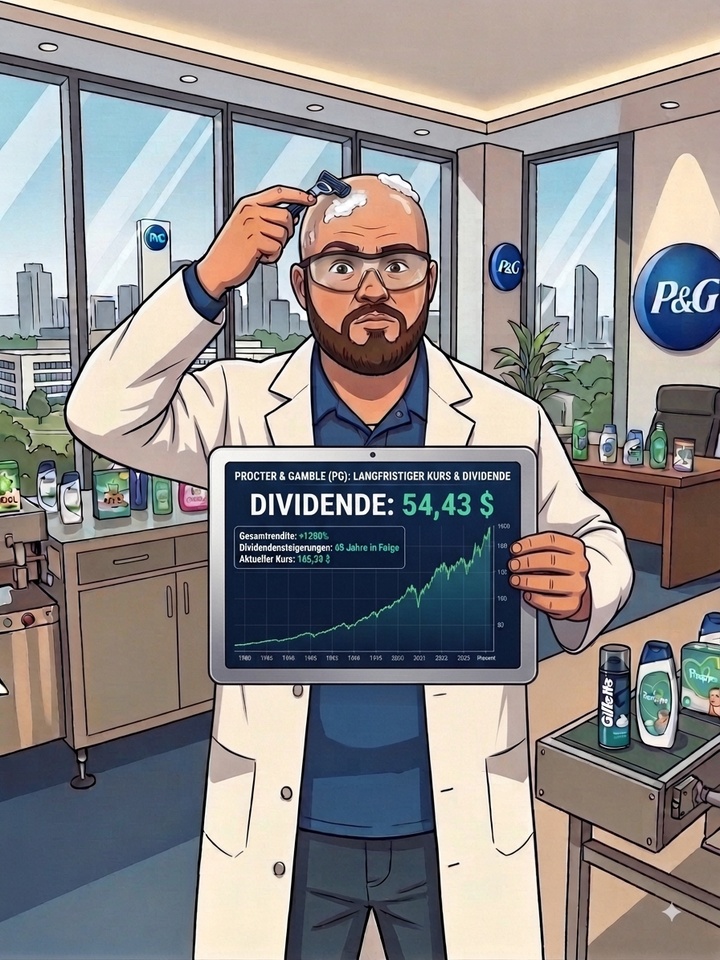
Procter & Gamble Dividend
Today, the consumer goods giant’s dividend $PG (+0.83%) has been credited to my brokerage account. The company’s products can likely be found in every household and retail store. Of course, they receive significantly less attention than, say, a $P911 (+0.27%) Porsche, $AAPL (+0.98%) iPhone, or $MC (-0.93%) luxury handbag—but they’re still deeply embedded in everyday life and can be found at various stages of a consumer’s life—and are probably bought more often than any of the luxury items just mentioned 😁
Even if you shouldn’t expect massive price jumps with basic consumer goods, they’re still a daily part of life, and the business will keep running even when another crisis hits the tech and industrial sectors 🤌
*AI-generated image*


3Mon·
Porsche Stock in 2026: Job Cuts, Billions in Profits, Plummeting Share Price — What’s Really Going On Here?
Summary:
The market is pricing in the future here rather than the past—and that is precisely what explains the contradiction. Porsche released its half-year report on July 29, 2026: Operating profit climbed to 755 million EUR in the second quarter (Q1: 595 million EUR)—totaling over 1.3 billion EUR in operating profit for the first half of the year, even though significantly fewer vehicles were delivered. The stock initially reacted with a jump of over 3% to EUR 46.20. But just one day later, the picture changed completely: The stock fell back to EUR 43.92—despite the actually better numbers. MarketScreener offers a possible explanation: A significant portion of the earnings surprise stems from one-time releases of provisions, not from a sustainable improvement in operations. At the same time, Porsche is cutting another 5,000 jobs, and the outlook for the second half of the year is weaker.
Key points:
- H1 2026: operating profit over 1.3 billion EUR (Q1: 595 million, Q2: 755 million EUR)
- Q2 2026: Revenue of EUR 8.83 billion (−5.1% YoY), deliveries of 61,315 (−18.2% YoY)
- Warning sign: Profit surge partly explained by one-time releases of provisions
- Another 5,000 jobs to be cut — second cost-cutting package in the works
- FY26 outlook signals a weaker second half of the year
- Stock price reaction: initially +3% to EUR 46.20, then a drop to EUR 43.92 within 24 hours
- Capital Markets Day featuring “Strategy 2035”: October 7, 2026
- Analyst makes a complete reversal: Upgrades rating from Sell to Buy, doubles price target (prior to earnings release)
Will $P911 (+0.27%) achieve the turnaround—what do you think?
22
2 Comments
3Mon
I’m 75% convinced, yes. With a small portion of your portfolio, it’s definitely worth investing here. The only question, as always, is when the cyclical low will be reached. Everyone knows—or can Google—the arguments for and against the stock. However, I’m always a fan of buying stocks when nobody else really wants them. Like Exxon in 2021, Ping An in 2023, BAT in 2024, and most recently Microsoft and P&G.
•
22
•3Mon·
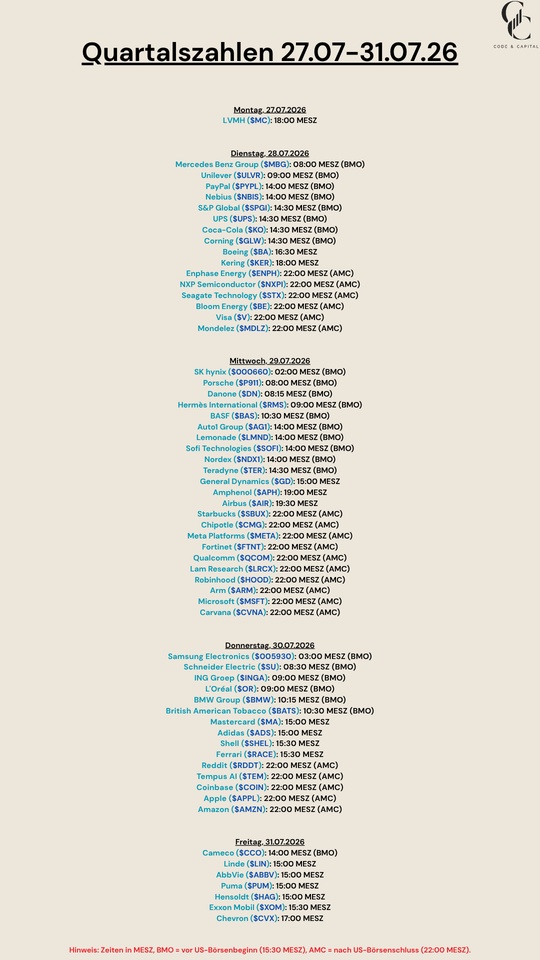
Quarterly Results: July 27–July 31, 26
$MC (-0.93%)
$MBG (+0.22%)
$ULVR (+0.37%)
$PYPL (+0.25%)
$NBIS (-4.36%)
$SPGI (+0.82%)
$UPS (+0.32%)
$KO (+0.88%)
$GLW (-3.68%)
$BA (+0.42%)
$KER (-1.86%)
$ENPH (+1.97%)
$NXPI (-1.15%)
$STX (-4.9%)
$BE (-6.03%)
$V (+0.85%)
$MDLZ (+0.78%)
$000660
$P911 (+0.27%)
$BN (+0.77%)
$RMS (-1.3%)
$BAS (+2.26%)
$AG1 (+5.9%)
$LMND (+5.12%)
$SOFI (-0.06%)
$NDX1 (+2.75%)
$TER (-4.44%)
$GD (+0.42%)
$APH (-1.76%)
$AIR (+0.1%)
$SBUX (+0.64%)
$CMG (+1.46%)
$META (+0.82%)
$FTNT (-1.85%)
$QCOM (-5.27%)
$LRCX (-4.56%)
$HOOD (-1.09%)
$ARM (-4.09%)
$MSFT (+0.61%)
$CVNA (-0.05%)
$005930
$SU (-0.61%)
$INGA (+0.62%)
$OR (+1.18%)
$BMW (-0.11%)
$BATS (+0.38%)
$MA (+1.27%)
$ADS (+2.39%)
$SHEL (+1.12%)
$RACE (-0.92%)
$RDDT (-0.27%)
$TEM (-2.56%)
$COIN (-1.09%)
$AAPL (+0.98%)
$AMZN (+1.81%)
$CCO (-0.25%)
$LIN (+1.05%)
$ABBV (+1.84%)
$PUM (+1.98%)
$HAG (-1.27%)
$XOM (+1.35%)
$CVX (+1.29%)
1414
3Mon·
Porsche Stock in 2026: China Crashes, the 911 Booms — Should You Buy Now or Wait?
Summary:
Porsche stock in 2026 is a contradiction on wheels: Sales of the best-selling 718 model are winding down, and sales in China have plummeted by 32%—yet the legendary 911 is up 19%, and Porsche ranks first in the key U.S. quality study by J.D. Power. Since its IPO in September 2022 at EUR 82.50, the stock has lost about 46% and is currently trading at around EUR 44–45. CEO Michael Leiters has declared 2026 the year of realignment—Cayenne production is moving to Leipzig, job cuts are underway, and Capital Markets Day in October will unveil the 2035 strategy. Citigroup has a price target of 56 EUR, while JPMorgan has an “Overweight” rating with a target of 50 EUR. Q2 results are due on July 29—the next key date.
Key points:
H1 2026: 122,306 deliveries (−16% YoY) — China −32%, North America −13% 911: +19% to 30,534 vehicles — the only model showing growth Cayenne Electric: Deliveries began in late June — positive dealer feedback 718 series: −73% — production ends in October 2025, no direct successor Q1 2026: Revenue −5.2% to 8.40 billion EUR, EBIT −22% to 595 million EUR2026 full-year forecast confirmed: 35–36 billion EUR in revenue, margin 5.5–7.5%Analysts: Citigroup 56 EUR · JPMorgan 50 EUR · Deutsche Bank 45 EUR · RBC 41 EURNext quarterly results (Q2): July 29, 2026
$P911 (+0.27%) Is this a buy for you, or just as much of a flop as the other German automakers?

66
7 Comments
3Mon
I'd say both: wait before getting involved right now.
Another question: Where will China make its move? At Porsche in Zuffenhausen?
Another question: Where will China make its move? At Porsche in Zuffenhausen?
•
11
•
3Mon·
News of the Week
As we do every Sunday, here are the top news stories from the past week:
Monday:
Huge contract for the German naval contractor $DE000TKMS001 (-3.92%) TKMS. The company is reportedly set to build submarines for Canada worth 62 billion euros. The stock rose significantly.
Tuesday:
The oil company $XOM (+1.35%) Exxon Mobil expects a significant jump in profits for the second quarter due to higher oil prices. The profit jump is expected to amount to up to 5 billion USD. However, revenue from the gas business is having a dampening effect.
Thursday:
Sugar producer$SZU (+0%) Südzucker is significantly more profitable. The Mannheim-based company is also raising its full-year revenue forecast to a range of 8.1–8.5 billion euros.
Sales of $P911 (+0.27%) Porsche plummeted by 16% to 122,306 vehicles in the first half of the year. Porsche is now once again selling more cars in Germany than in China. The 911, however, offers cause for optimism, with sales of that model rising by 19%.

www.handelsblatt.comTKMS: Deutscher Rüstungskonzern erhält Mega-U-Boot-Auftrag
1212
Trending Securities
Top creators this week
Real-time data from LSX · Fundamentals & EOD data from FactSet