
The SEC is reportedly investigating Nvidia amid CEO Jensen Huang's exit, a day after record results. Nvidia's board says it does not intend to reinstate Huang.

Nvidia
Stock
Stock
Ticker: NVDA
NVDA
Price
Discussion about NVDA
Posts
2,120
16H·
Nvidia hacked (again)
The Hackers Group “ The Gentleman” again put Nvidia on their site, and gave $NVDA (+2.5%) 10 days to fulfil the final financial wishes of the hack group.
If not they will make hacked info public, “worrying part” it’s the second time the same group hacked Nvidia.
Another big hit for the believed Getquin stock📉
bottom is far from reached guys, prepare yourself for some big weeks ahead 💣
88
3 Comments
Cash B.@Lumimyrsky
15H
•
44
•Show answer



20H·
The stock market does not reflect the economy!!
It's so ridiculous. They beat earnings expectations by a wide margin, raised their guidance, and expanded the share buyback program to 250 billion.
Then, during the earnings call, they mentioned that the roadmap is proceeding as planned, AND YET the stock is still falling.
At this point, I’m absolutely convinced that the stock market definitely doesn’t reflect the economy.
It’s just a narrative being traded. Sorry, but this is just getting me worked up.
Fingers crossed for all the hodlers, including me! 👍🏽
2828
24 Comments
The stock market has never done that before 😉
•
99
•
21H·
Nvidia rises 2.8% to $159.80 in premarket trading following its earnings report:
$NVDA (+2.5%)
Another massive beat & raise confirms strong AI demand, but the stock is struggling with the fallout from Jensen Huang's departure
⠀
The bottom line: The core business has weathered the leadership shakeup almost unscathed. Revenue was nearly $7 billion above expectations, Rubin contributed just under $20 billion in the first production quarter, and management raised its FY28 outlook. The fact that the stock is still rising only moderately is primarily due to leadership, regulation, and uncertainty about 2028—not demand.
⠀
Average price target: ~$233
Median: $230
Potential at $159.80: ~46% / ~44%
⠀
Current analyst estimates:
• Raymond James: $350 from $515 (+119%)
• BofA: Buy, $280 unchanged (+75%)
• Susquehanna: Positive, $275 unchanged (+72%)
• Morgan Stanley: Overweight, $260 from $267 (+63%)
• Wells Fargo: Overweight, $250 from $300 (+56%)
• Cantor Fitzgerald: Overweight, $250 (unchanged) (+56%)
• Jefferies: Buy, $250 from $300 (+56%)
• DZ Bank: Buy, $240 from $215 (+50%)
• JPMorgan: Overweight, $230 from $215 (+44%)
• Piper Sandler: Overweight, $230 from $300 (+44%)
• Citi: Buy, $225 (unchanged) (+41%)
• Goldman Sachs: Buy, $220 (unchanged) (+38%)
• Mizuho: Outperform, $220 (unchanged) (+38%)
• Stifel: Buy, $205 (unchanged) (+28%)
• Needham: Buy, $200 (unchanged) (+25%)
• Evercore ISI: In-Line, $184 from $186 (+15%)
• Truist: Hold, $174 unchanged (+9%)
• HSBC: Hold, $170 unchanged (+6%)
⠀
The Numbers:
• Revenue $115.8 billion vs. ~$108.9 billion expected, +103% YoY and +20% QoQ
• Adjusted EPS $2.68 vs. $2.47 expected
• Data Center: $107.6 billion, +110% YoY
• Vera Rubin: just under $20 billion in revenue
• Q4 guidance: ~$130 billion vs. ~$125 billion consensus
• FY28 growth outlook raised to ~75% from ~70%
• Additional $150 billion buyback approved; $227 billion still available
⠀
The most important indicator remains demand: Hyperscale revenue rose 23% quarter-over-quarter to around $60 billion, the cloud backlog jumped from $2.0 trillion to $2.5 trillion in three months, and management continues to state clearly: demand exceeds supply.
⠀
There is also little pressure on pricing. Some Hopper capacities were reallocated at prices up to twice as high, and B300 rental rates are more than 60% above their launch levels.
⠀
Rubin is taking off faster than expected: Nearly $20 billion in revenue in the first production quarter makes Vera Rubin Nvidia’s fastest product ramp to date. This is important because the transition to the next architecture following Huang’s departure was one of the biggest operational risks.
⠀
Why is the stock up only 2.8%?
• No permanent CEO
• The board of directors has ruled out Huang’s return
• Export controls and investigations remain a risk
• Hopper shipments to China have been halted
• Q4 gross margin is expected to drop to 71–72% initially
• Several analysts lowered their valuation multiples despite higher earnings estimates
⠀
Capital allocation is also changing: Nvidia intends to continue supporting customers and suppliers, but in a more selective manner. This alleviates concerns about circular financing amid the AI boom, but puts greater pressure on weaker customers to finance their own expansion.
⠀
The valuation has shifted dramatically: Several analysts now value Nvidia at less than 10 times its earnings estimates for 2027 or 2028. BofA calls it one of the most attractive risk/reward setups in its coverage universe, while Jefferies already sees much of the downside scenario priced into the stock.
⠀
The real debate is about 2028: In the short term, demand looks extremely strong. The key question is what will happen once supply bottlenecks ease, custom ASICs gain more capacity, and AI customers have invested even more massive sums.
⠀
Conclusion: Nvidia has shown that the business continues to operate smoothly even without Jensen Huang. Demand exceeds supply, Rubin is getting off to a faster start than expected, and the growth outlook is improving. At around $160, the market has no doubt that Nvidia can sell GPUs today. The discount reflects concerns about leadership and the question of how sustainable this extraordinary growth will remain beyond 2027.
99
4 Comments
21H
Could you please check the analysts' estimates? Most of them are very outdated. Starting with the first one, Raymond James has a current price target from last week of $185, not $350. BofA has $200, not $280; Wells Fargo has $200, not $250. Etc., etc....
It’s a shame, really, considering all the effort you put into this post.
It’s a shame, really, considering all the effort you put into this post.
•
55
•
1D·
And now what?
$NVDA (+2.5%) just beat expectations and even raised its guidance. Looking at the broader AI space, most companies have also been delivering strong results, with several beating estimates and raising their outlook.
So, what’s next?
At this point, what does the market actually need to see before these stocks start moving higher again?
Do we need another quarter of strong earnings to confirm that growth is sustainable? More evidence of AI monetisation? Stronger forward guidance? Or is the market simply expecting too much already?
What do you think will be the next catalyst for a new leg up in AI stocks?
Are we getting closer to seeing new all-time highs, or is there still something missing?
66
15 Comments
Just keep buying solid companies with good business and strong balance sheet like $NVDA and look out for interest rate shifts and companies who still loose money. Then wait a couple of years and don´t look into your portfolio that often :)
•
66
•
1D·
Nvidia Stock Forecast & Price Targets for 2027: Will It Bottom Out at $150 or Plunge to $131?
Nvidia is posting record numbers, but its stock is in the midst of its biggest crisis of confidence in years: In the third quarter of fiscal year 2027, revenue rose 103% to $115.8 billion, and adjusted earnings per share of $2.68 were well above the expected $2.47, and Nvidia is projecting $130 billion in revenue for the fourth quarter. During the conference call, interim CEO Colette Kress added: For fiscal year 2028, Nvidia now expects growth of around 75% instead of the previous estimate of around 70%, and the order backlog from cloud customers rose to $2.5 trillion. Nevertheless, the stock is trading at $155.46 (Nasdaq, Nov. 17, 2026), about 36% below its all-time high of $243.37, weighed down by Jensen Huang’s resignation on November 12. From a technical analysis perspective, the extremely high trading volume on the day of the Huang news has made the area around $150 a potential support zone. However, a sustained signal will only emerge above $170; only then is a recovery to $191.72—and potentially beyond toward the record high—possible. If the stock continues to fall, the next support level is around $131.
Key Points
- Q3 FY 2027: Revenue $115.8 billion (+103%), Data Centers $107.6 billion (+110%)
- Adjusted earnings per share: $2.68 (expected: approx. $2.47), free cash flow: $43.8 billion
- Q4 Outlook: $130 billion in revenue ±3%, gross margin 71% to 72%
- Conference call: FY 2028 growth of approximately +75%, order backlog of $2.5 trillion
- Leadership: Colette Kress is interim CEO; the board of directors will not bring Jensen Huang back
- Dividend: $0.25 per quarter; next payment on December 23, 2026
- Analysts: Average price target $265.23 (63 analysts, Nov. 18, 2026)
- Chart levels: Support zone around $150, signal above $170, targets at $191.72 and all-time high, downside risk to $131
What are Nvidia’s current key metrics?
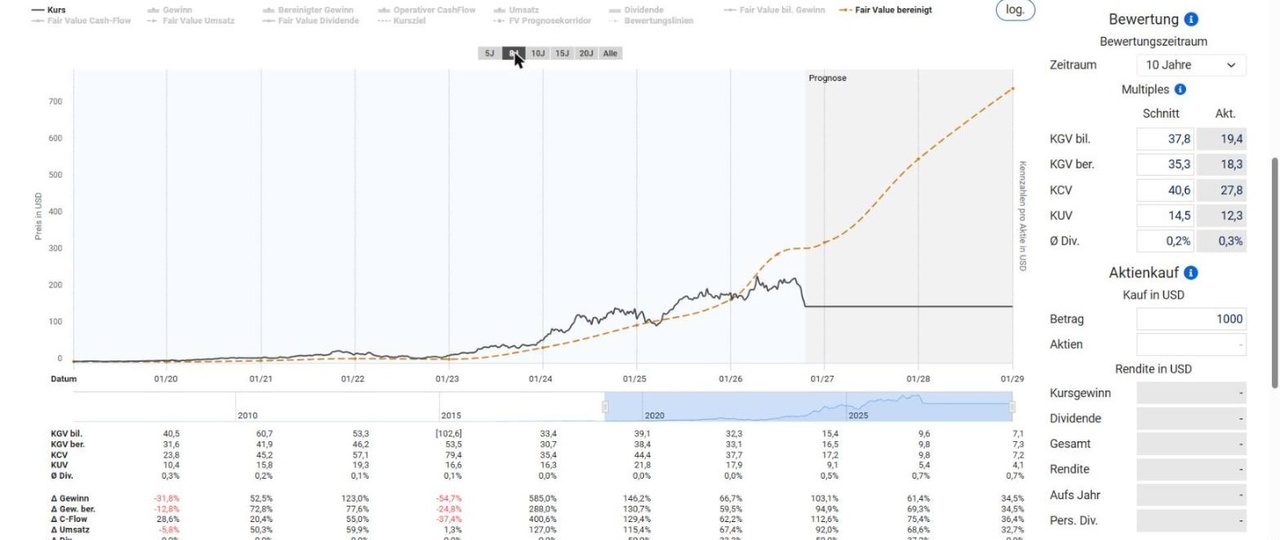
Following the crash, Nvidia stock is trading at its lowest valuation in years: According to Aktienfinder, the adjusted P/E ratio stands at 18.3; on average over the past ten years, investors have paid 36.8 times earnings.
Based on expected earnings for the next fiscal year, the P/E ratio drops below 10, according to Aktienfinder. The price-to-cash-flow ratio (27.8 instead of 42.7) and the price-to-revenue ratio (12.3 instead of 15.5) are also below their long-term averages.
- Price (Nasdaq: NVDA): $155.46 (Nov. 17, 2026)
- After-hours following the earnings report: $162.56 (+4.6%) (Nov. 17, 2026)
- All-time high = 52-week high: $243.37 (October 6, 2026)
- 52-week low: $148.80 (November 12, 2026)
- Distance from all-time high: approximately −36% (November 17, 2026)
- Year-to-date performance: approximately −17% (November 17, 2026)
- Market capitalization: approx. $3.8 trillion (November 17, 2026)
- Revenue for Q3 FY 2027: $115.8 billion (+103%) (Nov. 17, 2026)
- Data Centers Q3 FY 2027: $107.6 billion (+110%) (November 17, 2026)
- Edge computing Q3 FY 2027: $8.2 billion (+42%) (November 17, 2026)
- Q3 Gross Margin (Adjusted): 74.9% (November 17, 2026)
- Net Income Q3 (GAAP): $65.3 billion (+105%) (Nov. 17, 2026)
- Earnings per Share Q3 (adjusted): $2.68 (expected approx. $2.47) (Nov. 17, 2026)
- Q3 Free Cash Flow: $43.8 billion (November 17, 2026)
- Q4 FY 2027 Revenue Outlook: $130 billion ± 3% (November 17, 2026)
- Q4 Gross Margin Outlook: 71 to 72% (November 17, 2026)
- Adjusted P/E ratio (current / 10-year average): 18.3 / 36.8 (Aktienfinder, November 18, 2026)
- Current P/B ratio / 10-year average: 27.8 / 42.7 (Aktienfinder, Nov. 18, 2026)
- Current P/S ratio / 10-year average: 12.3 / 15.5 (Aktienfinder, November 18, 2026)
- Average Analyst Price Target: $265.23 (+71%) (63 analysts, November 18, 2026)
- Dividend: $0.25 per quarter (yield approx. 0.6%) (payment Dec. 23, 2026)
- Next Date: Q4 results for FY 2027 expected in late February 2027 (not yet confirmed)
- Index: Nasdaq 100, S&P 500, Dow Jones (—)
- WKN / ISIN / Ticker: 918422 / US67066G1040 / NVDA (—)
What news is currently driving Nvidia stock?
Nvidia stock is currently being driven by two opposing forces: record results with a significantly improved outlook on the one hand, and the leadership crisis following Jensen Huang’s resignation on the other.
On November 12, Huang stepped down as CEO following an internal investigation; CFO Colette Kress has been leading Nvidia on an interim basis ever since. The figures released on November 17 show that business has so far remained unaffected: Revenue significantly exceeded the company’s own forecast of $108 billion, and according to Nvidia, the new Vera Rubin platform got off to the fastest start in the company’s history. Full details on the quarter can be found in our Nvidia Aktie News zu den Quartalszahlen.
- Nov. 18, 2026 – Analyst reactions to the earnings report: Goldman Sachs reaffirms its “Buy” rating with a price target of $220, while JPMorgan raises its target from $215 to $230. Summit Insights, on the other hand, downgrades the stock to “Hold” (Neutral).
- November 17, 2026 – Q3: Revenue +103%, Outlook $130 billion: Revenue of $115.8 billion instead of the expected $109 billion; adjusted earnings per share of $2.68. Q4 outlook: $130 billion ± 3%. (Bullish)
- November 17, 2026 – Conference Call: +75% for FY 2028: Kress expects approximately 75% growth for fiscal year 2028; cloud customer order backlog at $2.5 trillion. Supervisory Board does not reinstate Huang. (Bullish)
- November 16, 2026 – Price target cuts ahead of earnings: Mizuho lowers the price target from $250 to $220 (Outperform) – Reason: Huang was considered the most important dealmaker in the AI industry. (Bearish)
- November 12, 2026 – Jensen Huang resigns: Following an internal investigation, Huang steps down as CEO. Colette Kress becomes interim CEO; the stock falls intraday to $148.80. (Bearish)
What did Nvidia management say about the outlook during the conference call?
Interim CEO Colette Kress significantly raised the outlook during the conference call on November 17: For fiscal year 2028 (February 2027 through January 2028), Nvidia now expects revenue growth of around 75% instead of the previous estimate of around 70%—and that’s on a higher base than previously anticipated.
“Our momentum is real,” said Kress, noting that demand continues to accelerate.
What went well: According to information from the conference call, the new Vera Rubin platform already generated nearly $20 billion in revenue in its first production quarter—the fastest ramp-up in the company’s history. The order backlog from cloud customers rose from $2 trillion to $2.5 trillion within three months. Business with enterprise customers is expected to more than double in fiscal year 2028. Racks are in operation at CoreWeave, Google Cloud, Microsoft Azure, Oracle, and Nebius, among others, and will soon be at SpaceXSI as well—my analysis of SpaceX Aktie.
The catch: The gross margin is expected to drop to 71–72% in the fourth quarter, down from 74.9% in the third quarter. Kress described this as a low point because Nvidia is fulfilling existing supply contracts under old terms. Added to this is the unresolved leadership issue: Supervisory Board Chairman Harvey Jones made it clear that Jensen Huang will not be returning; a permanent successor has yet to be named; and the Supervisory Board’s investigation is ongoing.
Outlook: For the fourth quarter, which includes an additional week, Nvidia is projecting $130 billion in revenue (±3%), excluding data center revenue from China. In addition, the board of directors has increased the share buyback program by $150 billion; approximately $227 billion remains available.
What does Nvidia do, and how does the company make money?
Nvidia is the world’s leading provider of AI chips and AI data centers—the Santa Clara-based company now generates over 90% of its revenue from systems on which cloud providers and AI companies train and run their models.
Nvidia was founded in 1993 by Jensen Huang, Chris Malachowsky, and Curtis Priem, originally as a manufacturer of graphics cards for video games.
Two segments: The Data Center segment ($107.6 billion in revenue in the third quarter of fiscal year 2027) includes AI accelerators such as Blackwell and Vera Rubin, the company’s own Vera CPUs, networking technology such as Spectrum-X, and complete rack systems. Edge Computing (USD 8.2 billion) includes graphics cards for gamers and PCs, chips for cars and robots, and local AI computers.
How Nvidia Makes Money: Nvidia doesn’t just sell chips; it sells entire AI ecosystems consisting of hardware, networking, and the CUDA software platform, to which developers have been tied for years. This results in gross margins of around 75%. New growth areas include software for AI agents, autonomous driving, robotics, and sovereign AI projects by governments—such as those in collaboration with Palantir, as my analysis Palantir Aktie .
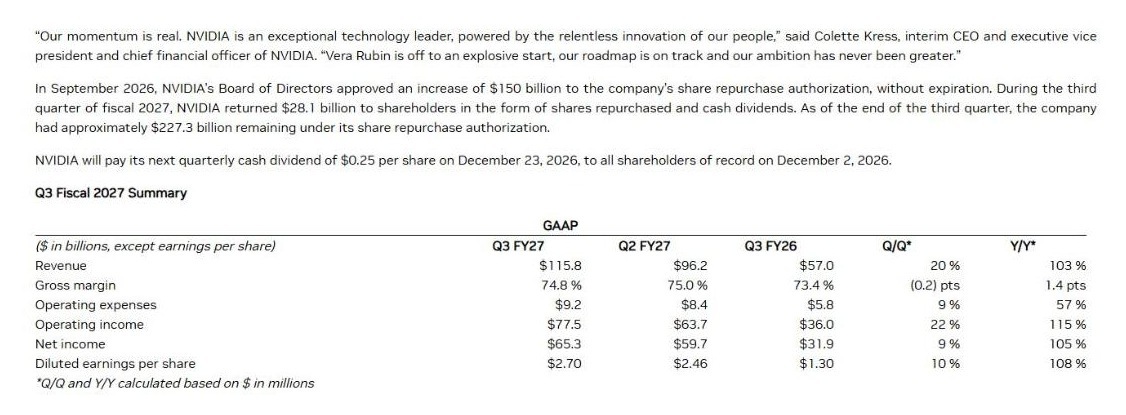
Nvidia Stock (NVDA) Third-Quarter FY 2027 Earnings, Buybacks, and Dividend (as of Nov. 18, 2026) – Source: Nvidia Investor Relations / Christian Lill
Nvidia Stock Fundamental Analysis: What Is the Fair Value of Nvidia Stock?
According to Aktienfinder’s calculation, based on adjusted earnings and the average P/E ratio over the last ten years, the fair value of Nvidia stock is approximately $300 for the end of 2026 and approximately $540 for the end of 2027 —nearly double to three and a half times the current price.
However, this calculation assumes that investors will once again pay a P/E ratio in line with the average of the past ten years and that earnings estimates will be met.
Growth: Revenue grew by 103% in the third quarter of fiscal year 2027, reaching $293.7 billion in the first nine months. Nvidia is projecting $130 billion for the fourth quarter and approximately 75% growth for fiscal year 2028. According to the FMP consensus, analysts expect revenue of approximately $411 billion for fiscal year 2027 and approximately $692 billion for 2028.
Margins: With an adjusted gross margin of 74.9% and an operating margin of approximately 67%, Nvidia is one of the most profitable large companies in the world. In the fourth quarter, the gross margin temporarily drops to 71–72%.
Cash Flow and Balance Sheet: Free cash flow reached $43.8 billion in the third quarter and $113.7 billion over nine months. Of this, $22.1 billion went toward share buybacks and $6.0 billion toward dividends. One of the largest customers is Amazon with its cloud division AWS, which will invest approximately $220 billion in 2026 alone—more on this in my analysis of Amazon Aktie.
Valuation: According to Aktienfinder, the adjusted P/E ratio stands at 18.3 instead of the ten-year average of 36.8, and the price-to-cash-flow ratio at 27.8 instead of 42.7. Based on the earnings expected for the coming fiscal year, the P/E ratio is below 10. The market is thus pricing in a significant risk that growth will collapse after the AI boom or that the leadership crisis will cost the company customers.
Fair Value Assessment of Nvidia Stock (NVDA) for 2027 (as of November 18, 2026) – Source: Aktienfinder / Christian Lill
Nvidia Stock Price Targets and Forecast for 2027
Analysts see an average price target of $265.23 for Nvidia stock, representing about 71% upside potential—however, from a technical analysis perspective, a sustainable signal will only emerge above $170; at which point $191.72 and, above that, the record high of $243.37 become attainable.
Below $148.89, there is a risk of a pullback to $131. My analysis of Infineon Aktie.
Key price levels:
- 52-week high = all-time high: $243.37 (Oct. 6, 2026)
- Current price: $155.46 (Nasdaq, Nov. 17, 2026), after-hours $162.56
- Resistance levels: $170.07, $191.72, $234.56
- Buy signal: sustained rise above $170
- Price targets after the signal: $191.72, then toward the all-time high
- Support zone: around $150, lower boundary at $148.89
- Critical downside level: $148.89, with support at $131 below that
Analyst price targets:
- Average price target: $265.23, range $130 to $515 (63 analysts, S&P Global/Stock Analysis, Nov. 18, 2026)
- Average price target: $261.83 (36 analysts, Public.com, November 18, 2026)
- JPMorgan: $230, previously $215 (November 18, 2026)
- Goldman Sachs: Buy, $220 confirmed (November 17, 2026)
- Mizuho: Outperform, $220, previously $250 (November 16, 2026)
- Summit Insights: Downgraded to Hold (November 18, 2026)
Chart Analysis:
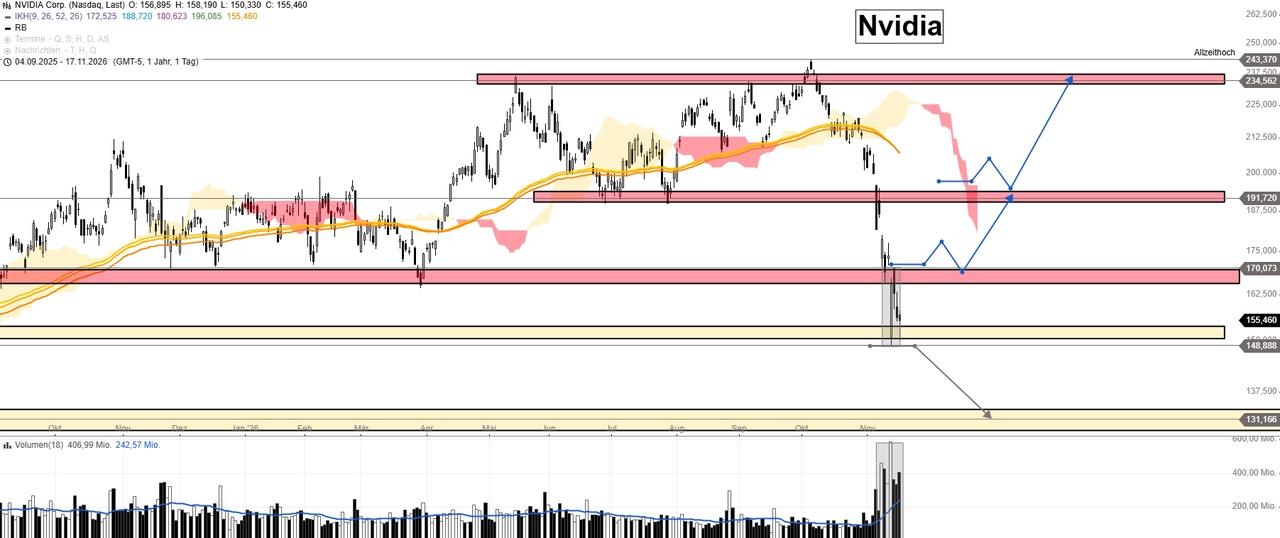
Nvidia Stock (NVDA) Chart Analysis and Price Targets for 2027 (as of Nov. 18, 2026) – Source: Stock3 / Christian Lill
On the daily chart, Nvidia stock showed a strong reversal candle following the announcement of Jensen Huang’s departure: On November 12, the price fell intraday to $148.80 and ended the day significantly higher. This reversal candle was accompanied by extremely high volume, the likes of which were not seen at all last year. High volume at a low generally indicates a bottom is forming, as large market participants have absorbed the panic selling. The area around $150 (yellow zone) could therefore be used to form a bottom, with $148.89 as the lower boundary.
The buy signal (blue arrow): However, a sustained signal confirming this bottom will only be triggered above $170. That is where the red resistance zone around $170.07 lies, a level at which the stock has recently failed to break through on multiple occasions. If the stock manages to break above this level, it could rally directly to $191.72, where the next red resistance zone and the price gap from early November are located. Furthermore, a rally toward the record high is even possible: The resistance zone at $234.56 lies just below the all-time high of $243.37.
The risk (gray arrow): If market participants do not begin to form a bottom and continue to sell the stock, the price will fall below $148.89. In that case, the next support level is already in the $131 range (yellow zone around $131.17).
My assessment: The trading volume suggests a bottom around $150, but this will only be confirmed above $170. Until then, the bottoming process is an opportunity, not a signal.
What is the forecast for Nvidia stock in 2030?
For the 2030 fiscal year (through January 2030), analysts expect revenue of approximately $1.08 trillion—the same figure cited by finanzen.net—and earnings per share of about $24.10, according to the FMP consensus. With a P/E ratio of 15 to 20, that would correspond to a share price of around $360 to $480.
This is a sample calculation, not a price forecast: It assumes that Nvidia will more than double its earnings per share compared to the current fiscal year (consensus around $9.30).
Factors supporting this: The $2.5 trillion order backlog from cloud customers, the projected growth of around 75% in fiscal year 2028, and the doubling of the company’s business. With Vera Rubin, its own CPUs, networking technology, and software for AI agents, Nvidia is further expanding its position.
Arguments against it: The estimates for 2030 are based on a small number of analysts (19 for earnings) and are therefore uncertain. If the major cloud providers cut back on their investments, growth could come to an abrupt halt. Added to this are export restrictions to China, dependence on contract manufacturer TSMC, and the unresolved succession of Jensen Huang. From a technical analysis perspective, a rise above $170 is first required.
How much is Nvidia’s dividend?
Nvidia pays a quarterly dividend of $0.25 per share; the next payment will be made on December 23, 2026, to all shareholders of record as of December 2, 2026.
On an annualized basis, this amounts to $1.00 per share; at a share price of $155.46, this corresponds to a dividend yield of approximately 0.6%.
For a long time, Nvidia’s dividend—at $0.01 per quarter—was almost symbolic, but in the current fiscal year 2027, Nvidia has raised it significantly. In the third quarter, $6.0 billion was paid out to shareholders as dividends. However, the majority of distributions continue to take the form of share buybacks: $22.1 billion in the third quarter, with approximately $227 billion still available under the buyback program. Nevertheless, Nvidia is not the right choice for investors primarily seeking regular income—the stock remains a growth stock.
Conclusion: Should you buy or sell Nvidia stock?
Nvidia is posting record operating results and raising its outlook, but following Jensen Huang’s resignation, the stock remains stuck about 36% below its all-time high—the extremely high trading volume suggests a bottom is forming around $150, but a sustainable signal will only emerge above $170.
Factors in Nvidia’s favor include a 103% increase in revenue, a growth outlook of around 75% for fiscal year 2028, a backlog of $2.5 trillion, and an adjusted P/E ratio of 18.3, well below the ten-year average. My analysis of how the company’s main competitor is handling the same AI demand is available at AMD Aktie.
Factors weighing against the stock include the unresolved leadership issue, the ongoing investigation by the supervisory board, the declining gross margin in the fourth quarter, and concerns about stricter AI regulations. From a technical perspective: Above $170, a rebound to $191.72—and potentially toward a record high—is possible. If the stock falls below $148.89, the next support level is at $131.
✅ Opportunities
- Revenue +103%, Q4 outlook: $130 billion
- Approximately 75% growth planned for fiscal year 2028
- Cloud customer order backlog: $2.5 trillion
- Adjusted P/E ratio of 18.3 vs. a 10-year average of 36.8
- Record trading volume at the low suggests a floor around $150
- A rebound from over $170 to $191.72 is possible
⚠️ Risks
- No permanent successor for Jensen Huang
- Supervisory Board investigation continues
- Gross margin drops to 71–72% in Q4
- Reliance on a few large cloud customers
- Export restrictions to China
- Below $148.89, a pullback to $131 is possible
Sources
- Nvidia Investor Relations: Third-Quarter Results for Fiscal Year 2027 (Nov. 17, 2026)
- SEC Form 8-K: Nvidia Q3 Fiscal 2027 Press Release (November 17, 2026)
- Nvidia Investor Relations: CFO Comments and Q3 FY 2027 Presentation
- Q3 FY 2027 Conference Call (November 17, 2026): Reports from Investing.com, TheStreet, PYMNTS, GuruFocus, and CoinDesk
- Analyst Reports: Investing.com (Goldman Sachs, November 17, 2026), CNBC (Mizuho, November 16, 2026), Stock Analysis (Summit Insights, November 18, 2026), Rallies.ai (JPMorgan, November 18, 2026)
- Average price target: Stock Analysis / S&P Global and Public.com, November 18, 2026
- Consensus estimates: Financial Modeling Prep (FMP) and finanzen.net, November 18, 2026
- Nasdaq prices: Alpha Vantage and Investing.com, as of November 17, 2026
- Stock3: NVIDIA Corp. (Nasdaq) daily chart, as of November 17, 2026
- Aktienfinder: Fair value calculation (adjusted earnings), valuation metrics for NVIDIA, as of November 18, 2026
This is not investment advice—all information is provided solely for financial education purposes.
What are your current thoughts on $NVDA (+2.5%) ?

1717
1 Comment22H
I find the classification of Nvidia as a pure-play growth company somewhat too narrow.
Traditional growth stocks are characterized by recurring revenue and low capital tied up in operations. Nvidia, however, is and remains a cyclical semiconductor company that exhibits all the characteristics of a cyclical stock—and it is precisely these metrics that one should focus on first and foremost. Not the P/E ratio.
Revenue (+20.4% QoQ), earnings, and the outlook were undoubtedly strong. But beneath the surface, risks grew far more significantly from Q2 to Q3 than the operating business did: Outstanding receivables rose by 28.4% to $81 billion, purchase commitments increased by 39.8% to $390 billion, and guarantees and sureties ballooned by 807% to $118 billion.
The hyperscalers will no longer increase their CapEx at the same pace and will gradually switch to their own chips. So Nvidia is increasingly relying on neoclouds. However, it must provide them with financial support, even if only through guarantees.
Nvidia is thus increasingly financing and securing its own sales. During an upswing, this acts like a turbocharger. But as soon as the hyperscalers cut back on their CapEx budgets—or data center operators simply lack the margin, after interest expenses and depreciation, to replace their chip inventory with newer generations on their own within 3 to 5 years— this effect turns into a negative lever against Nvidia—the classic risk of a cyclical stock at the peak of the boom.
And what do you learn at the beginning of your stock market career? You buy cyclical stocks when the P/E ratio is at its highest. When the P/E ratio for cyclicals is very low, we’re near the peak of the cycle.
Traditional growth stocks are characterized by recurring revenue and low capital tied up in operations. Nvidia, however, is and remains a cyclical semiconductor company that exhibits all the characteristics of a cyclical stock—and it is precisely these metrics that one should focus on first and foremost. Not the P/E ratio.
Revenue (+20.4% QoQ), earnings, and the outlook were undoubtedly strong. But beneath the surface, risks grew far more significantly from Q2 to Q3 than the operating business did: Outstanding receivables rose by 28.4% to $81 billion, purchase commitments increased by 39.8% to $390 billion, and guarantees and sureties ballooned by 807% to $118 billion.
The hyperscalers will no longer increase their CapEx at the same pace and will gradually switch to their own chips. So Nvidia is increasingly relying on neoclouds. However, it must provide them with financial support, even if only through guarantees.
Nvidia is thus increasingly financing and securing its own sales. During an upswing, this acts like a turbocharger. But as soon as the hyperscalers cut back on their CapEx budgets—or data center operators simply lack the margin, after interest expenses and depreciation, to replace their chip inventory with newer generations on their own within 3 to 5 years— this effect turns into a negative lever against Nvidia—the classic risk of a cyclical stock at the peak of the boom.
And what do you learn at the beginning of your stock market career? You buy cyclical stocks when the P/E ratio is at its highest. When the P/E ratio for cyclicals is very low, we’re near the peak of the cycle.
•
22
•

1D·
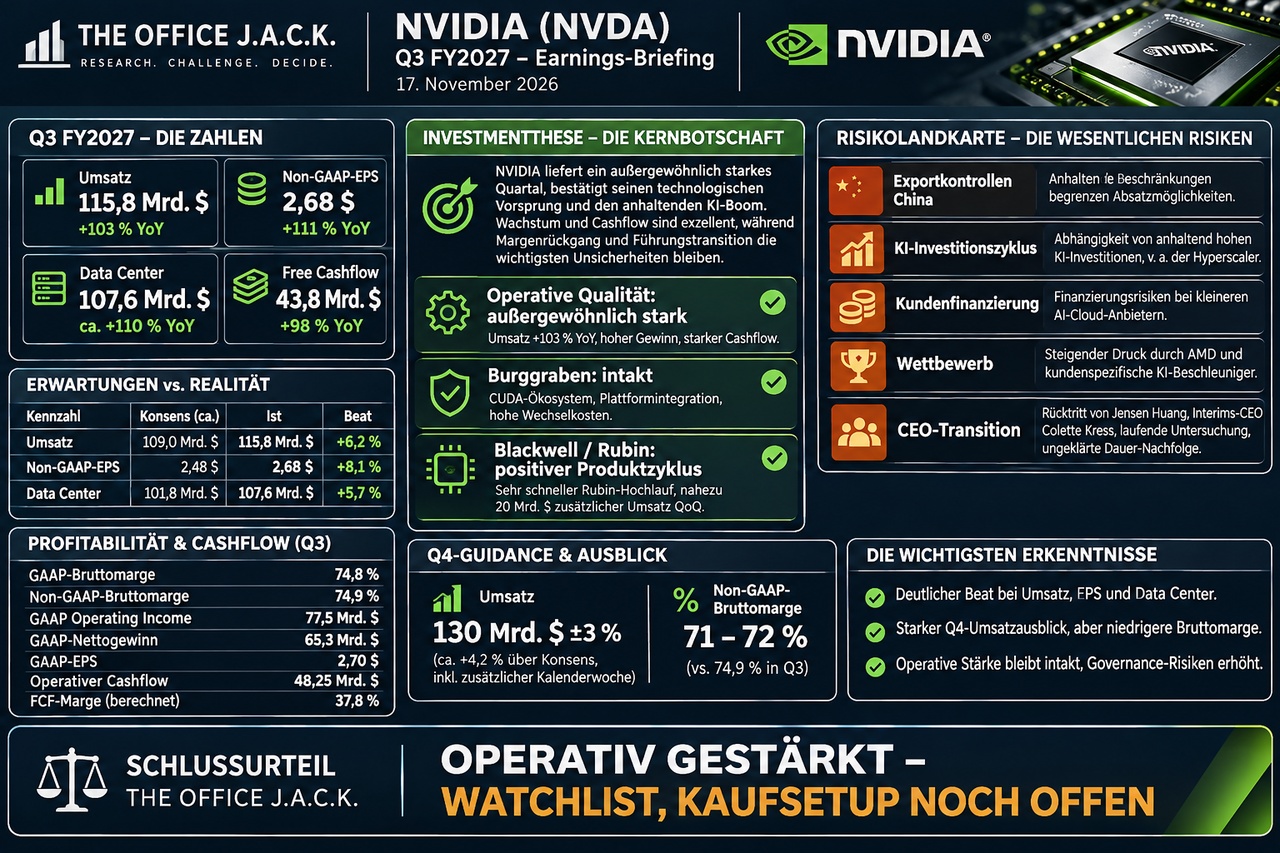
NVIDIA Q3 EARNINGS BRIEFING
🏛️ THE OFFICE J.A.C.K. | EARNINGS BRIEFING
NVIDIA – $NVDA (+2.5%) Q3 FY2027 | November 17, 2026
The Office has taken a close look at NVIDIA’s recently released quarterly results.
The key question: Can NVIDIA maintain its extraordinary growth momentum despite the company’s increasing size—and how significant is the uncertainty following Jensen Huang’s resignation?
The short answer: NVIDIA delivered an exceptionally strong quarter. Revenue and profit significantly exceeded market expectations, free cash flow reached new heights, and, according to management, Vera Rubin is on track to be the fastest product launch in the company’s history.
However, there are two major caveats: the gross margin forecast for the next quarter is significantly lower, and the leadership crisis remains unresolved.
━━━━━━━━━━━━━━━━━━
📊 DATA SECTION | The Facts
NVIDIA exceeds expectations on all key quarterly metrics.
Quarterly revenue
$115.8 billion
+103% YoY
Non-GAAP EPS
$2.68
+111% YoY
GAAP Net Income
$65.3 billion
+105% YoY
Free cash flow
$43.8 billion
+98% YoY
Key figures reported:
- Revenue: $115.8 billion → +103% YoY
- Data Center revenue: $107.6 billion → approx. +110% YoY
- GAAP gross margin: 74.8% → +1.4 percentage points
- Non-GAAP gross margin: 74.9% → +1.4 percentage points
- GAAP operating income: $77.5 billion → +115% YoY
- Non-GAAP operating income: $77.9 billion → +116% YoY
- GAAP EPS: $2.70 → +108% YoY
- Non-GAAP EPS: $2.68 → +111% YoY
- Free Cash Flow: $43.8 billion → +98% YoY
Expectations vs. Reality
Key Figure
Consensus approx.
$109.0 billion
Actual
Beat
Revenue
$115.8 billion
+6.2%
Non-GAAP EPS
$2.48
$2.68
+8.1%
Data Center
$101.8 billion
$107.6 billion
+5.7%
Consensus figures from analyst reports published prior to the earnings release. Comparative figures vary slightly among providers. marketbeat.com +2
Operating profit is particularly impressive.
While revenue more than doubled year-over-year, operating profit grew even faster.
This means that NVIDIA continues to achieve significant economies of scale.
Data Department’s Assessment: 🟢
A clear beat on revenue and profit. Operational strength has not been lost even after the recent growth spurt.
━━━━━━━━━━━━━━━━━━
🧠 ANALYST | The operational thesis
NVIDIA’s business model continues to be in an extraordinary growth phase.
The key development is not just the rising demand for AI chips.
NVIDIA is increasingly evolving into a provider of complete AI infrastructure systems—including accelerators, networking technology, software, and integrated computing platforms.
🚀 Vera Rubin – The Next Growth Engine
NVIDIA describes the launch of Vera Rubin as the fastest product rollout in its history.
According to the presentation:
- Vera Rubin contributed nearly $20 billion in additional revenue compared to the previous quarter.
- Demand is coming from hyperscalers as well as AI cloud and enterprise customers.
- At the same time, Blackwell remains a significant revenue driver.
- In its MLPerf training debut, Rubin NVL72 achieved up to twice the performance per GPU as Blackwell Ultra.
This is strategically important.
A major risk for fast-growing semiconductor companies is that the next product generation will be delayed or that demand for the current product will decline.
The numbers so far show the opposite: NVIDIA is benefiting simultaneously from Blackwell and the ramp-up of Rubin.
Demand Is Broadening
Demand from the major hyperscalers remains strong.
Even more remarkable, however, is the growth in the AI cloud, industrial, and enterprise sectors.
This segment is growing from $16.1 billion to $47.5 billion—an increase of about 195%.
In the long term, this could mean:
- A larger addressable AI infrastructure market.
- A broader customer base beyond the largest technology companies.
- Additional demand from industrial AI applications.
- Deeper integration of NVIDIA platforms into business processes.
- Recurring investments in new generations of hardware.
The potential moat is based on the synergy between CUDA, development tools, network infrastructure, software integration, and the installed hardware base.
However: The increasing adoption by smaller AI cloud providers does not necessarily lead to lower risk. The financial stability of these customers and their funding deserve special attention.
Analyst’s Assessment: 🟢
The operational growth thesis is significantly strengthened. Rubin is delivering a compelling product rollout, while the demand base is expanding beyond traditional hyperscalers.
━━━━━━━━━━━━━━━━━━
🔍 VALUATOR | What do the numbers mean for the company’s value?
This is where the firm takes a particularly critical view.
The quality of the quarter is exceptional. However, this does not automatically mean that the stock is attractive at every price.
Earnings Growth
Key Figure
Q3 FY2026
Revenue
$57.0 billion
GAAP Operating Income
$36.0 billion
GAAP Net Income
$31.9 billion
GAAP EPS
$1.30
Q3 FY2027
Revenue
$115.8 billion
GAAP Operating Income
$77.5 billion
GAAP Net Income
$65.3 billion
GAAP EPS
$2.70
The operating margin increases, on a pro forma basis, from approximately 63.2% to 66.9%.
This represents a significant improvement from an already exceptionally high level.
Cash Flow Quality
Free cash flow increases from $22.1 billion to $43.8 billion.
However, the FCF margin is trending somewhat differently.
Key Metric
Q3 FY26
Free Cash Flow
$22.1 billion
FCF Margin
38.8%
Q3 FY27
Free Cash Flow
$43.8 billion
FCF Margin
37.8%
Investments in Property, Plant, and Equipment and Intangible Assets*
$1.64 billion
$4.42 billion
*Acquisitions reported in the NVIDIA cash flow reconciliation, excluding depreciation and amortization expenses for property, plant, and equipment, which are shown separately.
The absolute cash flow trend is impressive.
However, the FCF margin is declining slightly, while investments are rising significantly faster than revenue.
This is not yet a warning sign of a structural deterioration. But it shows why we should not evaluate free cash flow in isolation based on the absolute growth rate.
Stock-Based Compensation and Earnings Quality
One positive point: NVIDIA has been including stock-based compensation in its non-GAAP results since Q1 FY2027. The comparative figures have been adjusted accordingly.
As a result, adjusted earnings are no longer artificially inflated by a blanket exclusion of these compensation costs.
At the same time, the GAAP earnings include a gain of approximately $1.77 billion from equity securities.
This is not income from the operating sale of AI infrastructure.
Consequently, GAAP EPS of $2.70 is actually slightly higher than the adjusted EPS of $2.68.
For a normalized valuation, the Office would consider such investment income separately.
Has NVIDIA become cheaper as a result?
Fundamentally, the figures strengthen the basis for a higher earnings estimate.
But to arrive at a robust fair value for the company, we need:
- A verified current stock price.
- The updated earnings estimates for FY2028 and FY2029.
- A normalized margin assumption following the Rubin ramp-up.
- The trend in actual free cash flow.
- A valuation that takes into account the additional governance risk.
A reverse DCF or a complete fair value calculation cannot yet be reliably performed based on this quarterly presentation alone.
Analyst’s conclusion: 🟡
Operating value creation is exceptionally strong. The higher profits strengthen the company’s value, but this does not yet prove that the stock is specifically undervalued.
━━━━━━━━━━━━━━━━━━
📰 NEWS SECTION | Guidance and Strategic Developments
Now we come to the crucial part of the earnings report.
Q4 FY2027 – the new forecast
Key Figure
Q3 Actual
Revenue
$115.8 billion
Non-GAAP Gross Margin
74.9%
Non-GAAP Operating Expenses
$8.8 billion
Q4 Guidance
Revenue
$130 billion ±3%
Non-GAAP Gross Margin
71–72%
Non-GAAP Operating Expenses
approx. $10.7 billion
The forecast implies nominal revenue growth of approximately 12.3% compared to Q3.
At first glance, that seems enormous.
But here we need to take two important factors into account.
⚠️ Q4 includes an extra week
NVIDIA’s fourth quarter spans 14 weeks instead of 13.
Mathematically speaking, a revenue forecast of $130 billion normalized to 13 weeks would correspond to approximately $120.7 billion.
That would represent only about 4.2% growth compared to the third quarter.
This calculation assumes an even distribution of revenue and is not an official company forecast.
Nevertheless, it shows why the $130 billion figure, when taken at face value, should not be interpreted as evidence of another massive acceleration.
⚠️ The gross margin is expected to decline
Even more significant is the decline in the expected gross margin.
From 74.9% in the third quarter to 71–72% in the fourth quarter.
Based on the midpoint of the forecast, this represents a decline of 3.4 percentage points.
Possible explanations include:
- A shift in the revenue mix between chips and complete systems.
- Higher costs during the early Rubin production ramp-up.
- Changes in the production and supply structure.
- Additional costs due to components and storage capacities.
These explanations are hypotheses at this point. The presentation does not quantify the causes.
The decline in margins is therefore the most important unresolved operational issue.
🇨🇳 China remains excluded
NVIDIA continues to exclude data center compute revenue from China from its Q4 revenue forecast.
On the one hand, this limits the immediately addressable market.
On the other hand, a potential easing of export restrictions would represent an additional growth opportunity that is not currently included in the guidance.
However, such an easing should not be assumed to be likely.
👔 Jensen Huang – The Leadership Crisis
On November 12, NVIDIA confirmed the resignation of Jensen Huang as CEO and member of the Board of Directors. Colette Kress was appointed interim CEO, and Harvey C. Jones was named Chairman of the Board. nvidianews.nvidia.com
This represents an unusually significant strategic turning point for NVIDIA.
For decades, Huang shaped the company’s architecture, platform strategy, and corporate culture.
The current presentation explicitly identifies the successful leadership transition and the recruitment and retention of executives as risks.
Three questions remain unanswered:
- Can NVIDIA maintain its current pace of product development and innovation in the long term without Huang?
- How will capital allocation, strategic investments, and partnerships change under the new leadership?
- Will the ongoing uncertainty have a lasting impact on the valuation multiple?
News Department’s Assessment: 🟡
The guidance signals strong demand but includes a significant margin decline and a one-time calendar-related effect. At the same time, the CEO succession remains a key governance issue.
━━━━━━━━━━━━━━━━━━
🛡️ RISK MONITOR | What could go wrong?
Despite the impressive numbers, the firm sees several risks.
Margin trend: The gross margin of 71–72% expected for Q4 could indicate temporary ramp-up costs or a permanently altered product mix. An explanation is pending.
Capital intensity: Investment requirements are increasing significantly. Even as free cash flow grows, NVIDIA must maintain its high cash flow conversion rate over the long term.
Dependence on the AI investment cycle: A significant portion of demand continues to depend on investment decisions by major technology conglomerates and AI infrastructure operators.
Customer Financing: Strong growth among AI cloud providers may entail additional credit, financing, and counterparty risks.
Competition: AMD, custom AI accelerators, and in-house developments by hyperscalers could put downward pressure on prices and market share in the long term.
China and export controls: Geopolitical restrictions may limit sales opportunities and result in additional compliance costs.
Leadership Change: The founder’s resignation creates uncertainty regarding strategic continuity, management retention, and long-term capital allocation.
Valuation: Even a company with exceptional profits can deliver a disappointing stock return if the expectations previously priced into the stock were even higher.
Risk Monitor’s Assessment: 🟡
The core operational thesis remains valid. The risks primarily concern future margins, the sustainability of AI investments, and the governance structure.
━━━━━━━━━━━━━━━━━━
⚔️ CRITICS | The Uncomfortable Counterargument
At first glance, the report appears nearly flawless.
Revenue doubled. Profit doubled. Free cash flow nearly doubled.
But the critic wants to know whether NVIDIA can sustain its extraordinary performance in the long term—or whether the current figures already reflect a particularly strong phase of the AI investment cycle.
First: The Margins
The gross margin rose to 74.9% in the third quarter.
However, management expects it to drop to just 71–72% as early as the next quarter.
That’s no small matter.
With quarterly revenue of $130 billion, a one-percentage-point difference in gross margin translates to $1.3 billion in gross profit.
A sustained decline in margins could therefore have a significant impact on profits.
Second: Adjusted revenue growth
The Q4 guidance of $130 billion appears spectacular.
However, after a simple adjustment for the additional calendar week, the calculated quarterly increase is significantly more moderate.
This raises an important question:
Is underlying revenue growth actually continuing to accelerate—or is NVIDIA gradually approaching a normalization at a very high level?
Third: The Quality of Demand
The rise in revenue outside the largest hyperscalers is positive.
But it does not yet prove that all customers can sustainably refinance their AI investments.
If part of the demand is driven by overly optimistic expectations regarding future AI revenues, investment programs could slow down later on.
Fourth: Valuation
Revenue growth of 103% is extraordinary.
But if the market already expects very high growth rates and margins to persist, even a quarter like this does not necessarily guarantee further price increases.
Critics therefore ask two questions:
How much growth and how high margins are already priced into the stock price?
And:
How significantly would the fair value of the company change if NVIDIA were to expand at only 15–20% in the long term instead of at exceptionally high double-digit growth rates?
The critic’s verdict: 🟡
The operating results are impressive. However, the expected decline in margins, the calendar-driven increase in Q4 guidance, and potential shifts in the AI investment cycle preclude an unreservedly bullish interpretation.
━━━━━━━━━━━━━━━━━━
SPECIAL REVIEW | Jensen Huang and the CEO Transition
The leadership crisis is a separate risk factor and must not be conflated with the company’s operational performance.
What has been confirmed?
Jensen Huang stepped down as CEO in November 2026. The former CFO, Colette Kress, temporarily took over leadership of the company.
The board of directors is searching for a permanent successor.
What has not been proven?
Media reports regarding personal relationships, potential conflicts of interest, and security risks contain allegations, not conclusively established misconduct.
An independent investigation or the corresponding audit procedures must therefore be distinguished from confirmed facts.
Does Jensen Huang want to return?
On November 17, Reuters reported that Huang was willing to return. At the same time, according to informed sources, the Board of Directors is not currently considering reinstating him.
This means that a return has neither been decided nor is it certain.
What does this mean for NVIDIA?
Governance: A clear, credible investigation and a permanent succession plan are essential to restoring the confidence of institutional investors.
Customer relationships: Major hyperscalers are long-term business partners. Operational contractual relationships do not necessarily have to be affected by the CEO change, but strategic negotiations could become more difficult.
Product Roadmap: Short-term Rubin production is already underway. This reduces immediate implementation risks. However, the long-term technological direction under new leadership has yet to prove itself.
Key-Person Risk: For decades, Huang has been a defining figure in technology, corporate culture, and capital allocation. His departure is therefore not equivalent to a typical CEO transition.
Stock Valuation: Even with profits remaining high, a persistent governance discount could weigh on the price-to-earnings ratio.
Special Audit Findings: 🟠
The leadership crisis does not invalidate the operational investment thesis. However, it increases uncertainty regarding strategy, governance, and the long-term valuation premium.
————————————————————————
⚖️ MANAGEMENT | The Final Verdict
The firm reaches a clearly positive operational conclusion, albeit with relevant strategic caveats.
NVIDIA once again demonstrated its exceptional profitability in the third quarter.
Particularly impressive:
🟢$115.8 billion in revenue → +103% YoY
🟢$107.6 billion in data center revenue
🟢$2.68 in adjusted EPS → +111% YoY
🟢$77.5 billion GAAP operating income
🟢$43.8 billion free cash flow → +98% YoY
According to the company, Vera Rubin is scaling exceptionally quickly
The operating results show that NVIDIA continues to benefit from an extremely strong AI infrastructure cycle.
At the same time, the company has so far demonstrated that the transition between new hardware generations does not necessarily lead to a disruption in growth.
What’s Still Missing
🟡 A robust explanation for the expected Q4 margin decline.
🟡 A comparison of underlying growth momentum adjusted for the additional calendar week.
🟡 A comprehensive review of accounts receivable, inventory, and working capital.
🟡 An updated valuation that takes into account long-term normalized margins.
🟡 Clarity regarding the CEO succession and the implications of the leadership change.
🟡 A verified after-hours stock price reaction.
The Different Perspectives Within the Analysis
The analyst sees clear confirmation of the long-term growth thesis. Vera Rubin, rising platform revenues, and the broader demand base strengthen NVIDIA’s strategic position.
The critic warns against uncritically extrapolating the strong quarterly figures. The Q4 margin and the additional calendar week, in particular, deserve attention.
The evaluator acknowledges the exceptional operational value creation but requires normalized free cash flow assumptions and updated market valuations.
The risk monitor views the unresolved leadership transition and the dependence on high AI investments as significant sources of uncertainty.
Management concurs with these findings.
NVIDIA delivers a convincing operational beat and a strong revenue forecast. However, margin trends and governance risks prevent this from automatically resulting in an unreservedly positive stock rating.
━━━━━━━━━━━━━━━━━━
🏛️ THE OFFICE J.A.C.K. – EXPERT OPINION
Evaluation Criteria
Rating
Business Quality
🟢 Exceptionally strong
Moat
🟢 Core thesis intact
Revenue Growth
🟢 Significantly above expectations
Profitability
🟢 Q3 outstanding
Cash Flow
🟢 Very strong, margins slightly declining
Product Development
🟢 Rubin ramp-up convincing
Q4 Revenue Guidance
🟢 Strong, note calendar adjustment
Q4 Margin Guidance
🟡 Significant decline
Governance
🟠 Leadership transition unresolved
Valuation
⚪ Update required
Long-term thesis: INTACT AND OPERATIVELY STRENGTHENED.
Earnings Assessment: Exceptional revenue and earnings beat with strong cash flow and a successful Rubin ramp-up. The lower margin forecast and the unresolved leadership crisis remain the key concerns.
Conclusion: WATCHLIST / LONG-TERM THESIS CONFIRMED – BUY SETUP OPEN.
For our firm, the next key signals are:
→ Management’s explanation for the Q4 gross margin of 71–72%.
→ Sustainability of demand for Rubin and Blackwell.
→ Trends in inventory, accounts receivable, and cash flow conversion.
→ Further investment plans by hyperscalers and AI cloud customers.
→ Official clarification of the CEO succession.
→ Revaluation based on updated earnings and cash flow estimates.
Operationally, NVIDIA is delivering exactly what long-term investors want: strong growth, high profitability, and exceptional cash flow generation.
Now the company must prove that this earnings power can be sustained even as growth rates normalize and under new leadership. 👀
━━━━━━━━━━━━━━━━━━
THE OFFICE J.A.C.K.
Research. Challenge. Decide.

Trending Securities
Top creators this week
Real-time data from LSX · Fundamentals & EOD data from FactSet