
🏛️ THE OFFICE J.A.C.K. | EARNINGS BRIEFING
NVIDIA – $NVDA (+1.92%) Q3 FY2027 | November 17, 2026
The Office has taken a close look at NVIDIA’s recently released quarterly results.
The key question: Can NVIDIA maintain its extraordinary growth momentum despite the company’s increasing size—and how significant is the uncertainty following Jensen Huang’s resignation?
The short answer: NVIDIA delivered an exceptionally strong quarter. Revenue and profit significantly exceeded market expectations, free cash flow reached new heights, and, according to management, Vera Rubin is on track to be the fastest product launch in the company’s history.
However, there are two major caveats: the gross margin forecast for the next quarter is significantly lower, and the leadership crisis remains unresolved.
━━━━━━━━━━━━━━━━━━
📊 DATA SECTION | The Facts
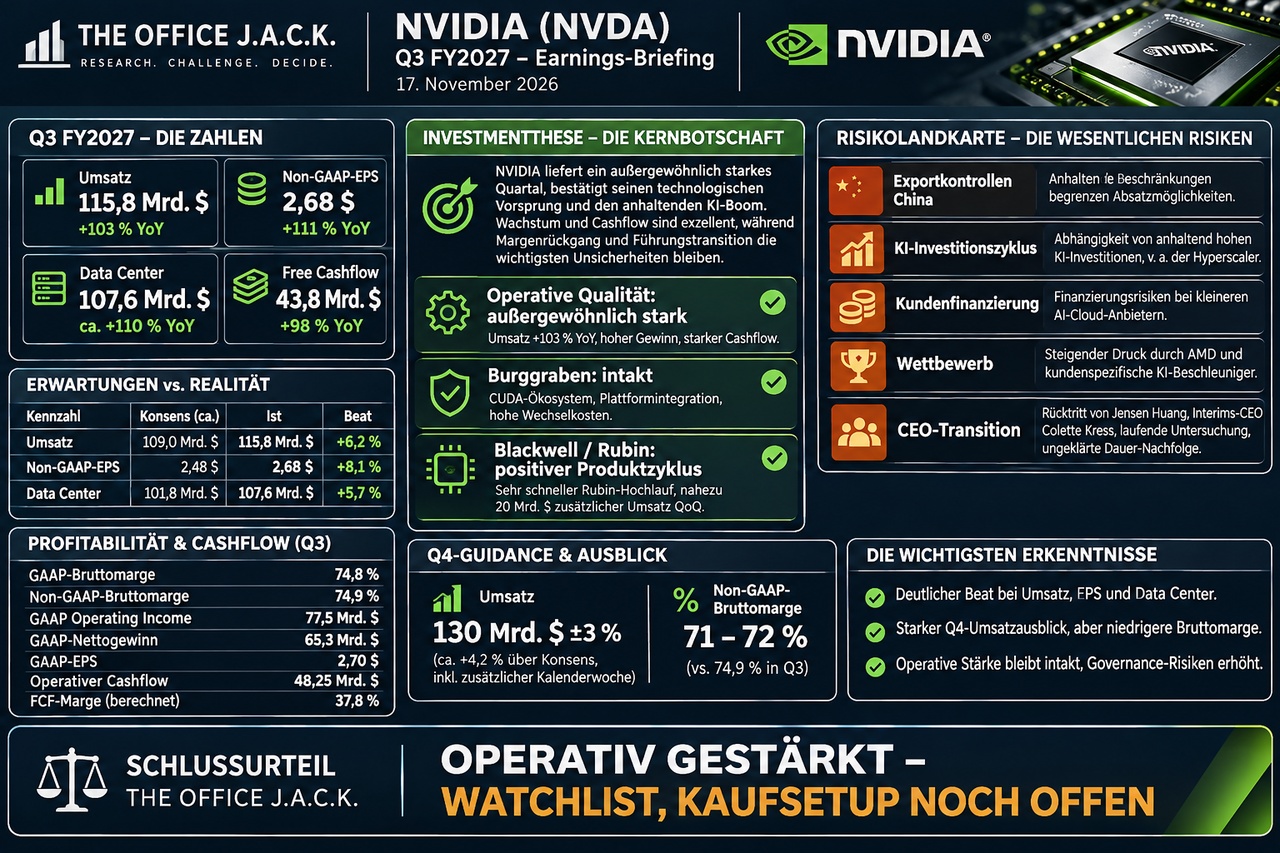
NVIDIA exceeds expectations on all key quarterly metrics.
Quarterly revenue
$115.8 billion
+103% YoY
Non-GAAP EPS
$2.68
+111% YoY
GAAP Net Income
$65.3 billion
+105% YoY
Free cash flow
$43.8 billion
+98% YoY
Key figures reported:
- Revenue: $115.8 billion → +103% YoY
- Data Center revenue: $107.6 billion → approx. +110% YoY
- GAAP gross margin: 74.8% → +1.4 percentage points
- Non-GAAP gross margin: 74.9% → +1.4 percentage points
- GAAP operating income: $77.5 billion → +115% YoY
- Non-GAAP operating income: $77.9 billion → +116% YoY
- GAAP EPS: $2.70 → +108% YoY
- Non-GAAP EPS: $2.68 → +111% YoY
- Free Cash Flow: $43.8 billion → +98% YoY
Expectations vs. Reality
Key Figure
Consensus approx.
$109.0 billion
Actual
Beat
Revenue
$115.8 billion
+6.2%
Non-GAAP EPS
$2.48
$2.68
+8.1%
Data Center
$101.8 billion
$107.6 billion
+5.7%
Consensus figures from analyst reports published prior to the earnings release. Comparative figures vary slightly among providers. marketbeat.com +2
Operating profit is particularly impressive.
While revenue more than doubled year-over-year, operating profit grew even faster.
This means that NVIDIA continues to achieve significant economies of scale.
Data Department’s Assessment: 🟢
A clear beat on revenue and profit. Operational strength has not been lost even after the recent growth spurt.
━━━━━━━━━━━━━━━━━━
🧠 ANALYST | The operational thesis
NVIDIA’s business model continues to be in an extraordinary growth phase.
The key development is not just the rising demand for AI chips.
NVIDIA is increasingly evolving into a provider of complete AI infrastructure systems—including accelerators, networking technology, software, and integrated computing platforms.
🚀 Vera Rubin – The Next Growth Engine
NVIDIA describes the launch of Vera Rubin as the fastest product rollout in its history.
According to the presentation:
- Vera Rubin contributed nearly $20 billion in additional revenue compared to the previous quarter.
- Demand is coming from hyperscalers as well as AI cloud and enterprise customers.
- At the same time, Blackwell remains a significant revenue driver.
- In its MLPerf training debut, Rubin NVL72 achieved up to twice the performance per GPU as Blackwell Ultra.
This is strategically important.
A major risk for fast-growing semiconductor companies is that the next product generation will be delayed or that demand for the current product will decline.
The numbers so far show the opposite: NVIDIA is benefiting simultaneously from Blackwell and the ramp-up of Rubin.
Demand Is Broadening
Demand from the major hyperscalers remains strong.
Even more remarkable, however, is the growth in the AI cloud, industrial, and enterprise sectors.
This segment is growing from $16.1 billion to $47.5 billion—an increase of about 195%.
In the long term, this could mean:
- A larger addressable AI infrastructure market.
- A broader customer base beyond the largest technology companies.
- Additional demand from industrial AI applications.
- Deeper integration of NVIDIA platforms into business processes.
- Recurring investments in new generations of hardware.
The potential moat is based on the synergy between CUDA, development tools, network infrastructure, software integration, and the installed hardware base.
However: The increasing adoption by smaller AI cloud providers does not necessarily lead to lower risk. The financial stability of these customers and their funding deserve special attention.
Analyst’s Assessment: 🟢
The operational growth thesis is significantly strengthened. Rubin is delivering a compelling product rollout, while the demand base is expanding beyond traditional hyperscalers.
━━━━━━━━━━━━━━━━━━
🔍 VALUATOR | What do the numbers mean for the company’s value?
This is where the firm takes a particularly critical view.
The quality of the quarter is exceptional. However, this does not automatically mean that the stock is attractive at every price.
Earnings Growth
Key Figure
Q3 FY2026
Revenue
$57.0 billion
GAAP Operating Income
$36.0 billion
GAAP Net Income
$31.9 billion
GAAP EPS
$1.30
Q3 FY2027
Revenue
$115.8 billion
GAAP Operating Income
$77.5 billion
GAAP Net Income
$65.3 billion
GAAP EPS
$2.70
The operating margin increases, on a pro forma basis, from approximately 63.2% to 66.9%.
This represents a significant improvement from an already exceptionally high level.
Cash Flow Quality
Free cash flow increases from $22.1 billion to $43.8 billion.
However, the FCF margin is trending somewhat differently.
Key Metric
Q3 FY26
Free Cash Flow
$22.1 billion
FCF Margin
38.8%
Q3 FY27
Free Cash Flow
$43.8 billion
FCF Margin
37.8%
Investments in Property, Plant, and Equipment and Intangible Assets*
$1.64 billion
$4.42 billion
*Acquisitions reported in the NVIDIA cash flow reconciliation, excluding depreciation and amortization expenses for property, plant, and equipment, which are shown separately.
The absolute cash flow trend is impressive.
However, the FCF margin is declining slightly, while investments are rising significantly faster than revenue.
This is not yet a warning sign of a structural deterioration. But it shows why we should not evaluate free cash flow in isolation based on the absolute growth rate.
Stock-Based Compensation and Earnings Quality
One positive point: NVIDIA has been including stock-based compensation in its non-GAAP results since Q1 FY2027. The comparative figures have been adjusted accordingly.
As a result, adjusted earnings are no longer artificially inflated by a blanket exclusion of these compensation costs.
At the same time, the GAAP earnings include a gain of approximately $1.77 billion from equity securities.
This is not income from the operating sale of AI infrastructure.
Consequently, GAAP EPS of $2.70 is actually slightly higher than the adjusted EPS of $2.68.
For a normalized valuation, the Office would consider such investment income separately.
Has NVIDIA become cheaper as a result?
Fundamentally, the figures strengthen the basis for a higher earnings estimate.
But to arrive at a robust fair value for the company, we need:
- A verified current stock price.
- The updated earnings estimates for FY2028 and FY2029.
- A normalized margin assumption following the Rubin ramp-up.
- The trend in actual free cash flow.
- A valuation that takes into account the additional governance risk.
A reverse DCF or a complete fair value calculation cannot yet be reliably performed based on this quarterly presentation alone.
Analyst’s conclusion: 🟡
Operating value creation is exceptionally strong. The higher profits strengthen the company’s value, but this does not yet prove that the stock is specifically undervalued.
━━━━━━━━━━━━━━━━━━
📰 NEWS SECTION | Guidance and Strategic Developments
Now we come to the crucial part of the earnings report.
Q4 FY2027 – the new forecast
Key Figure
Q3 Actual
Revenue
$115.8 billion
Non-GAAP Gross Margin
74.9%
Non-GAAP Operating Expenses
$8.8 billion
Q4 Guidance
Revenue
$130 billion ±3%
Non-GAAP Gross Margin
71–72%
Non-GAAP Operating Expenses
approx. $10.7 billion
The forecast implies nominal revenue growth of approximately 12.3% compared to Q3.
At first glance, that seems enormous.
But here we need to take two important factors into account.
⚠️ Q4 includes an extra week
NVIDIA’s fourth quarter spans 14 weeks instead of 13.
Mathematically speaking, a revenue forecast of $130 billion normalized to 13 weeks would correspond to approximately $120.7 billion.
That would represent only about 4.2% growth compared to the third quarter.
This calculation assumes an even distribution of revenue and is not an official company forecast.
Nevertheless, it shows why the $130 billion figure, when taken at face value, should not be interpreted as evidence of another massive acceleration.
⚠️ The gross margin is expected to decline
Even more significant is the decline in the expected gross margin.
From 74.9% in the third quarter to 71–72% in the fourth quarter.
Based on the midpoint of the forecast, this represents a decline of 3.4 percentage points.
Possible explanations include:
- A shift in the revenue mix between chips and complete systems.
- Higher costs during the early Rubin production ramp-up.
- Changes in the production and supply structure.
- Additional costs due to components and storage capacities.
These explanations are hypotheses at this point. The presentation does not quantify the causes.
The decline in margins is therefore the most important unresolved operational issue.
🇨🇳 China remains excluded
NVIDIA continues to exclude data center compute revenue from China from its Q4 revenue forecast.
On the one hand, this limits the immediately addressable market.
On the other hand, a potential easing of export restrictions would represent an additional growth opportunity that is not currently included in the guidance.
However, such an easing should not be assumed to be likely.
👔 Jensen Huang – The Leadership Crisis
On November 12, NVIDIA confirmed the resignation of Jensen Huang as CEO and member of the Board of Directors. Colette Kress was appointed interim CEO, and Harvey C. Jones was named Chairman of the Board. nvidianews.nvidia.com
This represents an unusually significant strategic turning point for NVIDIA.
For decades, Huang shaped the company’s architecture, platform strategy, and corporate culture.
The current presentation explicitly identifies the successful leadership transition and the recruitment and retention of executives as risks.
Three questions remain unanswered:
- Can NVIDIA maintain its current pace of product development and innovation in the long term without Huang?
- How will capital allocation, strategic investments, and partnerships change under the new leadership?
- Will the ongoing uncertainty have a lasting impact on the valuation multiple?
News Department’s Assessment: 🟡
The guidance signals strong demand but includes a significant margin decline and a one-time calendar-related effect. At the same time, the CEO succession remains a key governance issue.
━━━━━━━━━━━━━━━━━━
🛡️ RISK MONITOR | What could go wrong?
Despite the impressive numbers, the firm sees several risks.
Margin trend: The gross margin of 71–72% expected for Q4 could indicate temporary ramp-up costs or a permanently altered product mix. An explanation is pending.
Capital intensity: Investment requirements are increasing significantly. Even as free cash flow grows, NVIDIA must maintain its high cash flow conversion rate over the long term.
Dependence on the AI investment cycle: A significant portion of demand continues to depend on investment decisions by major technology conglomerates and AI infrastructure operators.
Customer Financing: Strong growth among AI cloud providers may entail additional credit, financing, and counterparty risks.
Competition: AMD, custom AI accelerators, and in-house developments by hyperscalers could put downward pressure on prices and market share in the long term.
China and export controls: Geopolitical restrictions may limit sales opportunities and result in additional compliance costs.
Leadership Change: The founder’s resignation creates uncertainty regarding strategic continuity, management retention, and long-term capital allocation.
Valuation: Even a company with exceptional profits can deliver a disappointing stock return if the expectations previously priced into the stock were even higher.
Risk Monitor’s Assessment: 🟡
The core operational thesis remains valid. The risks primarily concern future margins, the sustainability of AI investments, and the governance structure.
━━━━━━━━━━━━━━━━━━
⚔️ CRITICS | The Uncomfortable Counterargument
At first glance, the report appears nearly flawless.
Revenue doubled. Profit doubled. Free cash flow nearly doubled.
But the critic wants to know whether NVIDIA can sustain its extraordinary performance in the long term—or whether the current figures already reflect a particularly strong phase of the AI investment cycle.
First: The Margins
The gross margin rose to 74.9% in the third quarter.
However, management expects it to drop to just 71–72% as early as the next quarter.
That’s no small matter.
With quarterly revenue of $130 billion, a one-percentage-point difference in gross margin translates to $1.3 billion in gross profit.
A sustained decline in margins could therefore have a significant impact on profits.
Second: Adjusted revenue growth
The Q4 guidance of $130 billion appears spectacular.
However, after a simple adjustment for the additional calendar week, the calculated quarterly increase is significantly more moderate.
This raises an important question:
Is underlying revenue growth actually continuing to accelerate—or is NVIDIA gradually approaching a normalization at a very high level?
Third: The Quality of Demand
The rise in revenue outside the largest hyperscalers is positive.
But it does not yet prove that all customers can sustainably refinance their AI investments.
If part of the demand is driven by overly optimistic expectations regarding future AI revenues, investment programs could slow down later on.
Fourth: Valuation
Revenue growth of 103% is extraordinary.
But if the market already expects very high growth rates and margins to persist, even a quarter like this does not necessarily guarantee further price increases.
Critics therefore ask two questions:
How much growth and how high margins are already priced into the stock price?
And:
How significantly would the fair value of the company change if NVIDIA were to expand at only 15–20% in the long term instead of at exceptionally high double-digit growth rates?
The critic’s verdict: 🟡
The operating results are impressive. However, the expected decline in margins, the calendar-driven increase in Q4 guidance, and potential shifts in the AI investment cycle preclude an unreservedly bullish interpretation.
━━━━━━━━━━━━━━━━━━
SPECIAL REVIEW | Jensen Huang and the CEO Transition
The leadership crisis is a separate risk factor and must not be conflated with the company’s operational performance.
What has been confirmed?
Jensen Huang stepped down as CEO in November 2026. The former CFO, Colette Kress, temporarily took over leadership of the company.
The board of directors is searching for a permanent successor.
What has not been proven?
Media reports regarding personal relationships, potential conflicts of interest, and security risks contain allegations, not conclusively established misconduct.
An independent investigation or the corresponding audit procedures must therefore be distinguished from confirmed facts.
Does Jensen Huang want to return?
On November 17, Reuters reported that Huang was willing to return. At the same time, according to informed sources, the Board of Directors is not currently considering reinstating him.
This means that a return has neither been decided nor is it certain.
What does this mean for NVIDIA?
Governance: A clear, credible investigation and a permanent succession plan are essential to restoring the confidence of institutional investors.
Customer relationships: Major hyperscalers are long-term business partners. Operational contractual relationships do not necessarily have to be affected by the CEO change, but strategic negotiations could become more difficult.
Product Roadmap: Short-term Rubin production is already underway. This reduces immediate implementation risks. However, the long-term technological direction under new leadership has yet to prove itself.
Key-Person Risk: For decades, Huang has been a defining figure in technology, corporate culture, and capital allocation. His departure is therefore not equivalent to a typical CEO transition.
Stock Valuation: Even with profits remaining high, a persistent governance discount could weigh on the price-to-earnings ratio.
Special Audit Findings: 🟠
The leadership crisis does not invalidate the operational investment thesis. However, it increases uncertainty regarding strategy, governance, and the long-term valuation premium.
————————————————————————
⚖️ MANAGEMENT | The Final Verdict
The firm reaches a clearly positive operational conclusion, albeit with relevant strategic caveats.
NVIDIA once again demonstrated its exceptional profitability in the third quarter.
Particularly impressive:
🟢$115.8 billion in revenue → +103% YoY
🟢$107.6 billion in data center revenue
🟢$2.68 in adjusted EPS → +111% YoY
🟢$77.5 billion GAAP operating income
🟢$43.8 billion free cash flow → +98% YoY
According to the company, Vera Rubin is scaling exceptionally quickly
The operating results show that NVIDIA continues to benefit from an extremely strong AI infrastructure cycle.
At the same time, the company has so far demonstrated that the transition between new hardware generations does not necessarily lead to a disruption in growth.
What’s Still Missing
🟡 A robust explanation for the expected Q4 margin decline.
🟡 A comparison of underlying growth momentum adjusted for the additional calendar week.
🟡 A comprehensive review of accounts receivable, inventory, and working capital.
🟡 An updated valuation that takes into account long-term normalized margins.
🟡 Clarity regarding the CEO succession and the implications of the leadership change.
🟡 A verified after-hours stock price reaction.
The Different Perspectives Within the Analysis
The analyst sees clear confirmation of the long-term growth thesis. Vera Rubin, rising platform revenues, and the broader demand base strengthen NVIDIA’s strategic position.
The critic warns against uncritically extrapolating the strong quarterly figures. The Q4 margin and the additional calendar week, in particular, deserve attention.
The evaluator acknowledges the exceptional operational value creation but requires normalized free cash flow assumptions and updated market valuations.
The risk monitor views the unresolved leadership transition and the dependence on high AI investments as significant sources of uncertainty.
Management concurs with these findings.
NVIDIA delivers a convincing operational beat and a strong revenue forecast. However, margin trends and governance risks prevent this from automatically resulting in an unreservedly positive stock rating.
━━━━━━━━━━━━━━━━━━
🏛️ THE OFFICE J.A.C.K. – EXPERT OPINION
Evaluation Criteria
Rating
Business Quality
🟢 Exceptionally strong
Moat
🟢 Core thesis intact
Revenue Growth
🟢 Significantly above expectations
Profitability
🟢 Q3 outstanding
Cash Flow
🟢 Very strong, margins slightly declining
Product Development
🟢 Rubin ramp-up convincing
Q4 Revenue Guidance
🟢 Strong, note calendar adjustment
Q4 Margin Guidance
🟡 Significant decline
Governance
🟠 Leadership transition unresolved
Valuation
⚪ Update required
Long-term thesis: INTACT AND OPERATIVELY STRENGTHENED.
Earnings Assessment: Exceptional revenue and earnings beat with strong cash flow and a successful Rubin ramp-up. The lower margin forecast and the unresolved leadership crisis remain the key concerns.
Conclusion: WATCHLIST / LONG-TERM THESIS CONFIRMED – BUY SETUP OPEN.
For our firm, the next key signals are:
→ Management’s explanation for the Q4 gross margin of 71–72%.
→ Sustainability of demand for Rubin and Blackwell.
→ Trends in inventory, accounts receivable, and cash flow conversion.
→ Further investment plans by hyperscalers and AI cloud customers.
→ Official clarification of the CEO succession.
→ Revaluation based on updated earnings and cash flow estimates.
Operationally, NVIDIA is delivering exactly what long-term investors want: strong growth, high profitability, and exceptional cash flow generation.
Now the company must prove that this earnings power can be sustained even as growth rates normalize and under new leadership. 👀
━━━━━━━━━━━━━━━━━━
THE OFFICE J.A.C.K.
Research. Challenge. Decide.

