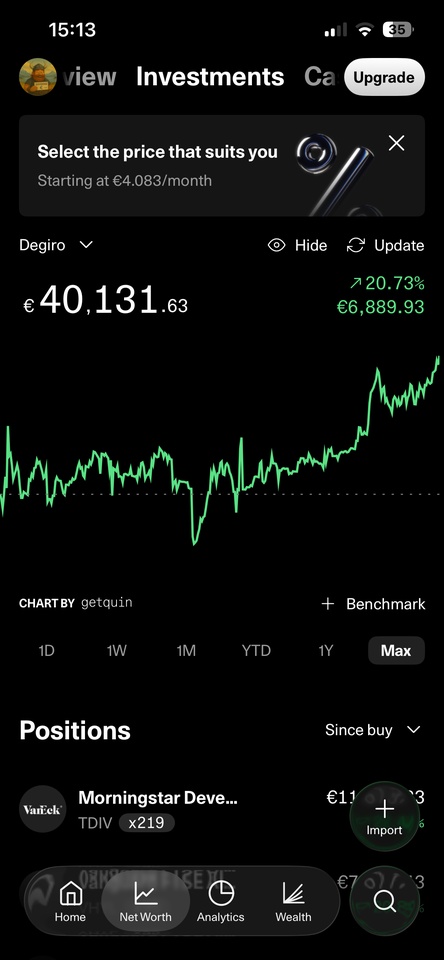
Allocating ~$10,500 more to Unilever, as it is a key defensive position, and we are underexposed to consumer staples.
This brings our $ULVR (-0.34%) holdings at 395 shares worth ~$22,780.

Posts
348Allocating ~$10,500 more to Unilever, as it is a key defensive position, and we are underexposed to consumer staples.
This brings our $ULVR (-0.34%) holdings at 395 shares worth ~$22,780.
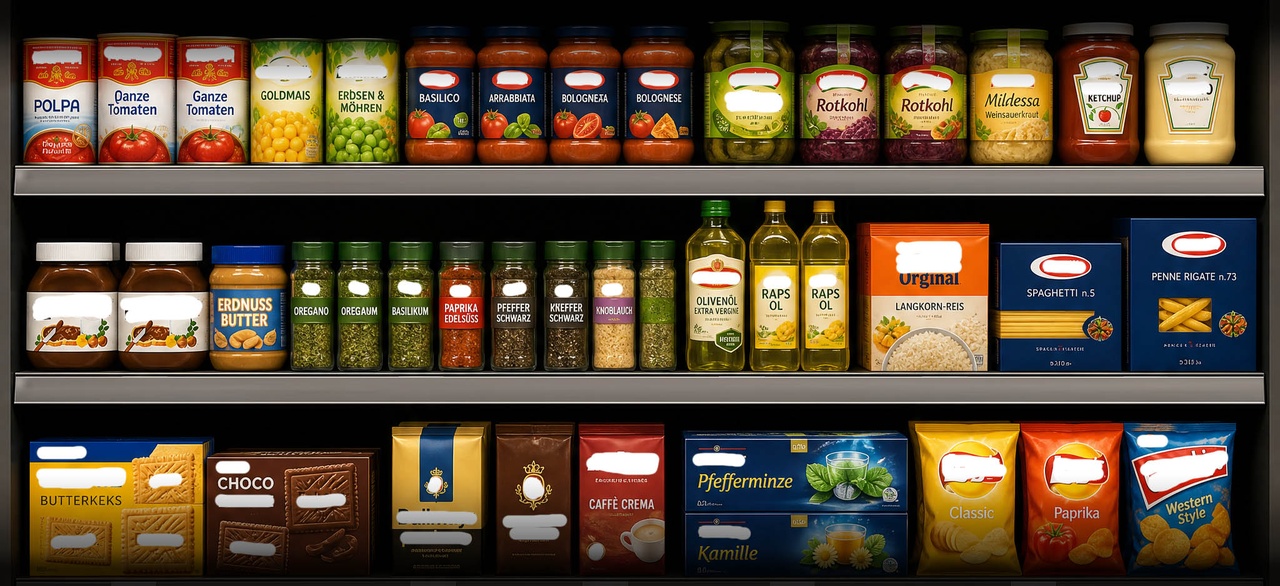
I have noticed that shares in food manufacturers are somehow not in demand at all at the moment. Why is that? Consumer staples and food should actually offer a certain degree of resilience in turbulent times, as people always eat regardless of economic growth and the economy. So why is this sector just bobbing around like this?
Here are a few examples:
$ULVR (-0.34%) Unilever, YTD = -9.1% , P/E=18.3, Divi = 4%
$NESN (+0.29%) Nestle, YTD = + 2.4%, P/E=22.4, Divi = 4%
$HRL (+0.62%) Hormel Foods, YTD = -11% , P/E=23.3 , Divi = 5.7%
$GIS (-1.4%) General Mills, YTD = -21.8%, P/E=8.6 , Divi = 6.8%
$KHC (+0.3%) Kraft Heinz, YTD = -3.1% , P/E=negative , Divi = 6.8%
$FLO (-3.88%) Flowers Foods, YTD = -20% , P/E=21.81 , Divi = 11.5%
$NOMD (-3.34%) Normad Foods, YTD = -17.2% , P/E=9.8 , Divi = 6.8%
$TBS (-0.34%) Tiger Brands, YTD = -20% , P/E=12 , Divi = 11.4%
I understand that many branded companies are coming under increasing pressure from the discounters' own brands when the economy is bad, but is that really the whole truth?
(Illustration generated with lovart.ai, modified in Photoshop)

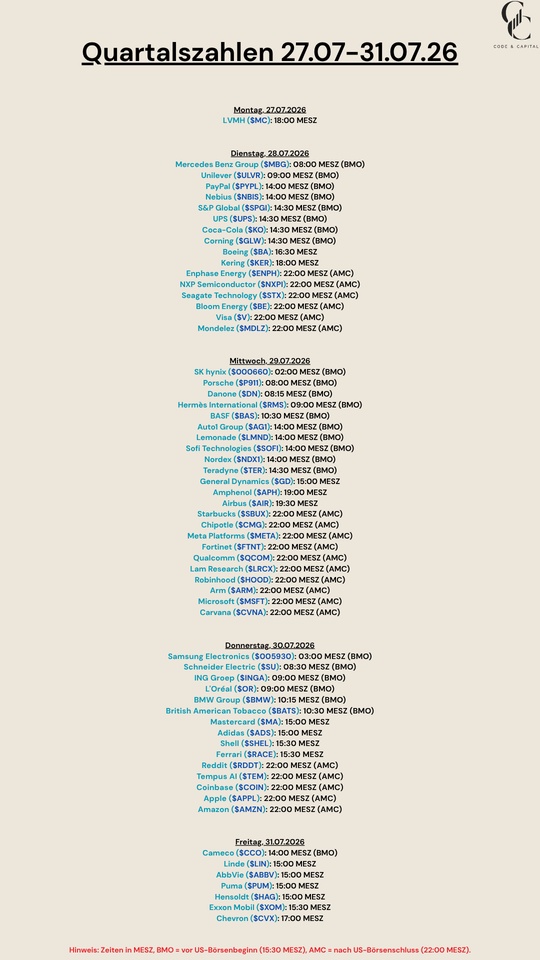
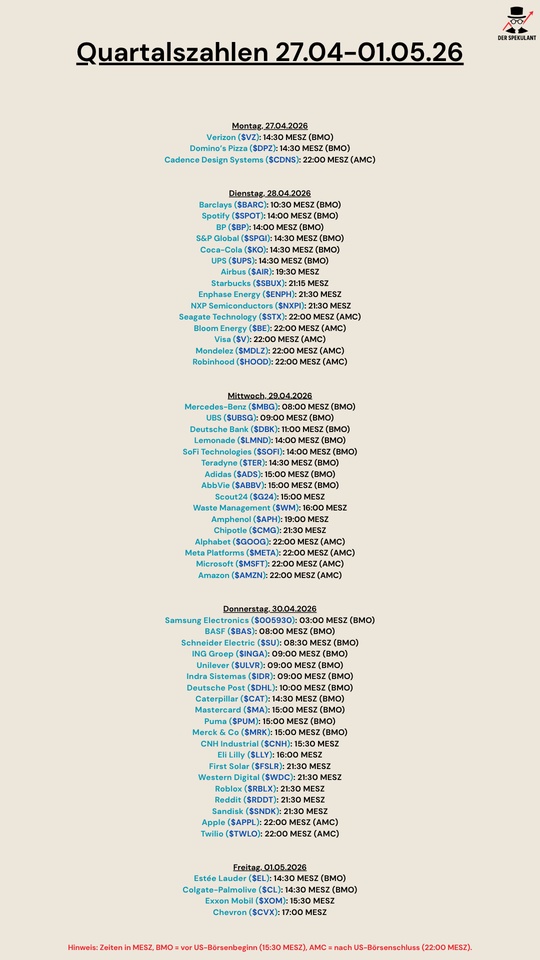
$VZ (+0.82%)
$DPZ (+0%)
$CDNS (+2.56%)
$BARC (+0.1%)
$SPOT (+16.3%)
$BP. (+0.63%)
$SPGI (-0.63%)
$KO (-0.11%)
$UPS (-0.17%)
$AIR (-3.8%)
$SBUX (-0.96%)
$ENPH (+11.35%)
$NXPI (-2.87%)
$STX (+7.78%)
$BE (+10.97%)
$V (+0.49%)
$MDLZ (-0.6%)
$HOOD (+0.05%)
$MBG (-0.24%)
$UBSG (-0.02%)
$DBK (-0.38%)
$LMND (+0.18%)
$SOFI (-1.06%)
$TER (+2.58%)
$ADS (+1.03%)
$ABBV (+0.93%)
$G24 (-2.99%)
$WM (-0.04%)
$APH (+0.81%)
$CMG (-0.35%)
$GOOG (+0.82%)
$META (-0.01%)
$MSFT (-0.29%)
$AMZN (+0.41%)
$005930
$BAS (+1.66%)
$SU (-0.57%)
$INGA (+0.69%)
$ULVR (-0.34%)
$IDR (-1.4%)
$DHL (-0.16%)
$CAT (-0.89%)
$MA (+0.63%)
$PUM (+2.19%)
$MRK (+0.82%)
$CNHI (-4.33%)
$LLY (+2.34%)
$FSLR (+3.44%)
$WDC (+5.25%)
$RBLX (+2.3%)
$RDDT (+3.59%)
$SNDK
$AAPL (+1.01%)
$TWLO (-2.49%)
$EL (+0.4%)
$CL (-0.99%)
$XOM (+0.39%)
$CVX (+0.45%)
The company is not broken , the world around it became more difficult, and that pushed the price down for now. And the company is changes to household products instead of food etc. What do you think? I think when the war will end, it goed up fast.
Hello everyone,
here is my review for March. Even really early this time.
📈 Performance:
S&P500: -3.9%
MSCI World: -4.8%
DAX: -10.3%
Dividend portfolio: -5.9%
My high and low performers in March were (top/flop 3):
🟢 ($PETR4 (+1.27%) ) Petroleo Brasileiro +19.38%
🟢 ($ADM (+0.45%) ) Archer Daniels +10.98%
🟢 ($GAIN (+1.15%) ) Gladstone Invest +4.08%
🔴 ($CTAS (+1.82%) ) Cintas -13.88%
🔴 ($MC (+0.98%) ) LVMH -14.49%%
🔴 ($ULVR (-0.34%) ) Unilever -18.70%
Dividends:
March 2026: €178.82
March 2025: € 182.98
Change: -2.27%
This change is partly due to the fact that the USD exchange rate is still worse than last year. In addition, Imperial Brands also paid a significantly higher dividend last year (I think it was a special dividend). Otherwise, Unilever only pays in April and STAG has also switched to quarterly distributions, so that nothing was paid in March either.
Sales:
🟥 None
Purchases:
🟩 SIXT ($SIX2 (-0.8%) )
🟩 Ferrari ($RACE (+1.42%) )
Savings plans:
($CTAS (+1.82%) ) Cintas (50€)
($MC (+0.98%) ) LVMH (50€)
($MSFT (-0.29%) ) Microsoft (25€)
The sale of Lockheed Martin in February was fairly neutral from a purely price perspective. Lockheed has neither risen nor fallen significantly. So far, I have no regrets about the sale (although the dividend for March is now missing, of course).
What else has happened?
March was pretty up and down. In terms of performance, this was one of the worst months ever for me. The only worse month for me was September 2022 with -6.3%.
The nest egg continues to grow and, as I said, it will be fully built up in April. But I may have to work on it again. At the moment, I'm thinking about a photovoltaic system. With an almost new build, heat pump, hybrid and purely electric car, the advantages are obvious. The roof is south-facing. So I would benefit fully. The only question is how to finance it. Do I need the money that is earmarked for the loan repayment in 5 years? 100% financing from the bank? At the moment I've sent out a few requests for quotations.
My Payback points were stolen in February. 12995 points were used for a payment at DM. Well, I just hadn't activated the 2FA. Stupid myself. I wrote about it in last month's report. In fact, the Payback points were credited back to me by DM at the beginning of March. I don't know whether this was a scam or whether Payback did something because of my call. I only saw it by chance and of course had everything paid out directly to my account. Lesson learned - I will rebook more often in future.
🥅 Goals for 2026:
I'm trying to reach €85,000 in my dividend portfolio this year. This is to be achieved through dividends, deposits and, of course, share price increases. Let's see how things look at the end of the year, as the first quarter was rather sluggish. I'll have to make up for that over the course of the year.
Anyone who liked the report and would like to read more is welcome to follow me,
If you're not interested, you can keep scrolling or use the block function.
$ULVR (-0.34%) is now divesting itself of the $MICC (+0.11%) the food business.
The food division is being merged with McCormick $MKC (+0.05%) to form a ~€20 billion food giant.
Unilever thus develops into a pure Home & Personal Care player, with sales of €40 billion and an operating margin of ~20%.
With the planned demerger in mid-2027, Unilever shareholders will receive pro rata shares in the combined food company with McCormick. At the same time, Unilever is strategically focusing more clearly on the higher-growth and more attractive margin segments.
Unilever Press Release: https://www.unilever.com/news/press-and-media/press-releases/2026/unilever-announces-the-combination-of-unilever-foods-with-mccormick/
Hello my dears,
Recently, consumer goods giants were mentioned here as a good hedge in times of war.
I was perhaps not entirely wrong in my opinion that this would not be a good choice after all.
The consumer goods group is reacting to the economic consequences of the war in Iran and is halting new recruitment worldwide for at least three months. The move is part of a comprehensive cost-cutting program.
The consumer goods group Unilever has imposed a worldwide hiring freeze at all levels with immediate effect. The manufacturer of brands such as Dove and Knorr is thus reacting to die wirtschaftlichen Folgen des Iran-Kriegsaccording to an internal letter obtained by the Reuters news agency.
The freeze is to last at least three months. "The macroeconomic and geopolitical realities, particularly the conflict in the Middle East, pose significant challenges for the coming months," Fabian Garcia, head of the personal care division, wrote to employees last week. The war, which has been going on for a month now, has disrupted global trade and caused the most serious Unterbrechung der Öl- und Gasversorgung in der Geschichte verursacht.
The hiring freeze comes on top of an already ongoing savings program. Unilever The company wants to save around 800 million euros within three years from 2024 and cut around 7500 jobs in the process. The britische Group has been struggling with weak sales figures since the coronavirus pandemic.
r is currently negotiating the sale of its food division to its smaller competitor McCormick. The number of employees has already fallen from around 149,000 in 2020 to 96,000 at present. Unilever shares rose by 1.1 percent in London on Monday.
Konsumgüterkonzern: Unilever verhängt globalen Einstellungsstopp wegen Iran-Krieg
The British consumer goods giant Unilever is considering a sale worth billions. This would also affect the traditional German brand Knorr.
The traditional German brand Knorr could soon change hands. The British consumer goods group Unilever is negotiating the sale of its food division to the US spice manufacturer McCormick & Company. Unilever announced on Friday that it had received a corresponding purchase offer from its smaller rival. The division also includes brands such as Hellmann's, Colman's and Marmite.
However, it remains to be seen whether an agreement will actually be reached. Both companies emphasized in separate announcements that there is no certainty that the talks will be concluded. They did not provide any financial details. Last year, the division accounted for around a quarter of Unilever's turnover and generated sales of more than 12.9 billion euros.
The talks are in line with Unilever CEO Fernando Fernandez's strategy of focusing the group more strongly on higher-margin areas such as beauty and personal care following the spin-off of the ice cream business. The portfolio there includes brands such as Axe, Rexona and Dove. The processed food business, on the other hand, is under pressure across the industry.
Pure share transaction planned
The companies confirmed the negotiations after the Wall Street Journal reported on them on Thursday evening. According to the report, it could be a pure share transaction that could take place in the coming weeks. The Financial Times had already reported in March that Unilever had previously unsuccessfully considered merging its food division with Kraft Heinz's sauces business.
Unilever shares rose around one percent on the stock exchange at the start of trading. However, Tineke Frikkee, portfolio manager at Unilever investor W1M, was skeptical. McCormick is significantly smaller than Unilever's food division, which generates around three times the profit of the US company. It is therefore unclear what added value a joint venture could create.

My entire position in $ULVR (-0.34%) sold. They are in the process of splitting off the nutrition division. I am tired of the divestitures.
$ULVR (-0.34%) presented its figures for the fourth quarter and the full year 2025 today - with a result that at first glance does not quite meet expectations.
Despite the sales disappointment $ULVR (-0.34%) strong volume and price growth in the quarter (4.2% organic in Q4) as well as progress in the portfolio mix. Operating margin improved and free cash flow remained robust at c. €5.9bn with 100% cash conversion.
Outlook for 2026:
For 2026, management expects sales growth at the lower end of the target range of 4-6%, including at least 2% volume growth, and anticipates moderate margin improvements. At the same time, a new share buyback program of € 1.5 billion was announced and Unilever reiterates its focus on attractive, growing dividends.
I will continue to monitor the following points for myself:
How do you assess these results and the outlook? Is this just a temporary blip or an indication of structural challenges in the consumer goods sector?
Top creators this week