
Hello, everyone,
Following our last stock showdown between Eli Lilly $LLY (+2.49%) and Novo Nordisk $NOVO B (+2.56%) , today we’re deliberately switching industries.
Away from weight-loss injections, drug pipelines, artificial intelligence, and major tech topics—and toward a business that operates behind the scenes, yet without which our modern economy could hardly function:
global logistics.
Because no matter which new smartphone is sold, which medication is produced, or which online store is supplied—in the end, raw materials, components, and finished goods actually have to get from one place to another.
By plane, container ship, truck, and finally to the warehouse or directly to the customer.
This is exactly where companies like DSV $DSV (+0.21%) and Kühne+Nagel $KNIN (-0.1%) make their money.
These may not be the stocks everyone talks about every day. But they ensure that the products of the big stock market stars actually make it onto the roads, into the factories, and to the customers.
That’s why two of the world’s leading logistics groups are going head-to-head today:
DSV from Denmark and Kühne+Nagel from Switzerland.
Both manage global supply chains, but they take different approaches.
DSV has relied heavily on major acquisitions for years and must now prove whether the massive integration of DB Schenker is truly paying off.
Kühne+Nagel is growing less spectacularly but is currently impressing with a stronger balance sheet, solid operational performance, and new growth areas centered on cloud infrastructure, healthcare, and its partnership with Amazon and AWS.
As always, we’ll take a look at the business models, current figures, balance sheets, cash flows, dividends, valuations, as well as opportunities and risks.
Of course, this also includes daily and weekly charts, as well as specific potential entry points.
The key question this time is:
Is DSV, with its enormous potential for synergies and growth, the more exciting stock—or is Kühne+Nagel, with its proven quality, stronger balance sheet, and cleaner chart the better choice in the end?
Enjoy today’s stock duel: DSV $DSV (+0.21%)
vs. Kühne+Nagel $KNIN (-0.1%)
— integration giant versus quality leader.
What this duel is really about
Neither company sells its own ships or aircraft; instead, they manage global supply chains. Their most important “raw material,” therefore, isn’t steel but information:
Whoever does a better job of coordinating capacity, routes, customs, warehousing, and customer demand earns revenue from every container shipped or every air freight shipment.
That’s what makes scale valuable—and explains why DSV has been acquiring companies for decades, while Kühne+Nagel grows more through organic expansion and specialization.
DSV has become a global platform following the acquisition of DB Schenker.
Kühne+Nagel remains more compact but, by its own account, is the world’s number one in air and ocean freight volume.
The comparison is therefore less a case of David versus Goliath than two different operating systems:
DSV buys scale and squeezes out synergies; Kühne+Nagel tries to use its existing scale in a more profitable and customer-oriented way.
DSV: The Schenker Bet
The enterprise value of the Schenker transaction was 106.7 billion DKK.
DSV expects annual synergies of approximately 9 billion DKK, with full financial impact beginning in 2027. By the end of the third quarter of 2026, approximately 8.7 billion DKK of the expected 11 billion DKK in integration and transaction costs had been booked. Nearly all countries have been integrated or are in the midst of the process.
This is both a major opportunity and the greatest risk. If the integration succeeds, buying power, network utilization, cross-selling, and back-office efficiency will all increase.
If it fails in part, the result will be customer losses, duplicate structures, and high debt. DSV reports a gearing ratio of 2.5, while the long-term target is less than 2.0.
Cash flow must therefore first repair the balance sheet before large share buybacks once again become the dominant driver of returns.
Four points are crucial for me:
- Road must stabilize,
- the DKK 9 billion in synergies must not be delayed any further,
- adjusted free cash flow must increase without real estate sales, and
- gearing should fall below 2.0 by 2027.
Kühne+Nagel: Quality with a New Growth Edge
In 2026, Kühne+Nagel announced a seven-year strategic partnership with Amazon and AWS. The focus is on infrastructure, equipment, maintenance, and the expansion of cloud data centers. The agreement is accompanied by a performance-based option on existing Kühne+Nagel shares. This locks Amazon in for the long term but also increases the bargaining power of an already very large customer.
In addition, air freight for cloud and semiconductor customers, healthcare logistics, and integrated contract logistics are growing. In the third quarter, EBIT for Air Logistics rose by 84 percent, Sea Logistics by 55 percent, Road by 40 percent, and Contract Logistics by seven percent.
This is broad enough that we cannot speak of just a single division.
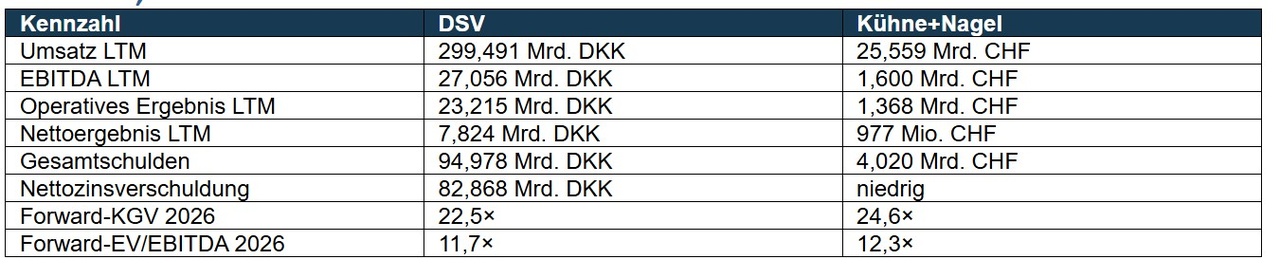
The downside is the valuation. Anyone buying Kühne+Nagel at around 24.6 times expected earnings is assuming that 2026 will not mark a short-term cyclical peak.
The company can hardly afford to make any operational mistakes.
Q3 2026: Who currently has the better momentum?
Kühne+Nagel delivered the stronger quarter. All four segments grew; Air Logistics saw a 10 percent increase in volume in the third quarter, and management raised its forecast once again. At DSV, Air & Sea and Contract Logistics are strong, but Road remains a work in progress. There, quarterly EBIT fell by 35.1 percent because integration, productivity, and customer retention are not yet functioning as planned.
Kühne+Nagel clearly wins the balance sheet comparison. DSV’s debt is strategically justified by the Schenker acquisition, but it is a real economic burden. On the positive side, net interest-bearing debt has been declining since the end of 2025. On the downside, part of the strong Q3 cash flow came from real estate sales. At Kühne+Nagel, cash on hand covers a large portion of the debt, making it easier to weather economic downturns.
Dividends and Capital Returns
Kühne+Nagel is the clear favorite when it comes to dividends.
The six CHF paid for 2025 represent a yield of approximately 2.5 percent at the current price. DSV pays seven DKK, which amounts to only about 0.5 percent.
At DSV, share buybacks have historically been more important than dividends; following the Schenker acquisition, debt reduction is the priority for now.
Kühne+Nagel, on the other hand, distributes a large portion of its profits— in 2025, the payout ratio was around 81 percent.
Valuation and My Own DCF
In the base case, both stocks are trading above my DCF value.
This is not evidence of overvaluation, but rather an indication of market expectations.
For DSV , following the Schenker acquisition, a normalized free cash flow of around 18 billion DKK and several years of growth are needed.
For Kühne+Nagel , it requires free cash flow of around 1.15 billion CHF and consistently solid margins. About three-quarters of both base-case values come from the terminal value—small changes in the cost of capital and long-term growth significantly impact the fair value.
Customer Concentration and AI
Neither DSV nor Kühne+Nagel publishes a reliable top-10 customer ratio. Kühne+Nagel reports having around 400,000 customers. Amazon is strategically important, but the overall customer base remains broad. At DSV, the issue is less about a single major customer and more about the loss of several customers during the Road integration.
DSV expects total productivity gains of approximately 9 billion DKK by 2030 from AI, technology, and network optimization—in addition to the Schenker synergies. Kühne+Nagel expects significant AI effects starting in 2027 and is enhancing its data and cloud infrastructure via AWS. For me, AI is not a competitive moat for either company. It is becoming a tool for route planning, capacity management, quote generation, customs, warehousing, and back-office operations. Whoever integrates processes and data more seamlessly will win; however, the physical network remains indispensable.
Technical Analysis and Entry Strategy
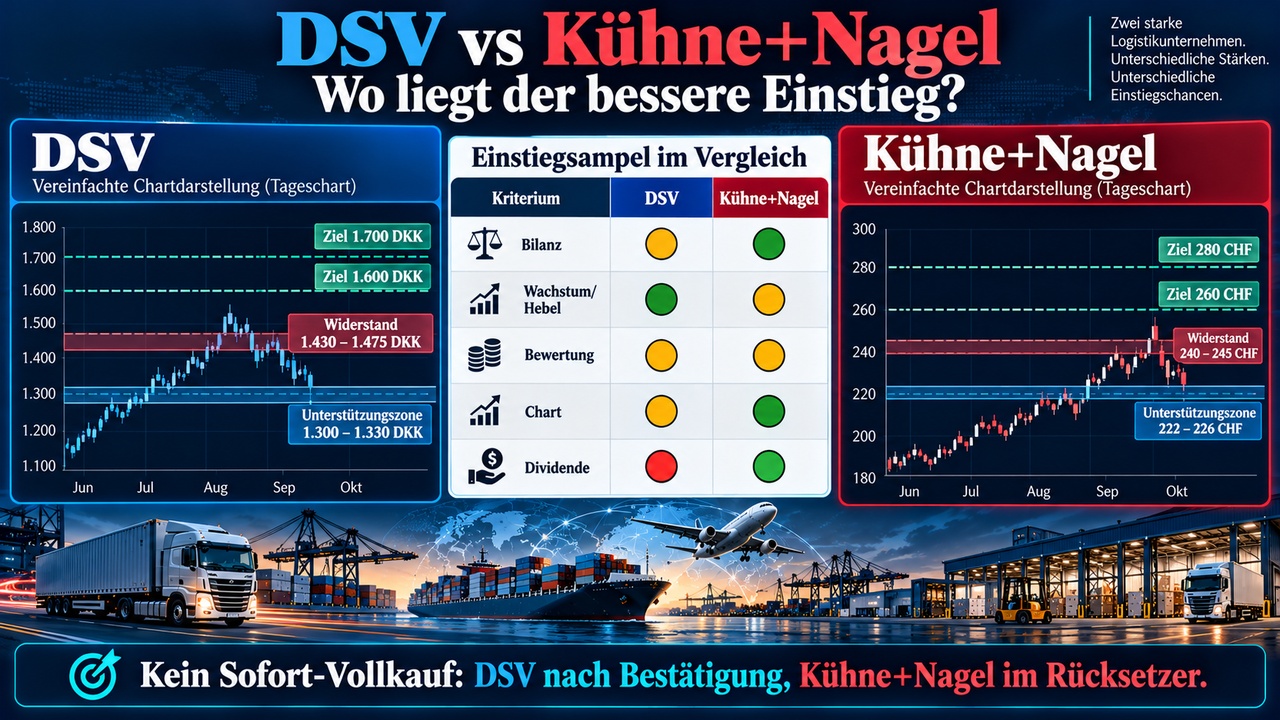
Kühne+Nagel is trading above the 50-day and 200-day EMAs on the daily chart; the RSI is around 63, and the MACD is positive.
The weekly chart confirms the trend but is approaching the resistance zone of 240 to 245 CHF. Entering the position on a pullback around 224 CHF offers a better risk-reward ratio than buying directly at the high.
DSV has made a strong turnaround on the daily chart but remains below the 200-day moving average at 1,432 DKK.
The weekly chart is still neutral: RSI just below 50, MACD still negative but improving. Therefore, I’d like to see either a pullback into the 1,300s or a confirmed breakout above 1,475 DKK.
My Final Verdict
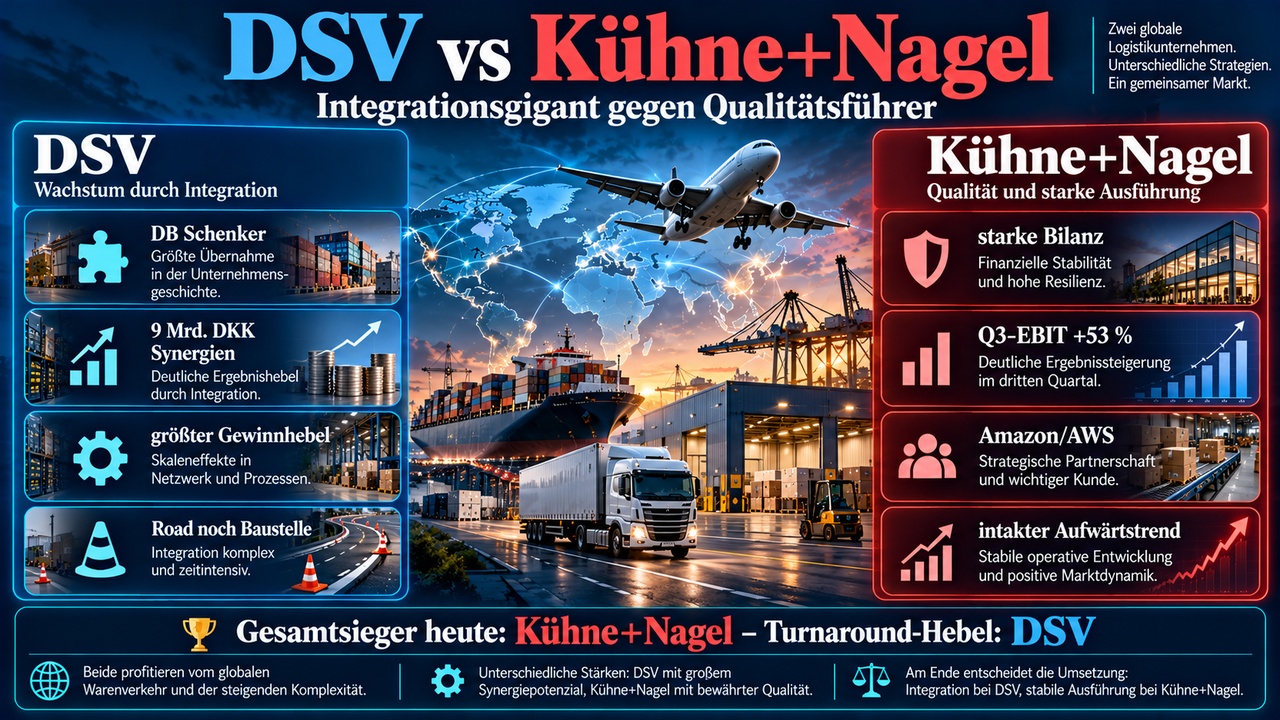
This stock showdown goes to Kühne+Nagel—albeit by a narrow margin.
For me, DSV remains the more exciting bet on successful integration and strong synergies, while Kühne+Nagel currently scores points with its stronger balance sheet, better operational execution, and more convincing chart.
Now I’m curious to hear your thoughts:
Which of the two logistics companies would you prefer?
Are you betting on the greater leverage at DSV $DSV (+0.21%) or on the currently more visible quality of Kühne+Nagel $KNIN (-0.1%) ?
Do you even have stocks like these in your portfolio?
In the next stock showdown, we’ll return to the healthcare sector.
Then, AstraZeneca $AZN (+6.73%)
and Roche $ROP (+0.24%) . Among other things, we’ll be discussing oncology, diagnostics, pipeline quality, patent risks, dividends, and, of course, current valuations.
See you at the next Stock Duel!
Your Raketentoni from Denmark
Sources and Notes
DSV: Q3 2026 Interim Report, Annual Report 2025, Capital Markets Day 2026, and official Schenker data.
Kühne+Nagel: Q3 2026 Earnings, Annual Report 2025, Q3 Presentation, and Amazon/AWS announcement.
ECB reference rates as of October 29, 2026; two research PDFs provided and four charts as of October 30, 2026.
Valuations and scores are based on my own scenario calculations; this is not investment advice.
and, of course, everyone else :)