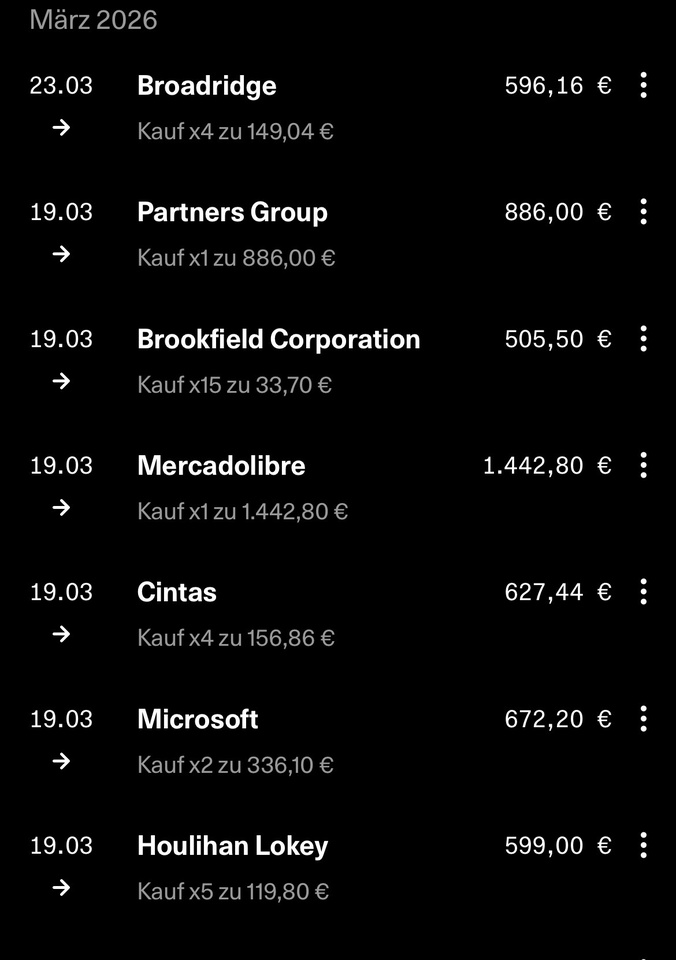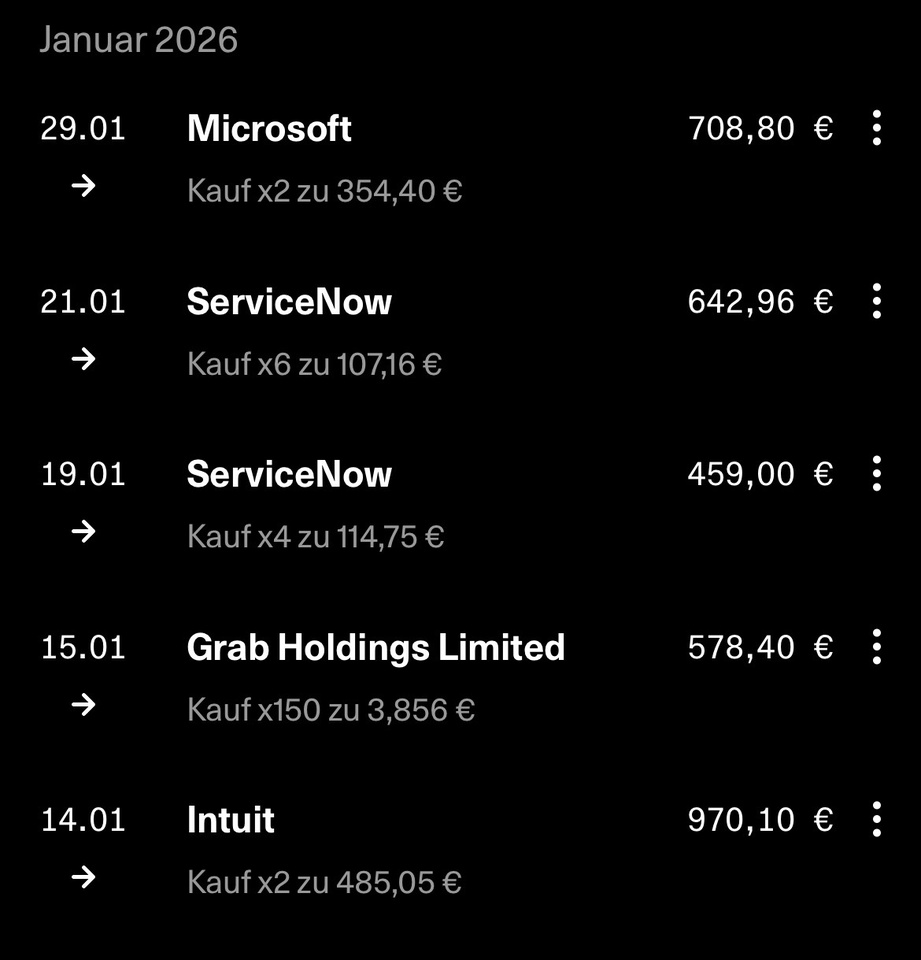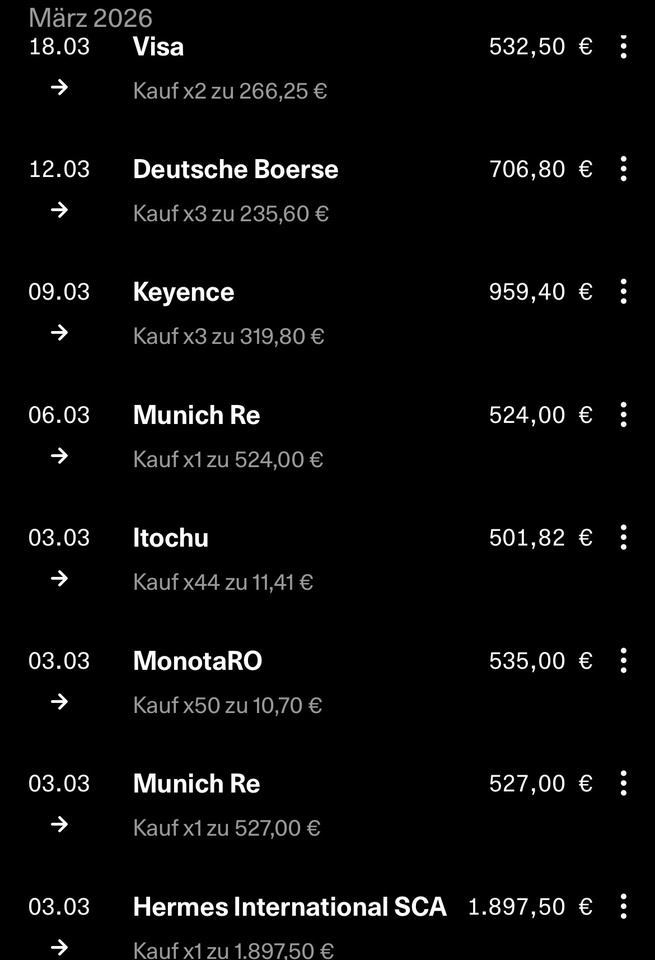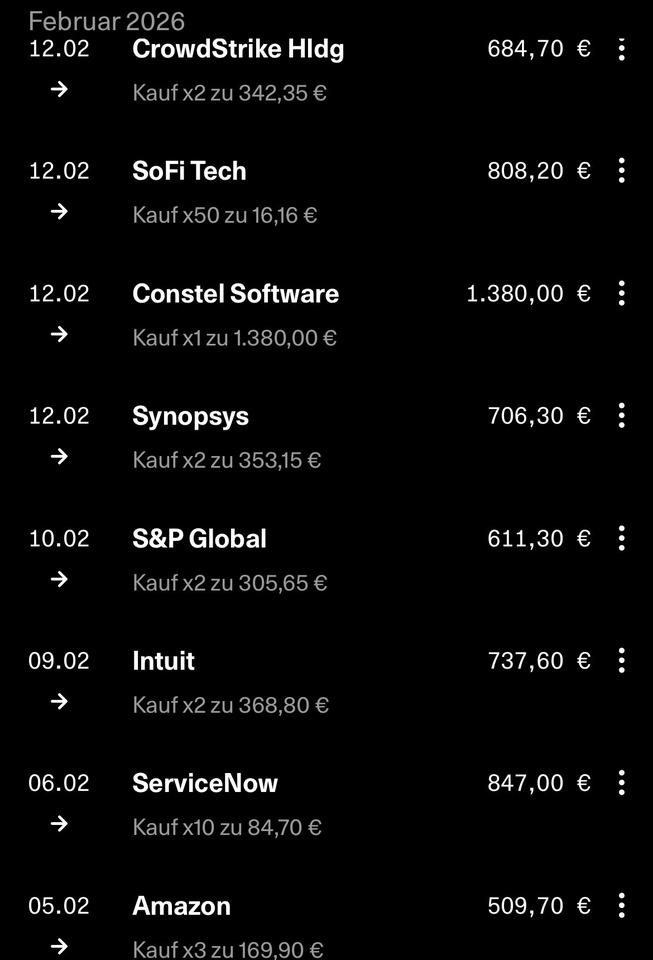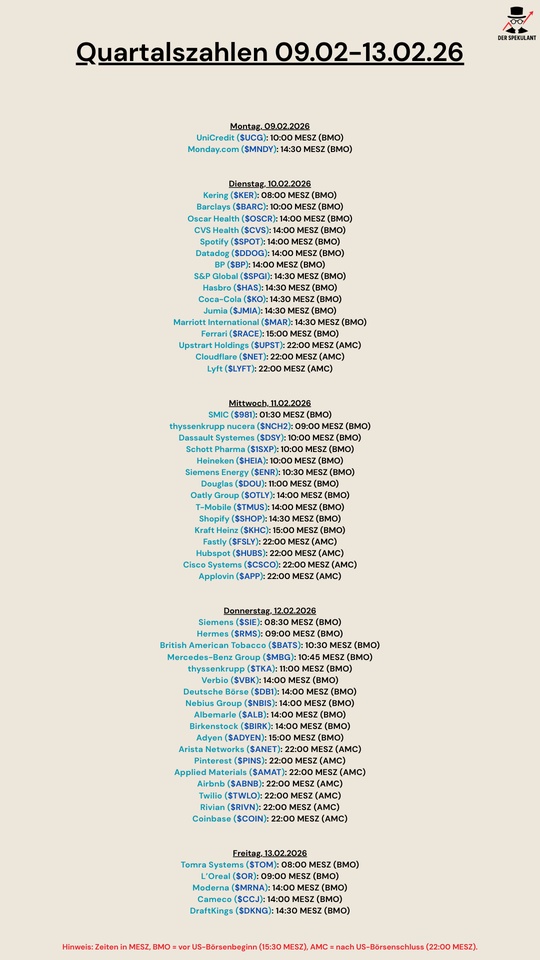
New in:
Stocked up
And much more
.....
Sold

Postes
37Good morning dear community.
As things have become a little more uncomfortable on the stock market recently, I'm wondering where there are now good opportunities to invest money in good, profitable companies.
Which stocks do you have on your radar?
For me it is among others in the USA
In Europe
These are just a few examples.
What else could you add?
Best regards 💥🗡️
Salvete, investors!
My name is Automatix - the name says it all.
Like my namesake from the Gallic village, I prefer to focus on craftsmanship, substance and consistency rather than magic potions or short-term success.
I'm 37 (turning 38 this year) and have only been actively investing in the capital market since the end of 2024 - a pretty bumpy journey so far
But my goal has now become clear to me:
long-term wealth accumulation with a focus on dividends.
I am aware that it is ambitious - perhaps even unrealistic - to live entirely from dividends one day.
But it is precisely this idea that drives me, not my promise.
Professionally, I have been working full-time for a large German tech company for 15 years.
Here I have worked my way up from the very bottom - call center supporter to key account manager to my current position as senior project manager - so structured work, long-term thinking and risk assessment are part of my everyday life.
At the same time, I run a family farm as a sideline
This combination of technology, project work and real economic substance also characterizes my investment approach.
Before I became intensively involved with shares, my first major investments were in real assets:
For me, shares are therefore not a substitute, but a supplement to existing tangible assets.
I invest at least €750 per month, usually more, and focus on:
For individual stocks, I prefer healthy, growing companies.
I prefer dividend growth to high initial yields without substance.
The core of my portfolio will be $SIE (+2,79 %) supplemented by stocks such as
$ALV (+1,33 %) , $DTE (-0,74 %) , $SAP (+3,03 %) , $MUV2 (+0,97 %) and $DB1 (+1,13 %) .
Each position is built up gradually - first €500, then €1,000, and significantly more in the long term.
No more hectic reallocations, no more chasing - just buy and hold!
I was a silent reader here for a long time, but would like to share my thoughts, decisions and learnings in the future - objectively & long-term (if there is interest)
No trading, no noise -
but patience, discipline and a stable anvil 🛠️
I am looking forward to your feedback - constructive criticism is always welcome.
Here's to a good exchange!
Hello everyone
I thought it was time for an introduction to me and my current portfolio.
Briefly about me, I'm Chris, 27 years old, work in IT and moved to Switzerland a good 7 months ago. I'm definitely very happy with my decision, even though it wasn't easy.
Apart from that, I love good food and am absolutely fascinated by cars and motor racing. I'm neglecting traveling a bit at the moment, but I also really enjoy it.
My dad laid the foundation stone of my depot when I was born. I saw it for the first time after my 18th birthday and was pretty excited. Unfortunately, I wasn't excited enough to continue with it. I then became more interested at the end of 2024, beginning of 2025 and so it was that I made my first transaction in April and $NVDA (+7,48 %) bought shares.
My approach is to build a highly focused portfolio of high-quality individual stocks. Around 10% of my portfolio is currently in $BTC (-1,74 %) , $ETH (+0,3 %) & $Sol are currently invested.
There are basically two reasons why I decided against a core-satellite structure.
A fee of CHF 50 + stamp duty has to be paid for each transaction and therefore a savings plan does not make sense in my opinion. My basic idea was to save in 3 different ETFs each month.
Furthermore, I find $BRK.B (+0,22 %) as a core position more attractive than an ETF, as they benefit from their capital strength especially in times of crisis and can make strategic acquisitions.
My next sales are as follows:
Once the sales are completed, my cash position will be around 20%. I currently have the following shares on my list that are eligible for purchase:
$RKLB (+13,89 %) I actually wanted to buy this stock in December, but couldn't because it is not traded at my bank.
It is quite possible that the portfolio performance is not quite right because I have linked the positions manually, as getquin does not offer a link to my bank.
Thanks also to those who post so many interesting articles on strategies and reviews of stocks here, such as @Tenbagger2024, @Multibagger, @Epi, @BamBamInvest & many many others! Thank you, thank you, thank you!
To anticipate the obvious question of why I don't transfer my custody account to another provider due to high fees and limited share availability:
Please let me know what you think of my custody account. 😃
Have a nice Sunday evening!
Best regards
Chris
Handelsblatt searched the Dax, Stoxx 50 and Dow Jones for so-called quality stocks that are undervalued - i.e. whose price level is lower than the long-term average.
In order to be selected as a quality stock, the companies must have consistently fulfilled five conditions over the past five years:
The sharp rise in share prices in recent years means that only five out of a total of 120 companies listed on the Dow, Stoxx and Dax fulfill all five conditions. Only one stock from the leading German index is included.
Visa $V (+0,16 %): The moat stock is available with a six percent valuation discount
Current dividend yield: 0.8%
Several million merchants worldwide accept payments in supermarkets, when shopping online or when traveling abroad. More than half of the group's revenues remain as profit, making Visa one of the most profitable companies worldwide and at the same time a typical moat share.
Higher prices and thus inflation have a positive effect, as they mean higher revenues for Visa because the credit card fees are linked to the merchant's turnover as a percentage.
L'Oréal $OR (+0,4 %): Ten percent valuation discount and the Group is growing faster than the market
Current dividend yield: 1.9%
When the world's largest cosmetics manufacturer reported sales growth of 4.2 percent in the past quarter, the share was one of the biggest losers of the day. Analysts had expected more. The share is trading 20 percent below its record high.
According to analysts' average forecasts, L'Oréal should earn 6.7 billion euros before interest and taxes in the current full year. That would be more than ever before and almost twice as much as five years ago. In the same period, the dividend per share rose from 3.85 euros to seven euros.
With a P/E ratio of 27.4 based on the earnings forecast for the next four quarters, the share is valued ten percent lower than its ten-year average.
Procter & Gamble $PG (-0,24 %): The dividend is safe and always rising
Current dividend yield: 2.9%
Branded products such as Ariel, Pampers, Braun and Gillette provide the American consumer goods manufacturer with reliably rising earnings. Over the past five years, earnings before interest and taxes have risen by 23%.
However, this year has shown that even such defensive shares are not resistant to price losses. Procter & Gamble is currently trading just under 20 percent below the record high it reached twelve months ago.
There are two reasons for this: the preference of many investors for more speculative technology shares, but also higher financial burdens for many consumers due to the rising cost of living. As a result, more consumers preferred cheaper own brands from retailers such as Walmart in the USA or Edeka and Rewe in Germany.
In the long history of the stock market, such price setbacks have almost always proved to be good opportunities to enter the market. The share is currently valued at a P/E ratio of 20.8 based on the earnings forecast for the next four quarters. This is seven percent below the average of the past ten years - after P&G had been valued above the historical average in recent years.
The strongest argument is probably the profit distributions. The Group has paid dividends every year since 1890. Since the end of the 1950s, Procter & Gamble has increased its dividend every year. Around 50 percent of profits go to shareholders.
This leaves enough of a buffer to increase the dividend even in years with slightly falling profits. Over the past five years, the dividend has risen by around one euro to 3.75 euros per share.
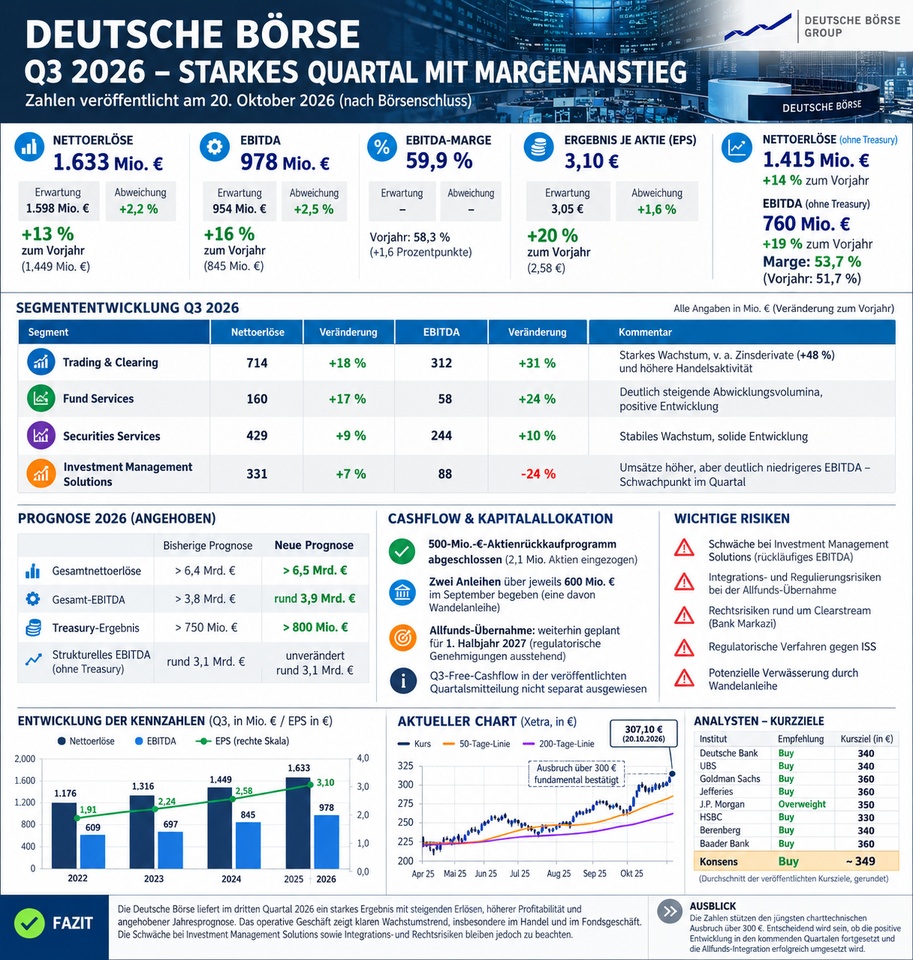
German Stock Exchange $DB1 (+1,13 %): Not only the stock market business drives profits
Current dividend yield: 1.8%
The Frankfurt stock exchange operator is set for its seventh record profit year in a row in 2025. In the third quarter, net revenue, pre-tax profits and earnings per share continued to rise as usual. Nevertheless, the share, which has risen sharply in recent years, has come under pressure in recent months: down 25% since the beginning of May.
Deutsche Börse is currently negotiating the purchase of the fund management platform Allfunds for 5.3 billion euros. Allfunds offers fund managers and distributors a platform for trading, data analysis and compliance systems.
The result of so much consistency is reliable dividends: The dividend has risen for nine years in a row, and the tenth increase is due next spring.
In view of the recent share price losses - coupled with rising consolidated profits - the share is no longer overvalued after a long time. With a P/E ratio of 18.7 based on the expected profits in the next four quarters, the share is valued three percent lower than its ten-year average.
Novo-Nordisk $NOVO B (+10,5 %): Highest valuation discount and highly speculative
Current dividend yield: 3.8%
The most speculative share among the stocks portrayed here is Novo Nordisk. With the presentation of its third-quarter results, the Danish pharmaceutical group once again lowered its sales and earnings targets. In addition, the management, under its new CEO since August, Maziar Mike Doustdar, cut its investment plans.
The company had grown strongly with the sales injection Wegovy, which had made Novo Nordisk the most valuable stock market group in Europe for a time, before competitors, above all the US group Eli Lilly $LLY (+4,15 %)successfully competed with similar products. Mass redundancies at Novo Nordisk were the result.
Despite all the setbacks, the pharmaceutical company is still increasing its profits - but at a slower rate. In the current year, analysts are forecasting average earnings before interest and taxes of the equivalent of 14.1 billion euros, compared to 13.5 billion euros in the previous year.
Since last summer's record high, the share price has fallen by 70 percent. This constellation - rising profits, collapsing share price - makes the once very highly valued share with a P/E ratio of 12.9 suddenly inexpensive. The ten-year average is almost twice as high with a P/E ratio of 23.4. No other quality share is currently trading at such a high valuation discount.
Novo Nordisk recently achieved positive results in tests with the drug Amycretin in diabetes patients. According to the company, these patients reduced their weight considerably and were also able to significantly lower their blood sugar levels.
This was Novo Nordisk's core business before the hype surrounding weight loss injections began. Over the past 30 years, the number of diabetics worldwide has quadrupled to around half a billion. According to the market research institute Mordor Intelligence, the Group has a 45 to 50 percent share of insulin products, making it the undisputed global market leader.
Source text (excerpt) & image, Handelsblatt 01.12.25

The second "What if" report by climate tech company Right° was published on Thursday. Right° compares company data with the goals of the Paris Climate Agreement. Right° sets the limit value at a global warming of 1.7 degrees by 2100.
None of the 34 DAX companies analyzed would be Paris-compatible if no further measures were taken to reduce emissions. However, according to the data, twelve companies have decoupled their value creation from climate-damaging emissions in recent years to such an extent that they are on a Paris-compatible path.
And five of these companies also have a Paris-compatible climate target.
For companies, doing business in line with Paris means decoupling their value creation from climate-damaging emissions.
According to the "What if" report, the climate pioneers RWE $RWESiemens Healthineers $SHL (-2,22 %)Adidas $ADS (+1,03 %)Deutsche Börse $DB1 (+1,13 %) and Porsche, which was relegated from the DAX $P911 (-1,18 %). Both the climate targets and the track record of these companies are on a Paris-compatible path.
However, there are clear differences between the DAX companies in terms of their track record. Many are a long way off the targets of the Paris Climate Agreement.
Source text (excerpt) & graphic: Handelsblatt, 31.10.25
$KDP (+0,88 %)
$7751 (+0,88 %)
$NXPI (+0,66 %)
$WM (-0,58 %)
$CDNS (+4,67 %)
$BN (-0,92 %)
$SOFI (+11,67 %)
$UNH (+5,94 %)
$AMT (-0,97 %)
$UPS (+0,48 %)
$BNP (+2,27 %)
$NVS (+1,54 %)
$DB1 (+1,13 %)
$MSCI (-1,77 %)
$ENPH (+4,36 %)
$BKNG (+0,05 %)
$LOGN (+3,04 %)
$V (+0,16 %)
$MDLZ (-0,7 %)
$PYPL (+0,74 %)
$000660
$MBG (-0,12 %)
$BAS (-1,63 %)
$UBSG (-0,01 %)
$SAN (+2,41 %)
$CVS (+3,39 %)
$OTLY (+4,41 %)
$GSK (+0,12 %)
$ETSY (+5,84 %)
$CAT (+6,69 %)
$KHC (+0,14 %)
$ADYEN (+0,46 %)
$ADS (+1,03 %)
$AIR (+1,17 %)
$SBUX (+3,05 %)
$CMG (+2,18 %)
$META (+0,39 %)
$KLAC (+7,87 %)
$MELI (-3,17 %)
$WOLF (+4,3 %)
$GOOGL (-1,59 %)
$EQIX (+3,89 %)
$MSFT (+1,81 %)
$CVNA (+5,17 %)
$EBAY (-0,29 %)
$005930
$6752 (+4,02 %)
$KOG (+15,07 %)
$VOW3 (-0,39 %)
$GLE (+0,34 %)
$LHA (+2,08 %)
$STLAM (-23,63 %)
$SPGI (-3,35 %)
$MA (-1,21 %)
$PUM (+0,29 %)
$AIXA (+1,24 %)
$FSLR (-6,57 %)
$AAPL (+0,26 %)
$REDDIT (+0 %)
$AMZN (+3,61 %)
$NET (+6,25 %)
$MSTR (+31,41 %)
$GDDY (+0,61 %)
$TWLO (+5,14 %)
$COIN (+12,69 %)
$066570
$CL (-0,83 %)
$ABBV (+1,28 %)
$XOM (+1,68 %)
Following the rebalancing of the S&P Quality Aristocrats last Friday, the following stocks were removed from or added to my two ETF indices (50% weighting):
New additions:
$QDEV (+2,03 %): $NOVN (+1,87 %) , $REL (-2,58 %) , $ITX (+1,54 %) , $LSEG (+1,44 %) , $DB1 (+1,13 %) and more
$QUS5 (+2,05 %): $BKNG (+0,05 %) , $MRK (+1,57 %) , $CRM (+0,38 %) , $UNP (+0,2 %) , $COR (+1,71 %) , $CAH (-0,61 %) and more
Kicked out of both indices and therefore according to S&P no longer Quality Aristocrats are among others: $BATS (+1,63 %) , $7974 (+2,78 %) , $HD (-0,58 %) , $LOW (+0,51 %) , $HLT (+1,62 %)
In addition, the allocation of all individual stocks in the indices was reduced again to max. 5 % was limited.
Thanks to the recent rally of $$HY9H (+8,07 %) my current top 10 weighting (ETFs+shares) is as follows:
3.48% Alphabet
3.04% SK Hynix
3.04% Broadcom
2.93% Meta
2.75% Microsoft
2.71% Apple
2.71% NVIDIA
2.55% Taiwan Semiconductor
2.13% Mastercard
2.08% Visa
New portfolio key figures:
P/E: 27.1 (<30) 🟢
Forward P/E: 21.1 (<25) 🟢
P/Β: 11.5 (<5) 🔴
EV/FCF: 28.7 (<25) 🟡
ROE: 42% (>15%) 🟢
ROIC: 19% (>15%) 🟡
EPS growth for the next 5 years: 15% (>7%) 🟢
Sales growth for the next 5 years: 9% (>5%) 🟡
My internal rate of return is currently 20.19%

👋 Introduction & background
Hey everyone!
I'm 33, married and dad to two small children (18 months and 2 months old). I've been working in the automotive industry since 2011 and in management consulting since 2019. ⚙️🚗💼
My wife is an engineer and also works in the automotive industry. 👩🔧🚗
I've been with getquin since 2022, but so far I've been reading along rather than actively posting. 👀
My wife is currently on parental leave and receives parental allowance. I will go on parental leave in Q2 2026 (also with parental allowance), then she will start working again. This means that only one of us will receive a full salary until the end of 2026 - but we'll still be sticking to our savings and investment quota. 👶💶
💰 Current status:
A good mid-six-figure amount has already been saved in our custody accounts. 📈
👶 Children & investments
For each child, we invested €10,000 in the Vanguard FTSE All World ($VWRL) (+1,8 %) invested. In addition, each child receives €150 per month in the same ETF - via junior custody accounts at ING. 📊
💍 My wife's investments
She invests monthly:
- 🌎 500 € in the MSCI World ($XDWL) (+1,92 %)
- 💸 500 € in the Vanguard FTSE All World High Dividend ($VHYL) (+1,77 %)
📈 My investment strategy
Long-term, diversified and with a focus on cash flow & wealth accumulation.
🔹Core portfolio (ETF & Bitcoin)
€1,000 flows in every month:
- 💵 €600 in SPDR S&P 500 ($SPY5) (+2,01 %)
- 🌍 €200 in Vaneck Morningstar Developed Markets Dividend Leaders ($TDIV) (+1,56 %)
- ₿ 200 € in Bitcoin ($BTC) (-1,74 %)
🔹 Individual share savings plans (€25/ €600 each)
Target per company: €10,000 investment amount.
Currently participating:
$DB1 (+1,13 %) , $UNP (+0,2 %), $RACE (-0,63 %) , $MRK (+1,57 %) , $MUV2 (+0,97 %) , $DGE (+0 %) , $DE (+2,89 %) , $TXN (-1,18 %) , $AWK (-1,34 %) , $ADP (-1,58 %) , $PLD (-0,19 %) , $HEN (+0,78 %) , $ITW (+1,49 %) , $UNH (+5,94 %) , $LLY (+4,15 %) , $BEI (-0,5 %) , $MCD (+0,81 %) , $DTE (-0,74 %) , $WMT (+1,86 %) , $COST (+0,39 %) , $WM (-0,58 %) , $JPM (+3,58 %) , $BLK (+0,02 %) , $SY1 (-0,59 %)
🔹 Cash reserve
💰 Set aside at least €1,000 every month to be able to strike flexibly when opportunities arise.
🏘️ Real estate strategy
We live in our own home and own a rental apartment that pays for itself. ✅
Further real estate purchases are planned. 🏡📈
🎯 Target (15-20 years)
Financial freedom - with the option of part-time or complete independence from employment. Focus on more time for family, projects and quality of life. ✨
How do you structure your portfolios? What is your strategy and what are your long-term goals?
I look forward to the exchange!
At 54 billion euros, the 40 companies listed in Germany's leading index, the Dax, paid out as much to their shareholders this year as in the previous record year.
However, only 21.7 billion euros of these dividends, three percent less than in the previous year, went to domestic investors. 26.9 billion euros were transferred abroad. That was 2.4% more than a year ago and more than ever before.
52.6 percent of shares in the top listed companies are in the hands of foreign investors. Only one third of Dax shares are still held in Germany - almost one percentage point less than in the previous year. Around 14 percent of shares cannot be clearly allocated to a specific region.
This is shown by a recent study by management consultants EY, which was made available to Handelsblatt in advance. According to the study, 24 of the 40 DAX companies, three more than in the previous year, are predominantly held by foreign investors.
The highest foreign share is held by diagnostics specialist $QGEN (-0,4 %) Qiagen with 93 percent, followed by the chemicals trader $BNR (-0,43 %) Brenntag with 88 percent. The aviation supplier $MTX (+1,2 %) MTU , the real estate group $VNA (+0,16 %) Vonovia and the Frankfurt stock exchange operator $DB1 (+1,13 %) Deutsche Börse, four out of five shares are held in foreign portfolios.
The highest transfer abroad was made by $ALV (+1,33 %) Allianz. The insurer, 58 percent of whose shares are held outside Germany, paid dividends of just under 3.5 billion euros to foreign investors after its Annual General Meeting on May 8. Just under 2.5 billion euros flowed into the accounts of German investors.
The industrial group $SIE (+2,79 %) Siemens, the car manufacturer $MBG (-0,12 %) Mercedes and the telecommunications provider $DTE (-0,74 %) Deutsche Telekom each transferred more than two billion euros to foreign investors. The shares of all four companies have been among the highest dividend-paying stocks in the DAX for years: measured in terms of the absolute amount, but also in terms of the yield and reliability of the distributions.
US investors in particular have significantly increased their exposure to the top German companies in recent years, while at the same time investors from other European countries have become more cautious: Since 2010, the proportion of North American investors in those DAX companies for which corresponding time series are available has risen from 17.1 to currently 25.4 percent. The proportion of European investors, on the other hand, fell from 25.7% to 22.9%.
Henrik Ahlers, Chairman of the EY Management Board, sees the strong commitment of foreign investors as "proof of the continued attractiveness of top German companies and the trust that these companies enjoy worldwide". Although the problems of Germany as a business location are well known, "most DAX companies are now so strongly positioned worldwide that Germany is just one of many markets".
According to Ahlers, the recent good share price performance also testifies to the trust that top German companies continue to enjoy worldwide. It proves the reputation and credibility of major German corporations on the global market.
Source (excerpt) & graphic (excerpt): Handelsblatt, 04.08.25
Meilleurs créateurs cette semaine