

Hi from sunny—but windy—Denmark! 🚀☀️
I hope you’re enjoying the weekend as much as I am!
When you’re sitting on the patio on a sunny afternoon here in our beautiful Scandinavian home of Denmark, sipping an ice-cold can of Pepsi Max , as a stock trader, you can’t help but wonder: Who’s actually bottling this stuff right here locally and making a fortune off it?
Since we’ve been looking for a crisis-proof consumer staples stock for our portfolio, I immediately set out to find one and unearthed a Danish heavyweight that hasn’t hasn’t been mentioned yet:
Royal Unibrew A/S $RBREW (+2,24 %)
Before we dive into the 15-point analysis, a quick hello to everyone:
@Tenbagger2024 and @Aktienhauptmeister (Brian, old Grim Reaper 👊)—get your notepads ready!
And don’t forget: The Q2 earnings report is just around the corner—on Monday, August 17, 2026!
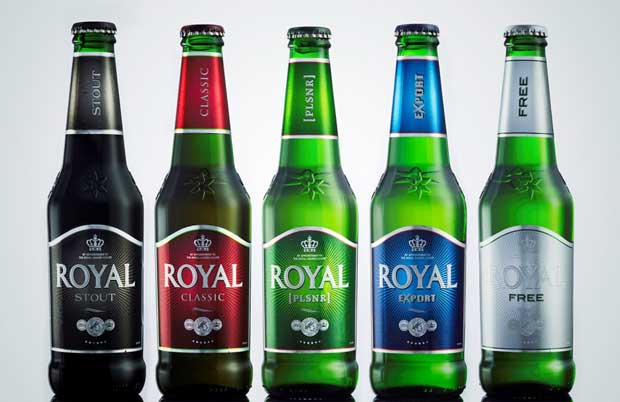
Any of you who’ve ever been on vacation in Denmark and maybe had a Royal beer—one of the Danes’ favorite beers—have already held one of the company’s products in your hands.
1. What does the company do?
Royal Unibrew is the No. 2 in the Danish brewing market (right behind Carlsberg) and a leading regional beverage group. The company produces, markets, and distributes beer, soft drinks, energy drinks, ciders, fruit juices, and mineral water.
In addition to its own brands, the group acts as the exclusive bottling and distribution partner for global giants such as PepsiCo (Pepsi Max, 7UP, Mountain Dew).
2. Geographic Presence & Brand Portfolio
The focus is on the Nordic countries (Denmark, Sweden, Finland), the Baltic states, Italy, France, and the Benelux countries.
- Well-known brands: Royal Beer, Faxe, Lapin Kulta, Faxe Kondi, Vitamalt, Egekilde.
- M&A Expansion: Through acquisitions such as Vrumona (Netherlands, 2023), PepsiCo’s Benelux beverage business (2024), and Pernod Ricard’s Nordic brands (2025), the company’s size has nearly doubled over the past four years.
3. Key Figures, Data & Facts (as of August 2026)
(A quick dig at Brian: Yes, my dear, as a brewery, Royal Unibrew does have EBITDA—unlike a bank—but we still prefer to look at actual free cash flow and unadjusted GAAP earnings rather than your “adjusted EBITDA” fantasy figures!)
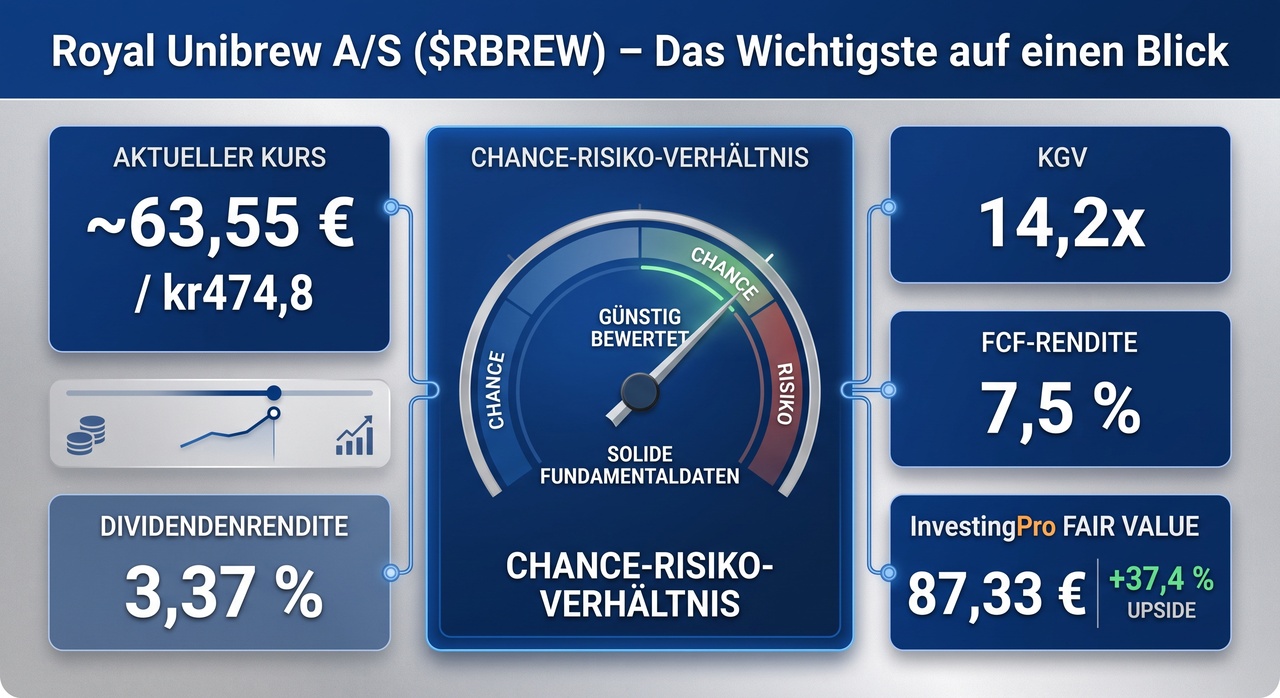
- Current share price: €63.55 (kr474.8) – Recovery phase following the April low.
- Market capitalization: kr22.8 billion (approx. €3.06 billion) – Solid mid-cap.
- P/E ratio (LTM / Forward 2026): 14.2x / 13.6x – Historically inexpensive for a consumer goods stock.
- Dividend yield: 3.37% (€2.14 per share) with a payout ratio of ~46.7% – extremely well-covered.
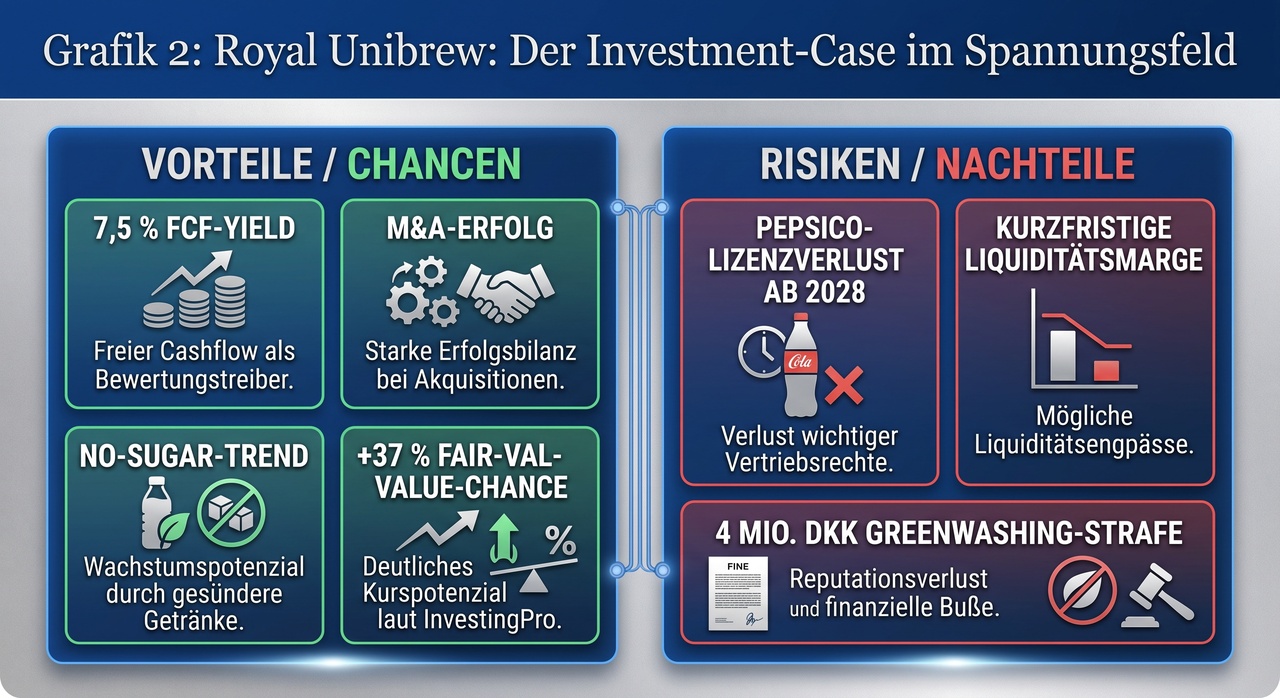
- Free Cash Flow Yield: 7.45% (~7.5%) – A true cash generator!
- Return on Equity (ROE): 23.8% – An exceptionally strong return on equity.
- Revenue (LTM): 15.8 billion kr (approx. 2.12 billion €) – Growing steadily (+5.2%).
4. Check against our established formulas
- 1. Core Quality Formula (Revenue Growth + EBIT Margin):
- 5.2% growth + 14.3% EBIT margin = 19.5
- Result:
Solid range (range 15–25). Not a hyper-grower, but a rock-solid foundation.
- 2. Cash Flow Quality Formula (FCF Yield):
- FCF Yield = 7.5
- Result:
Very attractive! Easily clears our >5% threshold. A true cash machine for dividends and buybacks.
- 3. Dividend Filter:
- Dividend yield: 3.37%.
- Cash Flow Coverage: Payout ratio of 46.7%. The dividend is fully covered by operating cash flow and is absolutely crisis-proof.
5. Chart Analysis of Recent Months: The April Crash & the Recovery
- 52-week range: The 52-week high is €87.50, and the 52-week low is €52.85.
- Current share price: The stock is currently trading at €63.55.
The Earnings Paradox on April 21, 2026:
- The numbers were exceptionally strong: The past quarter significantly exceeded expectations. Earnings per share (EPS) beat the forecast by +25.4% , and revenue came in at +1.2% above estimates.
- And yet the stock price plummeted by -27.57%! That same day, a bombshell dropped unrelated to the quarterly results: Carlsberg announced that, starting in 2029, it would take over exclusive distribution for PepsiCo in the Nordic countries. As a result, Royal Unibrew will lose its PepsiCo licensing agreement—which accounts for about 13% of the group’s revenue—at the end of 2028.
- Conclusion on the chart: The market did not punish the company for its quarterly operating performance, but rather pulled the emergency brake out of panic over the loss of the PepsiCo contract starting in 2029. Since hitting a low of €52.85, however, the realization has set in that the core business is highly profitable: The stock has formed a solid bottom and has already risen by around +17% to €63.55!
6. Special Entry Zones (“Bargain Hunter List”)
- Bargain Zone (Absolute Bargain):
€52.00 – €55.00 (Near the 52-week low). - Fair-Value Entry:
€60.00 – €63.00 (Here, we’re building our first positions at current levels). - Sell/Take partial profits: Starting at €85.00 (Near all-time high and InvestingPro Fair Value).
7. Risk Deep Dive 1: The PepsiCo Sword of Damocles ⚠️
The biggest operational risk: The licensing agreement with PepsiCo for Northern Europe will expire at the end of 2028.
- The impact: This affects approximately 13% of net revenue.
- One-time charge: The transition is estimated to cost 300 million DKK in transformation costs.
- Opportunity amid risk: Management is using the time until 2028 to build higher-margin private labels and form new partnerships.
8. Risk Deep Dive 2: Liquidity & ESG Slips ⚠️
- Balance Sheet Caveat: Current liabilities currently exceed cash and cash equivalents (cash flow rating of only 5/10).
- Regulation / Penalty: In 2025, Royal Unibrew had to pay a fine of 4 million DKK for greenwashing involving the mineral water brand Egekilde .
9. Future Outlook & Growth Drivers
- Trend toward “Low/No Sugar”: Strong growth in sugar-free beverages and energy drinks with higher margins.
- M&A Integration: The company has a scalable IT platform that allows acquired breweries and brands to be quickly optimized for margins.
- Organic EBIT Target: Organic EBIT growth of 6–10% is targeted for 2026.
10. Competition & Substitutes
- Carlsberg $CARL B (+2,39 %)
: The large Danish neighbor (greater global scale, but more expensively valued). - Heineken $HEIA (+0,53 %)
/ AB InBev $ABI
: Global giants with high debt levels. By comparison, Royal Unibrew is the more agile regional niche player.
11. Margin & Profitability Analysis
- Gross Margin:
43.1% (Solid for the beverage sector). - EBIT Margin:
14.3% (Steadily rising). - ROCE (Return on Capital Employed):
23.8% (Very high efficiency of capital employed).
12. Analyst Opinions, Fair Value & Sentiment
- InvestingPro Fair Value: The fair value, calculated using 15 financial models, is €87.33 (kr652.8). This corresponds to a theoretical upside potential of +37.4% with low uncertainty!
- Analyst Consensus (Median Target): Wall Street analysts see the average price target at €65.88 (kr492.0).
- Current price: €63.55 (kr474.8).
- Wall Street Sentiment: A total of 15 analysts cover the stock (6 Buy, 8 Hold, 1 Sell). Heavyweights such as Morgan Stanley (price target kr505) and Goldman Sachs (price target kr530) are currently maintaining a “Neutral/Equalweight” rating.
13. Upcoming Catalysts 🎯
Monday, August 17, 2026: Announcement of Q2 earnings!
Analysts expect EPS of €1.52 (5.41 DKK) on revenue of approximately €586 million. A positive surprise could suddenly accelerate the recovery.
14. SEO & Market Sentiment
The stock is extremely underrepresented in German-speaking markets (low search volume), which gives us, as early-bird investors, a clear information advantage. Sentiment is currently shifting from “panic following the Pepsi shock” to “quality rebound.”
15. Future Viability & My Personal Conclusion 🏆
Dear Community, Royal Unibrew $RBREW (+2,24 %) is a first-class, defensive consumer staples stock with genuine turnaround potential!
Anyone looking for a crisis-resistant stock with 7.5% FCF yield, a 3.37% reliable dividend and a fair value premium of over +37% will find an absolute Scandinavian gem here. The loss of the PepsiCo contract in 2028 is unfortunate, but it’s already more than factored into the current P/E ratio of just 13.6x.
My verdict: A strong buy candidate for anyone looking for solid cash flow growth with a generous margin of safety. I’m considering getting in before the earnings report, but I still have until Monday 😉
I’m looking forward to hearing your thoughts! Brian, you old Grim Reaper—start sharpening your arguments for Monday’s Q2 earnings! 😉
Best regards from Denmark
Your RaketenToni
and, of course, everyone else :)