
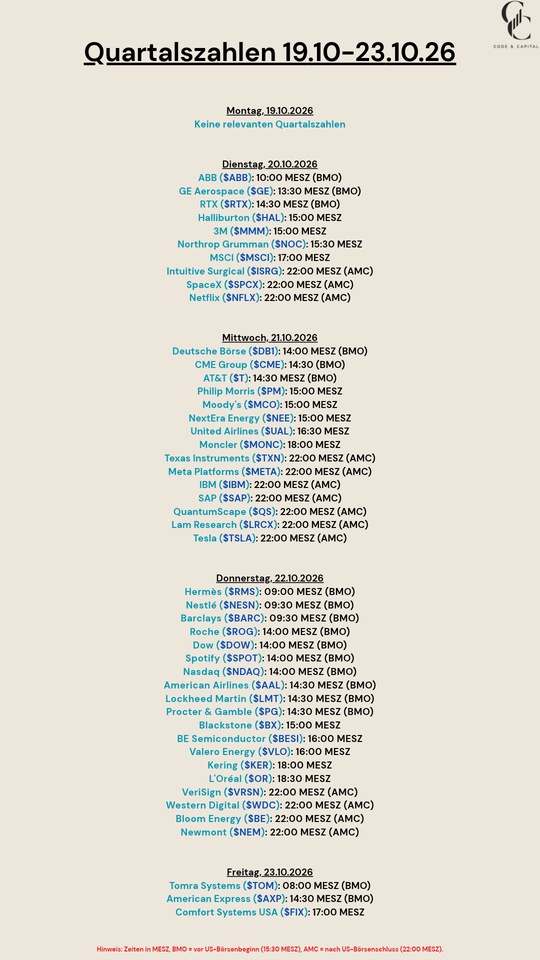
$ABBN (+2,43 %)
$GE
$RTX (+3,3 %)
$HAL (+0,86 %)
$MMM (-0,56 %)
$NOC (+2,86 %)
$MSCI (+0,56 %)
$ISRG (-0,36 %)
$SPCX (+0,05 %)
$NFLX (-2,97 %)
$DB1 (+0,48 %)
$CME (+0,77 %)
$T (-0,38 %)
$PM (+0,96 %)
$MCO (+0,58 %)
$NEE (+0,38 %)
$UAL (+3,44 %)
$MONC (+0,54 %)
$TXN (+4,88 %)
$META (-1,1 %)
$IBM (-0,01 %)
$SAP (+0,06 %)
$QS (-3,6 %)
$LRCX (+3,92 %)
$TSLA (+5,61 %)
$RMS (+2,43 %)
$NESN (-0,5 %)
$BARC (+2,85 %)
$ROP (-1,52 %)
$DOW (+4,65 %)
$SPOT (-1,15 %)
$NDAQ (+2,18 %)
$AAL (+1,33 %)
$LMT (+5,28 %)
$PG (-0,47 %)
$BX (+0,62 %)
$BESI (+7,82 %)
$VLO (+2,34 %)
$KER (-0,23 %)
$OR (-0,72 %)
$VRSN (+3,08 %)
$WDC (+4,6 %)
$BE (+7,3 %)
$NEM (+1,67 %)
$TOM (+2,58 %)
$AXP (+0,61 %)
$FIX (+7,45 %)

Spotify Tech
Action
Action
ISIN: LU1778762911
Ticker: SPOT
LU1778762911
SPOT
Price
Discussion sur SPOT
Postes
1411Sem.·
Quarterly Results: Oct. 19–23, 2026
99


2Mo·
Spotify Falls Short of Expectations
Here's the hot stuff from Spotify Technology
$SPOT (-1,15 %) (NYSE: SPOT) Q2 2026 Earnings Release, delivered fresh from Stockholm/New York on August 4, 2026, before the U.S. markets opened:
🚀 Top-Line Performance & Historic Milestone
In the second quarter of 2026, Spotify breaks a historic record that no audio streaming service has ever achieved before and accelerates revenue growth:
Total revenue: Climbed by +14% YoY (currency-adjusted +15%) to 4.8 billion euros.
300-Million Club (Premium Subscribers): The number of paying subscribers grew by +9% YoY to exactly 300 million —a milestone for the industry!
Monthly Active Users (MAU): Soared by +12% YoY to 777 million (+16 million new users in the quarter).
🔮 Profitability & All-Time High Margins
The days when Spotify was just racking up users without making any money are finally over. The monetization machine is running at full speed:
Record gross margin: Climbed to an all-time high of 33.4% (an increase of ~193 basis points compared to the previous year).
Pricing power & efficiency: Rising subscription prices and optimized pricing for podcasts and audiobooks are directly boosting the margin.
🤖 Operating Income Overview
The operating income reflects the platform’s massive economies of scale:
Operating Income: Soared by +61% YoY to 655 million euros .
Free Cash Flow & Capital Discipline: Higher margins and reduced operating costs are continuously feeding substantial cash reserves into the company’s coffers.
⚡ 💡 Jack’s Take
Spotify is delivering a truly picture-perfect performance! 300 million paying customers are an impregnable fortress and demonstrate just how deep the moat is in audio streaming. The fact that operating profit skyrocketed by +61% and the gross margin hit a new record high of 33.4% proves that Daniel Ek & Co. have mastered the art of turning massive user growth into real FCF and fat margins!
1010
2Mo·
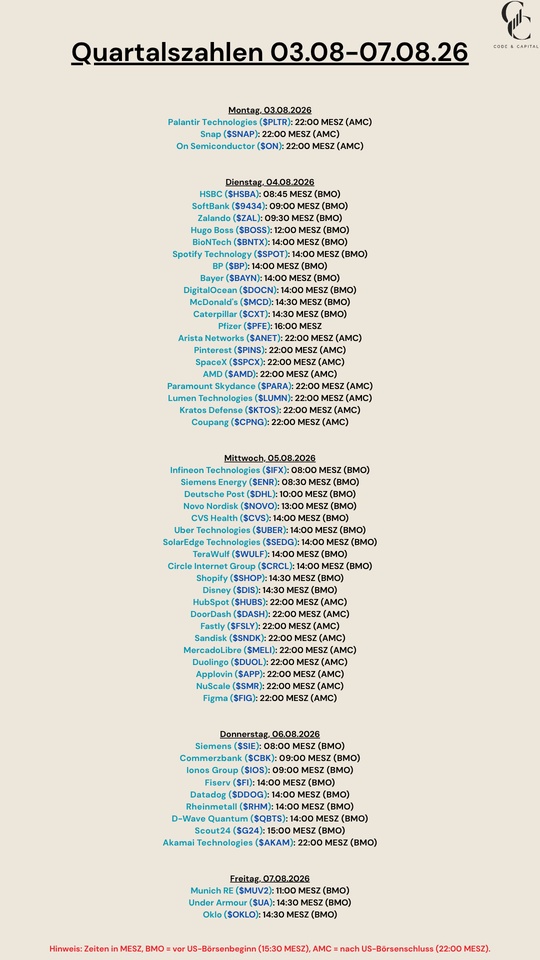
Quarterly Results August 3–7, 2026
$PLTR (+1,09 %)
$SNAP (+0,35 %)
$HSBA (+0,7 %)
$9434 (+0,52 %)
$ZAL (-0,56 %)
$BOSS (+0,64 %)
$BNTX (-1,14 %)
$SPOT (-1,15 %)
$BP. (-1,05 %)
$BAYN (+3,62 %)
$DOCN (+8 %)
$MCD (+1,06 %)
$CAT (+1,11 %)
$PFE (-0,72 %)
$ANET (+3,07 %)
$PINS (-5,53 %)
$SPCX (+0,05 %)
$AMD (+3,11 %)
$PARA (-4,21 %)
$LUMN (-2,33 %)
$KTOS (+3,93 %)
$CPNG (-1,43 %)
$IFX (+4,77 %)
$ENR (+4,46 %)
$DHL (+1,78 %)
$NOVO B (-0,61 %)
$CVS (-1,04 %)
$UBER (-1,17 %)
$SEDG (-4,77 %)
$WULF (+5,8 %)
$CRCL (-6,71 %)
$SHOP (-0,17 %)
$DIS (-1,78 %)
$HUBS (-2,07 %)
$DASH (-5,4 %)
$FSLY (+4,37 %)
$SNDK (+1,81 %)
$MELI (-7,61 %)
$DUOL
$APP (+0,4 %)
$SMR
$FIG (-4,66 %)
$SIE (+1,92 %)
$CBK (+2,7 %)
$IOS (+0,48 %)
$FI (-3,02 %)
$DDOG (+4,02 %)
$RHM (+1,76 %)
$QBTS (-0,86 %)
$G24 (-0,59 %)
$AKAM (+5,44 %)
$MUV2 (+1,03 %)
$UA (-1,97 %)
$OKLO
1313
4Mo·
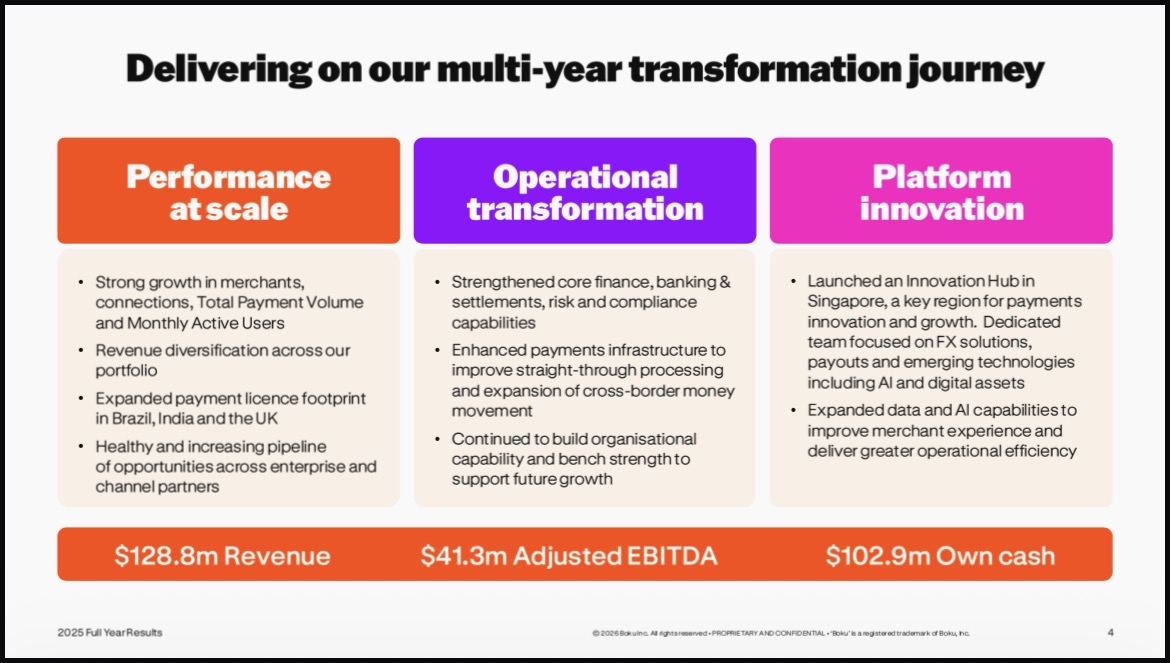
Company presentation: Boku
Hello to Community✌️
At the end of the month, I would like to introduce you to another stock that I personally find extremely exciting. After that, that's it for the next few weeks. 👀
In my opinion, this stock is interesting for both short-term gamblers and long-term investors. The former 🫵 @Multibagger will primarily celebrate the momentum and the potentially rapid price movements. 📈
Others could discover an exciting growth story with long-term potential. 👀🤔
Today it's all about Boku $BOKU
BOKU INC. : The invisible tollbooth of the global tech giants:
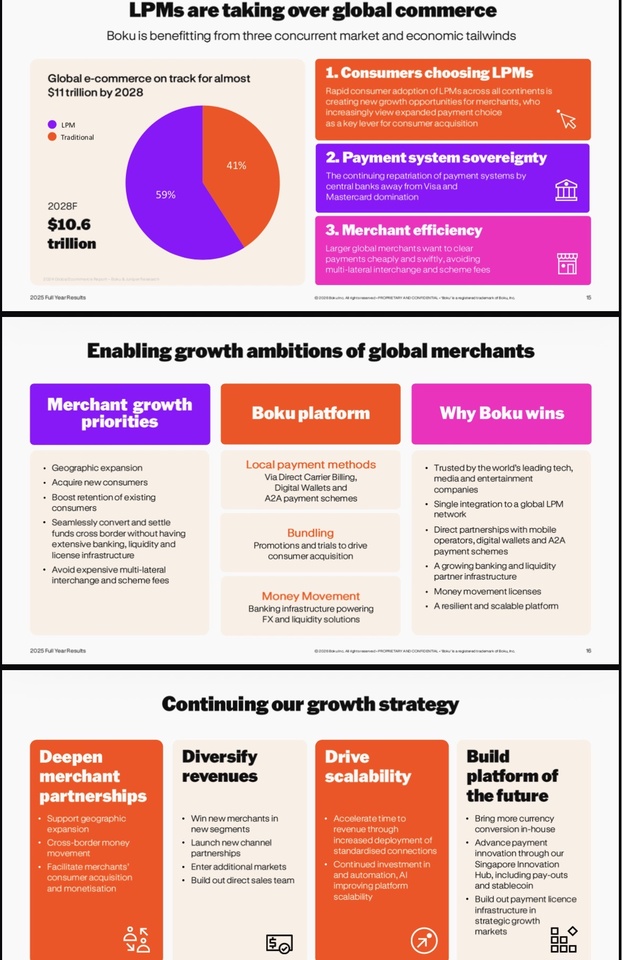
Boku $BOKU is not a hyped, unprofitable FinTech dream that thrives on venture capital. It's a highly profitable, UK-based network powerhouse that's carving out the niche of Alternative Payment Methods (APMs) has occupied. While traditional credit card giants are reaching their limits in emerging markets and with Generation Z, Boku $BOKU acts as the invisible digital toll booth for the world's biggest companies. If someone is on Spotify, $SPOT (-1,15 %) Netflix $NFLX (-2,97 %) or the $GOOGL (-0,92 %) Google Play Store via cell phone bill (direct carrier billing) or local eWallet (such as Pix, Mercado Pago $MELI (-7,61 %) , Alipay $9988 (+0,63 %) or GrabPay $GRAB (-3 %) ), Boku mercilessly cuts off its fee in the background. Boku $BOKU benefits from the unstoppable global trend of digital consumption - regardless of which app is currently in vogue.
📱The business model: the 3-pillar transaction rocket 💳🌐📈
Boku $BOKU has transformed itself from a pure SMS payment service into a state-of-the-art, global identity and payment network (Boku Platform):
The insatiable eWallet & Account-to-Account (A2A) lever: Traditional business mobile operators (DCB) is solid, but the real hyper growth is coming from local wallets (Pix in Brazil, PromptPay in Thailand, Twint in Switzerland). Boku connects these fragmented local markets via a single API for the tech giants. This segment is growing rapidly and driving up transaction value (TPV) massively.
The fortress customer base (The "Whale" portfolio): Boku's client list reads like a who's-who of Silicon Valley: Apple $AAPL (-0,83 %)
, Google $GOOGL (-0,92 %)
, Meta $META (-1,1 %)
, Microsoft $MSFT (+1,8 %)
, Netflix $NFLX (-2,97 %)
, Spotify $SPOT (-1,15 %)
, Amazon $AMZN (+0,46 %)
, Tencent $700 (-0,64 %) . These giants won't just throw Boku out of their checkout infrastructure because setting up their own local connections in 60+ countries would be regulatory and technical suicide. High switching costs par excellence.
The recurring network effect premium (NRR 124%): Boku grows organically with the success of its customers. The more subscriptions $AMZN (+0,46 %) Amazon Prime or Spotify $SPOT (-1,15 %) sell in India or Southeast Asia, the more transaction volume automatically flows through Boku's servers - without Boku having to burn new marketing money.
📊The key figures (as of Q1 2026 / FY25 history)
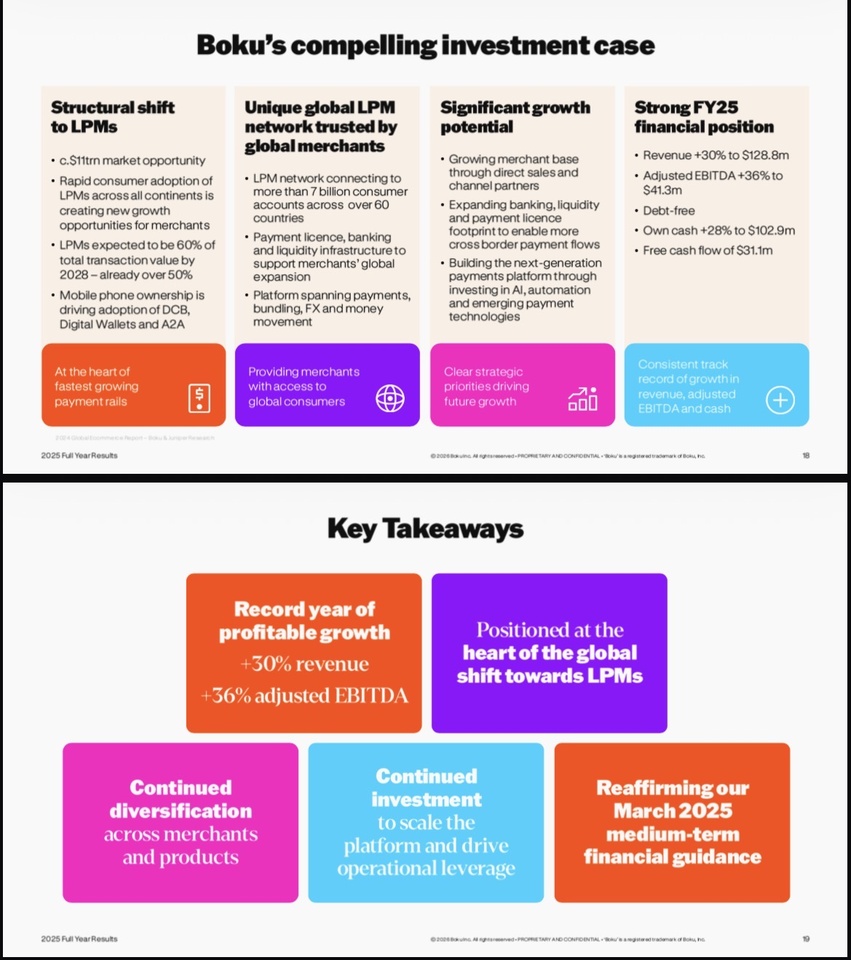
Market capitalization: Approx. GBP 540 million / ~EUR 635 million (Listed on the London Stock Exchange, AIM). A genuine, profitable small cap.
Sales momentum: Continuous growth of around +15% p.a. The shift from pure mobile billing to eWallets and A2A payments is taking off completely and is compensating for the maturity of the old DCB business.
EBITDA levers & margins: The adjusted EBITDA margin is scratching the 35% mark. As the platform infrastructure is in place, almost every additional dollar in transaction fees flows directly through to the bottom line (Gross margin of a proud ~68.5%).
Real FCF margin (SBC-adjusted): Strong ~24,0% of sales. Boku is a cash machine that easily digests its share compensation from operating cash flow without painfully diluting shareholders.
Balance sheet solidity (net cash): No long-term financial debt. Boku is sitting on a net cash position of around USD 50-60 million. This means zero refinancing risk in the current interest rate environment and maximum flexibility for smaller, strategic tech acquisitions.
🚀Why is the share exciting?
✅The demographic bet in e-commerce: In the growth regions (South East Asia, Latin America, Africa), billions of people don't have a credit card, but almost everyone has a smartphone and a local wallet. If you want to sell subscriptions there as a Western tech company, you have to use Boku.
✅The win-win shield against big tech: The often criticized cluster risk is not a one-way street. In markets such as Indonesia, Brazil and India, Boku is $BOKU for Apple $AAPL (-0,83 %) and Google $GOOGL (-0,92 %) not an annoying cost factor, but the exclusive revenue enabler. Without Boku's local infrastructure, the tech giants would have to do without millions of customers who are willing to pay and simply do not have a credit card. Apple $AAPL (-0,83 %) and Google $GOOGL (-0,92 %) are therefore structural partners 🤝not opponents - Boku brings them incremental revenue that they could not generate on their own.
✅Evolution of the moat & diversification: Management understood the historical "what if" scenario (the loss of a major customer) and proactively mitigated the risk. Through aggressive expansion into digital wallets and account-to-account (A2A) payments (which now account for 45% of revenue), Boku has fundamentally diversified. The moat today is of a technical, regulatory and geographical nature - not even a Silicon Valley giant can copy that in two quarters.
✅Operating leverage beats inflation: Boku's cost base consists primarily of IT infrastructure and developers. If the price of digital subscriptions rises worldwide due to inflation, Boku's transaction volume and thus its fee income automatically increases with it. A perfect inflation hedge.
✅Consolidation of the FinTech infrastructure: Boku $BOKU has spent years digging the regulatory foundation (licenses in dozens of countries). You don't rebuild this moat in two quarters. This also makes the company a permanent, highly attractive takeover target for larger payment groups.
⚠️Die Risks
❗️Brutal cluster risks (whale dependency): Apple $AAPL (-0,83 %) , Google $GOOGL (-0,92 %) and Amazon $AMZN (+0,46 %) account for a lion's share of the volume. If one of these giants decides to slash fees or build its own global wallet infrastructure, the Boku story will be fundamentally shaken
❗️Commercial pressure on margins: Unit economics for eWallets are often thinner than for the old Direct Carrier Billing (DCB). Boku has to bolt on massive volumes to cushion the structural decline in margins per transaction
❗️Currency effects (FX risk): As Boku collects fees worldwide in local currencies (and accounts in GBP), severe currency turbulence in the emerging markets can visually spoil operating performance .
✍️Mein personal conclusion + Reaper verdict 💀
I personally find Boku Inc. extremely exciting. Boku $BOKU has an amazingly strong business in the background. For me, this is a highly profitable niche champion with a strong balance sheet and a business model that is much more robust than it appears at first glance.
What I particularly like is that without Boku $BOKU companies like Google $GOOGL (-0,92 %) or Apple $AAPL (-0,83 %) would miss out on millions of potential customers that they would not be able to reach via their traditional payment channels. Boku $BOKU opens up sales for them that would otherwise simply not exist. Why should the tech giants invest hundreds of millions of dollars to apply for their own regulatory licenses in dozens of emerging countries and connect local payment systems when they can simply use Boku's ready-made infrastructure instead? Boku $BOKU solves a complex problem that its customers could only solve themselves with considerable effort and is paid well for doing so. This also seems to me to limit the risk of major customers suddenly ending the collaboration. The benefit is simply too great and the alternative too costly.
BONUS MATERIAL:
💀Jack's Verdict:
"Let's not kid ourselves: Boku's operating business is sexy as a perfectly oiled money printing press. The NRR of 124% shows that the tech giants are becoming more and more dependent on Boku's API. But on the stock market, the music is also made by the price. A fwd P/E ratio of over 31x and a PEG of 1.7 for 15% growth? Once again, the market has looked a little too deeply into the hype bowl. The market is currently pricing in that the next 10 years will be flawless. If Apple coughs tomorrow and pushes down the fees by one basis point, the valuation will plummet. Therefore: stock on the watchlist, no emotional market purchases. We are laying down at 135 GBX on the lookout. If the impatient retail investors lose their nerve at the next macroeconomic dip and the stock corrects there, we will grab it. Before that, the capital stays in the holster."
Reaper rating: WATCH, TEND TO BUY 🔥
Reaper Score:
6,8/10
@Get_Rich_or_Die_Tryin
@Tenbagger2024
@Raketentoni
@schlimmschlimm
@Stocktective and of course all other ✌️
+ 4
3636
17 Commentaires
Tenbagger-Capital@Tenbagger-Capital
4Mo
•
66
•
5Mo·
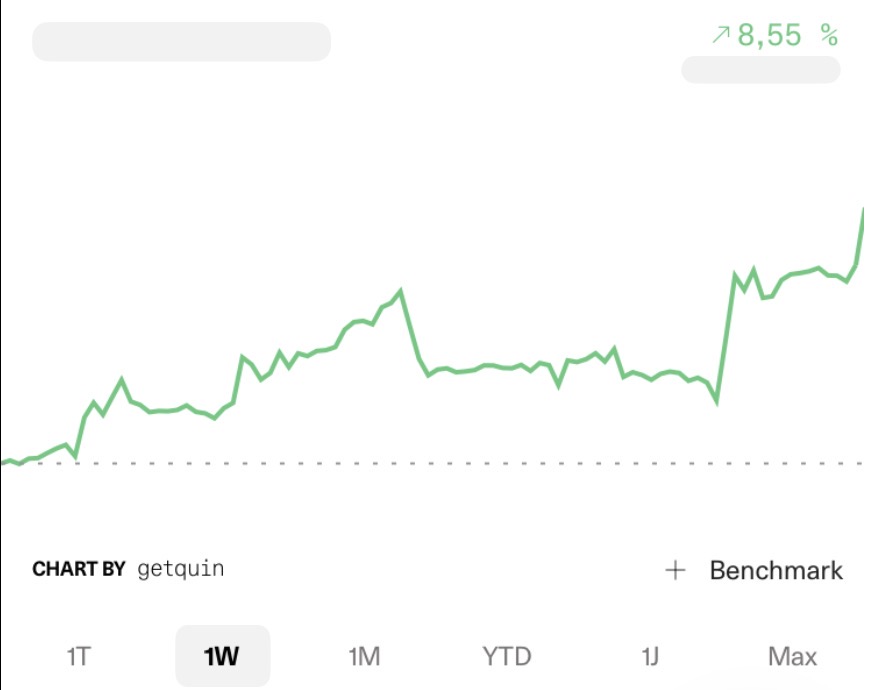
Weekly recap
🇩🇪 Very strong week 📈
The drivers of the portfolio this week were
$SPOT (-1,15 %)
$CEG (-0,19 %) and $NOW (-1,15 %) .
🇬🇧 Very strong week 📈
Main drivers of the portfolio this week were
33

5Mo·
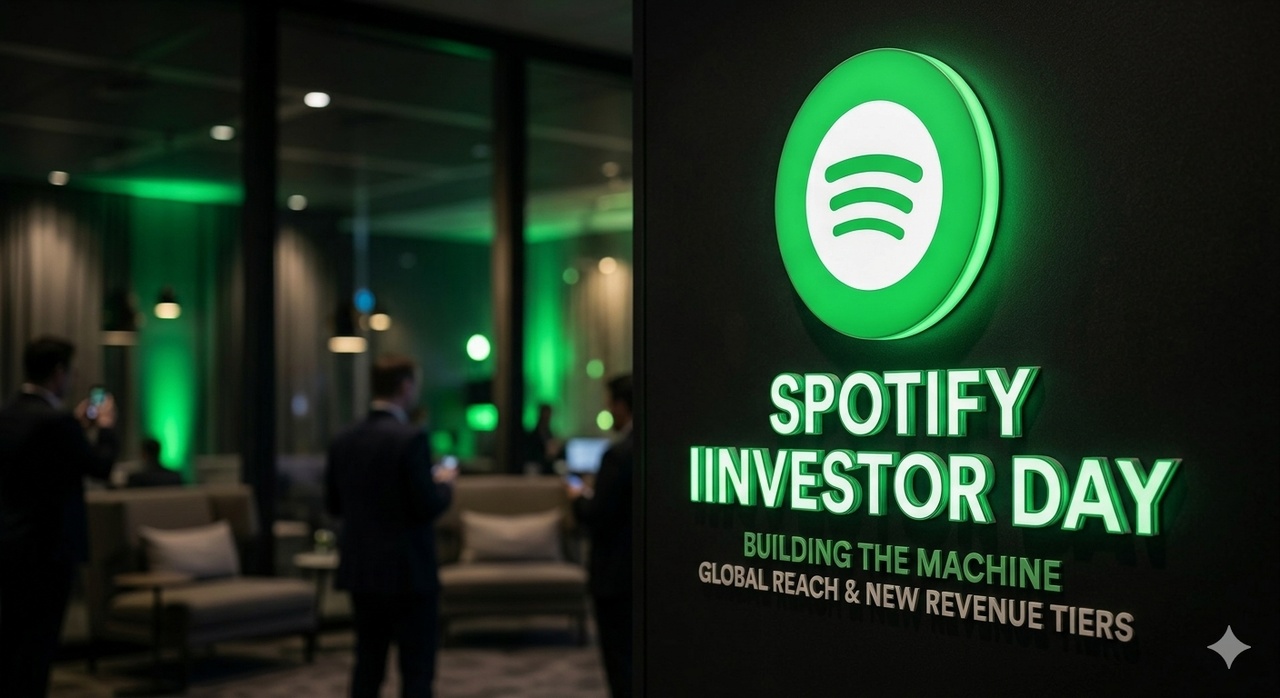
🎧 The "Spotify Machine" upgrade: More AI, new prices & the future of streaming! 🚀
Big day for the entire audio and music industry! At today's Spotify Investor Day $SPOT (-1,15 %) CEO Daniel Ek laid his cards on the table - and what was discussed there is sending shockwaves (and plenty of optimism) through the market.
Here are the 3 key takeaways to have on your radar right now:
🤖 The AI roadmap is in place:
Spotify is making a massive bet on artificial intelligence. From even smarter personalization ("discoverability") to new AI-supported features for creators - the platform wants to show that it is setting the tone technologically.
💰 Monetization & new pricing strategies:
Higher margins and more flexible premium models (tiers) are at the top of the agenda. The goal? Higher customer lifetime value and more stable profits despite global market changes.
🎵 A signal effect for the music industry:
It wasn't just exciting for Spotify shareholders today. Major labels such as the Warner Music Group are also taking a very close look.
If Spotify stabilizes its margins and opens up new sources of revenue, the entire music value chain will benefit.
Spotify no longer wants to be just a music streaming service. It is building the ultimate global creator platform - driven by machine learning and smart monetization. The competition needs to dress warmly! 🔥
#Spotify #InvestorDay #Streaming #MusicBusiness #ArtificialIntelligence #TechNews #Monetization #Finance
1212
6 Commentaires
•
33
•
5Mo·
Apr 28 / Earnings Roundup — Tuesday
In the coming days I’ll probably do a bit of earnings commentary, sometimes like today as a summary of a few interesting reports, and sometimes as a more focused piece. With all the heavy hitters reporting on Wednesday, I’ll probably have to write throughout next week to cover everything. But let’s start with today.
While last week already had some significant reports, now is where it really gets interesting. The biggest mover before the open was definitely Spotify, and I have to admit it’s a company I really like. In many ways it reminds me of Netflix. Strong brand, large market share, over one third of global music streaming, and fast, consistent growth. But it’s also similar to Netflix in a way I don’t like, and that’s valuation.
Even after the stock dropped almost 20% and moved closer to its February lows, the forward P/E is still around 29x. The company is doing well, no doubt, and the multiple reflects that, but it shows once again that not every dip automatically creates an attractive entry point. I should also add that I still think Netflix is the better business overall. Not just in terms of valuation, with a forward P/E closer to 25x, but also when it comes to customer retention and moat. Speaking for myself, switching from Spotify to Apple Music feels far less significant than switching from Netflix to Amazon Prime. Netflix offers differentiated content, while Spotify mainly competes on user experience.
So why did the stock sell off? The report itself was solid, with beats across the board, but guidance was mixed. Not a bad quarter by any means, but clearly not strong enough to justify the valuation.
Another company that reported was Visa. With strong beats on both revenue and EPS, the payment processor defied the negative sentiment around the stock. The business remains in a duopoly with Mastercard, or at least an oligopoly when you include Amex, and global payment volumes continue to grow. There’s not much to worry about here. The market seemed to agree, and the stock moved up sharply after earnings.
Robinhood is a slightly different story. I talked about the company a few weeks ago as a kind of sentiment indicator for retail activity. It’s one of the main platforms for younger investors, and when it misses expectations, it often signals that retail participation is slowing. After a strong run over the past few years, driven by increased interest in self-directed investing, this quarter didn’t quite deliver. Revenue and EPS both came in slightly below expectations, and the commentary wasn’t particularly encouraging either.
Overall, it’s a quarter to forget and move on from. It probably doesn’t change the long-term story too much, but with a forward P/E of around 40, the stock still looks expensive.
44
6Mo·
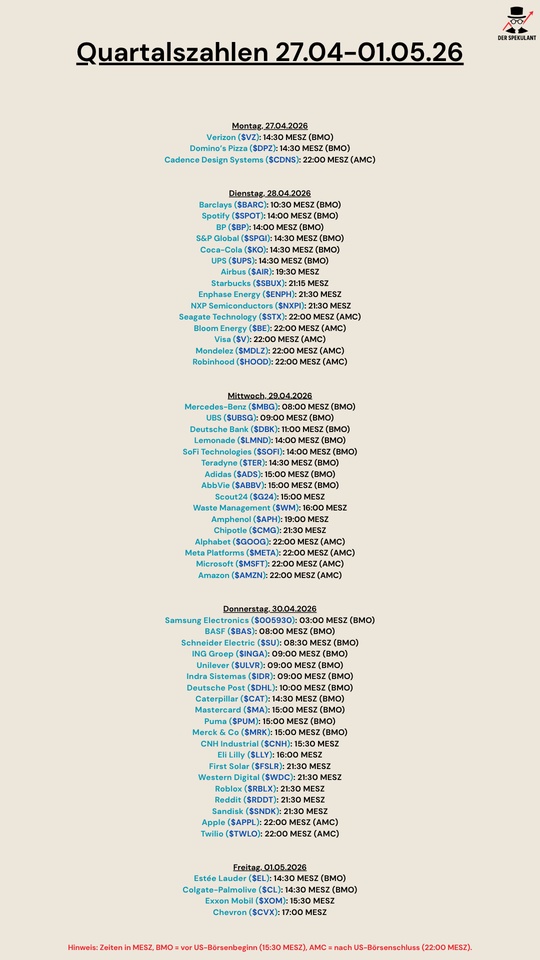
Quarterly figures 27.04-01.05.26
$VZ (-2,74 %)
$DPZ (-1,07 %)
$CDNS (+3,98 %)
$BARC (+2,85 %)
$SPOT (-1,15 %)
$BP. (-1,05 %)
$SPGI (+0,27 %)
$KO (+0,1 %)
$UPS (-0,72 %)
$AIR (+0,46 %)
$SBUX (+2,29 %)
$ENPH (-4,63 %)
$NXPI (+5,09 %)
$STX (+3,36 %)
$BE (+7,3 %)
$V (-0,98 %)
$MDLZ (-1,7 %)
$HOOD (-1,88 %)
$MBG (+1,35 %)
$UBSG (+0,07 %)
$DBK (+2,69 %)
$LMND (+0,42 %)
$SOFI (-0,97 %)
$TER (+0,49 %)
$ADS (+1,7 %)
$ABBV (+1,02 %)
$G24 (-0,59 %)
$WM (+0,61 %)
$APH (+2,34 %)
$CMG (+3,25 %)
$GOOG (-0,85 %)
$META (-1,1 %)
$MSFT (+1,8 %)
$AMZN (+0,46 %)
$005930
$BAS (-0,9 %)
$SU (+1,91 %)
$INGA (+1,88 %)
$ULVR (-0,71 %)
$IDR (+3,91 %)
$DHL (+1,78 %)
$CAT (+1,11 %)
$MA (-1,4 %)
$PUM (+1,74 %)
$MRK (-2,94 %)
$CNHI (-2,33 %)
$LLY (+0,83 %)
$FSLR (-2,21 %)
$WDC (+4,6 %)
$RBLX (+2,32 %)
$RDDT (-4,25 %)
$SNDK (+1,81 %)
$AAPL (-0,83 %)
$TWLO (+0,73 %)
$EL (+0,45 %)
$CL (-0,62 %)
$XOM (+0,9 %)
$CVX (-0,42 %)
2121
2 Commentaires
Lemonade will be interesting and may already point the way forward.
Mercedes could hurt...
Mercedes could hurt...
•
22
•
8Mo·
🎧 Spotify in a record rush: the Q4 figures are here!
$SPOT (-1,15 %) has ended the year 2025 with a bang. The results published today for the fourth quarter show that the streaming giant is growing faster than ever before.
The highlights at a glance:
- 📈 Record number of users: Monthly active users (MAUs) climbed to 751 million (+11% YoY). With an increase of 38 million, it was the strongest quarter in the company's history!
- 💎 Premium growth: 290 million people now pay for their subscription (+10% YoY).
- 💰 Profitability: An operating profit of 701 million euros and a record gross margin of 33.1% show that Spotify has finally become a profit machine.
- 📊 Revenue: Quarterly revenue increased by 13% adjusted for currency effects to 4.5 billion euros.
Why are things going so well?
Especially the success of Spotify Wrapped (over 300 million users!) and the expansion of audiobooks and video podcasts have driven the figures upwards. The new co-CEO duo has declared 2026 to be the "year of ambition".
The stock market is celebrating: The share price has already reacted with a significant jump today. 🚀
#Spotify
#Earnings
#Streaming
#MusikBusiness
#Finanzen
#TechNews
#SpotifyWrapped

Titres populaires
Meilleurs créateurs cette semaine
Données en temps réel par LSX · Données financières de FactSet