
$MCD (+0,69 %) - I missed out on the last McRib!!! 😭😭😭. It's sold out, and today is the last day!

McDonald's
Action
Action
Ticker: MCD
MCD
Price
Discussion sur MCD
Postes
513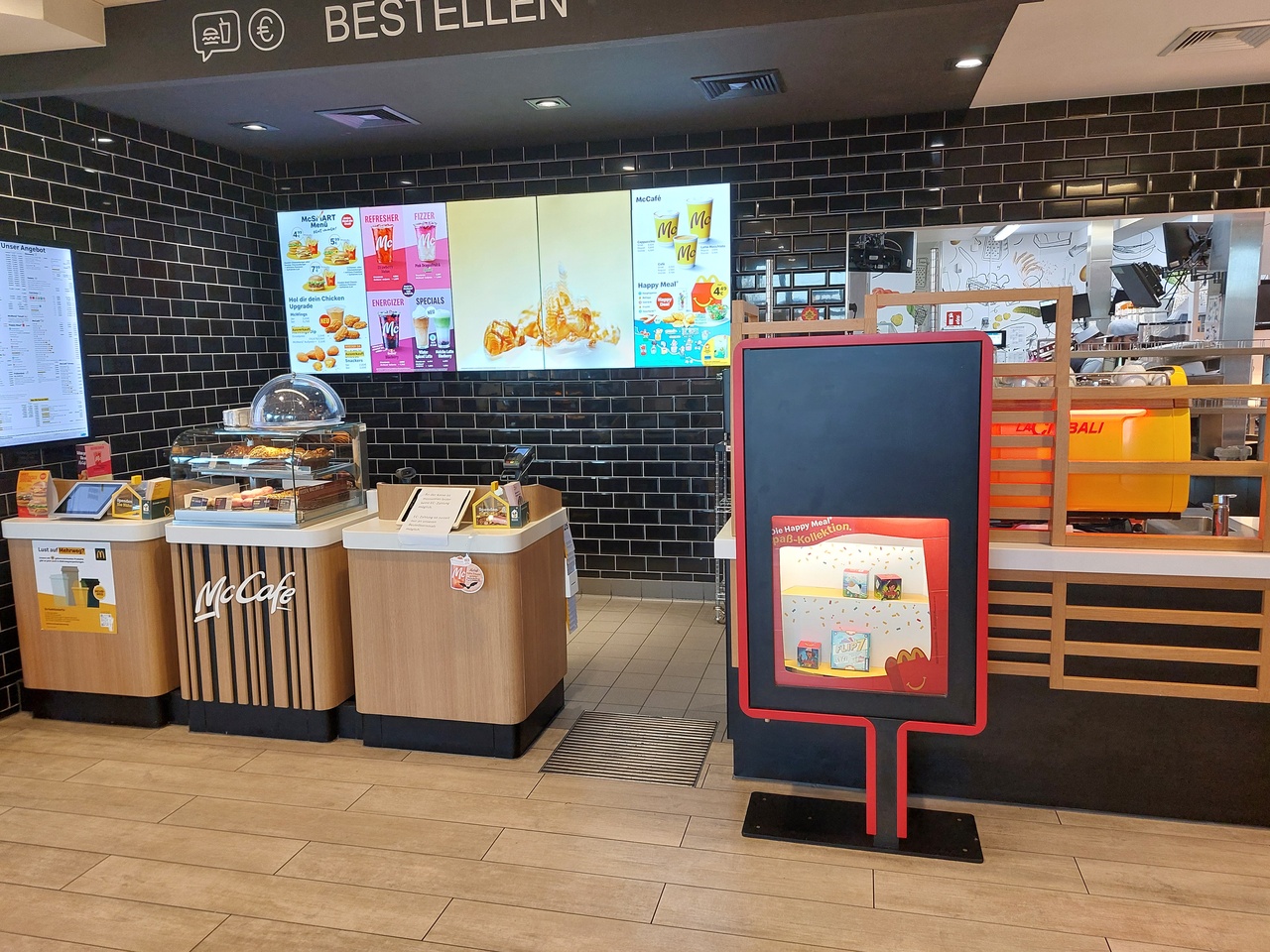


1J·
Info
So, the next purchases have been made—here’s a brief overview of the structure.
95% goes into securities, just under 2.5% into gold, and 2.5% into fixed-income securities.
Of that, just under 78% is in ETPs and the remaining 22% in stocks.
As for sector weighting, currently just under 28% is in financials, 22% in information technology, 9% in semiconductors, 8% in real estate stocks, and ~6% in major banks; the rest is further diversified.
What is the goal? Well, part of the goal is to preserve and grow capital—as we all know.
To that end, my father and I decided to use a ready-made ETF ($GERD (+0,2 %) ) that has a weighting of just under 75%. About 5% is in gold and an overnight swap. The remaining 20% consists of individual stocks, such as $MP (-0,07 %) ,$PG (+0,15 %) ,$JNJ (+1,38 %) , $CAT (-0,64 %) or even $KHC (-0,69 %) .
How do we determine which stocks to include in the portfolio—specifically, the background stocks required for Ki, such as $MP (-0,07 %)
$CMS (-1,4 %)
$CRWD (-6,86 %)
$RKLB (-1,89 %)
$SYM (-0,4 %) and $AVGO (+0,22 %) . The key factors for these companies are, first and foremost, energy consumption, security, raw materials, robotics, and systems.
However, we’ll also include a few standard holdings in the portfolio, such as $SHEL (+0,74 %)
$MCD (+0,69 %)
$TSLA (-1,99 %)
$CVX (+0,67 %) or $BAC (+0,02 %) . Since, in our opinion, these are strong and important fundamentals.
As I said, in a few days there will most likely be a portfolio post where you can critique it however you like.
This is currently our decision and strategy, and thanks to it, we’re already up nearly 20k in profit since our first purchases this week.
Best regards. ✌🏻
66
17 Commentaires
1J
Awesome!? 🤷
What do you want from us?
You're just doing your own thing anyway.
What do you want from us?
You're just doing your own thing anyway.
•
1212
•1J·
MCD — new position opened 🍟
Picked up shares of $MCD (+0,69 %)
at $250.
I believe in the name and I think I caught it at a great price: has been trading around the low-$300s lately, with a 52-week high above $340. Getting in at $250 means buying one of the most defensive blue chips out there below its recent range — a global brand, a growing dividend (~2.4% yield), consistent buybacks, and the kind of business that keeps compounding through any macro cycle.
Analyst average target sits in the mid-$340s with a Buy rating.
I'm not here for the quick move though — this is a long-term hold, collecting the dividend and letting it work.
Buying quality on weakness. 🍔📈

1414
7 Commentaires
Dividend Yeld With This Price: 3,30%
•
55
•
5J·
Let's keep going :)
I got paid for my side job, and with what was left over, I bought a few new things.
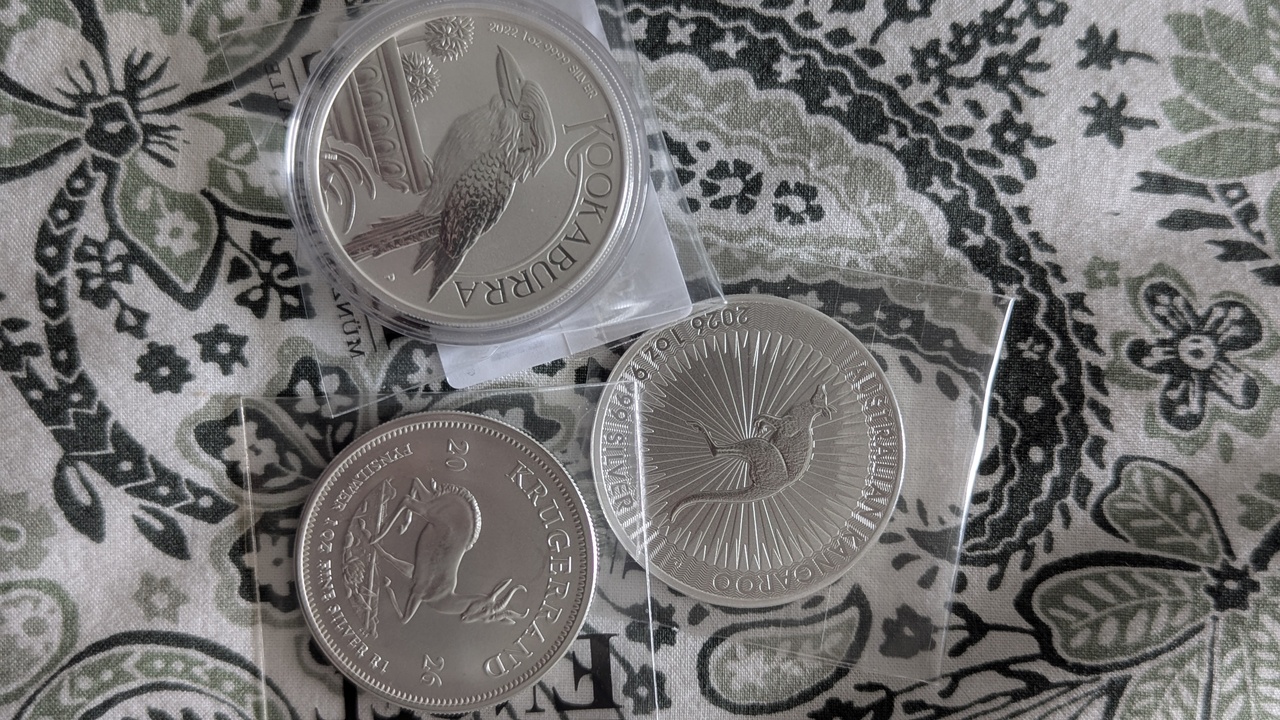
First, I expanded my precious metals collection. Three beautiful new coins. I now have 5 troy ounces of silver.
Plus, I spent 100€ at McDonald’s.
Personally, I’m proud of what I’ve accomplished.
Have a great weekend, and here’s to successful investments for all of you! 🎉💪🏻
3939
21 Commentaires
Beautiful coins and a great stock. Congratulations. 🙂
•
88
•
1Sem.·
Comparison Series, Part 3: Lumentum and Applied Optoelectronics—Who Profits from Artificial Intelligence Data Traffic?
Following PepsiCo $PEP (+0,5 %) versus McDonald’s $MCD (+0,69 %) and Nu $NU (-4,7 %) versus SoFi $SOFI (+2,54 %) , today we’re taking a look at two companies without whose technology a lot of data in data centers would be stuck in a traffic jam for quite a while.
Today we have our first requested comparison of @Tenbagger-Capital
Lumentum $LITE (+15,58 %) and Applied Optoelectronics $AAOI (+8,9 %) both supply optical components for faster connections. Both are benefiting from the expansion of AI.
Nevertheless, they differ significantly in how much of that is already trickling down to shareholders today.
If you have a request for a comparison, feel free to write it in the comments—just one condition: both companies should be from the same sector and, ideally, be competitors :)
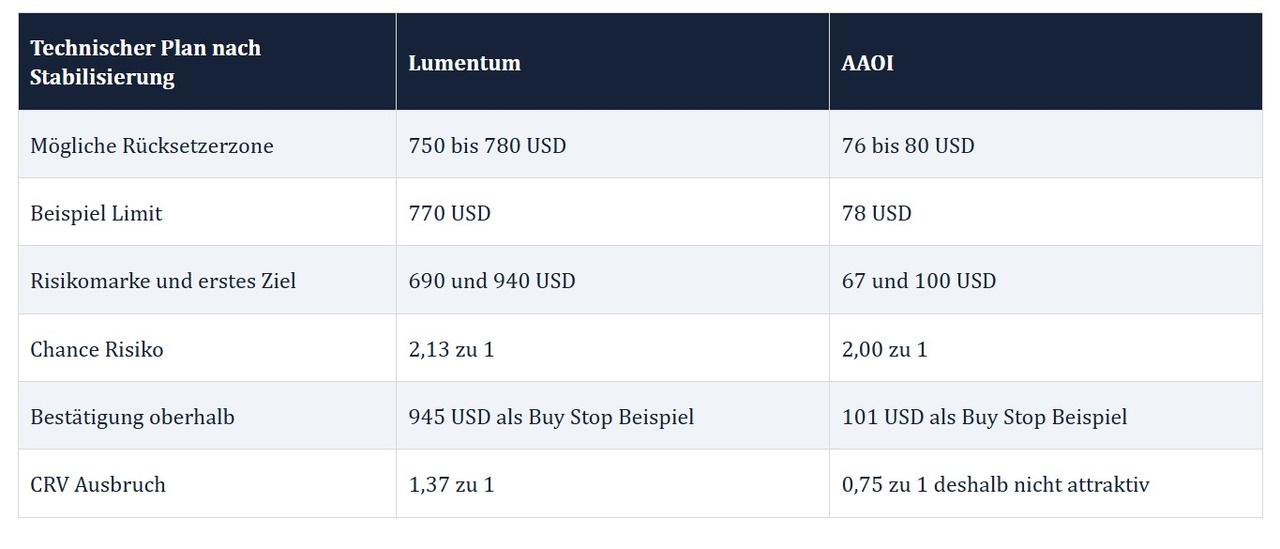
Quick note: As of October 16, 2026. Common price basis (U.S. close on October 15): Lumentum $869.54, AAOI $83.73. General comparison independent of any personal portfolio strategy. All scenarios are based on my own assumptions; these are not guaranteed price targets.
How the Companies Came to Be
Lumentum was formed in 2015 through a spin-off from JDS Uniphase. Over the years, other specialists joined the company, including Oclaro, NeoPhotonics, and Cloud Light. Today, its product portfolio includes laser chips, optical components, modules, and optical switches. This gives the company multiple opportunities to profit from the expansion of data communications.
AAOI was founded in Houston as early as 1997 and has been listed on the Nasdaq since 2013. The company produces optical transmitter and receiver modules and manufactures its own lasers. It also supplies cable network operators through its CATV business. In the last quarter, approximately 42 percent of revenue came from this segment. AAOI is therefore more than just an AI play, even though the market is currently paying particular attention to high-speed data center modules.
What I Like Better About Lumentum
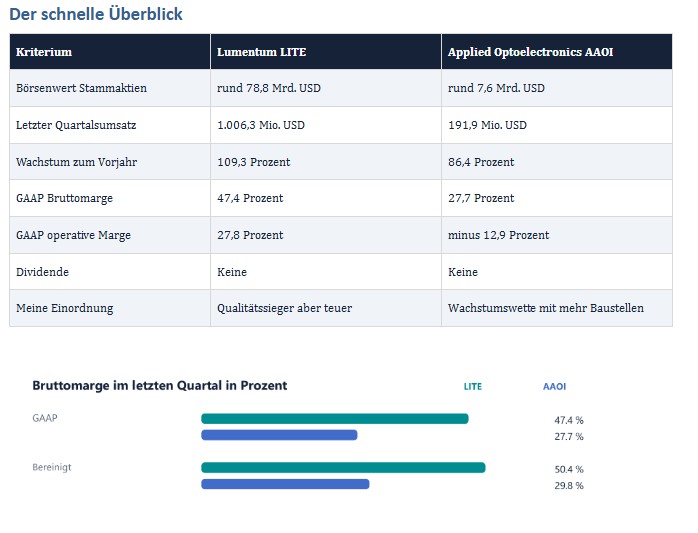
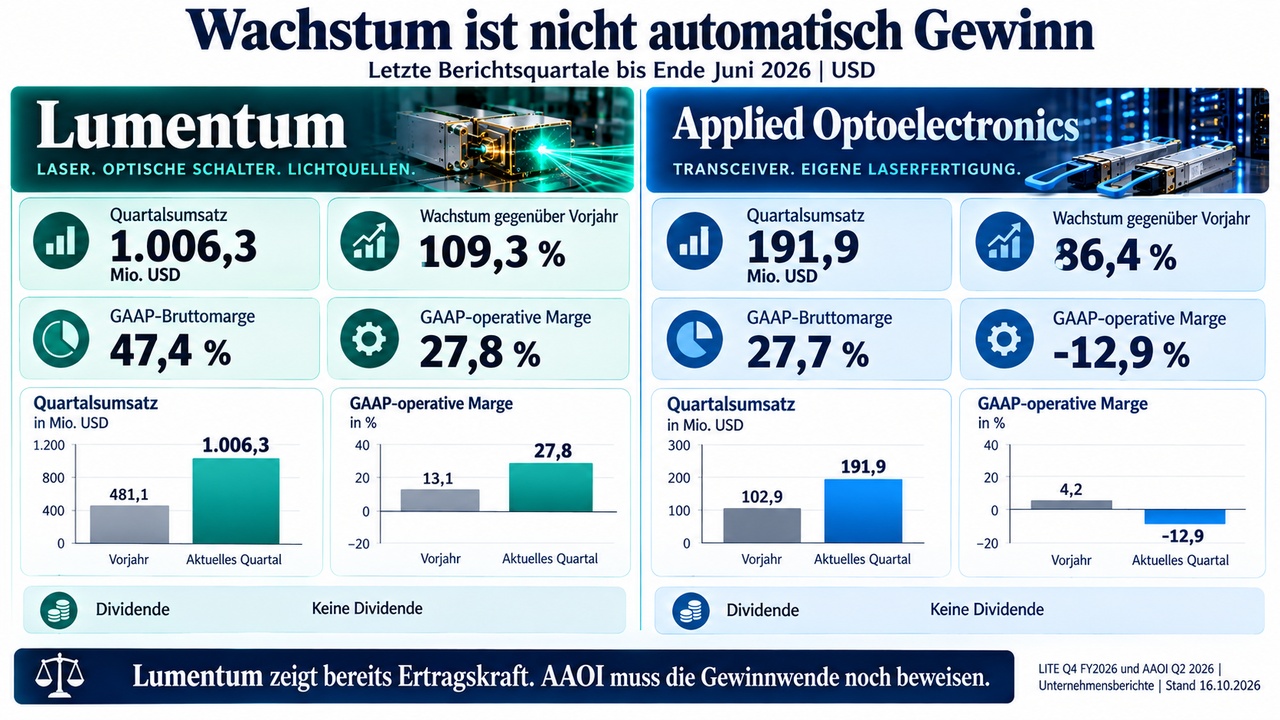
Lumentum has already demonstrated that high demand translates into strong operating profits. With quarterly revenue exceeding $1 billion, the GAAP operating margin stood at 27.8 percent. AAOI is also growing strongly but is still posting operating losses.
For me, that’s the most important difference: With Lumentum, I don’t have to pin my hopes as much on a turnaround in profitability that has yet to materialize.
Added to this is the broader technical portfolio. If the design of a data center changes, Lumentum can remain involved through specialized lasers, external light sources, or optical switches, for example.
AAOI also has an advantage with its own laser production. However, its financial success currently depends more heavily on ramping up new transceiver capacity quickly and with reasonable margins.
Lumentum’s massive reported annual loss warrants an explanation.
It was primarily caused by a non-cash charge resulting from the conversion of convertible bonds. This was not a billion-dollar outflow from day-to-day operations.
The transaction is nonetheless relevant to shareholders because it alters the capital structure and dilutes equity. Simply dismissing it as a “one-time item—no big deal” would be too convenient for me.
What’s particularly exciting about AAOI
is that AAOI is starting from a significantly smaller base.
If the expansion for 800G and 1.6T modules succeeds, the company can grow at a higher rate than its larger competitor. In-house lasers can further improve costs and delivery capabilities.
In a best-case scenario, this would provide significant revenue and margin leverage. That’s where AAOI could very well come out on top in this head-to-head competition.
I wouldn’t, therefore, label AAOI as a bad company.
The question is how much of the future capacity will be used profitably and how many additional shares will be issued by then. After all, capacity listed on a presentation slide doesn’t pay the bills.
Especially with an expansion like this, one must distinguish between revenue growth and earnings per share growth.
Where Lumentum still doesn’t convince me
The company is good, but the market has known that for a long time. A market capitalization of nearly $79 billion contrasts with about $300 million in free cash flow from the last fiscal year.
Of course, this cash flow is expected to grow significantly. Nevertheless, the gap shows just how much of the future is already being priced in today. Even a good company can disappoint on the stock market if it delivers only “very good” results rather than “sensational” ones.
Added to this are new factories, bottlenecks, and a growing share of large customers.
The largest disclosed end customer most recently accounted for 26.6 percent of annual revenue, compared to 15.4 percent in the previous year. Long-term capacity utilization forecasts are positive. However, they are no substitute for addressing the question of how binding orders actually are and what prices will ultimately be achieved.
What makes me significantly more cautious about AAOI
The expansion is initially a cash drain. In the first half of the year, operating cash outflow totaled around $74 million.
Together with plant and equipment, advance payments for equipment, and land purchases—according to this broad definition of investment—approximately $707 million was spent. Part of this is intended to generate revenue later on. For now, however, it represents a real financing need.
The capital increase completed on October 5 raised a net total of approximately $588 million and improves the company’s financial flexibility. At the same time, about 5.7 million new shares were issued.
Both of the following are true: The financing situation has improved, and the existing shareholders’ stake has decreased. Whether another capital raise will be necessary depends primarily on the actual expansion costs and future cash inflows.
A completed program is no guarantee that another one will never follow.
The customer base is particularly important to me.
Three customers accounted for a combined 92 percent of revenue. In addition, approximately 67 percent of receivables were attributable to Digicomm, a distributor in the cable network business. This isn’t automatically a payment issue, but it is a significant concentration. A distributor can serve many end customers and still remain a single major payer for the manufacturer.
AI helps both, but the technology may change
Both companies benefit from the fact that data centers need to process more data. The risk isn’t so much that AI will replace the laser. What’s more intriguing is whether new architectures will shift the value chain.
As optical connections move closer to the chips, the requirements for traditional pluggable modules will change.
At Lumentum, , I like that lasers and external light sources can still be used even in new architectures.
AAOI also has opportunities through its laser manufacturing, but it must first translate this into lucrative products on a larger scale. Lumentum’s recent demonstration with Astera Labs and Corning is interesting. However, a demonstration does not yet equate to mass-production business with a steady profit contribution.
I wouldn’t factor in an allegedly certain tailwind from an immediate ban on Chinese transceivers for any stock. There are political initiatives and reports about potential FCC rules.
However, the reviewed official Senate bill pertains to specific procurements and includes long transition periods. I do not view this as a guaranteed source of additional revenue.
What I expect for the coming years
For Lumentum, in my base case scenario, I expect continued strong growth and a healthy operating margin, but also high capital expenditures and increased competition down the road.
The company has the potential to grow significantly larger. I simply don’t expect today’s scarcity-driven prices and exceptional growth rates to last forever.
With AAOI, I see the potential for a bigger leap, but also a wider range of possible outcomes. In the best-case scenario, new capacity comes online smoothly, 1.6T gains traction, and higher revenue translates into higher earnings per share. In the worst-case scenario, new facilities come online too late, capacity utilization lags behind, or additional capital requirements dilute returns for existing shareholders. Here, the path to profit is at least as important as the potential target.
My conservative cash flow model currently yields, in the base case, around $365 for Lumentum and $44 for AAOI.
For both companies, this is below the current market price.
That doesn’t mean the market has to fall to those levels tomorrow. It means that a great deal of growth is already priced in, and my conservative scenario does not offer a clear margin of safety.
The range is wide: In the bear case, my model puts Lumentum at about $96.
The extreme AAOI stress case comes in at less than one dollar, because expansion costs, combined with too-low future margins, would virtually erode the entire shareholder value.
This is not a prediction of insolvency. In the bull case, the figures come to approximately $1,170 and $169, respectively.
This scenario assumes exceptionally successful expansion and high future margins. Such possibilities are appealing, but I wouldn’t present them as the standard outcome.
A potential entry point does not constitute an obligation to buy
On the chart, Lumentum is relatively stronger. The price is still above the long-term daily moving average but has broken below the shorter-term trend line.
AAOI is trading below both the 50-day and 200-day moving averages.
For both, I don’t see a confirmed bottom at the moment. A red chart doesn’t turn green just because the stock was more expensive last week.
These levels are trading plans in case of stabilization; they are not a call to place blind orders immediately. In a pullback trade, I would assess the first target zones to determine whether to reduce my position or let the recovery continue. For a long-term investment, I would additionally require a reasonable valuation and stronger operational evidence.
A technical stop may be executed significantly worse in the event of a price gap.
A normal buy stop does not wait for a confirmed closing price.
Anyone who wants this confirmation will have to reassess the situation afterward. Limit orders and breakout orders are alternative approaches; an entry OCO order is only an option if the broker supports this order type. The upcoming earnings report on November 5, in particular, could lead to significant price swings.
My conclusion on this showdown
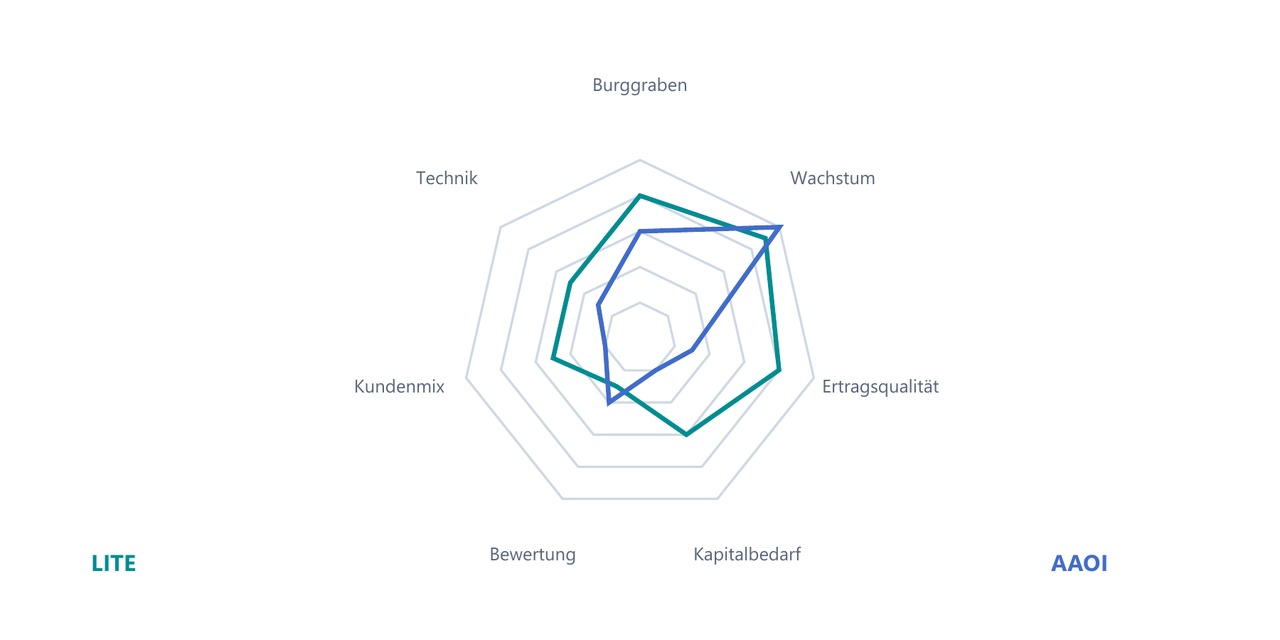
If I were to choose, independently of any portfolio strategy, I’d have to choose one of the two companies , it would be Lumentum.
Its operational profitability, broader product portfolio, and stronger cash flow base convince me more.
If AAOI successfully expands, it could offer greater upside potential.
However, this requires putting up with significantly more uncertainty regarding margins, financing, and customer dependence.
For an entry today, my verdict on both is: wait a little longer.
Lumentum remains my preferred stock to watch.
With AAOI, before making a long-term purchase, I’d first like to see not only new factories and new shares being added, but also a sustainable increase in free cash flow per share.
The AI boom is interesting enough on its own. I don’t need to chase every valuation associated with it.
The strongest counterargument to my caution is a prolonged shortage leading to much higher future profits.
In that case, the market could be right, and my conservative estimate might be too low. That’s exactly why I’m looking forward to both companies’ next earnings reports on November 5. Solid new evidence would change my assessment; another high analyst target alone wouldn’t be enough.
What do you think: would you rather go with Lumentum’s already proven earnings power or the bigger catch-up bet on AAOI?
Feel free to share your arguments in the comments, along with two other stocks for an upcoming showdown.
Ideally, they should be from the same sector and have comparable business models.
Constructive counterarguments are expressly welcome.
Greetings from Denmark
Raketentoni
Sources:
S1 Lumentum Q4 and FY2026 Earnings Report, August 11
S2 Lumentum FY2026 Annual Report, including Form 10-K
S3 AAOI Q2 2026 Results and GAAP-to-Non-GAAP Reconciliation
S4 AAOI Form 10-Q as of June 30, 2026
S5 AAOI 2025 Annual Report (Form 10-K)
S6 AAOI Completion of Capital Increase, October 5
S7 NVIDIA Strategic Partnership with Lumentum, March 2
S8 Lumentum, Astera Labs, and Corning OCP Demonstration, October 12
S9 U.S. Senate Bill S 5548 Introduced, September 24
S10 Lumentum Stock Price and Valuation Data
S11 AAOI Stock Price and Valuation Data
S15 Lumentum Investor Relations Calendar
S16 AAOI Investor Relations Calendar
S17 AAOI Company History
and, of course, all the others :)
+ 3
2929
13 Commentaires
1Sem.
Well, which one do you think I'd prefer!😂😎 It's not that hard to guess if you know me. No risk, no fun! Of course, $AAOI
Right now, though, I wouldn't jump into either one. I don't think we're done with the setbacks yet.
Right now, though, I wouldn't jump into either one. I don't think we're done with the setbacks yet.
•
66
•
1Sem.·
Thank you, world 🌍🙏🏽
Wow, what a year... I'm speechless. 🤐
First and foremost, I’d like to thank to you—the folks at Getquin. Also, the comments, casual conversations and even the occasional constructive criticism, above
especially your posts have helpedform in my opinion , hybrid portfolio .
Lvl 180 – Milestone 🪨
In the beginning, it consisted mainly of dividend aristocrats and Kingswhose prime may already past . Through the encouragement from so many of you, I’ve listenedand reflected and decidedto focus more on the winners . Stocks that are in demand in demand, not the ones that used to were.
I like companies that are deeply entrenched in the system, including $MSFT (+1,68 %)
$MCD (+0,69 %)
$META (-0,5 %)
$UNH (-0,38 %)
$CME (+0,29 %) etc.
But I also love totally ordinary, simple businessesthat appeal to consumers extremely well. For me, these include $TJX (-1,19 %)
$AD (-0,74 %)
$MDLZ (+0,48 %)
$PEP (+0,5 %) and $MRK (+0,32 %) and again $MCD (+0,69 %) :)
For me, this year was the “Year of Rebalancing.”
My strategy is simple: I invest in sound companies whose stocks have taken a hit… mostly
In addition to the financial figures, which, of course, should be in order, I look at the dividend yield. If it’s historically particularly high and is the business still sound, it will be . I want to buy in at a low price and secure a high YoC . That company’s of the company should then take care of the rest.
Stocks with dividend growth can certainly deliver good price gains. Investors who dividend consistently significantly must also increase its profits and its cash flow increase increase.
Otherwise, at some point, more will be distributed than is earned.
If the company grows organically and also regularly buys back its own shares, these are good conditions for rising stock prices in the long term.
Be that as it may. I sold shares that I’d held for several years. Some were in the black, others, of course, in the red. I reinvested part of the proceeds into new companies.
I always say “scale up”...—no idea if that makes sense 😆
Goals?
I don’t know. I had goals. Now I just want to be better every day than I was yesterday.
Even if things don’t go so well one day, I’ll still stick with it. Even if it’s only 10%... 10% is better than 0%. The compound interest is a part of in life.
I also believethat there is happiness exists. But who works at it works at it every day increases the chanceof finding that one lucky day . Because it’s on that very day active on that very day.
You shape your own destiny!
And what I also find important :
Always be grateful, no matter what.
We’re lucky to be able to build a financial foundation. We must never take that for granted.
With that in mind! Stick with it, no matter what... Fighter’s instinct 🗻
❗️This is not investment advice❗️
The image is AI-generated :)



2Sem.·
September 2026 in Review
Hi,
September marks the end of the third quarter. I always feel like a lot happens in the fourth quarter. Winter starts, winter tires need to be put on, Christmas preparations, New Year’s Eve preparations, the last few days of vacation are coming up, and in December I’m somehow constantly attending birthday parties anyway. So for me, the fourth quarter just flies by.
But let’s take a look at the performance first.
📈 Performance:
S&P 500: +2.90%
MSCI World: +1.89%
DAX: -4.03%
Dividend portfolio: -2.23%
My top and bottom performers in September were (Top/Flop 3):
🟢 ($TXN (+0,74 %) ) Texas Instruments +10.17%
🟢 ($PETR4 (-0,27 %) ) Petroleo Brasileiro +8.83%
🟢 ($8001 (-1,93 %) ) Itochu +8.66%
🔴 ($O (-0,54 %) ) Realty Income -8.86%
🔴 ($HD (-0,24 %) ) Home Depot -10.37%
🔴 ($MC (-1,03 %) ) LVMH -13.96%
Dividends:
September 2026: €247.58
September 2025: €223.22
Change: +10.91%
Sales:
🟥 None
Purchases:
🟩 ($MCD (+0,69 %) ) McDonald’s (€428)
🟩 ($DTE (+0,7 %) ) Deutsche Telekom (€371)
🟩 ($HD (-0,24 %) ) Home Depot (€261)
Savings plans:
($CTAS (-0,04 %) ) Cintas (€50)
($MSFT (+1,68 %) ) Microsoft (€25)
What else has been going on?
The heating bill is finally paid; the company deducted the repair costs, so the bill for the solar panel system is now a thing of the past. In September, I also took two weeks off, including a four-day mini-vacation in Croatia. That was really needed, since my last extended vacation was already a year ago. The four days in Croatia were also very refreshing, and it was nice to be back there after about 25 years.
Other than that, not much has happened.
Things won’t get exciting again until October, when the next big vet bill is due. Before my vacation, my boss told me I’d be getting a performance-based bonus. I didn’t even know such a thing existed, but I was really happy about it. I guess that money will end up going toward the vet bill, though.
🥅 Goals for 2026:
I’m trying to reach €85,000 in my dividend portfolio this year. Currently, I’m at around €82,391. I expect to receive about €464 in net dividends this year (according to getquin). So I’m still about €2,500 short. That’s definitely going to be a huge challenge. Maybe the last few months will go better for me again—then it should be doable.
If you enjoyed this post and would like to read more like it, feel free to follow me;
if you’re not interested, feel free to scroll past or use the block feature.
4444
20 Commentaires
2Sem.
What the vet is to you, the tax office is to me—always trying to squeeze money out of me 😅
•
66
•
2Sem.·
Sell oil companies?
Sell oil companies $PBR (-1 %)
$CNQ (+1,38 %) and buy $MCD (+0,69 %)
$VICI (+0,58 %)
$SGO (-0,39 %) ? #portfoliofeedback
#dividends
15Positions
0,70 %
66
2Sem.·
Let's talk about TJX 🛒🛍️ + my thoughts on TJX 💬
TJX Companies is the world's largest off-price retailer of fashion, home goods, and everyday products for people and pets.
$TJX (-1,19 %) purchases surplus inventory, excess inventory etc. directly from brand manufacturers and designers at affordable prices. Often because these companies don’t
sell
sell in time. The manufacturers and designers have to constantly bring out new collections and don’t always have time to sell everything…
and that’s when TJX steps in.
Through bulk purchases and flexible contracts , TJX gets these brand-name products at a discounted
prices.
The savings are $TJX (-1,19 %) to the customers . In most cases, the products are 20% to 60% cheaper than the regular comparable prices.
That’s why TJX is always so affordable… and yes, the brand-name products there are genuine… you wouldn’t always think so given the prices, would you? 😄
The selection at $TJX (-1,19 %) is constantly changing. So always something new on offer.
The Treasure Hunt principle.
The Treasure Hunters keep coming back to check for a product to discover and snagbefore someone else snatches it up.
The early bird catches the worm.
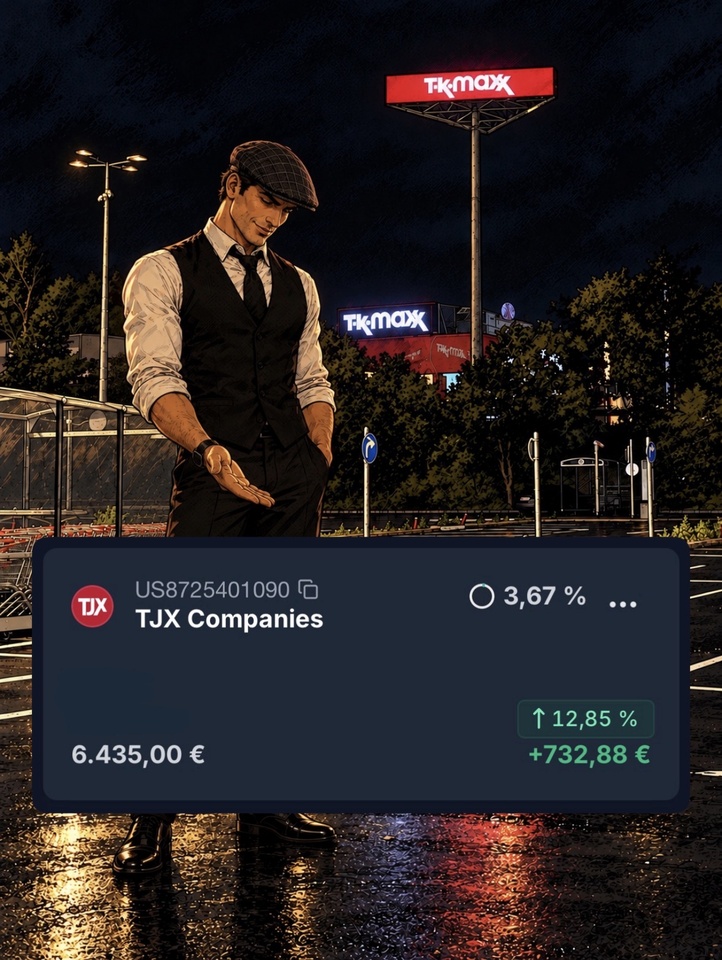
I took this photo at TK Maxx myself yesterday and used AI to turn it into a comic to show how crowded it is there and how long the line at the register is.
Crazy
That’s business model works well in times of high inflation, because customers want to , and in times of low inflation, because consumers are once again are willing to spend more and still prefer to shop .
Win-win, right?
- Revenue growth: Approx. 6% to 8% annual average. Steadily rising
- Gross margin: on average 35% to 37%.
- Profit growth (net income): Approx. 10% to 15% on average, supported by operational efficiency.
- Return on equity is usually between 30% and over 50%. Very efficient.
- The dividend was in 2020 due to COVID-19 in 24 years of steady increases cut, as revenue has plummeted … which makes sense. Let’s briefly recall the FFP2 masks😷 Personally, I’m turning a blind eye to this because, after 2020, the dividend returned to the its previous level and has been steadily increased
- The average annual dividend growth over the last 20 years has been over 15%! Over the past 10 years, it has been approximately 15% to 16%. A true dividend compounder.
- The payout ratio is approximately 32% to 35%. Very healthy.
My thoughts on TJX:
Every time I walk through the stores, I’d love to buy everything , which means I want to buy the company. Which means I want to own the stock. 😋
$TJX (-1,19 %) It felt like never had the problem of customers rarely stopping by.
It’s always packed! Somehow, it always is!
There’s literally a traffic jam at the checkout counters. No matter where I look… the behavior of the customers. They don’t just shop and leave. They go to pass the time , spend their time there, and talk to each other, look at the products… and then buy something because they find something interesting at a good price. Or simply out of boredom?
Just brilliant.
From brand-name clothing to kitchen products, toys, furniture and household goods to electronics… simply everything.
Many would say that the stock is overvalued. But you could have seen that coming over the past 15 years time and again. Whenever people thought they’d suffered a drawdown was finally cheap , it was back well above the low.
So I figured I’d just jump in instead of just just watching…
You hear so little about $TJX (-1,19 %) and I think that’s a good thing. The company can deliver at a relaxed pace without constant fuss, headlines and anxiety.
By now, my opinion… when there’s there’s too much talking , one should be … aka $MCD (+0,69 %) recently. First, there’s a lot of talk, then comes the panic.
The P/E ratio for the stock is currently around 28. The average over the past few years is roughly >30.
My entry point was $TJX (-1,19 %) was around €109, at a P/E ratio of about 26.
Yes, for me, this is actually a bargain
Are you an investor in TJX? Are you thinking about becoming one? Or do you steer clear of the company? Let me know! 😄💪🏽
❗️Not a buy recommendation❗️

2424
16 Commentaires
2Sem.
That's funny—I bought into the exact same stock for the second time last week.
•
22
•2Sem.·
Part 2 of the series: FinTechs Without Branches—Stocks with Potential? Nu vs. SoFi
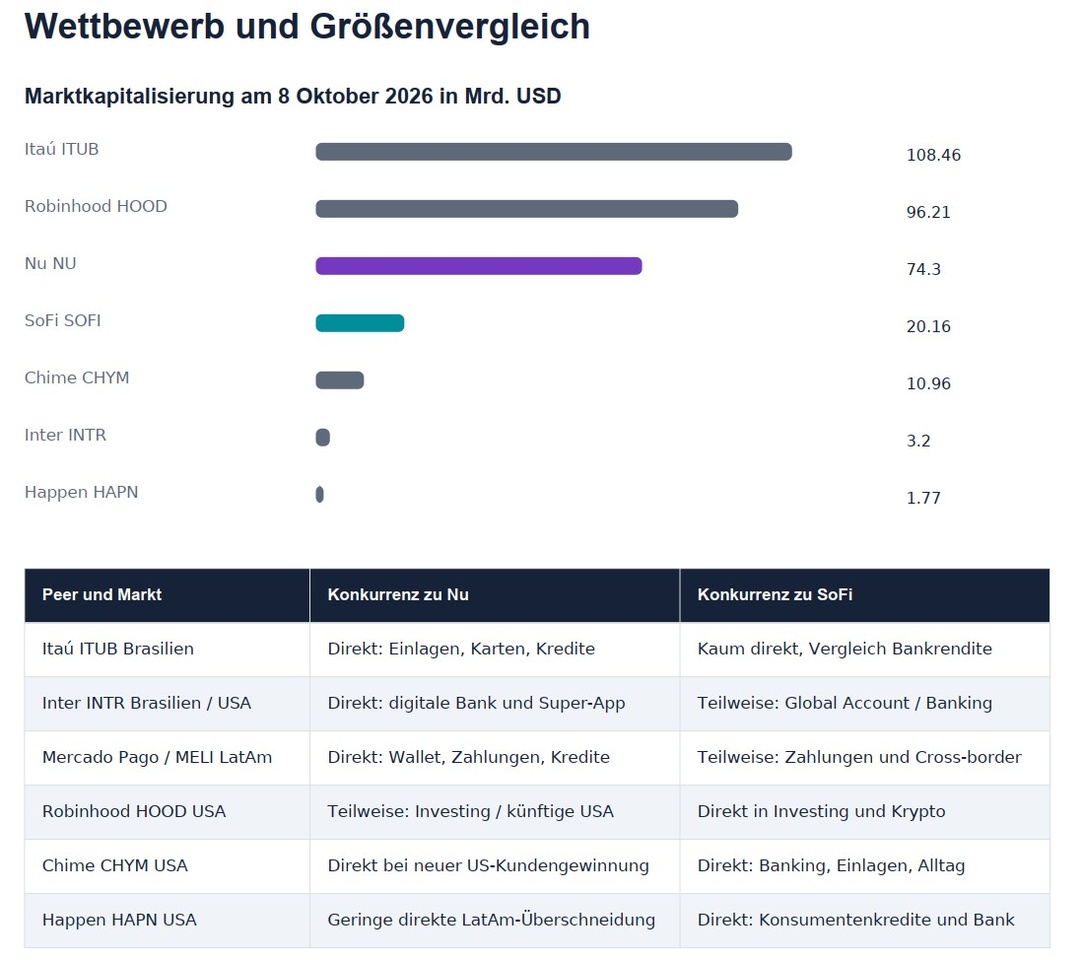
Following PepsiCo $PEP (+0,5 %) versus McDonald’s $MCD (+0,69 %) , our comparison series continues today—this time with two fintech companies:
Nu Holdings $NU (-4,7 %) and SoFi Technologies $SOFI (+2,54 %) .
Since we’re also invested in U.S. stocks, we’ll take a closer look at these two U.S.-listed companies.
Nubank was founded in Brazil in 2013 with the goal of making banking simpler and more affordable. SoFi was founded in 2011 in the Stanford University community and started out offering student loans.
Today, both companies offer a much wider range of financial services.
We’ll compare which stock performs better in terms of quality, valuation, opportunities, and risks.
Do you have any requests for future comparisons?
Feel free to suggest two stocks in the comments.
The only requirement: They should be from the same sector and, ideally, be direct competitors.
First things first: if I had to decide today, my choice would be Nu Holdings. Why?
Its established profitability, large active customer base, and
scale in Latin America are more compelling.
SoFi offers interesting U.S. banking, lending platform, and
payment options, but has earned significantly less on its capital so far. A nearly identical stock price does not imply comparable enterprise value.
Nu Holdings and the Quality of Its Earnings
How a large customer base becomes a profitable bank
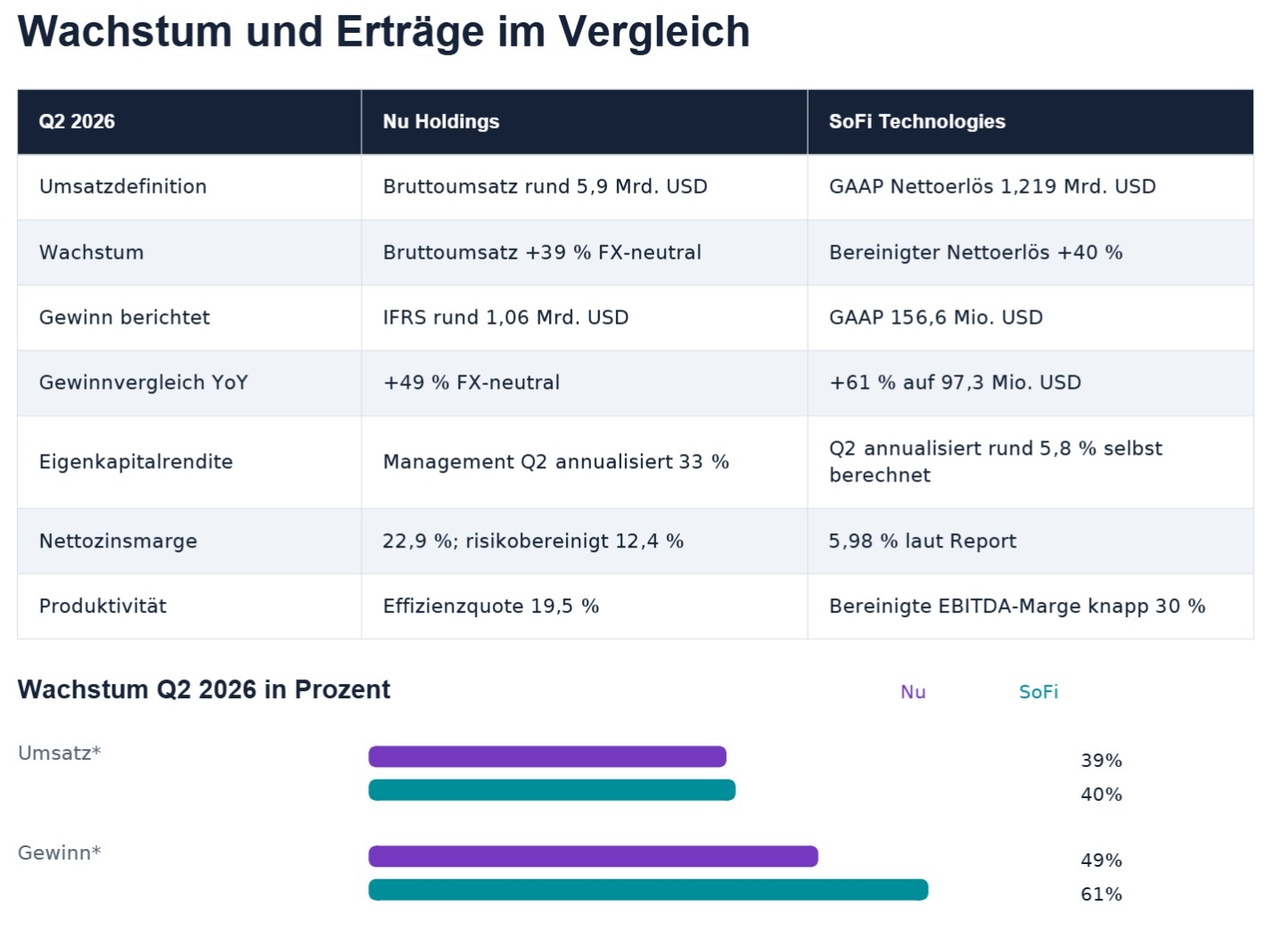
Nu posted a profit of approximately $1.06 billion in the second quarter. This figure is particularly impressive because it comes with a return on equity (ROE) of 33% and an efficiency ratio of 19.5% . ROE, or return on equity, measures profit relative to equity invested.
The efficiency ratio here describes expenses relative to the revenue base. Together, these metrics show how much revenue remains after operating expenses.
The company’s financial strength stems from low customer service costs and deeper customer relationships. A customer who consolidates their income, payment transactions, and multiple products with the same bank generates additional revenue and provides more information for credit decisions.
New offerings can then be sold within an existing relationship. Therefore, what matters is not just the number of customers, but whether activity, revenue per customer, and credit quality are all increasing together.
It is precisely this combination that makes Nu the top performer in this comparison.
The company does not need to base its appeal solely on future U.S. business. Its current core markets already provide a substantial profit base.
For valuation purposes, however, this also means that part of this advantage is already reflected in the high premium over book value. Strong financial results do not allow for an arbitrary entry price.
High returns also carry credit risk
The risk-adjusted net interest margin reached 12.4%. Put simply, it represents net interest income after accounting for credit costs. At the same time, the ratio of loans more than 90 days past due rose to 6.9%. Earlier stages of delinquency showed a more favorable trend. The figures therefore indicate neither a green light nor a confirmed credit default.
More unsecured loans can generate higher interest income and profits, but they also increase sensitivity to weaker income. At a growing bank, defaults on new loans often appear less serious at first because new loans do not reveal their losses until later.
That is why loan cohorts are important:
Loans from the same origination period are monitored over time, rather than simply comparing the average of the entire growing portfolio.
I would only consider the high margin sustainable if more mature loan cohorts also remain stable.
The counter-scenario to today’s quality assessment is a credit cycle in which higher losses erode part of the interest yield. Mexico and the U.S. offer additional opportunities, but should not mask this risk.
In our assessment, U.S. expansion is an option, not a necessary justification for the company’s overall value.
SoFi and the Path to Higher Returns on Capital
Strong growth alone is not yet enough for the quality premium
SoFi reported $156.6 million in GAAP net income and an adjusted EBITDA margin of just under 30%. Among other things, EBITDA excludes certain expenses from the operating picture; for a bank, it replaces neither shareholder returns nor return on equity. My Q2 ROE, calculated from quarterly net income and average shareholders’ equity, Q2 ROE, calculated based on quarterly profit and average equity, is approximately 5.8% on an annualized basis.
The long-term profitability target has thus not yet been achieved.
The Group is expanding several offerings simultaneously. In the long term, this can increase customer loyalty and revenue per member. In the short term, however, this incurs development, sales, and start-up costs.
The unchanged EBITDA forecast despite a higher revenue outlook shows that not every additional dollar of revenue immediately benefits shareholders. Furthermore, a higher absolute profit may grow at a slower rate due to a larger number of shares outstanding.
In my view, SoFi deserves a growth valuation, but not yet an unconditional quality premium.
A stronger case for buying will emerge if additional products actually deliver more recurring earnings per share. This comparison is therefore not a bet on whether SoFi can grow. The crucial question ishow profitable this growth will be for existing shareholders.
The lending platform and technology must each prove their worth separately
The Loan Platform business generated approximately $143 million in adjusted net revenue in Q2. It facilitates loans for partners and generates fees without having to permanently carry every brokered loan on its own balance sheet.
This is a sensible approach to achieving growth with less capital tied up.
The technology platform, on the other hand, generated only $84.5 million in revenue and shrank by 23% year-over-year.
Less balance-sheet exposure does not mean independence from the credit cycle. Partners must still be willing to purchase or finance loans. If loss assumptions worsen or yield requirements rise, their demand may decline.
Different metrics apply to the technology platform: customer retention, new contracts,
revenue growth, and margins. A new card partnership could improve this trend, but it alone does not prove a successful recovery for the entire segment.
The positive counterexample is: SoFi increases profitable multi-use, wins new B2B customers, and boosts its return on equity over several years.
Then today’s book value premium may prove to be a bargain.
If the yield remains low or the number of shares grows too quickly, the seemingly low book value multiple is of little help. That’s why I would place greater weight on the earnings confirmation more weight than a mere decline in the stock price.
For banks, deposits are a source of funding and loans are operating assets. The generic negative FCF figures in the reports are therefore not suitable as direct indicators of insolvency or cash burn.
Even the “Net Debt / EBITDA” ratio would misinterpret the bank’s balance sheet in this context. The key factors are capital ratios, deposit stability, maturities, realized loan losses, and liquid assets.
The reported figure “Nu Loan-to-Deposit 35%” applies to Mexico, not to the group. 39.4 / 45.3 calculates to approximately 87% for the entire published loan portfolio. Due to differing portfolio and balance sheet definitions, this is also not automatically an identical regulatory ratio.
Why Nu Leads Operationally
Nu operates a digital bank under the Nubank brand in Brazil, Mexico, and Colombia. The bank generates revenue from loans, cards, deposits, and fees. Its strengths lie in low operating costs and the ever-increasing proportion of customers who use Nu as their primary bank. This generates data and facilitates the marketing of additional products.
In the second quarter, the return on equity was 33 percent, according to the company. The efficiency ratio was 19.5 percent. This is a very strong foundation. Gross revenue rose 39 percent and profit 49 percent, both on a currency-adjusted basis. Mexico is expanding the growth potential, while the expansion into the U.S. still entails start-up costs and execution risks.
What Makes SoFi Interesting
SoFi combines U.S. banking, lending, investments, and financial technology. Its banking license enables deposit-based financing, while the loan platform business generates additional fees through loans to partners. Cross-selling is working: 51 percent of new products were opened by existing members.
Growth is strong: adjusted net revenue up 40 percent, members up 35 percent, products up 42 percent. GAAP profit totaled $156.6 million. However, the self-calculated annualized Q2 return on equity is only 5.8 percent. That is precisely where the difference lies compared to Nu. The B2B technology platform also shrank by 23 percent year-over-year and achieved a contribution margin of only 14 percent.
Opportunities, Risks, and Latest News
With Nu , I need to keep a close eye on credit quality. The proportion of loans more than 90 days past due rose to 6.9 percent in Q2. The company attributes part of this to seasonal factors and portfolio mix. However, this explanation does not replace ongoing monitoring of loan vintages. Added to this are Brazil’s economic policies and exchange rates, which affect U.S. dollar earnings.
SoFi stands to benefit more from a recovery in earnings but also faces greater uncertainty. The proportion of additional shares has grown significantly. It is not enough for revenue and absolute profit to rise; what matters is what remains per share. Both banks must comply with capital regulations and maintain stable deposit levels.
SoFi announced a stablecoin settlement with Mastercard as well as an Orbi card partnership in Mexico on October 8. This is strategically interesting. However, the reported annual settlement volume of more than $25 billion represents payment volume, not additional revenue. In my view, new payment offerings only make a significant contribution to valuation once they generate verifiable profits.
Nu’s price surge in early October was also part of a broad rally in Brazil following the first round of the presidential election. Ahead of the runoff election on October 25, I would not consider a political optimism premium a given.
Valuation and Entry Point
Nu is cheaper relative to expected profits.
SoFi is cheaper relative to book value.
Both statements can be true at the same time:
Nu is already generating much higher returns on its capital, while SoFi must first significantly increase its returns. I do not automatically treat the negative standard free cash flow reported in financial statements as cash burn for banks. Loan growth and deposit movements significantly affect this metric.
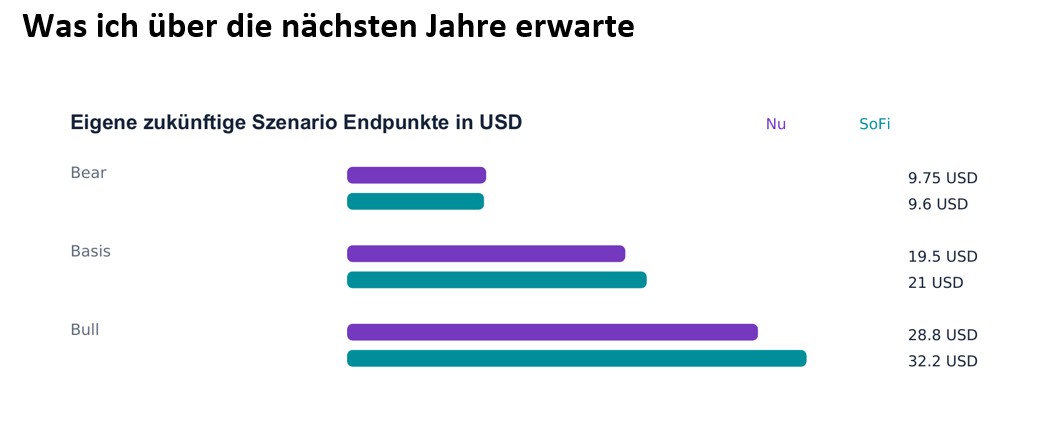
My bank earnings value model uses book values and discounted surplus earnings. In the conservative base case, this currently yields approximately $14.90 for Nu and $13.60 for SoFi. Both stock prices are thus trading above the conservative estimate. Technical buy zones do not guarantee bargain prices.
In a favorable scenario, SoFi could realize its higher upside potential. For that to happen, its return on equity, earnings per share, and Tech Solutions must show convincing improvement.
With Nu $NU (-4,7 %) , a significant portion of its operational strength is already evident. Nu therefore remains my long-term favorite. However, following the rapid rise, I would take a staggered approach and prefer to wait for a pullback.
SoFi $SOFI (+2,54 %) is an interesting stock to watch for me, but not an automatic buy solely because of the price drop. The Q3 earnings on October 27 are particularly important. According to calendars, Nu is expected to report on November 12; this date has not yet been officially confirmed in my research.
Sources:
Nu Q2 2026 Results
SoFi Q2 2026 SEC Earnings Report
Nu SEC Clarification on Monzo, September 30
Nu US Launch and Nu Global, September 10
SoFi Mastercard Settlement, September 22
SoFi Tech Solutions Orbi, October 8
SoFi Q3 Date Officially Confirmed
Nu Share Buyback of Up to $1 Billion
Nu Stock Prices and Key Figures
SoFi Stock Prices and Key Figures
Reuters Brazil Election Rally, October 5
and, of course, all the others :)
+ 4


Titres populaires
Meilleurs créateurs cette semaine
Données en temps réel par LSX · Données financières de FactSet