Maybe it's the most boring portfolio here on GQ when my first doublers are just the $ING (+0 %) & $BATS (-1,02 %) are... I started investing in 2023, before that I only tested the $EQQQ (-0,95 %) and yes, if I had put 100% in there in 2020 and not let it run in the savings plan, it wouldn't be 94% now but a good 400% profit, but you're always smarter afterwards :-)

British American Tobacco
Price
Discussion sur BATS
Postes
439BAT ~ 10% price increase in 1 week
3 possible reasons:
1) A US federal judge has finally dropped the criminal proceedings for North Korea sanctions violations.
BAT had paid around 630 million dollars in 2023.
2) Competitor $IMB (+0,44 %) is currently deliberately losing market share; the company would rather increase prices than defend volumes. What Imperial leaves behind, BAT can take with it.
3) On top of this, the 1.3 billion pound share buyback program is still running. BAT is continuously buying back its own shares and destroying them. Fewer shares in circulation means that every remaining share automatically becomes more valuable.
Over the year $BATS (-1,02 %) is therefore +54%.
I am bullish and will be delighted when we break the ATH from 2016/17.
What is your opinion on BAT?
Happy smoking 🚬
💶🔄💶
After much deliberation, I have decided $BATS (-1,02 %) 🤑😬 to get rid of the two $MUV2 (-0,48 %) & $ROP (+1,7 %) each went into the depot.
With 72% and 93% profit respectively, approx. 32% p.a.📈 more than previously expected.
It was also one of my first investments at the time, still with BitPanda, so it was just a derivative.
I see the two new players in the portfolio as very solid companies in their fields and will improve my portfolio in terms of diversification in the INS and HC areas.
Either increase it significantly so that a reclaim makes sense or bite the bullet.
I would also have preferred $NOVN instead of $ROP. In balance sheet terms, $NOVN is in a better position. $ROP is a riskier investment.
Tobacco dividend 🚬
In future, I will only receive half as many BATS dividends, as I have halved my position. $BATS (-1,02 %) halved my position.
Divis for Poor Dad 💷
This time it's my favorite asset class that I'm reporting on for the first time
Hello everyone.
Today I'm not going to analyze my $ALV (+0,41 %) or $BATS (-1,02 %) . By the way, I'm currently looking for a really cool dividend stock, but the final analysis is not yet complete, a few exciting companies are still on the longlist (e.g. $ABT (+2,34 %) , $NOVO B (+0,19 %) , $SAN (+0,27 %) ) - no matter. That's not what we're talking about today, but P2P loans. Do you know this class? I've been using this class for almost 6 years and just wanted to report on it and then go into more detail about my "third oldest" platform - Income Marketplace. If you want to see nice graphics and my portfolio charts, you should go to my free blog post, if the text is enough, stay here ;) - Otherwise here: https://steady.page/de/finanzen-anders/posts/7f29f472-572d-49aa-98da-bd0978640036
Why I invest a lot of money without deposit protection - and still sleep soundly
"Imagine someone offering you a permanent 12% return per year."
"The first question is not where can I sign upbut:
Who actually bears the risk here?"
I myself have been investing since 2022 part of my assets in P2P loans (€ 88,064 as at the end of April 2026)specifically via Income Marketplace - Income is my third oldest platform. I've been invested in Bondora for almost 6 years.
This is not a self-experiment out of boredom, but a deliberate addition - and yes, so far with returns well over 10 % p.a.
This means that the investment beats both my call money and most of my broadly diversified ETFs in difficult market phases.
But:
If double-digit returns beckon anywhere on a sustained basis, then the same applies in accounting as in real life:
"If it looks too good to be true, someone is obviously taking risk."
So the question is not whether risk exists - but who bears it, how it is structured and whether you are fairly rewarded for it.
P2P is not a savings product.
Rather, it is the asset class for people who know that returns do not fall from the sky, but from assumed risk.
If you are interested in the P2P asset class in video form, please watch my video:
I have also written about the P2P asset class in great detail on my financial blog (in 7 parts). Here is the link to part 1:
Why I like to invest in P2P loans? Take a look at this graphic - in my financial blog :)
The purple curve is my main stock portfolio at ScalableThe purple curve is my main stock portfolio at , strong highs and when Donald Trump declares tariffs, my portfolio plummets. Not for the faint-hearted.
The yellow curve is my investment in P2P loans as a whole, a really nice yield ladder. And Income? In light green, significantly higher returns than the yellow curve. In other words, I have a relatively predictable passive income here!
What is the business model - quite soberly?
With P2P loans, we give investors money to lendersmostly fintechs in Europe or emerging markets.
These lenders grant (among other things) consumer loans with high interest rates - and we get part of it.
👉 We are replacing the bank to a certain extent.
With the small difference that we:
- no deposit protection
- no state protection
- and no guarantee have.
- We take over but also parts of the credit risk,
- but in return get we also higher interest rates.
That is uncomfortable - but honest.
Income Marketplace is thereby not a lenderbut a marketplacethat connects investors with fintech lenders (loan originators) brings them together.
👉 Anyone who invests here is not in loans in Germanybut in loan portfolios from Europe, Central and South America, Asia. And I personally find that very exciting.
Income
So why Income of all things?
Income Income differs from many P2P platforms in a way that you can only appreciate if you have experienced early P2P crises:
A buyback guarantee is only as good as the lender who can pay it in an emergency.
That is why Income on a multi-level security concept:
- Lenders retain 20-35 % of the loans themselves,
- but subordinated - we are serviced first.
- If a lender defaults entirely, the portfolio can Income take over the portfolio
- and continue to process it via debt collection.
This is not a magic trick.
But it is structurally cleaner than the classic "Trust me, I'll buy it back later".
Now the honest part
Income is:
- not regulated
- not profitable
- and the security mechanisms have never been tested in a real major crisis
And yet I invest.
Why?
Because I:
- understand the risk understand
- it limit it
- and don't confuse it with "safe money"
In other words:
This money doesn't have to be there in three years - but it is very welcome to work.
The most important distinction
The officially reported defaults are less than 2 %.
Depending on the country, the real borrower defaults are 20-25 %.
This is not a contradiction -
but shows that there is constant regrouping, buying back and reinvesting.
👉 The return is not generated because nobody defaults -
but because the system expects defaults.
The mistake many beginners make
Many people hear:
"Buy-back guarantee, auto-invest, 12% - sounds relaxed."
And that's exactly that is the dangerous moment.
P2P only works well if you:
- diversified
- critically scrutinize lenders
- and come to terms internally with defaults
If you are looking for absolute security lost nothing here.
But if you are looking for returns and consciously manage riskwill find an interesting niche here.
Conclusion
My conclusion in one sentence
P2P loans are not a substitute for overnight money -
but a deliberately risky addition to returns for people who know why they are getting 12 or 13 %.
And when we think about it, it's not with the question
"Is that safe?"
but with the much more important one:
"What risk am I consciously taking - and am I getting a fair price for it?"
If you would like to open an account with Income, please use my affiliate link: https://link.finanzenanders.de/income
Not enough?
If you Income Marketplace or P2P investments interest you, then let's get down to business.
Income Marketplace In figures (so we're not just talking about feelings)
- Foundation: 2020
- Registered office: Tallinn, Estonia
- Regulation: ❌ None
- Investor assets under management: ~EUR 26-27 million
- Financed loan volume: >EUR 220 million
- Average yield: approx. 11-14 % p. a. (13,78 % lt. Income)
- Deposit protection: ❌ None
- My current investment: € 3,579
- My current return: 12.95 %
In short: Not a savings account. Not even close, but a very high return.
At times I've invested over €10,000 on Income I withdrew a lot from all my P2P loans when we bought our house. That was the plan. And now the great thing is that with Income the transfer to my reference account is free of charge and super fast!
I like the UI / structure of Income:
Everything at a glance.
I also really like the cash flow forecast.
Why Income not simply "Mintos with a different logo" is
Income is trying to solve a problem that P2P investors have known well since corona:
The buyback guarantee is only worth as much as the lender who promises it.
Therefore Income on two additional security mechanisms:
Security concept 1: Junior Share
("Skin in the Game - but the right way, please")
With almost all loans, the lender holds a subordinated subordinated equity share - usually 20-35 %.
This means that
- Investors are are given priority
- the lender receives money only when we are fully repaid
- if the portfolio turns out worse → the lender loses first
👉 This is structurally better than classic "skin in the game", but:
- It protects not from poor collection rates
- It does not protect not from systemic crises
- It has never been proven in a major stress test
Security concept 2: Cash flow buffer
(Or: "Plan B in case the lender disappears")
If a lender defaults:
- Income takes over the loan portfolios via SPVs
- Repayments continue
- Collections are made via local partners
- Losses are to be cushioned by surpluses & junior shares
Sounds good - and is conceptually clean.
But to be fair, it has to be said:
The real thing hasn't really been played out yet.
The well-known problem case ClickCash (Brazil) was simply too small to seriously test the system.
Failure rates: Apparently low - potentially brutally different
This is where it gets exciting:
- Official platform statistics (March 2026):
- → only 1,7 % of the portfolio in debt collection
- Lender-specific:
- → partial 20-25 % defaults with high-risk originators
- (e.g. Indonesia, Brazil with ClickCash)
This is not a contradiction:
- Short-dated + buyback + regrouping conceal short-term defaults
- In the long term, everything depends on Lender quality & collection efficiency
👉 Diversification is not a "nice to have" here, but essential for survival.
Auto-Invest: Passive income - or passive looking away?
Income lives from Auto-Invest.
Once configured, the capital (usually) continues to work diligently.
Advantages:
- Compound interest
- hardly any cash drag
- Very granularly controllable
But:
- You must not not blindly filter for yield
- if you take all lenders & countries, you also buy problems
💡 My personal lesson:
Better fewer lenders - but understood risks.
This is how my auto-invest is set up
However, I also have the option of investing manually, such as in this short-term business loan:
Sorted by shortest term
I have chosen the top loan and will invest €25.41.
Done.
The inconvenient truth: Income is not (yet) profitable
Income earned:
- approx. 2-4 % p. a. fees on loan portfolios
- no fees from investors
Problem:
- Losses in the annual reports
- No audited financial statements
- Dependent on investor and financing rounds
Plain language:
You also invest to a certain extent in the hope that Income survives as a platform.
For whom is Income suitable - and for whom not?
Suitable for: ✅ Yield-oriented investors
✅ People with previous P2P experience
✅ Investors who can mentally & financially cope with total losses
✅ Addition of up to ~5-10% of total assets
Not suitable for: ❌ Security lovers
❌ "This is my nest egg" faction
❌ Investors without time to monitor risk
❌ People who believe that 12% is "virtually safe"
Conclusion: Exciting, lucrative - but not a free ride
Income Marketplace is not a miracle investmentbut:
- structurally more sophisticated than many P2P platforms
- transparent
- high-yielding
- so far without losses for investors
👉 Whether it stays that way is decided not the marketingbut:
- a real lender crash
- a recession in emerging markets
- or your own discipline when investing
In other words:
Income is not a savings account.
But perhaps that's precisely why it's interesting. Definitely for me :)
Disclaimer
Of course, investing in shares, ETFs, crypto, ... is always associated with risks. My thoughts are therefore not to be understood as concrete recommendations for action (neither buy nor sell recommendations), but are intended to stimulate your way of thinking. So that you can also develop your own opportunities. Past performance is no guarantee of future returns. Capital is at risk. Furthermore, the data and figures are not accurate. For links with * I receive a commission if you order through them. There are no additional costs for you. Thank you for your support!
Even I can make mistakes, so please always double-check.
This article reflects my opinion and my experience, although it is financially supported by Income is financially supported.
Paychex first purchase📄📃
After the partial sale of $BATS (-1,02 %) the proceeds were invested directly in $PAYX (+2,94 %) invested. With the initial purchase, I secured a personal dividend of ~4.7%. Further purchases are planned in the near future.

British American Tobacco partial sale 🚬
After more than 3 years, I am reducing the $BATS (-1,02 %) my portfolio by more than half. The reason is profit-taking and reallocation to another company.
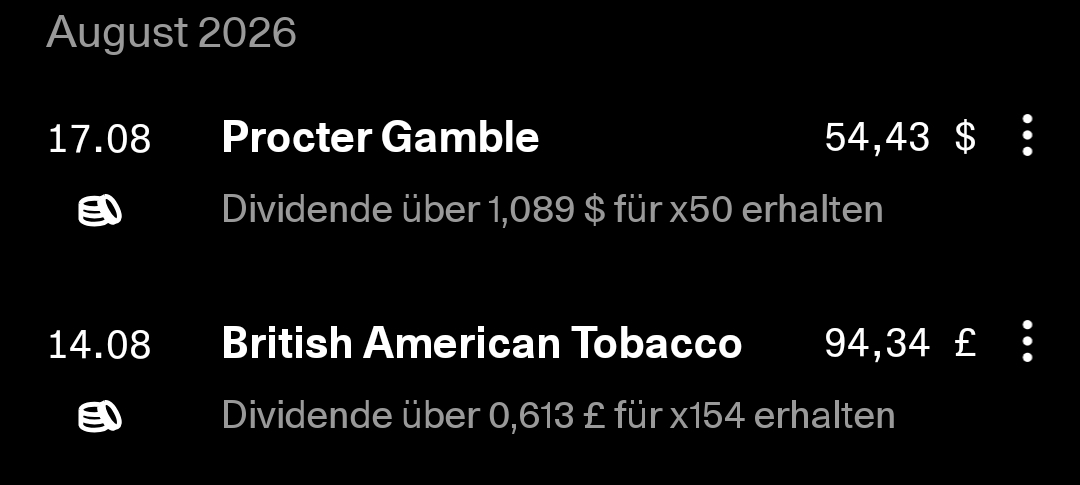
The second picture shows the distributions of my BATS position to date.

Dividendenopi inside ..... Dividendopi report for March 2026 and quarter 1 together with strategy description
The good @Tenbagger2024 has in his contribution Das Leben ist wie eine Schachtel Pralinen Man weiß nie was man kriegt a joint dividend carryforward. As this is difficult to implement in practice, I'll start with my figures from March and add a short report on how the first quarter went. This is followed by a few more insights into my investment approach.
In March, I received a total of € 2,345.17 gross in dividends from 7 distributions. The month is therefore on average for what my pure dividend share portfolio regularly yields. You can find the strongest payers on the table in the picture above, plus my EM dividend ETF also paid out.
According to GQ-Rewind, my time-weighted return in March was minus 0.09%, which is somewhere in the middle of the average. So far so good.
The first quarter was dominated by the war in Iran and had already seen some turbulence before that. From this point of view, I am more than satisfied that my portfolio has gained 9.52% YTD. These YTD figures are up to and including 02.04.2026.
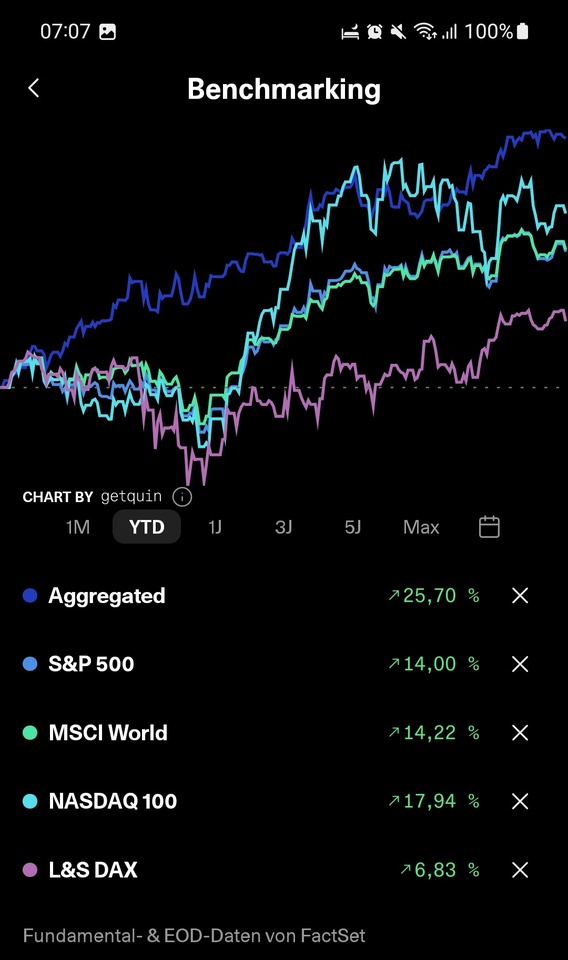
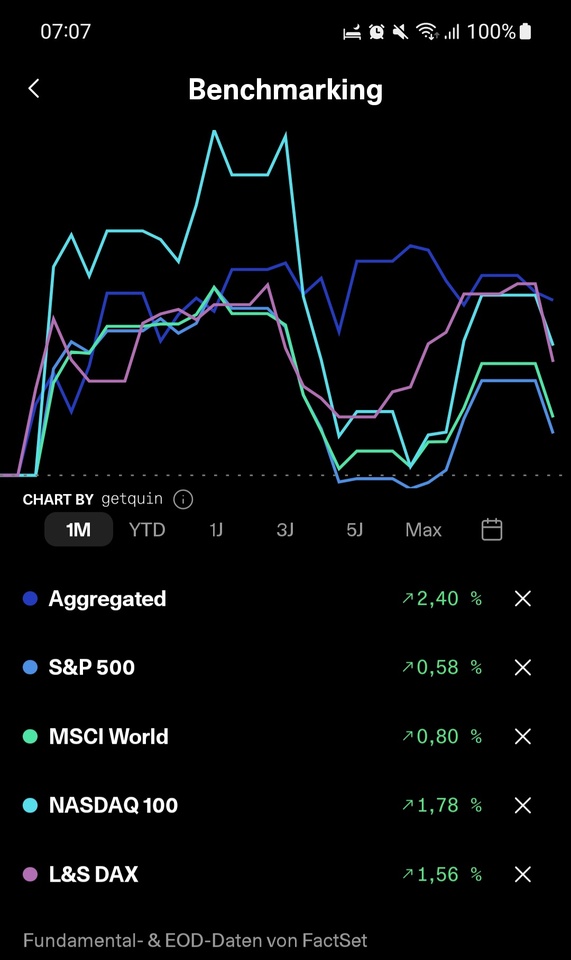
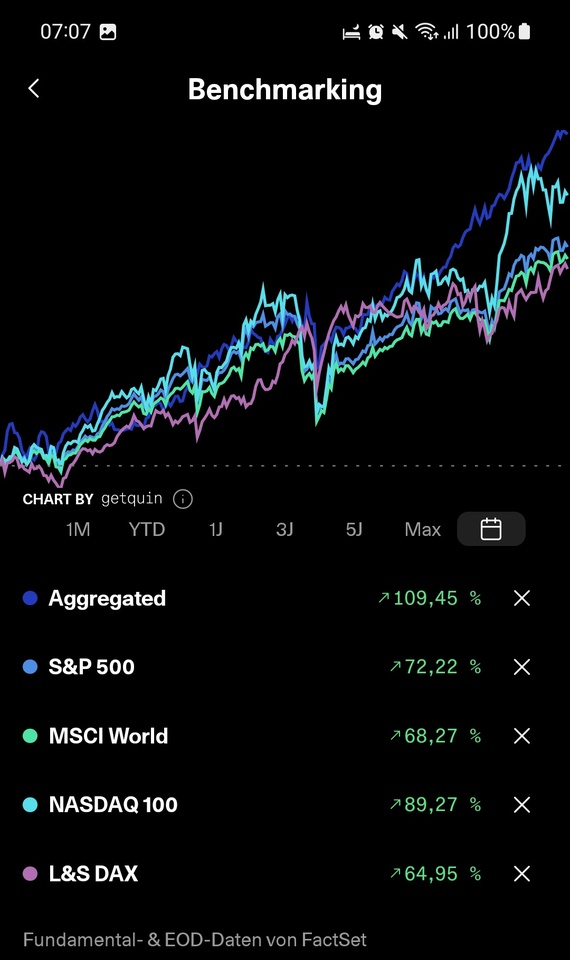
For the overall performance for the benchmark, I took YTD to 31.03.2026, 12:00 noon. And here I am clearly ahead with 14.37% and clearly beat corresponding indices as you can see in the following picture.
This has made it relatively easy for me to deal with the market fluctuations in recent months under the aforementioned circumstances. But I don't have to hide my overall performance in the longer term either. For 1 year and 3 years I am also ahead, only when looking at 5 years do I have to admit defeat to the Nasdaq 100, all others are behind.
And that brings us to the crucial point for me. My investment strategy. I can sleep peacefully in pretty much all market phases without having to get into an operational frenzy, and I have the psychological advantage of the relatively predictable cash flow that comes even when prices fall.
Here I go into more detail on the contribution by @Tenbagger2024
Wer die Wahl hat hat die Qual in more detail.
Lest we misunderstand each other, my approach is certainly not the Holy Grail for relaxed investing, but is purely due to my personal life situation. If you are young and still have an investment horizon of 20 or 30 years, then you have significantly more opportunities for stable wealth accumulation with growth stocks or ETFs. However, you also have to put up with price fluctuations. Perhaps some of you will still find an idea to take some risk out of your portfolio and stay a little calmer in turbulent phases.
How am I currently positioned as at the beginning of 04/2026? My capital is currently 35% in equities, 25% in some bonds and mostly fixed-coupon certificates and 40% in cash.
Cash is quickly described, a quarter in fixed-term deposits, the rest in overnight money hopping with currently 3.25% BBVA, 3.4% Consorsbank and 3.35% Advanziabank, conditions for overnight money fixed until the end of the first half of the year. After that, the search continues. Apart from Consorsbank, the other two pay interest monthly. I also receive the interest on my fixed-term deposit regularly every month via Ford Money. Plannable cash flow month after month at the price of constantly having to open and close accounts. But always better than with most house banks or neo-brokers.
I still have old federal bonds with a coupon of more than 6% and the rest is defined by express certificates with a fixed coupon. The bonds pay out once a year, one at the beginning of January. This has the positive side effect that my tax-free allowance is fully utilized immediately and I no longer have the withholding tax problem with all US dividends. The express certificates all relate to shares that I do not actively hold in my portfolio. As the name suggests, they pay fixed interest. This is paid quarterly and, depending on the certificate, is between 8% and 11.7% p.a. Maturities are usually 18 to 30 months. No matter what the stock markets do or how the individual shares perform, the cash flow comes. Sounds great at first, and it is during the term. The risk lies at the end, on the final valuation date. There, the underlying should not be below the corresponding barrier. This is usually 40 to 50% below the price on the fixing date. Of course, this requires a corresponding valuation and selection of the underlyings. I currently hold certificates on Renk, Hensoldt, Vonovia, BMW, LVMH, Nvidia, Infineon and Heidelberg Materials. New issues that I have subscribed to for the beginning of April are Banco Santander, MTU and Rheinmetall. This is an overview of what I am investing in indirectly.
You can see the current composition of the 25 stocks in my portfolio in my profile. In principle, I invest between 1% and max. 2% of my total capital in the respective shares, and I weight them accordingly via the purchase price. The purchase price also determines my total dividend yield. Measured against my current investments, I achieve a gross return of 8.90% on the capital invested with the dividends already paid and expected in 2026. The different weightings in my portfolio therefore result from the different price gains. My largest position at the moment, $BATS (-1,02 %) currently contains over 50% price gains and is fully invested. Dividend yield measured against the buy-in is well over 8% gross p.a. I am currently only fully invested in 2 stocks. I usually buy in 3 or 4 tranches spread over several months in different market phases. Under no circumstances do I select my shares according to a buy and hold forever principle. That's not possible with high yield. I have to keep a close eye on the "narrow" positions at all times. High dividends are not always a good sign and can also be cut quickly. If a negative trend proves to be sustainable, we restructure. The weighting is reduced and another stock from the same sector is added to the portfolio, or the stock is removed completely. My buy and hold a while motto....
My portfolio is significantly overweighted in the EU/UK at around 60%, with 25% in the USA and the rest in Latin America and Asia. Within Europe, the most represented countries besides the UK are D, NO, DK, A, NL, BE and Sweden. Consumer staples - clearly dominated by tobacco - and financial services are the largest sectors, followed by materials, energy, healthcare, communications and industry.
The primary objective is to preserve capital with a corresponding cash flow. For this reason, I am happy about price gains, the distance to the loss zone increases accordingly and I let the shares run without regularly evaluating the value. As long as there are no serious changes in the earnings situation or even a reduction in dividends, these stocks remain on the fringes of the radar. For the rest, or for new stocks, I set a tight SL to be reasonably protected against the risk of losses and monitor developments more closely.
And of course, sometimes my fingers itch. To this end, I have set myself a limited budget of a maximum of 5% of my total capital to realize short-term trades. These are held in a separate portfolio. These are stocks from the biotech, information technology and commodities sectors, which of course do not pay dividends. This prevents me from getting the wrong idea if I invest too much.
I've also been holding some physical gold for a few years to enjoy the shine 😉
As I'm still a bit at war with AI, this is a rustic compilation of my goals and results. Please forgive me for that. If you have any general or in-depth questions about individual points, please feel free to ask in the comments.
I wish us all a successful new trading week!
Your return is really impressive, I think it's really strong.🫶🏻
To be honest, I'm interested in your fixed-coupon expressers. How do you go about selecting the underlying? I mean, we've just seen in the recent past what can sometimes go wrong, so you have to have something, at least in terms of feeling, to determine where your barrier should be, which you buy or which underlying it will be. Or are you specifically looking for stocks where you wouldn't mind having the underlying put into your portfolio?
Titres populaires
Meilleurs créateurs cette semaine