
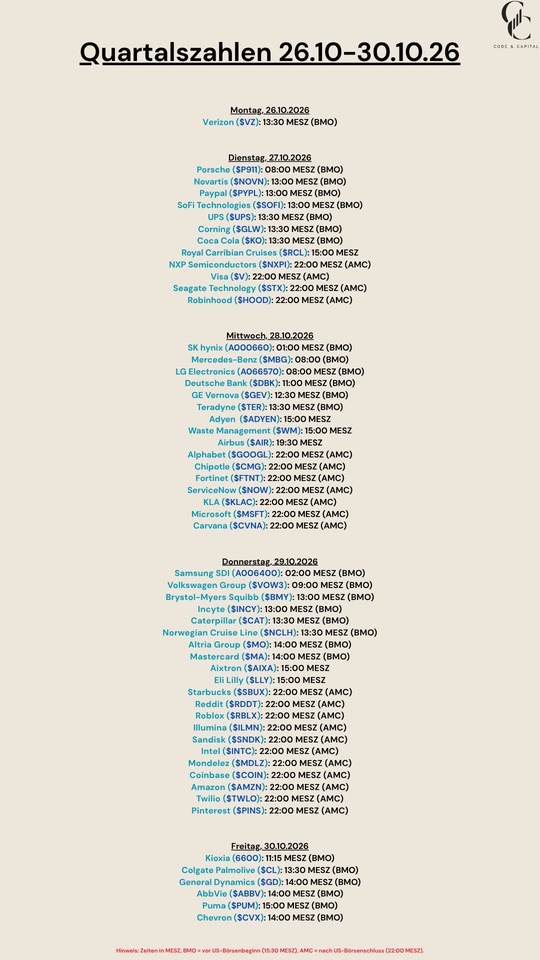
$VZ (+2,09 %)
$P911 (+1,28 %)
$NOVN (-0,3 %)
$PYPL (-0,8 %)
$SOFI (-1,83 %)
$UPS (+1,14 %)
$GLW (-0,55 %)
$KO (+0,52 %)
$RCL (-0,58 %)
$NXPI (+0,11 %)
$V (+0,49 %)
$STX (-4,94 %)
$HOOD (-3,29 %)
$SKHY (-4,32 %)
$MBG (+0,45 %)
$DBK (-2,44 %)
$GEV (-0,94 %)
$TER (-4,38 %)
$ADYEN (+0,92 %)
$WM (+0,43 %)
$AIR (-2,68 %)
$GOOGL (+0 %)
$CMG (+2,8 %)
$FTNT (-0,99 %)
$NOW (-2,64 %)
$KLAC (-3,2 %)
$MSFT (-0,97 %)
$CVNA (+0,81 %)
$006400
$VOW3 (-0,46 %)
$BMY (+2 %)
$INCY (+3,25 %)
$CAT (-2,99 %)
$N1CL34
$MO (+1,32 %)
$MA (-0,23 %)
$AIXA (-4,06 %)
$LLY (+2,49 %)
$SBUX (+0,27 %)
$RDDT (-13,65 %)
$RBLX (-0,51 %)
$ILMN (-6,74 %)
$SNDK (-10,82 %)
$INTC (-10,36 %)
$MDLZ (-1,33 %)
$COIN (-7,18 %)
$AMZN (+4,71 %)
$TWLO (+1,51 %)
$PINS (+9,46 %)
$285A (-13,04 %)
$CL (+1,2 %)
$GD (+0,68 %)
$ABBV (+0,23 %)
$PUM (+4,91 %)
$CVX (+1,29 %)

General Dynamics
Price
Discussion sur GD
Postes
27Quarterly Results: Oct. 26–30, 2016


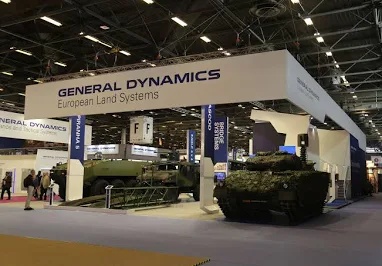
General Dynamics
General Dynamics Corporation is one of the most established and financially strong conglomerates in the global defense and aerospace industry12. With a global workforce of over 120,000 employees and consolidated annual revenue of more than $52 billion, the company holds key structural positions in markets with extremely high barriers to entry345. Its business model differs fundamentally from that of broadly diversified industrial conglomerates: It deliberately avoids volatile mass markets and instead focuses on oligopolistic high-tech sectors6. Value creation is concentrated in nuclear sea-based deterrence, heavy and highly mobile land systems, military command and IT networks, and the top segment of the civil business aviation market
General Dynamics is headquartered in Reston, Virginia, and is traded on the New York Stock Exchange. The ownership structure is broadly diversified and is primarily held by large institutional asset managers such as Vanguard, BlackRock, and State Street. For many years, the company’s leadership has been characterized by exceptional continuity and strict operational cost discipline. Phebe N. Novakovic, who has led the company as Chairman and Chief Executive Officer since January 2013, has been instrumental in driving margin expansion and portfolio consolidation. Effective January 1, 2027, Danny Deep—who held leadership positions in the Land Systems and Combat Systems divisions for over two decades and most recently served as Group President—will assume the role of CEO, while Novakovic will remain on the Board of Directors as Executive Chairman.
The Four Operating Segments
General Dynamics’ corporate structure is divided into four independent business segments: Marine Systems, Combat Systems, Aerospace, and Technologies. Each segment is focused on specific procurement markets and has distinct margin and cash flow profiles.
.
Financial Performance and Global Market Position
General Dynamics recorded a steady increase in key earnings metrics during fiscal years 2024 and 2025. This trend was driven by higher procurement volumes from NATO countries in the naval and land systems sectors, as well as the normalization of delivery processes at Gulfstream.
The trailing P/E ratio of approximately 20.2 and the forward P/E ratio of approximately 18.9 are within the typical range for a defensive defense stock, though not particularly cheap. The expected EPS growth rate of about 7.3% per annum supports this valuation; a P/E ratio below 19 for 2026 is fair given the stable order backlog.
The dividend is secure and growth-oriented, but the yield is rather modest at less than 2%. For dividend investors, GD is more of a “dividend growth” stock than a high-yield stock.
GD has marginally outperformed the S&P 500 over five years but has been a significant underperformer over the past one to three years. This explains the relatively moderate P/E ratio: the market is not currently rewarding the fundamentals with a significant re-rating.
GD is a good candidate for a defensive, long-term core holding in a portfolio focused on quality and defense. From a fundamental perspective, the entry point is more attractive than it was a year ago, but technically it is not yet convincing; a staggered purchase or waiting for the price to stabilize above the 50- and 200-day moving averages would be the lower-risk option.
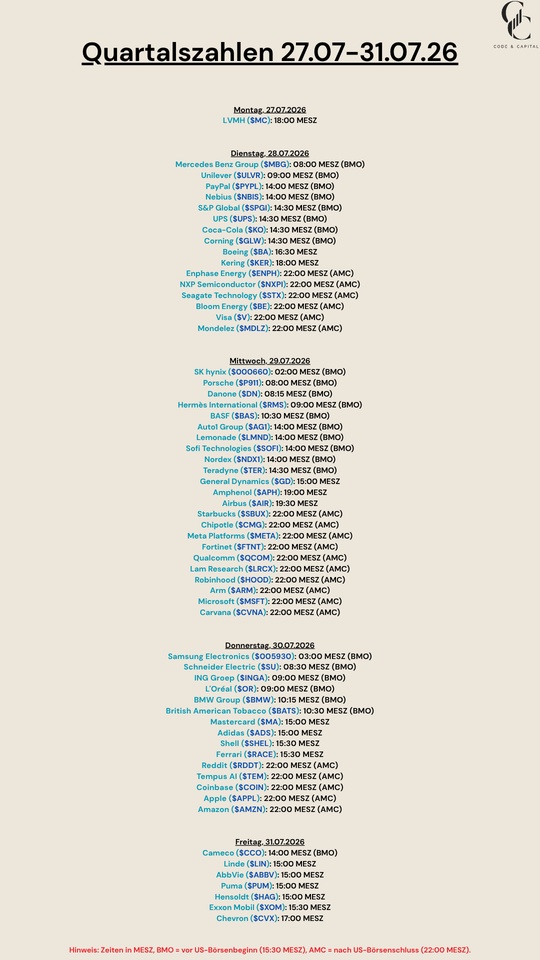
Quarterly Results: July 27–July 31, 26
$MC (+0,48 %)
$MBG (+0,45 %)
$ULVR (+1,44 %)
$PYPL (-0,8 %)
$NBIS (-4,09 %)
$SPGI (+0,83 %)
$UPS (+1,14 %)
$KO (+0,52 %)
$GLW (-0,55 %)
$BA (+0,35 %)
$KER (+1,89 %)
$ENPH (+1,77 %)
$NXPI (+0,11 %)
$STX (-4,94 %)
$BE (-2,67 %)
$V (+0,49 %)
$MDLZ (-1,33 %)
$000660
$P911 (+1,28 %)
$BN (+1,65 %)
$RMS (+1,74 %)
$BAS (-0,07 %)
$AG1 (+0,16 %)
$LMND (-5,38 %)
$SOFI (-1,83 %)
$NDX1 (-2,69 %)
$TER (-4,38 %)
$GD (+0,68 %)
$APH (-2,59 %)
$AIR (-2,68 %)
$SBUX (+0,27 %)
$CMG (+2,8 %)
$META (-0,98 %)
$FTNT (-0,99 %)
$QCOM (-7,5 %)
$LRCX (-2,25 %)
$HOOD (-3,29 %)
$ARM (-2,74 %)
$MSFT (-0,97 %)
$CVNA (+0,81 %)
$005930
$SU (-3,37 %)
$INGA (-1,7 %)
$OR (+2,99 %)
$BMW (-0,05 %)
$BATS (+0,79 %)
$MA (-0,23 %)
$ADS (+0,63 %)
$SHEL (+0,1 %)
$RACE (-1,38 %)
$RDDT (-13,65 %)
$TEM (-5,74 %)
$COIN (-7,18 %)
$AAPL (-1,58 %)
$AMZN (+4,71 %)
$CCO (-7,66 %)
$LIN (+2,38 %)
$ABBV (+0,23 %)
$PUM (+4,91 %)
$HAG (-2,81 %)
$XOM (+1,7 %)
$CVX (+1,29 %)

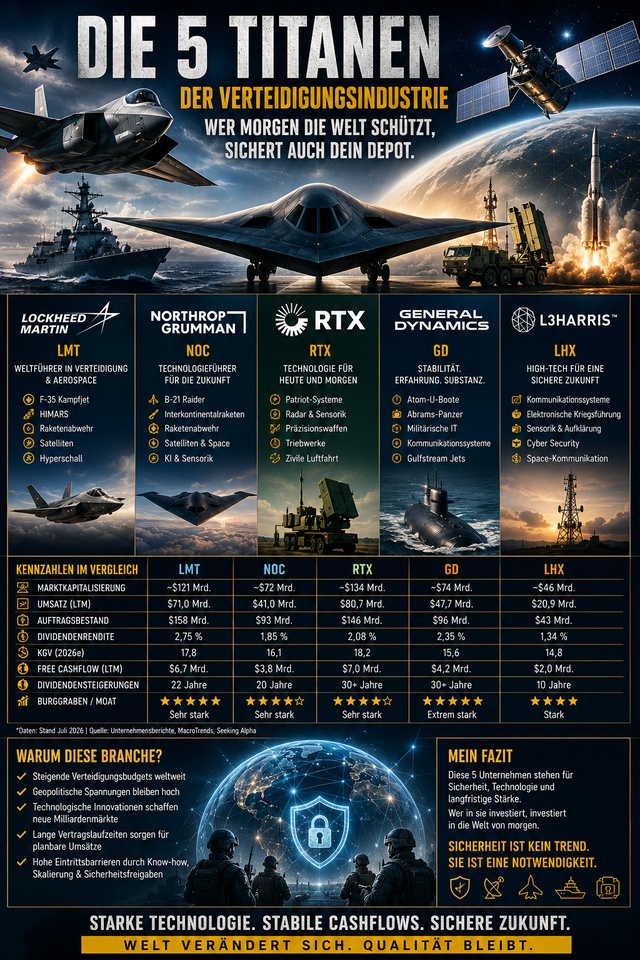
The Titans of the Defense Industry – Who Will Protect the World Tomorrow?
War. Cyberattacks. Space. Artificial intelligence.
The world is changing faster than ever before. While many industries are struggling with economic fluctuations, governments worldwide are investing record amounts in their security.
But which companies will benefit from this in the long term?
I’ve compared five of the most important defense companies in the Western world.
1. Lockheed Martin ($LMT (-1,57 %)
) – The undisputed market leader
When you think of modern defense, you can’t ignore Lockheed Martin.
Among other things, the company develops:
- F-35 Lightning II (the world’s most successful fighter jet program)
- HIMARS missile systems
- Missile defense
- Satellites
- Hypersonic technologies
What makes Lockheed special:
• Contracts worth billions over decades
• Enormous barriers to entry
• High free cash flows
• Dividends that have been rising for over 20 years
For many investors, Lockheed Martin is the benchmark for quality across the entire industry.
2. Northrop Grumman ($NOC (-1,01 %)
) – The future is taking flight behind the scenes
Northrop is less well-known than Lockheed.
Technologically, however, the company ranks among the absolute world leaders.
Highlights:
• B-21 Raider stealth bomber
• Intercontinental ballistic missiles
• Missile defense
• Satellites
• Space systems
• Artificial intelligence
Northrop has enormous competitive advantages, particularly in the areas of space and strategic deterrence.
3. RTX ($RTX (-0,25 %) )– The Invisible Giant
Many people still know RTX as Raytheon.
Yet its technology is embedded in countless defense systems.
Its portfolio includes:
• Patriot air defense
• Radar technology
• Aircraft engines
• Missiles
• Sensors
The major advantage:
RTX generates revenue from both military and commercial aviation.
This diversification makes the company particularly resilient.
4. General Dynamics ($GD (+0,68 %)
) – Stability for Decades
General Dynamics manufactures:
• Nuclear submarines
• Abrams tanks
• Military IT systems
• Communications solutions
It also owns Gulfstream, a leading manufacturer of business jets.
For dividend investors, General Dynamics has been one of the most reliable companies in the industry for years.
5. L3Harris ($LHX (-0,16 %)
) – The High-Tech Specialist
L3Harris doesn’t develop spectacular fighter jets.
Instead, the company provides the technology without which modern armed forces would be virtually incapable of operating.
This includes:
• Communication systems
• Reconnaissance
• Sensors
• Electronic warfare
• Cybersecurity
Anyone who believes in the digital transformation of defense should keep an eye on L3Harris.
My Comparison
Technology leader: Northrop Grumman
Market Power: Lockheed Martin
Best Diversification: RTX
Most Stable Dividend Payer: General Dynamics
Greatest Future Potential: L3Harris
Why I Find This Sector Exciting
Many investors associate defense companies exclusively with geopolitical conflicts.
In doing so, they often overlook other growth drivers:
✓ Rising NATO defense spending
✓ Cybersecurity
✓ Satellite communications
✓ Space technology
✓ Artificial intelligence
✓ Hypersonic technology
✓ Drones
✓ Electronic warfare
The industry is increasingly evolving into a high-tech sector and is no longer limited to traditional weapons manufacturers.
My Conclusion
I don’t invest based on short-term headlines.
I’m interested in companies with:
• decades of government contracts
• high barriers to entry
• tremendous technical expertise
• solid cash flows
• long-term dividend potential
That’s exactly why, in my view, Lockheed Martin, Northrop Grumman, RTX, General Dynamics, and L3Harris are among the most exciting quality companies in the defense sector.
#Aktien
#Investieren
#Langfristig
#Dividenden
#QualityInvesting
#Defense
#Aerospace
#LockheedMartin
#NorthropGrumman
#RTX
#GeneralDynamics
#L3Harris
#CyberSecurity
#Space
#KI
#ValueInvesting
#Cashflow
#Getquin


Pride Month is there 💸🏳️🌈💸
Me during Prime Month 😁 $LMT (-1,57 %)
$GD (+0,68 %)
$BA (+0,35 %)
$HO (-1,28 %)


Apr 22 / Time to Buy More Defence?
War is ubiquitous right now. Whether you look at Ukraine, Iran, the Gulf, Pakistan, or not so long ago Venezuela. And that’s despite Trump’s claims that he supposedly ended eight wars since he came into office. While nobody knows which wars he ended, most people definitely know which he has begun. And that’s not to critique the engagement in Iran or Venezuela. Trying to overthrow evil dictators is not an inherently bad cause, however the method might be more than questionable.
At this point, the standoff between Trump and whoever is in charge of Iran seems more like two kids fighting in the playground over who opens the Strait of Hormuz first and finally gives the Gulf nations some breathing space again.
But one thing is undoubtedly clear in all this. The defence sector is booming everywhere. In Europe, the US and Asia, countries are rearming themselves, for very different reasons. Europe because the American security guarantee is no longer completely reliable, with NATO seemingly in question. Asia because China continues to expand its dominance and push to become the leading world power. And the US because it still wants to play “World Police,” even if that might not be the most popular approach domestically anymore. But I guess we’ll find that out in the midterms.
Considering all of this, nobody can doubt the importance of defence companies, and their backlogs are as full as you would expect. The poster child of European rearmament is Rheinmetall, growing at unprecedented rates with order books stretching years into the future. And that is definitely reflected in the stock price. Since the start of the Ukraine War five years ago, the stock has risen by more than 2,200%. Yes, that’s right, if you invested $10k then, they would be worth $220k now.
But we all know that Europe’s defence industry has been historically underfunded, so it’s no surprise that it eventually caught up. What about the US then?
The sector is doing well, as always, but the stock performance hasn’t been as extraordinary. Around 110% over the last five years for the SPDR U.S. Aerospace & Defense ETF is solid, but not exactly record-breaking. So is now the time to invest? After all, Trump did announce a massive hike in the defence budget from currently $901 billion to more than $1.5 trillion.
Whether that actually goes through is a different question, considering the already massive national debt and Trump’s midterm concerns. But we also know he can take a different approach.
Just a few months ago, the President floated the idea of a pay cap for defence executives and even proposed restricting share buybacks and dividends. Our wonderful “businessman” of a president wants to cut incentives for both management and investors. How encouraging.
So ultimately, whether you should invest in defence right now is a matter of opinion. Personally, I think the European sector is overbought, but demand is clearly there, so I wouldn’t be too worried about holding names like Rheinmetall or others. For the US, it seems the market doesn’t fully believe in the trillion-dollar budget, given current valuations and revenue expectations of the major players.
But again, it’s still one of those sectors where you probably can’t go too wrong, and there is definitely still some upside left.
$ITA (-2,45 %)
$LMT (-1,57 %)
$GD (+0,68 %)
$NOC (-1,01 %)
$RTX (-0,25 %)
$LHX (-0,16 %)
$BA (+0,35 %)
$AIR (-2,68 %)
$RHM (-2,1 %)


🚀 Munich start-up tests first European hypersonic rocket - technological breakthrough or military game changer?
Introduction
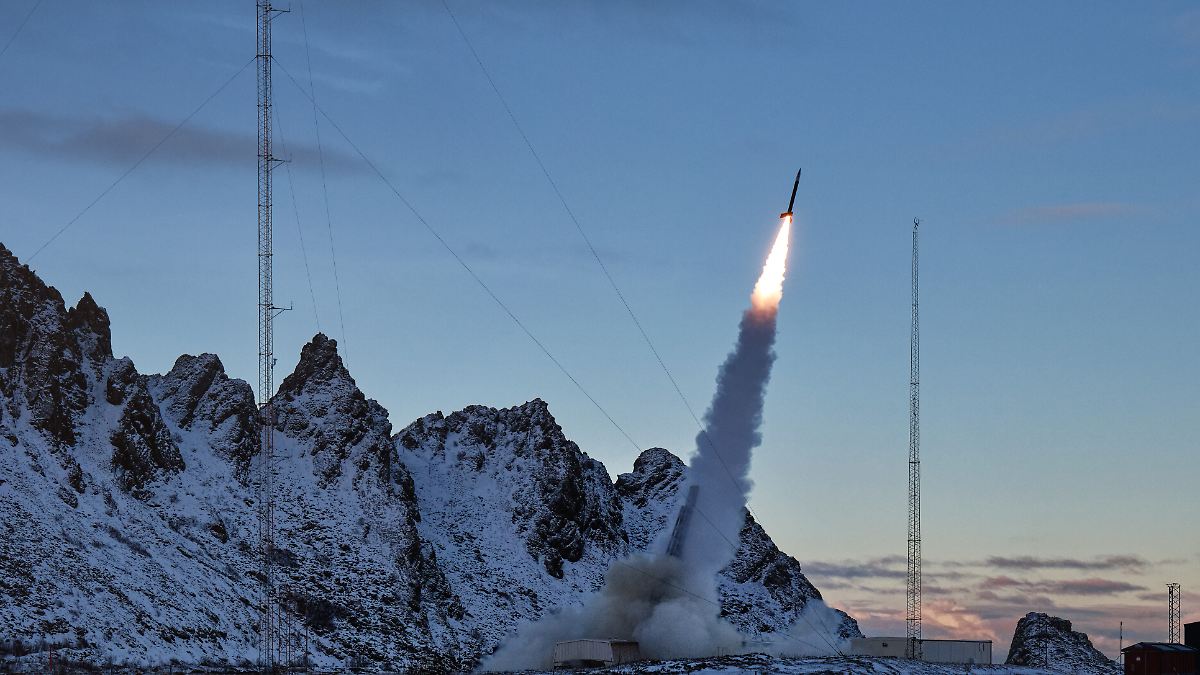
A young German-British company has taken a remarkable step: For the first time first time a prototype of a hypersonic rocket has been successfully successfully tested for Europe. And after just nine months of construction 😳 This test marks an important milestone in an area that has so far been dominated almost exclusively by major powers such as Russia, the USA and China.
_________________________
⚡️ 1st European hypersonic test flight successful 🚀
On February 3, 2026, the Munich-based startup Hypersonica launched its HS1 prototype from the Norwegian spaceport Andøya. According to the company:
- The rocket reached hypersonic speeds of over Mach 6 (more than 7,400 km/h).
- It covered a distance of around 300 kilometers.
- The prototype did not carry a warhead - it was purely for flight testing.
- A production-ready version is to be developed by 2029.
Hypersonica has thus achieved an unprecedented success for a privately financed European armaments and aviation project in the hypersonic sector.
_________________________
🧪 2. why hypersonic missiles are relevant
Hypersonic missiles fly extremely fast (faster than Mach 5) and are traditionally difficult to intercept. This gives them:
- ⇨ strategic importance in the field of modern defense systems,
- ⇨ high importance for future military technologies,
- ⇨ Influence on the geopolitical balance of power.
Only a few countries still possess such technology - Russia and the USA have already developed or deployed their own systems. Europe has so far lacked a comparable, sovereign solution.
_________________________
🇪🇺 3. Europe wants to become more technologically independent
The background to the project is not only technical ambition, but also geopolitical strategy:
- Europe is to become more technologically independent from the USA and other major powers.
- Public debates show that security policy and defense technology are seen as part of sovereignty.
- Hypersonica's success could strengthen Europe's role in defense and space technology.
Hypersonica was only founded in 2023, is based in Munich and has a subsidiary in London. The CEO and co-founders emphasize that the technology has long been neglected and that faster development cycles are needed.
_________________________
🧠 4. technical & strategic challenges
Hypersonic missiles are not only fast, but also complex:
- The engine is not the central problem, but
- combining high speed with precise control and stable maneuverability.
- Mach speeds generate enormous thermal loads that require special protection and materials.
Hypersonica wants to address these challenges and carry out further tests and developments in the coming years.
_________________________
👍 5. significance for industry & research
Successful testing is not only a technological step, but can also
- Boost investment in European aerospace
- Boost research networks between universities, start-ups and defense agencies
- Strengthen Europe's presence in a globally strategic technology
Competition and comparison: To date, the USA, Russia and China have also been working on their own hypersonic systems, which have significantly greater ranges. Europe's approach, however, is a fast, private development path, similar to the influence of companies like SpaceX on space development as a whole.
_________________________
$LMT (-1,57 %)
$RYTT34
$BA (+0,35 %)
$GD (+0,68 %)
$LHX (-0,16 %)
$KTOS (-3,37 %)
$SAF (-1,61 %)
$RHM (-2,1 %)
$AM (-0,1 %)
$SAAB B (+0,69 %)


Possible profiteers ?!
Should there be a military escalation or a direct U.S. attack in Iran (or in the Middle East in general), three sectors typically react most strongly: Defense, Energy (oil/gas), and Safe-Haven Assets (gold/precious metals).
1. Defense Industry (Defense & Aerospace)
This sector benefits directly from expectations of government contracts for ammunition, missile systems, drones, and logistics. U.S. companies are the focus here, but European stocks often follow suit.
ETF Option (Broad Diversification):
iShares US Aerospace & Defense ETF (Focus on U.S. defense):
VanEck Defense UCITS ETF.
VanEck Defense ETF: WKN: A3D9M1 / ISIN: IE000YYE6WK5
2. Energy Sector (Oil & Gas)
Iraq is a major oil producer. A conflict in this region immediately fuels fears of supply shortages or blockades (e.g., the Strait of Hormuz). The price of oil (Brent/WTI) usually spikes, which increases the margins of the major oil companies (“Big Oil”).
Exchange-traded commodities (ETCs) tracking the oil price:
Investors who want to bet directly on the commodity price (Brent Crude Oil) often use ETCs (Exchange-Traded Commodities).
WisdomTree Brent Crude Oil: WKN: A1N49P/M/N / ISIN: JE00B78CGV99
3. Safe Havens (Gold & the Dollar)
In times of military uncertainty, capital flees from high-risk investments (such as tech stocks) into so-called “safe havens.”
Gold: Considered the number one crisis currency.
U.S. Dollar: Often strengthens because it is considered the most stable currency, which in turn can weigh on export-oriented U.S. companies but benefit dollar holders.
Important Risk Notes
“Sell the News”: Markets often price in conflicts before the first shot is fired. Once the attack actually takes place, it can paradoxically happen that prices (e.g., oil, gold, silver)
fall because the uncertainty has subsided (“Sell on good news, buy on bad news”—or vice versa).
Overall market reaction: While defense and oil stocks rise, broad indices such as the DAX or the S&P 500 often fall initially, as transportation costs rise (bad for airlines like Lufthansa) and consumer sentiment declines.
Political intervention: When oil prices become too high, the U.S. often taps into its strategic oil reserves, which can quickly ease downward pressure on energy stocks.



General Dynamics exceeds expectations for quarterly profit and sales with strong defense business.
General Dynamics reported a profit and turnover for the fourth quarter on Wednesday that exceeded Wall Street's expectations. This performance was driven by the growth areas of combat systems and naval systems.
As geopolitical uncertainty and global conflict continued to drive demand for weapons and ammunition during the quarter, General Dynamics' naval business benefited from improving supply chain conditions and support from government investment in the Columbia and Virginia-class nuclear-powered submarine programs.
The combat systems segment, which manufactures combat vehicles, weapons systems and ammunition, also benefited from growing international demand, particularly in Europe.
In the quarter ending December 31, total quarterly sales rose by almost 8% year-on-year to USD 14.38 billion.
According to data compiled by LSEG, analysts had on average expected sales of 13.81 billion US dollars in the fourth quarter.
The company's profit amounted to 1.14 billion US dollars, compared to 1.15 billion US dollars in the previous year. Adjusted earnings per share were USD 4.17, above analysts' estimates of USD 4.09.
The company's order intake for the quarter was 1.6 times billings, indicating a strong overall order backlog.
Gulfstream's business jet division delivered 45 aircraft in the fourth quarter, compared to 47 in the year-ago quarter.
In November, the President of Gulfstream Aerospace noted the decline in business jet opportunities in China during the quarter due to trade tensions with the United States.
However, annual deliveries of Gulfstream aircraft rose to 158 units, up from 136 a year earlier, as the segment continues to ramp up production and recover from supply chain issues.
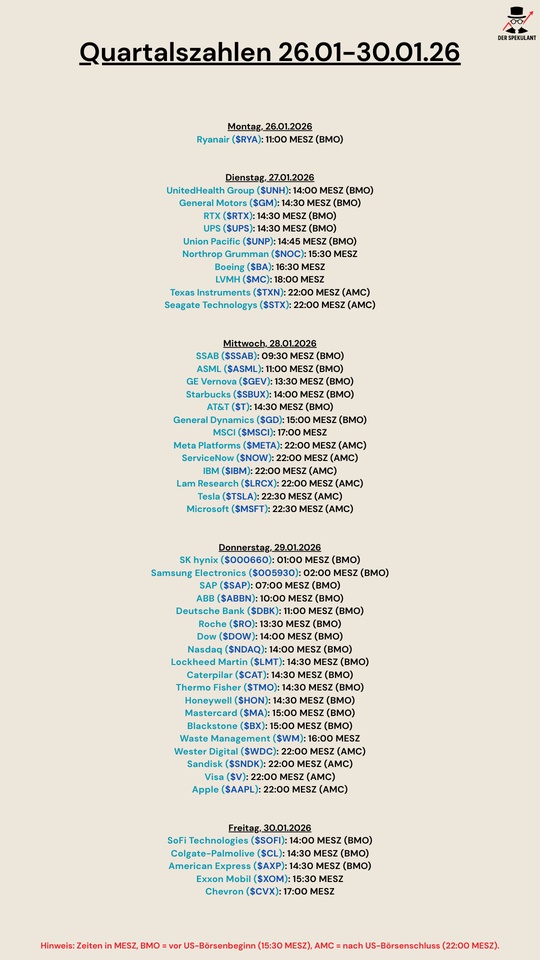
Quartalszahlen 26.01-30.01.2026
$RYA (-2,32 %)
$UNH (-1,54 %)
$GM (+2,45 %)
$RTX (-0,25 %)
$UPS (+1,14 %)
$UNP (+0,79 %)
$NOC (-1,01 %)
$BA (+0,35 %)
$MC (+0,48 %)
$TXN (-2,27 %)
$STX (-4,94 %)
$SSAB A (-2,65 %)
$ASML (-4,98 %)
$GEV (-0,94 %)
$SBUX (+0,27 %)
$T (+2,02 %)
$GD (+0,68 %)
$MSCI (+0,96 %)
$META (-0,98 %)
$NOW (-2,64 %)
$IBM (+0,97 %)
$LRCX (-2,25 %)
$TSLA (+0,6 %)
$MSFT (-0,97 %)
$000660
$005930
$SAP (+0,67 %)
$ABBN (-3,32 %)
$DBK (-2,44 %)
$ROG (+0,24 %)
$DOW (+2,98 %)
$NDAQ (+0,32 %)
$LMT (-1,57 %)
$CAT (-2,99 %)
$TMO (-2,5 %)
$HON (-2,27 %)
$MA (-0,23 %)
$BX (-1,44 %)
$WM (+0,43 %)
$WDC (-4,37 %)
$SNDK (-10,82 %)
$V (+0,49 %)
$AAPL (-1,58 %)
$SOFI (-1,83 %)
$CL (+1,2 %)
$AXP (-1,26 %)
$XOM (+1,7 %)
$CVX (+1,29 %)

Titres populaires
Meilleurs créateurs cette semaine