
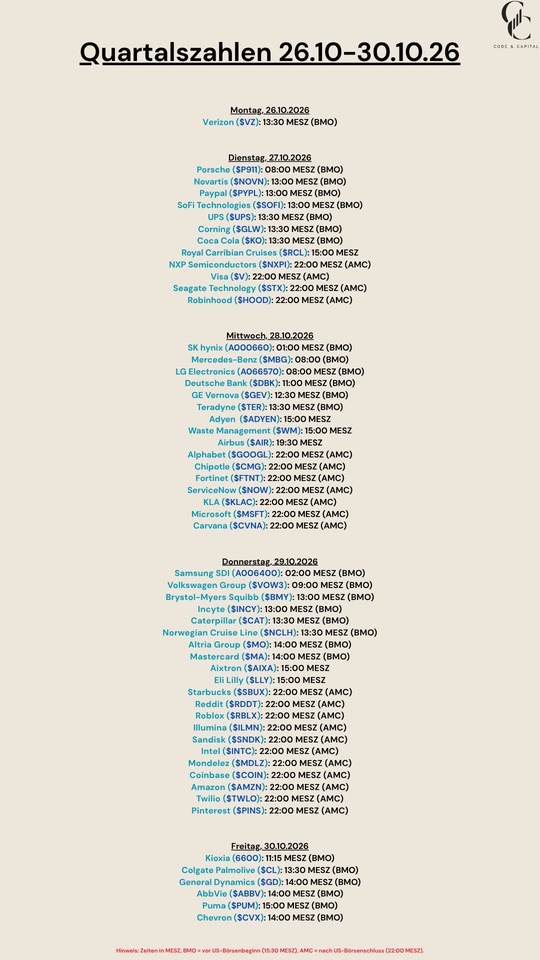
$VZ (+0,68 %)
$P911 (+3,06 %)
$NOVN (+2,42 %)
$PYPL (+1,71 %)
$SOFI (+3,79 %)
$UPS (+0,95 %)
$GLW (-0,79 %)
$KO (-0,41 %)
$RCL (+4,38 %)
$NXPI (+4,51 %)
$V (+1,75 %)
$STX (+1,95 %)
$HOOD (+0,79 %)
$SKHY (+0,35 %)
$MBG (+1,79 %)
$DBK (+3,84 %)
$GEV (+2,1 %)
$TER (-4,3 %)
$ADYEN (-0,04 %)
$WM (+0,96 %)
$AIR (+1,28 %)
$GOOGL (-2,84 %)
$CMG (+1,45 %)
$FTNT (+4,91 %)
$NOW (-10,6 %)
$KLAC (+1,74 %)
$MSFT (-6,92 %)
$CVNA (+8,29 %)
$006400
$VOW3 (+1,5 %)
$BMY (-0,66 %)
$INCY (-1,34 %)
$CAT (-8,59 %)
$N1CL34
$MO (+2,69 %)
$MA (+3,92 %)
$AIXA (+9,62 %)
$LLY (+4,46 %)
$SBUX (-0,01 %)
$RDDT (-4,18 %)
$RBLX (-3,56 %)
$ILMN (-0,57 %)
$SNDK (-2,43 %)
$INTC (-2,68 %)
$MDLZ (-0,94 %)
$COIN (-0,01 %)
$AMZN (-4 %)
$TWLO (-4,39 %)
$PINS (-1,08 %)
$285A (-0,33 %)
$CL (-0,08 %)
$GD (+3,81 %)
$ABBV (+0 %)
$PUM (+0,18 %)
$CVX (+0,05 %)

Teradyne
Price
Discussion sur TER
Postes
29Quarterly Results: Oct. 26–30, 2016

📊 Wikifolio Update September 2026: up 1.03%, tech stocks up, mining stocks down, and 18 of 30 positions swapped on October 1
In August, gold mines were the market's top performers. In September, they were the most expensive. Fresnillo
$FRES (-1,5 %) down 15 percent, Micron
$MU (-3,36 %) up 17. At the end of the month, the Wikifolio was up 1.03 percent, and one day later, I swapped out 18 of 30 positions.
September was all about interest rates and oil. Brent rose above $100 in the second week and, following a Saudi pipeline outage, briefly hit $110. U.S. inflation stood at 3.4 percent in August. On September 16, the Fed raised the benchmark interest rate by a quarter point to 3.75 to 4.00 percent, for the first time since July 2023. The 10-year U.S. yield subsequently climbed to 5.19 percent, a level last seen in 2007. This hardly bothered tech stocks. The Nasdaq hit a record high on September 21, and AMD has been worth one trillion dollars ever since. The situation was different in Europe. German inflation jumped to 3.3 percent, and the DAX lost about four percent over the month.
📊 Monthly performance: +1.03%
📊 Price as of September 30: €117.97
📊 Largest loss since inception: −14.6%
📊 Max performance: +18% (since March 13, 26)
Next rebalancing: Early January 2027
Performance & Comparison 🚀
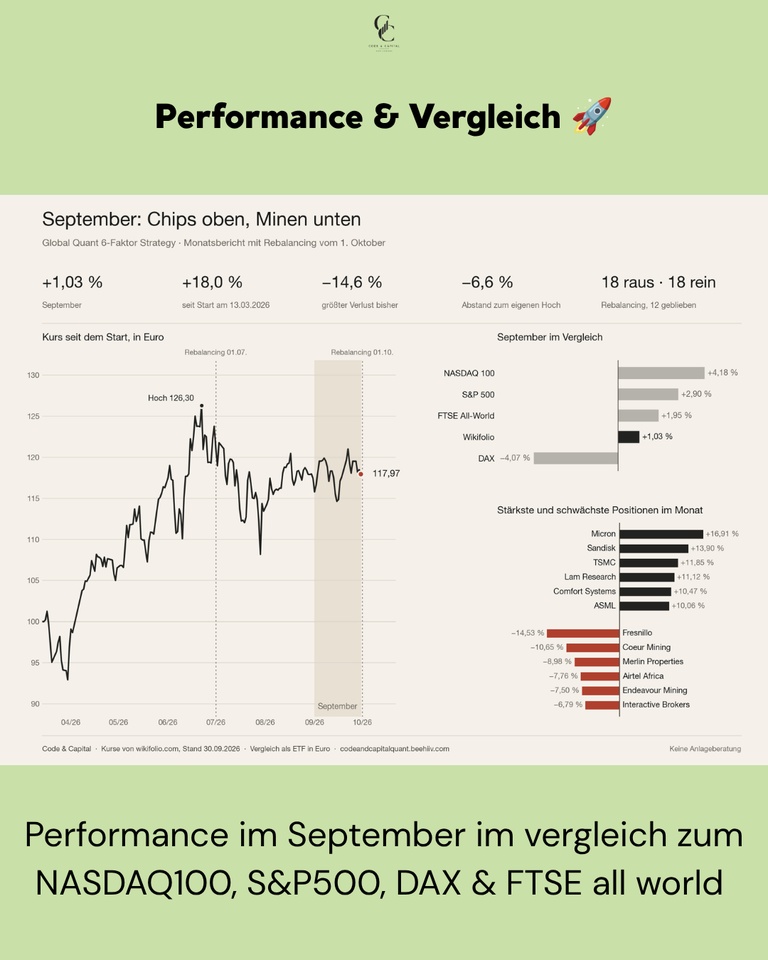
The U.S. indices posted clear gains when calculated in euros, with the Nasdaq leading the way. The Wikifolio did not keep pace. It lagged behind the Nasdaq, S&P 500, and FTSE All-World, and outperformed only the DAX.
Performance Comparison (September 1–30, 2026, end of day):
Global Quant 6-Factor: +1.03%
NASDAQ 100: +4.18%
S&P 500: +2.90%
FTSE All-World: +1.95%
DAX: −4.07%
You can see what caused this in the two lists below. Tech stocks delivered, while mining stocks and a few individual stocks ate up a good chunk of those gains.
Purchases & Sales 💶
None in September itself. The model trades only on four dates per year, and the third was on October 1. What happened then is detailed in its own section below.
Top Movers in September 🟢
The month belonged to semiconductors and memory stocks. Midway through the month, Intel’s CEO said the company could currently only meet about half of the demand for processors. After that, the entire industry picked up steam. Micron
$MU (-3,36 %) topped the list with +16.91%, followed by SanDisk
$SNDK (-2,43 %) at +13.90% and TSMC
$2330 at +11.85%. Lam Research
$LRCX (+1,59 %) rose +11.12%, ASML
$ASML (+2,15 %) +10.06%. In between is Comfort Systems $FIX (-0,12 %) , a stock that has nothing to do with chips, up 10.47%. In August, Comfort Systems was still among the losers.
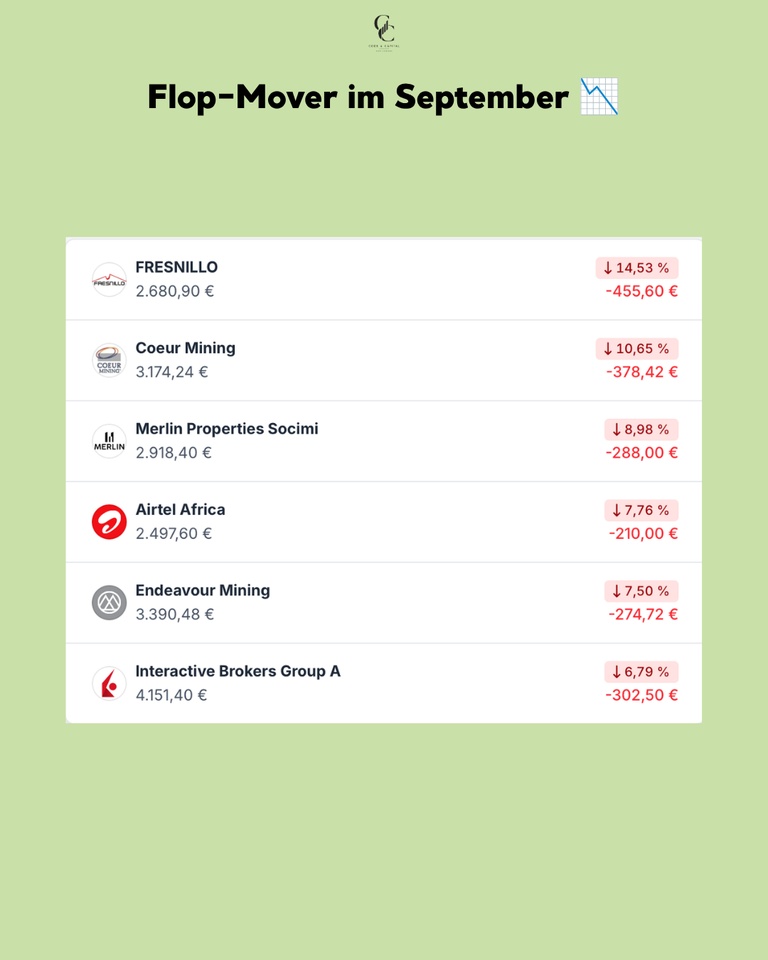
September’s Big Losers 🔴
Gold and silver declined in September, with silver falling much more sharply. Rising yields and a stronger dollar weighed on prices. Mining stocks followed suit. Fresnillo
$FRES (-1,5 %) lost −14.53%, Coeur Mining
$CDE (-2,41 %) −10.65%, and Endeavour Mining $EDV (-3,82 %) -7.50%. In August, all three were still on the other list with gains of over 25 percent. Merlin Properties fell −8.98%, Airtel Africa
$AAF (+2,61 %) down 7.76%, and Interactive Brokers
$IBKR (-0,34 %) fell by 6.79%.
Rebalancing on October 1 🔄
On October 1, the third rebalancing since the start took place. I swapped out 18 of 30 positions—more than ever before. In July, it was nine.
All nine banks are out: Bankinter
$BKT (-1,17 %) , CaixaBank
$CABK (-1,67 %) , BBVA
$BBVA (-2,46 %) , UniCredit
$UCG (-0,36 %) , BPER
$BPE (+0,02 %) , Monte dei Paschi $BMPS (+0,31 %) , Banca Mediolanum
$BMED (-1,16 %) , Swedbank$SWED A (+0,44 %) and HSBC
$HSBA (-0,03 %) . In addition, Interactive Brokers $IBKR (-0,34 %) , Antofagasta $ANTO (+0,33 %) , Coeur Mining
$CDE (-2,41 %) , AppLovin
$APP (-1 %) , Airtel Africa
$AAF (+2,61 %) , Merlin Properties and Solaria
$SLR (+0,18 %) . Investor AB
$INVE B (-0,49 %) and Pershing Square
$PSH (+2,01 %) are also no longer in the portfolio. So four of the six underperformers listed above are no longer in the portfolio.
Six stocks from the healthcare sector were added: Eli Lilly
$LLY (+4,46 %) , Bristol-Myers
Squibb
$BMY (-0,66 %) , Vertex $VRTX , Incyte
$INCY (-1,34 %) , Illumina
$ILMN (-0,57 %) and WuXi AppTec
$603259 . Five are from the semiconductor and storage sectors: Seagate
$STX (+1,95 %) , Marvell
$MRVL (-5,02 %) , Applied
Materials
$AMAT (+1,37 %), Teradyne
$TER (-4,3 %) and KLA
$KLAC (+1,74 %) . The rest is split among Fortinet
$FTNT (+4,91 %) , CF Industries
$CF (-2,19 %) , Marathon Petroleum
$MPC (-5,21 %) , APA
$APA (-0,1 %) , Pop Mart $9992 (-1,01 %) , Hong Kong Exchanges
$388 (-0,6 %) and Lion Finance
$BGEO (+2 %) .
Twelve remain: SanDisk, Micron, Western Digital, Nvidia, Lam Research, TSMC, ASML, Alphabet, Comfort Systems, Fresnillo, Endeavour and Newmont. All six of September’s top movers are included.
Two names stand out. Applied Materials and KLA I sold on July 1, up 92 and a gain of 90 percent. Now both are back in my portfolio. The model doesn’t remember what it has sold in the past. It only looks at where a stock stands in the ranking today.
Conclusion 💡
The portfolio looks different after October 1 than it did before. In September, about 41 percent was still in financial stocks; now there are two positions out of 30. Instead, 12 out of 30 are in semiconductors and memory, and six are in the healthcare sector. There’s no sector limit; the model sorts by score, not by industry. Trading won’t resume until early January.
How was your September? And did you hold onto your stocks after the pullback, or did you sell them? 👇
➡️ Every month, you’ll find the complete Wikifolio update here, along with research in between.
📈 Wikifolio $DE000LS9V052 (-0,45 %)

+ 1


Robotics / Physical AI—the next big thing?
In my opinion, robotics and physical AI will be among the most significant fields of the future in the coming years. I’d like to follow this trend with my own portfolio of stocks, which I’ve carefully put together. (It contains only a few stocks from this sector—unfortunately, I can’t invest in everything.)
The focus is deliberately on higher-risk, opportunity-driven stocks—rather than on large, defensive names. Below, I’ll briefly outline the stocks I’ve already invested in or plan to invest in, and I’ll also highlight a few other alternatives.
I’d be very interested to know what stocks in this sector you’ve already invested in or plan to invest in.
I’ve decided on:
Nabtesco (rotary gearboxes)
THK (linear actuators)
Allegro (sensor technology)
UBTECH (high risk, ready-to-use robots)
Xpeng
Overview of the stocks + additional alternatives:
(Of course, there are many more. This is just a small selection of possible stocks.)
$6324 (-2,54 %)
Harmonic Drive Systems (Japan)
• Global market leader in precision strain-wave gearing, an alternative to Nabtesco’s cycloidal gears
• Extremely common in robot joints, where low weight and high precision are required
• One of the companies that has already benefited the most from the robotics boom
Nabtesco (Japan)
• Global market leader in precision reduction gears (especially cycloidal gears)
• Found in the majority of industrial robot arms worldwide
• Highly focused business closely tied to robotics
THK (Japan)
• Inventor and market leader in linear guides and ball screws
• Enables precise, linear motion in robots, machine tools, and factory automation
• More diversified than pure gear manufacturers, with a strong presence in traditional mechanical engineering as well
Schaeffler (Germany)
• Traditional automotive supplier (rolling bearings, drivetrain technology)
• Has been strategically positioning itself toward robotics since 2025/26, including with a planetary gear actuator for humanoid robots
• The existing core automotive business drives the stock; robotics is an additional option
Allegro Microsystems (U.S.)
• Manufacturer of sensor technology, primarily magnetic sensors for engine control
• Crucial for precise motion control in robotic joints and the automotive sector
Ambarella (USA)
• Develops edge AI chips for image processing and computer vision
• Increasing focus on robotics and autonomous systems rather than just traditional surveillance cameras
Teradyne (U.S.)
• Originally a manufacturer of semiconductor test equipment
• Through acquisitions, owns Universal Robots (market leader in collaborative robots/cobots) and Mobile Industrial Robots (MiR, autonomous transport robots)
• Thus, a diversified approach to investing in commercial robotics applications without being a pure-play robotics company
UBTECH Robotics (China)
• Builds complete humanoid robots (e.g., Walker S); not a pure supplier
• Already undergoing initial industrial trials
• Listing in China introduces additional regulatory/geopolitical risk
Rainbow Robotics (South Korea)
• Korean manufacturer of humanoid and collaborative robots
• Samsung Electronics is the largest shareholder and is driving the integration into its own manufacturing operations
• A small, highly volatile small-cap stock with significant price movements since Samsung’s investment
Doosan Robotics (South Korea)
• Part of the Doosan Group, a manufacturer of collaborative robots (cobots)
• Focus on industrial applications such as welding, palletizing, and food service automation
• Listed on the stock exchange since 2023; still a relatively new listing
XPeng (China)
• Primarily an electric vehicle manufacturer, but also operates a robotics division (humanoid robots) and is developing air taxis (XPeng AeroHT)
• The stock price depends largely on the low-margin core EV business; the robotics potential has had little impact so far
Nvidia (U.S.)
• Provides the computing platform behind Physical AI: Jetson chips and the Isaac platform for robot control and training
• A key “enabler” for virtually all robotics players, but itself a massive, broadly diversified chip company—no pure-play robotics exposure
Tesla (U.S.)
• Electric car manufacturer with its own humanoid robotics program (Optimus)
• Optimus is not yet in large-scale commercial use; it remains a growth opportunity alongside the core business
Hyundai Motor Group (South Korea)
• Core business is traditional automotive manufacturing; has held a majority stake in Boston Dynamics since 2021
• Boston Dynamics unveiled the new humanoid robot Atlas at CES 2026; mass production is planned to begin at the new U.S. factory in Georgia starting in 2028
• Here, too, robotics is a supplementary option alongside a large, established automotive business
Nidec (Japan)
• The world’s largest manufacturer of electric motors, ranging from micromotors to industrial drives
• Investing heavily in actuators specifically for humanoid robots—a gap that THK/Schaeffler (linear actuators) and Nabtesco/Harmonic Drive (gearboxes) have not yet filled
• Complements the drive chain with the missing core component: the actual motor
Cognex (U.S.)
• Global market leader in machine vision systems for manufacturing automation
• Considered “the eyes” of modern robotic cells in factories—detects, inspects, and positions components
Classification by Field
Gearboxes
Harmonic Drive, Nabtesco
Actuators / Linear and Drive Technology
THK, Schaeffler
Sensors / Chips / AI Computing Platform
Allegro Microsystems, Ambarella, Nvidia
Automation Equipment / Cobots (Close to suppliers, but diversified)
Teradyne
Pure-play or specialized robot manufacturers
UBTECH, Rainbow Robotics, Doosan Robotics
Large conglomerates with robotics as a secondary business (core business in auto/mobility)
XPeng, Tesla, Hyundai Motor Group
What do you think of this stock selection? Do you have any additions?
@Multibagger
@Tenbagger-Capital
Generated using AI. Not investment advice.

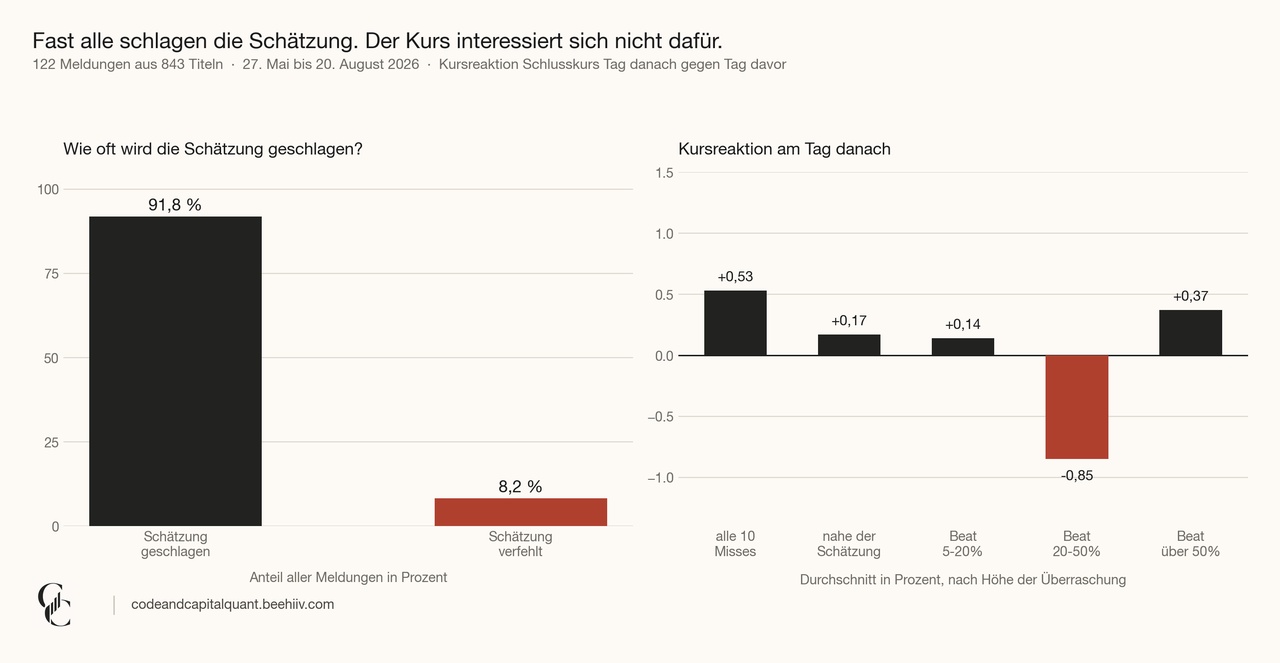
📊 92 percent exceed the estimate. Yet the price usually falls anyway.
Alphabet $GOOGL (-2,84 %) exceeded earnings estimates by 214 percent. The stock price then rose by 0.65 percent.
Coeur Mining $CDE (-2,41 %) missed expectations by 54 percent during the same period. The stock rose 11 percent.
Since the end of May, I’ve had every quarterly earnings report from my stock universe automatically recorded, along with the stock price reaction the following day. A total of 122 reports were collected between May 27 and August 20. This isn’t a simulation; the data was collected as events unfolded.
The common assumption goes like this: A company beats estimates—that’s good news—so the stock price rises. None of these three steps holds true.
1️⃣ Almost all beat estimates
112 out of 122 were above expectations. That’s 91.8 percent. Ten missed.
The rate says nothing about the companies. It says something about the estimates. Analysts lower their forecasts in the weeks leading up to the earnings release because the companies prepare them accordingly. What’s left is a bar that practically everyone clears. Anyone who reads “exceeded expectations” has learned about as much as they would from the news that a train departed on time.
2️⃣ The stock price falls anyway
Of the 112 companies that beat estimates, the stock price fell in 65 cases—that’s 58 percent.
On average, the reaction after a “beat” was a decline of 0.03 percent, and after a “miss,” an increase of 0.53 percent. The median shows the same pattern: -0.47 versus -0.28. Both figures are close to zero, so I wouldn’t base a trading rule on them. With only ten misses, the second figure is insignificant anyway. But the trend is consistent in both calculations.
3️⃣ Even a big surprise doesn’t help
It might seem obvious that two percent above the estimate isn’t enough and that a real outlier is needed. The correlation between the magnitude of the surprise and the price reaction is minus 0.042. That’s just noise. Alphabet $GOOGL (-2,84 %) 214 percent above estimates, stock price up 0.65. Warner Bros. Discovery $WBD 154 percent above estimates, stock up 1.44. Centene $CNC (-0,08 %) 133 percent above estimate, price down 1.59. Intel $INTC (-2,68 %) 95 percent above estimates, down 7.89.
There’s movement, but it’s coming from elsewhere
NetApp rose $NTAP (-1,07 %) up 22.4 percent, Teradyne $TER (-4,3 %) up 14.4 percent, and Seagate $STX (+1,95 %) up 11.4 percent. On the downside, Reddit $RDDT (-4,18 %) was down 21.0 percent, Ciena $CIEN (-3,47 %) down 8.9 percent, Broadcom $AVGO (-0,11 %) down 7.9 percent, and Apple $AAPL (+1,37 %) down 7.4.
These are double-digit daily movements. Reddit $RDDT (-4,18 %) beat estimates by 30 percent and lost a fifth of its value. Broadcom $AVGO (-0,11 %) was 1.7 percent above estimates and lost nearly 8 percent. The number in the headline doesn’t explain any of these movements. It’s about the outlook, margins, and a statement in the earnings call.
What it isn’t
Three months constitute an earnings season, not a cycle. In a period of falling earnings, the 92 percent rate would likely look different. I measure only the day after the announcement, not the two weeks that follow. My universe consists of large-cap stocks from fourteen indices; with small-cap stocks, things can play out differently. I’ll keep collecting data; in a year, I’ll have four quarters.
For me, this means: Anyone who buys after a report because expectations were exceeded is reacting to information that everyone has and that almost always comes to pass. The reverse scenario is more interesting—when a stock price reacts strongly even though the numbers were unremarkable. That means there’s something else in the report.
❓ Do any of you deliberately trade around earnings reports? And does anyone have an explanation for why misses, on average, fare better than beats?
👇 Leave your thoughts in the comments!
➡️ I do analyses like this regularly; in between, I post the monthly Wikifolio update.
🗞️ Newsletter: codeandcapitalquant.beehiiv.com
📈 Wikifolio: https://www.wikifolio.com/de/de/w/wf0gquant6
Not investment advice; based on my own research. Past performance is not indicative of future results.


Chipmakers slide again
📉 Semiconductor stocks extended losses: AMD -5%, Teradyne -4%, Micron -2%. The VanEck Semiconductor ETF (SMH) added to Friday's drop even as it bounced off session lows.
$AMD (-1,08 %)
$TER (-4,3 %)
$MU (-3,36 %)
$SMH (-0,39 %)
$NVDA (-0,9 %)

The risk-off seems a bit hysterical.
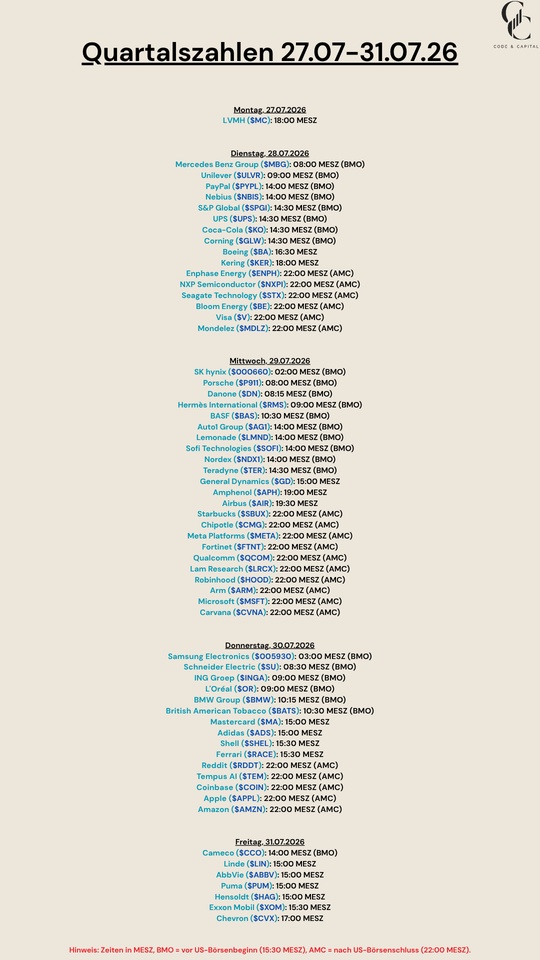
Quarterly Results: July 27–July 31, 26
$MC (-0,6 %)
$MBG (+1,79 %)
$ULVR (-0,05 %)
$PYPL (+1,71 %)
$NBIS (-1,84 %)
$SPGI (+1,43 %)
$UPS (+0,95 %)
$KO (-0,41 %)
$GLW (-0,79 %)
$BA (+3,94 %)
$KER (-0,15 %)
$ENPH (+1,07 %)
$NXPI (+4,51 %)
$STX (+1,95 %)
$BE (-0,3 %)
$V (+1,75 %)
$MDLZ (-0,94 %)
$000660
$P911 (+3,06 %)
$BN (+2,12 %)
$RMS (+0,74 %)
$BAS (+1,88 %)
$AG1 (+4,59 %)
$LMND (+1,38 %)
$SOFI (+3,79 %)
$NDX1 (+1,15 %)
$TER (-4,3 %)
$GD (+3,81 %)
$APH (+2,13 %)
$AIR (+1,28 %)
$SBUX (-0,01 %)
$CMG (+1,45 %)
$META (+1,29 %)
$FTNT (+4,91 %)
$QCOM (+1,5 %)
$LRCX (+1,59 %)
$HOOD (+0,79 %)
$ARM (-1,2 %)
$MSFT (-6,92 %)
$CVNA (+8,29 %)
$005930
$SU (+1,14 %)
$INGA (-2,12 %)
$OR (+0,44 %)
$BMW (+0,65 %)
$BATS (+0,63 %)
$MA (+3,92 %)
$ADS (+5,58 %)
$SHEL (+1,95 %)
$RACE (+1,28 %)
$RDDT (-4,18 %)
$TEM (+2,52 %)
$COIN (-0,01 %)
$AAPL (+1,37 %)
$AMZN (-4 %)
$CCO (+0,27 %)
$LIN (-1,97 %)
$ABBV (+0 %)
$PUM (+0,18 %)
$HAG (+2,2 %)
$XOM (-0,35 %)
$CVX (+0,05 %)
Nasdaq 100 Rebalancing
The rebalancing of the Nasdaq 100 Index was announced $NDX was announced.
Starting June 22, the following companies will be added:
The following companies will be removed:
Source: Nasdaq-100 Index® June 2026 Quarterly Changes | Nasdaq, Inc. https://share.google/wnk6Xt3oa7cqzGshd

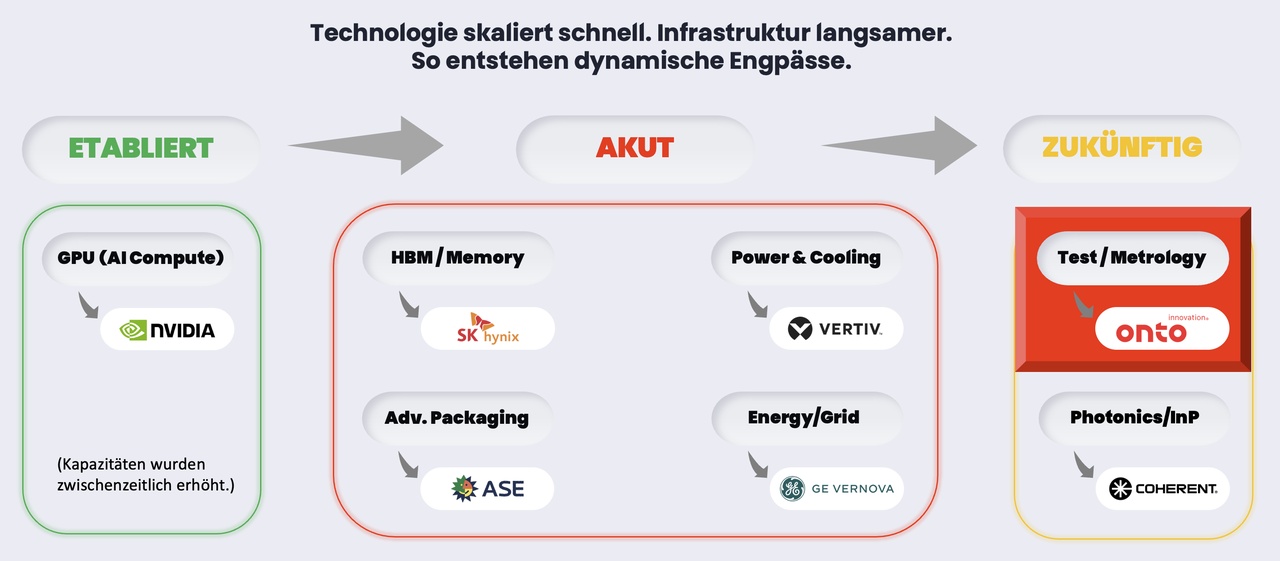
Future AI bottleneck #1: Test/Metrology 🔬
Today we are leaving the field of acute AI bottlenecks (HBM/Memory, Power & Cooling, Advanced Packaging, Energy/Grid) and take a look at future AI bottlenecks.
Here I see, among other things Test & Metrology, because modern AI systems are becoming increasingly complex. More layers, more integration, smaller structures and higher power densities. At the same time, fault tolerance is decreasing massively. Or to put it another way:
‼️ The industry is slowly moving towards "zero tolerance".
Even minimal deviations can affect yield, energy consumption or stability in the future. Precisely because of this This is precisely why the requirements for measurement, control, verification and precision along the entire production chain.
Level 1: Core Metrology (measurement & process control)
For me, this is the structural core. Put simply, it's about making the smallest deviations in modern production processes visible and controllable. Company $ONTO (+0,42 %) (Onto Innovation), $CAMT (-1,19 %) (Camtek) or even $FORM (-5,74 %) (FormFactor) address precisely this level.
Level 2: Test & Verification (functional testing & verification)
It is checked whether complex systems function stably at all. As integration density increases, the importance of test systems also grows considerably. It is often almost impossible to correct errors later on. Companies such as $TER (-4,3 %) (Teradyne) show how important Test & Verification becomes with increasing system complexity.
Level 3: Yield Engineering & Integration Control
This is where a lot of value is currently shifting within the stack. With topics such as HBM, chiplets or 3D integration, the requirements for precision, yield and thermal control are increasing massively. For me, for example $BESI (+0,82 %) (BE Semiconductor) is very close to this development.
Level 4: Specialized Metrology (high-precision special metrology)
Future optical systems and new integration architectures will further increase the requirements for precision and control. Increasingly, the bottleneck no longer lies in the integration itself, but in the ability to combine highly complex components without errors and maintain stable quality. Companies such as $BESI (+0,82 %) (BE Semiconductor) or $ONTO (+0,42 %) (Onto Innovation) are addressing precisely this development.
The more complex modern systems become, the more critical the ability to make minimal errors visible and controllable becomes.
Emerging areas such as photonics (optical data transmission), optoelectronics (combination of electronics and lighting technology) or CPO/Co-Packaged Optics (optical components directly next to the chip) are also driving this development, as increasingly complex stacks, optical connections and integration architectures are being created.

MY NEW HIGH-RISK SETUP: THE HUNT FOR THE NEXT TENBAGGERS
In the past, I had the right touch (and admittedly also the necessary bit of luck) and was able to celebrate two real tenbaggers in my portfolio with Palantir and Rigetti. I secured my profits and took out my risk by consistently selling some of the stocks.
But instead of resting on my laurels, I am now attacking again. I am currently investing 20% of my total capital in a new, highly aggressive high-risk/high-reward part. The aim? To find the market leaders of tomorrow before the masses discover them.
🛠 My "future-of-humanity" ecosystem:
I have specifically divided my risk segment into four technological power clusters that reinforce each other:
🛰 Space Infrastructure (The Backbone): With $RKLB (+3,66 %) , $LUNR (+2,56 %) , $RDW (+4,37 %) and $ALMU I occupy the entire value chain - from rocket launch to lunar economy to sensor technology. $ASTS (+5,01 %) is my joker for the global mobile communications revolution.
🧬 Bio-Tech 2.0: I combine the gene scissors from $CRSP (-0,18 %) with the AI-supported search for active ingredients from $RXRX . That's healing plus industrial efficiency.
💻 Quantum sovereignty: After $RGTI (-2 %) I am now focusing on the next generation. With $IONQ (-1,3 %) and $CHAC (-3,99 %) (photonics!) and $LAES (-2,41 %) for encryption, I am positioned for the computing revolution after the silicon age.
📊 Intelligence & Fintech: $PLTR (-1,17 %) the brain stays in the background while $NU (+0,42 %) and $SLYG (-0,69 %) show how scalable software is printing real profits.
This is complemented by tech giants such as $TER (-4,3 %) and $MIPS (+0,97 %) .
Why this setup?
This portfolio is not a blind gamble. It is a bet on the convergence of technologies. AI needs quantum power, quantum power needs space infrastructure for global networking, and biotech needs the data processing of tomorrow.
Each of these stocks has the potential to grow tenfold because they are not copies - they have unique selling points in markets that are only just emerging.
Important: This is the Champions League of volatility. 50 % drawdown? That's part of it. But if you're looking for the next tenbagger, you can't stay in your comfort zone.
What about you? What do you think of my potential rockets?

"The power behind flawless chips - and the robotics engine that makes modern factories autonomous."
Hello my dears,
As we are still looking for an exciting value for a project with the semiconductor machine builders. There is a doubly exciting stock today, because the equally exciting growth theme of robotics is being played out several times here through the subsidiaries.
That's why I don't want to keep you in suspense any longer.
Have fun with the presentation of Teradyne $TER (-4,3 %)
Teradyne, Inc. specializes in the development, manufacture and marketing of automated test equipment. Net sales break down by product family as follows:
- Semiconductor Testers (75.3%);
- System test solutions (12.6 %): Testers for integrated circuits, digital network cards, electronic modules, military and aeronautical instruments, vehicle diagnostic systems, etc.;
- Solutions for industrial automation (12.9%);
- wireless test solutions (11.7%): for manufacturers of mobile devices and equipment (smartphones, tablets, laptops, etc.).
Net revenue is broken down by revenue source into product sales (81.4%) and services (18.6%; consulting, development, training and technical support).
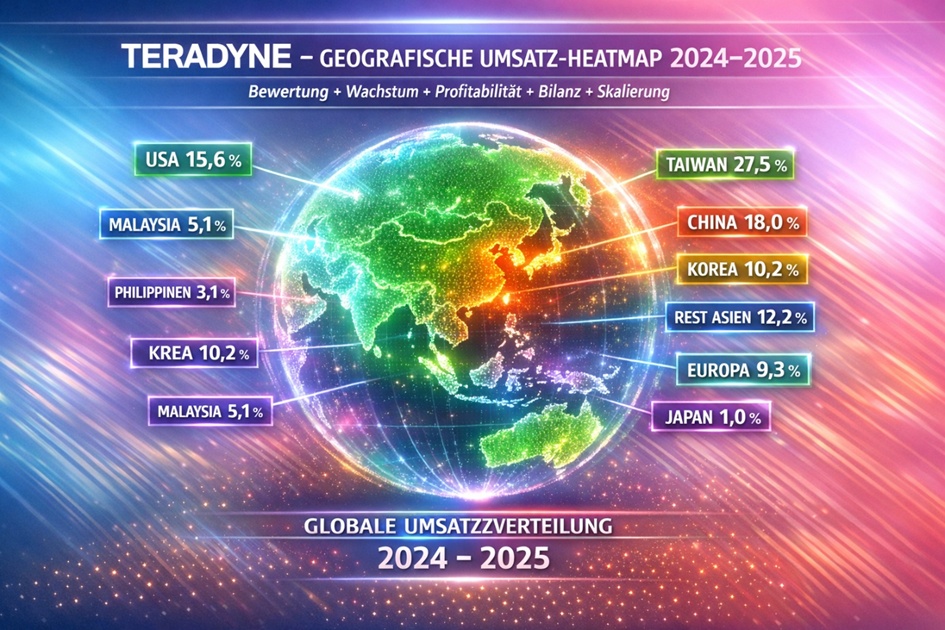
The geographical breakdown of net sales is as follows: Americas (15.4 %), Asia/Pacific (75.5 %), Europe/Middle East/Africa (9.1 %).
Number of employees: 6,600
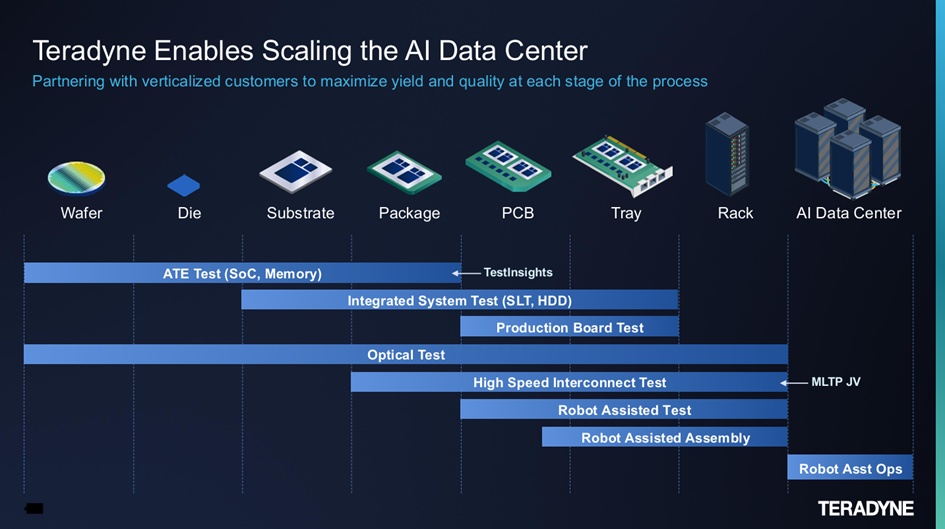
On April 16, Teradyne acquired TestInsight, a leading developer of semiconductor test validation and conversion software to address the increasing complexity of AI and data center hardware. The acquisition aims to tighten the workflow between initial design planning and final testing, a process often slowed by the complex requirements of modern silicon.
Teradyne - key supplier behind global AI infrastructure expansion with record figures, all-time high and six billion sales target
Teradyne (TER) is one of the world's leading suppliers of automated test systems for the semiconductor industry and is headquartered in Massachusetts.
The company was founded in 1960 and has established itself over decades as a technological standard setter in a highly specialized market.
The business model is divided into three segments. The largest segment by far is semiconductor testing, which recently accounted for around 80 percent of sales. Teradyne develops fully automated test systems that test chips for functionality, speed and energy efficiency - both logic chips for AI accelerators and memory chips such as DRAM and NAND.
The second segment is product testing. Here, the company serves customers in the aerospace and defense sectors and is growing through the acquisition of Quantifi Photonics.
The third segment is industrial automation, under which the Universal Robots brand sells collaborative robotic arms and compact industrial robots that work safely alongside humans.
On February 3, 2026, Teradyne presented its results for the fourth quarter of 2025. The share price rose by 15 % at its high and reached a new all-time high. Turnover increased by almost 45%. AI-related demand now accounts for over 60% of quarterly sales. For the first quarter of 2026, the company expects revenue of between USD 1.15 and 1.25 billion. This is significantly higher than the analysts' estimate of USD 954 million at the time. In the long term, the management has issued a sales target of around USD 6 billion, which would correspond to a doubling compared to the 2025 level.
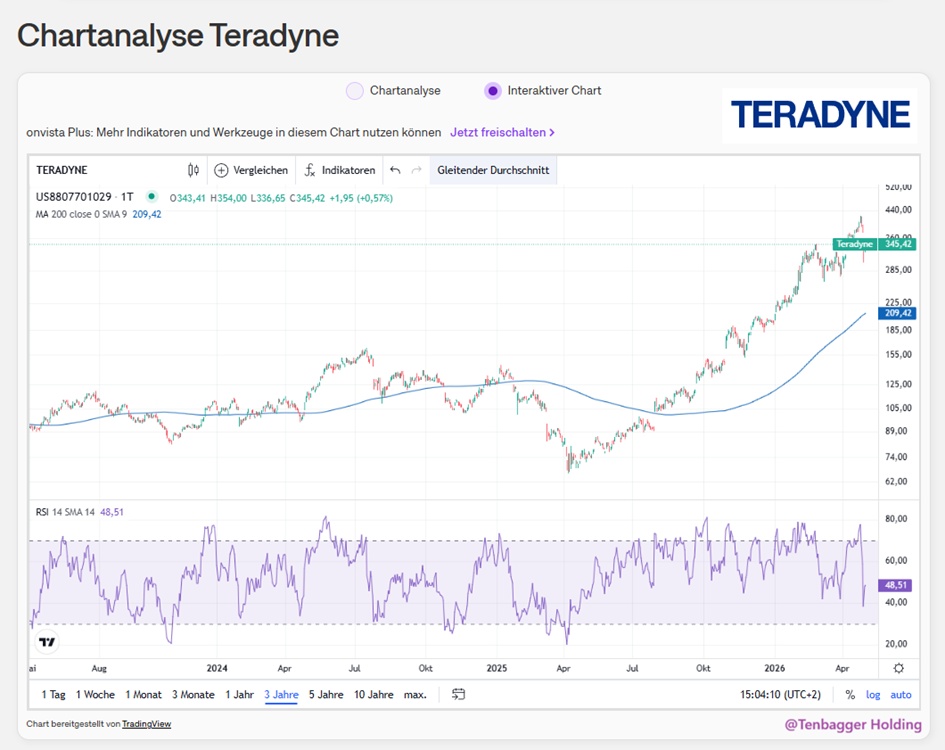
On April 8, the share broke out of a sloping resistance line and reached a new all-time high. The relative strength is 99, making it a leader share. The share now needs to consolidate before it can be entered. The share therefore currently belongs on the watch list.
( Von M. Müllerhoff - Updated on 10.04.26 12:08)
My dears, the correction has now taken place, perhaps a good time to get in.
Record figures: Turnover in Q1 2026 at USD 1.282 billion (+87 %), earnings per share 2.56 USD (+241 %), gross margin 60,9 % - all above expectations.
Market reaction: Nevertheless, the share fell fell by 12.9 % in the aftermarket and 18.3 % in the pre-marketbecause investors doubted the sustainability sustainability of the AI-driven growth of AI-driven growth.
Background: Around 70 % of revenue comes from the AI sectormainly from the area of semiconductor testing. This strong concentration raises concerns about market saturation and cyclical fluctuations.
Risks: The management mentions possible supply chain problems, competitive pressure and technological changes as challenges.
Conclusion: The slump reflects not so much the figures, but the uncertainty about the future pace of growth - investors investors fear that the AI boom will not remain so strong in the long term.
Your opinion in the comments.
In the news
Teradyn launches Photon 100
Teradyne announces Photon 100, a comprehensive optoelectrical automated test platform specifically designed to accelerate the manufacturing of high-volume silicon photonics (SiPh) and co-packaged optics (CPO).
Lesen Sie die Pressemitteilung
In the news
Teradyne introduces Omnyx: Redefining board testing for the AI era
Teradyne announces Omnyx, a breakthrough manufacturing test platform for printed circuit board assemblies and subassemblies designed to meet the unique test requirements of AI and data centers.
Lesen Sie die Pressemitteilung
Teradyne Company:
- MiR:
Simplifying transportation and material handling
- MiR autonomous mobile robots (AMR) optimize intralogistics and increase efficiency for some of the world's leading manufacturers. MiR AMRs are highly customizable and can be adapted for towing, lifting and transporting racks or pallets, providing flexible, ready-made options for different tasks.
- Mobile Industrial Robots - Automate your internal transportation
- UNIVERSAL ROBOTS:
Innovative cobot solutions for unlimited automation
- Teradyne Robotics is a global leader in advanced robotic solutions and is dedicated to revolutionizing manufacturing processes through innovations in collaborative and mobile robot technology.
- Universal Robots delivers collaborative robots designed for industrial performance - with payloads up to 35 kg, reach up to 1750 mm and deployment in minutes. Our kollaborativen Roboterarm-Lösungen robots are trusted across industries such as electronics, metalworking, logistics and education, helping manufacturers increase productivity, reduce downtime and accelerate return on investment.
- LITEPOINT:
Simplifying wireless testing for lab, TVT and manufacturing
- LitePoint simplifies wireless testing for lab, DVT and manufacturing.
- Ready for the chip you're testing, without programming or software development.
- Führender Anbieter von Innovationen im Bereich drahtloser zellularer Tests – LitePoint
- QUANTIFI PHOTONICS:
Leading the way in scalable photonics testing
- With a growing portfolio of photonics and high-speed I/O test instruments, they work with the world's leading photonics developers and manufacturers to develop scalable test solutions that provide a competitive advantage.
- Vorreiter im Test und Messung skalierbarer Photonik – Quantifi Photonics
Short Juan summary
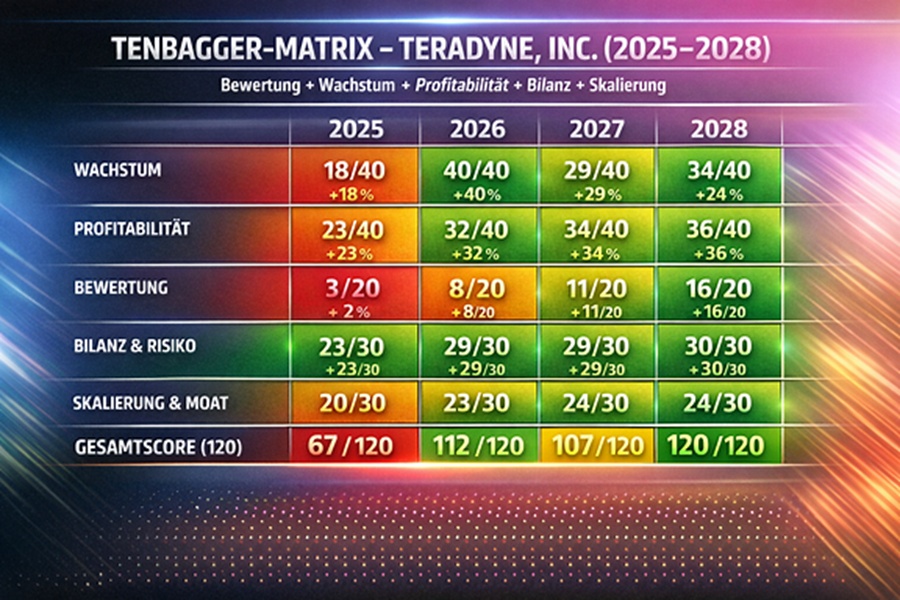
Juan leans forward, taps his badge once and grins: "Teradyne is delivering a strong comeback - sales, EBIT and cash flow are picking up strongly from 2025. Margins are rising cleanly, FCF is jumping particularly strongly. To me, this looks like a clear quality rebound in semiconductor testing."
Market value: 54,073
Number of shares (in thousands): 156,542
Date of publication: 02,02,2026
Brief Juan summary of the valuation ratios
Juan pushes up his glasses, looks at the valuation line and nods: "Teradyne looks expensive at first glance - high P/E ratio, high P/B ratio. But the PEG drops significantly from 2027 and the FCF yield picks up cleanly. For me, this means: currently a premium price, but the valuation runs into the story."
PRICE: USD 346.99 (04.05.2026 16:16)
+ 6


Titres populaires
Meilleurs créateurs cette semaine