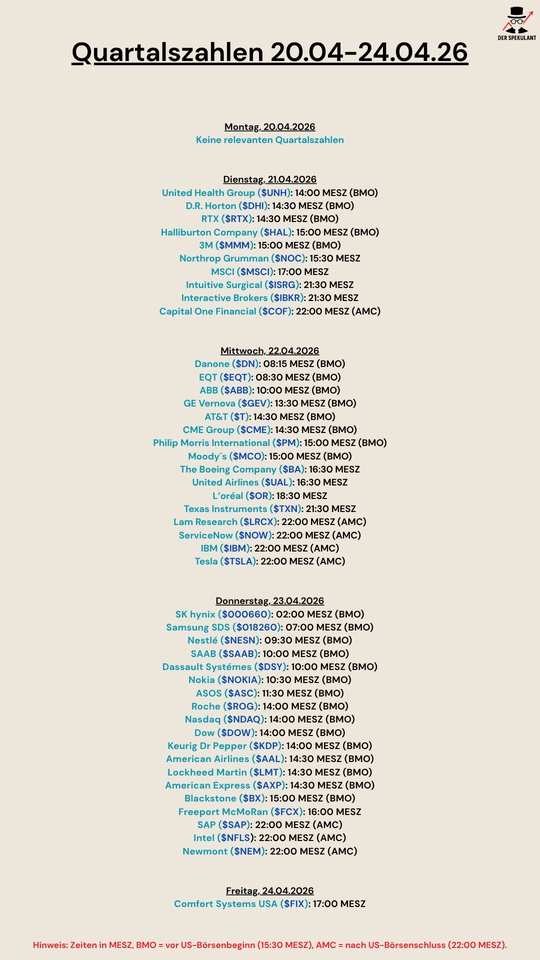
$UNH (-0,07 %)
$DHI (-2,57 %)
$RTX (-3,38 %)
$HAL (+1,21 %)
$MMM (+0,44 %)
$NOC (-2,68 %)
$MSCI (-1,21 %)
$IBKR (+1,15 %)
$ISRG (+0,63 %)
$COF (-2,05 %)
$BN (+0,03 %)
$EQT (-0,18 %)
$ABBN (+0,58 %)
$GEV (-1,07 %)
$T (-1,84 %)
$CME (-0,53 %)
$PM (-3,06 %)
$MCO (+0,52 %)
$BA (-0,79 %)
$UAL (+1,93 %)
$OR (+2,57 %)
$TXN (-1,66 %)
$LRCX (+3,58 %)
$NOW (+4,85 %)
$IBM (-0,2 %)
$TSLA (+0,55 %)
$000660
$018260
$NESN (+2,06 %)
$SAAB B (-4,43 %)
$DSY (+1,11 %)
$NOKIA (+1,16 %)
$ASC (+6,78 %)
$ROG
$NDAQ (+3,23 %)
$DOW (+0,21 %)
$KDP (+1,97 %)
$AAL (+1,14 %)
$LMT (-3,59 %)
$AXP (-1,61 %)
$BX (-0,72 %)
$FCX (-2,26 %)
$SAP (+1,3 %)
$INTC (+7,11 %)
$NEM (+8,4 %)
$FIX (-8,86 %)
SK Hynix
Price
Discussion sur 000660
Postes
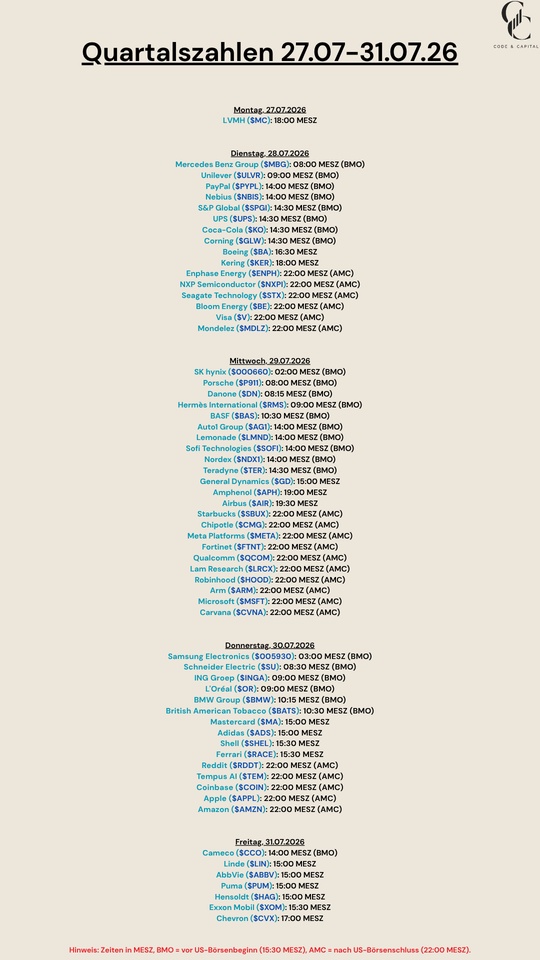
12Quarterly figures 20.04-24.04.26
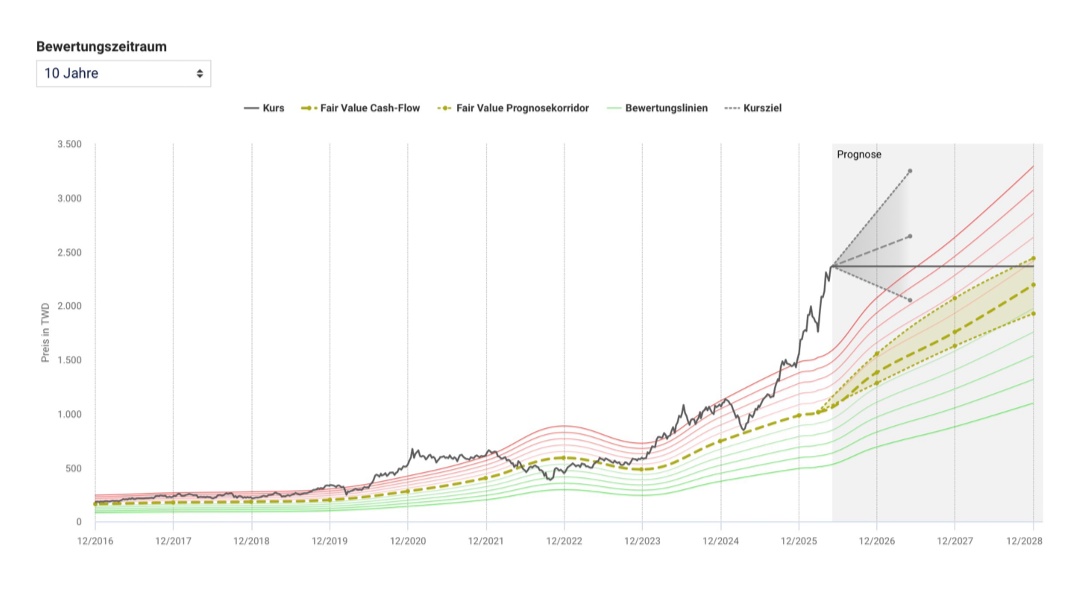
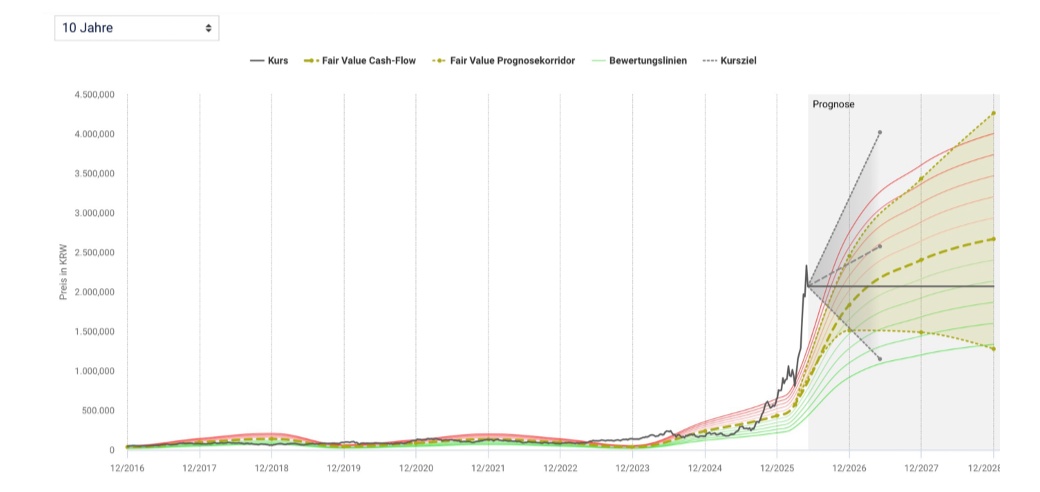
SK Hynix Inc. (KRX: 000660, KR7000660001): The AI King's Sword
New Episode
$000660 - SK Hynix Inc
⚠️ Disclaimer: This content is provided for informational and educational purposes only and does not constitute investment, financial, legal, or tax advice. The information presented does not take into account the specific investment objectives, financial situation, or particular needs of any individual. This content may include speculative analysis and forward-looking statements that are subject to change and may not materialize. Past performance is not indicative of future results. Nothing in this content should be construed as a personal recommendation or an inducement to buy, sell, or hold any financial instrument. Financial markets involve risk, including the potential loss of capital. Viewers are strongly encouraged to conduct their own independent research and, where appropriate, seek advice from a qualified professional authorized and regulated under applicable local regulations. The creator of this content accepts no liability for any direct or indirect losses or damages arising from any reliance placed on the information provided.
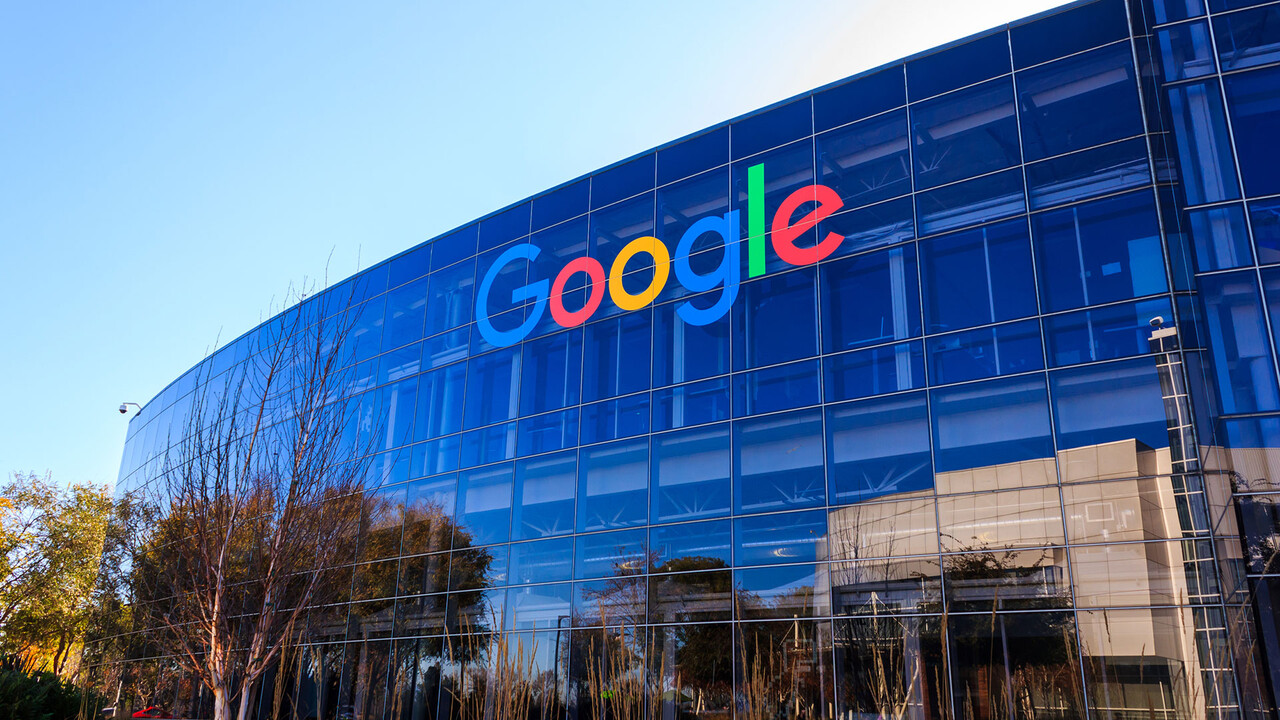
"Six times less memory": Google announcement causes chip shares to plummet
$GOOGL (+1,36 %)
$GOOG (+1,06 %)
Google has developed a new compression method for its AI applications that allegedly reduces the memory requirements of large language models by a sixth. As a result, investors are sending the share prices of memory chip manufacturers such as Samsung and Micron plummeting.
SK Hynix $000660
Samsung $samsung
Sandisk $SNDK
Micron $MU (+2,38 %)
Western Digital $WDC (-0,1 %)
Do you see this as an opportunity to get in? Or is it too risky at the moment?


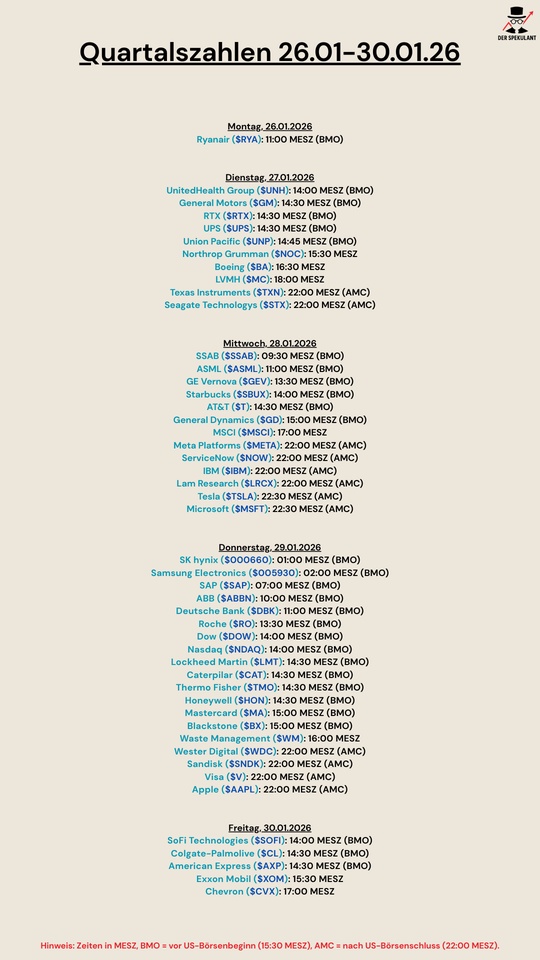
Quartalszahlen 26.01-30.01.2026
$RYA (+1,41 %)
$UNH (-0,07 %)
$GM (-1,16 %)
$RTX (-3,38 %)
$UPS (-0,84 %)
$UNP (-0,15 %)
$NOC (-2,68 %)
$BA (-0,79 %)
$MC (+1,86 %)
$TXN (-1,66 %)
$STX (-1,18 %)
$SSAB A (-1,48 %)
$ASML (+2,14 %)
$GEV (-1,07 %)
$SBUX (-0,94 %)
$T (-1,84 %)
$GD (-1,67 %)
$MSCI (-1,21 %)
$META (+2,51 %)
$NOW (+4,85 %)
$IBM (-0,2 %)
$LRCX (+3,58 %)
$TSLA (+0,55 %)
$MSFT (+1,38 %)
$000660
$005930
$SAP (+1,3 %)
$ABBN (+0,58 %)
$DBK (+0,9 %)
$ROG (+1 %)
$DOW (+0,21 %)
$NDAQ (+3,23 %)
$LMT (-3,59 %)
$CAT (-0,98 %)
$TMO (+0,15 %)
$HON (-0,65 %)
$MA (+0,07 %)
$BX (-0,72 %)
$WM (-1,71 %)
$WDC (-0,1 %)
$SNDK
$V (-0,08 %)
$AAPL (-0,73 %)
$SOFI (+0,13 %)
$CL (+0,29 %)
$AXP (-1,61 %)
$XOM (-1,41 %)
$CVX (-1,69 %)
Strategy Update 2026
Hi folks,
I'm about to make a major strategic change to my portfolio this month. I have cracked the €120,000 mark 🎉 and have taken this as an opportunity to weatherproof my allocation for the coming years.
Here is my roadmap:
1. the tax "life hack": FIFO optimization 💡
I stop my previous core ETFs ($VHVG (+0,37 %) , $MEUD (+0,36 %) , $EXCH (+2,47 %) ) and leave them untouched. Why? In Germany, the FIFO principle (First-In-First-Out) applies. By saving new ISINs from now on (MSCI World ex-USA, NASDAQ 100 & MSCI EM), I "protect" my old shares with the high book profits. Later, I can sell the younger tranches first with less profit and massively defer the tax burden.
2nd core update: USA cap & EM limits 🌍
From now on, my core (approx. 74% of the portfolio) will be re-saved with €280 per month. I love US performance, but don't want any bulk risk:
USA cap: maximum 55% in the core.
Emerging markets: cap at 10%
3. satellite & venture: my high-conviction stocks
This area should make up 20% of my portfolio. Here I invest €400-600 per month in themes that I absolutely believe in. Currently in focus:
Cloudflare ($NET (-0,31 %) ): Infrastructure & cybersecurity are the basis of everything for me.
Siemens Energy ($ENR (+0,73 %) ): My play on the energy transition and grid expansion.
Hims & Hers ($HIMS) (+8,01 %)Exciting disruptor in the telehealth sector.
Tech from the Far East: With Xiaomi ($1810 (+0,75 %) ) and CATL ($3750 (-1,23 %) ) I cover important future markets.
Coinbase $COIN (+0,8 %) complements my direct Bitcoin holdings (target: 3.5% crypto share of the overall portfolio).
Other additional stocks are $NBIS (-6,29 %) , $000660 and $RKLB (-6,5 %)
4. the big goal: retirement in 2054 🏁 or perhaps even earlier
The math is done: I am aiming for a final capital of around € 780,000 by 2054. With a sustainable withdrawal rate of 4%, this will give me a monthly pension of around €2,600 without having to deplete the capital stock in the long term, thus closing my pension gap. It should be mentioned in the calculation that I calculate with a 5% return per year instead of the expected long-term return of 7-8% and therefore include a safety factor.
The whole thing is rounded off with a 3% share of gold (Euwax Gold II) and 17% bonds as a safety anchor.
What do you think of the FIFO tactic? Do you also use different ISINs for the same market in order to remain flexible in terms of tax, or is that too much "portfolio messing around" for you? 😉 And what do you think of my selection in the venture sector?
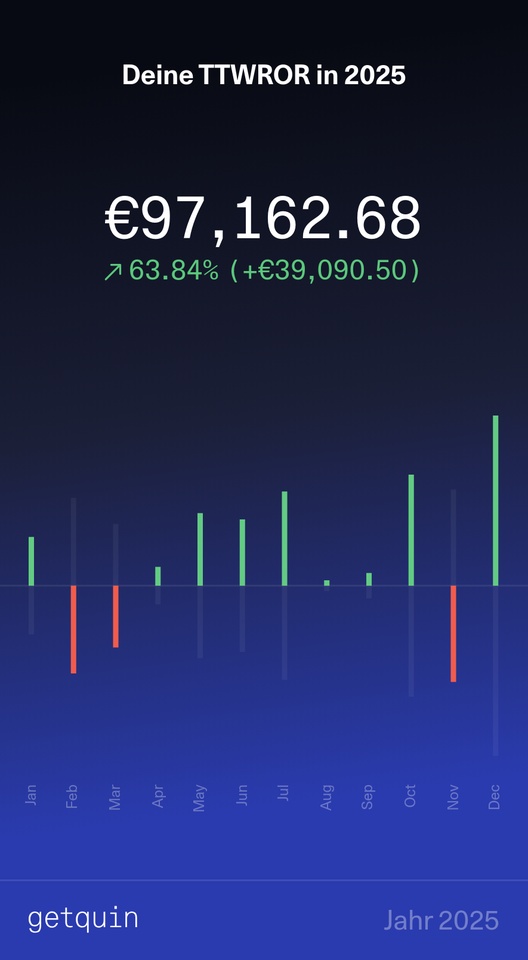
2025 Review: Goal achieved thanks to a strong core
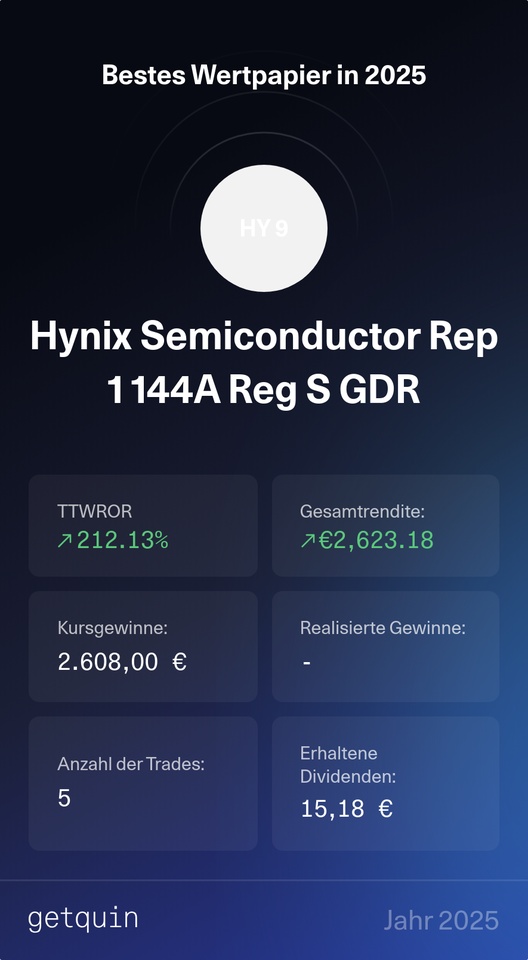
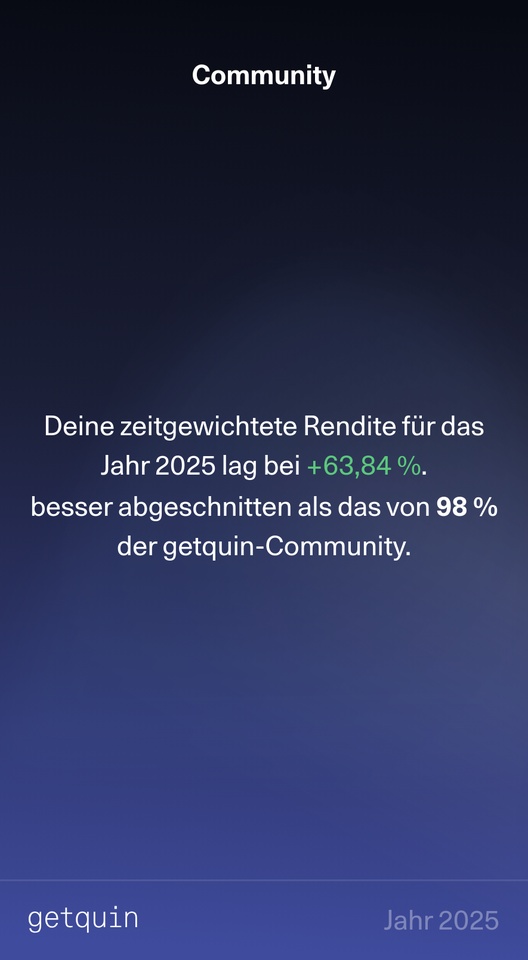
I didn't have such high expectations this year, after last year went very well thanks to $RKLB (-6,5 %) went very well last year. Nevertheless, I was able to exceed my target of €80k and would like to thank above all $000660 (SK Hynix) and again to $RKLB (-6,5 %) for a great year-end rally.
I am still very convinced of SK Hynix and think it is undervalued, Rocket Lab has of course run very hot and will probably come down to earth again (as it did today).
Happy New Year to you all and good luck with your investments in 2026 🙏🏼
Quarterly figures 27.10-31.10.25
$KDP (+1,97 %)
$7751 (-2,48 %)
$NXPI (+0,67 %)
$WM (-1,71 %)
$CDNS (+4,98 %)
$BN (+0,03 %)
$SOFI (+0,13 %)
$UNH (-0,07 %)
$AMT (-0,75 %)
$UPS (-0,84 %)
$BNP (+0,21 %)
$NVS (-1,98 %)
$DB1 (+0,74 %)
$MSCI (-1,21 %)
$ENPH (-1,29 %)
$BKNG (+2,43 %)
$LOGN (+0,23 %)
$V (-0,08 %)
$MDLZ (-0,14 %)
$PYPL (+1,67 %)
$000660
$MBG (+0 %)
$BAS (+0,46 %)
$UBSG (+0,76 %)
$SAN (-0,69 %)
$CVS (-1,07 %)
$OTLY (-0,69 %)
$GSK (-2,08 %)
$ETSY (-1,42 %)
$CAT (-0,98 %)
$KHC (-0,32 %)
$ADYEN (+0,26 %)
$ADS (-0,76 %)
$AIR (-0,09 %)
$SBUX (-0,94 %)
$CMG (+0,6 %)
$META (+2,51 %)
$KLAC (+6,29 %)
$MELI (+0,95 %)
$WOLF (+11,87 %)
$GOOGL (+1,36 %)
$EQIX (-0,5 %)
$MSFT (+1,38 %)
$CVNA (+1,2 %)
$EBAY (-5,62 %)
$005930
$6752 (-1,17 %)
$KOG (-5,03 %)
$VOW3 (-1,5 %)
$GLE (+0,17 %)
$LHA (-0,66 %)
$STLAM (-3,26 %)
$SPGI (-1,07 %)
$MA (+0,07 %)
$PUM (+0,16 %)
$AIXA (+2,78 %)
$FSLR (-2,09 %)
$AAPL (-0,73 %)
$REDDIT (-1,33 %)
$AMZN (+3,03 %)
$NET (-0,31 %)
$MSTR (-1,75 %)
$GDDY (+0,37 %)
$TWLO (+0,54 %)
$COIN (+0,8 %)
$066570
$CL (+0,29 %)
$ABBV (-1,37 %)
$XOM (-1,41 %)
SK Hynix [ NVDA Supplier ] Q1'25 Earnings Highlights:
🔹 Revenue: ₩17.64T (Est. ₩17.2T) 🟢; UP +42% YoY
🔹 Operating Profit: ₩7.44T (Est. ₩6.62T) 🟢; UP +158% YoY
🔹 Net Income: ₩8.11T (Est. ₩5.04T) 🟢; UP +323% YoY
🔸 Overtook Samsung to become global No.1 in DRAM revenue and profitability in Q1
Segment & Operational Highlights:
🔹 DRAM Revenue Share: ~80%
🔹 DRAM Profitability Improved QoQ despite seasonal price weakness
🔹 NAND: Maintained profitability despite declining prices and volumes
🔹 Cash & Equivalents: ₩14.3T (UP ₩0.2T QoQ)
🔹 Debt Ratio: 29%, Net Debt Ratio: 11%
🔹 Operating Margin: 42% (vs. 23% YoY); UP +19pp YoY
🔹 Net Margin: 46%
Outlook & Guidance:
🔹 Q2 DRAM Sales: Expected to grow low-teens % QoQ
🔹 Q2 NAND Sales: Expected to grow over 20% QoQ
🔹 Maintains HBM demand projection: To double YoY in FY25
🔹 Capex: Slight increase YoY; remains disciplined and focused on ROI
🔹 eSSD Trend: Shift from 61TB to 122TB; developing 244TB QLC eSSD
🔹 AI-optimized eSSD demand (QLC/TLC) remains strong due to data center needs
Market Position:
🔹 Overtook Samsung to become global No.1 in DRAM revenue and profitability in Q1
🔹 HBM3E 12-layer chips to exceed 50% of HBM3E sales in Q2
🔹 Leading early mass production and customer qualifications for HBM4
🔹 DRAM mix shifting toward DDR5, 24Gb/32Gb chips
Strategic Developments:
🔸 Continued expansion of M15X fab to support AI memory scaling
🔸 AI-driven demand and DeepSeek models supporting long-term HBM growth
🔸 Entered LPCAMM2 production for AI PCs; SOCAMM2 for servers to follow
🔸 Strengthening supply chain collaboration amid global uncertainty
🔸 Proactive response to tariff-driven customer stockpiling; limited inventory concerns
Commentary:
🔸 CFO Kim Woo-hyun: “Tariffs and protectionist measures are making market forecasting increasingly difficult. We remain cautious yet flexible on Capex.”
🔸 “Despite macro volatility, HBM demand remains strong and predictable due to annual supply agreements.”
🔸 “Direct U.S. exports remain low; shipments for American clients are routed globally.”
Competitive Positioning:
🔸 “SK Hynix’s lead in AI memory and customized HBM solutions underpins our #1 position in DRAM.”
🔸 “We aim to maintain profit-led growth by focusing on high-margin, high-performance memory products.”
SK Hynix Q4 '24 Earnings Highlights;
🔹 Operating Profit: ₩8.08T (Est. ₩8.03T) 🟢
🔹 Net Income: ₩8.00T (Est. ₩5.91T) 🟢
🔹 Revenue: ₩19.77T (Est. ₩19.77T) 🟡
Outlook:
🔹 1Q 2025 DRAM B/G: Low-teen% decrease QoQ
🔹 1Q 2025 NAND B/G: High-teen% decrease QoQ
🔹 2025 DRAM Market Outlook: Mid-to-high teen% growth
🔹 2025 NAND Market Outlook: Low-teen% growth
🔹 HBM Revenue: Expected to grow over 100% YoY in 2025
Q4 Segments:
🔹 HBM Revenue: Over 40% of total DRAM revenue in Q4, with HBM3E shipments beginning as planned.
🔹 DRAM ASP: Increased +10% QoQ due to a favorable product mix (HBM and DDR5).
🔹 NAND Revenue: Growth driven by enterprise SSD (eSSD) demand, though legacy products like DDR4 saw price declines.
Full-Year 2024 Financial Performance:
🔹 Operating Profit: ₩23.47T; UP +102% YoY
🔹 Revenue: ₩66.19T; UP +102% YoY
Capital Expenditures and Strategic Investments:
🔹 2025 Capex: Significant increase for new FAB infrastructure and HBM production.
🔹 Dividend Plan: Fixed annual dividend to increase by 25% during 2025-2027.
🔹 1Cnm Technology: Production ramp-up of DDR5 and HBM4 products to maintain competitive edge in high-performance DRAM.
Key Strategic Highlights:
🔸 AI-Driven Growth: Strong demand for HBM products driven by AI servers and GPUs like NVIDIA’s Blackwell expected in 2025-2026.
🔸 General DRAM Shift: Reduced DDR4/LPDDR4 production to single-digit revenue share in 2025, focusing on DDR5 and HBM profitability.
🔸 Customer Alignment: Securing long-term agreements for HBM supply and aligning investments with hyperscale customers’ AI priorities.
🔸 China Concerns: Continued market dominance in advanced DRAM and HBM as Chinese manufacturers face challenges in producing high-performance memory products.
Europe hopelessly left behind? 🇪🇺📉
I would like to initiate a discussion on the occasion of the recently announced 500 billion dollar Stargate project in the USA.
Do you think it is possible for Europe to catch up with the existing technological backlog? Or is "Stargate" the final nail in the coffin? And which countries do you see at the forefront of the AI age in the future?
For me, these countries are on the winning side:
USA 🇺🇸 - The USA has been at the forefront of technology right from the start. OpenAI (ChatGPT), Alphabet $GOOGL (+1,36 %) (Gemini), Meta $META (+2,51 %) Microsoft $MSFT (+1,38 %) .... The list of companies relevant to the industry is long. Nowhere else in the world is more invested in AI. "Stargate" will now increase this imbalance many times over
China 🇨🇳 - China acts independently of the West and yet is still a major player with companies such as Tencent $TCEHY (+0 %) , Alibaba $BABA (+3,02 %) , Huawei, Xiaomi $1810 (+0,75 %) and Baidu $9888 (+5,58 %) are ideally positioned. Chinese companies are fast and innovative. The gigantic subsidies from the Chinese government also play a decisive role in this context. Another advantage is that the Chinese are currently receiving energy from Russia virtually as a gift.
Japan 🇯🇵 - With SoftBank, Japan has $9984 (+6,07 %) a real AI champion in its country. In Japan, NVIDIA and SoftBank $NVDA (+4,29 %) and SoftBank are building a joint innovative AI infrastructure. The fact that SoftBank and OpenAI are to be the lead partners in the Stargate project and that Masayoshi Son (CEO of SoftBank) will chair the new company will benefit Japan. The huge assets that are being built up there will flow back into the home country in one way or another. The close cooperation with the government (+high subsidies), the leading position in robotics and the recent developments in the semiconductor industry should also be noted.
Singapore 🇸🇬 - Very small country, lots of money, very good government, very well-educated population, lots of expats, lots of foreign investment, very few logistical challenges as a city state...... So things are looking VERY good for Singapore.
UAE 🇦🇪 /Saudi Arabia 🇸🇦/Qatar 🇶🇦 - Rich Gulf states that will invest billions in AI projects abroad (e.g. UAE participation in "Stargate"). They will generate large returns on these investments, while at the same time investing in the digitalization of their own country, thereby bringing great prosperity to their relatively small populations. Although there is also a large expat community in the UAE, including in the field of AI, I think that the Gulf states will mainly benefit from their investment funds.
I am unsure about these countries unsure:
Canada 🇨🇦 - Canada is innovative and wealthy, but there are not really any relevant companies in the AI sector. In addition, the universities are middle class and they lose a lot of talent to their neighbor, the USA. However, the country has potential, also because it is very attractive for foreign specialists.
Taiwan 🇹🇼 - TSMC $2330 from Taiwan supplies the world with chips, including those urgently needed for AI, but the country's heavy dependence on a single company, which has recently been expanding abroad (especially Japan and the USA), poses a risk. The development of the conflict with China and the possible success of Rapidus from Japan and Samsung in the field of 2nm chips will also be decisive for Taiwan's future in the field of AI.
South Korea 🇰🇷 - Technological leader, politically unstable. Companies like Samsung $005930 and SK Hynix $000660 from South Korea are leaders in the field of AI. There is a great deal of expertise in the country and the government is also supporting the transformation. However, I am unsure about the excessive dependence on the chaebols (e.g. Samsung), which account for an unhealthily large proportion of economic output. The dysfunctionality of the rule of law due to corrupt politicians and courts, the recent very tense domestic political situation and the constant threat from neighboring North Korea should also be viewed critically.
India 🇮🇳 - The next few years will show whether India can become the new China. India is growing dynamically and, with its 1.4 billion inhabitants, has a huge potential workforce, but it is still heavily dependent on foreign know-how. India is not as innovative as developed countries and has to deal with domestic challenges such as hunger, which could make investment in AI more difficult. Indian companies are very open to AI and are trying to adapt it quickly, but developing it is another matter.
The Netherlands 🇳🇱 - With ASML $ASML (+2,14 %) the Netherlands is home to one of the most important companies when it comes to AI. Without ASML's machines, the particularly advanced chips required for AI could not be produced. This puts the Netherlands, with its small population, in a rather comfortable position. However, it is also heavily dependent on a single company, which is also increasingly being targeted by geopolitics, with the result that the USA regularly blackmails the Netherlands to dictate where it has to deliver these machines. Recently, there have also been developments that threaten ASML's monopoly.
Germany 🇩🇪 - Germany is good at AI research, but there is a lack of AI champions. Companies such as Siemens $SIE (+0,85 %) are doing well in terms of industrial AI and SAP is also $SAP (+1,3 %) is investing heavily in its own AI, but there is still no sign of a German export hit in the field of AI. There is also a massive lack of investment in AI infrastructure and politicians are blocking rather than promoting. There is a general lack of a national vision, a combination of strategic policy and large-scale private investment, as is the case in other countries. The EU is also more of an obstacle to new investments. The concept of joint ventures is also used less in this country, although this could help to pool knowledge and resources in order to make a difference for one's own country. So all is not lost, but a political reorientation and new entrepreneurial courage are needed to catch up, which is getting bigger every day.
France 🇫🇷 - The French are also innovative and have an AI star in their country with Mistral AI, but they have similar problems to the Germans. Politics at national and EU level and the lack of major investments and new infrastructure are paralyzing the country.
UK 🇬🇧 - With universities such as Oxford and Cambridge, the UK has been conducting top-level research for a long time, including in the field of AI. They are innovative with many expats from abroad, although recently less from continental Europe. Unfortunately, however, they do not have any notable tech companies to call their own. Two of the most innovative tech companies and British hopefuls, ARM $ARM (+9,34 %)
and Graphcore, are now both owned by the aforementioned Japanese SoftBank Group, but this does not mean that the UK can no longer benefit from the positive development of these companies. Nevertheless, they are no longer British.
ConclusionIt will not be easy for Europe to catch up. The competitors are mostly fast, very financially strong, innovative and led by visionaries. We cannot compete with a fragmented capital market, slow decision-making processes and bureaucrats from Brussels. However, it is also clear that the potential is there. We (still) have many bright minds here, but without a fundamental change in policy, decisive reforms and some pioneering spirit, I believe it will be impossible to catch up. The window of opportunity is getting smaller.
How do you see it all? Do you disagree somewhere or are you missing an important country?
We are transferring our entire wealth to the Americans.
People invest billions of their hours (free time) to watch free advertising on instagram, YouTube and co. And they are still training their ML models.
We can no longer catch up :)
Titres populaires
Meilleurs créateurs cette semaine