Allocating ~$10,500 more to Novartis, as it is a key position, and healthcare is underrepresented in our portfolio.
This brings our $NOVN (-0,24 %) holdings at 170 shares worth ~$25,695.

Postes
38Allocating ~$10,500 more to Novartis, as it is a key position, and healthcare is underrepresented in our portfolio.
This brings our $NOVN (-0,24 %) holdings at 170 shares worth ~$25,695.
The pharmaceutical giant Novartis ($NOVN (-0,24 %) ) is attracting attention with a new acquisition: the company is securing a promising cancer drug from Synnovation Therapeutics - with a total volume of up to USD 3 billion.
_________________________
💰 1. deal details
📌 Goal: access to the drug program around SNV4818
_________________________
🧬 2. what is it specifically about?
The focus is on a new type of active ingredient:
👉 SNV4818 - a so-called PI3Kα inhibitor
💡 Background:
Around 40% of breast cancer patients in this segment have corresponding mutations - a large addressable market.
_________________________
⚔️ 3. Strategic importance for Novartis
Why does Novartis pay so much money?
👉 Several reasons:
👉 Particularly important:
Novartis already has a PI3K inhibitor on the market with Piqray - the new candidate could represent an improved next generation.
_________________________
🚀 4. why this approach is exciting
The big advantage of the new drug:
➡️ This could lead in the long term to
_________________________
📊 5. significance for the stock market
💡 Bull case for Novartis ($NOVN (-0,24 %) ):
⚠️ Risks:
👉 In short:
A classic big pharma move - expensive, but with potentially huge upside.
_________________________
🧠 Conclusion
Novartis is focusing on the future of cancer medicine:
Whether the investment pays off depends largely on whether SNV4818 is clinically convincing.
For investors, this remains the case:
👉 A clear strategic expansion of a core segment
_________________________
🔗 Source
Ground News: Novartis to acquire Synnovation Therapeutics' pan-mutant selective PI3K inhibitor program
Hello my dear GQ community, since dear @Tenbagger2024 somehow has problems with his company presentation post, I'm jumping in for a change 😝 so that you have something to read 😂 I hope I still reach a few of you readers 🤓
have fun 😬
Today I would like to introduce you to a company that I am sure many of you are not yet familiar with.
It is the Japanese BioTech Pharma / Tech (?) company with the name: PeptiDream $4587
PeptiDream $4587 is not a classic pharmaceutical company that only sells its own pills. It is a technology platformthat provides the "operating system" for the discovery of new active ingredients. In the world of biotechnology, PeptiDream $4587 is the undisputed king of macrocyclic peptides.
👤 Management: Visionary & Strategic
- CEO: Patrick C. Reid
- Reid is not a typical Japanese CEO, which gives the company a very international and agile culture. Under his leadership, PeptiDream has been transformed from a small university spin-off to a global player with over 120 research programs.
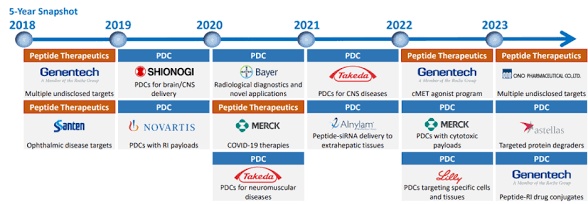
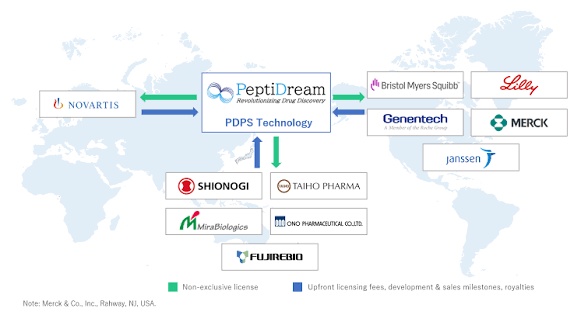
- Strategy: He consistently focuses on collaborations with "big pharma" (Novartis $NOVN (-0,24 %) , Eli Lilly $LLY (+0,97 %) Merck $MRK (+3,88 %) Genentech $GENETEC ) in order to shift the risk of failures in clinical trials onto the partners, while PeptiDream $4587 profits from milestone payments and license fees.
--------------------------
🔬🏭The business model: "The Discovery Powerhouse" 🎯
PeptiDream $4587 pursues a strategy of massive scaling through partnerships. Instead of investing billions in their own research and hoping for a "blockbuster", they let the giants of the industry work for them.
1-core technology PDPS: The Peptide Discovery Platform System is a kind of "Google high-speed search engine" for active ingredients. It can screen trillions (!) of different peptides in just a few weeks to find exactly the one molecule that binds to a disease target.
PDPS in detail:
Imagine you are looking for a matching key 🔑 for a very complicated lock (a protein that causes a disease). Classic pharmaceutical companies laboriously try out a few thousand keys 🔐.
- PDPS (Peptide Discovery Platform System): PeptiDream builds a "library" in a test tube trillions (10¹²) different macrocycles (ring-shaped peptides).
- The highlight: Each peptide is labeled with a DNA "barcode". When a peptide binds to the target protein, the barcode is read and the company knows immediately: "This is the active ingredient!"
- Success rate: PeptiDream $4587 states that for over 95 % of all biological objectives🎯 (targets) within just 4 weeks. This is record-breaking in the industry.
Technology licenses: Partners such as Lilly $LLY (+0,97 %) or Novartis $NOVN (-0,24 %) pay millions to be allowed to use the PDPS technology themselves.
🚀2 The growth pillar:
The "PDRadiopharma" transformation:
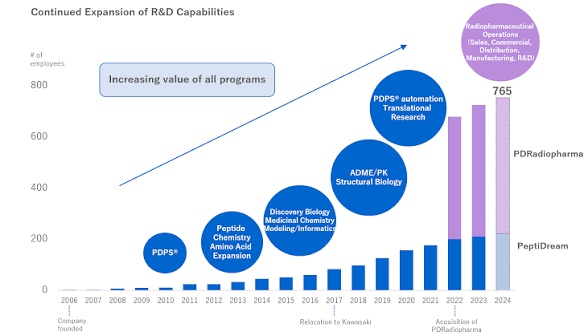
Through the acquisition of the radiopharmaceutical business of Fujifilm Toyama Chemical PeptiDream has $4587 vertically integrated. They now own the entire chain: from the discovery of the peptide to the production and marketing of nuclear medicine diagnostics and therapeutics in Japan.
This is currently the most exciting transformation. With the acquisition of PDRadiopharma (formerly Fujifilm $4901 (-1,55 %) ), PeptiDream is no longer just a software developer, but also a logistics giant. logistics giant in Japan.
- Why radiopharmaceuticals? These drugs decay quickly (radioactivity!). You need an extremely precise network to get them from the reactor to the patient. PeptiDream now has this infrastructure in Japan.
🔁3 The " $AMZN (+0,1 %)
Amazon model" of the pharmaceutical world
PeptiDream $4587 follows the principle of reinvestment:
They are using the stable cash flows from radiopharma sales in Japan to further automate their PDPS platform. The screening system is now largely robotized, which reduces the marginal costs per new project to almost zero.
--------------------------
🆕📰- Latest news (February/March 2026): PeptiDream $4587 has just completed the first patient dose in a Phase 2 trial for a new treatment for prostate cancer (177Lu-PSMA-I&T) in Japan. This is in collaboration with the Curium Group.
Strategic realignment 2026
The latest earnings calls (February 2026) show that
- Focus on in-house development: PeptiDream is moving to bring more programs to clinical phase 1 or 2 itself before licensing them. Although this will increase costs in the short term (R&D budget for 2026 increased to approx. JPY 6.4 billion), but massively increases the value of the deals.
- Pipeline turbo: The number of clinical programs (the phase where it gets really expensive and valuable) has almost doubled in the last year. The target for T2026 is 6 to 12 new clinical programs
--------------------------
🤝The "Big Three" alliances
These are the most lucrative and strategically important partnerships, often worth billions (in milestones).
- Novartis $NOVN (-0,24 %)
: Probably the closest partner. In May 2024 the collaboration was massively expanded. Novartis paid USD 180 million in advancewith the prospect of a total of up to USD 2.71 billion. Focus: Radioligand therapy (RLT). Novartis uses PeptiDreams peptides to precisely steer radioactive particles to tumors.
- Eli Lilly $LLY (+0,97 %) A partnership worth up to 1.2 billion USD. Lilly is using the PDPS platform primarily to find peptides that can deliver drugs across the blood-brain barrier or for the next generation of metabolic drugs (keyword: weight loss injection optimization).
- Bristol Myers Squibb $BMY (+0,05 %): BMS has "inherited" an existing alliance with PeptiDream through the acquisition of RayzeBio. This is also about targeted cancer therapy.
The global network (excerpt)
In addition to those mentioned above, there are over 120 research programs. The partners include:
- Merck (MSD) $MRK (+3,88 %)
: Focus on various therapeutic areas.
- Genentech (Roche): $ROG (+0,7 %) Collaboration on multi-specific antibodies and PDCs.
- Astellas $4503 (-1,61 %)
& Takeda $4502 (-2,17 %) Strong local partnerships in Japan.
- Amgen $AMGN (+0,19 %)
& Bayer $BAYN (-0,98 %)
: Licensees of the PDPS technology.
--------------------------
📊Sales development (growth leap through acquisition) in recent years:
- 2021: approx. JPY 9.4 billion
- 2022: approx. JPY 26.8 bn (massive leap due to the integration of the Fujifilm radiopharmaceuticals business)
- 2023: approx. JPY 31.1 bn
- Trend: Sales have more than tripled within three years. While milestone payments used to account for almost 100% of revenue, stable revenue is now generated from the sale of radiopharmaceutical diagnostics in Japan.
📈Profitability and margins
PeptiDream $4587 is an exception in the biotech sector, as they have been almost consistently profitable:
- Operating margin: This often used to be over 40-50% (before 2022) as there were hardly any production costs. Since the acquisition of the radiopharmaceutical business, the operating margin has fallen to around 20-25 % has fallen. This sounds like a step backwards, but it is a sign of a more mature business model with physical products.
- Net result: After a dip in 2022 (acquisition costs), net profit stabilized significantly in 2023 and 2024. For 2025/26 the economies of scale of the PDPS platform are expected to lead to rising margins again.
Expenditure on research and development
A critical point for biotech:
- PeptiDream $4587 continuously spends about 20-30 % of its turnover on R&D.
- The special feature: Since partners (such as Eli Lilly $LLY (+0,97 %) or Novartis $NOVN (-0,24 %) ) pay for phase 2 and 3 clinical trials for the joint programs, PeptiDream's burn rate remains extremely low compared to US biotechs. $4587 remains extremely low compared to US biotechs. They conduct research "at the expense of others".
💴The cash position and debt:
- Cash reserves: At the end of 2023/beginning of 2024, the company held approx. JPY 28-30 billion in cash and cash equivalents.
- Debt: Debt was raised through the acquisition of PDRadiopharma, but the ratio of net debt to EBITDA is very healthy (often below 1.0), which means a very conservative balance sheet for a growth company.
The "pipeline" key figures
The most important non-financial key figure for PeptiDream $4587 is the number of programs:
- 2020: approx. 100 programs
- 2024: over 120 programs️
- Meaning: Each program is a "ticket" in a lottery in which PeptiDream $4587 does not pay for the stake, but participates in the winnings. According to management, the hit rate of PDPS technology in identifying binding agents is almost 100%.
The current key figures 2025/26 📊
- Market capitalization: approx. USD 2.5 - 3 billion (depending on exchange rate).
- Exchange rate: approx. 2,200 - 2,500 JPY (TSE: 4587).
- Sales forecast 2026: approx. 32 billion JPY.
- Profitability: PeptiDream $4587 is one of the few biotech companies that has been consistently profitable for years.
- Growth turbo: For 2026, profit growth of over 30 % driven by new clinical programs (target: 6-12 new programs in 2026).
- Return on equity (ROE): Forecast at approx. 17 %which is exceptionally efficient for the biotech sector.
Key figures for the last few years:
The market often punished the share between 2021 and 2023 because the integration of the radiopharmaceuticals division diluted the clean "software margins".
Since 2024, however, the market has recognized the strategic value 👀:
PeptiDream $4587 is now no longer just a supplier of ideas, but controls the platform and the delivery (PDCs).
--------------------------
Why is the share exciting? (Bull case) 🚀
1. Validation by giants: When companies like Eli Lilly $LLY (+0,97 %) (market leader in weight loss products) sign contracts worth USD 1.2 billion with PeptiDream $4587 shows the quality of the technology.
2. Scalability: PeptiDream $4587 can earn money on hundreds of drugs simultaneously without bearing the full development costs.
3. Radiopharma boom: The market for targeted radiation therapy (radioligand therapy) is exploding right now. PeptiDream $4587 is perfectly positioned here thanks to PDRadiopharma and the $NOVN (-0,24 %) Novartis deals perfectly positioned.
4. Enormous upside potential: Many analysts see a price target of over JPY 3,000which corresponds to a potential of +30 % to +50 %.
Risks (bear case) ⚠️
- Dependence on partners: If a major partner stops a program, planned milestone payments are lost.
- Currency risk: As many contracts are in USD but invoiced in JPY, exchange rate fluctuations affect the balance sheet.
- Clinical setbacks: Despite the best technology, drugs can fail in phase 2 or 3 due to side effects.
--------------------------
✍️Meine personal conclusion & rating:
At first glance $4587 an absolute disaster in terms of share price and key figures, but Peptidream $4587 is the "paddlewheel stock" in the gold rush of modern drug discovery. If you don't want to bet on a single drug, but on the technology that makes them all possible, you will find a highly profitable niche king here. The potential is definitely there.
- Status: Growth stock with solid cash position (approx. JPY 28 bn reserves).
- They do not develop drugs, but the "peptide keys" that bring active ingredients precisely into the cell. In 2026, their radiopharma division will be the big driver.
- Status: Platform model with many global partners (license fees)
-The big $LLY (+0,97 %) & $NOVN (-0,24 %) - effect
unfortunately the share is not (yet) tradable in Germany only on the Tokyo Stock Exchange 🥲
Your stock master ✌️
Looking forward to your assessment of how you rate the company?
@Tenbagger2024
@Get_Rich_or_Die_Tryin
@PikaPika0105
@Multibagger
@Klein-Anleger
@Raketentoni
@Liebesspieler
@HoldTheMike
@Shiya and of course others from the community 🙇♂️
Novo Nordisk 3.0% $NOVO B (-1,18 %) NVO
LVMH 2.0% $LVMH
Pernod Ricard 6.35% $RI (+0,71 %)
Imperial Brands 5.5% $IMB (-1,35 %)
BAT 6.2% $BATS (-0,56 %)
Sunrise Communications 8.00%
Nestle 4.05% $NESN (+0,24 %)
Roche 2.85% $ROG (+0,7 %)
Novartis 3.07% $NOVN (-0,24 %)
Shell 4.07% $SHEL (+0,51 %)
German Post 3.86% $DHL (+3,16 %)
Swisscom 3.75% $SCMN (-0,2 %)
German Telekom 3.52% $DTE (+0,84 %)
Strabag 2.72% $STR (+1,19 %)
Vonovia 4.82% $VNA (-5,69 %)
BASF 5.01% $BAS (-0,8 %)
Puma 2.8% $PUMA
Hannover Re 3.62% $HNR1 (-0,65 %)
Munich Re 3.8% $MUV2 (-1,72 %)
Allianz 4.00% $ALV (-0,3 %)
BP 5.76% $BP. (+0,02 %)
Spotify
https://open.spotify.com/episode/1zt05UZlehInr81iaZMdY5?si=e676f0a812014943
YouTube
Appple Podcast
Following the rebalancing of the S&P Quality Aristocrats last Friday, the following stocks were removed from or added to my two ETF indices (50% weighting):
New additions:
$QDEV (+0,17 %): $NOVN (-0,24 %) , $REL (-0,35 %) , $ITX (+0,1 %) , $LSEG (-0,59 %) , $DB1 (-0,15 %) and more
$QUS5 (+0,36 %): $BKNG (+0,56 %) , $MRK (+3,88 %) , $CRM (-0,51 %) , $UNP (+0,68 %) , $COR (+0,42 %) , $CAH (+0,29 %) and more
Kicked out of both indices and therefore according to S&P no longer Quality Aristocrats are among others: $BATS (-0,56 %) , $7974 (-2,61 %) , $HD (+0,11 %) , $LOW (+1,03 %) , $HLT (+0,36 %)
In addition, the allocation of all individual stocks in the indices was reduced again to max. 5 % was limited.
Thanks to the recent rally of $$HY9H (-0,23 %) my current top 10 weighting (ETFs+shares) is as follows:
3.48% Alphabet
3.04% SK Hynix
3.04% Broadcom
2.93% Meta
2.75% Microsoft
2.71% Apple
2.71% NVIDIA
2.55% Taiwan Semiconductor
2.13% Mastercard
2.08% Visa
New portfolio key figures:
P/E: 27.1 (<30) 🟢
Forward P/E: 21.1 (<25) 🟢
P/Β: 11.5 (<5) 🔴
EV/FCF: 28.7 (<25) 🟡
ROE: 42% (>15%) 🟢
ROIC: 19% (>15%) 🟡
EPS growth for the next 5 years: 15% (>7%) 🟢
Sales growth for the next 5 years: 9% (>5%) 🟡
My internal rate of return is currently 20.19%

Even in uncertain times like these, there are reliable stocks: with strong growth and stable dividends. Here are the best stocks from the Stoxx Global 1800.
Excluded were:
1. liabilities/total capital > 70%
2. negative EPS development in the last 5 years and those where analysts see a negative development in the next few years
3. KCV > 20
4. p/e/earnings growth > 5
5. companies that have canceled or cut dividends in the last 25 years
I'll name a few of the remaining companies here and maybe there are some that you don't know yet. Of course, these include companies such as Caterpillar, Chevron, Henkel, Munich Re, Merck and Union Pacific. They are well known. The following stocks are stable, established companies, so please don't expect any tenbagger opportunities in the next 10 months ;)
Armaments:
BAE Systems $BA. (+0,33 %)
If Europe wants to build a missile defense shield, there is no way around BAE Systems: the British armaments group was formed 26 years ago from the merger of British Aerospace and telecommunications supplier Marconi. BAE is building the Eurofighter Typhoon fighter aircraft with Airbus, and the company is also developing a new nuclear submarine for the Royal Navy. Since Russia's attack on Ukraine, the British company's order backlog has been growing and CEO Woodburn has raised the profit outlook for this year.
General Dynamics $GD (+0,34 %)
The German Armed Forces are receiving new ambulances: 80 so-called Eagle V 6x6s from the US armaments company General Dynamics. However, the Virginia-based company is best known for its Fighting Falcon F-16 fighter aircraft, which was launched in 1978 and is one of the most widely used military jets in the world. However, the fact that General Dynamics has recently surprised with positive sales and profit figures is due to its submarine division: the US Department of Defense significantly increased an existing order.
Construction
Ackermans & van Haaren $ACKB (-0,07 %)
The deepening of the Elbe near Hamburg is controversial, but the marine technology company Deme, the highest-revenue subsidiary of the Belgian conglomerate Ackermans & van Haaren, continues to dig. Deme is also involved in the construction of offshore wind farms and gas pipelines. Ackermans & van Haaren is also active in banking and the energy sector. The company's coffers are well filled and the profit prospects are intact.
Assa Abloy $ASSA B (+0,32 %)
If you have never heard of Assa Abloy, you should look out for the manufacturer of security doors. It often bears the name of the Swedish company, which claims to be the world market leader for security and access systems. Assa Abloy regularly strengthens its position with acquisitions - twelve in the past few years. The Group can afford this, as can the rising dividend.
Idex $IEX (-0,62 %)
Without water pumps from Godiva, many firefighters would quickly be left high and dry. The pumps from the US company Idex are installed in fire engines worldwide, but also in aircraft, for example. With the purchase of Micro-Lam, Idex is strengthening its optical systems division in order to win the defense industry as a customer. The share has recently been under pressure.
Pharmaceuticals
Novartis $NOVN (-0,24 %)
At the beginning of September, things went from strength to strength at the Swiss pharmaceutical group: first the healthcare giant from Basel secured the worldwide license for a new Parkinson's drug, then access to several new cardiovascular drugs from China. Both therapies have the potential to generate billions in sales in the near future. Novartis can also be satisfied with its own developments: according to initial studies, the Swiss company is on the trail of an active ingredient that should help against Sjögren's syndrome, a common rheumatic disease. But Novartis is also under the threat of US tariffs. Novartis generates around 40 percent of its total sales, approximately 17 billion euros, in the USA. To avoid the additional burden, the company is investing in seven new production facilities there.
Industry
Kurita Water $6370 (+2,05 %)
The fact that astronauts on the ISS space station have clean water is mainly thanks to the Japanese company Kurita Water. The company specializes in water treatment, develops systems and chemicals for this purpose and uses them to build self-sufficient water systems - a business with good prospects. Kurita Water also scores with stable finances and a rising dividend.
SGH $SGH (+0,79 %)
Under the umbrella of the Australian conglomerate SGH (formerly Seven Group Holdings), there is a strange mix: on the one hand, SGH sells construction machinery, building materials and energy. On the other hand, the Chairman of the Supervisory Board, Kerry Stokes, is something of a second Rupert Murdoch thanks to his shares in the media group Seven West Media. SGH has doubled both its profit and turnover since 2020.
Spirax $SPX (-0,61 %)
The highly upgraded steam systems from Spirax (formerly Spirax-Sarco) are used in almost all industries and sectors. However, the most promising segment is "electrical heating solutions". Here, Spirax is developing CO2-free systems for gas-powered steam power plants, for example. Spurred on by the business prospects, the share price jumped - but the price is still below the value targeted by analysts.
Source: Capital Magazine
📈 New purchase - CapsoVision
I am with CapsoVision
$CV an innovative MedTech company that is setting new standards with its 360° capsule endoscopy. No external recorder required, full perspective - and already FDA-approved & in use in the USA.
💡 Why this investment?
🚀 Vision:
If CapsoVision reaches USD 50-100m sales in the medium term, a multiple in the share price is possible. In the long term I see 10-25 USD+ per share as realistic - depending on market penetration and access to capital, of course.
I think: exciting small cap story with disruptive potential - What do you think?
👉 Do you know the company? How do you rate the opportunities & risks?
Please leave your opinion!
#aktien
#investieren
#MedTech
#CapsoVision
#SmallCap
#langfristig
#innovation
#getquin
#medizin
#medizintechnik
#pharma
#medical
#zukunft
$NOVO B (-1,18 %)
$PLTR (+0,25 %)
$AMD (+2,16 %)
$NOVN (-0,24 %)
Since the beginning of the year, analysts have lowered their profit estimates for the 50 largest listed companies in Europe by almost four percent. This is according to data from the financial specialist Bloomberg.
One of the main reasons for this is the tariffs imposed by US President Donald Trump Trump and the associated uncertainty. Tariffs make products more expensive, making them less affordable for end customers. In addition, the recent euro exchange rate against the dollar is affecting companies. This makes products sold in the dollar zone more expensive and less competitive. In addition, turnover and profits are reduced as soon as companies convert their dollar earnings into euros and report them on their balance sheets.
But there are exceptions. For five companies in the European Stoxx 50 share index, analysts have increased their profit forecasts for the current financial year by at least five percent since the beginning of the year. by at least five percent - for one group by as much as 15 percent.
Handelsblatt profiles the shares of these companies with a view to their business prospects, their stock market valuation and their share price potential.
The candidates are:
$PRX (-1,99 %) - Prosus | 20 analysts per buy / 4 hold
$CFR (-2,59 %) - Richemont | 17 buy / 16 hold / 1 sell
$NOVN (-0,24 %) - Novartis | 9 buy / 15 hold / 5 sell
$SAP (-0,63 %) - SAP | 25 buy / 6 hold / 3 sell
$IBE (-0,15 %) - Iberdrola | 12 buy / 19 hold / 2 sell
The detailed analysis is available here (€):
https://hbapp.handelsblatt.com/cmsid/100124777.html
Source: Handelsblatt, 09.05.25
Lufthansa: $LHA (-1,87 %)
- Q1 revenue: €8.13bn (expected: €8.04bn)
- Q1 adj. EBIT: € -722 million (expected: € -718 million)
- Passenger airlines weaker than expected.
- Forecast 2025 confirmed: Significantly higher adj. EBIT than 2024.
- Task force for rapid capacity adjustment in the event of weaker demand.
- North American traffic strong in Q1 (+25% US passengers in March).
HelloFresh: $HFG (+1,51 %)
- Q1 revenue: € 1.93 billion (-7%), adjusted EBITDA: € 58.1 million (+250%).
- Efficiency program bears fruit.
- 2025 forecast confirmed: Sales -3% to -8%, EBITDA € 450-500 million.
Novartis: $NOVN (-0,24 %)
- Q1 net profit: USD 3.6 bn (+33%).
- Forecast raised: Sales growth now expected in the high single-digit percentage range.
Mutares: $MUX (-0,46 %)
- Q1 revenue: €1.53bn (+13%), net result holding company: €29.5m.
- Exits planned for 2025 (>€200m gross proceeds expected).
- Partial sale of Steyr Motors generates € 74m.
Symrise: $SY1 (+1,98 %)
- Q1 organic growth: 4.2%, sales: € 1.32 bn.
- Full-year forecast confirmed: 5-7% organic growth, EBITDA margin ~21%.
DWS Group: $DWS (-0,82 %)
- Q1 revenues: €753m (+3%), net income: €199m (+13%).
- Record inflows: € 19.9 billion.
- Cooperation with Deutsche Bank in the Private Credit segment.
Deutsche Bank: $DBK (-1,38 %)
- Q1 pre-tax profit +39%, highest quarterly profit in 14 years.
- Revenue growth and cost reductions drive earnings above expectations.
Meilleurs créateurs cette semaine