
When the AI boom subsides. In my opinion, the biggest beneficiaries will be the hyperscalers such as $GOOGL (+2,41 %) , $AMZN (+0,89 %) , $MSFT (+2,02 %) . Because when the boom subsides and delays occur, the hyperscalers will return to positive cash flows thanks to lower Capex expenditures. And after the initial shock, their stocks will benefit again. At risk are stocks such as $CRWV (+2,57 %) , $NBIS (+0,47 %) , $IREN (+0,02 %) and, of course, chip suppliers, memory manufacturers, etc.

CoreWeave, Inc. Class A
Action
Action
Ticker: CRWV
CRWV
Price
Discussion sur CRWV
Postes
87


5J·
Today in the Wall Street Journal... Who is Colette Kress?
Here’s a recent report on Colette Kress, Nvidia’s new interim CEO. It’s clear that she has views that are completely different from Jensen Huang’s—especially when it comes to the controversial vendor financing. That’s exactly why I believe we’re in for a big surprise when the earnings are released next Tuesday.
Events surrounding Nvidia are unfolding rapidly these days. Following the abrupt departure of founder and CEO Jensen Huang, the chip giant is facing a historic turning point. While the stock market is eagerly awaiting Tuesday’s quarterly earnings, a recent report in the Wall Street Journal has brought to light just how fiercely things have recently come to a head behind the scenes due to the enormous financial risks.
The Internal Clash: Vision vs. Ironclad Financial Discipline
In recent years, Nvidia has operated not only as a chip manufacturer but, thanks to so-called vendor financing , it has also functioned as a sort of private central bank for the AI industry. To keep demand high and enable emerging cloud providers to purchase the extremely expensive hardware, guarantees and credit facilities totaling astronomical sums were granted.
But it was precisely at this point that internal resistance emerged. According to the Wall Street Journal , Colette Kress openly questioned the wisdom and the enormous default risks of these billion-dollar deals during a board meeting last August. She demanded strict criteria for return on investment (ROI).
Jensen Huang’s reaction was brutal: He reportedly called the experienced CFO a “deer in the headlights” (“deer in the headlights”) and accused her of being too nervous about the risks.
Actions Speak Louder Than Words: Kress Cuts Back on Billion-Dollar Deals
However, Kress proved she wouldn’t be intimidated not only through her words but, above all, through her decisions:
- During negotiations for a massive OpenAI data center project in Ohio, she prevailed against the original plans and without hesitation cut Nvidia’s financial guarantee in half, from 250 billion to 105 billion U.S. dollars.
- Some of the riskier, revenue-based financing structures were put on hold for the time being with her involvement.
Given supply and purchase commitments totaling over $530 billion across the entire group, this marks a fundamental shift: away from the unconditional expansion and hype-driven policies under Huang, toward rock-solid risk management.
What this means for next Tuesday
On Tuesday, Colette Kress will face her first major test as interim CEO. Given stalled data center approvals in the U.S., full chip inventories, and looming export restrictions on the crucial Asian business, the stage is set for a reality check.
Anyone expecting Kress to throw borrowed money around in her usual style on Tuesday and artificially fuel optimism is likely to be disappointed. As a rational CFO who has sharply criticized the risks of “vendor financing” internally, she has all the tools at her disposal to ground the forecasts on a conservative foundation.
The question is no longer whether Nvidia’s fundamentals are changing—they have already changed. The question is how candidly Kress will disclose this shift on Tuesday. Personally, I don’t think she’ll say, “Business as usual.” However, the biggest losers next week will likely be the “neoclouds,” which have relied—and continue to rely—on Nvidia’s deep pockets.
$NVDA (+1,88 %)
$CRWV (+2,57 %)
$NBIS (+0,47 %)
$IREN (+0,02 %)
2929
34 Commentaires
Luckily, Iren is only a 0.8% position in my portfolio! I'm already down 60%, so I'm not selling now either! Maybe the stock will rebound, and if not, I'll just let it run until I lose everything 🤪
•
77
•

1Sem.·
Coreweave looks more stable after yesterday's earnings report—what does that mean for Merlin?
$MRL (-0,35 %) has significant exposure to $CRWV (+2,57 %) . If the latter are no longer treated as defaulted/junk bonds, Merlin could also start to recover. @Codeandcapital You’re still invested there—how do you view the REIT from this perspective? And how does our Spanish @investron Merlin look once the transition to a DC REIT is essentially on a more solid footing (see also my last post on this)?
44
6 Commentaires
I haven't been in it since October 1; Merlin has slipped too far down in the rankings. I wouldn’t overestimate the Coreweave situation, though. It accounts for only about 8.6% of total rents, but a good 80% of the data center business. If Coreweave remains stable, that tends to alleviate concerns about the data center segment. The majority of the portfolio is still made up of office, logistics, and retail properties.
•
11
•

1Sem.·
CoreWeave rises 13.2% to $55.11 in premarket trading following its earnings report:
$CRWV (+2,57 %)
A strong quarter, but the real driver behind the stock price is the significantly more credible financing of the massive AI expansion
⠀
The key takeaway: CoreWeave didn’t just beat expectations and raise its guidance. What was decisive was the answer to the question that had triggered the previous crash: Can a company with nearly $47 billion in debt continue to invest aggressively without its balance sheet becoming a problem?
⠀
Average price target: $112
Median price target: $100
Upside potential at $55.11: ~104% on average / ~81% relative to the median
⠀
Current analyst estimates:
• Citizens: Market Outperform, $180 unchanged (+227%)
• Rosenblatt: Buy, $160 (unchanged) (+190%)
• Citi: $149 (up from $128) (+170%)
• Truist: Buy, $115 (+109%)
• Cantor Fitzgerald: Overweight, $100 from $176 (+81%)
• Baird: Outperform, $100 from $130 (+81%)
• Evercore ISI: Outperform, $100 from $150 (+81%)
• Jefferies: Buy, $90 from $150 (+63%)
• Mizuho: Neutral, $68 from $88 (+23%)
• Stifel: Hold, $60 from $120 (+9%)
⠀
What has really improved:
• Revenue of $3.66 billion, up 168% year-over-year and above expectations
• Adjusted operating income of $379 million vs. previous guidance of $200–$260 million
• Operating margin rose from 1% in Q1 to 5% in Q2 and 10% in Q3
• Backlog reached approximately $133 billion, +138% YoY
• FY26 revenue guidance raised to $13.0–$13.3 billion
⠀
Demand is not the problem: According to CoreWeave, qualified demand will be approximately 10 times greater than available capacity through the end of 2027. Demand is already significantly exceeding supply for 2028 as well.
⠀
Pricing is also becoming more aggressive: A price increase of about 25% in July was followed by another 10% in Q3. New contracts for Ampere and Hopper infrastructure were awarded at 30–50% higher rates. Short-term capacity generates more than $40 million per MW annually, compared to $20–$25 million for four- to five-year contracts.
⠀
The main reason for the rally: Management provided specific details on how the expansion will be financed without taking on new, expensive unsecured debt.
⠀
• Approximately $9 billion in customer prepayments and deposits over the next three months
• More than $3 billion of that without additional CapEx
• No new unsecured parent-level debt through the end of 2027 at current yields
• Less than $5 billion in additional parent-level capital expected through the end of 2027
• Asset-based financing is expected to cover the majority of the remaining CapEx
⠀
An underestimated lever: More than 130,000 GPUs will expire from existing contracts in 2027, with another approximately 170,000 following in 2028. At current prices, renewals could generate nearly $4 billion in additional annualized revenue in 2027 and nearly $10 billion including 2028, without any new GPU CapEx.
⠀
Why many price targets are falling anyway: The entire Neocloud sector has been significantly devalued. Several analysts lowered their price targets despite stronger demand, better pricing, and higher operating leverage.
⠀
The risk remains: Q3 CapEx came in at $14.5 billion, with $37–$39 billion expected for FY26. Interest expenses reached $846 million in Q3 and are expected to rise to $1.05–$1.15 billion in Q4. Positive adjusted net income is not expected until the first half of 2028.
⠀
Conclusion: CoreWeave remains a high-risk investment. But for the first time, the financing model appears significantly more resilient. Demand, pricing, and margins are improving fast enough to challenge the central bear case: that debt will eventually derail the growth story.


1Sem.·
CoreWeave: Demand Ten Times Higher Than Capacity & 100% Prepayments
$CRWV (+2,57 %) Key Takeaways from the Earnings Call:
– Mike Intrator (CEO): By the end of 2027, there will be 10 times more qualified demand than available capacity. 2027 is largely sold out. Capacity for 2028 has not even officially hit the market yet, but demand for it is already several times the supply.
– Prepayments: In 70% of this year’s deals, customers paid in advance, in some cases up to 100% of the contract value. Over the next three months, CoreWeave expects approximately $9 billion in prepayments and down payments.
– Price increases: In July, prices across all GPU types rose by about 25%, followed by a further 10% later in the quarter. They will continue to rise in the fourth quarter.
– Rental rates per megawatt:
Short-term contracts: over $40 million per MW per year
New four- to five-year contracts: $20–25 million per MW per year
– Older GPUs are becoming more expensive: Nvidia’s Ampere and Hopper chips $NVDA (+1,88 %) were rented out at rates 30–50% higher this quarter than in the previous quarter, now exceeding the original contract price.
– Expiring contracts: Over 130,000 GPUs will become available in 2027, with another 170,000 or so in 2028. At current prices, this could generate nearly $10 billion in additional annual revenue without new investments.
– Financing: Interest expense totaled $846 million, and the net loss was $709 million. By 2027, CoreWeave aims to raise less than $5 billion in new capital at the corporate level and, at current yields, does not plan to issue unsecured bonds.
$NBIS (+0,47 %)$IREN (+0,02 %)$ORCL (+0,9 %)$MSFT (+2,02 %)$GOOGL (+2,41 %)$AMD (-6,74 %)
1313
3 CommentairesKey Figures for Neoclouds👍🏽
•
33
•1Sem.·
𝐂𝐨𝐫𝐞𝐖𝐞𝐚𝐯𝐞: 𝐐𝟑 𝐑𝐞𝐯𝐞𝐧𝐮𝐞 𝐁𝐞𝐚𝐭𝐬 𝐄𝐬𝐭𝐢𝐦𝐚𝐭𝐞𝐬, $𝟏𝟑𝟐.𝟓𝐁 𝐁𝐚𝐜𝐤𝐥𝐨𝐠, 𝐑𝐚𝐢𝐬𝐞𝐬 𝐅𝐘𝟐𝟎𝟐𝟔 𝐆𝐮𝐢𝐝𝐚𝐧𝐜
⠀
📊 𝐑𝐞𝐬𝐮𝐥𝐭𝐬
• Revenue: $3.661B (Est. $3.54B) ✅, +168% YoY.
• GAAP EPS: -$1.27 (Normalized Est. -$1.21, not directly comparable).
• GAAP Net Loss: $709M (vs. $110M loss YoY).
• Adjusted Net Loss: $529M (vs. $41M loss YoY).
• GAAP Operating Income: $207M, +298% YoY.
• Adjusted Operating Income: $379M, +75% YoY.
• Adjusted Operating Margin: 10% (vs. 16% YoY).
• Adjusted EBITDA: $2.256B, +169% YoY.
• Adjusted EBITDA Margin: 62%.
• Net Interest Expense: $846M (vs. $310M YoY).
• Revenue Backlog: $132.5B.
⠀
🎯 𝐆𝐮𝐢𝐝𝐚𝐧𝐜𝐞
• FY2026 Revenue: $13.0B–$13.3B, midpoint $13.15B (Est. $12.88B) ✅, raised.
• FY2026 Adjusted Operating Income: $1.275B–$1.375B, midpoint raised 26%.
• FY2026 CapEx: $37B–$39B, low end raised from $35B.
• FY2026 Exit Revenue Run Rate: $20B–$21B, raised.
• Q4 Net Interest Expense: $1.05B–$1.15B.
• Year-End Active Power: >1.85 GW, reaffirmed.
⠀
📌 𝐊𝐞𝐲 𝐓𝐚𝐤𝐞𝐚𝐰𝐚𝐲𝐬
• Q3 revenue beat consensus by ~3.4%, increasing more than $1B sequentially.
• Revenue backlog reached $132.5B, providing substantial long-term contracted revenue visibility.
• Active power increased by more than 200 MW to over 1.7 GW, while contracted power exceeded 4.6 GW.
• International contracted power surpassed 1.3 GW across markets including India, Indonesia and Spain.
• Adjusted operating margin reached 10% ahead of schedule but declined 600 bps YoY.
• Net loss widened to $709M as quarterly net interest expense surged to $846M.
• FY2026 CapEx guidance increased to $37B–$39B, reflecting accelerated infrastructure deployment.
• Management expects approximately $9B in customer prepayments and deposits over the next three months.
• Raised ~$4.2B through convertible notes and established an ATM equity program for up to 35M shares.
• Closed a $2.6B financing facility supporting shorter-duration customer contracts.
• Deployed NVIDIA Vera Rubin NVL72 systems, with Cognition workloads achieving 4.8x the token throughput of GB200 NVL72.
• Expanded AI cloud relationships with OpenAI, Cohere, Perplexity and other customers.
• Launched CoreWeave Forge for AI training, inference, evaluation and agent development.
⠀
💬 𝐌𝐚𝐧𝐚𝐠𝐞𝐦𝐞𝐧𝐭 𝐂𝐨𝐦𝐦𝐞𝐧𝐭𝐚𝐫𝐲
“This was a breakout quarter for CoreWeave, with revenue increasing by more than $1 billion sequentially and adjusted operating margins reaching double digits a quarter ahead of plan.”
1010
1Sem.·
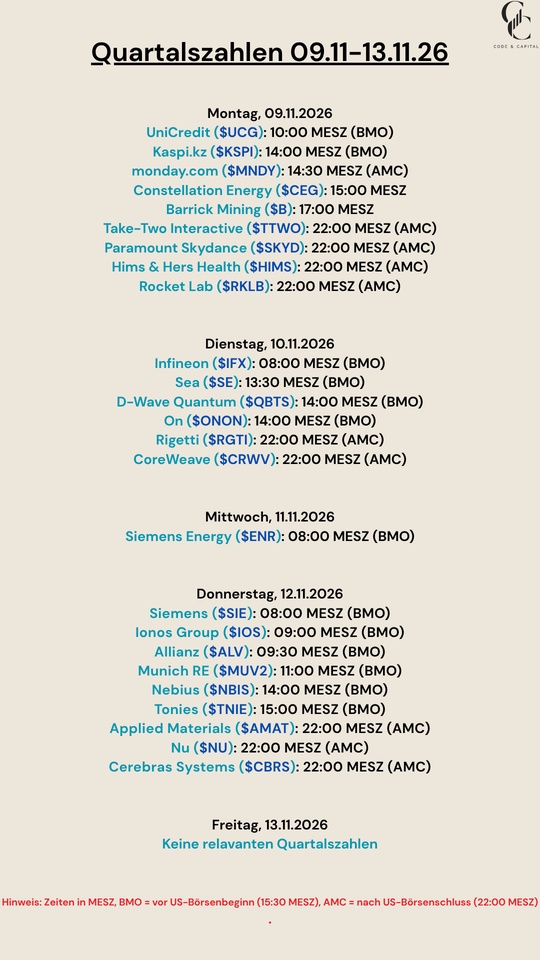
Quarterly Results Nov. 9–13, 26
$UCG (-0,12 %)
$KSPI (-1,23 %)
$MNDY (-0,74 %)
$CEG (-1,26 %)
$ABX (-1,67 %)
$TTWO (-2,06 %)
$PARA (-3,65 %)
$HIMS (-3,63 %)
$RKLB (-1,04 %)
$IFX (+0,22 %)
$SE (-0,64 %)
$QBTS (+1,38 %)
$ONON (-2,5 %)
$RGTI (+2,52 %)
$CRWV (+2,57 %)
$ENR (+0,47 %)
$SIE (+0,59 %)
$iOS$ALV (-0,22 %)
$MUV2 (-1,01 %)
$NBIS (+0,47 %)
$TNIE (-0,92 %)
$AMAT (+1,22 %)
$NU (-1,82 %)
$CBRS
1919
1Sem.·
The Perpetual Motion Machine of Data Centers: Why the Data Center Hype Is Once Again Pushing the Limits of the Laws of Money
Every technological megatrend needs that one magical moment when all healthy skepticism is collectively set aside. Today we’re witnessing this spectacle unfold with artificial intelligence: Expectations are astronomical, future revenues have long since been mentally booked away in our minds, and data centers are springing up like mushrooms after a gentle spring rain. Everyone is in complete agreement: This technology will liberate humanity and rake in trillions. But amid all the euphoria, it’s easy to forget one tiny, ruthless truism: Visions take a hell of a long time—but bills and loans have a rock-solid due date.
The Principle of Infinite Growth
To satisfy the insatiable hunger for computing power, the infrastructure pioneer reaches deep into the bag of tricks of modern financial wizardry. He floods the market with billions in convertible bonds and high-yield debt, while simultaneously signing 10- or 15-year lease agreements as if there were no tomorrow.
The reassuring narrative sounds like pure gold at every investor conference:
Whoever builds the data centers today will collect the tolls for the entire digital universe tomorrow.
And if someone does timidly point out the gigantic mountains of debt, the manager waves it off: “Don’t worry, tech heavyweights have secured capacity for years anyway. It’s all absolutely rock-solid!”
The Deadly Trap of Convertible Bonds
Convertible bonds are particularly appealing during such hype phases because, thanks to low interest rates, they seem wonderfully cheap. The clever promise to creditors: “You’ll get almost no interest, but in return, you’ll soon convert your bonds into soaring stocks when our share price goes through the roof.”
It’s just too bad that this is the classic balance-sheet time bomb. If the stock price misses the magic target at maturity, the conversion right vanishes into thin air. And in exactly that fraction of a second, reality strikes with the force of a sledgehammer: The company is contractually obligated to repay the entire amount to investors in real, hard cash.
If the coffers are completely empty at that point—because the revolutionary AI application hasn’t yet brought in billions—it means: batten down the hatches; the bankruptcy trustees take over.
On top of that comes the second, wonderfully creative lever: The financial circular economy. Hardware giants grant data center operators lucrative vendor credit or invest capital directly in them (vendor financing) so that the operators can use that very borrowed money to repurchase expensive servers and chips in record time. This artificially drives chip manufacturers’ revenues through the roof, but at its core, it’s based on pure speculation.
When harsh reality sets in
What actually happens when the hype fizzles out? It’s simple: The laws of money are damn humorless.
- No leniency: Creditors and bondholders want to see real money on the due date—very few bakers will accept promises of a bright future or PowerPoint slides as payment for their bread rolls.
- Pricing collapse: When overcapacity suddenly looms in the market because customers are staying away, rents and prices for computing power plummet.
- Merciless major clients: Even the richest tech giants show zero loyalty as soon as cheap vacant space becomes available. They mercilessly exploit the crisis to renegotiate existing contracts downward.
- Those lovely fixed costs: Meanwhile, interest payments, cash repayments due, and long-term data center leases merrily continue, regardless of whether the servers are humming or standing idle.
The Resolution: A Brief History Lesson
Exactly this brilliant mechanism—endless revenue fantasies, tangled hardware deals, billions in convertible bonds, and outrageously expensive, long-term leases—has, of course, existed before in economic history. We’re talking about the period from 1998 to 2001. And back then, too, it was a data center operator.
I’m not settling scores with today’s NeoClouds here. This is the almost tragicomic story of the company Exodus Communications in the late 1990s and how it built its highly hyped data centers back then, until reality caught up with it.
Exodus was the absolute megastar on the stock market back then. It operated the server infrastructure for the Internet pioneers of the time: Yahoo!, eBay, and Cisco. Tech giants like Intel and Microsoft , as strategic partners, provided the hardware and the funding. Exodus issued convertible bonds on a massive scale and was valued at over $32 billion. Everyone swore back then: The Internet is unstoppable; the debt will pay for itself.
What Nvidia, Broadcom, and AMD are today—key financiers and, at the same time, the largest hardware suppliers for modern cloud operators—was back then Intel, Cisco, and Microsoft, using exactly the same method: They injected capital into the market, extended loans, and, in return, equipped the infrastructure to boost their own sales through targeted vendor financing.
But then came the spring of 2000. Suddenly, it dawned on the market that monetizing the Internet would take much longer than had been simply imagined in the billion-dollar business plans and PowerPoint fantasies. The dot-com bubble burst with a massive bang, and stock prices plummeted.
This abruptly shut the door on the stock consolidation of the convertible bonds—and creditors demanded their hard cash back. Customers went bankrupt, major clients drove down prices, and the coffers were empty. In September 2001 —a mere three years after the triumphant IPO—Exodus was bankrupt and filed for bankruptcy. The shareholders’ money had simply vanished.
What We Can Learn From This
The parallels to today’s NeoClouds are striking. The technology may sound fancy today, but the fundamental mathematical laws of interest, fixed costs, and the harsh reality of failed convertible bonds haven’t changed one bit since 1998.
“History doesn’t repeat itself, but it does rhyme.” (M. Twain)
$IREN (+0,02 %)
$CRWV (+2,57 %)
$NBIS (+0,47 %)
$HUT (+2,06 %)
$CIFR (+1,29 %)


Titres populaires
Meilleurs créateurs cette semaine
Données en temps réel par LSX · Données fondamentales et de clôture de FactSet