
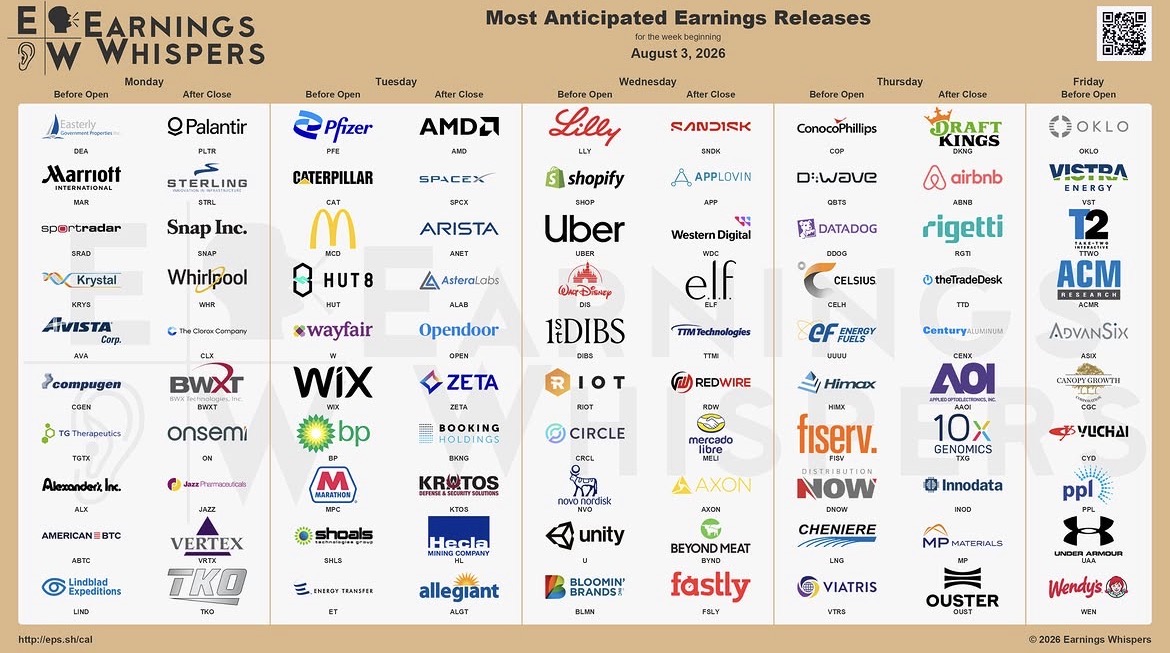
$MAR (-1,2 %)
$KRYS (-0,51 %)
$PLTR (-2,49 %)
$STRL (-10,19 %)
$SNAP (-2,16 %)
$WHR (+7,77 %)
$CLX (+4,7 %)
$BWXT (-5,49 %)
$ON (-6,56 %)
$VRTX (+4,26 %)
$PFIZER
$CAT (-4,9 %)
$MCD (+2,72 %)
$HUT (-11,09 %)
$WIX (+4,56 %)
$W (+0,45 %)
$BP. (+0,29 %)
$SHLS
$AMD (-8,32 %)
$SPCX (-8,41 %)
$ANET (-7,81 %)
$ALAB (-11,39 %)
$OPEN (+4,62 %)
$ZETA (-2,71 %)
$BKNG (+2,15 %)
$KTOS (-2,08 %)
$HL (-6,95 %)
$LLY (+2,96 %)
$SHOP (-5,19 %)
$UBER (+1,83 %)
$DIS (+1,16 %)
$RIOT (-9,13 %)
$CIRC
$NOVO B (+0,86 %)
$U (-2,69 %)
$SNDK (-10,61 %)
$APP (-1,73 %)
$WDC (-13,87 %)
$ELF (+0,74 %)
$MELI (-1,66 %)
$AXON (+3,78 %)
$TTMI (-29,19 %)
$RDW (-5,24 %)
$QBTS (-4,53 %)
$DDOG (-6,13 %)
$CLA (+0 %)
$FI (+5,07 %)
$LNG (+1,15 %)
$UUUU (-6,79 %)
$HIMX (-6,81 %)
$ABNB (+1,47 %)
$RGTI (-5,6 %)
$TTD (+3,75 %)
$AAOI (-13,31 %)
$TXG (-7,59 %)
$INOD (-2,56 %)
$OUST
$MP (-3,12 %)
$OKLO
$VST (-10,1 %)
$TTWO (+0,46 %)
$ACMR (-10,11 %)
$WEED (+1,67 %)
$UAA (+5,66 %)
Redwire
Price
Discussion sur RDW
Postes
13Let's move on to the next round!


Bottleneck Space Infrastructure: 4. lunar infrastructure 🌖
The first three levels of this series dealt with access to orbit, the operation of orbital infrastructure and the resulting data and communication systems. Lunar Infrastructure goes one step further.
There is still hardly any economic activity there. This is precisely why I find this area exciting. Many of the necessary building blocks are known, but the infrastructure is almost completely lacking.
Should a permanent economic presence develop beyond the Earth's orbit in the coming decades, new bottlenecks will arise practically from scratch. These include, among others:
- Energy supply - Electricity will become a basic requirement for any activity on the moon and space stations
- Nuclear systems - compact Compact reactors for permanent energy supply in extreme environments
- Communication networks - Data links between Earth, Moon and orbital infrastructure
- Navigation and positioning - GPS does not exist on the moon
- Resource extraction - Using water, oxygen and raw materials directly on site
- Robotics and autonomous systems - Maintenance and operation without permanent human presence
- Transportation and logistics systems - Supply of lunar and orbital sites
- In-Situ Manufacturing - Production directly outside the earth (advantage: no gravity)
- New space stations - Research, industrial and logistics platforms in orbit
- Computing power and data processing - Local processing of large amounts of data in space
I find it particularly interesting that many of these future bottlenecks are already recognizable today. Some of the actual business models do not even exist yet. The infrastructure problems, on the other hand, are already becoming apparent. Investment in this area has so far been limited.
$LUNR (-5,3 %) (Intuitive Machines) is working on central building blocks for a future lunar infrastructure. $FLY (-0,64 %) (Firefly Aerospace) is increasingly expanding its activities in the direction of lunar services. $RDW (-5,24 %) (Redwire) is developing technologies for space stations and industrial applications in orbit. $VOYG (-2,74 %) (Voyager Technologies) is working on commercial space station projects (Starlab) as a possible successor to today's government infrastructure. $OHB (+0,61 %) (OHB) builds satellite and space systems that could also become relevant for more distant missions in the long term.
Companies outside the traditional space sector could also play a role in the future. If nuclear energy supplies on the moon or space stations become a reality, suppliers of compact reactor systems, e.g. $OKLO (Oklo) will come more into focus. The same applies to robotics, communication and automation technologies.
Many of these ideas still seem a long way off today. However, this applies to almost any infrastructure before it is actually built. Perhaps the next major infrastructure zone will not be built on Earth, but a few hundred thousand kilometers away.

Join us at 2pm ET on Tuesday, May 26, for a live news event where we’ll share updates on our lunar exploration plans: go.nasa.gov/4uinkLi“.
Bottleneck Space Infrastructure: 2nd Orbital Services 🗑️
With increasing activity in orbit, the bottleneck is slowly shifting further. Access to space is becoming cheaper and more frequent. At the same time, however, a new problem is growing: Who will control, maintain and protect the emerging infrastructure up there?
This is where the next level of space infrastructure begins. The more satellites, stations and military systems there are in orbit, the more important visibility, control and operational monitoring become increasingly important. Orbit is gradually developing from a largely unregulated space into an increasingly dense infrastructure zone.
Orbital Services encompasses much more than just "space repairs". The new bottleneck arises in areas such as:
- Space domain awareness - Overview and control of orbital activities
- Debris Removal - Removal of hazardous space debris
- On-Orbit Servicing - Maintenance of technical systems in space
- Refueling - Refueling of orbital infrastructure
- Repair and maintenance systems - Longer service life of critical systems
- precise navigation and control - Stable positioning in orbit
- secure communication between orbital systems - resilient data and control levels
- frequency and spectrum management - limited communication resources in orbit
- re-entry services - Controlled return of satellites, samples and materials to earth
With increasing satellite density stability more important than mere presence in orbit. A single failure, collision or uncontrolled space debris could have a major impact on entire communication and infrastructure systems in the future. This is precisely why control and maintenance more strategically relevant in the long term.
Companies such as $186A (-4,94 %) (Astroscale, Japan) are addressing early debris and servicing issues. $MDA (MDA Space, Canada) is working on robotic servicing and control systems. $OHB (+0,61 %) (OHB, Germany) is increasingly positioning itself along European satellite and infrastructure programs. $RDW (-5,24 %) (Redwire, USA) addresses technical systems for the permanent operation of orbital infrastructure.
In addition, new requirements are arising from military use, resilient communication networks and the increasing commercialization of orbit.
However, many of these areas are still at an early stage. Numerous specialized companies are privately financed, small or not yet investable. Especially in debris removal, reentry and orbital maintenance, an independent industrial ecosystem is only slowly emerging. In my view, this makes the development strategically interesting, but at the same time difficult to invest in directly.
The bottleneck is therefore shifting again. No longer just: Can we get infrastructure into space? But rather: Can we control and operate it up there permanently?
More on this in the third post in the series on "Space Data".
Bottleneck Space Infrastructure: 1st launch 🚀
Space infrastructure is increasingly developing into a real infrastructure level. In fact, the first bottlenecks are already emerging today!
With the development of large satellite constellations, military systems and new communication networks the need for reliable access to orbit is increasing much faster than long expected.
This is not just about rockets. It is becoming increasingly important who can reliably organize launches, integrate payloads and bring satellites precisely into their target orbits.
This also became apparent recently when $ASTS (-5,8 %) (AST SpaceMobile) failed to reach the originally planned orbit after a false launch. Space infrastructure often fails not because of the idea itself, but because of the operational implementation.
Launch Infrastructure is thus gradually evolving from a vision to a genuine industrial infrastructure level.
The bottleneck lies on several levels at the same time:
- available launch capacity
- launch frequency
- precise orbital placement
- militarily resilient launch systems
- vertical integration
- industrial production capability
As satellite density increases, reliability becomes more important than individual spectacular missions. SpaceX has massively changed this market. Reusable rockets and high launch frequencies have significantly reduced the cost of entry into orbit.
At the same time, a second ecosystem is emerging around this new infrastructure. $RKLB (-5,71 %) (Rocket Lab) is working on a more industrialized launch and space systems platform. $FLY (-0,64 %) (Firefly Aerospace) addresses responsive launch systems (flexible, fast launch capability) as well as increasing government and military requirements.
$LUNR (-5,3 %) (Intuitive Machines) addresses early lunar and infrastructure missions. $RDW (-5,24 %) (Redwire) is increasingly positioning itself along the technical value chain in orbit.
Traditional aerospace and defense companies are also benefiting from the fact that access to orbit is becoming more strategically relevant.
With growing activity in space, the bottleneck is slowly shifting further. No longer just: Can we launch? But rather: Can we operate infrastructure in orbit permanently? More on this in the next post.


MY NEW HIGH-RISK SETUP: THE HUNT FOR THE NEXT TENBAGGERS
In the past, I had the right touch (and admittedly also the necessary bit of luck) and was able to celebrate two real tenbaggers in my portfolio with Palantir and Rigetti. I secured my profits and took out my risk by consistently selling some of the stocks.
But instead of resting on my laurels, I am now attacking again. I am currently investing 20% of my total capital in a new, highly aggressive high-risk/high-reward part. The aim? To find the market leaders of tomorrow before the masses discover them.
🛠 My "future-of-humanity" ecosystem:
I have specifically divided my risk segment into four technological power clusters that reinforce each other:
🛰 Space Infrastructure (The Backbone): With $RKLB (-5,71 %) , $LUNR (-5,3 %) , $RDW (-5,24 %) and $ALMU I occupy the entire value chain - from rocket launch to lunar economy to sensor technology. $ASTS (-5,8 %) is my joker for the global mobile communications revolution.
🧬 Bio-Tech 2.0: I combine the gene scissors from $CRSP (-1,2 %) with the AI-supported search for active ingredients from $RXRX . That's healing plus industrial efficiency.
💻 Quantum sovereignty: After $RGTI (-5,6 %) I am now focusing on the next generation. With $IONQ (-4,36 %) and $CHAC (-4,22 %) (photonics!) and $LAES (-4,79 %) for encryption, I am positioned for the computing revolution after the silicon age.
📊 Intelligence & Fintech: $PLTR (-2,49 %) the brain stays in the background while $NU (-1,72 %) and $SLYG (-0,99 %) show how scalable software is printing real profits.
This is complemented by tech giants such as $TER (-11,83 %) and $MIPS (+2,33 %) .
Why this setup?
This portfolio is not a blind gamble. It is a bet on the convergence of technologies. AI needs quantum power, quantum power needs space infrastructure for global networking, and biotech needs the data processing of tomorrow.
Each of these stocks has the potential to grow tenfold because they are not copies - they have unique selling points in markets that are only just emerging.
Important: This is the Champions League of volatility. 50 % drawdown? That's part of it. But if you're looking for the next tenbagger, you can't stay in your comfort zone.
What about you? What do you think of my potential rockets?


Redwire builds Belgium's first national security satellite
Big news from the defense and space sector! Redwire Corporation $RDW (-5,24 %) has been selected as prime contractor for the MATTEO mission - the first ever national security satellite for the Belgian defense.
MATTEO is an In-Orbit Demonstrator (IOD) designed to provide Belgium with secure and independent access to critical space-based services. The project is fully funded by the Belgian defense and aims to strengthen the country's technological sovereignty.
Redwire is developing the satellite together with Aerospacelab. MATTEO will help Belgium to better monitor and respond to global security challenges.
Defense and war are no longer won on the ground. I am curious to see which EU countries will follow suit.
I already have shares in Redwire in my portfolio 🤑🤞🏼


Overall, we still have a downward trend since the January25 high at 26$, but maybe something will happen again driven by news.
There are old traders and there are brave traders. But there are no old, brave traders! 📈📉📈📉📉
What is this quote trying to tell us?
As always, this topic is aimed at anyone interested in trading. The rest just keep scrolling. Although after the last week with some extreme drawdowns, it may also be of interest to some B&H investors 😅
Source of the picture: YouTube Mind Math Money
What are my reflections from my trading journal?
For the TL;DR my conclusion first:
The optimal position size is not the one that mathematically promises the highest profit. It is the one at which you psychologically stable, disciplined and clear remain!
Because in the end, it's not the bravest trader who wins. It's the one who stays in the game long enough.
In the course of my trading posts, someone asked me last year: https://getqu.in/cbIOkg/
"If you have an 80% win rate, why don't you just increase your position sizes? Then you would earn a lot more!"
A legitimate question, it sounds logical. Mathematically even absolutely correct. Pretty much at the same time as this question, I also started to raise my upper limit from 10k per trading position to 15k and later 20k last year. It worked, but I didn't feel comfortable. Something has changed. I couldn't put my finger on it at the time, but I felt it: These 20k positions are doing something to me.
In Q4 2025, I then consistently went back to around 10k per position. My absolute profit in euros was no higher in the end, despite larger position sizes.
Today I stumbled across a YouTube video that describes exactly what I intuitively felt at the time. I can recommend it to anyone interested in trading!
The core message is simple, but extremely important:
Position size doesn't determine your profit, it determines your psyche.
The following happens above a certain size:
- You you lose the ability to think clearly ("the ability starts to disappear").
- You no longer trade the market, you trade your account.
- Discipline fades into the background.
- Trading becomes less of a probability game and more of a psychological psychological stress management.
Mark Douglas, whose book is also quoted in this video, sums it up perfectly:
"The market is a probability environment. Your brain is not designed to operate calmly when too much is at stake."
Link YouTube https://youtu.be/yWOviauHmT8?si=_AQpcXk5URZ2ZmbT
The matching book recommendation: "Trading in the Zone" by Mark Douglas
$IREN (-9,27 %)
$RDW (-5,24 %)
$ZETA (-2,71 %)
$AMZN (-4,39 %)
$MSFT (-1,94 %)


As with swing trading or buy&hold, there is also the risk appetite that you should know and where you feel comfortable and it makes sense.
For the last 3-4 years I've had around 5K positions in individual stocks.
This year I opened a larger position. Over 20k in one position.
I don't feel nervous or worried (or so I thought)- but something has changed and there is a new feeling that I haven't experienced before.
Of course, this week was the best example of this - it went down a lot. But even weeks like that are part of it and then maybe it shows you that it can trigger some nervousness that you didn't know before.
I still feel comfortable with it, but you can tell that it does make a difference. 🙏🏼

The restructuring is having an effect!
Redwire selected for the Missile Defense Agency's $151 billion multi-vendor SHIELD IDIQ program in support of homeland defense
Key details at a glance:
- The Contract: Redwire has been selected to develop a novel design for a space-based sensor system. The goal is to improve defense against advanced ballistic missile and hypersonic weapon threats.
- Technology: The company will use its expertise in digital satellite designs and optical sensors to design a solution that optimizes the tracking and identification of threats from space.
- Background: The contract is part of MDA's efforts to build a more robust "sensor layer" in space. This is to ensure that modern missiles, which are becoming ever faster and more agile, can be monitored seamlessly.
- Significance for Redwire: This win underscores Redwire's growing role as a major player in the U.S. national security strategy for space technology.Analysts and investors speculate that Redwire's expertise in sensors and satellite technology will allow it to gain a significant share.
Even if Redwire only holds 1 % to 2 % of the volume over 10 years, this would correspond to a turnover of 1.5 to 3 billion USD. By comparison, that would be 5 to 10 times its current annual turnover.

News about Redwire!!! Redwire joins forces 🚀🛡️
Redwire today announced an important strategic restructuring. The main objective is to strengthen the "Edge Autonomy" brand (which was purchased in June 2025 for $925m) and to market all products directly under the strong main brand Redwire brand.
The most important points in brief:
Unified brand: The name "Edge Autonomy" is disappearing. All drones (UAS) and defense technologies will now officially operate under the name Redwire.
New company structure: The company splits into two clear divisions to offer investors more transparency:
- Space division: Focus on satellites, infrastructure in space and the biotech division SpaceMD. Headed by Mike Gold.
- Defense Tech" division: Focus on autonomous systems (drones), sensors and reconnaissance for the military. Managed by Steve Adlich.
Financial transparency: From the next quarterly report (Q4 2025expected on March 09, 2026), Redwire will report its financials separately for these two divisions.
1. what does "sunsetting" of a brand mean? In English, "sunsetting" means that a brand or a product is planned to be is scheduled to expire. It is not a sudden stop, but a strategic process. In this case, it means that the technology remains, but the "Edge Autonomy" label is scrapped. This saves marketing costs and strengthens the clout of the main Redwire brand against giants such as Lockheed Martin or Northrop Grumman.
2 What is "SpaceMD"? This is Redwire's own biotech subsidiary. They use weightlessness (microgravity) in space to grow drugs and crystals for the pharmaceutical industry that could not be produced in this way on Earth. The fact that this division is now firmly anchored in the "Space" segment shows that Redwire is hoping to generate commercial income outside of government contracts.
3 "Multi-domain missions" - what is that? In modern defense, this means that a company provides solutions for several areas of application at the same time at the same time: Space (satellites), air (drones) and ground (data processing). By integrating Edge Autonomy, Redwire can now build a bridge: the drone in the air communicates directly with the Redwire system in the satellite.
4. why is the restructuring important for you as a shareholder? Until now, Redwire was a "black box" of many small acquisitions for many analysts. The division into Space and Defense Tech makes the company more comparable with large defense companies. If the "Defense Tech" division grows strongly due to the "America First" momentum (reshoring of drone production), this will be clearly visible in the figures for the first time from March 2026.
I find this number of in-house components and associated competencies astonishing. Sure, we're talking about a mega cost-intensive sector. But you can currently get all this for <$2 billion market cap

Titres populaires
Meilleurs créateurs cette semaine