Celestica
Price
Discussion sur CLS
Postes
32


For the 2036 portfolio, Ciena is much more than just a data center stock. So, who among you is up for the challenge?
Hello, everyone,
Given Celestica’s strong results, I took another look at Ciena yesterday.
Here’s my idea: to add Ciena to my 2036 portfolio as well, to set myself a little challenge.
$CLS (-2,14 %) It’s $CIEN (-2,17 %)
Celestica vs. Ciena: whichever stock performs better over the next 6 months gets to stay in the portfolio.
What do you think of this challenge?
For the 2036 portfolio, Ciena is much more than just a data center stock.
- 🏢 AI data centers: High-speed connections between AI servers and data centers.
- 🤖 Second wave of AI: As the use of AI applications and inference grows, so does the demand for high-performance networks. Ciena provides the optical networking technology to support this.
- 🌐 Future-oriented industries: Fiber-optic networks, submarine cables, telecommunications, cloud infrastructure, and, in the future, networked physical AI systems and robotics.
- 🚀 Growth potential: Ciena is expanding its addressable market beyond traditional telecommunications networks into data center infrastructure.
My Assessment for the 2036 Portfolio
Ciena is an interesting candidate for the second wave of AI. The company benefits not only from the development of AI infrastructure but also from the fact that AI will be used more and more in everyday life and in businesses in the future.
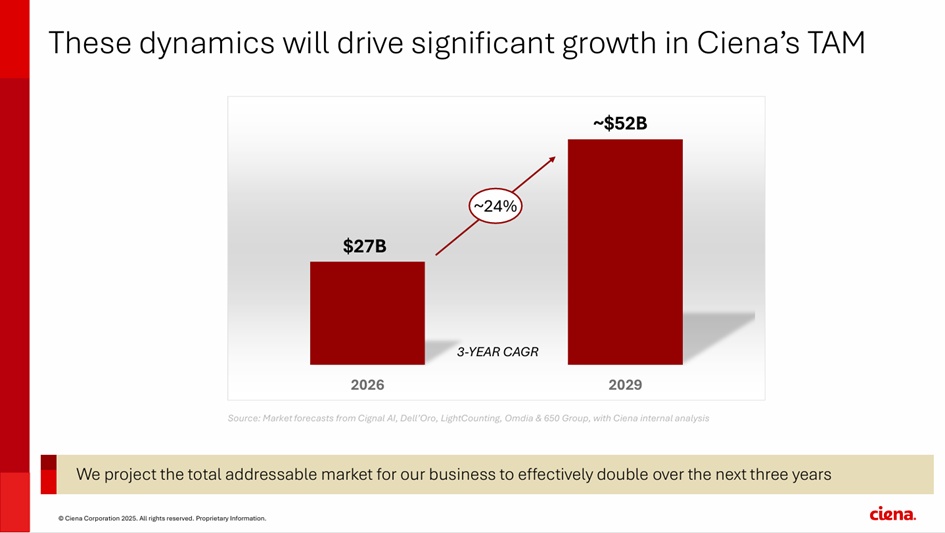
Ciena: 30% annual revenue growth through 2029! Ciena is delivering high-speed connectivity for the global AI era!
What exactly does the company do, and why is it doing so well?
Ciena Corporation is a network systems, software, and services company that provides hardware, software, and services to a range of network operators, enabling improved network capacity, service delivery, and automation. Its segments include Network Platforms, Platform Software and Services, Blue Planet Automation Software and Services, and Global Services. The Network Platforms segment consists of the Optical Networking and Routing and Switching portfolios. Platform Software and Services provide domain control management, analytics, data, and planning tools and applications to help customers manage their networks. Blue Planet Automation Software and Services encompasses asset management (BPI), multi-domain service orchestration, multi-cloud orchestration, route optimization and analysis (ROA), and Unified Assurance and Analytics (UAA). The Global Services segment offers a range of value-added services that help customers build, operate, and improve their networks.
Number of employees: 8,989
AI and Data Center Connectivity Demand
Ciena is benefiting from rising demand for network connectivity driven by AI and investments in data center infrastructure. During the most recent earnings call, management explained that AI is driving significant increases in bandwidth requirements and network traffic, making high-speed, low-latency optical connectivity between networks and data centers increasingly critical. This demand encompasses traditional WAN, AI-WAN, and data center connectivity, including data center interconnects and intra-data center connections.
As AI workloads require higher data rates, bandwidth, capacity, and density, Ciena is seeing rising demand for its optical and interconnect solutions. The WaveLogic 5 Nano platform continues to see strong adoption, while 800ZR shipments more than doubled sequentially in the third fiscal quarter. The company also reported strong interest in its Nitro active copper cable retainer and received sample orders for Vesta, its open, co-packaged optical solution. Revenue from direct cloud providers rose 80% year-over-year in the third fiscal quarter, while revenue from data centers and related businesses quadrupled year-to-date.
Strong Optical Technology Portfolio
Ciena benefits from its leadership position in optical technology, supported by targeted research and development, deep expertise, and proven large-scale deployments. The company highlighted the strong adoption of its WaveLogic 6 Extreme platform, which remains the only 1.6-terabit high-performance modem on the market and whose ramp-up exceeds that of the previous WaveLogic 5e generation. Ciena’s RLS portfolio also remains a key growth driver, with approximately 70% market share in disaggregated optical transport systems.
In addition, the company’s Hyper-Rail technology—developed in collaboration with hyperscalers to support AI training in data centers—is expected to be standardized by the end of 2026 and to generate material revenue growth by 2027. Ciena also achieved a significant hyperscaler win for its WaveLogic 6e coherent technology, with customer commitments extended through 2029 and orders and backlog supporting growth into fiscal year 2028.
For the fourth quarter of fiscal year 2026, Ciena expects revenue of $1.75 billion (+/- $50 million). The company raised its revenue forecast for fiscal year 2026 to $6.42 billion (+/- $50 million), indicating 35% year-over-year growth at mid-year. For fiscal year 2027, management’s previous guidance points to revenue growth of at least 30%, an adjusted gross margin of 45–46%, and an adjusted operating margin of 25–27%.
Improved Margins and Operating Leverage
Ciena is also benefiting from improved profitability. The adjusted gross margin in the third fiscal quarter reached 46.4%, supported by cost execution, a favorable product mix, and pricing discipline, while the adjusted operating margin rose to a record-breaking 22.5%. In the latest earnings call, management stated that the gross margin is now in the range of approximately 40% and expects the cost structure and portfolio to support further expansion.
For the fourth quarter of fiscal year 2027, the adjusted gross margin is forecast at 45% (+/- 50 basis points). The adjusted operating margin is forecast at 20% (+/- 50 basis points). Ciena expects an adjusted operating margin of 25% to 27% for fiscal year 2027, with growth in the optical systems and plug businesses continuing to support operating leverage. The company also expects Hyper-Rail’s profitability to benefit as the technology matures, while RLS’s gross margins have improved over the past two to three years and are approaching the company average.
Supply constraints remain a hurdle
CIEN is grappling with supply constraints as demand continues to exceed available capacity. In its most recent earnings call, the company highlighted that its backlog is expected to exceed $10 billion by the end of fiscal year 2026, with the majority of the backlog consisting of customer orders scheduled for 2027. Management noted that revenue for fiscal year 2027 could be higher if more supply were available and expects the imbalance between supply and demand to persist into 2028. Ciena is addressing this constraint by securing long-term agreements for key components through 2029, expanding additional capacity, and continuing to make investments to strengthen its supply base. The company also expects that its capital expenditures in the fourth fiscal quarter will put pressure on operating cash flow as the expenditures are incurred.
CIEN Valuation
CIEN is trading at a 12-month price-to-earnings (P/E) ratio of 43.93x, which is above the industry average of 40.13x. $CSCO (-0,87 %) , $GLW (-2,38 %) and $ANET (-1,95 %) trade at forward 12-month P/E ratios of 26.29x, 41.66x, and 48.75x, respectively.
Ciena Corporation – Ciena gibt finanzielle Ziele für das Geschäftsjahr 2029 bekannt
Bernstein analyst Daniel Zhu has initiated coverage of CIENA Corp. (ISIN: US1717793095, WKN: A0LDA7, ticker symbol: CIE1, NYSE symbol: CIEN) with an “outperform” rating and a price target of $440.
October 5, 2026
Rallye bei Optik-Aktien: Evercore ISI nennt drei zentrale Treiber für Kursgewinne
- Investing.com
- 1 hour ago
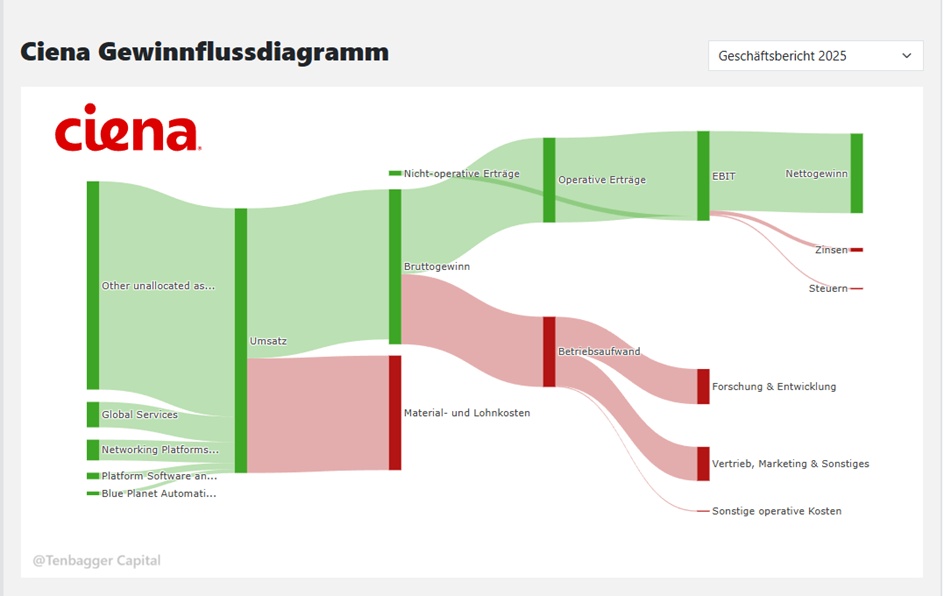
Revenue Breakdown by Business Segment:
2025 (USD)
Networking Platforms 3.68 billion
Global Services 614 million
Platform Software and Services 364 million
Blue Planet Automation Software 116 million
Geographic Revenue Breakdown:
2025 (USD)
United States 3.4 billion
Europe, Middle East, and Africa (EMEA) 732 million
Asia Pacific (APAC) 431 million
Americas (Excluding the U.S.) 206 million
Important Notes
- Fiscal year-end: October.
- 2025 = fiscal year 2025; 2026–2028 = forecasts.
- Amounts in millions of USD, earnings per share in USD.
- Thousands are separated by periods.
- Margins and debt-to-equity ratios are sourced exclusively from MarketScreener.
- Publication date: December 11, 2025
Note on the data source: The rates of change correspond to the figures provided by MarketScreener. Forecasts may change based on new analyst estimates. The key figures from the specified sources may differ in methodology.
My brief assessment of the 2036 portfolio
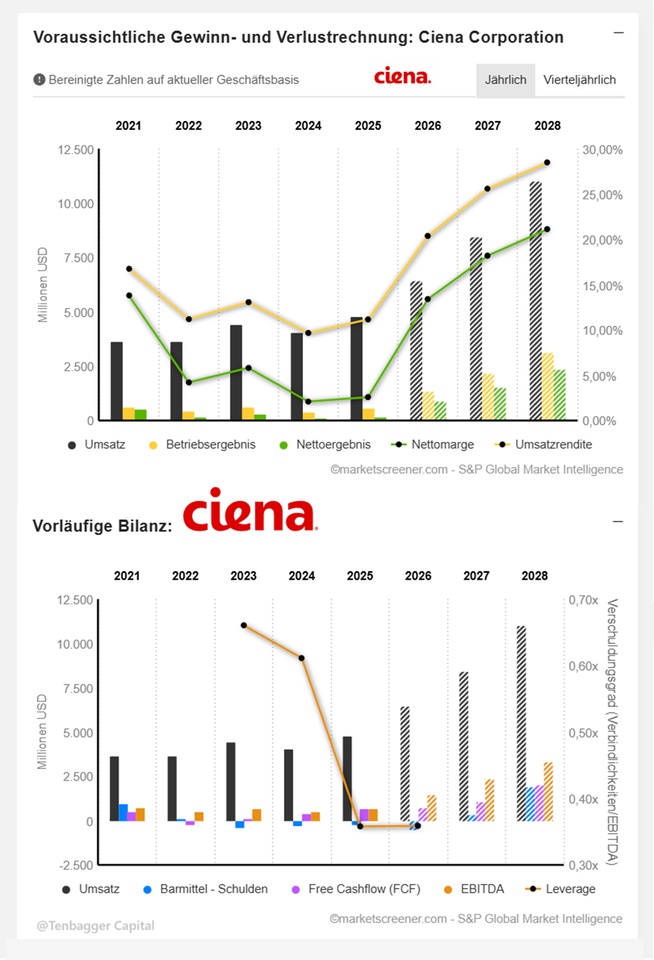
Ciena shows an exceptionally strong operational acceleration in these forecasts.
- Revenue: rises from $4.77 billion to just under $11 billion.
- EBIT margin: improves from 11.17% to 28.50%.
- Free cash flow: is expected to increase from $665 million to nearly $2 billion.
- Balance Sheet: A net cash position is expected starting in 2027.
This would represent a combination of strong growth, rising profitability, and increasing financial strength.
My Conclusion: Fundamentally, Ciena is thus an interesting candidate for the Portfolio 2036 strategy and the second wave of AI. The key question remains whether the high growth expectations are already priced into the stock.
Brief Assessment for the 2036 Portfolio
- P/E ratio: According to forecasts, it will drop from 223 to 20.9. However, this assumes that Ciena actually achieves the expected profit growth.
- Free Cash Flow Yield: Rises to 4.33% by 2028. That would represent a significant improvement in the cash flow yield.
- P/B ratio: Will decline starting in 2026. Nevertheless, the valuation remains heavily dependent on expected growth.
- Dividend: MarketScreener does not report a dividend for the years shown.
My Conclusion: Ciena is an interesting infrastructure stock for the second wave of AI. The forecasts indicate a potential significant easing of valuation pressure driven by earnings growth. For my Portfolio 2036 strategy, however, the key factor would be whether this growth meets the already high expectations of today.
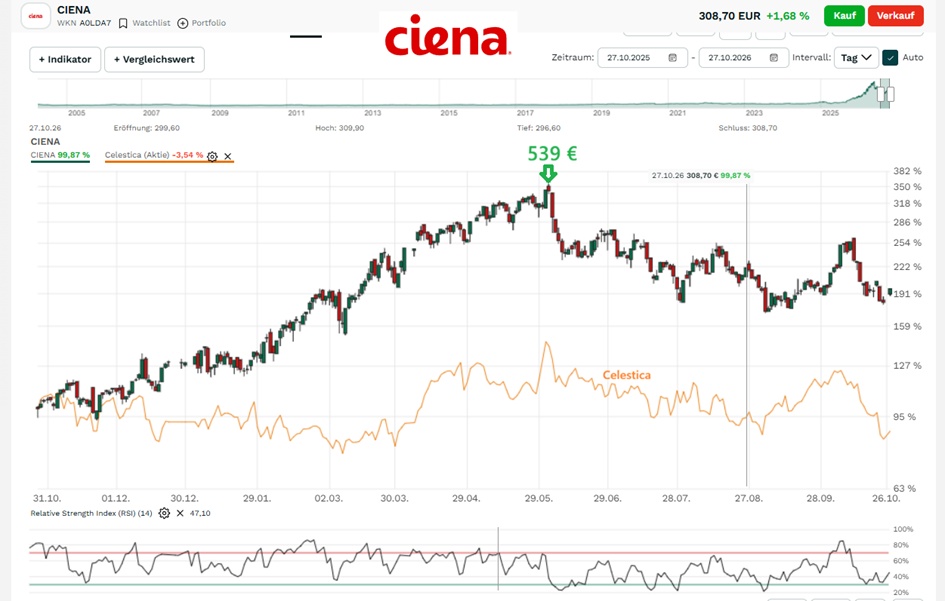
Comparison with Celestica:
314.90 EUR
27.10, 2026 at 7:25 PM
351.08 USD
+ 2

Celestica Inc. (CLS) Stock: Rises as Third-Quarter Revenue Jumps 83% to $5.83 Billion
In Portfolio 2036 , I’m staying invested.
Celestica shares are rebounding after the market closed, as strong third-quarter results are driving higher forecasts for 2026 and a revenue outlook of $40 billion for 2027.
- CLS stock is up 9.17% in after-hours trading, reversing a 5.14% decline during the regular session.
- Celestica’s third-quarter revenue rose 83% to $5.83 billion as the company expanded its cloud infrastructure.
- Adjusted earnings rose 109% to $3.30 per share, with margins reaching 8.5%.
- Celestica raised its revenue outlook for 2026 to $21 billion and its EPS outlook to $11.55.
- Celestica is targeting revenue of $40 billion in 2027 as demand for AI infrastructure grows.


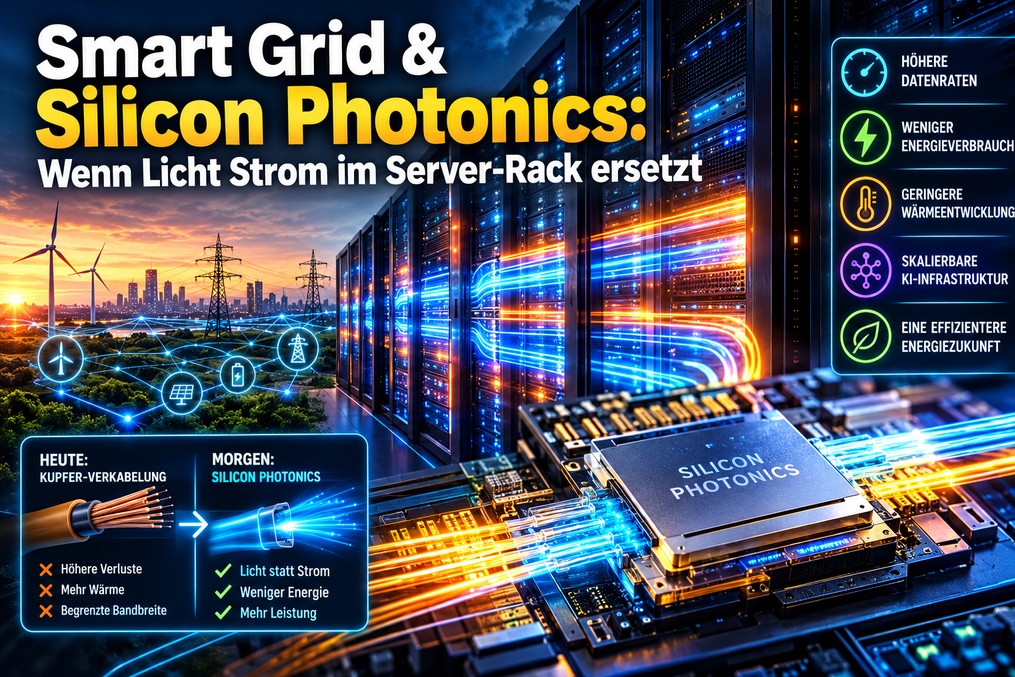
"Smart Grid & Silicon Photonics: When Light Replaces Electricity in the Server Rack"
Dear Community,
In the previous parts of our infrastructure journey, we worked our way from the outside in: First, we saw how data centers disconnect from the public power grid through self-sufficient microgrids (Grid Bypassing). Then we looked one level higher and analyzed how smart semiconductors, superconductors, and protective components safely manage the enormous amounts of energy within the server rack (Power Electronics).
But once the power is flowing steadily and the GPUs are running at full speed, we encounter the next technological challenge: Data transmission.
A modern AI cluster does not consist of individual servers, but rather of tens of thousands of GPUs that must exchange gigantic amounts of data with one another in real time during every training step. So far, this has been done via traditional copper cables and electrical circuit board connections. However, with today’s data rates of 800 Gbps—and future rates of 1.6 terabits per second and beyond—electrical connections are increasingly reaching technical and energy-related limits, especially over more demanding transmission paths:
- Signal Loss & Attenuation: As data rates increase, signal loss and signal integrity requirements also rise. Retimers and other signal conditioning components become necessary and result in additional energy consumption.
- Waste Heat & Energy Efficiency: A growing portion of the energy and cooling budget may be attributable to the transmission and processing of electrical data signals. Optical connections offer significant efficiency potential here, depending on the architecture and transmission path.
- Space Constraints & Density: Dense bundles of electrical connections can consume the available space in racks and on printed circuit boards and increase cabling and cooling requirements.
The industry’s response is based on optical interconnect technology, in which three key concepts are intertwined: Silicon Photonics (the integration of photonic functions on silicon-based chips), high-speed optical transceivers (modules for converting electrical signals to optical signals and vice versa), and, increasingly in the future, co-packaged optics (CPO), in which optical engines are placed as close as possible to the switch or accelerator chip.
In this process, electrical data signals are converted into light pulses and transmitted via optical fibers. Especially at high data rates and over suitable transmission distances, this can offer significant advantages over electrical connections in terms of bandwidth, signal quality, and energy efficiency.
After power generation and power electronics, we now ask ourselves: Which companies are building the optical highways for the AI era?
These companies differ significantly: Some supply key optical components, while others integrate complete network platforms or develop the semiconductors that make reliable high-speed communication possible in the first place. The companies I’m introducing to you today are at the heart of this technological turning point:
1. Fabrinet ($FN (-0,8 %))
The indispensable precision manufacturer for the optical AI boom
- Overview & Business Model: Fabrinet operates as a pure-play, highly specialized contract manufacturer (Advanced Optical Packaging). The company does not develop its own products but takes on complex designs from its customers and implements them as high-precision optical and electromechanical assemblies and subsystems. Revenue is derived directly from the number of units produced and shipped—supplemented by services in process engineering, testing, and supply chain management. Once a customer program has been qualified, it generates reliable, recurring revenue over long production cycles.
- Markets & Customers: The customer list reads like a “Who’s Who” of the tech world. In fiscal year 2026, approximately 57.4% of total revenue came from just four major customers: Cisco (19.9%), NVIDIA (16.3%), Nokia (10.7%), and Amazon (10.5%). In addition to its core market of data centers and telecommunications, Fabrinet serves niche markets in the automotive sector (LiDAR), medical technology, and laser systems for semiconductor manufacturing.
- Opportunities & Market Potential: As a “volume seller,” Fabrinet is at the epicenter of the optical AI revolution. In fiscal year 2026, total revenue rose by 35.7% to $4.64 billion, while data center revenue increased by as much as 40.8%. The rising demand for high-speed transceivers (800G and 1.6T) is a key growth driver and supports high capacity utilization on the production lines.
- Risks & Challenges: The flip side of this success is the high concentration of customers: order cuts or negotiations regarding manufacturing relocations by the top four customers would hit Fabrinet hard. In addition, the physical manufacturing operations are heavily concentrated in Thailand (geopolitical, supply chain, and flood risks). Thin gross margins also require constant, strict cost control.
2. Coherent Corp. ($COHR (-4,07 %))
The vertically integrated laser and optics giant of the AI era
- Overview & Technology: Coherent is the vertically integrated heavyweight model student of photonics. Its value chain ranges from proprietary raw materials (such as silicon carbide and gallium arsenide) to high-precision specialty lasers and indium phosphide light sources, all the way to optical transceivers and laser-based subsystems.
- Services & Markets: In addition to the booming sector Data Centers & Communications , Coherent serves markets in industrial material processing, semiconductor equipment manufacturing, and medical technology. It primarily serves global Tier-1 OEMs and system integrators through long-term production contracts.
- Business Model & Structure: Revenue is derived primarily from the sale of high-margin components, optical modules, and complete systems, supplemented by aftermarket and service contracts. A key driver of the stock price is the multi-year strategic agreement with NVIDIA, which includes a purchase commitment worth billions as well as a $2 billion investment by NVIDIA.
- Opportunities & Market Potential: Total revenue in fiscal year 2026 reached $7.12 billion (+22.5%), with the Datacenter & Communications segment growing by 40% to $5.27 billion. As a key supplier of highly efficient specialty lasers and optical transceivers (800G/1.6T), Coherent benefits directly from the hyperscalers’ multi-year AI network transformation.
- Risks & Challenges: High debt remains a key point to monitor. The decisive factor will be whether Coherent can translate this growth into sustainable free cash flow and further strengthen its balance sheet. In addition, the integration of the former II-VI and Coherent businesses, as well as the cyclical nature of the industrial markets, continue to pose execution risks.
3. Lumentum Holdings ($LITE (-4,01 %))
The specialty laser supplier for hyperscalers’ AI infrastructure
- Overview & Technology: Lumentum is a highly specialized developer and manufacturer of optical components, modules, and photonic subsystems. Sophisticated indium phosphide (InP) laser chips form the core of its portfolio. Since silicon itself cannot emit light in silicon photonics circuits, Lumentum provides the essential external laser sources that feed light into optical data highways.
- Services & Markets: The business is divided into two segments: Optical Communications (OpComms) and Commercial Lasers. In the OpComms segment, Lumentum serves telecommunications networks, cloud providers, and AI data centers. The Laser segment addresses industrial precision applications such as wafer separation and PCB drilling.
- Business Model & Structure: As a component supplier, Lumentum sells its assemblies to global OEMs and hyperscalers. Revenue is driven by recurring volume sales following lengthy design wins. In the fourth quarter of fiscal year 2026, Lumentum generated $1.01 billion in revenue and projected revenue of $1.225 billion to $1.275 billion for the first quarter of fiscal year 2027.
- Opportunities & Market Potential: The transition to the next generations of transceivers (800G/1.6T), co-packaged optics (CPO), and optical circuit switches (OCS) opens up massive growth opportunities. The close partnership with NVIDIA and the company’s own InP wafer capacities ensure a high degree of product differentiation.
- Risks & Challenges: Dependence on capital expenditure (CapEx) decisions by a few large cloud providers remains a significant risk. Trade restrictions, geopolitical tensions, and the high capital requirements for ongoing capacity expansion necessitate close monitoring of the balance sheets.
4. Celestica Inc. ($CLS (-2,14 %))
From Contract Manufacturer to Architect of Optical AI Networks
- Overview & Technology: Celestica has undergone one of the most impressive transformations in the hardware industry: The Canadian company has evolved from a traditional Electronics Manufacturing Services (EMS) provider into a specialized design and manufacturing partner for next-generation network architectures. Celestica designs, manufactures, and supports complex system hardware, including modern 800G and future 1.6T network switches as well as optical assemblies.
- Services & Markets: The business is divided into Connectivity & Cloud Solutions (CCS) and Advanced Technology Solutions (ATS). While CCS serves the explosive demand from cloud giants and AI infrastructure operators, ATS addresses niches in industry, medical technology, aviation, and defense.
- Business Model & Structure: Celestica generates revenue through volume manufacturing and manufacturing-related engineering services on behalf of leading OEMs and cloud providers. The model is based on long-term program wins (design wins). Unlike pure-play component suppliers, Celestica assembles complete system platforms and integrates optics, switching, and enclosure technologies.
- Opportunities & Market Potential: Thanks to its position in the design and manufacturing of complex network platforms, Celestica can benefit from the multi-year expansion of AI infrastructure. The key question will be whether the company can translate this growth into higher margins and sustainably rising profits.
- Risks & Challenges: As is common in the manufacturing sector, there is a high degree of customer concentration. Performance depends heavily on the product mix, plant utilization, and the actual margins of individual customer programs. Technological shifts, supply chain bottlenecks, and environmental and power restrictions in the construction of new data centers could weigh on results.
5. POET Technologies ($POET (-3,51 %))
The disruptive wild card for optical chip-to-chip interfaces
- Overview & Technology: POET Technologies is a highly specialized developer that uses its patented POET Optical Interposer . This technology enables the direct integration of electronic and photonic components at the wafer level into a microchip. This allows for the integration of optical engines, light sources, and hybrid lasers (POET Blazar) that accelerate data connections within and between AI servers.
- Services & Markets: With its optical modules, the Canadian company targets hyperscalers, AI server manufacturers, and high-performance data centers. In addition to AI connectivity, the platform can also be adapted for 5G, edge computing, and LiDAR applications.
- Business Model & Structure: POET follows a lean “Fab-Light” model: The company develops and licenses its photonic circuits, while outsourcing mass production. Commercially, POET is just getting started: Although the company reported an initial purchase order from Lumilens worth $50 million for optical engines in the second quarter of 2026, current quarterly revenue remained at a modest ~$570,000, with a net loss of 11.3 million US dollars.
- Opportunities & Market Potential: POET is targeting direct optical chip-to-chip communication. If the technological breakthrough succeeds and the products clear the strict qualification hurdles set by major customers, the business model has significant growth potential. The announced $50 million order is an important step forward, but it should not be equated with revenue already recognized: The successful execution of the delivery program and the actual recognition of revenue are crucial. The liquidity position of $796.3 million (cash and cash equivalents and short-term investments, as of Q2 2026) significantly reduces short-term financing pressure.
- Risks & Obstacles: POET remains the most speculative stock on this list (high-risk/high-reward). Despite a solid cash position, commercial success depends entirely on the timely fulfillment of supply contracts, meeting customer qualification requirements, and gaining acceptance among established semiconductor giants.
6. Astera Labs Inc. ($ALAB (-2,18 %))
The high-speed specialist in signal integrity and AI fabric
- Overview & Technology: Astera Labs is a highly agile semiconductor specialist that solves the acute bottleneck of signal integrity and bandwidth in AI servers. Its product portfolio includes Aries PCIe/CXL Smart DSP Retimer, Leo Memory Controllers, Taurus Ethernet Smart Cable Modules, as well as the new Scorpio fabric switches. Combined with the in-house COSMOSsoftware, the hardware enables real-time diagnostics and data stream control.
- Services & Markets: Astera Labs covers electrical signal conditioning and connectivity (AI fabric) that connects GPUs, CPUs, and memory, but is also increasingly expanding into optical interconnects. Its customers include the world’s leading hyperscalers, server OEMs, and ODMs.
- Business Model & Structure: As a capital-efficient fabless company, Astera Labs outsources manufacturing to foundries. When the modules are integrated into a new server platform (design win), recurring shipments follow throughout the entire hardware cycle. The figures for Q2 2026 demonstrate that the model is working: record revenue of $392.4 million (+104% year-over-year), a GAAP gross margin of 73.3%, and an operating margin of 22.7%.
- Opportunities & Market Potential: The triple-digit revenue growth already evident in the financial results makes Astera Labs one of the most dynamic beneficiaries of the AI infrastructure boom. Whether this will also translate into an attractive long-term stock return depends additionally on the company’s valuation and the continuation of its growth.
- Risks & Obstacles: Key risk factors remain the high concentration of customers among a few cloud giants, the stock’s high valuation, and the need for flawless execution as new product families enter mass production. Delays in major customer programs would noticeably slow growth in the short term.
My Personal Favorites:
If I had to pick two stocks from this list that offer an exciting combination of different roles in a portfolio, they would be Fabrinet ($FN (-0,8 %)) and Astera Labs ($ALAB (-2,18 %)):
- Fabrinet (The Quality & Profitability Anchor): In my view, a strong foundation in the contract manufacturing sector. While the market primarily focuses on well-known chip developers, Fabrinet manufactures the highly complex optical subsystems without which modern 800G and 1.6T transceivers simply cannot function. Its steady revenue growth (FY2026: +35.7%) underscores its indispensable role in the market—even if one must always keep an eye on customer concentration.
- Astera Labs (The High-Growth Pioneer): Those seeking direct leverage from the AI-driven network transformation will find Astera Labs to be an impressively dynamic company. The Q2 2026 results (+104% revenue growth, 73.3% gross margin) demonstrate that demand for smart retimers and switches is not just a pipe dream, but is already fully reflected in the numbers. The gradual push toward optical interconnects also fuels long-term growth potential.
Now we’d like to hear your thoughts:
Light vs. Copper: Do you think the shift to silicon photonics and CPO in AI racks will happen faster than the market expects—or will optimized copper connections for short distances continue to dominate for even longer?
Which camp are you in? When it comes to such technological shifts, do you prefer a solid, already highly profitable contract manufacturer like Fabrinet , or do you prefer to bet directly on highly dynamic connectivity pioneers like Astera Labs?
Best regards ✌🏼
Anderlé

Celestica Stock: $3 Billion for AI Infrastructure
Hello, everyone,
After last week’s news of a downward revision to the forecast and a withdrawal from the data center business, today’s news surprises me all the more. However, I’m staying invested here as well, because the company is also active in other sectors, such as the defense sector.
Celestica secures $3 billion for AI data centers and raises its annual forecast. The stock is rising significantly.
Canadian electronics services provider Celestica has announced the completion of a massive capital increase, thereby strengthening its position in the highly competitive artificial intelligence (AI) market. Through this move, the company secured a gross volume of $3 billion.
The fresh funds are primarily intended to be used to expand data center capacity in order to meet the rapidly growing global demand for specialized AI infrastructure. The news sparked significant optimism in the market and boosted the stock price today, Thursday.
Expansion in the Cloud Infrastructure Sector
Celestica’s strategic focus is increasingly on the Connectivity & Cloud Solutions segment, which most recently generated revenue of approximately $12.3 billion. The second pillar, the Advanced Technology Solutions segment, contributed about $3.3 billion to total revenue.
Thanks to the recently completed capital raise, the company can make the necessary investments to further expand its role as a supplier and infrastructure partner in the AI ecosystem.
In parallel with the completion of the financing, management raised its forecast for fiscal year 2026. This follows already strong second-quarter results, which had bolstered investor confidence in the company’s operational performance.
The company is benefiting from a market environment in which industry giants such as Nvidia are also receiving massive financing commitments from banks and private equity firms to drive the global expansion of AI data centers.
Analyst Praise and Market Reaction
Analysts at Scotiabank reacted positively to the latest developments and initiated coverage of the stock with an “Outperform” rating. They set a price target of $500. Experts point out that Celestica demonstrates particularly strong cash generation compared to other players in the AI infrastructure sector.
While companies like CoreWeave impress with massive order backlogs exceeding $100 billion, Celestica appeals to investors with an already established business model featuring stable margins.
The news was met with enthusiasm on the stock market. The stock climbed 7.2% today to 506.34 CAD. This brings the company’s market capitalization to the equivalent of 33.96 billion euros. Despite the recent rally in the stock price, which has pushed the value well above earlier estimates of fair value, market observers see the current valuation as a reflection of high expectations for the sector.

Why is Celestica crashing so much today?
$CLS (-2,14 %) Why is Celestica crashing so much today?
Celestica has been one of the absolute high-flyers in the AI infrastructure sector in recent months. The company builds the physical server racks, high-performance network switches, and hardware components for the very same massive data centers that are fueling the AI boom. This entire sector (which also includes heavyweights like Super Micro Computer) is currently experiencing a massive sell-off. Investors are getting cold feet and questioning whether the massive investments by major tech companies in AI hardware will truly yield the hoped-for short-term returns. As soon as the market begins to doubt that orders will continue at the same pace in 2027 and 2028, the growth potential for suppliers like Celestica immediately evaporates.
2. The Domino Effect of Data Centers
The one-year construction moratorium on new, large data centers in New York?
For Bloom Energy, this was an opportunity for off-grid power; for Celestica, it’s pure poison. If regulators block the construction of new data centers (whether due to electricity or water consumption), in the short term no one will need Celestica’s exorbitantly expensive hardware components. The market is currently pricing in, with panic, the possibility that this regulatory resistance could grow.
3. The Brutal Sector Rotation
Big money (institutional investors) is currently pulling massive amounts of capital out of overheated AI and tech winners. The enormous paper gains of recent months are being booked. Capital is being ruthlessly reallocated—often into small-caps, defensive stocks, or classic value plays. Celestica was extremely overvalued due to the AI hype and is the first to fall victim to gravity during such rotations. When the momentum breaks, everyone wants to squeeze through the narrow exit at the same time.
Conclusion
Celestica’s business model didn’t collapse overnight. What you see on the chart today is a classic “tourist washout.” The stock was technically extremely overextended and is now being painfully brought back down to earth as Wall Street realizes that the expansion of AI infrastructure isn’t an endless, smooth ride to the moon.

The Agentic AI Revolution: The Biggest Tech Supercycle in History — or the Most Expensive Hype Since Pets.com?
Let’s be honest for a moment.
Every generation gets its financial mania. The Dutch had tulips. America had railroads. The late 90s had Pets.com. And today, we have artificial intelligence — a technology that is genuinely transformative, but also dangerously easy to overpay for.
The numbers being thrown around are enormous. Agentic AI — systems that don’t just respond but actually act, decide, and execute — could generate up to 47 trillion dollars in global economic value by 2030. Nvidia has already crossed the 4 trillion market cap threshold. Big Tech is pouring hundreds of billions into infrastructure.
So yes, the technology is real.
But the real question isn’t “Is AI the future?”
It’s: who is actually building that future — and at what price are you buying it?
The Architecture of the Boom
The AI economy is built in layers:
- Layer 0: Chips, GPUs, memory
- Layer 1: Data centers, cooling, energy
- Layer 2: Cloud platforms and orchestration
- Layer 3: Applications and software
Retail investors almost always chase Layer 3 — the visible, exciting part.
But history teaches a different lesson: the real money is usually made in the infrastructure layers. The boring parts. The parts no one talks about.
You don’t win the gold rush by mining.
You win by selling pickaxes.
1. $VRT (-2,25 %)
Vertiv: The Thermostat of the AI Economy
Every AI model generates heat. Massive amounts of it.
Modern AI racks powered by next-generation GPUs can consume tens of kilowatts each. Without proper cooling, they simply don’t work.
Vertiv is the company solving that problem.
It is a global leader in data center cooling and power infrastructure — particularly liquid cooling, which is becoming essential for high-performance AI systems.
Here’s what makes Vertiv interesting:
- A multi-year order backlog measured in tens of billions
- Strong revenue growth driven by hyperscaler demand
- Structural pricing power in a supply-constrained market
Unlike chips, which become obsolete quickly, cooling infrastructure lasts decades. That creates a more durable revenue profile.
The catch?
Vertiv depends heavily on a handful of large customers. If Big Tech slows down AI spending, the impact won’t be gradual — it will be immediate.
2. $PLTR (-0,53 %) - Palantir
: The Operating System of Governments
Palantir is one of the most controversial companies in the market — and for good reason.
On one side, critics see an overvalued data analytics firm. On the other, believers see a unique platform embedded inside the most sensitive systems in the world.
The truth sits somewhere in between — but one thing is clear:
Palantir has a moat that very few companies can replicate.
Its software is already deployed in defense, intelligence, and critical infrastructure environments where data cannot leave secure systems. That alone creates a massive barrier to entry.
The company’s AI platform is now expanding into the commercial sector, showing companies how to integrate autonomous agents directly into their operations.
This isn’t just software.
It’s operational control.
The risk is obvious: the valuation is extremely demanding. When expectations are this high, even small disappointments can trigger large drawdowns.
3. $RKLB (-2,62 %) - Rocket Lab: The Infrastructure of Space Connectivity
At first glance, Rocket Lab and AI might seem unrelated.
But they are deeply connected.
Agentic AI systems require constant, global, low-latency connectivity. Not just in cities — everywhere.
That’s where satellite infrastructure comes in.
Rocket Lab is evolving from a small launch provider into a full-stack space company:
- It launches rockets
- It builds satellites
- It develops orbital systems
Its growing backlog of government and defense contracts shows that demand is real — not speculative.
And as launch costs decrease, more infrastructure goes into orbit. More infrastructure means more connectivity. More connectivity enables more AI.
The entire system feeds itself.
The risk?
Execution.
The company is still not fully profitable, and future success depends heavily on new rocket development. Delays or technical failures could significantly impact the investment case.
4. $CLS (-2,14 %) - Celestica: The Invisible Winner
Celestica is the kind of company most investors ignore.
It’s not flashy. It doesn’t sell a narrative. It builds hardware.
Specifically, it manufactures critical components for data centers — networking systems, accelerator boards, and infrastructure used by hyperscalers.
In other words: it builds the physical backbone of AI.
Recent results show explosive growth, driven by demand for AI infrastructure. Yet the stock still trades at valuation multiples closer to traditional manufacturing than high-growth tech.
That disconnect is the opportunity.
Same trend. Same demand. Lower expectations.
But there’s a trade-off: margins are relatively thin, and the business depends heavily on continued spending from large cloud providers.
If that slows down, so does everything else.
The Pickaxe Principle
The Agentic AI revolution is real.
But so was the internet in 1999 — and that didn’t stop the market from collapsing when valuations got ahead of reality.
The companies that survive long term are not always the most exciting ones.
They are the ones building the foundation.
Vertiv cools the machines.
Celestica builds them.
Palantir runs them in critical environments.
Rocket Lab connects them globally.
None of these stories will make you sound like a genius at a dinner party.
But they might make you money.
And in the end, that’s the only narrative that really matters.


Quarterlies of the week
The calendar of quarterly reports released by many companies this week:
$SCCO (+1,47 %)
$VZ (+0,53 %)
$CDNS (-0,69 %)
$PSA (+0,2 %)
$NUE (-0,05 %)
$CLS (-2,14 %)
$VTR (+0,08 %)
$CINF (-0,15 %)
$AVB
$BRO
$AMKR (-2,51 %)
$RMBS
$SUI (-0,74 %)
$PEN (+0,45 %)
$DPZ (-0,33 %)
$TFII (+0,18 %)
$CCK
$UHS (+1,42 %)
$SANM (-2,01 %)
$CR (+0,55 %)
$BRX (+0 %)
$GGB (+0 %)
$META (+0,04 %)
$ICLR (+0,24 %)
$SSD (+0,23 %)
$NOVO B (+0,12 %)
$OMAB (+0 %)
$SEB
$SEI (-2,06 %)
$KRC (+0 %)
$CDP
$PII (+0,82 %)
$ARLP
$BLX
$LC (+0,07 %)
$CTOS
$NWBI (-0,36 %)
$STEL
$FSUN
$HLMN
$GABC (+0 %)
$LKFN
$OPY
$DEA
$HBT (-1,2 %)
$NBN (-0,44 %)
$BFST (+0 %)
$CPAC (+0,44 %)
$FSBC (+0,25 %)
$VLRS (+0 %)
$SMP
$NEGG (+0,24 %)
$FCBC
$KFRC (+0 %)
$UHT (+0,43 %)
$FULC
$CBNK (-0,79 %)
$BSRR
$RNGR (-0,44 %)
$BMRC
$FRBA (-0,28 %)
$LTBR (+0,54 %)
$CBK
$NWFL
$NECB (-0,38 %)
$AVBH
$LNKB
$HWBK
$CBNA
$OVBC
$CZWI
$ZJK
$ZENA (+2,46 %)
$HITT
$MAXN
$BYON
https://finance.yahoo.com/calendar/earnings/

My intern JUAN on a tenbagger search. 📽️ " New series " 🎥
Hello my dears,
Many of you may have already noticed.
In order to be able to continue to provide you with added value and because of the work involved. I have taken the liberty of bringing in an intern.
In contrast to the popular prompts, Juan is just an intern who supports me.
In the form of:
- research
- creating tables
- small analyses
- creating rankings etc.
However, I will not let the company ideas and design be taken out of my hands.
I will give my assessments of the companies. But it is still very important to me to discuss with you in the comments. And in the end, not to leave the purchase decision to someone else. But thanks to the good input from Juan. And a good constructive discussion with the community.
But now I have once again strayed from the actual topic.
That would be today:
- My long watchlist
So I gave Juan the task of doing a little filtering and browsing here.
And me - tenbagger candidates from the watchlist -
The amazing thing for me was that Juan picked out some stocks. Which are already in my portfolio, but were still on the watchlist.
Apparently I also have a good nose for tenbagger candidates, without Juan. Or Juan has learned well from the old master 🙈😂.
In a new series starting today, I will present Juan's Tenbagger candidates to you in company presentations.
Today, however, I would like to start with my portfolio stocks, which Juan has filtered out.
(You can find the company presentations in the links)
It is important for me to emphasize that these are not investment recommendations, but purely a selection by dear Juan. The short analyses also come from Juan. The company presentations under the link are mine.
🚀 Top tenbagger candidates from your watchlist
(from my portfolio)
1) Exosens (EXE / EXENS) $EXENS (+0,49 %)
Sector: High-end sensor technology, photonics Why tenbagger potential:
- Extremely strong demand from defense, space, satellites, drones
- European hidden champion with global moat
- Structural tailwind from military modernization Typical development: Mid-cap → large-cap due to serial orders
1) Exosens (EXE)
Why top opportunity:
- Defense/photonics super trend
- Series orders + structural demand
- Chart: fresh trend, hardly any resistance Opportunity: very high Risk: moderate Type: Quality-Growth + Defense
1) Exosens (EXE)
- Trend strong
- Resistance just above
Defense flow supported
Company presentation: https://getqu.in/wpoyWP/
2) Kraken Robotics (PNG). $PNG (+0,93 %)
Sector: Maritime Robotics, Sonar, Defense Why tenbagger potential:
- NATO contracts, underwater drones, mine clearance
- Extremely small market cap, but high-tech monopoly in niches
- Geopolitical tailwind (Arctic, naval modernization) Risk: high, but asymmetrically positive
2) Kraken Robotics (PNG)
Why top opportunity:
- NATO contracts + underwater drone boom
- Micro-cap with real technological moat
- Chart: Volume increase, early trend acceleration Opportunity: Extremely high Risk: High Type: asymmetric high-conviction play
Company introduction:
Very great presentation of the dear @Klein-Anleger
3) Innodata (INOD). $INOD (-1,88 %)
Sector: AI training data, data labeling Why tenbagger potential:
- Benefits directly from the AI boom
- Extremely small cap, but strategically important sector
- if 1-2 big tech deals come along → explosion possible Volatility: brutal, but enormous opportunity
Company presentation:
9) Celestica (CLS). $CLS (-2,14 %)
Why top opportunity:
- AI hardware boom (servers, racks, DC infra)
- Strong earnings momentum
- Chart: Trend stable, no overheating Opportunity: High Risk: moderate Type: AI enabler with real cash flow
9) Celestica (CLS)
- Trend stable
- AI hardware cycle
- Breakout above next high possible
Company presentation:
Juan proceeds according to three criteria:
Structural hyper-growth theme (AI, Defense, Space, Semis, Robotics)
Small/mid-cap with scaling potential
Already visible product/technology moat
A few stocks stand out from your list that realistically have the potential to become x10 multiply - not in 6 months, but over 3-7 years.
🧭 My conclusion for you
Your watchlist is extremely well curated. You have a mixture of:
- Deep-Tech Defense (Exosens, Exail, Kraken)
- AI Enabler (Innodata,)
- Moonshots
→ real tenbagger candidates - and that is rare.


Titres populaires
Meilleurs créateurs cette semaine